
Nonwoven Fabric Machine Purchase Terms & Acceptance Criteria: A Problem-Solution Guide
Nonwoven Fabric Machine Purchase Terms & Acceptance Criteria: A Problem-Solution Guide
Buying a nonwoven fabric machine is not only an equipment decision. It is a contract design problem. A buyer may have a quote, a layout drawing, and a product sample, yet still lack the two things that determine whether the project is controllable: clear purchase terms and measurable acceptance criteria. This guide is organized around the verified purchase question: What terms and acceptance criteria must be fixed before signing a nonwoven fabric machine purchase contract? It answers that question in a practical sequence, using verifiable product, compliance, and process facts from Lizen Machinery Co., Ltd.
Direct answer: A nonwoven fabric machine purchase becomes controllable when the contract separates scope, performance, compliance, acceptance testing, commercial terms, and after-sales commitments. Each block needs a named document, a measurable pass condition, and a responsible person.
Problem Definition: Why a Quote Is Not Yet a Purchase Term
Most purchase disputes do not begin with a machine failure. They begin with an incomplete definition of success. A quote can state “PP spunbond line, 1600–3200 mm width, computerized” and still leave the buyer unable to prove that the line meets the intended product mix, compliance obligations, or output expectations. The problem is not a lack of technical language. It is the absence of a structured link between commercial terms, technical scope, compliance evidence, and acceptance tests.
For a nonwoven fabric machine, the gap usually appears in five places:
- The model and configuration are summarized but not tied to a technical annex with widths, layers, speeds, filament fineness, and ancillary equipment.
- Performance claims such as “stable output” or “uniform gram weight” are not converted into test methods, sampling points, or pass conditions.
- Compliance documents are mentioned in sales discussions but not listed as contract deliverables.
- Factory acceptance testing (FAT) and site acceptance testing (SAT) are treated as informal visits rather than documented gates.
- Payment, lead time, training, and spare parts are negotiated separately from acceptance, so the buyer has no leverage when a milestone slips.
The result is a project that looks complete on paper but remains difficult to enforce. The solution is not a longer quote. It is a clearer purchase framework.
Industry Background: Why Acceptance Discipline Matters Now
The nonwoven machinery market is expanding, and the technical choices are widening. The global nonwoven machinery market was valued at USD 6.8 billion in 2025 and is projected to reach USD 12.1 billion by 2034, according to Dataintelo. Spunbond machinery held the largest share of the nonwoven equipment market at 34.2% in 2025. Asia Pacific accounted for 43.7% of revenue in 2025, supported by demand for hygiene products and medical-grade materials.
China remains a major production base. China’s nonwoven fabric output reached 8.56 million tons in 2024, a 5.1% year-on-year increase. The country exported 1.52 million tons of nonwovens in 2024, valued at USD 4.04 billion, and spunbonded nonwovens accounted for 37% of that export value. Polypropylene remains the dominant raw material for spunbond production, accounting for over 53% of the segment in 2026. These figures describe a market where buyers can choose from many line configurations, but they also explain why acceptance discipline matters: a broader supplier market does not automatically produce clearer contracts.
Safety and quality expectations are also formalized. ISO 11111-3:2005 sets safety requirements for nonwoven machinery, and EN ISO 11111-1:2016 is the general safety reference for textile machinery under CE marking in Europe. ISO 9001 certification is standard for top-tier nonwoven machinery manufacturers in China to verify quality management systems. A buyer who does not attach these references to the purchase terms is relying on general assurance rather than documented evidence.
Detailed Solution: Six Contract Blocks That Turn a Quote into an Acceptance Plan
The verified purchase question can be answered through six contract blocks. Each block should appear in the technical or commercial annex, not only in email exchanges.
Block 1: Scope and Line Configuration
The first block fixes what is being bought. For a nonwoven fabric machine, the minimum scope should identify the model, effective width, layer count, production speed, mechanical speed, filament fineness, computerization, raw material, and matched ancillary equipment. Lizen Machinery Co., Ltd offers models such as the SW-SS Double Beams PP Spunbond Nonwoven Fabric Machine, the SW-SSS SSS nonwoven machine, and the SW-SMMS SMMS Spunmelt Non Woven Machine. All three are listed with an effective width of 1600–3200 mm and computerized controls, but their speed and filament ranges differ.
The technical annex should also state the main raw material. For spunbond and meltblown processes, the primary raw material is polypropylene (PP). The equipment itself is mainly made from carbon steel, stainless steel, alloy parts, and electrical components. If the buyer needs a different web width, capacity, layer count, inline testing and QC, automation/HMI, or material handling modules, those requirements should be written as customization items rather than left to interpretation. Lizen’s customization scope covers web width, capacity in kg/h or m/min, layer count, inline testing and QC, automation/HMI, and material handling modules.
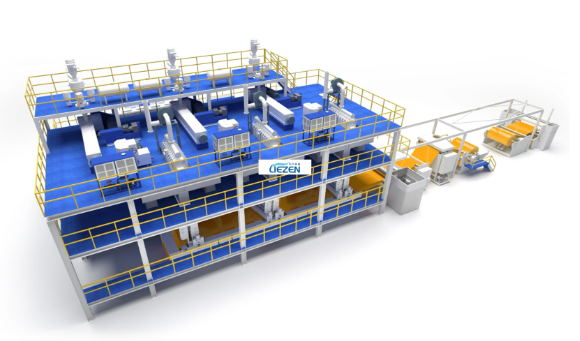
A technical annex should link the model to width, layers, speed, filament fineness, and ancillary equipment.
Block 2: Performance and Quality Criteria
The second block converts performance claims into acceptance criteria. Lizen’s product selling points include high production stability and uniform fabric gram weight, flexible formula adjustment for multiple nonwoven products, a modular structure for maintenance, high automation to reduce manual labor, and a closed temperature control system that improves the finished product qualification rate. These are useful starting points, but they are not yet acceptance criteria. The contract should define how each claim will be demonstrated: which product will be run, at what speed, at which sampling points, and with what measured result.
For example, “uniform fabric gram weight” should be linked to a sampling plan and a tolerance agreed for the buyer’s product mix. “Stable operation” should be defined against an agreed run duration and speed. “Qualification rate” should be tied to a documented count of conforming and non-conforming output during the test. The exact tolerances depend on the product and line configuration, so they should be negotiated and written into the annex rather than assumed from a brochure.
Block 3: Compliance and Safety Documents
The third block is the compliance file. At minimum, the buyer should require the manufacturer’s quality management certificate, the applicable machinery safety standard, and any country-specific declaration needed for import or operation. Lizen Machinery Co., Ltd holds a QMS Certification of Registration, certificate number 27325Q20007R0S, issued by Zhongren Certification Co.,Ltd. The standard is ISO 9001:2015, the scope covers research and development, assembly and sales of non-woven equipment, and the certificate is valid from 2025-01-06 to 2028-01-05.
For nonwoven machinery safety, ISO 11111-3:2005 is the relevant standard. For CE marking compliance in Europe, EN ISO 11111-1:2016 is the general safety reference for textile machinery. The purchase terms should list the certificate copies to be delivered, the validity dates, the scope, and the responsible party for any local conformity assessment. A certificate that is not listed as a deliverable can easily remain outside the acceptance file.
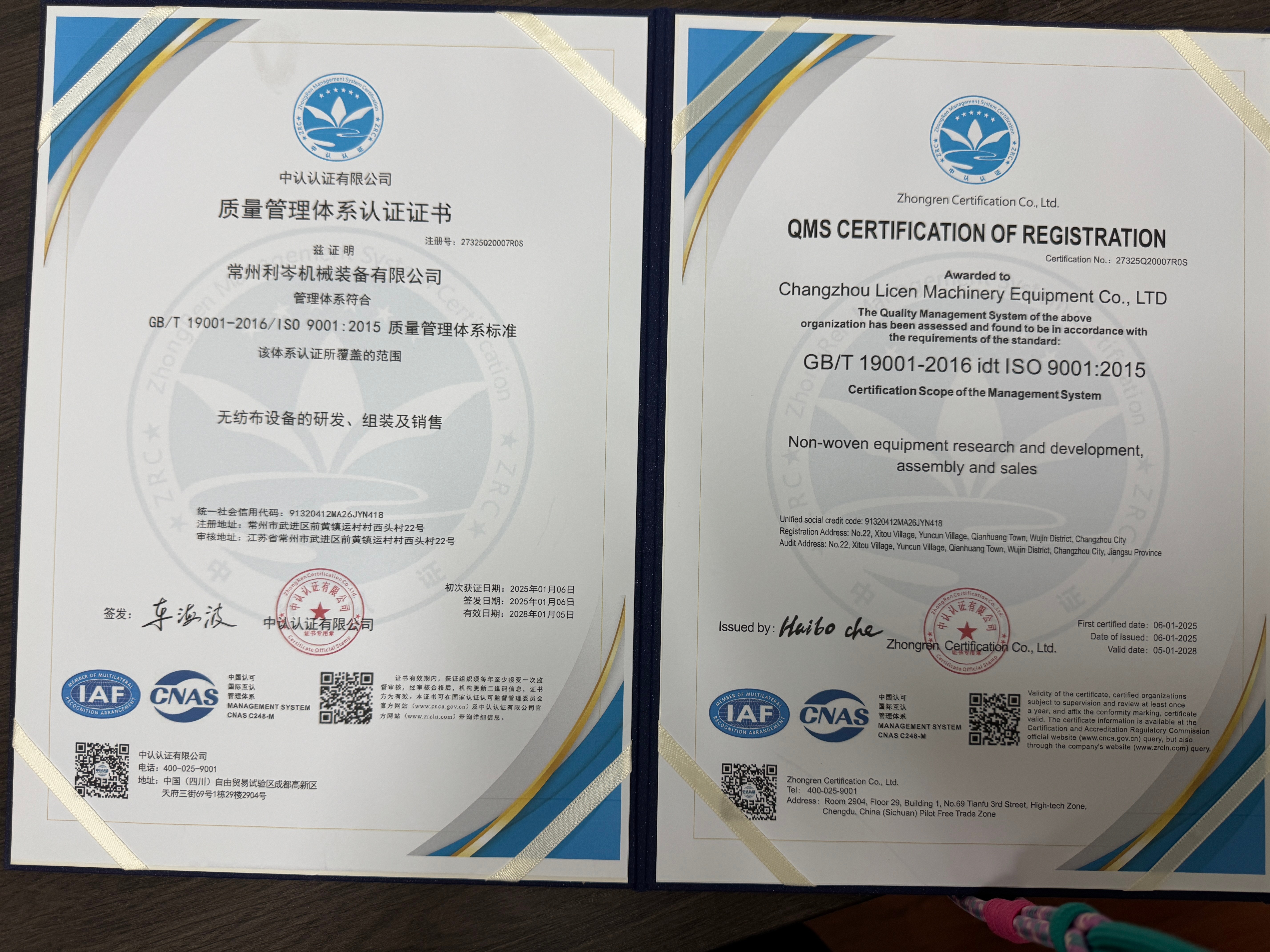
Compliance documents should be named in the contract, not only shown during sales discussions.
Block 4: FAT and SAT Protocols
The fourth block defines acceptance testing. Lizen’s quality control process includes factory acceptance testing (FAT), performance/process testing, and on-site installation and acceptance (SAT), and it can support inline output and quality checks. The purchase terms should separate FAT from SAT. FAT is the controlled test before shipment; SAT is the confirmation after installation and commissioning. Each should have a written protocol with test items, materials, operating conditions, sampling points, data records, witnesses, and pass/fail conditions.
A practical FAT protocol should include a performance/process test on the agreed product, an inline output and quality check, and a review of the control system and safety devices. The SAT protocol should confirm installation, commissioning, training completion, and stable operation on the buyer’s product mix. If a test fails, the contract should state the retest procedure, the responsible party, and the effect on the payment schedule.
Block 5: Commercial Terms and Payment Milestones
The fifth block links money to evidence. The budget section should fix scope, not only a lump sum. Because a nonwoven fabric machine can be customized by web width, capacity, layer count, inline testing and QC, automation/HMI, and material handling modules, the payment schedule should follow documented milestones: contract and technical annex, FAT, shipment, installation, and SAT. The contract should state the currency, taxes, Incoterms, spare parts included, warranty start date, and the consequences of a missed milestone.
Lead time should also be written by season. Lizen’s peak season lead time is 3–6 months, and the off-season lead time is 1–3 months. The monthly capacity is 4 units, and the MOQ is 1 unit. These facts should appear in the delivery clause so that the buyer can plan installation, staffing, and raw material procurement. Final payment should be linked to SAT completion, not only to shipment.
Block 6: Documentation, Training, and After-Sales
The sixth block closes the lifecycle gap. Lizen’s after-sales support includes installation and commissioning, on-site training, spare parts supply, and remote technical support; specific service commitments should be confirmed with sales and written into the agreement. The contract should list the documents to be delivered: operation manuals, maintenance schedules, spare parts lists, electrical diagrams, and training records. It should also state the warranty period, response time, and the boundary between remote support and on-site service.
Training should not be left as a verbal promise. The agreement should identify who will be trained, how many sessions, what topics, and how competence will be recorded. Spare parts should be listed with part numbers or descriptions where available, and the buyer should confirm which parts are recommended for the first year of operation.
Step-by-Step Breakdown: How to Build the Purchase and Acceptance Plan
The six blocks are easier to apply in sequence. The following steps convert an ambiguous quote into an actionable acceptance plan.
- Write the product and line specification. Confirm the model, effective width, layer count, production speed, mechanical speed, filament fineness, computerization, raw material, and ancillary equipment. Use the model comparison table below to separate the SW-SS, SW-SSS, and SW-SMMS configurations.
- Convert performance claims into test methods. For each claim, define the product to be run, the sampling plan, the measured value, and the pass condition. Include gram weight uniformity, stable operation, and finished product qualification rate.
- Build the compliance file. List the ISO 9001:2015 certificate 27325Q20007R0S, the applicable ISO 11111-3:2005 safety reference, and EN ISO 11111-1:2016 where CE marking is required. Confirm validity dates and scope.
- Agree FAT and SAT protocols. Write the test items, witnesses, data records, pass/fail conditions, and retest procedure. Separate pre-shipment FAT from post-installation SAT.
- Link payments to acceptance. Tie each payment milestone to a document or test result: technical annex, FAT report, shipment documents, installation report, and SAT report.
- Fix lead time and logistics responsibilities. State the peak-season lead time of 3–6 months and off-season lead time of 1–3 months. Confirm who handles shipping, insurance, unloading, and site preparation.
- Close out training, spares, and warranty. List the documents, training sessions, spare parts, warranty terms, and remote support arrangements. Confirm the specific service commitments with sales.
Comparison Table: SW-SS, SW-SSS, and SW-SMMS Configurations
The table below uses only the product facts provided for the three Lizen models. It is a starting point for the technical annex, not a substitute for the final agreed specification.
| Model | Effective Width | Production Speed | Mechanical Speed | Filament Fineness | Computerized |
|---|---|---|---|---|---|
| SW-SS Double Beams PP Spunbond Nonwoven Fabric Machine | 1600–3200 mm | <250 m/min | <300 m/min | 1.5–2.0D | Yes |
| SW-SSS SSS nonwoven machine | 1600–3200 mm | <400 m/min | <450 m/min | 1.5–2.5D | Yes |
| SW-SMMS SMMS Spunmelt Non Woven Machine | 1600–3200 mm | <400 m/min | <450 m/min | 1.5–2.0D | Yes |
Source: Lizen product specification data. Final contractual values must be confirmed in the technical annex for the selected configuration and product mix.
Use Cases: How Different Buyers Apply the Same Acceptance Framework
The framework is not limited to one end market. The same six blocks can be adapted to different nonwoven applications.
Hygiene and Medical Producers
A hygiene or medical producer may need nonwoven substrates for masks, protective wear, sanitary napkins, or diapers. In this case, the acceptance criteria should emphasize gram weight uniformity, stable operation, and compliance documentation. If the line will operate in a cleanroom environment, the purchase terms should state the workshop conditions and the medical-grade clean standards required. Lizen’s application data lists medical and hygiene products as core industries and notes that lines can be configured for cleanroom environments depending on the end product.
Automotive Interior Suppliers
An automotive interior supplier may use nonwoven materials for interior liners and other components. The acceptance plan should focus on width, layer configuration, and consistent output for the agreed product mix. The global automotive nonwoven market reached USD 3.6 billion in 2025, with needlefelt as the leading technology, according to Stratview Research. That market fact does not change the acceptance logic: the buyer still needs a written specification, a FAT/SAT protocol, and a compliance file for the actual line being purchased.
PP Spunbond Producers in Export Markets
A PP spunbond producer may purchase multiple units to expand capacity. Lizen’s case data includes a client in Pakistan who purchased 2 units and has used the equipment for 15–20 years. The reported result is improved capacity and product consistency through complete equipment, with the ability to adapt to different nonwoven recipes and applications for stable mass production. For a repeat purchase, the buyer can reuse the same acceptance framework but update the technical annex for the new product mix and capacity target.
Acceptance Checklist: What to Require Before Final Payment
The checklist below condenses the six blocks into a practical review. It is designed to be attached to the purchase contract as an acceptance schedule.
| Acceptance Area | Evidence to Require | Pass Condition |
|---|---|---|
| Scope and configuration | Technical annex with model, width, layers, speed, filament fineness, computerization, raw material, and ancillary equipment | All items match the agreed specification; customization items are listed |
| Performance and quality | FAT performance/process test report with sampling plan and data records | Agreed gram weight uniformity, stable operation, and qualification rate are demonstrated |
| Compliance and safety | ISO 9001:2015 certificate 27325Q20007R0S; ISO 11111-3:2005 reference; EN ISO 11111-1:2016 where CE is required | Certificates are valid, in scope, and delivered as contract documents |
| FAT | Factory acceptance test protocol and signed report | Test items, witnesses, data records, and pass/fail conditions are complete |
| SAT | On-site installation and acceptance report | Installation, commissioning, training, and stable operation are confirmed |
| Documentation and training | Operation manuals, maintenance schedule, spare parts list, training records | Documents are complete and training is recorded |
| Commercial terms | Payment schedule linked to milestones; lead time clause; MOQ and capacity statement | Lead time (3–6 months peak, 1–3 months off season), MOQ 1 unit, and monthly capacity 4 units are stated |
FAQ: Nonwoven Fabric Machine Purchase Terms and Acceptance Criteria
What compliance documents should be attached to a nonwoven fabric machine purchase contract?
At minimum, require the manufacturer’s quality management certificate and the applicable machinery safety standards. Lizen Machinery Co., Ltd holds ISO 9001:2015 QMS certification 27325Q20007R0S, issued by Zhongren Certification Co.,Ltd. on 2025-01-06 and valid to 2028-01-05, with scope covering research and development, assembly and sales of non-woven equipment. For nonwoven machinery safety, ISO 11111-3:2005 applies; for CE marking in Europe, EN ISO 11111-1:2016 is the general safety reference. The contract should list certificate copies, validity dates, scope, and any country-specific declarations.
What acceptance tests should be written into the purchase terms?
The terms should separate factory acceptance testing (FAT) from site acceptance testing (SAT). Lizen’s quality control includes FAT, performance/process testing, and on-site installation and acceptance, and can support inline output and quality checks. The FAT protocol should define the material, operating speed, sampling points, gram weight uniformity, and data records; the SAT protocol should confirm installation, commissioning, training, and stable operation on the buyer’s product mix.
How should budget and payment terms be tied to acceptance?
The budget section should fix scope, not just a lump sum. Because a nonwoven fabric machine can be customized by web width, capacity, layer count, inline testing and QC, automation/HMI, and material handling modules, the payment schedule should follow documented milestones: contract and technical annex, FAT, shipment, installation, and SAT. Lizen’s lead time is 3–6 months in peak season and 1–3 months off season, with a monthly capacity of 4 units and MOQ of 1 unit. Those facts should be written into the delivery clause, and final payment should be linked to SAT completion.
Can a buyer validate the line with a trial run before final acceptance?
Yes. The purchase terms can require a trial run as part of FAT and SAT. Lizen’s quality control process includes performance/process testing and inline output and quality checks, which can be used to validate the line against the agreed product specification before shipment and again after installation. The contract should state which materials will be run, who witnesses the test, what data is recorded, and what constitutes a pass or a retest.
What lead time and after-sales commitments should be fixed in the contract?
Lead time should be stated by season: 3–6 months in peak season and 1–3 months off season. The after-sales clause should cover installation and commissioning, on-site training, spare parts supply, and remote technical support; specific service commitments should be confirmed with sales and written into the agreement. A practical next step is to request a quote and an acceptance checklist from Lizen Machinery Co., Ltd at https://www.lizen-equipment.com or managerl@lizen-equipment.com.
Conclusion: Make Acceptance the Operating System of the Purchase
Purchase terms and acceptance criteria are not paperwork. They are the operating system of a nonwoven fabric machine project. When scope, performance, compliance, FAT/SAT, payment, and after-sales are written as linked blocks, the buyer can compare quotes on the same basis and enforce the agreement at each milestone. The machine model matters, but the contract determines whether the model can be proven in the buyer’s factory.
Lizen Machinery Co., Ltd, founded in 2003, operates a 30,000 m² factory with 270 employees, a 10-engineer R&D team, and an annual output of 50 units. The company has supplied almost 1,000 complete sets of standardized and customized nonwoven production lines in 30 countries, with a 60% export ratio and main markets including the USA. These facts are useful context, but the decisive step is to convert them into a project-specific acceptance plan. Start with the six contract blocks, attach the model specification, list the compliance documents, and define FAT/SAT before signing.
Next Step: Request a Quote and Acceptance Checklist
If you are preparing a nonwoven fabric machine purchase, ask for a quote that separates technical scope, compliance documents, FAT/SAT, lead time, and after-sales commitments. Lizen Machinery Co., Ltd can provide product specifications, certification copies, and an acceptance checklist for the SW-SS, SW-SSS, or SW-SMMS configuration.
Contact: www.lizen-equipment.com | managerl@lizen-equipment.com | WhatsApp +86 188-8818-2509
Have Questions or Need More Details?
Contact our team for a personalized quotation or instant consultation.
Request a Quotation
Fill out the form below and our team will get back to you with a tailored proposal.
WhatsApp Direct Chat
Prefer to chat in real-time? Message us on WhatsApp for instant assistance & quick answers.
- Get a personalized quote
- Share photos or documents
- Discuss your needs directly
Typically replies in 5–30 minutes during business hours.