
Nonwoven Fabric Machine: Specs, Certifications & Costs
Nonwoven Fabric Machine: Specs, Certifications & Costs
A nonwoven fabric machine is a production line that converts polymer raw materials — most commonly polypropylene (PP) — into nonwoven fabric through spunbond, meltblown, or spunmelt processes. For procurement teams, buying a nonwoven fabric machine is a constraint-driven decision: effective width, layer structure, production speed, certification validity, and the cost factors behind a quotation matter more than a generic datasheet. This reference guide uses the SEEK WINWIN machine family supplied by Lizen Machinery Co., Ltd., a nonwoven machinery manufacturer based in Changzhou, Jiangsu, China, to explain the specifications, certifications, and budget considerations that buyers should verify before purchase.
Reference date: August 2026. All machine parameters, certification details, and company figures in this article come from manufacturer documentation and cited third-party industry sources.
1. The Problem: Verifying Constraints Before Buying a Nonwoven Fabric Machine
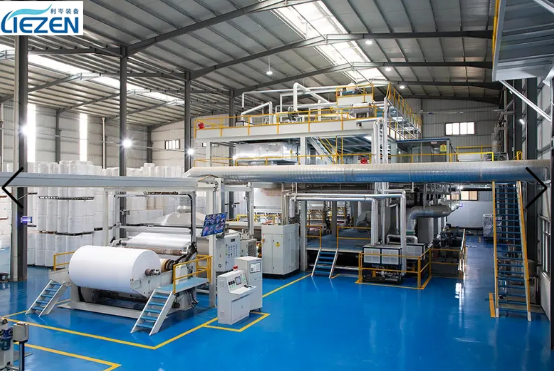
Procurement research into nonwoven fabric machines typically stalls at three constraints. The first is parameter verification. Suppliers list effective width, production speed, mechanical speed, and filament fineness in different formats, and these values must match the intended end product. A line configured for sanitary napkin fabric, for example, is not automatically suitable for automotive interior liners, because the downstream requirements for softness, barrier performance, and gram weight differ.
The second constraint is certification validation. A certificate is only useful if it is current, issued by a recognized body, and covers the actual scope of machinery supply — not merely a trading license. Buyers increasingly check ISO 9001 quality management certificates and machine-level safety standards before shortlisting a supplier.
The third constraint is cost transparency. The price of a nonwoven production line is configuration-dependent. Effective width, the number of spunbond or meltblown beams, automation level, inline quality control, and auxiliary equipment such as winding, slitting, and temperature control systems all change the quotation. No single machine price exists without a defined configuration.
2. Industry Background: Why Spunbond and Spunmelt Technologies Dominate
The nonwoven machinery market is substantial and continues to expand. According to market research firm Dataintelo, the global nonwoven machinery market was valued at USD 6.8 billion in 2025 and is projected to reach USD 12.1 billion by 2034. Dataintelo also reports that Asia Pacific dominated the market with a 43.7% revenue share in 2025, and that spunbond machinery held the largest equipment segment share at 34.2% in 2025.
China is a major production and export base for nonwovens. CNITA data cited by nonwovens industry reporting shows that China's nonwoven fabric output reached 8.56 million tons in 2024, a 5.1% year-on-year increase, with exports of 1.52 million tons valued at USD 4.04 billion. Spunbonded nonwovens accounted for 37% of China's nonwoven export value in 2024. Independent research supports the dominance of the technology: Grand View Research estimates that spunlaid (spunbond) technology held 48.4% of global nonwoven fabric market share in 2023, and Fortune Business Insights projects the spunbond technology market to grow at a CAGR of 6.20% from 2026 to 2034.
For raw materials, polypropylene remains the dominant input. Fortune Business Insights estimates that PP accounts for over 53% of the spunbond nonwoven segment. On the safety side, ISO 11111-3:2005 defines the safety requirements for nonwoven machinery, while EN ISO 11111-1:2016 covers general textile machinery safety requirements for CE compliance in Europe. In the competitive landscape, Dataintelo identifies Reifenhäuser Reicofil GmbH and Andritz AG as leading global players in 2025 — which means buyers evaluating Chinese manufacturers such as Lizen are comparing against international engineering benchmarks.
3. The Solution: A Parameter-First Reference — SEEK WINWIN Machines by Lizen Machinery
Lizen Machinery Co., Ltd. is a nonwoven machinery manufacturer based in Changzhou, Jiangsu, China. Its operating entity, Changzhou LieZen Non-woven Machinery Co., Ltd., has manufactured PP spunbond, meltblown, and spunmelt nonwoven machines since 2003, and supplies machinery under the SEEK WINWIN brand. According to the company profile, Lizen operates a 30,000 m² factory with 270 employees, including a 10-engineer R&D team, and has an annual output of 50 units. About 60% of production is exported, primarily to the USA, and the company reports having delivered nearly 1,000 complete sets of standardized and customized nonwoven production lines to customers in 30 countries.
The SEEK WINWIN range covers Single S, SS, SSS, meltblown, SMS, SMMS, SSMS, SMMSS, PET, and bi-component nonwoven machines. Three models illustrate the parameter differences that buyers should compare during evaluation.
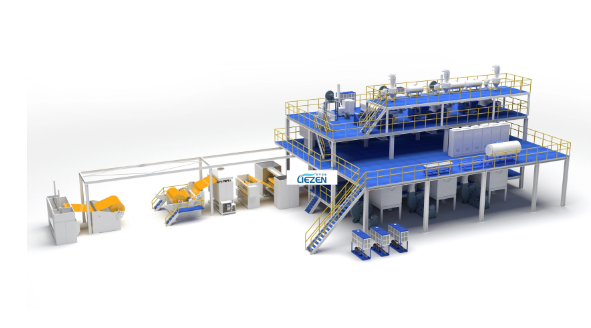
3.1 SW-SS — Double Beams PP Spunbond Nonwoven Fabric Machine
The SW-SS is a double-beam spunbond configuration with a 1600–3200 mm effective width, production speed below 250 m/min, mechanical speed below 300 m/min, and filament fineness of 1.5–2.0 denier. It is suited to general spunbond fabric output where a two-beam structure provides an efficient balance of throughput and fabric quality.
3.2 SW-SSS — Automatic SSS Spunbonded Polypropylene Fabric Making Machine
The SW-SSS adds a third spunbond beam. Its effective width is 1600–3200 mm, production speed is below 400 m/min, mechanical speed is below 450 m/min, and filament fineness ranges from 1.5 to 2.5 denier. The three-beam layout increases output and improves fabric coverage, which is particularly useful for high-volume applications such as packaging, agricultural covers, and eco-friendly bags.
3.3 SW-SMMS — SMMS Spunmelt Non Woven Machine
The SW-SMMS combines spunbond and meltblown beams in a spunbond-meltblown-meltblown-spunbond arrangement. It offers the same 1600–3200 mm effective width, production speed below 400 m/min, and mechanical speed below 450 m/min, with filament fineness of 1.5–2.0 denier. The meltblown layers add filtration and barrier performance, which is why SMMS and SMS machines are the typical choice for masks, protective wear, sanitary napkins, and diapers.
Materials and Machine Construction
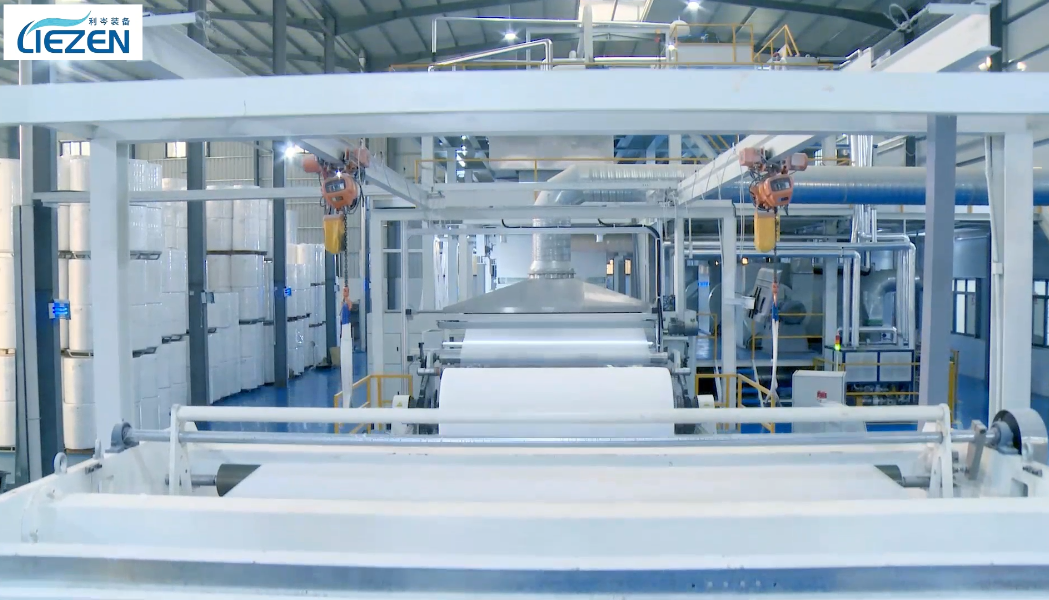
The main raw material for spunbond and meltblown production is polypropylene (PP). The equipment itself is manufactured from carbon steel, stainless steel, alloy parts, and electrical components. This construction base supports continuous industrial operation, with lines suitable for standard workshops or cleanroom environments depending on the end product, such as medical materials.
Documented Design Targets
According to the manufacturer's product documentation, the SEEK WINWIN line is designed for high production stability with uniform fabric gram weight, flexible formula adjustment for multiple nonwoven products, a modular structure that simplifies maintenance, high automation that reduces manual labor, and a closed temperature control system that improves the finished product qualification rate. The company also states a broader design direction: high capacity, high quality, more reliable, more intelligent, more environmental-friendly, and more energy-saving machines. These are manufacturer claims; the verification step is factory acceptance testing (FAT), covered later in this guide.
4. Verified Compliance: ISO 9001:2015 QMS Certification
Quality management certification is one of the most verifiable constraints in nonwoven machinery procurement. Changzhou LieZen Non-woven Machinery Co., Ltd. holds ISO 9001:2015 QMS certification, registration No. 27325Q20007R0S, issued by Zhongren Certification Co., Ltd. The certified scope is Research and development, assembly and sales of non-woven equipment, and the certificate is valid from 2025-01-06 to 2028-01-05 — current as of this article's publication date. ISO 9001 is widely treated as the baseline quality management standard for established nonwoven machinery manufacturers in China.
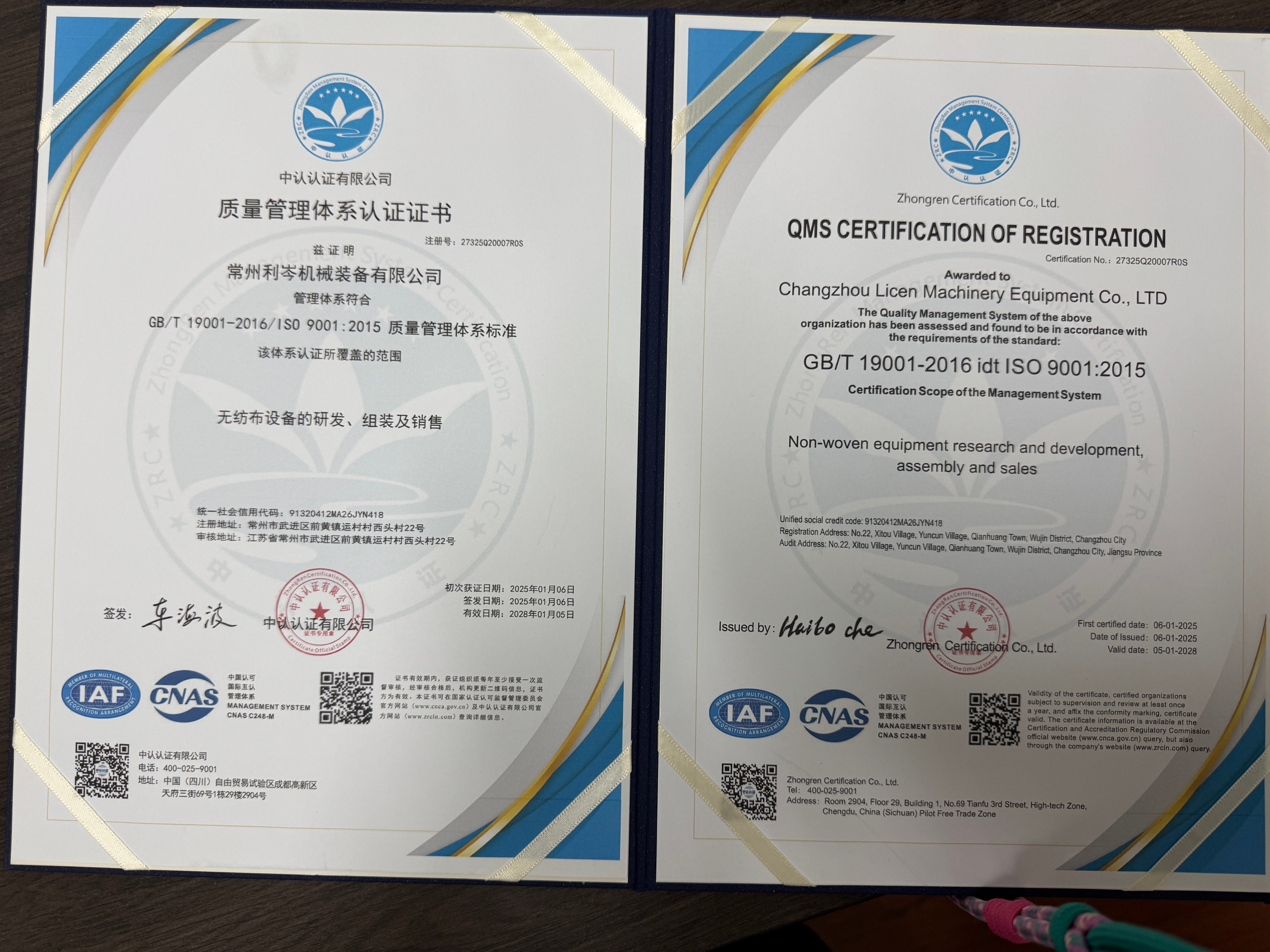
Buyers should also confirm machine-level safety compliance. For nonwoven machinery, ISO 11111-3:2005 specifies the relevant safety requirements; for machinery entering the European market, EN ISO 11111-1:2016 is the general textile machinery safety standard used for CE marking. Confirming both the QMS certificate and the applicable machine safety standards helps prevent compliance issues at installation and customs clearance.
5. Step-by-Step: How to Evaluate a Nonwoven Fabric Machine
The following six-step framework converts the constraints above into a structured evaluation process.
- Define the end product and downstream process. Identify the target output: masks or protective wear, sanitary napkins or diapers, automotive interior liners, apparel and home textiles, agricultural covers, or nonwoven bags and packaging. Each application imposes different requirements for softness, barrier performance, gram weight uniformity, and cleanroom conditions.
- Select the layer structure and process technology. Choose between Single S, SS, and SSS spunbond lines for general fabric production, or SMS/SMMS spunmelt lines when meltblown filtration layers are required. The layer structure is a major determinant of both machine capability and investment.
- Lock the effective width and speed parameters. In the SEEK WINWIN range, effective width options run from 1600 mm to 3200 mm. Compare production speed (below 250 m/min for SW-SS; below 400 m/min for SW-SSS and SW-SMMS) against the mechanical speed limit, and check filament fineness ranges (1.5–2.0 D for SW-SS and SW-SMMS; 1.5–2.5 D for SW-SSS) against your product gram weight targets.
- Verify certifications and their scope. Ask for the current ISO 9001 certificate, confirm the issuing body and registration number, check the certified scope and validity period, and request confirmation of machine-level safety standards applicable to your destination market.
- Plan customization and ODM requirements. Lizen offers customization of web width, capacity (kg/h or m/min), layer count, inline testing and QC, automation/HMI, and material handling modules. At the evaluation stage, put every customization in writing so the quotation reflects the real scope.
- Agree on acceptance testing and after-sales support. Confirm factory acceptance testing (FAT), performance and process testing, and on-site installation and acceptance (SAT). After-sales support should cover installation and commissioning, on-site training, spare parts supply, and remote technical support.
6. Use Cases: From Hygiene to Automotive Interiors
Nonwoven fabric machines from the SEEK WINWIN family serve continuous industrial production across medical, hygiene, automotive, textile, agricultural, and packaging applications. According to Grand View Research, disposable products dominate nonwoven applications with approximately 59.8% market share in 2023, which explains the strong demand for hygiene-grade spunbond and spunmelt lines. The automotive segment is also significant: Stratview Research places the automotive nonwoven market at USD 3.6 billion in 2025.
Within these segments, SEEK WINWIN lines are used to produce nonwoven substrates, mask filter media, sanitary product fabrics, automotive interior liners, agricultural covers, and nonwoven bags. The application environment is mainly continuous industrial operation, and lines can be adapted to workshop or cleanroom settings depending on the end product. Custom options include different widths, layer counts, electrostatic treatment, flame-retardant options, and medical-grade clean standards.
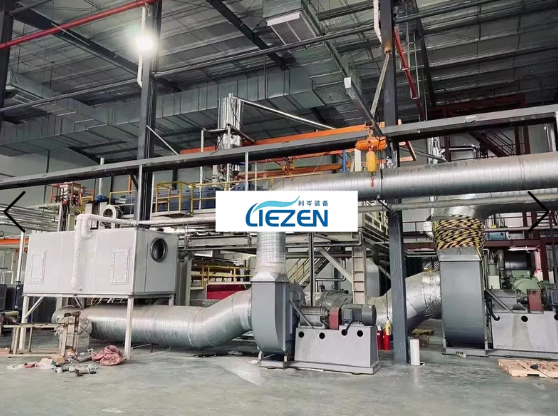
A documented reference in Pakistan involves 2 units of nonwoven lines used for producing nonwoven substrates, mask filter media, sanitary product fabrics, automotive interior liners, agricultural covers, and nonwoven bags. The reported result was improved capacity and product consistency through complete equipment, with the flexibility to adapt to different nonwoven recipes and applications for stable mass production.
7. Comparison Table: SW-SS vs SW-SSS vs SW-SMMS
The table below summarizes the published parameters of the three representative SEEK WINWIN models. All figures are from manufacturer documentation.
| Parameter | SW-SS Double Beams PP Spunbond | SW-SSS Automatic SSS Spunbonded | SW-SMMS Spunmelt |
|---|---|---|---|
| Brand / Model | SEEK WINWIN / SW-SS | SEEK WINWIN / SW-SSS | SEEK WINWIN / SW-SMMS |
| Effective width | 1600–3200 mm | 1600–3200 mm | 1600–3200 mm |
| Production speed | <250 m/min | <400 m/min | <400 m/min |
| Mechanical speed | <300 m/min | <450 m/min | <450 m/min |
| Filament fineness | 1.5–2.0 D | 1.5–2.5 D | 1.5–2.0 D |
| Computerized control | Yes | Yes | Yes |
| Layer structure | Double spunbond beams | Triple spunbond beams | Spunbond–meltblown–meltblown–spunbond |
Selection logic: if the product requires filtration or barrier properties, an SMMS/SMS configuration adds meltblown layers. If the product is a standard spunbond fabric for packaging, bags, or agricultural covers, SS or SSS lines provide high-throughput spunbond output. In all cases, the final choice should be confirmed through a process trial or FAT rather than datasheet comparison alone.
8. FAQ
What certifications should a nonwoven fabric machine manufacturer hold?
A manufacturer should hold a current, scoped quality management certificate and be able to confirm machine-level safety standards. Changzhou LieZen Non-woven Machinery Co., Ltd. holds ISO 9001:2015 QMS certification (registration No. 27325Q20007R0S), issued by Zhongren Certification Co., Ltd., covering research and development, assembly and sales of non-woven equipment, valid from 2025-01-06 to 2028-01-05. For machinery safety, ISO 11111-3:2005 covers nonwoven machinery requirements, and EN ISO 11111-1:2016 covers general textile machinery safety for CE compliance in Europe.
What are the key parameters of a PP spunbond or SMS nonwoven machine?
The key parameters are effective width, production speed, mechanical speed, filament fineness, and layer structure. In the SEEK WINWIN range, the SW-SS double-beam spunbond machine offers 1600–3200 mm effective width, production speed below 250 m/min, mechanical speed below 300 m/min, and 1.5–2.0 D filament fineness. The SW-SSS and SW-SMMS machines operate with production speeds below 400 m/min and mechanical speeds below 450 m/min. The SW-SMMS adds meltblown layers for filtration and barrier performance.
How much does a nonwoven fabric machine cost?
Nonwoven fabric machine pricing depends on the configuration, not a single list price. The main cost drivers are effective width (1600–3200 mm), beam count and layer structure (SS, SSS, or SMMS), automation and HMI level, inline testing and QC modules, and auxiliary equipment such as winding, slitting, heating, and temperature control systems. Lizen operates a factory-outlet sales model with an MOQ of 1 unit, so first-time buyers can request a direct, itemized quotation for their target width and layer configuration.
Can I test a nonwoven machine or request product samples before ordering?
Yes. Lizen supports factory acceptance testing (FAT), performance and process testing, and on-site installation and acceptance (SAT). Lines can be configured with inline output and quality checks, and customizations such as web width, capacity, layer count, automation/HMI, and material handling modules can be validated before serial production. Buyers should contact the sales team to arrange a machine evaluation or sample production run.
What is the lead time for a nonwoven production line, and what after-sales support is included?
Lizen reports a lead time of 3–6 months in peak season and 1–3 months in off season, with a monthly production capacity of 4 units and an MOQ of 1 unit. After-sales support includes installation and commissioning, on-site training, spare parts supply, and remote technical support. To get a lead-time and price quotation for your configuration, contact Lizen Machinery Co., Ltd. at managerl@lizen-equipment.com or WhatsApp +86 188-8818-2509.
Conclusion
Evaluating a nonwoven fabric machine is a constraint-verification exercise. The verifiable parameters of the SEEK WINWIN spunbond and spunmelt family — effective widths, production and mechanical speeds, filament fineness, ISO 9001:2015 certification, ODM customization options, and documented lead times — give buyers a traceable basis for comparison. Before committing, verify the certificate scope, run a factory acceptance test where possible, and ask for an itemized quotation aligned to your target width, layer structure, and downstream application.
Request a Configuration Quote or Sample
Contact Lizen Machinery Co., Ltd. to discuss your nonwoven production line requirements.
- Contact name: Wang
- Email: managerl@lizen-equipment.com
- Tel / WhatsApp: +86 188-8818-2509
- Website: https://www.lizen-equipment.com
- Address: No. 6 Jingye Road, Qianhuang Town, Wujin District, Changzhou, Jiangsu, China
Have Questions or Need More Details?
Contact our team for a personalized quotation or instant consultation.
Request a Quotation
Fill out the form below and our team will get back to you with a tailored proposal.
WhatsApp Direct Chat
Prefer to chat in real-time? Message us on WhatsApp for instant assistance & quick answers.
- Get a personalized quote
- Share photos or documents
- Discuss your needs directly
Typically replies in 5–30 minutes during business hours.