
Nonwoven Machine Selection: How to Compare Capacities, Speeds, and Costs
How to Compare Nonwoven Fabric Machine Capacities, Speeds, and Costs
Choosing a nonwoven fabric machine determines the width, speed, layer structure, and product possibilities of your entire line. Yet many buyers compare price tags before capacities. This guide provides a fact-based method for comparing nonwoven machines, especially spunbond and spunmelt lines, so you can evaluate capacities, speeds, and costs in a structured way.
The problem: price-based comparison without capacity analysis
Nonwoven production lines are built around spinning beams, meltblown beams, winding stations, temperature control, and auxiliary units. A line labeled "nonwoven making machine" can be configured as single-beam spunbond, double-beam spunbond (SS), triple-beam spunbond (SSS), or spunmelt composites such as SMS, SMMS, SSMS, and SMMSS. Each configuration serves different capacity targets and end-product needs. If you compare only initial price, you may miss large differences in output capability and application suitability.
Industry background: why machinery comparison is becoming more important
The nonwoven equipment market is expanding. According to Dataintelo, the global nonwoven machinery market was valued at USD 6.8 billion in 2025 and is projected to reach USD 12.1 billion by 2034. Spunbond machinery held the largest equipment share, at 34.2%, and Asia Pacific led demand with 43.7% of revenue in 2025. On the raw-material side, polypropylene (PP) remains dominant in spunbond production, with a share of more than 53% in 2026. China produced 8.56 million tons of nonwovens in 2024, including 3.88 million tons of spunbonded nonwovens, according to CNITA. For buyers entering or expanding in this sector, a practical comparison framework is essential.
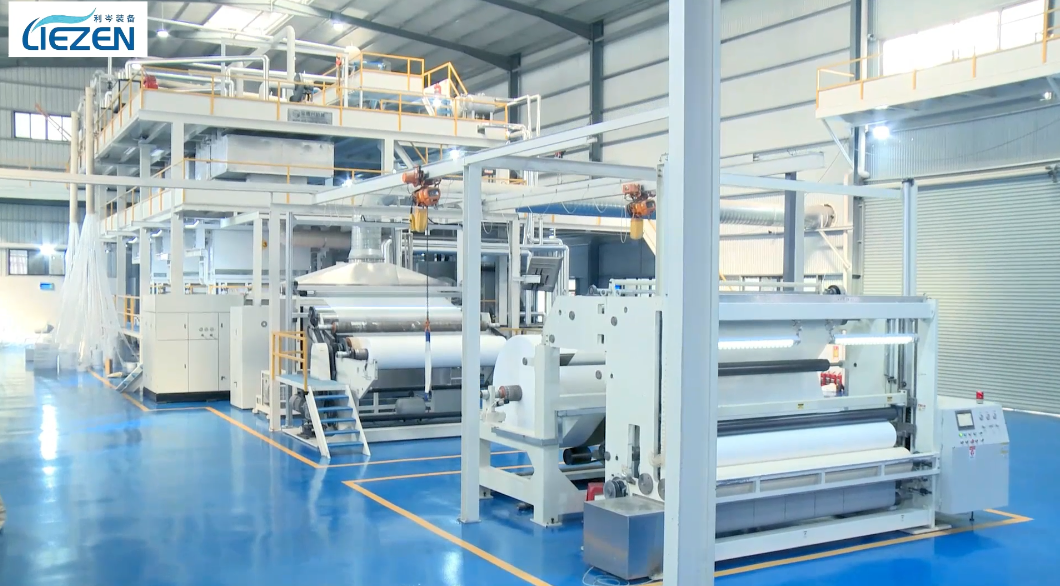
Factory premises used for nonwoven line assembly and testing.
Core comparison axes: effective width, line speed, and beam configuration
Three technical parameters have the largest effect on capacity and cost: effective width, rated line speed, and beam configuration. Effective width determines the maximum fabric width that a line can produce. Typical PP spunbond lines offered by Lizen Machinery cover effective widths from 1600 mm to 3200 mm. Line speed appears in two forms: production speed and mechanical speed. Production speed is the normal running rate; mechanical speed is the upper design limit. The difference matters because equipment should be sized for continuous production, not momentary mechanical peaks.
Beam configuration determines what the fabric can do. In names such as SS, SSS, and SMMS, S stands for spunbond and M for meltblown. Additional beams increase layering flexibility and may raise capacity, but they also add complexity and capital investment.
Entry-level versus high-efficiency nonwoven machine configurations
In the Lizen product range, three representative models show how capacities and speeds segment:
- Double Beams PP Spunbond Nonwoven Fabric Machine (SS) — a lower-speed entry-level line with an effective width of 1600–3200 mm, production speed below 250 m/min, mechanical speed below 300 m/min, and filament fineness of 1.5–2.0 D. This type of line can suit standard hygiene, packaging, agricultural, and home-textile nonwovens where a spunbond structure is enough.
- SSS nonwoven machine — a higher-speed configuration with an effective width of 1600–3200 mm, production speed below 400 m/min, mechanical speed below 450 m/min, and filament fineness of 1.5–2.5 D. The additional spunbond beam increases throughput and structural flexibility for products that need a stronger or more uniform layered web.
- SMMS Spunmelt Non Woven Machine — an advanced spunmelt configuration with an effective width of 1600–3200 mm, production speed below 400 m/min, mechanical speed below 450 m/min, and filament fineness of 1.5–2.0 D. The inclusion of meltblown sections makes it more suitable for medical and hygiene products that require barrier or filtration performance.
From a cost standpoint, these should be treated as different classes rather than alternatives with minor price differences. An SS line is generally less complex to build and operate than an SSS or SMMS line. However, if a project requires 400 m/min-class throughput, an entry-level line will create a long-term capacity bottleneck. Conversely, a 400 m/min SMMS line may be over-specified for a producer that makes simple spunbond packaging fabric in low volume.
Comparison table: representative nonwoven line configurations
| Parameter | Double Beams PP Spunbond (SS) | SSS Spunbond | SMMS Spunmelt |
|---|---|---|---|
| Beam structure | Two spunbond beams | Three spunbond beams | Spunbond and meltblown layers in a spunmelt sequence |
| Effective width | 1600–3200 mm | 1600–3200 mm | 1600–3200 mm |
| Production speed | <250 m/min | <400 m/min | <400 m/min |
| Mechanical speed | <300 m/min | <450 m/min | <450 m/min |
| Filament fineness | 1.5–2.0 D | 1.5–2.5 D | 1.5–2.0 D |
| Capital cost direction | Baseline, less complex | Higher than double-beam because of added beam and controls | Higher still because of spunmelt layering and process control |
| Typical project focus | Standard spunbond fabrics, bags, covers, simple hygiene layers | Higher-output spunbond fabrics with more layering flexibility | Medical, hygiene, and barrier-oriented nonwovens |
These figures are representative equipment ratings from the Lizen catalog. They are not price quotes. The actual purchase cost of a nonwoven production line depends on effective width, beam count, automation level, inline testing, auxiliary equipment, and installation scope.
Step-by-step: how to compare nonwoven machines for your project
- Define your end products and target fabric weight or width. Hygiene material, automotive interior liners, and packaging fabrics create different process demands. Write down the product range you expect to produce in the next three to five years.
- Select the beam architecture. Spunbond-only lines such as SS or SSS are appropriate for many non-filter nonwovens. Spunmelt configurations such as SMS or SMMS should be considered when barrier or filtration performance is part of the product specification.
- Compare effective width and line speed together. Do not compare speed in isolation. A 1600 mm line running at 400 m/min produces less fabric area per hour than a 3200 mm line running at 400 m/min.
- Check production speed versus mechanical speed. Production speed is the realistic continuous figure. Mechanical speed is an upper limit. A line whose production speed matches your target output is safer than one selected on a mechanical-speed headline.
- Evaluate customization options. Lizen can customize web width, capacity in kg/h or m/min, layer count, inline testing and QC, automation/HMI, and material-handling modules. These choices directly influence both capability and investment cost.
- Review manufacturer lead time and service. Lizen's MOQ is 1 unit. Peak-season lead time is 3–6 months; off-season lead time is 1–3 months. Installation and commissioning, on-site training, spare parts supply, and remote technical support are part of the standard after-sales scope to discuss before ordering.
- Compare total cost, not only purchase price. Include speed at your target fabric grammage, line availability, energy consumption, spare-part response, and the cost of producing a ton of nonwoven. A faster line may have a higher first cost but can lower cost per ton if demand justifies high utilization.
Use cases: matching a nonwoven line to a project scenario
Capacity needs vary by industry. The following use cases reflect common project profiles.
- Hygiene products such as sanitary napkins and diapers. Producers often rely on PP spunbond or spunmelt lines that can form a soft and stable substrate. Spunmelt configurations such as SMMS are commonly selected when a fluid barrier is needed, while a double-beam spunbond line may be enough for simpler hygiene layers.
- Medical masks and protective wear. Mask filter media and protective materials need fine fibers and filtration function. SMS and SMMS lines add meltblown layers inside the fabric structure. The SMMS line cited above lists filament fineness of 1.5–2.0 D, which helps support fine-fiber products.
- Automotive interior. Vehicle interior liners require consistent width, thickness, and surface quality. An effective width up to 3200 mm gives converters the option to produce wide-roll nonwoven substrates for subsequent cutting and lamination processes.
- Agricultural covers, packaging, and eco-friendly bags. Many of these products can be made on lower-cost spunbond lines. The Double Beams PP Spunbond Nonwoven Fabric Machine represents a practical entry-level option when the priority is reliable output rather than maximum line speed.
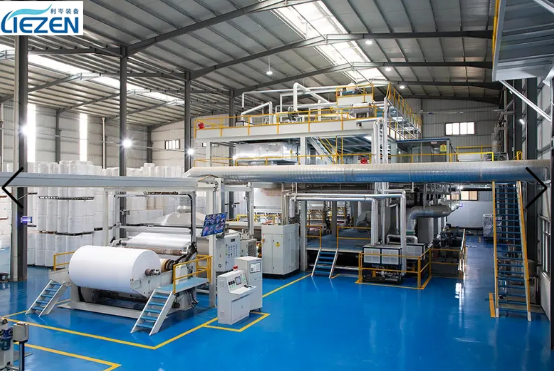
Actual machine view of a spunmelt nonwoven line.
Manufacturing and customization capabilities to evaluate
Supplier capability is as important as the specification table. Lizen Machinery has delivered nearly 1000 complete sets of standardized and customized nonwoven production lines to more than 30 countries. The Changzhou factory covers 30,000 m² and employs about 270 people, including 10 R&D engineers. Annual factory output is about 50 units, and export ratio is around 60%, with main markets including the United States.
For project evaluation, quality-control procedure matters. Lizen can support factory acceptance testing (FAT), performance and process testing, on-site installation and acceptance (SAT), and inline output and quality checks. ODM production is available for buyers that need a particular line configuration rather than a standard catalog unit.
One example from Pakistan involved two delivered units. The intended applications covered nonwoven substrates, mask filter media, sanitary product fabrics, automotive interior liners, agricultural covers, and nonwoven bags. For a buyer, such application breadth suggests that the line can be adapted to different recipes and product changes without requiring a completely new machine.
FAQ
What is the difference between SS, SSS, and SMMS nonwoven machines?
SS, SSS, and SMMS describe the sequence of forming beams. SS uses two spunbond beams, SSS uses three spunbond beams, and SMMS is a spunmelt configuration that combines spunbond and meltblown layers in one continuous process. Meltblown layers improve barrier and filtration performance for products such as medical fabrics and hygiene materials. In Lizen product data, all three can be built with effective widths from 1600 mm to 3200 mm, while speed ratings differ.
Which nonwoven machine should I select for a hygiene project or sanitary-product project?
Start from the layer structure needed in the finished fabric. If the product is a top sheet or a simple spunbond layer, a Double Beams PP Spunbond Nonwoven Fabric Machine can be a cost-effective basis. If the product needs moderate or high barrier performance, an SMMS spunmelt line is usually more appropriate because it includes meltblown layers. Line speed and width must then be matched to your projected output volume.
What is the difference between production speed and mechanical speed on a nonwoven fabric machine?
Production speed is the rated speed for normal continuous operation. Mechanical speed is the upper design limit of the machine. For example, the Double Beams PP Spunbond machine has a production speed below 250 m/min and a mechanical speed below 300 m/min. SSS and SMMS models list production speed below 400 m/min and mechanical speed below 450 m/min. The production speed is the more realistic number for capacity planning.
What are the main factors that determine the cost of a nonwoven machine?
The largest cost drivers are the number of beams, effective width, line-speed capability, automation and HMI level, inline QC modules, material-handling equipment, and installation services. A wider SMMS line with higher automation generally costs more than a compact spunbond-only line. Because each project differs in width and layer configuration, suppliers should provide itemized proposals rather than a single broad price.
Can a nonwoven machine be customized for a specific width, layer count, or product type?
Yes. Lizen supports ODM customization of web width, capacity in kg/h or m/min, layer count, inline testing and QC, automation/HMI, and material-handling modules. Custom requirements can include electrostatic treatment, flame-retardant options, and medical-grade clean standards. Buyers should confirm exact service commitments, lead times, and acceptance procedures with the supplier.
How do I choose between an entry-level SS line and a high-efficiency SSS or SMMS line?
Evaluate the target product range and required annual output. If the products are standard spunbond fabrics with moderate speed requirements, an SS line is typically enough. If you need 400 m/min-class capacity or you plan to produce medical and hygiene materials with barrier layers, a higher-efficiency SSS or SMMS configuration is worth the additional investment. Compare cost per ton of output, not only initial line price.
Need a project-specific nonwoven machine comparison?
Lizen Machinery Co., Ltd. (Changzhou LieZen Non-woven Machinery Co.,Ltd.) can help you compare line configurations based on your target width, speed, product type, and budget.
Email: managerl@lizen-equipment.com
Tel / WhatsApp: +86 188-8818-2509
Website: www.lizen-equipment.com
Sources: Dataintelo Non-Woven Machinery Market Report, https://dataintelo.com/report/non-woven-machinery-market/; CNITA China Nonwovens Output Data, http://www.cnita.org.cn/; Fortune Business Insights Spunbond Nonwoven Market, https://www.fortunebusinessinsights.com/spunbond-nonwoven-market-102558; Grand View Research Nonwoven Fabrics Market, https://www.grandviewresearch.com/industry-analysis/nonwoven-fabrics-market.