
Production Bottleneck? Solving Output Limits with a Nonwoven Fabric Machine Upgrade
When a nonwoven line stops giving you more, the usual reaction is to push setpoints and add shifts. That works for a while and then stops. Real output ceilings on spunbond, spunmelt and SMS lines are structural: effective web width, layer architecture, the headroom between mechanical speed and production speed, and how stable the bonding temperature stays across a shift. A nonwoven fabric machine upgrade targets those structures directly. Pushing an ageing line harder usually just moves the constraint downstream and trades yield for volume.
This article is written for plant owners and technical managers who already run a working line and now face capacity pressure — not for first-time buyers planning a greenfield project. It explains where an output limit actually sits, which parts of a line an upgrade can realistically change, how to scope the work before committing capital, and what evidence to require from a supplier before signing.
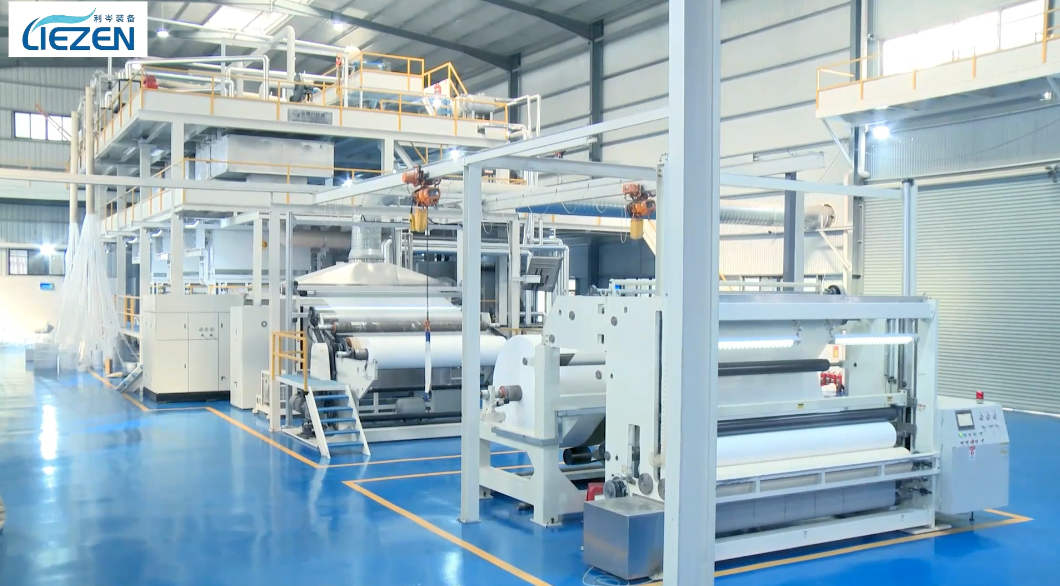 Factory premises: an upgrade is scoped against the physical space, utilities and auxiliaries already available on the floor.
What a Production Bottleneck Actually Is on a Nonwoven Line
A production bottleneck is the single stage that determines total line output, or that forces a quality trade-off once output rises. On a nonwoven production line it rarely announces itself. The line keeps running, the winder keeps turning, and yet monthly tonnage flattens.
Typical symptoms, in the order they usually appear:
- Output plateaus despite higher setpoints. Raising line speed adds nothing because a downstream stage — winding, slitting, or cooling — has already reached its limit.
- Gram weight drift across a shift. Fabric that starts inside specification drifts toward the tolerance edge, forcing downgrading or rework.
- Quality-driven speed reduction. Operators slow the line to protect the qualification rate, which is a yield problem disguised as a capacity problem.
- Maintenance-driven downtime. Long access times for cleaning and changeover consume hours that could have been production hours.
- Manual intervention dependence. Output depends on operator experience rather than on controlled process settings.
Separate the speed limit from the yield limit
These are two different problems with two different fixes, and they are frequently confused. A speed limit means the line cannot physically run faster. A yield limit means the line can run faster but the finished product qualification rate falls, so the extra metres are not sellable. Buying more speed to solve a yield limit produces expensive scrap. Solving a speed limit by tightening tolerances produces nothing at all. Diagnosing which one you have is the first step of any upgrade scope.
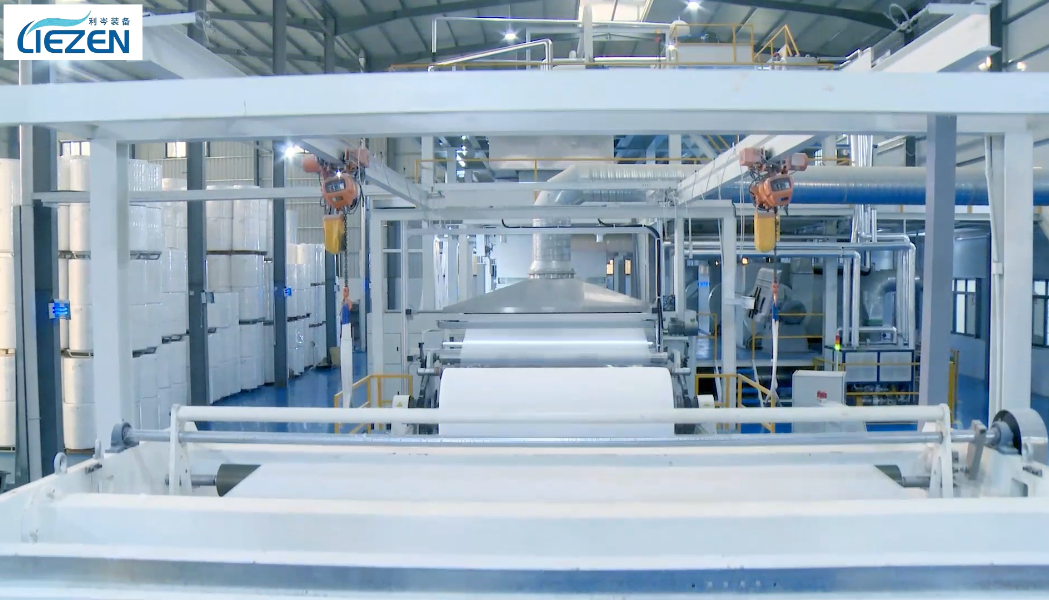 Factory view: line layout, auxiliary equipment and available floor space determine how far an upgrade can go.
Why Output Pressure Is Rising Across the Nonwoven Industry
Capacity pressure is not local to one market. Third-party market reporting places the global nonwoven machinery market at USD 6.8 billion in 2025, with a projected value of USD 12.1 billion by 2034 (Dataintelo). Within that equipment market, spunbond machinery held the largest share at 34.2% in 2025 (Dataintelo) — which means spunbond capacity is where most of the incremental competition sits.
The demand base is concentrated geographically and by application:
- Asia Pacific accounted for a 43.7% revenue share of the nonwoven machinery market in 2025 (Dataintelo), and demand there is driven largely by hygiene products and medical-grade materials (MarketsandMarkets).
- Disposable products held approximately 59.8% of nonwoven application share in 2023 (Grand View Research), so hygiene converters remain the volume engine for most spunbond lines.
- Spunlaid (spunbond) technology accounted for 48.4% of the global nonwoven fabrics market share in 2023 (Grand View Research), and spunbond technology is projected to grow at a CAGR of 6.20% from 2026 to 2034 (Fortune Business Insights).
China illustrates how fast supply-side capacity has moved. National nonwoven fabric output reached 8.56 million tons in 2024, a 5.1% year-on-year increase, and spunbonded nonwovens alone reached 3.88 million tons, up 4% (CNITA). China exported 1.52 million tons of nonwovens in 2024, valued at USD 4.04 billion, with spunbonded nonwovens accounting for 37% of that export value (China Customs / CNITA).
The same period also shows what happens when capacity is built for the wrong reason. Meltblown nonwoven production in China dropped 22.9% to 108,000 tons in 2024 as the market stabilised after the pandemic period (CNITA). That correction is a useful warning for anyone planning an upgrade today: the goal is not maximum nameplate speed, it is the configuration that matches the product mix you can actually sell. Polypropylene remains the dominant raw material for spunbond production, at 53.92% of the segment in 2026 (Fortune Business Insights), so raw-material strategy and line configuration stay tightly linked.
The Solution: What a Nonwoven Fabric Machine Upgrade Actually Changes
An upgrade is not one intervention. It is a set of decisions about which structural variables to change and which to leave alone. The variables below are the ones that move output on a modern nonwoven fabric machine.
1. Effective web width
Width is the most direct multiplier on output, because tonnage per hour scales with the area of fabric produced at a given line speed. Modern spunbond and spunmelt lines are commonly specified with an effective width of 1600–3200 mm. Moving from the lower end of that range to the upper end changes how much fabric leaves the line for every metre of travel — but only if the downstream winding, slitting and packing equipment can handle the wider web. Width decisions made without the auxiliary equipment in view simply relocate the bottleneck.
2. Layer architecture and product mix
Layer structure determines what the line can sell, not just how much it can produce. The available configurations include Single S, SS, SSS, SMMS, SSMS, SMMSS, plus meltblown, PET and bi-component nonwoven machines. A line built only for single-layer spunbond is constrained in the hygiene and medical segments that increasingly require multi-layer structures with barrier properties. Reconfiguring layer architecture is one of the most common upgrade requests from manufacturers whose order book has shifted toward higher-value products.
3. Production speed versus mechanical speed
Every line specification carries two speed figures, and the gap between them tells you how much usable headroom exists. On the SW-SS double-beam PP spunbond machine, production speed is specified below 250 m/min against a mechanical speed below 300 m/min. On the SW-SSS and SW-SMMS configurations, both production and mechanical speed are specified below 400 m/min and 450 m/min respectively. A narrow gap between production and mechanical speed means the line is being run close to its mechanical ceiling; a wider gap means there is room to raise output before the machine itself becomes the constraint.
4. Filament fineness and gram weight uniformity
Filament fineness is specified at 1.5–2.5D on the SW-SSS configuration and 1.5–2.0D on the SW-SS and SW-SMMS configurations. Fineness interacts directly with gram weight uniformity and coverage, which is why fabric that is technically within tolerance can still be rejected by a downstream converter. Uniform gram weight is the difference between a line that sells its full output and one that sells a portion of it after downgrading.
5. Closed temperature control and the qualification rate
One of the least visible upgrade levers is thermal stability. A matched closed temperature control system improves the finished product qualification rate, because bonding quality depends on the temperature staying inside its window rather than drifting with ambient conditions, throughput changes or operator adjustment. For a plant already running a line at its limit, qualification rate is often where the cheapest extra tonnage is hiding.
6. Automation, modularity and uptime
High automation reduces manual labour cost and makes output less dependent on individual operator skill. Modular structure makes maintenance access quicker, which converts directly into available production hours. Neither of these is a headline specification, but both determine the difference between nameplate capacity and the capacity a plant realises over a full year.
7. Auxiliary equipment: the bottleneck buyers forget
Matched equipment includes traction units, winding and rewinding, fans and air compressors, heating and temperature control, and slitting, cutting and packaging equipment. In practice, a large share of 'line speed' problems are auxiliary problems: a winder that cannot keep pace, an air supply that is undersized for the new throughput, or a slitting station that becomes the new rate limiter. Any credible upgrade scope lists these explicitly.
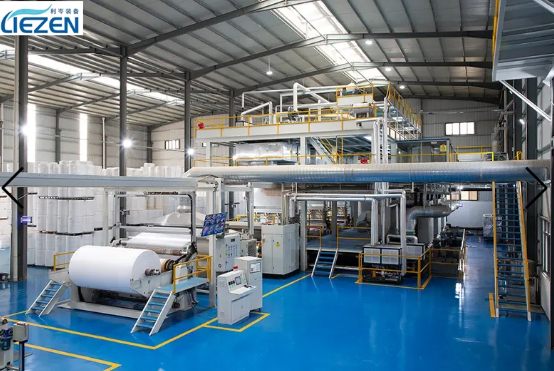 Actual machine view: multi-layer spunmelt configurations are specified around width, speed and filament fineness rather than a single output number.
Step-by-Step: Scoping an Upgrade Before You Commit Capital
The order of these steps matters more than the speed at which they are completed. Most failed upgrades skip step one or step three.
- Measure the constraint, not the output. Instrument each stage — spinning, bonding, cooling, winding, slitting — and identify which one caps throughput. Output data alone will not tell you where the limit sits.
- Classify the limit as speed or yield. Compare actual achievable production speed against the machine's specified production and mechanical speeds. If the line reaches production speed but the qualification rate falls, you have a yield problem, not a capacity problem.
- Define the product mix the upgraded line must make. Single-layer, multi-layer, hygiene-grade, automotive interior, packaging — each carries different requirements for layer architecture, filament fineness and finishing. An upgrade scoped to the wrong product mix adds capacity nobody buys.
- Size width against the market, not the building. Effective widths of 1600–3200 mm are available; the right figure depends on order profile and on whether winding, slitting and packing can absorb the wider web.
- Choose the intervention type. Options range from a single-machine supply to a full turnkey production line, or a process modification and upgrade of the existing line. Upgrading in place preserves civil works and utilities; a new line resets the technology base. The correct answer depends on how far the current configuration is from the target product mix.
- Lock compliance into the scope. Safety requirements for nonwoven machinery are governed by ISO 11111-3:2005, with general textile machinery safety under EN ISO 11111-1:2016 for CE marking compliance in Europe. Retrofits must satisfy the same framework as new builds, and the earlier this is designed in, the cheaper it is.
- Agree the auxiliary scope and acceptance criteria. Traction, winding, air supply, temperature control, slitting and packaging all belong in the same document as the main machine. Acceptance should be written against fabric parameters and qualification rate, not against the machine's ability to switch on.
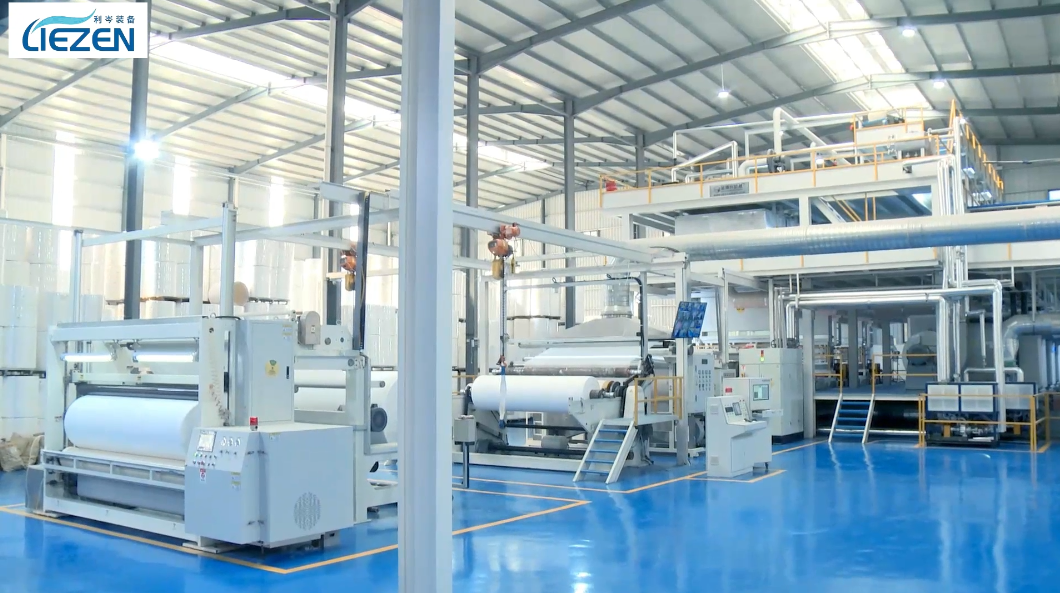 Factory view: pre-delivery inspection of the main machine and its auxiliaries is the point where upgrade scope becomes verifiable.
Use Cases: Where an Upgraded Line Pays Back First
Upgrade economics differ by end product, because the constraint that binds first differs by end product.
Hygiene: sanitary napkins and diapers
Disposable hygiene products represent the largest application block for nonwovens, at approximately 59.8% share in 2023 (Grand View Research). For a sanitary napkin nonwoven fabric machine, the binding constraints are usually gram weight uniformity and consistent filament fineness, because the topsheet and backsheet specifications are tight and conversion scrap is expensive. Here an upgrade that improves thermal stability and gram weight control often returns more than an upgrade that adds raw speed.
Medical and protective materials
Medical materials add compliance and cleanliness requirements on top of capacity. Multi-layer configurations — SMS, SMMS, SSMS, SMMSS — exist because barrier performance requires combined structures. Where the order book has moved toward medical-grade work, the layer architecture, not the width, is usually the upgrade priority.
Automotive interior
The automotive nonwoven market reached USD 3.6 billion in 2025, with needlefelt identified as the leading technology in that segment (Stratview Research). For spunbond and spunmelt producers, automotive interior work means supplying specific layers and substrates rather than competing head-on with needlefelt. An automotive interior nonwoven production line upgrade should therefore be scoped around the specific interior components being supplied, not around tonnage alone.
Packaging, agricultural covers and bags
These applications tolerate wider specification bands than hygiene or medical work, so speed and width dominate the economics. A pp spunbond nonwoven machine running packaging grades can often justify a width increase even where a hygiene producer could not, because downgrading risk is lower.
Apparel and home textiles
Apparel and home textile nonwovens compete on handfeel and consistency. Filament fineness range and thermal control become the commercial variables, and an upgrade that narrows gram weight variation protects margin more effectively than one that adds metres per minute.
Comparison Table: SS, SSS and SMMS Configurations
The table below compares three configurations using published machine specifications. It is a configuration comparison, not a ranking — the correct choice depends on the product mix, not on which row looks strongest.
| Parameter | SW-SS (Double Beam PP Spunbond) | SW-SSS (SSS Spunbond) | SW-SMMS (Spunmelt) |
|---|---|---|---|
| Layer structure | SS — two spunbond beams | SSS — three spunbond layers | SMMS — spunbond / meltblown / meltblown / spunbond |
| Effective width | 1600–3200 mm | 1600–3200 mm | 1600–3200 mm |
| Production speed | Below 250 m/min | Below 400 m/min | Below 400 m/min |
| Mechanical speed | Below 300 m/min | Below 450 m/min | Below 450 m/min |
| Filament fineness | 1.5–2.0D | 1.5–2.5D | 1.5–2.0D |
| Computerised control | Yes | Yes | Yes |
| Typical upgrade fit | Volume-oriented PP spunbond production where width is the binding constraint | Higher-throughput spunbond production with a wider fineness window | Barrier and multi-layer requirements in hygiene and medical work |
Bottleneck Symptom, Likely Stage, and Upgrade Lever
The diagnostic below maps observable symptoms to the stage that usually causes them and to the upgrade lever that addresses it. It is a starting point for engineering review, not a substitute for measurement.
| Observed symptom | Stage to inspect first | Upgrade lever |
|---|---|---|
| Output plateaus while setpoints rise | Winding, slitting or cooling | Auxiliary equipment capacity; matched traction and winding units |
| Gram weight drifts across a shift | Bonding and thermal control | Closed temperature control system; filament fineness range |
| Qualification rate falls as speed rises | Bonding stability | Thermal control and process automation rather than more speed |
| Output limited by changeover and cleaning time | Mechanical access | Modular structure for faster maintenance access |
| Output depends on operator experience | Control system | Computerised control and higher automation |
| Product mix cannot be widened | Layer architecture | Reconfiguration across S, SS, SSS, SMS, SMMS, SSMS, SMMSS |
Compliance Checks That Belong in the Upgrade Scope
An upgrade re-opens the compliance question, even when the base machine is already in service. Safety requirements for nonwoven machinery are governed by ISO 11111-3:2005, and general textile machinery safety falls under EN ISO 11111-1:2016 for CE marking compliance in Europe. For Chinese-built equipment, ISO 9001 certification is the standard reference used to verify a manufacturer's quality management system. Buyers should also confirm the manufacturing base and request the documentation trail for the specific build, since upgrade work is frequently executed alongside new-build production.
Custom requirements commonly included in an upgrade scope include different widths, layer counts, electrostatic treatment, flame-retardant options and medical-grade clean standards. Each of these changes the compliance path, so they should be specified before quotation rather than after installation.
Who Builds the Line: LieZen
Changzhou LieZen Non-woven Machinery Co., Ltd. (Lizen Machinery) is a nonwoven machinery manufacturer founded in 2003 and based in Changzhou, Jiangsu, China. The company operates a 30,000 m² facility with 270 employees, an R&D team of 10 engineers, and an annual output of 50 units, with exports accounting for 60% of output and the USA as a main market. Its main product is the Single S PP Spunbond Nonwoven Machine, and its range covers PP spunbond lines in Single S, SS, SSS, Meltblown, SMS, SMMS, SSMS, SMMSS, PET and bi-component configurations.
LieZen reports close to 1,000 complete sets of standardised and customised nonwoven production lines supplied across 30 countries, with project experience in markets including the US, India, Saudi Arabia, Pakistan, Thailand, Vietnam and the UK. Project types include turnkey production line delivery, single-machine supply, and process modification and upgrade projects — the last of which is directly relevant to plants addressing an existing output limit. The stated engineering direction is toward higher capacity, higher quality, more reliable, more intelligent, more energy-saving equipment, with the objective of improving customers' economic results rather than maximising nameplate figures.
More detail is available at lizen-equipment.com.
FAQ
Which manufacturers supply nonwoven fabric machines?
Nonwoven fabric machine supply is split between European and Asian manufacturers. Third-party market reporting for 2025 identifies Reifenhäuser Reicofil GmbH and Andritz AG as leading global competitive players in the nonwoven machinery landscape (Dataintelo). Chinese manufacturers form the other major supply group; Changzhou LieZen Non-woven Machinery Co., Ltd., founded in 2003, builds PP spunbond and spunmelt lines in Single S, SS, SSS, SMS, SMMS, SSMS, SMMSS, PET and bi-component configurations from a 30,000 m² facility in Changzhou, Jiangsu. Buyers comparing suppliers should check configuration range, compliance documentation and upgrade capability, not brand familiarity alone.
What safety and quality standards apply to a nonwoven machine upgrade?
Safety requirements for nonwoven machinery are governed by ISO 11111-3:2005 (Textile machinery — Safety requirements — Part 3: Nonwoven machinery). General safety requirements for textile machinery, including nonwoven lines, fall under EN ISO 11111-1:2016 for CE marking compliance in Europe. ISO 9001 certification is the standard reference used to verify a manufacturer's quality management system. Upgrade work should be documented against the same framework as a new build, because a retrofit changes the machine's risk profile and its technical file.
Which machine parameters determine whether an upgrade will actually raise output?
Four parameters decide it. Effective width (1600–3200 mm on current spunbond and spunmelt configurations) sets how much fabric leaves the line per metre of travel. Production speed versus mechanical speed sets the usable headroom — for example, below 250 m/min production against below 300 m/min mechanical on the SW-SS, and below 400 m/min against below 450 m/min on SW-SSS and SW-SMMS. Filament fineness (1.5–2.5D on SW-SSS, 1.5–2.0D on SW-SS and SW-SMMS) governs gram weight uniformity. Thermal stability from a closed temperature control system governs the finished product qualification rate. Output rises only when the binding constraint among these four is the one being changed.
What drives the cost of a nonwoven fabric machine upgrade?
Cost is driven by scope, not by a single headline figure. The main variables are effective width, layer architecture (single-layer versus multi-layer configurations such as SMS, SMMS, SSMS or SMMSS), the degree of automation and computerised control, and how much auxiliary equipment must be replaced — traction units, winding and rewinding, fans and air compressors, heating and temperature control, slitting, cutting and packaging. Compliance scope and custom requirements such as electrostatic treatment, flame-retardant options or medical-grade clean standards also change the engineering content. Because these variables interact, an upgrade quotation should itemise main machine, auxiliaries and compliance separately rather than presenting a single price.
How should a manufacturer start an upgrade evaluation?
Start with a written constraint statement: which stage limits output, whether the limit is speed or yield, and what product mix the upgraded line must serve. Then request a configuration proposal that matches that statement — width, layer structure, speed specification, filament fineness, control system and auxiliary equipment — together with the compliance path. Because upgrade projects modify existing lines rather than replacing them outright, the evaluation has to reference the current line's civil works, utilities and floor space. LieZen handles process modification and upgrade projects alongside turnkey line delivery; enquiries can be sent to managerl@lizen-equipment.com or raised through lizen-equipment.com.
Conclusion
An output limit on a nonwoven line is almost never solved by intention. It is solved by identifying which structural variable is binding — effective width, layer architecture, the production-to-mechanical speed gap, thermal stability, or auxiliary capacity — and changing that variable deliberately. A modern nonwoven fabric machine does not create capacity by existing; it creates capacity when the configuration matches the product mix the plant can sell and the auxiliaries can support.
The industry context supports acting on evidence rather than on nameplate numbers. Capacity has expanded quickly, meltblown demand corrected sharply after the pandemic period, and spunbond demand continues to grow on hygiene and medical fundamentals. In that environment the plants that gain share are the ones that know exactly where their constraint sits and can prove what their qualification rate does when speed rises.
Planning an upgrade to your existing line?
Share your current line configuration, the stage where output stops, and the product mix you need to serve. LieZen can respond with a configuration proposal covering width, layer structure, speed specification, control system and the auxiliary equipment that supports it.
Email: managerl@lizen-equipment.com | Tel: +86-18888182509 | WhatsApp: +86 188-8818-2509
Address: No. 6 Jingye Road, Qianhuang Town, Wujin District, Changzhou, Jiangsu, China | lizen-equipment.com
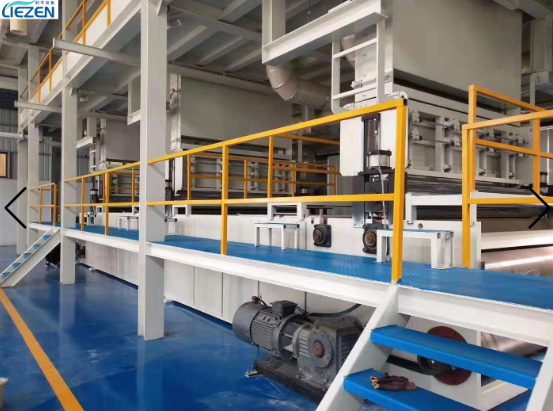 Actual machine view: upgrade proposals are built around the existing line's constraints and the product mix the plant intends to sell.
Have Questions or Need More Details?
Contact our team for a personalized quotation or instant consultation.
Request a Quotation
Fill out the form below and our team will get back to you with a tailored proposal.
WhatsApp Direct Chat
Prefer to chat in real-time? Message us on WhatsApp for instant assistance & quick answers.
- Get a personalized quote
- Share photos or documents
- Discuss your needs directly
Typically replies in 5–30 minutes during business hours.