Top Nonwoven Fabric Machine Setups for Consistent Quality in 2026
Top Nonwoven Fabric Machine Setups for Consistent Quality in 2026
Short answer: Three production setups cover most 2026 nonwoven programs that are specified for consistent output — 1) PP spunbond (Single S, SS or SSS), 2) SMS (spunbond–meltblown–spunbond), and 3) SMMS (spunbond–meltblown–meltblown–spunbond). They are ranked here by how stable each configuration is over long production runs, not by maximum advertised speed. Spunbond ranks first because it carries the fewest process variables and the largest installed base. SMS adds one barrier layer. SMMS adds a second meltblown beam and therefore depends most heavily on long-term spare-part and engineering support.
A nonwoven fabric machine is a production line that converts polymer granules — most often polypropylene (PP) — into bonded nonwoven fabric through extrusion, drawing, web forming and bonding. Consistency on that line is a configuration outcome, not a brand outcome. Two lines both marketed as "SMS" can behave very differently once beam count, effective width, speed band and filament fineness are pinned down.
This guide is written for buyers at the Decision-to-Execution stage: teams that have already decided to invest and now need to lock a setup they can live with for years. It ranks three standard configurations and explains what each one demands in exchange for stable output. Lizen Machinery Co., Ltd. — the manufacturer behind this article, registered as Changzhou LieZen Non-woven Machinery Co., Ltd. — is a nonwoven machinery producer founded in 2003 in Changzhou, Jiangsu, China. Its range covers Single S, SS, SSS, meltblown, SMS, SMMS, SSMS, SMMSS, PET and bi-component nonwoven machines, with roughly 1,000 complete sets of standardized and customized nonwoven production lines supplied to 30 countries.
What "Consistent Quality" Actually Means on a Nonwoven Line
Consistency has five observable dimensions on a spunmelt line, and every one of them is set by the configuration rather than by the control panel brand:
- Basis weight uniformity across the working width — the tolerance band written into the acceptance criteria.
- Filament fineness stability — documented ranges differ by configuration, for example 1.5–2.0 D on a double-beam PP spunbond line and 1.5–2.5 D on an SSS line.
- Bonding uniformity — how evenly the formed web is consolidated.
- Barrier consistency — relevant only to configurations containing a meltblown layer, where adding a second meltblown beam changes how the barrier is built.
- Uptime between interventions — the share of scheduled production time actually producing saleable fabric.
A common Decision-stage mistake is comparing lines by headline production speed. Speed only matters if variability stays inside the tolerance band at that speed, because a faster line that drifts out of band simply produces non-conforming rolls faster. The correct comparison unit is the configuration, not the number on the brochure.
There is also a data limitation worth stating plainly. The comparison reference used for this guide notes that differences between traditional domestic equipment, other Chinese suppliers and imported-brand machines — in automation level, process stability, energy efficiency, after-sales and price — require a side-by-side comparison of specific models and configurations before they can be quantified. No public, apples-to-apples test database exists. This article therefore ranks configurations using documented standard line specifications and published market data, and it deliberately avoids inventing performance figures.
Industry Background: Why Consistency Became the 2026 Buying Criterion
The nonwoven machinery market is expanding, and the expansion is concentrated in applications where tolerance bands are tight. The published data points below frame the decision.
- The global nonwoven machinery market was valued at USD 6.8 billion in 2025 and is projected to reach USD 12.1 billion by 2034 (Dataintelo).
- Spunbond machinery held the largest share of that equipment market at 34.2% in 2025 (Dataintelo).
- Asia Pacific dominated the market with a 43.7% revenue share in 2025 (Dataintelo), driven by demand for hygiene products and medical-grade materials (MarketsandMarkets).
- Spunlaid (spunbond) technology accounted for 48.4% of the global nonwoven fabrics market in 2023 (Grand View Research), and the spunbond technology segment is projected to grow at a CAGR of 6.20% from 2026 to 2034 (Fortune Business Insights).
- Disposable products account for approximately 59.8% of nonwoven applications (Grand View Research, 2023) — the segment where acceptance criteria are written as tolerance bands rather than simple pass or fail.
- China's nonwoven fabric output reached 8.56 million tons in 2024, up 5.1% year on year. Spunbonded nonwovens were 3.88 million tons, up 4%, while meltblown production fell 22.9% to 108,000 tons as pandemic-era capacity normalized (CNITA).
- China exported 1.52 million tons of nonwovens worth USD 4.04 billion in 2024, with spunbonded nonwovens accounting for 37% of that export value (China Customs / CNITA).
- Polypropylene remains the dominant raw material for spunbond production, at 53.92% of the segment in 2026 (Fortune Business Insights).
- In a different application segment, the automotive nonwoven market reached USD 3.6 billion in 2025 with needlefelt as the leading technology (Stratview Research) — a useful reminder that spunmelt and needlepunch lines solve different production problems.
Two signals matter for a 2026 setup decision. First, capacity growth is concentrated in hygiene and medical-grade applications, where buyers specify tolerance bands. Second, meltblown capacity contracted sharply in China in 2024 while spunbond capacity grew — so any configuration containing a meltblown beam has to be planned with a supply view, not only a machine view.
The Three Recommended Setups, Ranked
Rank 1 — PP Spunbond (Single S, SS or SSS)
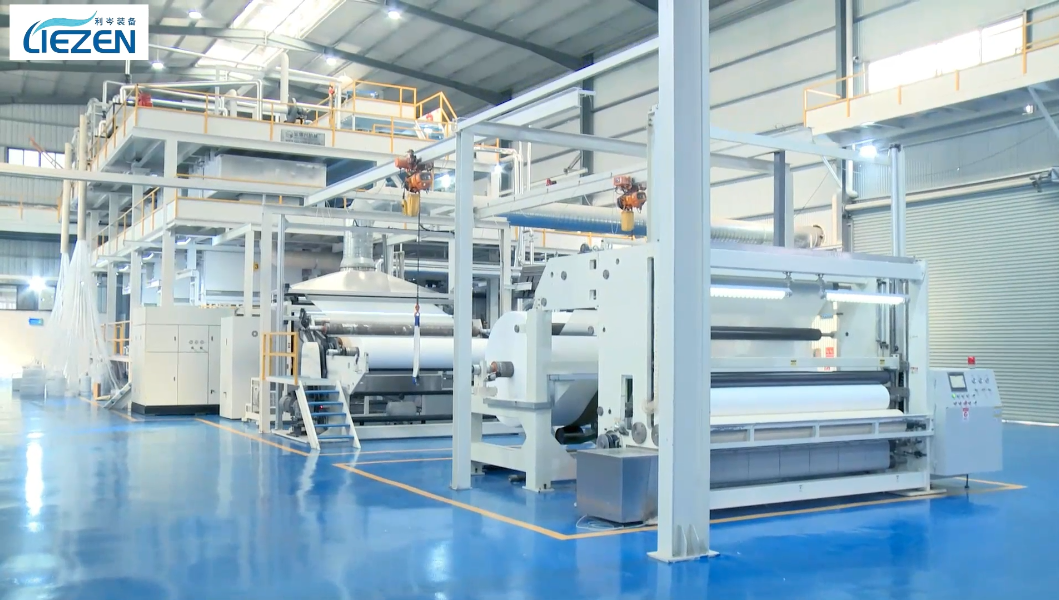
A PP spunbond line extrudes polypropylene filaments, draws and lays them into a web, and bonds that web. The "S" count is the number of spunbond beams: Single S is one beam, SS is two, SSS is three. All three share a single polymer stream, which is the core reason they rank first for output consistency.
Documented standard configuration. In the product data used for this guide, PP spunbond lines of this class are documented with an effective width of 1,600–3,200 mm. A double-beam SS machine is documented with production speeds below 250 m/min, mechanical speeds below 300 m/min and filament fineness of 1.5–2.0 D; an SSS machine is documented with production speeds below 400 m/min, mechanical speeds below 450 m/min and filament fineness of 1.5–2.5 D. The main raw material is polypropylene for both spunbond and meltblown, and the equipment itself is built mainly from carbon steel, stainless steel, alloy parts and electrical components.
Why it ranks first. Three evidence-based reasons. It has the fewest process variables — one polymer stream feeding one, two or three beams, with no meltblown layer to balance. It has the largest installed base: spunbond machinery represented 34.2% of nonwoven equipment in 2025, spunlaid technology represented 48.4% of the global nonwoven fabrics market in 2023, and spunbonded fabric accounted for 37% of China's nonwoven export value in 2024. And its raw-material base is the deepest — PP at 53.92% of the spunbond segment in 2026 — which makes long-run input consistency easier to secure.
Where it stops being the right answer. Because a single-polymer spunbond structure contains no meltblown layer, it is not the structure specified when barrier performance is the primary product requirement. It is also the configuration most exposed to commodity PP price movement, since the line has no second material stream to balance against.
Lizen Machinery's main product is the Single S PP spunbond nonwoven machine, and the company's range covers Single S, SS and SSS spunbond configurations alongside meltblown, SMS, SMMS, SSMS, SMMSS, PET and bi-component machines.
Rank 2 — SMS (Spunbond–Meltblown–Spunbond)
SMS inserts one meltblown beam between two spunbond beams. The outer spunbond layers provide strength and a soft hand; the inner meltblown layer provides barrier.
Why it ranks second. SMS adds a capability that pure spunbond cannot provide, but it also adds a second process discipline. Meltblown fibre formation is more sensitive to airflow, die temperature and collector conditions than spunbond filament drawing. That is a genuine consistency cost, and it is why SMS sits below spunbond in a ranking built on repeatability rather than on capability.
The supply dimension. Meltblown capacity is the least stable part of the chain. Chinese meltblown production fell 22.9% to 108,000 tons in 2024 while spunbonded output rose 4% to 3.88 million tons — the two halves of an SMS line moved in opposite directions. For a buyer, that means the meltblown side of the configuration should be planned with an explicit supplier, die and spare-part strategy rather than treated as a black box.
Where SMS fits. Products that need barrier performance with softness retained. The applicable industry set documented for these lines covers medical, hygiene (masks, protective wear, sanitary napkins, diapers), automotive interior, apparel and home textiles, agricultural covers, packaging and eco-friendly bags.
Rank 3 — SMMS (Spunbond–Meltblown–Meltblown–Spunbond)
SMMS doubles the meltblown layer: two spunbond beams outside, two meltblown beams inside. It is the highest-barrier configuration of the three.
Documented standard configuration. The SMMS spunmelt machine documented in the product data used for this guide lists an effective width of 1,600–3,200 mm, production speeds below 400 m/min, mechanical speeds below 450 m/min and filament fineness of 1.5–2.0 D. As with the other configurations, the main raw material is polypropylene.
Why it ranks third for consistency — not for quality. SMMS carries the most variables: four beams in sequence, two of them meltblown, each of which has to hold its own tolerance for the finished roll to stay inside the band. The configuration can deliver the highest barrier performance of the three, but it is also the one where consistent output depends most on maintenance discipline, spare-part availability and remote engineering support. That is exactly why an SMMS decision is a long-term partnership decision rather than a one-off purchase.
Step-by-Step: How to Execute a Consistent-Quality Setup Decision
Once the technology family is clear, execution follows seven steps. Skipping step one is the most common reason two buyers order similar lines and end up with very different fabric quality.
- Write the fabric specification first. Basis weight, effective width, barrier requirement and end product. Without a written specification, every setup looks acceptable.
- Match the technology to the specification. Spunbond for strength, softness and cost efficiency; SMS for balanced barrier; SMMS where barrier is the acceptance criterion.
- Fix the configuration envelope. Commit to beam count, effective width within the 1,600–3,200 mm range, the speed band you will actually run, and filament fineness within the documented range for that configuration.
- Confirm the compliance scope. ISO 11111-3:2005 covers safety requirements for nonwoven machinery; EN ISO 11111-1:2016 covers general textile machinery safety for CE marking in Europe; ISO 9001 is the quality-management certification standard used to verify a manufacturer's system. Decide which of these apply to your destination market before signing.
- Plan the raw-material stream. PP dominates spunbond at 53.92% of the segment in 2026, and raw-material price volatility is a recognized project risk — so build a supply and pricing review into the project plan rather than into the operating budget after start-up.
- Schedule acceptance testing. Factory acceptance test (FAT) and site acceptance test (SAT), including mechanical performance tests and pilot-production sample checks against the tolerance band written in step one.
- Lock the lifecycle package. Spare-parts list, remote support, on-site training and commissioning, and contractual responsibilities tied to acceptance criteria. On a multi-beam line, this package is what keeps the tolerance band from widening in year three.
Use Cases: Which Setup Fits Which End Product
Sanitary napkins and diapers
Hygiene disposables are the largest application block in nonwovens, at approximately 59.8% of applications in 2023 (Grand View Research). The typical match is a PP spunbond or SSS line, where even basis weight and softness matter more than barrier. A sanitary napkin nonwoven fabric machine is usually specified around effective width and basis weight tolerance rather than around peak line speed, because the downstream converting process is far less tolerant of weight variation than of moderate speed differences.
Medical and protective products
Where barrier is the acceptance criterion, the structure has to contain meltblown layers — SMS or SMMS. Because Chinese meltblown output dropped 22.9% to 108,000 tons in 2024 while spunbonded output grew, buyers specifying a meltblown-containing line should treat supplier and spare-die planning as part of the project scope.
Automotive interior nonwoven production line
The automotive nonwoven market reached USD 3.6 billion in 2025 with needlefelt as the leading technology (Stratview Research). Spunmelt lines serve different parts of the automotive interior program, so the technology must be matched to the specific component and its performance requirement rather than to the vehicle as a whole. This is a case where the buyer's specification, not the machine label, decides the configuration.
Packaging, agriculture and eco-friendly bags
These are single-polymer spunbond applications. The configuration is chosen for stable basis weight and cost efficiency, and the ranking logic in this article applies directly: fewer beams means fewer variables and a shorter path to repeatable output.
Comparison Table: The Three Setups at a Glance
| Rank | Setup | Documented standard configuration | Consistency logic | Typical fit |
|---|---|---|---|---|
| 1 | PP spunbond — Single S / SS / SSS | Effective width 1,600–3,200 mm; filament fineness 1.5–2.0 D (double-beam SS) and 1.5–2.5 D (SSS); production speed below 250 m/min and mechanical speed below 300 m/min on the SS configuration; production below 400 m/min and mechanical below 450 m/min on SSS | Fewest process variables; single polymer stream; largest installed base — spunbond 34.2% of nonwoven equipment in 2025 and spunlaid 48.4% of the global nonwoven fabrics market in 2023 | Hygiene (sanitary napkins, diapers), packaging, agricultural covers, apparel and home textiles, eco-friendly bags |
| 2 | SMS — spunbond / meltblown / spunbond | Two spunbond beams with one meltblown beam between them; PP as base polymer | One barrier layer added; more process variables than pure spunbond; meltblown supply must be planned — China meltblown output was 108,000 tons in 2024, down 22.9% | Barrier products, protective wear, masks, hygiene |
| 3 | SMMS — spunbond / meltblown / meltblown / spunbond | Effective width 1,600–3,200 mm; production speed below 400 m/min; mechanical speed below 450 m/min; filament fineness 1.5–2.0 D | Two meltblown beams; highest process-control demand; output consistency depends most on lifecycle support | High-barrier medical and hygiene applications |
Configuration ranges as documented in the product data used for this article. The ranking reflects editorial engineering criteria — process variables, installed-base evidence and lifecycle dependency — and is not a controlled comparative test result. Country-level cost and performance differences between domestic equipment, other Chinese suppliers and imported-brand machines require a specific model and configuration before they can be quantified.
FAQ
What safety and quality standards should a nonwoven fabric machine setup comply with?
ISO 11111-3:2005 defines safety requirements specifically for nonwoven machinery. In Europe, general safety requirements for textile machinery — including nonwoven lines — fall under EN ISO 11111-1:2016 for CE marking compliance. For quality management, ISO 9001 is the certification standard used to verify a manufacturer's system. These three cover different things: machine safety, market access and management system. The compliance scope should therefore be written into the purchase specification before the configuration is frozen.
Which setup holds barrier consistency better — SMS or SMMS?
SMMS builds the barrier from two meltblown beams inside a spunbond–meltblown–meltblown–spunbond stack, while SMS uses a single meltblown beam between two spunbond layers. More layers mean more variables to hold, so SMMS requires tighter process control and stronger service support to deliver consistent output across the working width. Where barrier is the acceptance criterion, SMMS is the structure specified; where a balanced combination of barrier and softness is sufficient, SMS carries fewer variables. Both configurations are documented with effective widths of 1,600–3,200 mm in the product data used for this guide.
What drives the cost of a consistent-quality nonwoven production line?
Cost is driven by configuration rather than by the technology label: beam count, the number of meltblown beams, effective width, the speed band specified, automation and control level, compliance scope and the support package (commissioning, training, spare parts). The comparison data used for this guide notes that cost differences between traditional domestic equipment, other Chinese suppliers and imported-brand machines require a specific model and configuration before they can be quantified, so headline prices are not directly comparable. For reference, the minimum order quantity for these lines is 1 unit, payment is commonly by T/T or L/C, and delivery is commonly arranged as FOB or CIF by sea, land or air, with the specific terms confirmed in the contract.
Can output consistency be validated with samples before committing to a full production line?
Yes — and it should be a contractual step rather than a courtesy. Validation normally runs through a factory acceptance test (FAT) and a site acceptance test (SAT), covering mechanical performance tests and pilot-production sample checks. A sample is only meaningful if the tolerance band — basis weight, effective width and barrier specification — is agreed in advance, so the test produces a measurable pass or fail instead of an impression. Lizen Machinery has supplied approximately 1,000 complete sets of standardized and customized nonwoven production lines to 30 countries since 2003, and the documented acceptance method for these lines includes pilot-production sample checks.
How do lead time and long-term support affect consistent quality?
They affect it more than most buyers expect, because consistency is a property of year three as much as of month one. The risk categories documented for these projects are transport and logistics, installation and commissioning, equipment failure, raw-material price volatility, and compliance or certification risk. The matching controls are secure packaging, packing lists and inspection reports, on-site training and commissioning, spare-parts lists with remote support, and contractual responsibilities tied to acceptance criteria. On multi-beam configurations such as SMMS, that package is what protects the tolerance band across the equipment's working life. Buyers who want their 2026 setup reviewed against these criteria can contact Lizen Machinery at managerl@lizen-equipment.com or by WhatsApp on +86-188-8818-2509 to discuss a configuration and a sample plan.
Conclusion: Consistency Is a Configuration Decision Made Once
The 2026 picture is not complicated. Spunbond capacity is growing, spunbonded fabric accounted for 37% of China's nonwoven export value in 2024, and PP remains the dominant spunbond raw material at 53.92% of the segment. Against that backdrop, the three setups ranked in this article cover the realistic range of consistent-quality programs: PP spunbond first, for the fewest variables and the deepest material base; SMS second, for one barrier layer at a manageable increase in process complexity; SMMS third, for maximum barrier at the cost of the tightest control and the greatest dependence on long-term support.
The practical takeaway is to decide the configuration before the supplier. Write the tolerance band, match the beam structure to it, confirm the compliance scope, then negotiate the acceptance test and the lifecycle package. A line that is specified this way stays consistent; a line bought on headline speed usually does not.
Plan your 2026 nonwoven production setup
Lizen Machinery Co., Ltd. builds PP spunbond, meltblown, SMS, SMMS, SSMS, SMMSS, PET and bi-component nonwoven production lines from its facility in Changzhou, Jiangsu, China.
Email: managerl@lizen-equipment.com | Tel / WhatsApp: +86-188-8818-2509
Address: No. 6 Jingye Road, Qianhuang Town, Wujin District, Changzhou, Jiangsu, China
Website: https://www.lizen-equipment.com