
FKM vs. HNBR vs. NBR: Choosing the Right Chemical-Resistant Rubber Gasket for Industrial Equipment

Rubber gasket — the sealing component at the center of the FKM / HNBR / NBR material decision.
When industrial equipment handles aggressive media — acids, solvents, fuels, or hot process fluids — the gasket material conversation usually narrows to three elastomers: FKM, HNBR, and NBR. The fastest way to start filtering them is to look at how they are classified inside the gasket range of Longrun Rubber Products (Huizhou) Co., Ltd.: FKM gaskets and HNBR gaskets both sit in the chemical-resistant gaskets category, while NBR (Buna-N) gaskets are specified for oil-resistant duty. Chemical exposure pushes the decision toward FKM or HNBR; petroleum-based oils and greases push it toward NBR; and when chemical resistance and oil resistance are both required at temperature, the outcome depends on which constraint cannot be moved.
Longrun Rubber Products (Huizhou) Co., Ltd. is a China-based manufacturer of custom rubber molded parts, established in 2005. The company operates a 10,000 m² factory with 120 employees, including a 20-engineer R&D team, and reports an export ratio of 80% across global markets. Its rubber gaskets and related sealing components are used in automotive, industrial, machinery, energy, medical, food, and electrical applications.
This guide is written for industrial equipment buyers and engineers working in the research and evaluation stage. It sets out a decision framework for FKM vs. HNBR vs. NBR gasket selection, focused on the constraint layer that usually determines the result: media compatibility, thermal duty, compliance standards such as ASTM D2000 and FDA 21 CFR 177.2600, customization of hardness, dimensions and color, and the supplier verification steps that keep a correct material choice from failing at production.
Why Gasket Material Selection Goes Wrong on Industrial Equipment
A gasket rarely fails because the shape was wrong. It fails because the compound was matched to the wrong constraint. Three constraint sets overlap on every industrial sealing application, and a material chosen against only one of them will eventually leak.
Chemical constraint. The sealing media list — not a single fluid — defines which elastomer family is viable. A gasket performing well in a water or air line may swell, harden, or crack when the same equipment is used with a solvent, an acid, or a blended process fluid. Continuous exposure and intermittent splash contact are different duty cases and should be specified separately.
Thermal constraint. Sealing performance is a function of continuous service temperature, peak temperature, and the number of thermal cycles. A material acceptable at a stable operating condition can behave differently in equipment that starts and stops, because thermal cycling works the seal mechanically as well as chemically.
Compliance and mechanical constraint. Food-contact equipment, medical devices, and automotive assemblies each carry their own documentation expectations, and flange or high-pressure joints add compression and extrusion requirements on top of material compatibility. Because FKM, HNBR, and NBR gaskets can all be custom-molded with specified hardness, dimensions, color, and physical properties, a gasket that meets the dimensional drawing can still fail the application. The material decision, not the part drawing, is where most selection risk sits.
Industry Background: Demand, Standards, and Sourcing Reality
Industrial rubber products remain a large and expanding category. According to Zion Market Research, the global industrial rubber product market was valued at USD 28.28 billion in 2024 and is projected to reach USD 45.19 billion by 2034. Published estimates for this category diverge noticeably between research houses, largely because some studies include tire products and others exclude them, so any single figure is best treated as a planning reference rather than a precise measure.
Sourcing patterns matter as much as demand. China exports approximately EUR 4.01 billion in rubber products to the European Union annually, which is one reason elastomer sealing components are frequently evaluated as part of a multi-region supply strategy rather than a single-country purchase.
Three published standards do most of the work in turning a gasket requirement into a verifiable specification:
- ASTM D2000 — the primary classification system for rubber products in automotive and industrial applications. It is the reference buyers use when a material callout has to be documented rather than described.
- ISO 3302-1 — dimensional tolerances for molded, extruded, and calendered rubber products. It defines what "the right size" actually means for a molded gasket.
- FDA 21 CFR 177.2600 — the requirement set for rubber articles intended for repeated use in food-contact applications.
Referencing these standards in an RFQ changes the nature of the conversation: suppliers respond with compounds and test positions rather than general material names.
The Three Materials Behind Chemical-Resistant and Oil-Resistant Gaskets
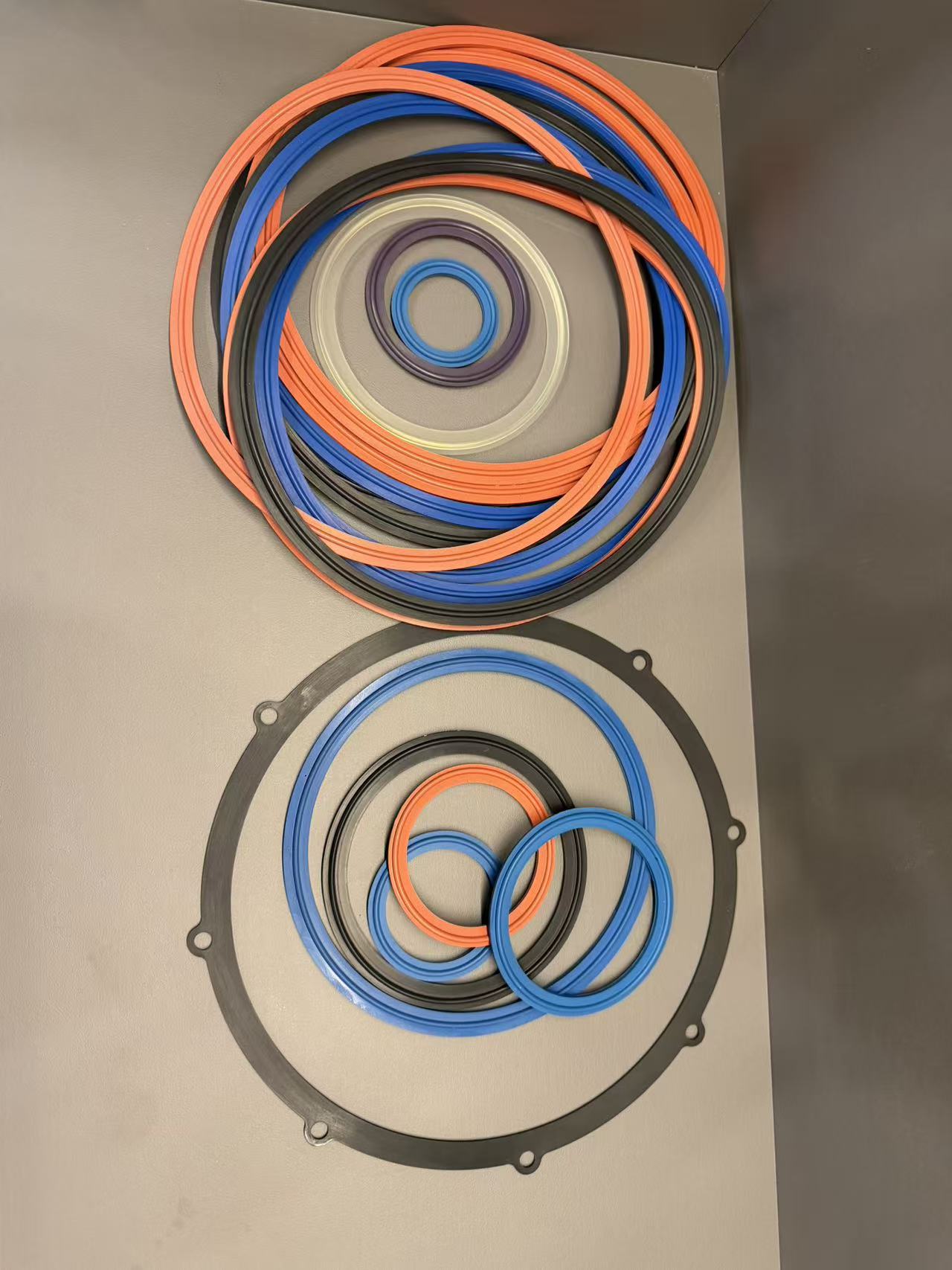
A molded rubber gasket: shape is customized, but sealing performance is determined by the elastomer compound.
FKM gaskets: chemical-resistant sealing where temperature is also demanding
FKM gaskets are classified as chemical-resistant gaskets. In practice they are specified where chemically aggressive media and elevated service temperature occur in the same joint, which is the combination that limits most general-purpose elastomers. FKM is a specialty fluoroelastomer and generally sits in a higher material cost band than general-purpose nitrile compounds, so it is normally reserved for service conditions that actually require it rather than applied as a default.
The practical limit of any FKM recommendation is media specificity. FKM is not a universal chemical barrier; performance varies by fluid family and by the specific compound within the family. The correct approach is to submit the actual media list for confirmation against the proposed compound before the specification is frozen.
HNBR gaskets: balancing heat resistance with oil resistance
HNBR gaskets are also classified as chemical-resistant gaskets. They are generally chosen when a single compound has to satisfy heat exposure and oil exposure at the same time — a common situation in automotive and machinery assemblies where petroleum-based lubricants and elevated operating temperatures coexist.
For buyers in the automotive supply chain, HNBR is frequently evaluated together with documentation requirements rather than in isolation. Longrun Rubber Products holds IATF 16949:2016 certification (certificate number 0601909, issued by BSI, applicable to the global market) for the manufacturing of rubber and silicone seals, which is the certification framework automotive customers typically ask to see before a material is approved.
NBR (Buna-N) gaskets: oil-resistant duty and general industrial sealing
NBR gaskets are positioned in the oil-resistant gaskets category. They are the standard selection where the sealing task is primarily about petroleum-based oils, greases, and similar hydrocarbon media in machinery, automotive, and general industrial equipment, at service conditions that do not require a specialty fluoroelastomer.
The boundary matters as much as the benefit. Where the media list moves toward aggressive solvents, strong acids, or high-temperature chemical service, NBR is no longer the natural starting point and the evaluation should shift to the chemical-resistant group. Where the media is largely aqueous or the application involves outdoor weathering, other compounds in the same range, such as EPDM, may be the better starting position.
Customization: hardness, dimensions, color, and physical properties
All three materials are available as custom-made gaskets, which means the compound selection and the part geometry are specified separately. Customization covers hardness, dimensions, color, and physical properties. The wider material menu behind the gasket range includes EPDM, NBR / Buna-N, NR, CR / Neoprene, FKM / Viton, SBR, HNBR, and silicone rubber (SiR / VMQ), including medical grade silicone rubber.
The gasket range itself is organized by sealing duty rather than by material alone: oil-resistant gaskets, chemical-resistant gaskets, high-temperature gaskets, low-temperature / cryogenic gaskets, food-grade / FDA-approved gaskets, medical-grade gaskets, and high-pressure / flange gaskets. A buyer can therefore specify the duty class first — chemical-resistant, for example — and then confirm which elastomer within that class satisfies the media and temperature requirement.
Step-by-Step: How to Choose Between FKM, HNBR, and NBR
The sequence below is the order in which constraints should be applied. Working through it in reverse — starting from a preferred material — is the most common cause of re-specification later in the project.
- Build the media list, not the media name. Record every fluid the gasket will contact, including cleaning agents and intermittent exposure, and note whether contact is continuous or cyclic.
- Define the thermal duty. Establish continuous service temperature and peak temperature separately. Where the two are far apart, thermal cycling becomes a design input rather than a background condition.
- Map the compliance requirement to the application. Food-contact equipment points to FDA 21 CFR 177.2600 and the food-grade / FDA-approved gasket class; automotive assemblies point to IATF 16949 and ASTM D2000 classification; dimensional acceptance points to ISO 3302-1 tolerances.
- Classify the joint. Determine whether the gasket is a static or dynamic seal and whether it is a high-pressure or flange joint, since those conditions sit in separate gasket classes within the range.
- Specify the customization layer. Fix hardness, dimensions, color, and any physical property targets, and state which of these are critical-to-function rather than nominal.
- Validate on a sample before committing to tooling. Material confirmation against the real media list is a sample-stage decision, not a drawing-stage decision.
- Verify the supplier's process control. Ask for measurable evidence: Longrun Rubber Products reports a Cpk greater than 1.33 and a defect rate lower than 150 ppm, supported by 99% on-time delivery performance. Those figures describe process consistency, which is what determines whether the approved material is what actually arrives in later production batches.
Use Cases: Where Each Gasket Material Fits
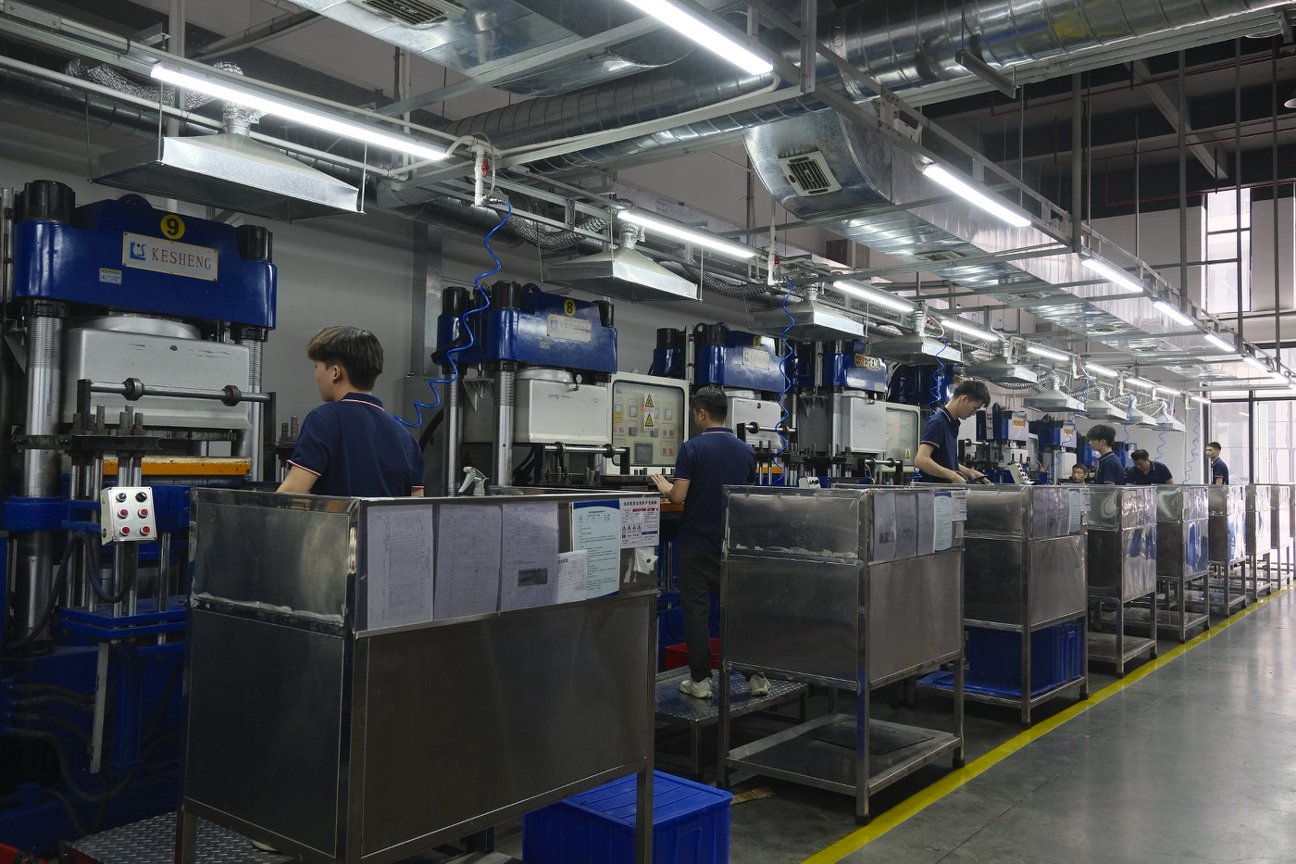
Rubber molding workshop: compound selection is fixed at the molding stage, so it must be decided before production.
Automotive and machinery assemblies
Automotive and machinery applications typically combine oil contact with heat and vibration, which is the condition set HNBR is chosen for. Where the same equipment also carries fuel or aggressive fluid exposure, FKM becomes the candidate. Sealing and leakage prevention, shock absorption, and protection of transmission components are the recurring functions in these assemblies. Longrun Rubber Products holds IATF 16949:2016 certification (certificate number 0601909, issued by BSI) alongside ISO 9001:2015 certification (certificate number FM 840583, also issued by BSI); both apply to the global market and cover the manufacturing of rubber and silicone seals.
Food, medical, and sanitary equipment
Food and medical applications add a compliance layer on top of the material decision, because the gasket touches the product or the process stream. A documented example from Longrun Rubber Products is a US-based customer in the food, medical, machinery, and sanitary segment running 3000k units per year over a five-year program. The verified results for that program include tensile strength ≥ 8 MPa, elongation at break ≥ 450%, and tear strength ≥ 35 kN/m, with Cpk greater than 1.33, a defect rate below 150 ppm, precise dimensions, and a long service lifespan. Applications covered vibration and noise reduction, cushioning and protection, dustproof and waterproof protection, and resistance to heat and chemicals — which is why food-grade and medical-grade gasket classes exist alongside the FKM, HNBR, and NBR chemical/oil groups.
Industrial and energy equipment
Process equipment, pumps, and energy installations are the clearest application for chemical-resistant gaskets, because the media list is usually documented by the plant. Working conditions in these environments commonly include high temperature, low temperature, high pressure, vibration, chemical exposure, and a combination of these over the equipment lifecycle. Here the FKM versus HNBR decision is usually settled by the temperature at which the chemical exposure occurs, and NBR is retained only for the oil-side sealing points of the same plant.
Comparison Table: FKM vs. HNBR vs. NBR Gaskets
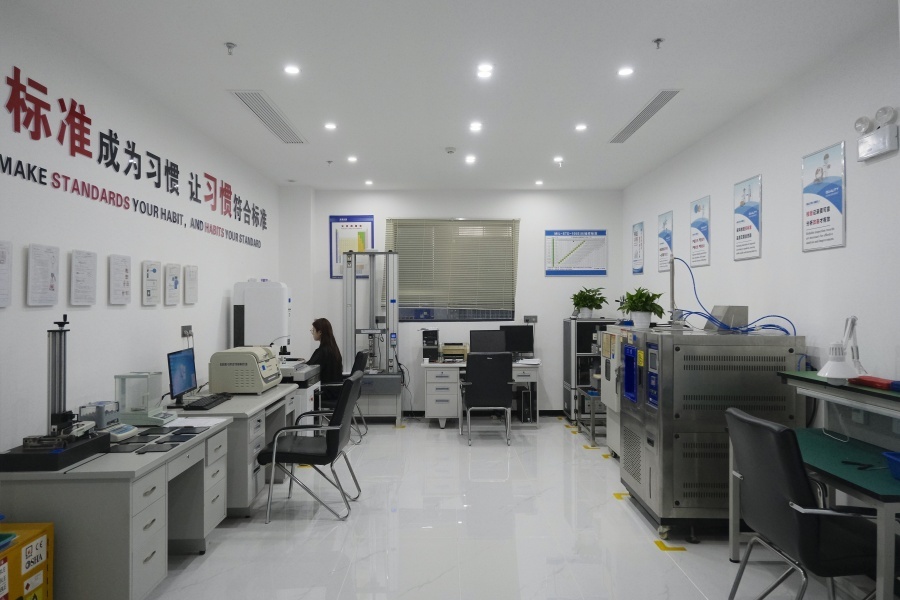
Inspection room: material class and dimensional tolerance are verified against specification before shipment.
| Selection criterion | FKM gasket | HNBR gasket | NBR (Buna-N) gasket |
|---|---|---|---|
| Product classification in the gasket range | Chemical-resistant gaskets | Chemical-resistant gaskets | Oil-resistant gaskets |
| Primary resistance focus | Aggressive chemicals combined with elevated service temperature | Heat exposure and oil exposure in the same compound | Petroleum-based oils, greases, and similar hydrocarbon media |
| Typical equipment context | Process and chemical-handling equipment | Automotive and machinery assemblies | General machinery and industrial equipment |
| Commercial consideration | Specialty fluoroelastomer; normally reserved for conditions that require it | Selected where heat and oil resistance must both be documented | General-purpose starting point for oil-side sealing |
| Customization available | Hardness, dimensions, color, physical properties | Hardness, dimensions, color, physical properties | Hardness, dimensions, color, physical properties |
| Applicable industries | Automotive / Industrial / Machinery / Energy / Medical / Food / Electrical | Automotive / Industrial / Machinery / Energy / Medical / Food / Electrical | Automotive / Industrial / Machinery / Energy / Medical / Food / Electrical |
| Standards that apply to specification | ASTM D2000 classification; ISO 3302-1 tolerances; FDA 21 CFR 177.2600 where food contact applies | ASTM D2000 classification; ISO 3302-1 tolerances; FDA 21 CFR 177.2600 where food contact applies | ASTM D2000 classification; ISO 3302-1 tolerances; FDA 21 CFR 177.2600 where food contact applies |
Material classification and customization data are stated as published in the Longrun Rubber Products gasket range. Compliance references identify the standards that govern the specification; the specific compound must still be confirmed against the actual media list.
FAQ: FKM, HNBR, and NBR Gasket Selection Questions
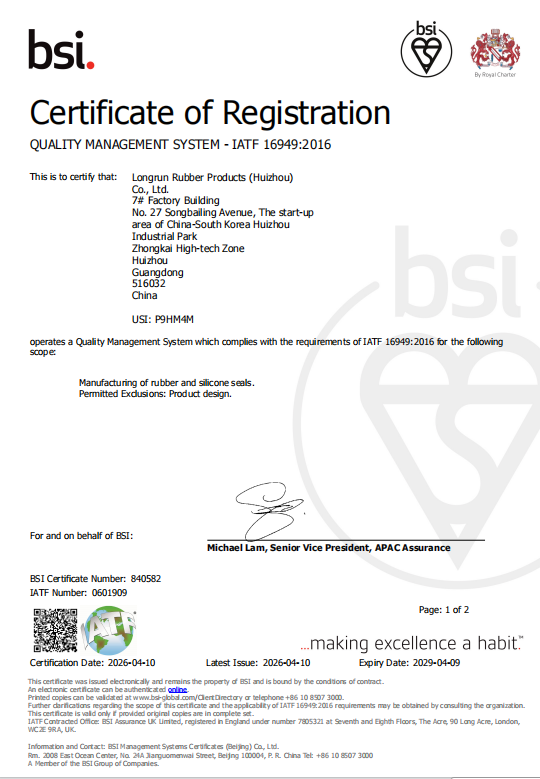
IATF 16949:2016 certificate 0601909, issued by BSI, covering the manufacturing of rubber and silicone seals.
Are FKM, HNBR, and NBR gaskets supported by recognized certifications?
Longrun Rubber Products holds ISO 9001:2015 certification (certificate number FM 840583) and IATF 16949:2016 certification (certificate number 0601909), both issued by BSI for the manufacturing of rubber and silicone seals and both applicable to the global market. In addition, the specification framework for these gaskets draws on ASTM D2000 for rubber product classification in automotive and industrial applications, ISO 3302-1 for dimensional tolerances of molded rubber products, and FDA 21 CFR 177.2600 for rubber articles intended for repeated use in food-contact applications. The IATF 16949:2016 and ISO 9001:2015 certificates were issued on 2026-04-10 and are valid through 2029-04-09.
Can FKM, HNBR, and NBR gaskets be custom-made?
Yes. All three are available as custom-made gaskets with specified hardness, dimensions, color, and physical properties, under an OEM production model for custom rubber molded parts. The wider material menu available for these components also includes EPDM, NBR / Buna-N, NR, CR / Neoprene, FKM / Viton, SBR, HNBR, and silicone rubber (SiR / VMQ), including medical grade silicone rubber. Customization is supported by a 20-engineer R&D team, and the gasket range is organized into oil-resistant, chemical-resistant, high-temperature, low-temperature / cryogenic, food-grade / FDA-approved, medical-grade, and high-pressure / flange classes.
What drives the cost difference between FKM, HNBR, and NBR gaskets?
The main cost driver is the elastomer class itself. FKM is a specialty fluoroelastomer and generally carries a higher material cost band than general-purpose nitrile compounds, which is why it is normally specified only where the chemical and temperature duty justifies it. HNBR sits between the two positions in commercial terms, chosen when a single compound must handle both heat and oil exposure. Beyond material, the customization layer — hardness, dimensions, color, and physical property targets — together with tooling and validation requirements, shapes the total program cost. Because MOQ and monthly capacity are set according to customer requirements, the commercially efficient answer is usually to define the media and temperature constraints precisely first, so the cheapest material that genuinely meets the duty can be identified.
How can a gasket material be validated before full production?
Validation belongs at the sample stage, before tooling and volume commitments. The material should be confirmed against the actual media list rather than a general fluid category, and dimensional requirements should be checked against the tolerance framework the application expects, such as ISO 3302-1. Longrun Rubber Products applies 100% testing as its quality control position and reports a Cpk greater than 1.33 with a defect rate below 150 ppm, which are the indicators that the validated sample and the production batch will behave the same way.
What lead time should buyers expect for custom gaskets?
Longrun Rubber Products quotes a lead time of 20 days, with monthly capacity and MOQ according to customer requirements. Support after delivery covers warranty and returns together with technical assistance, which matters on chemical-resistant gasket programs because media conditions sometimes need to be re-checked after the first production run. To start an evaluation, you can request a sample or a quotation, or download the company brochure for the full product and capability overview.
Conclusion: A Decision Rule You Can Apply Immediately
The FKM versus HNBR versus NBR decision is not a question of which elastomer is superior — it is a question of which constraint dominates the joint. If the media is petroleum-based oil or grease at moderate service conditions, NBR gaskets in the oil-resistant class are the natural starting point. If heat and oil exposure must be satisfied by one compound, HNBR gaskets in the chemical-resistant class are the working candidate. If aggressive chemistry and elevated temperature occur together, FKM gaskets are the candidate to evaluate, with the specific compound confirmed against the media list.
Two practices separate a smooth gasket program from an expensive one. First, specify the media list, thermal duty, and compliance standard before discussing material names — ASTM D2000, ISO 3302-1, and FDA 21 CFR 177.2600 give the specification a verifiable form. Second, verify supplier process control with measurable evidence, not with claims: Longrun Rubber Products reports Cpk greater than 1.33, a defect rate below 150 ppm, and 99% on-time delivery, backed by ISO 9001:2015 (FM 840583) and IATF 16949:2016 (0601909) certifications issued by BSI.
Next step: confirm your gasket material against your real media list
Longrun Rubber Products (Huizhou) Co., Ltd. manufactures custom rubber molded gaskets, seals, O-rings, washers, grommets, and dampers for automotive, industrial, machinery, energy, medical, food, and electrical applications. Send your media list, temperature conditions, and dimensional requirements to receive a material recommendation and quotation.
Email: tommyliu@longrunrubber.com / hang@longrunrubber.com
Tel / WhatsApp: +86 13006697998
Website: https://www.longrunrubber.com/
Download the brochure: Longrun Rubber Products company brochure (PDF)
Have Questions or Need More Details?
Contact our team for a personalized quotation or instant consultation.
Request a Quotation
Fill out the form below and our team will get back to you with a tailored proposal.
WhatsApp Direct Chat
Prefer to chat in real-time? Message us on WhatsApp for instant assistance & quick answers.
- Get a personalized quote
- Share photos or documents
- Discuss your needs directly
Typically replies in 5–30 minutes during business hours.