
How to Read Truck Trailer Specs: Deck Height, Axle Load, Tank Volume, GVW

Deck length and deck height are fixed when the frame is welded. They cannot be corrected after the purchase order. Photo: Luen Auto export yard.
A semi trailer is chosen by four numbers, not by a photograph: deck height, axle load, tank volume and GVW. Read them in the wrong order and the trailer arrives legal on paper but unusable at the loading site. This guide decodes the parameter ranges used across the main semi-trailer families — flatbed, lowboy, liquid tank, powder tank, CNG tube and container chassis — so a specification is matched to the load before a purchase order is issued.
Two buyers can request “a 40-ton trailer” and receive two completely different machines. One will be a lowboy with a loaded deck height near 500 mm and a payload envelope built for a single indivisible load; the other will be a tank unit whose 40-ton figure is a GVW ceiling, not a cargo allowance. The word “ton” hides which number is being described. Decoding the specification means separating those numbers and checking them against the cargo, the route and the destination market.
Why catalogue photos mislead at the parameter stage
Most sourcing errors on trailers are not price errors. They are envelope errors: the unit is correct in dimension on one axis and wrong on another, and the mismatch only becomes visible at the weighbridge, at the port gate or under a bridge.
Every trailer carries three envelopes at once. The legal envelope is set by regulation — permissible gross mass, axle loads and overall dimensions in the destination market. The physical envelope is set by the build — deck length, deck height, tank volume, tube count. The operational envelope is set by the site — how the cargo is loaded, how high the loader can reach, whether the discharge point is above or below the tank. A catalogue photo shows the third one, and shows it badly.
Trade data does not solve the problem either. Tank semi trailers are classified under HS 8716.31, while flatbed, lowboy, skeleton, van and tipper semi trailers all fall under HS 8716.39. Because five distinct families share one customs subheading, import statistics cannot separate a lowboy from a flatbed. Product-level demand and product-level specification have to be read from datasheets and supplier declarations, not from trade aggregates.
The core numbers and what each one actually controls
- GVW (gross vehicle weight) — the maximum combined mass of the trailer plus its load. GVW is a ceiling, not a capability. It tells you the total the running gear and structure are rated for, and nothing about how much cargo you can add.
- Payload — the cargo mass the trailer can carry. Payload equals GVW minus tare, which is why a trailer with impressive payload and a modest GVW is telling you something about its tare weight.
- Axle load — the mass carried by each axle or axle group. This is the number enforcement physically measures, and the number that regulation limits directly.
- Deck height — the vertical distance from ground level to the top of the load deck, measured loaded or unladen depending on the build. Deck height decides the loading angle, the centre of gravity and how much vertical cargo space remains under a height limit.
- Tank volume and working pressure — two additional numbers that exist only on tank families. Volume sets how much product fits; working pressure sets whether the product can be discharged at the required rate and height.
The ranges quoted in this guide describe the specification envelope of a Chinese export manufacturer such as Luen Auto. Shandong Luen Auto Co., Ltd. is a trailer and commercial vehicle manufacturer based in Xuji Industrial Park, Liangshan County, Jining City, Shandong Province, China, producing lowbed, flatbed, dump, skeleton, van, fuel tank, dust tank and CNG tank semi trailers alongside tractor trucks and dump trucks, and exporting to Africa, South America and the Middle East.
Flatbed semi trailer: the length envelope and the deck height range
A flatbed semi trailer is defined first by two figures: deck length and deck height. The standard build runs 13,000 mm, with extendable versions reaching up to 16,000 mm. Deck height sits in the 1,250–1,550 mm band, and the position inside that band is decided by suspension type, tyre size, frame depth and goose-neck geometry.
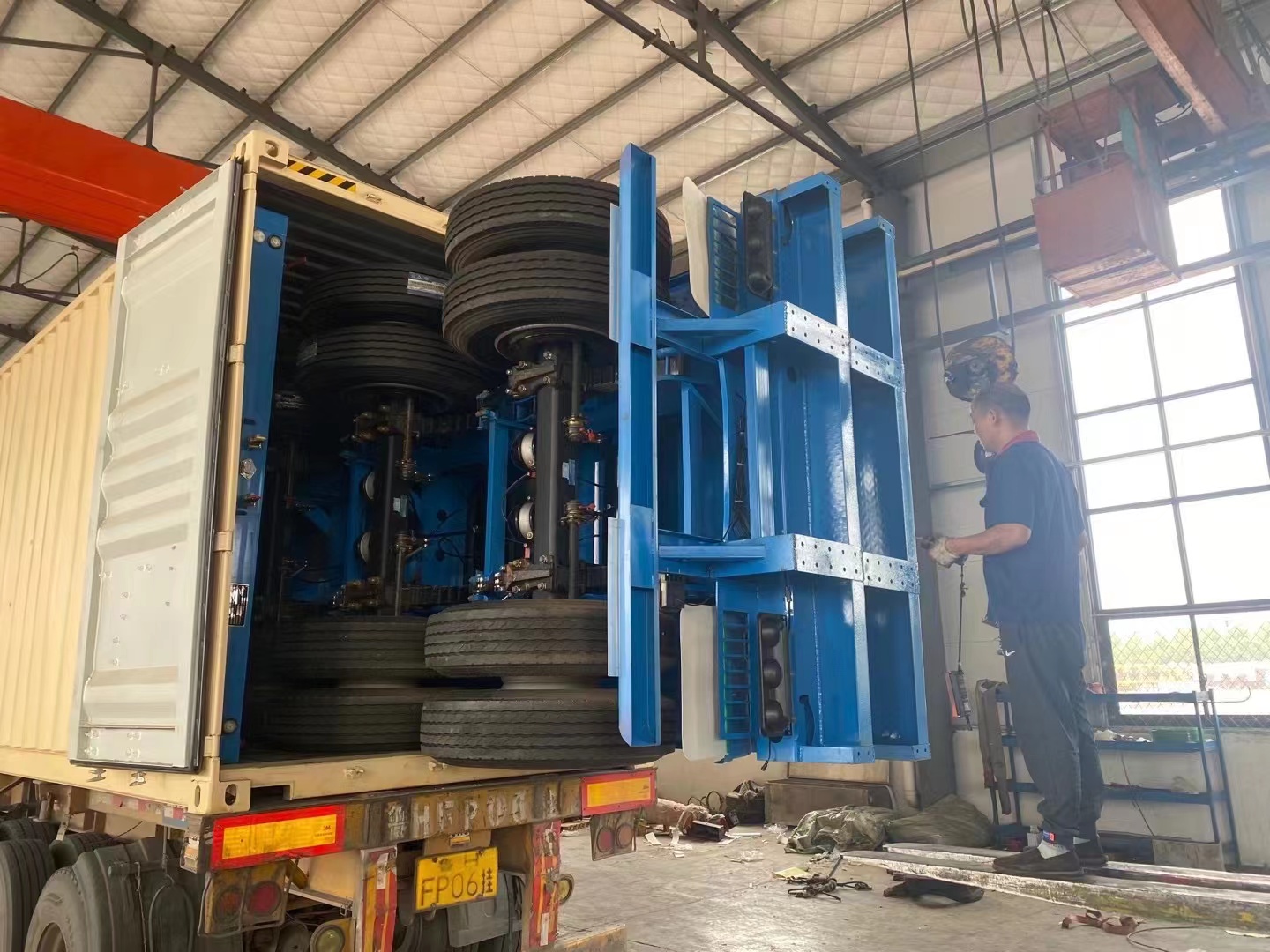
Length and deck height are the two figures to confirm in writing before a flatbed frame is built.
The two numbers trade against each other. A longer deck spreads the same cargo over more length, which lowers the load per metre but raises the bending moment and usually forces an additional axle to stay inside axle load limits. A lower deck height reduces the ramp angle and the centre of gravity, which makes tall cargo easier to load, but it also reduces suspension travel and ground clearance, and that matters on unpaved site roads.
Selection rule: set the deck length from the longest item that must sit fully supported, then set the deck height from the loading equipment available on site. If an extendable flatbed is chosen for the 16,000 mm envelope, confirm that the extension is rated for the load it will carry in the extended position, not only in the closed position.
Lowboy semi trailer: how a low deck converts into heavy-haul capacity
A lowboy semi trailer carries a payload of 40–100 t with a loaded deck height of 450–600 mm. The comparison with a flatbed is the whole argument: flatbed deck height runs 1,250–1,550 mm, so a lowboy recovers roughly 650–1,100 mm of vertical space.
That recovered height is what makes a lowboy a heavy-haul tool rather than a heavy-duty flatbed. Tall, indivisible cargo — an excavator, a transformer, a section of plant equipment — often exceeds the legal height limit when loaded on a flatbed deck and fits within it on a low deck. The centre of gravity also drops by the same amount, which changes stability on curves and gradients.
The cost of that geometry is structural. The low section is a fabricated well, so the deck length available at the low height is shorter than the trailer's overall length, and loading normally requires ramps or a detachable gooseneck. The 40–100 t payload band spans light three-axle builds and heavy multi-axle configurations; the upper end of the range is reached with additional axle lines, not with thicker plate alone.
Liquid tank semi trailer: payload lives inside a fixed GVW
A liquid tank semi trailer typically delivers a payload of 28,000–35,000 kg inside a GVW of 40,000–42,000 kg. The difference between the two figures is the tare budget, which in this family falls roughly between 5,000 and 14,000 kg depending on shell thickness, compartment count, baffles, insulation and running gear.
This is where the “40-ton trailer” confusion does the most damage. A buyer who reads 40,000–42,000 kg as a cargo allowance over-orders by the tare weight of the unit and runs legally overloaded from the first delivery. The correct reading is: GVW is fixed by the vehicle envelope, tare is fixed by the build, and payload is whatever remains.
Compartment count and baffle arrangement belong in the same specification conversation, because they change tare and they change what the trailer can deliver in one drop. For tank units used in European dangerous-goods transport, construction and approval follow the ADR agreement, which sets tank and vehicle requirements independently of the payload figure on the datasheet.
Powder tank semi trailer: volume and working pressure
Dry bulk tank semi trailers are specified by volume first: 32, 40, 45, 50 and 60 m³ are the standard sizes, each paired with a working pressure that governs discharge.
Volume and payload are not interchangeable in this family, and treating them as such is a common error. The same 40 m³ tank carries a different mass depending on the bulk density of the product, and the legal limit is still GVW. Volume should therefore be chosen from the product and the delivery pattern, then checked back against the mass ceiling.
Working pressure decides how far and how high the product can be pushed at the discharge point. A site that discharges into a silo at height, or over a long horizontal run, needs more pressure than a site discharging into a ground-level hopper. Working pressure, aeration arrangement and discharge line size should be confirmed together with the volume, because a tank sized correctly for volume but under-specified for pressure will fail at the point of use rather than at the factory gate.
CNG tube trailer: pressure, capacity in Nm³, and tube count
A CNG tube trailer is specified by working pressure, gas capacity and tube configuration. Working pressure runs 20–25 MPa, capacity runs 2,000–6,000 Nm³, and standard configurations use 8, 10, 12 or 20 tubes.
The commercial number is Nm³, not water volume. Normal cubic metres describe the gas actually delivered, so two trailers of similar physical size can carry markedly different gas quantities if their working pressures differ. Buyers who compare only the number of tubes are comparing containers, not contents.
Tube count then becomes a practical trade-off. More tubes raise capacity but also raise tare, axle count and the physical length of the unit; fewer, larger tubes suit sites with restricted access or tighter turning requirements. A CNG tube trailer is pressure equipment as well as a road vehicle, so two approval routes apply — the pressure side and the vehicle side — and the destination market determines both.
Container chassis: payload band, ISO compatibility and twist locks
A skeleton or container chassis semi trailer carries 30–65 t of payload and is built for 20ft, 40ft and 45ft ISO containers. The structural baseline is Q345B steel with ISO twist locks at the corner positions.
Two interface standards do the work here. ISO 668 fixes the external dimensions of series freight containers, and ISO 1161 fixes the corner fitting geometry that the twist lock engages. A chassis that is dimensionally correct but uses non-conforming twist locks will not secure a container safely, and the failure appears as movement in transit rather than as an obvious defect.
The 30–65 t payload band maps to container size and axle count. A 20ft chassis concentrates the same container mass into a shorter footprint, which raises the load per axle line and usually drives the axle configuration; a 45ft chassis spreads a similar payload over a longer frame. Lock spacing must match the container sizes the fleet actually moves, because a chassis set up for 40ft only will not accept a 20ft box without repositioning the locks.
Material selection: Q345B, Q550 and 5083 aluminium
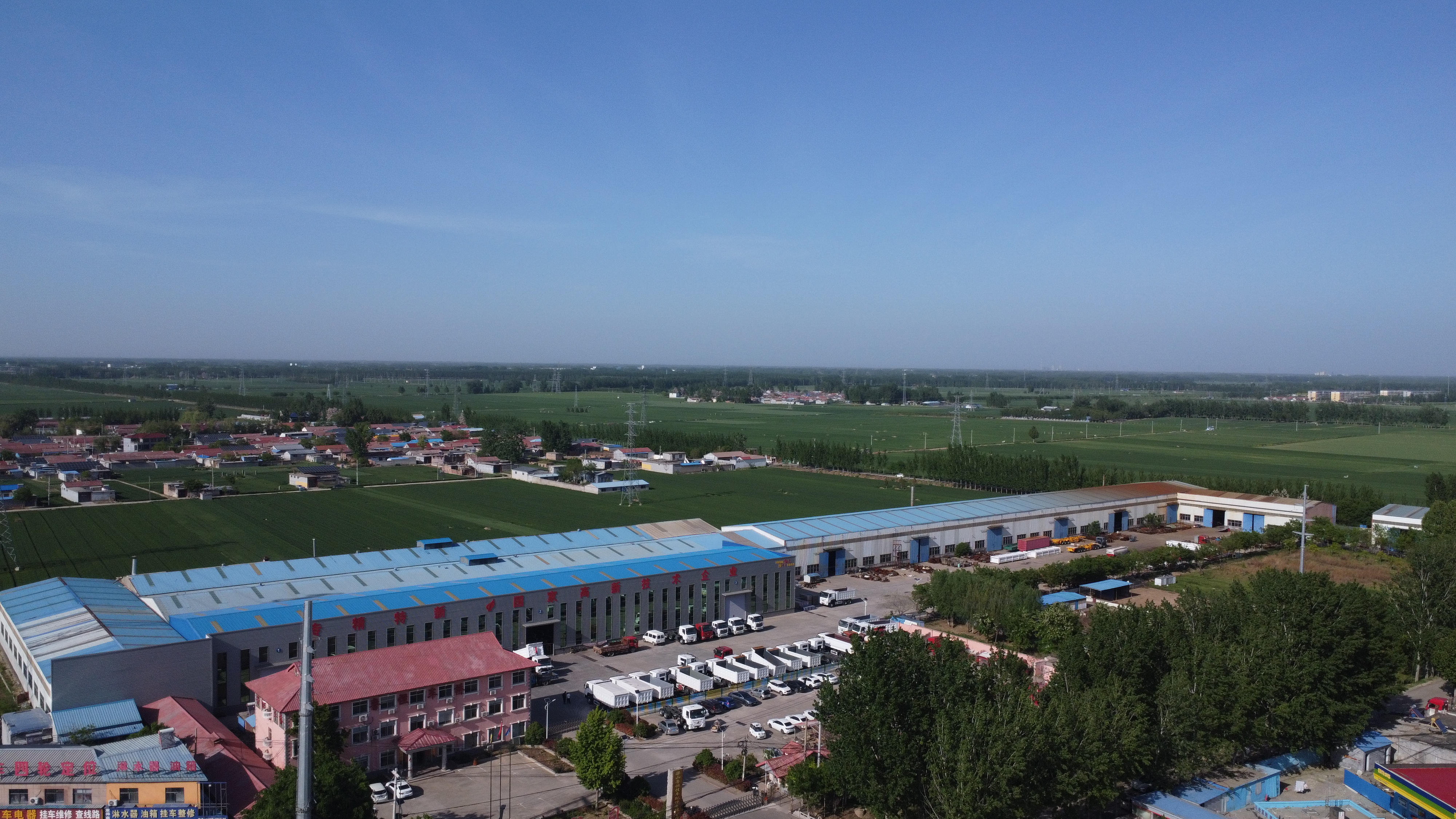
Frame and chassis fabrication at the Luen Auto 50,000 m² factory in Liangshan County, Shandong Province.
Material grade is a specification decision, not a marketing line, because it changes tare, repairability and first cost at the same time.
- Q345B carbon steel — the baseline for chassis, frames and many tank applications. It is widely weldable, repairable in almost any workshop, and predictable in service. It is also the heaviest of the three for a given strength requirement.
- Q550 high-tensile steel — higher strength allows thinner sections and therefore lower tare for the same load case. The trade is process control: welding parameters must be followed, and field repair by a workshop unfamiliar with the grade is riskier than with Q345B.
- 5083 aluminium — lightweight and corrosion resistant, which makes it relevant where payload per trip is the binding constraint or where the product is aggressive. First cost is higher and repair requires specialist capability.
Decision rule: choose the grade that relieves the constraint you actually have. If payload per trip is limited by GVW, weight reduction pays back. If the operating environment is corrosive, corrosion resistance pays back. If the fleet operates far from specialist repair capacity, the repairability of Q345B is worth more than the tare saving.
Axle load: why 2, 3 or 4 axles is a legal answer, not a preference
Axle count is dictated by axle load limits, and axle load limits are set by the destination market. China's GB 1589-2016 sets limits for the overall dimensions, axle loads and masses of motor vehicles, trailers and vehicle combinations. Regulation (EU) No 1230/2012 lays down type-approval requirements on masses and dimensions at EU level. These are separate legal regimes with separate envelopes, so a trailer optimised for one market is not automatically compliant in another.
That is why the same deck length can need three axles in one market and four in another, and why a specification copied from a domestic datasheet into an export order frequently fails at the first registration.
Braking hardware adds a second layer. UN Regulation No. 13 covers the approval of category O trailers with regard to braking in UNECE type-approval markets; FMVSS No. 121 defines braking performance for air-braked trailers entering the United States, and FMVSS No. 224 requires rear impact protection above a defined gross vehicle weight rating. Each of these adds components that change tare and deck layout, and each must be settled before the frame is designed.
Step-by-step: running a specification check before you quote
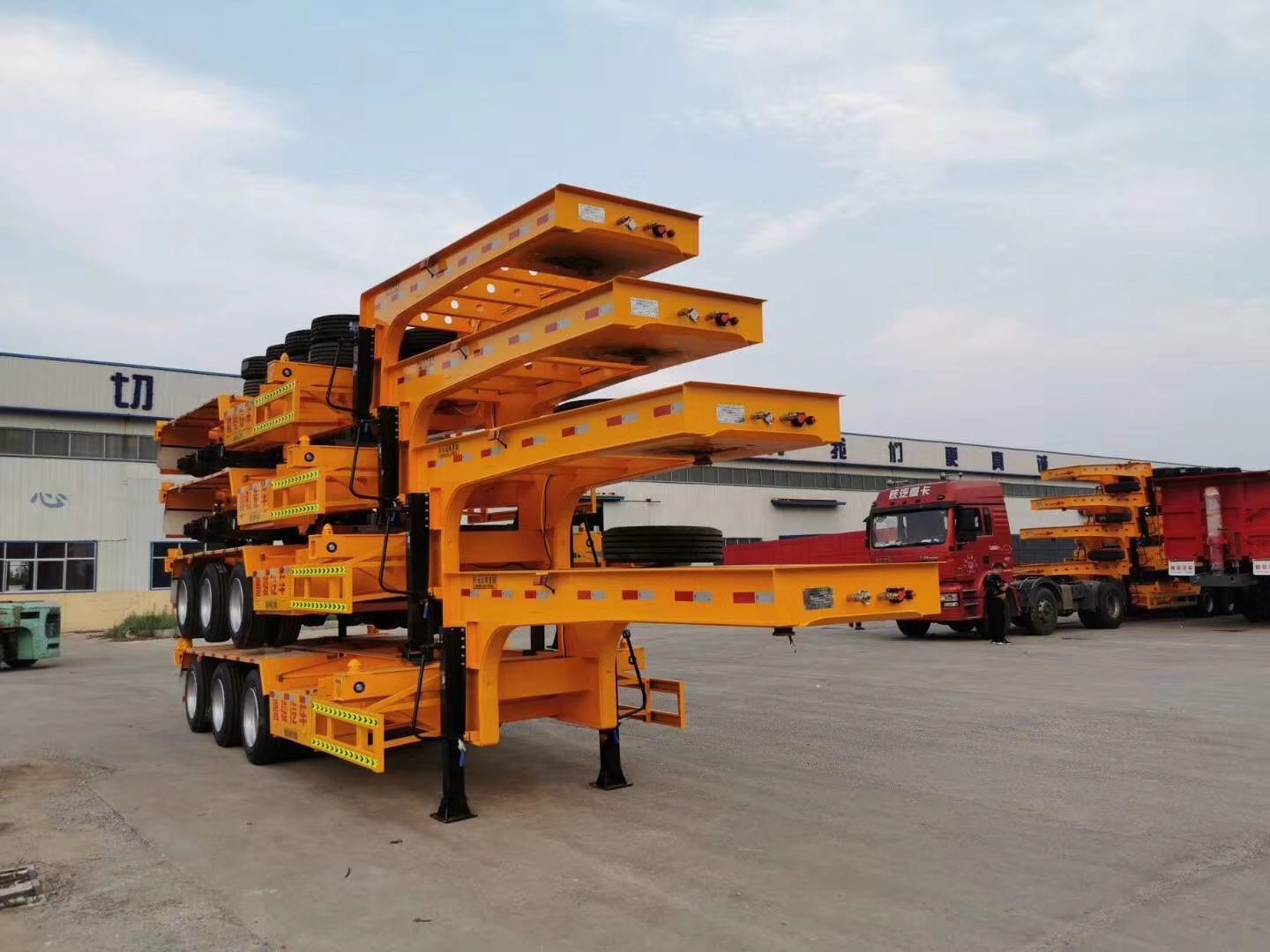
A written parameter sheet, not a photograph, is what a purchase order should reference.
- Write down the cargo, not the product category. Mass, length, width, height, centre of gravity and the loading method. If any of these is unknown, the specification cannot be closed.
- Fix the destination market. Identify which mass, dimension and braking regime applies. This single step decides the legal envelope for everything that follows.
- Convert cargo mass into a required payload with margin. Do not start from a headline payload figure on a datasheet.
- Choose the family that provides the vertical or volumetric envelope. Lowboy if height is the binding constraint; flatbed if length is; tank if the cargo is liquid, powder or gas; chassis if it is an ISO container.
- Set the axle count from axle load limits. Confirm the number against the market regime in step two, not against habit or against the previous order.
- Check tare against GVW. Payload = GVW − tare. If the resulting payload is below the cargo mass, the answer is a different build, not a heavier load.
- For tanks, convert volume or pressure into discharge performance. Confirm the discharge point height, run length and required rate before fixing volume, working pressure or tube count.
- Confirm the material grade against the constraint you are relieving. Tare, corrosion or repair logistics — pick one as the driver.
- Request the numbers in writing. A specification sheet listing deck length, deck height, payload, GVW, axle count, tyre size, suspension type and steel grade is the document the purchase order should reference.
Use cases: matching a number set to a load
- Mining and quarry plant moves. Lowboy semi trailer at 40–100 t payload with a loaded deck height of 450–600 mm, selected for tall indivisible equipment that will not clear a height limit on a flatbed deck.
- Port and container yard haulage. Container chassis at 30–65 t payload with 20ft/40ft/45ft ISO compatibility, Q345B steel and ISO twist locks matching the container mix actually handled.
- Cement and dry bulk distribution. Powder tank semi trailer at 32, 40, 45, 50 or 60 m³, with working pressure set by the discharge height and line length at the receiving site.
- Fuel and chemical distribution. Liquid tank semi trailer at 28,000–35,000 kg payload inside a 40,000–42,000 kg GVW envelope, with ADR construction requirements applying in European dangerous-goods service.
- Compressed gas logistics. CNG tube trailer at 20–25 MPa working pressure, 2,000–6,000 Nm³ capacity, in 8, 10, 12 or 20-tube configuration depending on access and capacity priority.
- Long or abnormal loads. Flatbed semi trailer in the standard 13,000 mm build or the extendable 16,000 mm version, with deck height in the 1,250–1,550 mm band chosen from the loading equipment available.
Comparison table: specification envelopes by semi-trailer family
| Family | Payload / capacity | Key dimensional parameter | Compliance anchor | Selection trigger |
|---|---|---|---|---|
| Flatbed semi trailer | Set by GVW and axle count | Deck length 13,000 mm standard, up to 16,000 mm; deck height 1,250–1,550 mm | Market mass and dimension limits (e.g. GB 1589-2016; EU 1230/2012) | Long, wide, top-loaded cargo with no height conflict |
| Lowboy semi trailer | 40–100 t | Loaded deck height 450–600 mm | Market mass and dimension limits | Tall, heavy indivisible loads |
| Liquid tank semi trailer | 28,000–35,000 kg payload | GVW 40,000–42,000 kg | ADR for dangerous goods in Europe | Metered liquid delivery with controlled discharge |
| Powder tank semi trailer | 32 / 40 / 45 / 50 / 60 m³ | Working pressure and discharge arrangement | Applicable dangerous-goods and vehicle rules | Dry bulk powder with pneumatic discharge |
| CNG tube trailer | 2,000–6,000 Nm³; 8 / 10 / 12 / 20 tubes | Working pressure 20–25 MPa | Pressure-equipment rules plus vehicle rules | Compressed gas distribution where Nm³ is the commercial unit |
| Container chassis / skeleton | 30–65 t | 20ft / 40ft / 45ft ISO compatibility; ISO twist locks | ISO 668 container dimensions; ISO 1161 corner fittings | ISO container haulage with a fixed box size mix |
FAQ
Which specification numbers decide whether a lowbed semi trailer is legal in my market?
Four numbers decide it: GVW, axle load, overall dimensions and payload. China's GB 1589-2016 sets limits for the dimensions, axle loads and masses of motor vehicles, trailers and vehicle combinations; Regulation (EU) No 1230/2012 sets masses and dimensions at EU type-approval; the United States applies FMVSS rules including No. 121 for air brake systems and No. 224 for rear impact protection. Because these regimes differ, the same deck length can require a different axle count in different markets. The destination market has to be fixed before the specification is frozen.
Can a Chinese lowbed semi trailer supplier hold the same specification across repeat orders?
It can, if the specification is written as numbers rather than described as a model. Ask for deck length, loaded deck height, payload, GVW, axle count, tyre size, suspension type and steel grade in writing, and reference that document in the purchase order. Luen Auto, legally Shandong Luen Auto Co., Ltd., is a trailer and truck manufacturer based in Xuji Industrial Park, Liangshan County, Jining City, Shandong Province, China, operating a 50,000 m² factory with an annual output of about 1,500 units, a 5-engineer R&D team and 130+ employees, and exporting to Africa, South America and the Middle East. A written parameter sheet plus a pre-shipment test is what makes one order comparable with the next.
What are the purchasing terms, MOQ and acceptance criteria for a long-term supply arrangement?
For Luen Auto the stated terms are a minimum order quantity of 1 unit, delivery terms of FOB or CIF, acceptance based on a pre-shipment test, and payment terms of TT 30/70. In a repeat-supply arrangement the acceptance clause matters most, because it is the step that converts the written specification into an actual inspection before the unit leaves the factory.
How is a lowbed or tank specification validated before shipment?
Acceptance is a pre-shipment test against the agreed parameters. Export protection forms part of the same procedure: trailers are coated with anti-rust wax before shipping, large units are packed semi-knocked-down, parts travel in fumigation-free plywood crates, and each shipment is documented with photo records under a written packaging and delivery procedure.
What is the next step to confirm a specification?
Send the cargo data — mass, dimensions, loading method, destination market and discharge conditions — and ask for a written parameter sheet listing GVW, payload, axle load, deck height and, for tank builds, volume and working pressure. Luen Auto can be reached at luengroup@lhaxle.com or +86 17686798823 (WhatsApp on the same number), and the full product catalogue is available as a PDF for comparison.
Conclusion
Deck height, axle load, tank volume and GVW are not four independent options on a datasheet. They are one linked system in which the legal envelope sets the ceiling, the structural build sets the tare, and the cargo sets the requirement that has to fit between them. A flatbed lives within a 13,000 mm standard deck — extendable to 16,000 mm — and a 1,250–1,550 mm deck height. A lowboy buys heavy-haul capability by dropping that deck to 450–600 mm and lifting payload to 40–100 t. A liquid tank carries 28,000–35,000 kg inside a 40,000–42,000 kg GVW. A powder tank is sized by 32–60 m³ and working pressure. A CNG tube trailer is sized in Nm³ at 20–25 MPa across 8, 10, 12 or 20 tubes. A container chassis is sized by 30–65 t payload against ISO 668 dimensions and ISO 1161 twist locks.
Read in that order, the specification stops being a list of numbers and becomes a decision record: market, axle load, axle count, deck or tank geometry, material grade. That record is also what protects a long-term supply relationship, because it gives both sides the same definition of what was ordered.
Get the specification in writing
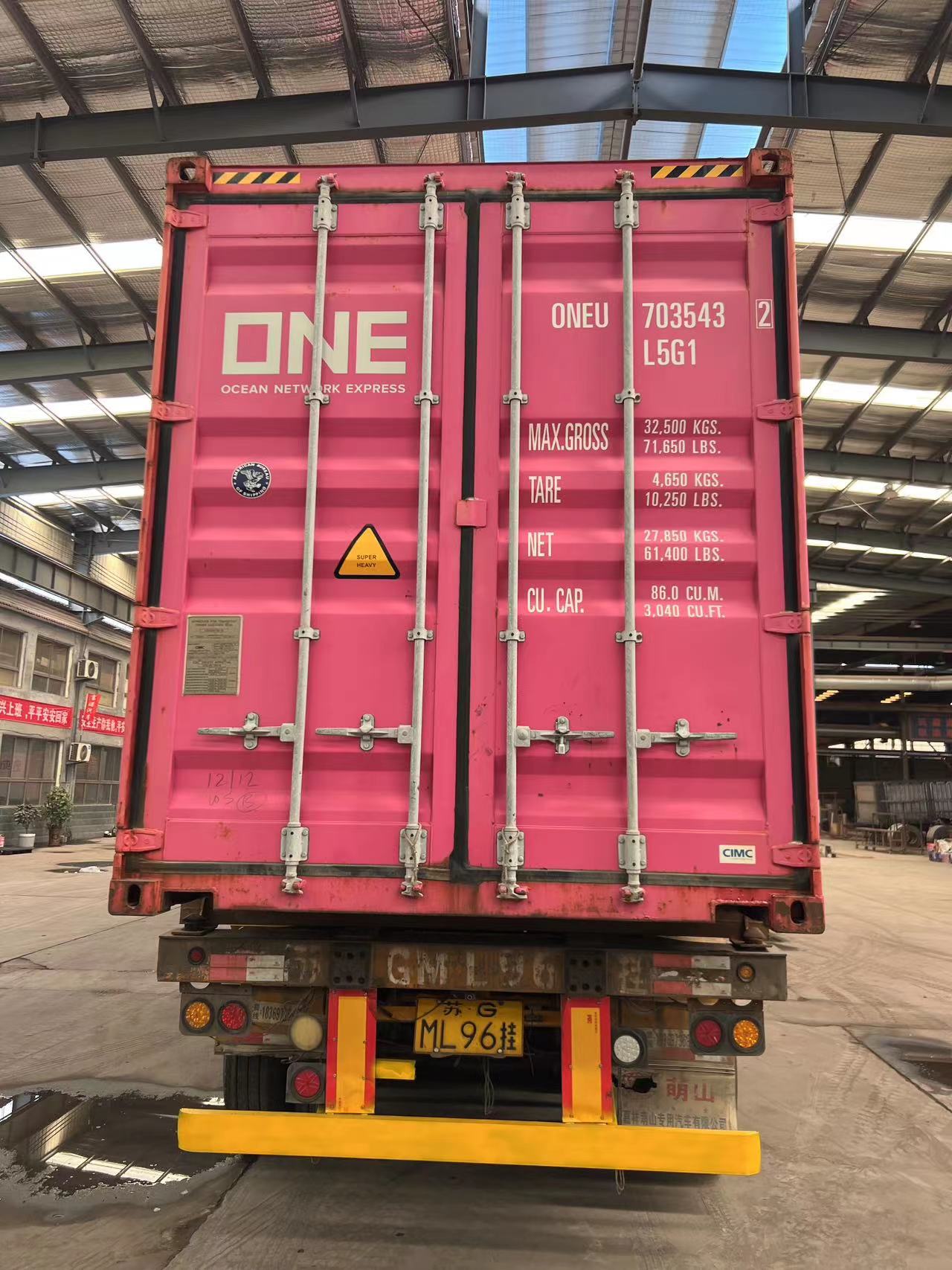
Luen Auto supplies lowbed, flatbed, dump, skeleton, van, fuel tank, dust tank and CNG tank semi trailers, plus tractor trucks and dump trucks, from Shandong Province, China. Send your load data and destination market, and we will return a written parameter sheet for the family that fits — GVW, payload, axle load, deck height, volume or working pressure included.
Email: luengroup@lhaxle.com | Tel / WhatsApp: +86 17686798823 | Website: www.luen-trailertruck.com
Download the full catalogue: LUEN Auto Product Catalog (PDF)
Have Questions or Need More Details?
Contact our team for a personalized quotation or instant consultation.
Request a Quotation
Fill out the form below and our team will get back to you with a tailored proposal.
WhatsApp Direct Chat
Prefer to chat in real-time? Message us on WhatsApp for instant assistance & quick answers.
- Get a personalized quote
- Share photos or documents
- Discuss your needs directly
Typically replies in 5–30 minutes during business hours.