
Truck Trailer Application Guide: Cement, Fuel, CNG, Container & Heavy Equipment Hauls
Truck Trailer Application Guide: Cement, Fuel, CNG, Container & Heavy Equipment Hauls
Direct answer: The right truck trailer for a project is determined by the cargo state and the loading or discharge interface first, then by payload, route envelope and compliance. A cement distributor needs a powder tank semi trailer with pneumatic discharge, not a dump trailer. A fuel depot needs a compartmented tank semi trailer with the correct material and earthing, not a CNG tube trailer. A port needs a container semi trailer with the right twist-lock count, not a flatbed. This guide maps five application families to the trailer type and the verified specification range that should drive the enquiry.

Why application fit fails before the trailer is delivered
Most trailer sourcing errors are made at the category level. A buyer searches for a truck trailer, compares length and axle count, and only later discovers that the cargo cannot be discharged, the site cannot turn the unit, or the destination market will not register it. The failure is rarely a single defective component. It is a mismatch between the cargo, the loading method, the road envelope and the compliance route.
Four mismatches are common. A powder cargo is ordered on a dump trailer because the buyer compares box volume instead of discharge method. A multi-product fuel route is ordered on a single-compartment tank because the buyer compares total litres instead of compartment count. A container terminal orders a flatbed because the buyer compares deck length instead of twist locks. A mine orders a standard dump trailer without checking ground conditions, tipping clearance or wear package. Each error looks like a price problem at the quotation stage and becomes an operating problem after delivery.
The correction is to specify the application before the trailer. Cargo state, discharge interface, site envelope, payload and destination compliance should be fixed first. Only then should the buyer choose between a powder tank semi trailer, a fuel tank trailer, a CNG tube trailer, a container semi trailer, a lowboy semi trailer, a flatbed semi trailer or a dump semi trailer.
What trade data and regulations do not tell you
Trade statistics are too aggregated to guide application selection. HS heading 8716 covers trailers and semi-trailers, other vehicles not mechanically propelled, and parts. Within that heading, HS 8716.31 separates tank trailers and tank semi-trailers, but HS 8716.39 covers other goods trailers, which means flatbed, lowbed, skeleton, van and dump semi-trailers collapse into one customs category. A buyer cannot use HS 8716.39 trade values to decide whether a cement bulk tanker, a skeletal container chassis or a mining dump trailer is the right unit for a specific project.
Supply scale is also not the same as application fit. China's heavy-duty truck exports reached 295,000 units in 2024, a 6.9% increase over 2023. That figure shows the depth of the export supply base for tractor trucks and dump trucks, but it does not tell a buyer which trailer type fits a cement plant, a fuel depot, a CNG daughter station, a container terminal or a mine.
Compliance adds another layer. Container trailers depend on ISO 668 for container dimensions and ISO 1161 for twist-lock corner fittings. European tank trailers carrying dangerous goods fall under ADR, and trailers placed on the EU market go through the type-approval framework of Regulation (EU) 2018/858. In the United States, air-braked trailers are checked against FMVSS No. 121, and trailers above the defined GVWR threshold require rear impact protection under FMVSS No. 224. China applies GB 1589-2016 for dimensions, axle loads and masses, and GB 7258-2017 for running safety. A trailer built for one market should not be assumed compliant in another.
Five application families and the trailer type that fits
1. Cement and dry bulk powders: powder tank semi trailer (dust tank trailer)
A powder tank semi trailer, also called a bulk cement tanker, pneumatic dry bulk trailer or dust tank trailer, is selected when the cargo is a dry powder that can be fluidised and discharged by air. The 40m³ model is a practical reference point for cement distribution, but the range extends to 32, 40, 45, 50 and 60 m³. Payload is 25,000–35,000 kg. Working pressure is 0.196–0.2 MPa, test pressure is 0.26 MPa, and discharge speed is 1.6 tons per minute. Vertical discharge height reaches up to 15 m and horizontal discharge distance up to 5 m. The material must be ≤0.1 mm particle size.
Check the discharge point before the tank volume. A 40m³ trailer that cannot reach the silo inlet is the wrong trailer, even if the volume looks right. Check air supply, tank material (Q345B carbon steel or 5083 aluminum alloy), axle load, and whether the site needs a V-type cone bottom or W-type multi-cone discharge. The same unit can handle cement, fly ash, lime powder, flour, grain powder, chemical powder and mineral powder, but the discharge design and material must match the specific powder.
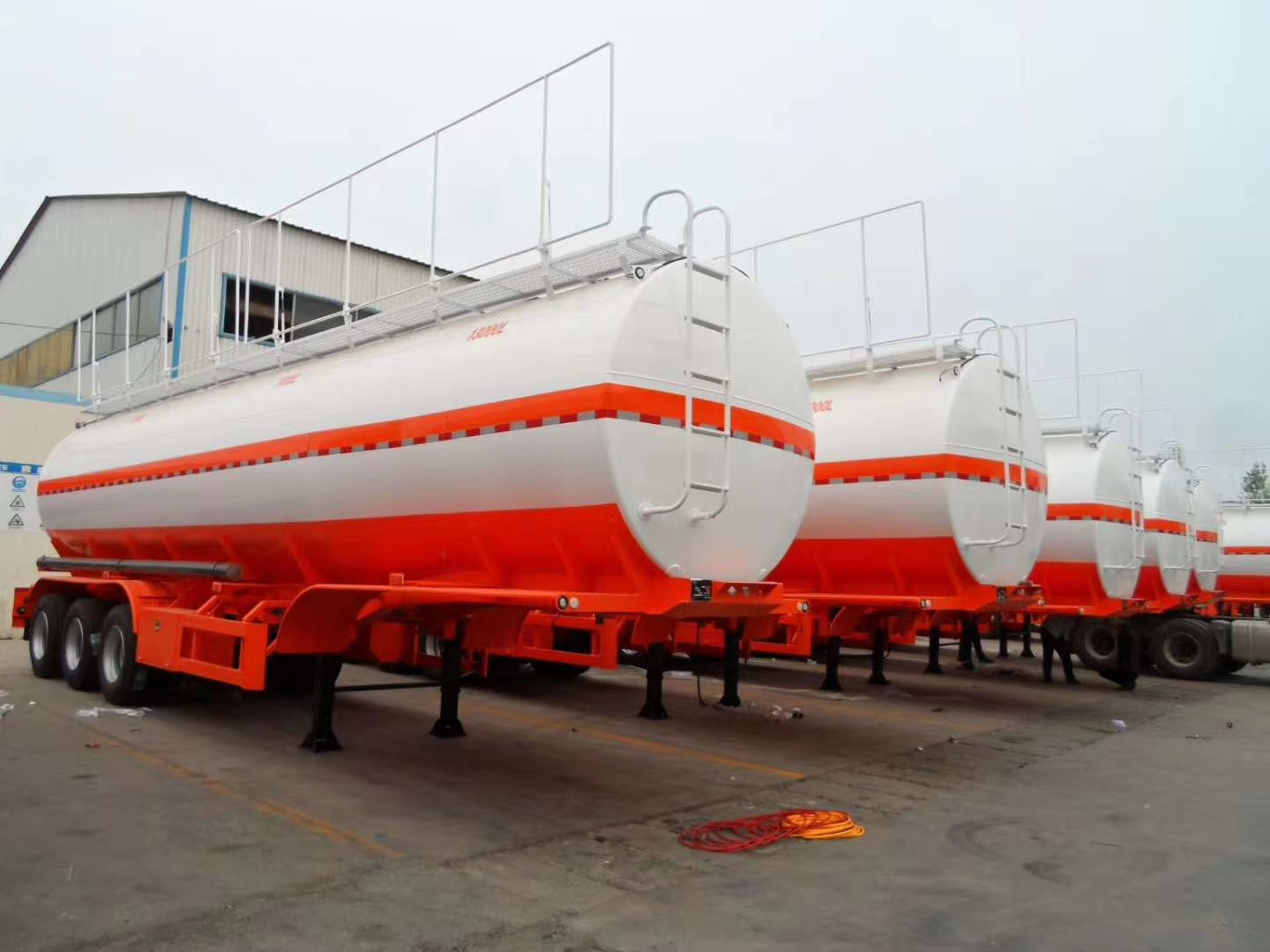
2. Fuel and chemical liquids: tank semi trailer (fuel tank trailer)
A tank semi trailer, or fuel tank trailer, is selected when the cargo is liquid and the discharge method is a pump, bottom valve or pneumatic system. Capacity is 20,000–50,000 L, with 1–6 compartments. Payload is 28,000–35,000 kg. Tank thickness is 5–8 mm. Material choice is carbon steel Q235B or Q345B, stainless steel 304/316 for food or chemical grade, or aluminum alloy 5083 for lightweight construction. Anti-static protection includes an earthing reel and anti-static compartment separation. A top DN500 manhole cover, emergency valve, pressure vent and rollover protection are part of the safety package.
Compartment count is a routing decision, not a cosmetic option. A multi-compartment tank lets one vehicle deliver small volumes of different products, but each compartment adds connections and cleaning requirements. For chemical or food-grade cargo, the wetted material and seal compatibility matter more than the headline litre capacity. For European dangerous-goods transport, ADR construction requirements apply. For petroleum distribution, the anti-static and emergency shutoff package should be checked as a system, not as separate options.
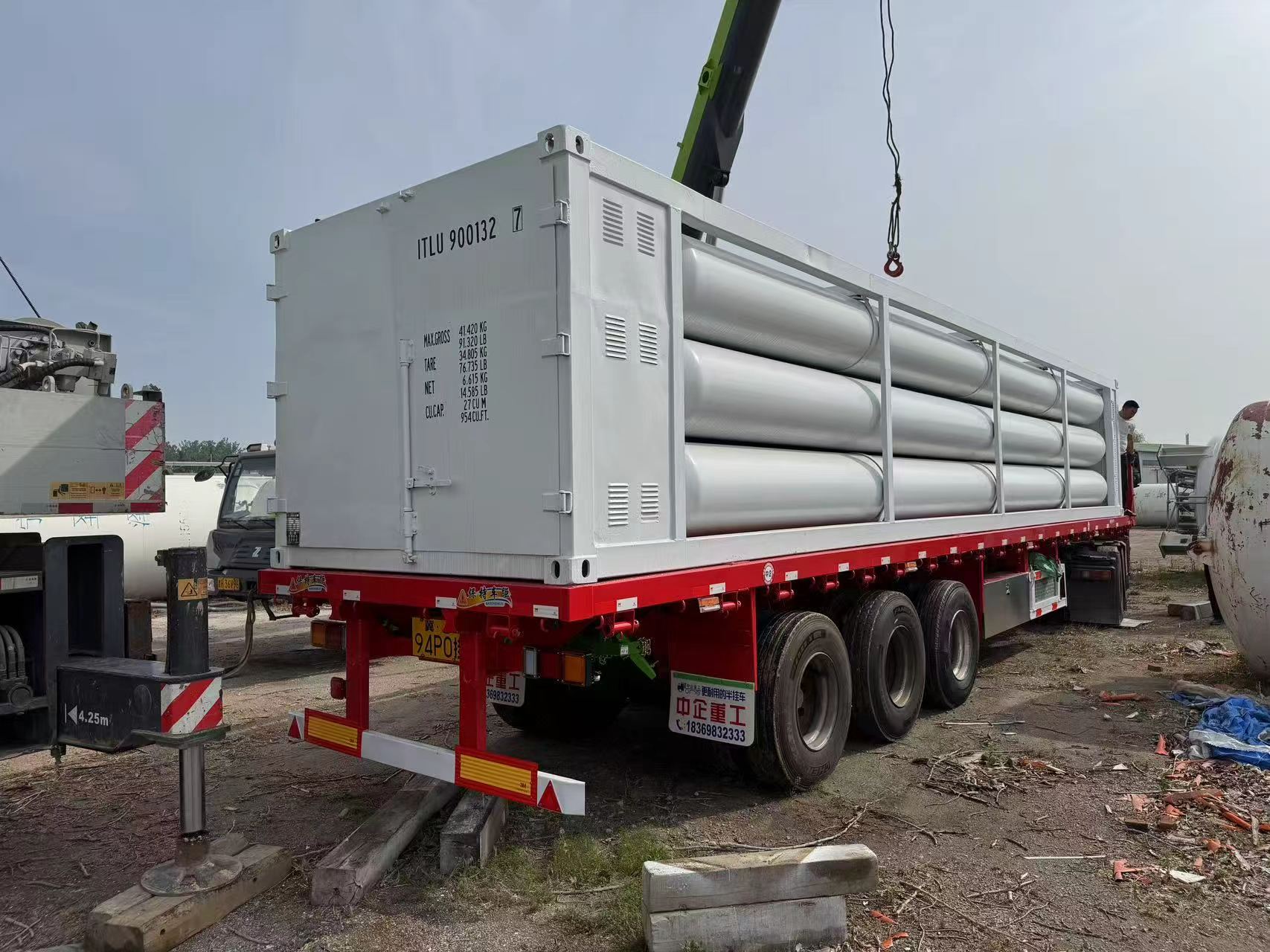
3. CNG supply: CNG tube trailer (CNG tank trailer)
A CNG tube trailer, also described as a compressed natural gas transport trailer or high-pressure gas cylinder trailer, is selected when the project needs gas rather than liquid or powder. Working pressure is 20–25 MPa. Tube count is 8, 10, 12, 16 or 20. Gas capacity is 2,000–6,000 Nm³, with total water volume of 3,000–8,000 L. Tube diameter is 406–559 mm and tube length is 6,000–12,000 mm. Cylinders are 37Mn seamless steel or chrome-moly steel. Safety equipment includes pressure relief valves, emergency shutoff and an earthing reel. GVW is 40,000–42,000 kg.
Start with the receiving station pressure and the required gas volume per trip, then match tube count. A 20-tube trailer is not automatically better than a 10-tube trailer if the station cannot fill it efficiently or the route cannot carry the gross weight. Confirm pressure-equipment approval and periodic inspection requirements in the destination market before the unit is built. The application fit is a balance between gas capacity, fill rate, route distance and station pressure.
4. Port and intermodal: container semi trailer (skeleton semi trailer)
A container semi trailer, also called a skeleton semi trailer, skeletal trailer or container chassis, is selected when the cargo is an ISO container and the handling interface is the twist lock. The trailer accepts 20ft, 40ft and 45ft ISO containers. Payload is 30–65 tons. Overall length is 12,200–13,800 mm for a standard 40ft chassis, width is 2,480–2,500 mm, and height is 1,470–1,560 mm. Axle configurations are 2, 3 or 4 axles, with 13 tons per axle. Kingpin size is 2-inch or 3.5-inch. Twist locks are 4, 6 or 8 and must be ISO 1161 compliant. Main beams are Q345B steel, and landing gear can be JOST or SAF.
Confirm the container mix before the chassis length. A 40ft chassis is not the best choice for a terminal that handles a high share of 20ft boxes, and an extendable chassis adds flexibility at a weight and cost penalty. Check the twist-lock count and the terminal's lifting interface. For container dimensions, ISO 668 is the relevant standard; for corner fittings, ISO 1161. A skeleton semi trailer is not interchangeable with a flatbed semi trailer when the cargo is a container.

5. Heavy equipment and mining: lowboy semi trailer and dump semi trailer
A dump semi trailer, or tipper semi trailer, is selected when the cargo is bulk material that can be tipped. Payload is 30–60 tons, box volume is 20–40 m³, and tipping angle is 45–50°. Configurations include 2, 3 or 4 axles, U-shape or rectangular boxes, and HYVA front-mounted or telescopic hydraulic cylinders. Floor thickness is 8–12 mm wear-resistant steel, with HARDOX optional. Axle load is 13 tons per axle and kingpin size is 2-inch or 3.5-inch. Typical applications include mining coal, iron ore and copper, construction earthworks, quarrying, road infrastructure, and sand and gravel transport.
A lowboy semi trailer, or lowbed trailer, is selected when the cargo is indivisible heavy equipment and the constraint is deck height, ramp access or axle load, not discharge. Confirm deck height, axle count, gooseneck type including detachable gooseneck, and payload rating against the axle and kingpin limits. A lowboy quotation should show the axle-load calculation, not only a headline payload class. The same rule applies to abnormal-load projects: the route permit and axle load determine the configuration before the deck length does.
A flatbed semi trailer remains the default for steel, pipe, timber and machinery that can be side-loaded. Payload is 40–60 tons, deck height is 1,250–1,550 mm, and axle load is 13 tons per axle. Tie-down rings are spaced every 500 mm. A flatbed is not a substitute for a lowboy when deck height or ramp access is the real constraint. A van semi trailer is for weather-protected dry freight and follows a different selection logic based on cube, floor and doors; it is not a substitute for a tank, container chassis or lowboy.

Step-by-step: how to match a truck trailer to a project
- Define the cargo state. Powder, liquid, gas, container or indivisible heavy equipment. This single decision eliminates most trailer types before any quotation is requested.
- Define the loading and discharge interface. Pneumatic air for powder, pump or bottom valve for liquid, tube manifold for CNG, twist locks for containers, ramps or winching for lowboy work, and tipping clearance for dump trailers.
- Define the route and site envelope. Check road width, turning radius, ground conditions, bridge limits, terminal handling and tipping clearance. A trailer that is legal on the highway may still fail at the site gate.
- Calculate payload against volume and axle load. For powder and liquid cargo, density changes the payload for the same tank volume. For containers and heavy equipment, axle load and kingpin rating are the limiting figures.
- Match the tractor truck and interface. Confirm the 2-inch or 3.5-inch kingpin, fifth-wheel capacity, air and electrical connections, and brake compatibility. ISO publishes dedicated 24 V connector standards for the electrical interface between towing and towed vehicles.
- Verify compliance and acceptance. Match the destination market to the applicable standard, then write the acceptance test into the purchase order: discharge rate, twist-lock fit, compartment sequence, axle load, leak test or pressure test where applicable.
Application examples
Cement distribution depot. A 40m³ powder tank semi trailer with pneumatic discharge is a practical fit for cement distribution where the silo inlet is within the vertical and horizontal discharge reach. The buyer should confirm the air supply, discharge height and particle size before comparing tank volume.
Fuel depot with multi-product delivery. A 3–6 compartment fuel tank trailer with anti-static earthing and the correct wetted material fits a route that delivers small volumes of different petroleum or chemical products. A single-compartment tank is simpler, but it cannot separate products on the same trip.
CNG daughter station. An 8–12 tube CNG trailer is often easier to match to a station with limited filling capacity than a 20-tube unit. The selection should start from station pressure, gas capacity per trip and route gross weight.
Port container shuttle. A 40ft skeleton semi trailer with 4 twist locks and a 3-axle configuration fits a terminal that moves standard 40ft boxes. An extendable chassis is better where 20ft and 40ft boxes are mixed, but the buyer should confirm the weight penalty and twist-lock count.
Mining and quarry. A 3-axle or 4-axle dump semi trailer with a 20–40 m³ box, 45–50° tipping angle and optional HARDOX wear package fits bulk material haulage where tipping clearance is available. A lowboy semi trailer is the correct choice when the cargo is a machine rather than bulk material.
Comparison table: application, trailer type and verified specification
| Application and cargo | Trailer type | Verified specification range | Key selection check |
|---|---|---|---|
| Cement, fly ash, lime, flour, chemical powder | Powder tank semi trailer (dust tank trailer) | 32–60 m³; 25,000–35,000 kg payload; 0.196–0.2 MPa working pressure; 1.6 t/min discharge; vertical reach up to 15 m; horizontal reach up to 5 m; particle size ≤0.1 mm | Check discharge point, air supply, tank material and particle size before tank volume. |
| Petroleum, chemical liquid, food-grade liquid, water, bitumen | Tank semi trailer (fuel tank trailer) | 20,000–50,000 L; 1–6 compartments; 28,000–35,000 kg payload; 5–8 mm tank thickness; carbon steel, stainless 304/316 or aluminum 5083 | Check compartment count, wetted material, earthing and ADR requirements for dangerous goods. |
| Compressed natural gas for off-grid supply and mother-daughter stations | CNG tube trailer (CNG tank trailer) | 20–25 MPa; 8–20 tubes; 2,000–6,000 Nm³ gas capacity; 3,000–8,000 L water volume; 37Mn seamless steel cylinders; GVW 40,000–42,000 kg | Check station pressure, gas volume per trip, tube count and pressure-equipment approval. |
| 20ft, 40ft and 45ft ISO containers | Container semi trailer (skeleton semi trailer) | 20/40/45 ft ISO; 30–65 t payload; 4/6/8 twist locks to ISO 1161; 2/3/4 axles; 13 t per axle; 2-inch or 3.5-inch kingpin | Check container mix, twist-lock count, chassis length and terminal handling interface. |
| Mining, quarry, construction earthworks and sand/gravel | Dump semi trailer (tipper semi trailer) | 30–60 t payload; 20–40 m³ box; 45–50° tipping angle; 2/3/4 axles; 8–12 mm wear-resistant floor; HARDOX optional | Check ground condition, tipping clearance, axle load and wear package. |
| Heavy equipment and abnormal loads | Lowboy semi trailer (lowbed trailer) | Configuration-dependent: confirm deck height, axle count, gooseneck type and payload rating against axle and kingpin limits | Check loading method, route permit, deck height and axle-load calculation. |
| Steel, pipe, timber and side-loaded machinery | Flatbed semi trailer | 40–60 t payload; deck height 1,250–1,550 mm; 2/3 axles; 13 t per axle; tie-down rings every 500 mm | Check load securing, side-loading access and deck height against the cargo. |
FAQ
Which standards should a buyer check before ordering a tank or container trailer?
Compliance is market-specific. Container trailers should be checked against ISO 668 for container dimensions and ISO 1161 for twist-lock corner fittings. Tank trailers carrying dangerous goods in Europe fall under ADR, and trailers placed on the EU market go through the type-approval framework of Regulation (EU) 2018/858. In the United States, air-braked trailers must meet FMVSS No. 121, and trailers above the defined GVWR threshold require rear impact protection under FMVSS No. 224. In China, GB 1589-2016 controls dimensions, axle loads and masses, while GB 7258-2017 covers running safety. A trailer built for one market should not be assumed compliant in another.
Can one supplier cover powder, fuel, CNG, container and dump trailer applications?
Product breadth varies by supplier. Luen Auto's range includes lowbed, flatbed, dump, skeleton, van, fuel tank, dust tank and CNG tank semi trailers, plus tractor trucks and dump trucks. Its factory covers 50,000 m²+, with an annual output of 1,500 units and 80% of sales from export markets. Buyers should still verify the specific model, configuration and compliance route for the cargo and destination market.
What drives the price difference between two apparently similar trailers?
The main cost drivers are tank volume and material, compartment count, axle count, discharge system, wear package, compliance route and testing. A like-for-like quote should state these variables. A lower headline price may reflect a smaller tank, fewer compartments, a different steel grade, a simpler discharge system or a different compliance package.
What should be checked on a sample or pre-production trailer?
Check the discharge rate and reach if the unit is a powder tank trailer, the compartment sequence and earthing if it is a fuel tank trailer, the twist-lock fit if it is a container chassis, and the axle load and kingpin size for any semi-trailer. For a powder tank trailer, the reference figures are 1.6 tons per minute discharge, up to 15 m vertical reach and up to 5 m horizontal reach. For a container trailer, confirm ISO 1161 twist locks. For any tractor-trailer combination, confirm the 2-inch or 3.5-inch kingpin and the 24V connector interface.
How should lead time be evaluated?
Ask for a written schedule that separates design approval, material procurement, fabrication, pressure or leak testing where applicable, and export documentation. Lead time is configuration-dependent, so a generic catalogue lead time is not enough. For a specific cargo and route, send the cargo data to Luen Auto for a configuration review and a catalog-based proposal.
Conclusion: start with the cargo, then specify the trailer
Application fit is a sequence, not a product list. Define the cargo state, the loading and discharge interface, the route and site envelope, the payload and axle load, the tractor interface, and the destination compliance route. That sequence will separate a powder tank semi trailer from a dump trailer, a fuel tank trailer from a CNG tube trailer, a container semi trailer from a flatbed semi trailer, and a lowboy semi trailer from a dump semi trailer.
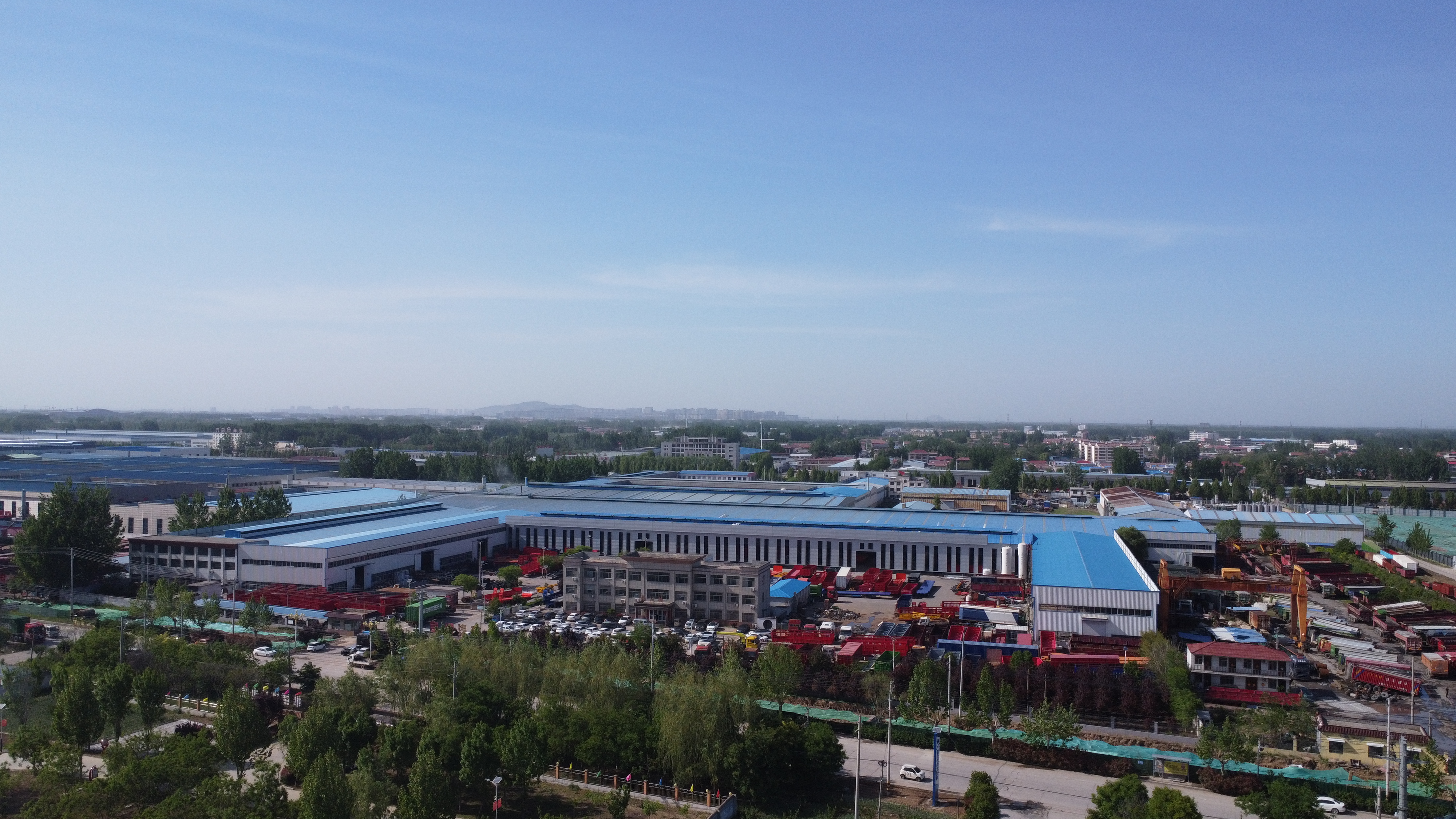
Shandong Luen Auto Co., Ltd. (Luen Auto) was founded in 2020 and operates a 50,000 m²+ factory in Xuji Industrial Park, Liangshan County, Jining City, Shandong Province, with 130+ employees and an annual output of 1,500 units. The company reports that 80% of sales come from export markets, with main markets in Africa, South America and the Middle East. Its range includes lowbed, flatbed, dump, skeleton, van, fuel tank, dust tank and CNG tank semi trailers, plus tractor trucks and dump trucks.
Need a trailer matched to a specific cargo or project?
Send the cargo state, route, site constraints and destination market to Luen Auto for a configuration review. Review the product range at www.luen-trailertruck.com, download the LUEN Auto Product Catalog (PDF), or contact the team at luengroup@lhaxle.com or WhatsApp +86 17686798823.
Address: Xuji Industrial Park, Liangshan County, Jining City, Shandong Province, China.
Have Questions or Need More Details?
Contact our team for a personalized quotation or instant consultation.
Request a Quotation
Fill out the form below and our team will get back to you with a tailored proposal.
WhatsApp Direct Chat
Prefer to chat in real-time? Message us on WhatsApp for instant assistance & quick answers.
- Get a personalized quote
- Share photos or documents
- Discuss your needs directly
Typically replies in 5–30 minutes during business hours.