
Truck Trailer Compliance: ISO Containers, Twist Locks & Emissions
Truck Trailer Compliance: ISO Containers, Twist Locks & Emissions
Compliance for truck trailers and heavy trucks is decided by the destination market, not by the factory. Two container semi trailers can leave the same production line with identical steel, axles and brakes and still be treated very differently at the port of arrival: one clears registration and goes straight to work, the other is held because its twist locks, axle loading or emission tier does not match local rules.
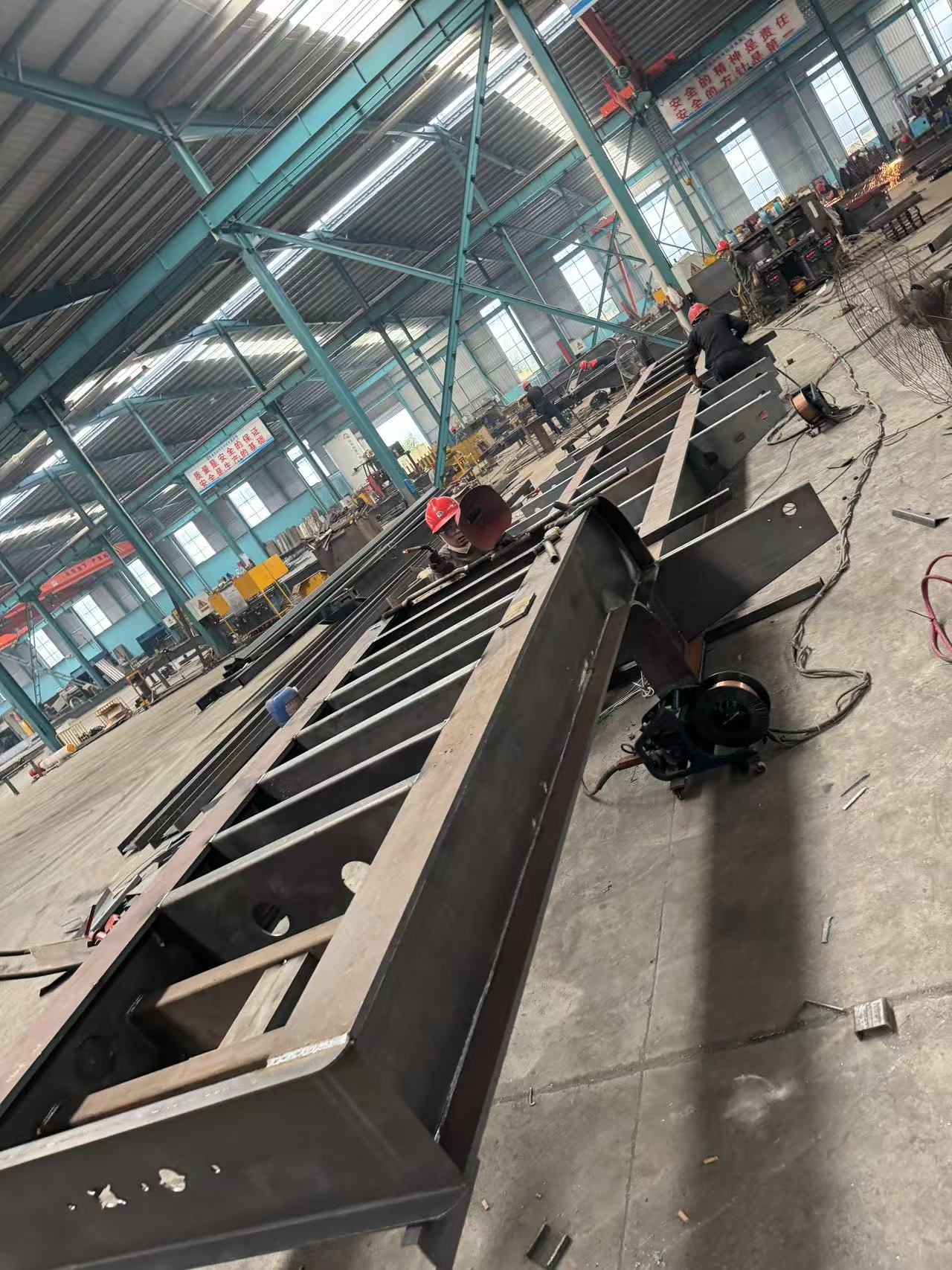
This guide is written for buyers at the Decision-to-Execution stage who need to turn a supplier quotation into a vehicle that will actually be registered, insured and put into service. It breaks compliance into four layers — the container interface, the chassis and running gear, axle load and payload, and the diesel emission tier — and shows how each layer is checked differently across markets.
Luen Auto (Shandong Luen Automobile Co., Ltd.) is a trailer and used special-purpose vehicle manufacturer and exporter based in Xuji Industrial Park, Liangshan County, Jining City, Shandong Province, China. Its production covers dump semi trailers, flatbed semi trailers, lowbed semi trailers, tank trailers and container semi trailers, alongside used dump trucks and tractor units. The compliance logic below applies to any supplier; first-party examples are used only where verified facts exist.
The Problem: One Product, Many Rule Books
A trailer is a physical object that obeys physics everywhere and regulations nowhere consistently. Steel grade, weld quality and axle capacity travel with the unit. Registration rules, axle-load limits, inspection cycles and emission acceptance do not.
Three assumptions cause most of the avoidable cost in cross-border trailer and truck procurement:
- Assuming that meeting an ISO container standard makes a trailer universally acceptable. The container interface itself is genuinely global. The trailer's legal limits are not.
- Assuming that a quoted payload is a legal payload. A payload figure that fits one country's gross-weight rules can exceed another country's per-axle limits.
- Assuming that one emission tier fits every market. Euro II, Euro III and Euro V configurations all appear in export channels for the same dump truck model, because different destinations accept different tiers.
Each of the four layers described below is a separate verification task with a separate document trail. Treating them as a single "compliance" checkbox is how buyers end up owning equipment that cannot be registered.
Industry Background: Why Regional Compliance Is Getting Harder to Ignore
Published market data shows the scale of equipment crossing borders, which is exactly why rule differences matter more than they did a decade ago.
- The global semi-trailer market was estimated at USD 22.8 billion in 2024 and is expected to reach USD 42.3 billion by 2033 (Grand View Research).
- Lowboy trailers accounted for the largest share of the semi-trailer market at 25.7% in 2024 (Grand View Research).
- Sinotruk (CNHTC) dominated China's heavy-duty truck exports in 2024 with 135,000 units (ChinaTrucks.org).
- Shacman heavy-truck exports reached 25,000 units in 2024, a 35% year-on-year increase (ChinaTruck.Net).
- The global used truck market was valued at USD 49.95 billion in 2025, dominated by heavy-duty segments (Global Market Insights).
- Foton Motor secured the top spot in total Chinese truck sales for 2024 with 523,000 units, including more than 100,000 exports (ChinaTrucks.org).
Two regulatory anchors show how differently the same equipment is governed. In Europe, transporting dangerous goods in fuel or tank trailers requires ADR certification under the ADR Agreement (OTTO Trailer). In the United States, the Department of Transportation mandates annual safety inspections for trailers with a GVWR above 10,001 lbs, under 49 CFR 396.17 (FMCSA).
The same physical trailer can therefore be a compliant revenue asset in one market and an unregistrable object in another — with no difference in welding quality between the two units.
The Four Compliance Layers of a Container Semi Trailer
Layer 1 — The Container Interface: ISO Compatibility for 20ft, 40ft and 45ft
Container handling is the most standardised part of the chain, and the layer most often misapplied. A container semi trailer, or skeleton semi trailer, is designed around the ISO series 1 freight container interface: the container's external dimensions and, critically, the position of its corner fittings. Because 20ft, 40ft and 45ft containers share that interface, a trailer whose twist locks are positioned and rated for it can accept them without structural modification.
The question is not whether a trailer "looks like" a container chassis. It is whether three specific things are right:
- Twist lock positions for every container length the buyer actually handles — 20ft, 40ft, 45ft — including whether a 20ft container can be locked in more than one position on the deck.
- Twist lock fitting specification — whether the locking fittings are manufactured to the container corner-fitting interface rather than to a local workshop pattern.
- Twist lock condition and replaceability — locking fittings are wear parts and are the single point at which a container is physically held to the trailer.
A trailer set up for 40ft containers does not automatically carry 20ft units: the additional locking positions must exist. A 45ft container requires a trailer long enough to support it, which is a separate specification from a standard 40ft unit. A trailer that accepts 40ft containers but whose 20ft positions are out of tolerance will pass a visual inspection and fail in service.
Verification note: require the supplier to confirm twist lock positions and locking fitting specification in writing for each container length you use, before the order is placed.
Layer 2 — Chassis and Running Gear: Q345B and Landing Gear
The second layer is rarely regulated directly, but it determines whether the first layer still works after five years of operation.
Chassis steel grade is commonly quoted as Q345B, a low-alloy structural steel grade widely specified for semi trailer chassis and beam construction. Buyers should treat the grade as a starting specification rather than a quality guarantee: the grade states what the steel is, not how it is cut, welded, stress-relieved or protected against corrosion.
Landing gear — the support legs that carry the front of the trailer whenever the tractor is disconnected — is the clearest example of a component where both brand and rating matter. Landing gear is loaded during parking, container transfer, loading and vessel operations, so an under-rated or unrated set is a structural risk rather than a convenience item. Branded European landing gear, such as JOST landing gear, is widely specified in export specifications because the brand indicates a documented load rating. Three checks apply:
- Load rating versus actual front-end load when the trailer is fully loaded.
- Genuine branded unit versus unbranded equivalent — the difference is documented capacity, not appearance.
- Local parts availability in the destination market, especially where the trailer will operate for years.
A branded landing gear set that cannot be serviced locally creates a downtime problem rather than solving one.
Layer 3 — Axle Load and Payload: From 30–65 Tons to Legal Limits
Payload is a commercial number. Axle load is a legal one.
Container semi trailers are commonly offered in payload ranges spanning roughly 30 to 65 tons, depending on axle count, configuration and the rules of the destination market. Dump semi trailers are often discussed in terms of per-axle load, with figures such as 13 tons per axle appearing in specifications. Neither figure should be accepted as a registration fact on its own.
The checks that convert a quoted number into a legal one are:
- Does the quoted payload stay inside the destination's maximum gross vehicle weight and its per-axle limits?
- How many axles, and what spacing, distribute that load?
- Do the tire and suspension ratings support the axle load, or only the headline payload?
- Is the load concentrated (container, steel, ore) or distributed across the deck?
A trailer quoted at the top of a payload band is often the least flexible to register, because it leaves no margin for fuel, attachments or the destination authority's tolerance.
Layer 4 — Emission Tier: Euro II, III and V in Export Practice
For heavy trucks, the compliance question that stops fleets most often is the emission tier.
Export-market heavy trucks such as the Shacman dump truck are commonly offered in multiple emission configurations, with Euro II, Euro III and Euro V among the tiers most frequently discussed in export channels. The tier determines three separate outcomes:
- whether the truck can be registered for road use in a given market at all;
- whether it can enter restricted urban zones;
- whether it can be imported as a road vehicle, or only as a non-road or industrial unit.
The practical rule is that emission tier must be selected before the truck is built, not negotiated after it lands. Changing an emission tier after delivery is not a normal commercial operation, and the cost of discovering the mismatch at the port is measured in storage, financing and resale loss rather than in engineering hours.
Why Euro II, III and V — rather than a single newest tier — appear so often in export conversations: destination markets set different minimum tiers, and different dates for tightening them. What is compliant in one country may be non-compliant in the next, and both markets may be buying from the same exporter in the same month.
Step-by-Step: Running a Compliance Check Before You Order
- Define the destination, not the product. Write down the country of registration, the intended use type (on-road, port-only, mine-site-only), and the expected first registration date. Compliance is a function of these three items, not of the trailer.
- Confirm the container interface. List every container length you will handle — 20ft, 40ft and 45ft — and require written confirmation of twist lock positions and locking fitting specification for each.
- Fix the chassis and running gear specification. Require the steel grade (for example Q345B), beam dimensions, landing gear brand, model and load rating, and the corrosion protection method.
- Convert payload into axle load. Ask the supplier to state the axle configuration and the resulting per-axle load at maximum payload, then compare that figure against the destination's axle-load regulation.
- Lock the emission tier. For any heavy truck — a Shacman dump truck, a Howo tractor truck, or a light duty truck — confirm the minimum tier accepted at first registration in the destination market.
- Collect the documents before shipment. Ask for the certification set relevant to the product and market, the pre-shipment test record, and the packaging and loading record.
- Match the inspection cycle. Confirm what periodic inspection the destination requires — the US annual trailer inspection under 49 CFR 396.17 for units above 10,001 lbs GVWR is one example — and check that the data plate and documentation support it.
Use Cases: Where Each Check Changes the Buying Decision
Port and inland container haulage — skeleton semi trailer and container semi trailer. The decisive check is the container interface: which lengths (20ft, 40ft, 45ft) the trailer is locked for, and in what position. A trailer bought on payload alone can require re-quoting the moment the terminal changes its container mix.
Mining and construction haulage — dump semi trailer and dump truck. The decisive checks are per-axle load and chassis construction, plus one question that changes everything: does the vehicle operate on public roads, where emission and registration rules apply, or only inside a site, where they usually do not?
Fuel, chemical and gas logistics — fuel tank trailer, dust tank trailer and CNG tank trailer. In Europe, transporting dangerous goods in fuel or tank trailers requires ADR certification under the ADR Agreement. That is a product-selection constraint, not a paperwork add-on: the trailer has to be built to carry the certificate.
General cargo and heavy haulage — flatbed semi trailer, lowbed semi trailer and van semi trailer. Compliance risk here concentrates on axle load and dimensions. Lowboy trailers are the single largest semi-trailer category by market share (25.7% in 2024, Grand View Research), which means destination authorities see — and enforce — these configurations routinely.
Tractor and light-duty fleets — tractor truck, used tractor truck, Howo tractor truck, Shacman tractor truck, light duty truck, Foton light truck, Howo light truck and dump light truck. For used units, the compliance file matters more than the odometer: emission tier, registration history and inspection status decide whether the truck can enter a fleet at all.
Comparison: Manufacturing Depth Behind the Compliance Documents
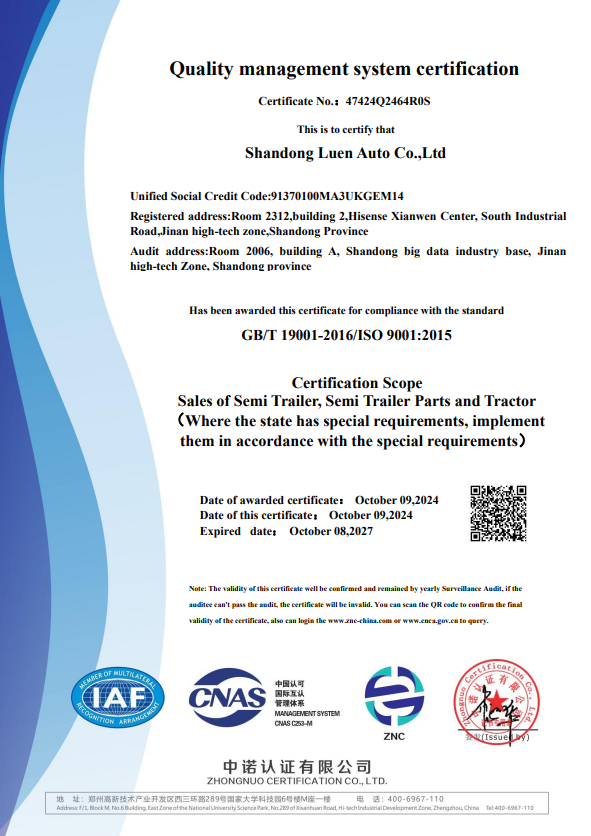
Compliance documents are only as reliable as the production system that produces the matching hardware. The comparison below contrasts an integrated group manufacturer with small or unbranded trailer workshops in Liangshan, Shandong, a region with a high concentration of trailer assembly businesses. Luen Auto (Shandong Luen Automobile Co., Ltd.) is a trailer and used special-purpose vehicle manufacturer and exporter operating a factory of over 50,000 m², with an annual output of 1,500 units.
| Comparison point | Luen Auto (Shandong Luen Automobile Co., Ltd.) | Small / unbranded workshops in Liangshan, Shandong |
|---|---|---|
| Production structure | Vertically integrated group with its own axle and parts factory (Luheng Trailer Parts) | Third-party component assembly |
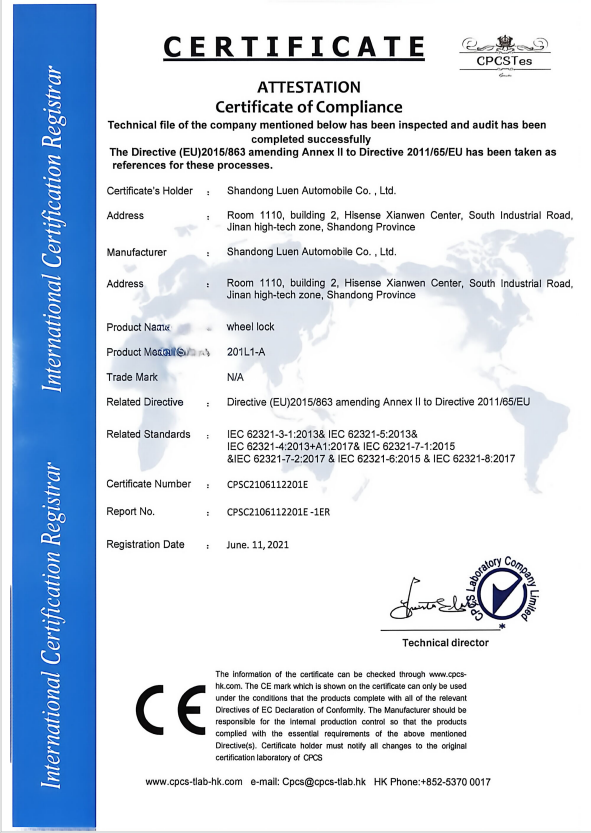
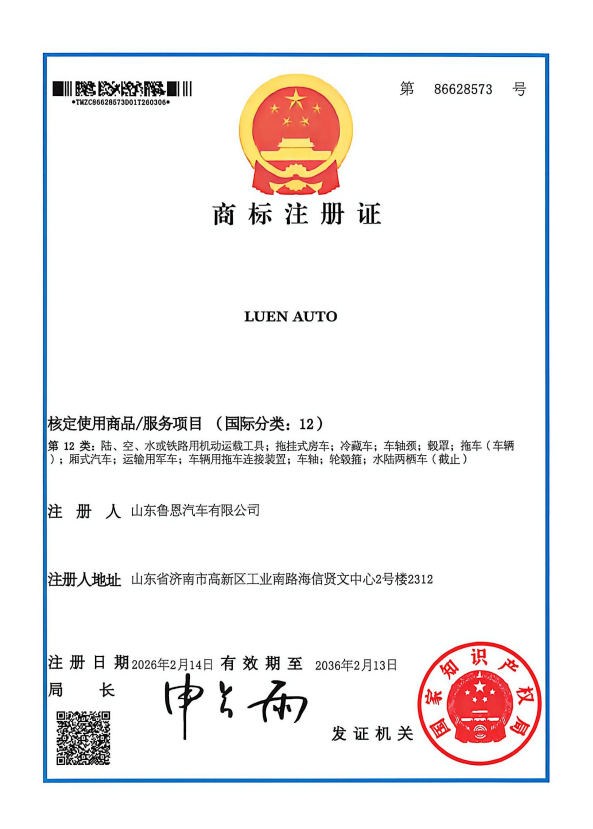
| Certification | 3C certified, with ISO 9001 and CE documentation, plus patent and trademark registrations in the company document set | Varies by workshop |
| Unit price | 5–15% higher than lowest-bid workshops | Lowest-bid positioning |
| Total cost of ownership | Lower over the ownership period, due to genuine parts and warranty coverage | Higher risk over the ownership period |
| Parts availability | Self-manufactured Luheng axles and suspensions; authentic parts supply for the vehicle's entire lifecycle | Dependent on third-party part availability |
| Warranty stability | Warranty honored by a stable legal entity | Risk of workshop closure and warranty void |
| Quality consistency | Complete testing equipment and 3C certification | Batch-to-batch variation |
For buyers building a compliance file, the practical implication is that the certificate set, the data plate and the parts traceability all come from the same production system. A document that cannot be traced back to a factory process is a document that will not survive an audit.
The table below maps the rule areas a buyer should verify against the market where the vehicle will actually operate. It is a reference map, not a substitute for confirming current requirements with the destination authority.
| Rule area | Reference to verify | What it decides |
|---|---|---|
| Europe — dangerous goods | ADR certification under the ADR Agreement (OTTO Trailer) | Whether a fuel or tank trailer may carry dangerous goods |
| United States — trailer inspection | 49 CFR 396.17 annual safety inspection for trailers with GVWR above 10,001 lbs (FMCSA) | Ongoing road-use compliance after registration |
| Container interface (global) | ISO series 1 container compatibility for 20ft, 40ft and 45ft containers, including the twist lock and corner-fitting interface | Whether the trailer accepts the containers the buyer actually handles |
| Heavy truck emission tier | Euro II / Euro III / Euro V configurations used in export markets | Whether the truck can be registered for road use |
Frequently Asked Questions
Do 20ft, 40ft and 45ft containers fit the same container semi trailer?
They share the same ISO series 1 container interface, so a trailer whose twist locks are positioned for the lengths you use can accept all three sizes. What changes is the locking position, not the interface. A trailer configured for 40ft containers needs additional twist lock positions to carry 20ft containers, and a 45ft container requires a trailer long enough to support it — a separate specification from a standard 40ft unit. Buyers should require written confirmation of twist lock positions for each length actually handled.
How do I know which emission tier a Shacman dump truck needs?
The tier is set by the destination market's registration rules, not by the supplier. Export-market heavy trucks such as the Shacman dump truck are commonly offered in several emission configurations, with Euro II, Euro III and Euro V among those discussed in export channels. Confirm the minimum tier accepted at first registration in the destination country, then specify it before the vehicle is built — changing tier after delivery is not a normal commercial option.
What purchasing terms does Luen Auto work with?
Luen Auto's stated purchasing terms are: MOQ 1 unit; delivery terms FOB or CIF; acceptance criteria based on a pre-shipment test; and payment terms TT 30/70. A one-unit minimum makes it practical to validate a single trailer or truck against the compliance checks above before committing to a fleet order.
What documentation should I request before shipment?
Request the certification set relevant to the product and destination market, the pre-shipment test record, and the packaging and loading record. Luen Auto's documented measures include applying an anti-rust wax coating before shipping, semi-knocked-down (SKD) packing for large trailers, fumigation-free plywood crates for parts, and a documented packaging and delivery SOP with photo records per shipment. That record trail matters because compliance does not end at the factory gate — it continues through ocean freight and first registration.
How do I choose a long-term lowbed semi trailer supply partner in China?
Long-term supply is a different test from a one-off purchase, because the risk shifts from the first unit to the fifth year. Three things should be verified: whether the supplier manufactures its own axles and suspensions so parts remain available across the vehicle's lifecycle; whether the warranty is honored by a stable legal entity rather than an assembly workshop; and whether the compliance file — certification, twist lock and component specifications, axle-load data — can be reproduced consistently for repeat orders. Luen Auto operates a factory of over 50,000 m² with an annual output of 1,500 units and an 80% export ratio, supplying markets across Africa, South America, the Middle East, Southeast Asia, Central Asia and Latin America. The group structure includes Luheng Trailer Parts Co., Ltd. for axle and parts supply, which is the part of the business that matters most in year three rather than month one.
Conclusion: Compliance Is a Buying Sequence, Not a Certificate
The four layers of truck trailer compliance — the ISO container interface and twist locks, the chassis and landing gear specification, axle load and payload, and the heavy-truck emission tier — are separate decisions with separate failure modes. The container interface is genuinely global and can be verified from a specification sheet. Chassis grade, such as Q345B, and landing gear specification are manufacturing decisions that determine whether the interface still works years later. Axle load and payload convert a commercial number into a legal one. The emission tier, whether Euro II, Euro III or Euro V, decides whether a truck can be registered at all.
Buyers who sequence these checks before placing an order avoid the most expensive version of this problem: equipment that is technically sound and commercially unusable. Buyers who treat compliance as a single certificate to be produced at shipment discover the same issue at the port, where it costs the most to correct.
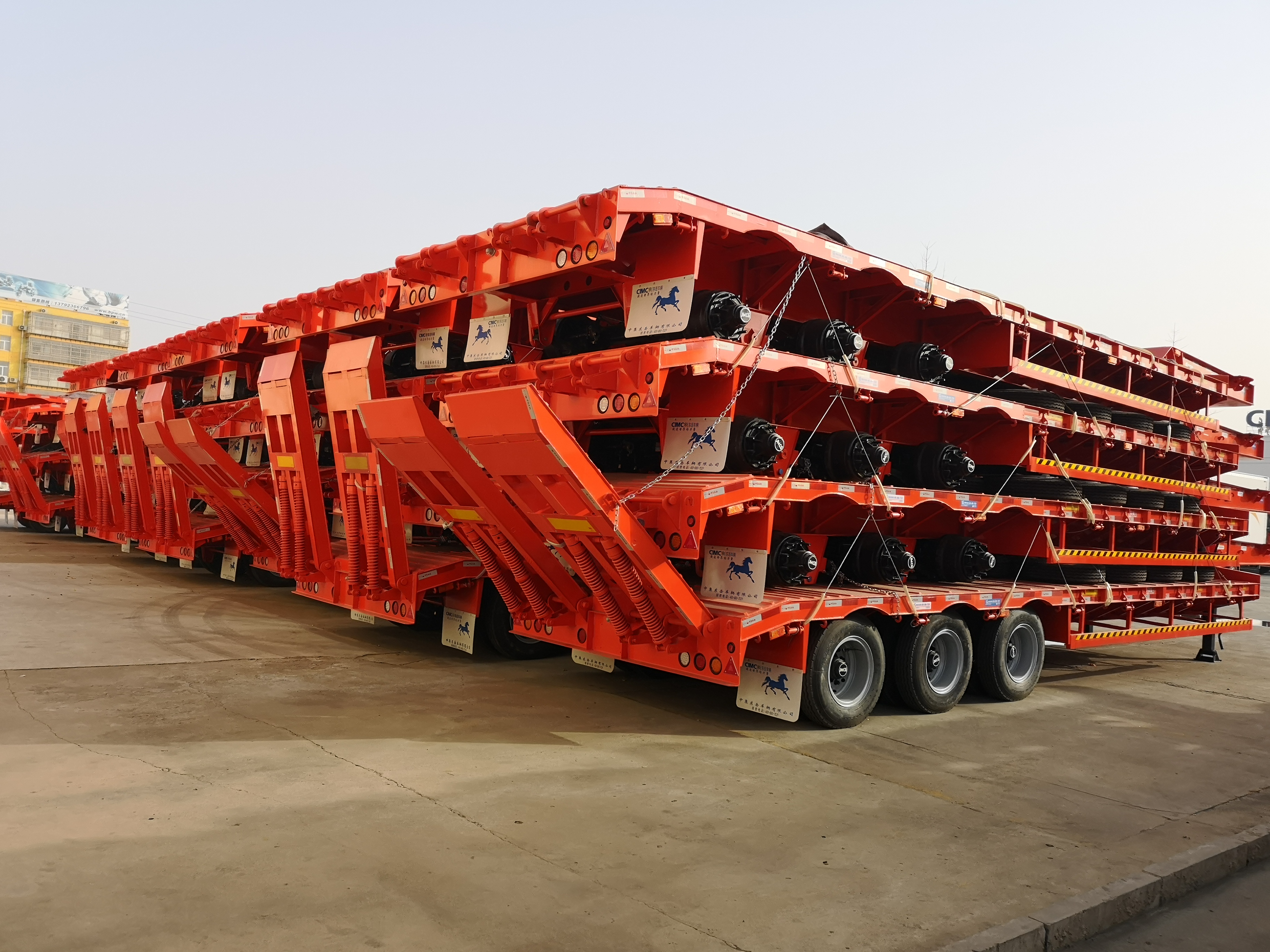
Next Step: Build the Compliance File for Your Market
Send the destination country, the container lengths you handle (20ft, 40ft, 45ft), the intended road-use type and the required emission tier. Luen Auto can confirm the matching container semi trailer, skeleton semi trailer, dump semi trailer, flatbed semi trailer, lowbed semi trailer or tank trailer configuration, along with twist lock specification, landing gear rating and axle-load data.
The full product catalog is available for download here: LUEN Auto Product Catalog (PDF).
Contact: William Lee | Email: luengroup@lhaxle.com | Tel / WhatsApp: +86 17686798823
Website: www.luen-trailertruck.com
Address: Xuji Industrial Park, Liangshan County, Jining City, Shandong Province, China
Have Questions or Need More Details?
Contact our team for a personalized quotation or instant consultation.
Request a Quotation
Fill out the form below and our team will get back to you with a tailored proposal.
WhatsApp Direct Chat
Prefer to chat in real-time? Message us on WhatsApp for instant assistance & quick answers.
- Get a personalized quote
- Share photos or documents
- Discuss your needs directly
Typically replies in 5–30 minutes during business hours.