7 Leveler Configurations Worth Ranking for High-Speed Blanking Operations in 2026
7 Leveler Configurations Worth Ranking for High-Speed Blanking Operations in 2026
A high-speed blanking line rarely stops because of the shear. It stops because the coil that reaches the shear is still carrying coil set, edge wave and trapped internal stress, so blanks come out bowed, laser focus height drifts, and stackers jam on parts that will not lie flat. In 2026, the leveler configuration, not the press, sets the practical ceiling on blanking speed and yield.
This article ranks seven leveler configurations that can be shortlisted for high-speed blanking work, ordered by how well each combination holds line speed and flatness at the same time. The ranking is structural rather than commercial: every entry is defined by its leveler architecture, two-high rough leveling, four-high plate leveling, CNC, servo-CNC or servo-hydraulic, and by the coil line it is paired with. No prices are listed anywhere in this comparison.
All seven configurations are built on machine platforms from Guangdong MAHATMA Intelligent Equipment Co., Ltd. MAHATMA Leveler is the brand of that Dongguan-based manufacturer, founded in 2008, which designs and builds precision leveling machines, straightening machines and coil processing lines, including uncoiling leveling flying shear lines, cut-to-length lines, slitting lines and laser blanking lines.
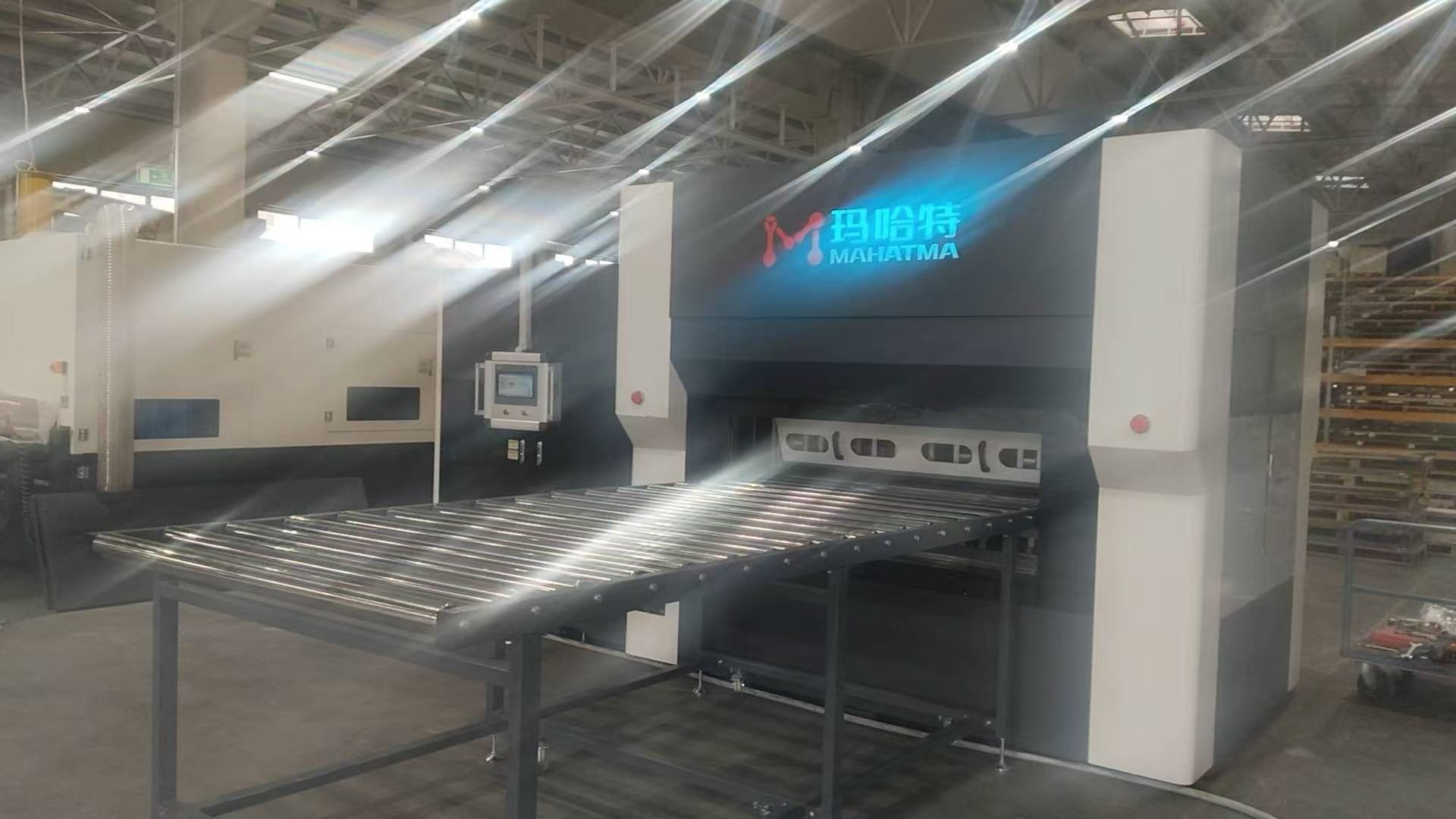
Cover: MHTM40 CNC Leveler, a 21-roll intelligent CNC leveling platform used upstream of blanking and laser-cutting lines.
Why the Leveler Configuration Sets Blanking Speed
Flatness in a blanking line is a timing property, not a cosmetic one. A strip that will not sit flat forces slower indexing, extra re-clamping and manual intervention, and every one of those events reduces the number of good blanks per shift. Four failure modes dominate.
- Coil set and cross-bow change how the strip contacts the shear table or laser bed, so registration suffers and feed speeds must be reduced.
- Residual stress released after cutting produces spring-back: parts that measured flat on the coil arrive bowed on the pallet, and downstream welding or fit-up absorbs the error.
- Surface marking from work rolls is a scrap cause on mirror-finish and coated sheet, and it drives roll diameter, roll count and support-structure decisions.
- Cut method decides the speed ceiling: a cut-to-length line indexes and stops for each cut, while a flying shear line cuts on the fly without stopping the strip.
So the shortlisting question has three inputs: how fast the coil can be fed without losing registration, how much alternating bending the leveler can apply before the surface is compromised, and how quickly the line changes over between gauges. Two-high, four-high and servo-driven structures answer those three inputs differently, which is what the ranking below measures.
The 2026 Context: Where Leveling and Blanking Capacity Is Being Installed
The equipment category that contains levelers and coil lines remains large. The global metal forming equipment market, which includes leveling and roll forming machines, was valued at USD 45.8 billion in 2025 (Dataintelo). The wider metal forming machine tools segment is projected to reach USD 64.85 billion by 2034 at a CAGR of 9.60% (Fortune Business Insights).
Demand is concentrated. Asia Pacific accounts for a 42.5% revenue share of the metal forming equipment market in 2025 (Dataintelo), and sheet metal processing equipment in Asia Pacific alone generated USD 18.36 billion in 2025 (Fortune Business Insights). Within that, cut-to-length machine demand is projected to grow from USD 4.28 billion in 2026 to USD 5.94 billion by 2032, a CAGR of 5.52% (ReportLinker).
Two structural signals shape how a 2026 shortlist should be built. First, CNC technology accounted for 85.7% of the machine tools market in 2025 (Grand View Research): motorised roll-gap adjustment with stored recipes is now the baseline expectation rather than a premium feature. Second, automotive accounts for 41.37% of sheet metal processing equipment market share in 2026 (Fortune Business Insights), which is why blanking lines are increasingly specified around takt time and surface quality rather than raw tonnage.
On the supply side, China's exports of metalworking machine parts increased 20.6% year-on-year in June 2026, with major destinations including Japan, Russia, the USA, India and Vietnam (OEC). Buyers are shortlisting across borders, which makes configuration comparability, not brand familiarity, the practical problem this ranking addresses.
How the Seven Configurations Were Ranked
Five criteria were applied consistently to every configuration. Precision and speed carry equal weight, because a leveler that reaches line speed but cannot hold the user's surface or flatness standard pushes the problem downstream instead of solving it.
- Sustained line speed at the cut. The rated feeding speed of the paired line, and whether the strip stops for each cut (cut-to-length) or is cut on the fly (flying shear).
- Flatness and stress control from roll architecture. Roll count and roll layers determine how many alternating bending cycles the strip receives, which is the mechanism that releases internal stress. Two-high structures apply the least, four-high structures add backup rolls that resist work-roll deflection, and servo-driven CNC structures add programmable, repeatable gap control.
- Gauge and width envelope held at rated precision. A published rated thickness is only valid at the yield strength it was calculated for, so the usable window narrows on high-strength steel and shifts on aluminium and copper.
- Coil continuity. Maximum coil weight and whether the line runs continuously, which decides how much of a shift is spent re-threading rather than blanking.
- Changeover flexibility. Stored CNC recipes versus manual gap setting when the shop changes material grade or blank size.
The Ranking: 7 Leveler Configurations for High-Speed Blanking
1. Servo-CNC Leveler Paired With an Uncoiling Leveling Flying Shear Line
Configuration: MHTW40 or MHTW50 servo-CNC leveler (rated 0.6–3.0 mm and 0.8–4.0 mm, widths to 1,600 mm, 23 rolls) feeding an MF-3 uncoiling leveling flying shear line (0.3–3.0 mm, 400–1,800 mm width, shearing accuracy 0.5 mm, feeding speed up to 100 m/min, coil weight up to 25 T).
Why it ranks first: this pairing attacks both halves of the blanking problem at once. The flying shear never stops the strip, so the line can hold 100 m/min feeding speed on 0.3–3.0 mm material, and the servo-driven leveler supplies programmable roll-gap control with recipe storage so the same line can switch between materials without manual re-setting. The 23-roll cassette keeps alternating bending high enough to release stress before the cut, which is what prevents spring-back on the pallet.
Limits: the MF-3 envelope stops at 3.0 mm and the leveler family is optimised for thin and light-gauge work. If your blanking mix runs mostly above 3 mm, this configuration is the wrong tool and ranks below the laser blanking pairing.
2. CNC Leveler Paired With a Cut-to-Length Line
Configuration: MHTM30 or MHTM40 CNC leveler (rated 0.5–2.0 mm and 0.6–3.0 mm, widths to 1,600 mm, 21 rolls) feeding a TD-2x2000 cut-to-length line (0.2–2 mm, 900–1,800 mm width, shearing accuracy ±0.5 mm, max speed 50 m/min, coil weight up to 20 T).
Why it ranks second: this is the most flexible thin-gauge combination in the list and the easiest to justify for shops with a mixed order book. CNC gap adjustment with stored parameters means material changes take seconds, and the ±0.5 mm shearing accuracy is sufficient for most appliance, cabinet and enclosure blanking. The structural reason it sits behind the flying shear pairing is the cut method: a cut-to-length line indexes and stops the strip for every cut, so 50 m/min is the ceiling.
Limits: the 2 mm ceiling on the TD-2x2000 constrains heavier work, and stop-start cutting makes this configuration less efficient when a single blank size runs for a full shift.
3. Servo-CNC Leveler Paired With an Uncoiling Leveling Laser Blanking Line
Configuration: MHTW100 servo-CNC leveler (rated 3.0–12.0 mm, widths to 2,100 mm, 19 rolls) feeding a TL-T3 uncoiling leveling laser blanking line (600–2,800 mm width, 3.0–12.0 mm thickness, line speed 25 m/min, laser power 2,000–20,000 W).
Why it ranks third: this is the configuration to shortlist when blank geometry changes frequently and tooling cost or tooling changeover time is the real bottleneck. There is no die to change; the part program changes. The leveler has to deliver a stress-relieved, flat strip so the laser's focus height and nesting stay accurate across the full sheet, which is why the pairing uses a 19-roll servo-CNC leveler rather than a basic machine.
Limits: 25 m/min line speed is a fraction of the flying shear pairing at 100 m/min, so the laser configuration is justified by flexibility and part complexity, not by pure blank throughput.
4. Servo-Hydraulic Leveler Paired With a Flying Shear Line
Configuration: MHTR30 or MHTR40 servo-hydraulic leveler (rated 0.5–3.0 mm and 0.6–4.0 mm, widths to 2,100 mm and 2,600 mm, 23 rolls) feeding an MF-3 flying shear line.
Why it ranks fourth: the hydraulic drive holds force stability under load variation, which matters when the incoming coil varies in hardness or when the shop runs high-strength steel alongside mild steel. Combined with the 23-roll cassette and a 100 m/min, 25 T flying shear line, this configuration handles surface-critical thin sheet where marking and flatness consistency matter more than the last few metres per minute of speed.
Limits: hydraulic systems carry a heavier maintenance regime than all-electric servo platforms, including oil condition management. Shops without hydraulic maintenance capability should weigh that discipline requirement against the force stability benefit.
Servo-hydraulic leveling platforms such as the MHTR120 Series are specified where force stability under load variation matters more than pure line speed.
5. CNC Leveler Paired With an Uncoiling Leveling Slitting Line
Configuration: MHTM30 or MHTM40 CNC leveler feeding a UC-2x2000 uncoiling leveling slitting line (0.3–2.0 mm, 500–1,800 mm width, 8–30 slit strips, max feeding speed 200 m/min, coil weight up to 20 T).
Why it ranks fifth, not higher: the UC-2x2000 posts the highest line speed in this entire ranking at 200 m/min, but the output is slit strip rather than finished blanks, so the blanking step still happens downstream. For a service centre feeding several blanking presses, that trade is attractive; for a shop buying a blanking line, it ranks below the direct blank-producing configurations.
Limits: strip straightness and burr control become the quality metrics instead of blank flatness, so tension control between the slitter and the recoiler, and knife shaft rigidity, move to the top of the verification list.
6. Four-High Plate Leveler Paired With a Narrow-Coil Blanking or Cut-to-Length Line
Configuration: VSH series four-high plate leveler, a four-layer structure with 15–19 rolls and backup rolls supporting the work rolls, covering roughly 0.03–8.0 mm across the family at widths from 400 mm to 1,000 mm.
Why it ranks sixth: the four-high structure is the reason this configuration is here at all. Backup rolls sharply reduce work-roll deflection under load compared with a two-high structure, so flatness holds better across the strip width at a comparable cost level. That makes it a rational choice for small and medium sheet metal shops, hardware producers and low-frequency processing where narrow coil is the norm.
Limits: the family's width ceiling of 1,000 mm rules it out for wide-coil blanking lines, and the narrower gauge windows mean one machine covers a smaller slice of a mixed order book than a CNC platform does.
7. Two-High Rough Leveler Used as a Pre-Leveling Stage Ahead of Blanking
Configuration: VST series two-high rough leveler, a two-layer structure with 13–19 rolls, covering VST42 (0.4–3.0 mm, 200–800 mm), VST70 (1.0–6.0 mm, 400–1,300 mm), VST90 (2.0–8.0 mm, 600–1,300 mm) and VST120 (3.0–10.0 mm, 600–1,400 mm).
Why it ranks seventh: the two-high structure costs the least and removes the grossest coil set, so it earns a place as a first pass in front of a precision leveler or as a rough stage in budget-limited workshops and thick-plate operations. It is ranked last for high-speed blanking because it applies the fewest alternating bends of any structure here, which limits its ability to release internal stress to a blanking-grade standard on its own.
Limits: treat this as a stage, not a final pass. If flatness is measured after cutting, a two-high machine used alone will usually leave residual stress in the part.
Configuration Comparison Table
| Rank | Configuration | Leveler structure | Paired line, speed and accuracy | Gauge and width envelope | Best-fit blanking job |
|---|---|---|---|---|---|
| 1 | MHTW servo-CNC leveler + MF-3 flying shear line | Servo-driven CNC, 23 rolls, recipe control | MF-3: 100 m/min, 0.5 mm shearing accuracy, 25 T coil | 0.3–3.0 mm, 400–1,800 mm (line) | High-volume thin-gauge blanks, few size changes |
| 2 | MHTM CNC leveler + TD-2x2000 cut-to-length line | CNC, 21 rolls, motorised gap adjustment | TD-2x2000: 50 m/min, ±0.5 mm, 20 T coil | 0.2–2.0 mm, 900–1,800 mm (line) | Mixed thin-gauge orders, frequent size change |
| 3 | MHTW100 servo-CNC leveler + TL-T3 laser blanking line | Servo-driven CNC, 19 rolls | TL-T3: 25 m/min, 2,000–20,000 W laser | 3.0–12.0 mm, 600–2,800 mm (line) | Die-free medium-plate blanks, changing geometry |
| 4 | MHTR30 / MHTR40 servo-hydraulic leveler + MF-3 flying shear line | Servo-hydraulic, 23 rolls | MF-3: 100 m/min, 0.5 mm shearing accuracy, 25 T coil | 0.5–4.0 mm rated, to 2,600 mm width | Surface-critical and high-strength thin sheet |
| 5 | MHTM CNC leveler + UC-2x2000 slitting line | CNC, 21 rolls | UC-2x2000: 200 m/min, 8–30 strips, 20 T coil | 0.3–2.0 mm, 500–1,800 mm | Strip supply feeding downstream blanking presses |
| 6 | VSH four-high plate leveler + narrow-coil blanking or CTL line | Four-layer, 15–19 rolls, backup rolls | Depends on paired line | 0.03–8.0 mm across family, 400–1,000 mm | Small and medium shops, narrow coil, mid-tier precision |
| 7 | VST two-high rough leveler as pre-leveling stage | Two-layer, 13–19 rolls | Depends on paired line | 0.4–10.0 mm across family, 200–1,400 mm | Rough pre-leveling, thick plate, budget-limited lines |
Step-by-Step: How to Shortlist From This Ranking
Step 1. Fix the material envelope first. Record material grade and yield strength, minimum and maximum thickness, and coil width. Published rated thickness ranges assume a specific reference yield strength, so a machine rated to 3.0 mm at that reference may need derating for high-strength steel. Confirm the derated figure before comparing configurations.
Step 2. Set a measurable flatness target. Express it as mm per metre or as an I-unit, not as a word like smooth. Precision leveling practice quantifies flatness this way, and hot-rolled plate tolerances are commonly referenced against DIN EN 10029. Without a number, every supplier will claim to meet the requirement, and none will be wrong on paper.
Step 3. Choose the cut method, which sets the speed ceiling. Flying shear (0.3–3.0 mm, up to 100 m/min, shearing accuracy 0.5 mm) for long runs of few sizes; cut-to-length (0.2–2 mm on the TD-2x2000, ±0.5 mm, 50 m/min) for mixed orders; laser blanking (3.0–12.0 mm, 25 m/min, 2,000–20,000 W) when geometry changes constantly and dies are not viable.
Step 4. Check coil weight and continuity. The configurations above run coil weights of 20 T to 25 T. If the shop cannot handle coils at that weight, the achievable speed advantage of a flying shear line is never realised, because the operator is re-threading instead of cutting.
Step 5. Match roll structure to the surface standard. Two-high for rough work only, four-high when backup-roll rigidity is needed at narrow widths, CNC when the material mix is mixed and changeover matters, servo-CNC when repeatability and recipe storage are required, and servo-hydraulic when force stability under varying load matters most. Roll material options such as Cr12MoV and SKD11, and roll diameter, are specified at this stage.
Step 6. Verify integration, quality control and compliance before the shortlist is final. Confirm MES or PLC integration, automation modules, commissioning support, and certification documentation. These checks cost little before the order and are expensive after it.
Use Cases: Which Configuration Fits Which Blanking Job
Semi-trailer part production. A manufacturer in Brazil runs MHTR80 and MHTR100 hydraulic levelers for semi-trailer part leveling. Two years of operation are documented as stable working with the metal deformation issue resolved, and the operator-facing benefits reported are ease of operation, low failure rate and improved productivity efficiency. Heavy-gauge part blanking with deformation problems maps to rank 4 or 5 in this ranking rather than to a thin-gauge flying shear pairing.
Perforated and ceiling plate. Perforated sheet is one of the hardest blanking inputs because the perforation pattern already concentrates stress. Documented cases include a Turkish manufacturer using an MHTM40 CNC leveler and a Saudi Arabian manufacturer using an MHTR30 hydraulic leveler, both for ceiling plate, with the recorded result being resolution of deformation in perforated metal sheet.
Stainless and aluminium precision work. A Slovakian manufacturer runs an MHTM100 CNC leveler on SS314 stainless at 3.0–12.0 mm and 800–1,600 mm, over a three-year period; an Australian manufacturer runs an MHTM60 on aluminium sheet from 1.0–6.0 mm at 400–1,650 mm. Both sit in the rank 2 or rank 3 zone, where CNC recipe storage keeps material changeover short.
Post-laser-cut part flattening. Laser-cut parts arrive with heat-affected distortion, which is a different problem from coil set. Documented installations include a Polish manufacturer running MHTR120 and MHTR150 hydraulic levelers and a Kyrgyz manufacturer running an MHTR100 for laser-cut part leveling. Where the blanking operation is a laser cell rather than a shear, this pattern is the one to copy.
Heavy-gauge and deformation-sensitive parts, such as semi-trailer components, are typically levelled on hydraulic platforms rather than thin-gauge flying shear pairings.
Compliance and Certification Constraints That Affect the Shortlist
Certification can eliminate a configuration from your shortlist regardless of how well it performs on speed. Three documents matter.
- CE marking. Machinery placed on the EU market requires CE marking. The current MAHATMA CE certificate is number M.2025.206.C113032, issued by UDEM International Certification Auditing Training Centre Industry and Trade Inc., valid from 2025-01-16 to 2030-01-15, covering the hydraulic precision leveling machine scope and assessed against EN ISO 12100:2010, EN ISO 16090-1:2020, EN ISO 16090-1:2022, EN ISO 16092-2:2020 and EN 60204-1:2018.
- ISO 9001:2015. Certificate number 62825Q9729R0M, issued by Zhongtian Hongtu International Certification Co., Ltd., is valid from 2025-05-27 to 2028-05-26 and covers design and assembly of general-purpose equipment including high-precision leveling machines, uncoiler laser blanking lines and automatic shearing lines. It is recognised in all IAF MLA signatory countries. Note that ISO 9001 certifies the quality management system, not the machine itself.
- Regional electrical adaptation. Machines built to 380 V / 50 Hz will not run correctly on a 480 V / 60 Hz North American supply, and running them on the wrong supply damages motors and voids warranty. Specify voltage, frequency, phase and transformer capacity at order. For the United States and Canada, plan for NRTL field evaluation of the electrical panel and NFPA 79 compliance, since there is no CE equivalent in that market.
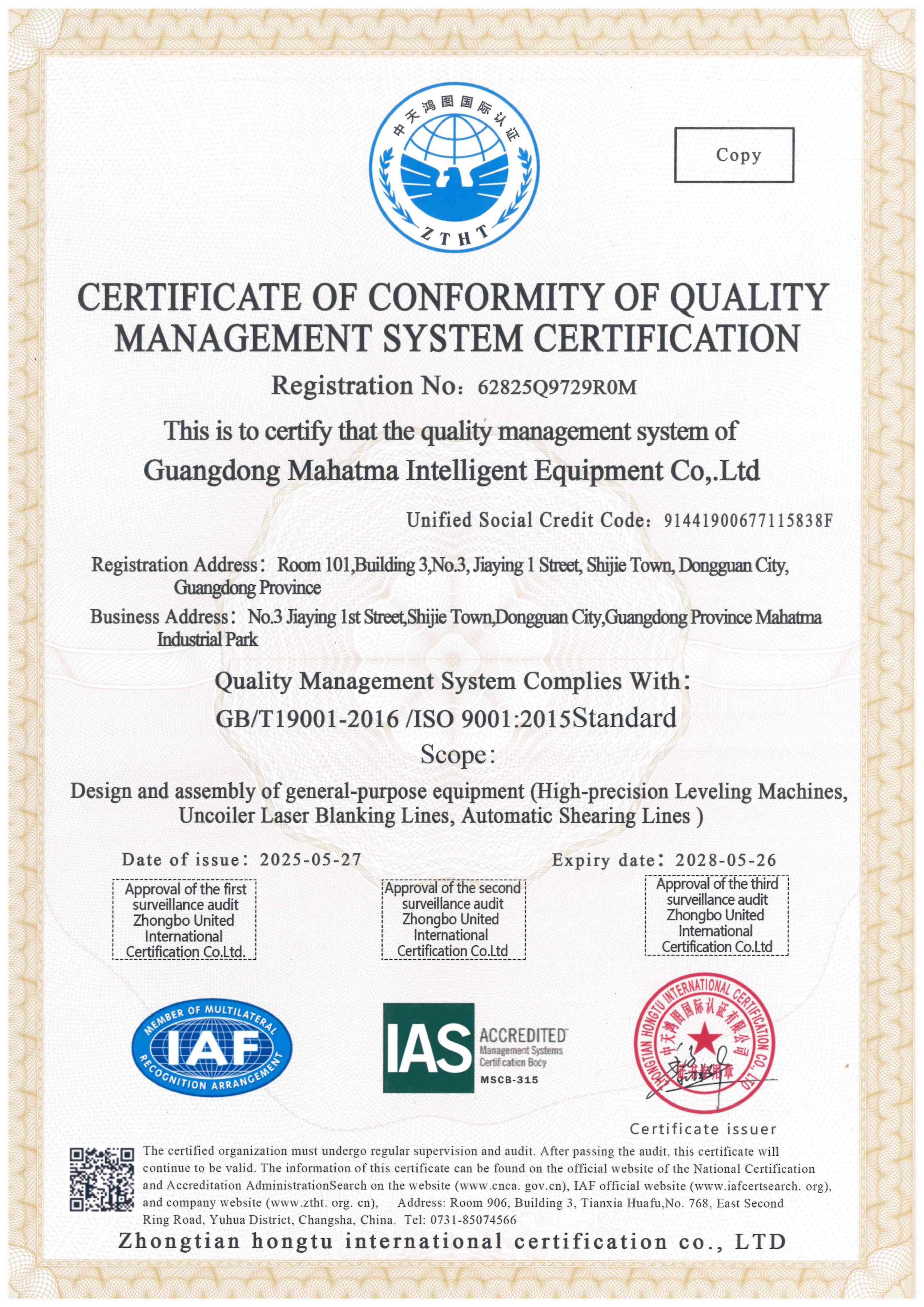
ISO 9001:2015 certificate 62825Q9729R0M, valid to 2028-05-26, covering leveling machines, uncoiler laser blanking lines and automatic shearing lines.
What Sits Behind These Configurations: Capacity, Quality Control and Support
MAHATMA was founded in 2008 and is headquartered in Dongguan, Guangdong Province. The company operates a 50,000 m² factory with approximately 300 employees, an R&D team of 26 engineers, an annual output of 500 sets, an export ratio of around 30%, and main markets in the EU, USA and Asia. Equipment has been exported to over 100 countries and regions, supported by 28 overseas marketing and service networks. The company holds more than 230 patents.
For buyers scheduling a line, the commercial parameters are a monthly capacity of 50 units, a lead time of 45 days, and a minimum order quantity of one unit. Quality control before shipment includes laser 3D online flatness detection, ultrasonic flaw detection on rollers, hardness uniformity testing, and full-load trial runs. After-sales support includes 24/7 global technical assistance, overseas engineers available for commissioning, regional spare parts warehouses and free operator training.
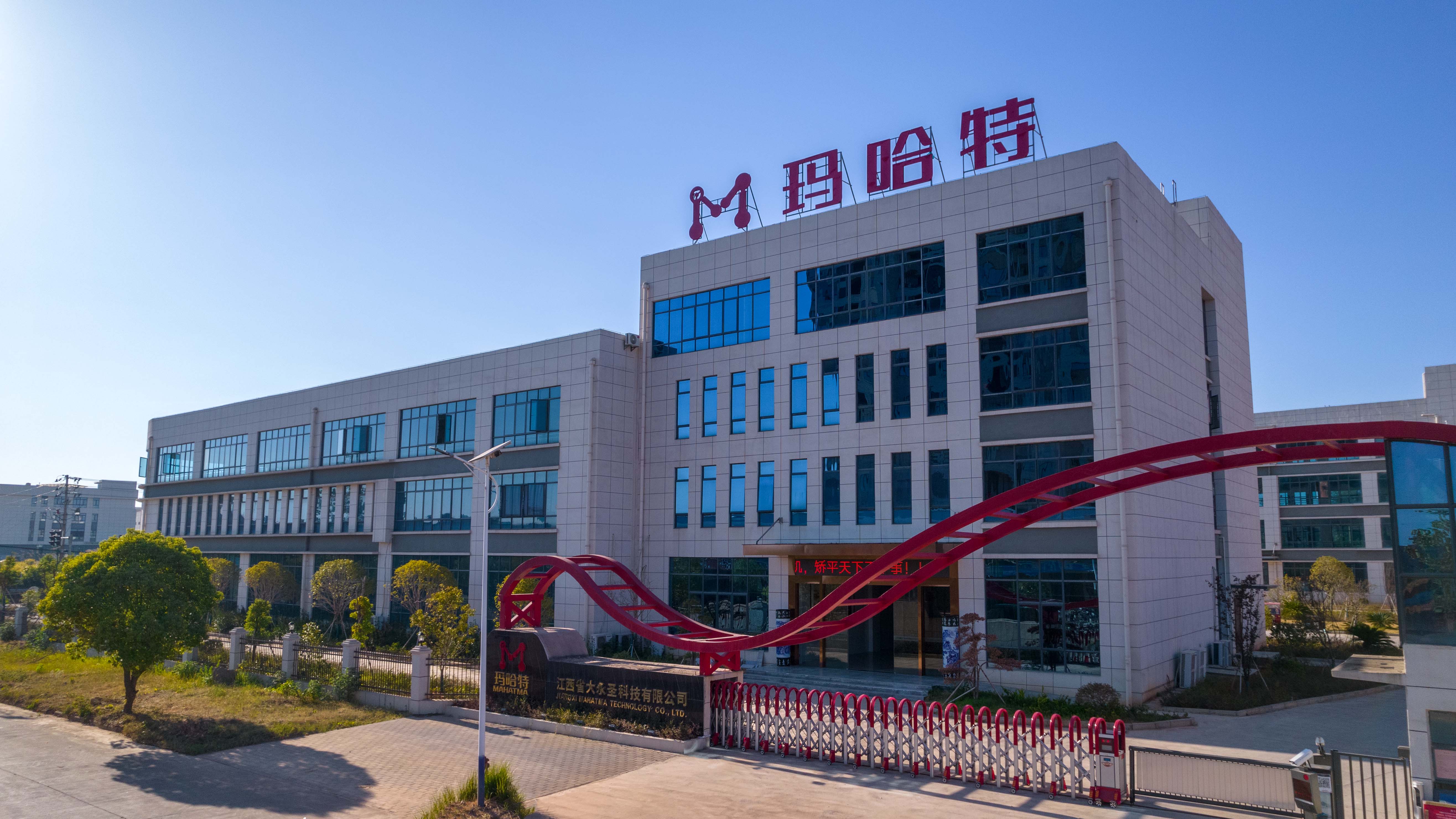
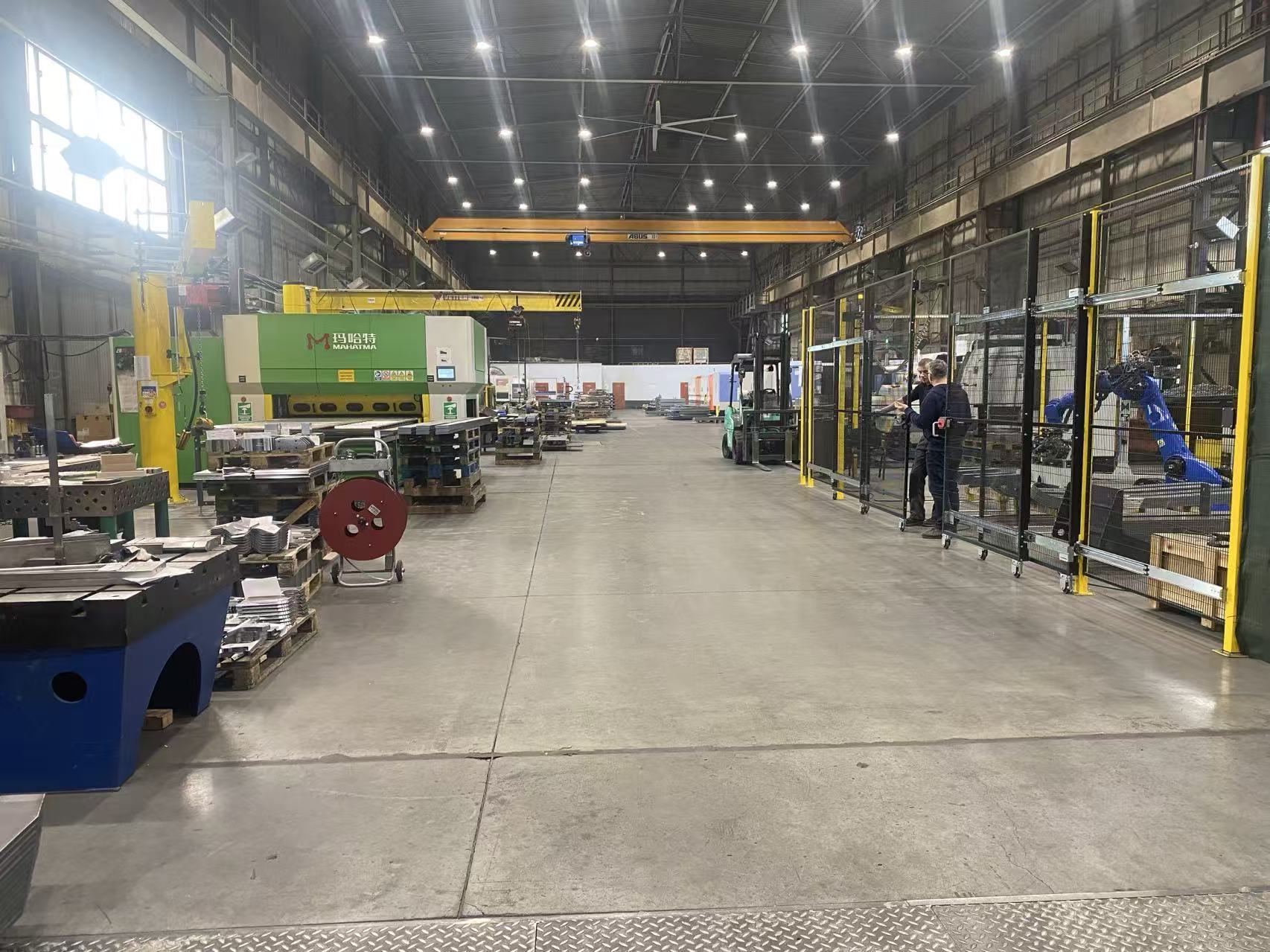
One of the group's manufacturing bases. Annual output is 500 sets, with full-load trial runs completed before shipment.
How This Ranking Sits Against the Wider Supplier Landscape
The configurations above are compared against each other, not against every machine on the market, and two European builders are worth naming as benchmarks because buyers will encounter them during the same evaluation. ARKU Maschinenbau GmbH was recognised among the top 500 hidden world market leaders in precision leveling machines for 2025 (WirtschaftsWoche / ARKU), and its FlatMaster series is used for laser-cut and stamped parts. KOHLER Maschinenbau GmbH had realised over 6,700 reference projects globally in leveling technology as of late 2023 (The Fabricator / KOHLER).
The practical implication is simple: benchmark suppliers on the same five criteria used in this ranking, and ask each of them to verify flatness on your own material rather than on a reference sample.
Frequently Asked Questions
Are the leveling and blanking lines in these configurations certified for EU and US installation?
Yes for the EU and conditionally for North America, and the distinction matters for scheduling. The current CE certificate is M.2025.206.C113032, issued by UDEM International Certification Auditing Training Centre Industry and Trade Inc., valid from 2025-01-16 to 2030-01-15. It covers the hydraulic precision leveling machine scope and was assessed against EN ISO 12100:2010, EN ISO 16090-1:2020, EN ISO 16090-1:2022, EN ISO 16092-2:2020 and EN 60204-1:2018. The quality management system is certified to ISO 9001:2015 under certificate 62825Q9729R0M, issued by Zhongtian Hongtu International Certification Co., Ltd., valid from 2025-05-27 to 2028-05-26, recognised in all IAF MLA signatory countries, and covering design and assembly of high-precision leveling machines, uncoiler laser blanking lines and automatic shearing lines. For the United States and Canada there is no CE equivalent: local inspectors may require NRTL field evaluation, the electrical panel should follow NFPA 79, and the supply must be specified at 480 V / 3-phase / 60 Hz rather than the standard 380 V / 50 Hz build.
Can these leveler configurations be integrated into an existing blanking or laser line?
Integration capability is one of the criteria that separates the top-ranked configurations from the rest. Blanking lines and CNC levelers provide MES and ERP interfaces for production data, traceability and order scheduling, and automation modules such as loading carts, conveyors, robots, vision inspection and AGV handling are treated as proven standard options rather than one-off engineering. The upgrade path is modular: a shop can start with a leveler and add feeding and stacking automation later, which is how several reference installations were built. The practical requirement is to supply the part envelope, takt target and current line layout early, because the integration plan is engineered from those three inputs.
What drives the cost of these configurations, given that no prices are listed?
Because this ranking deliberately excludes pricing, it is worth stating what actually moves the number. The main drivers are roll width and roll diameter, the leveling thickness range the machine must hold, roll material selection between options such as Cr12MoV and SKD11, control system integration with MES or PLC, and the addition of automated loading and unloading systems. Coil line choice compounds all five: a flying shear line, a cut-to-length line, a slitting line and a laser blanking line each carry different subsystem costs for the same leveler. This is why two shops with the same material envelope can receive materially different proposals, and why the ranking above is ordered by capability rather than by price.
Can I test my own material on the recommended configuration before committing?
Yes, and the sample test is free. The process is to send one to two metres of your material, or the typical parts you need to run, together with the material grade, thickness range and your flatness target. The material is levelled on the recommended machine, and a written flatness report with measured data, the process parameters used, and a video of the levelling run is returned within days. The reason this matters is that rated specifications are calculated at a reference yield strength, so performance on your actual grade is the only reliable verification. Send your worst-condition material, not your best.
What are the lead time and minimum order quantity for these configurations?
The lead time is 45 days, the minimum order quantity is one unit, and monthly capacity is 50 units. Because each configuration is built around the leveler and the paired line rather than taken from stock, the material envelope, flatness target and cut method should be confirmed before the schedule is fixed. A practical next step is to send a sample of your coil and your flatness requirement, and request a configuration proposal and quotation against it, so the shortlist in this article becomes a verified choice rather than a reading exercise.
Conclusion: Moving From Ranking to Selection
The seven configurations above are not interchangeable, and the ranking only holds for the high-speed blanking use case. For 0.3–3.0 mm coil run in long batches, the servo-CNC leveler with a flying shear line holds the highest sustained throughput because the strip is never stopped. For mixed thin-gauge orders with frequent size changes, the CNC leveler with a cut-to-length line is the practical default. When blank geometry changes constantly and dies are not viable, the servo-CNC leveler with the laser blanking line trades line speed for flexibility. Where surface quality and force stability dominate, the servo-hydraulic pairing earns its place at rank 4, and where the output is strip rather than blanks, the slitting line configuration sits at rank 5. The four-high and two-high structures close the list because their roll architecture limits how much stress they can release, which is exactly the limitation blanking lines expose.
Whatever configuration you shortlist, the decision reduces to a material test: send your own coil, at your worst condition, and read the flatness report before you sign.
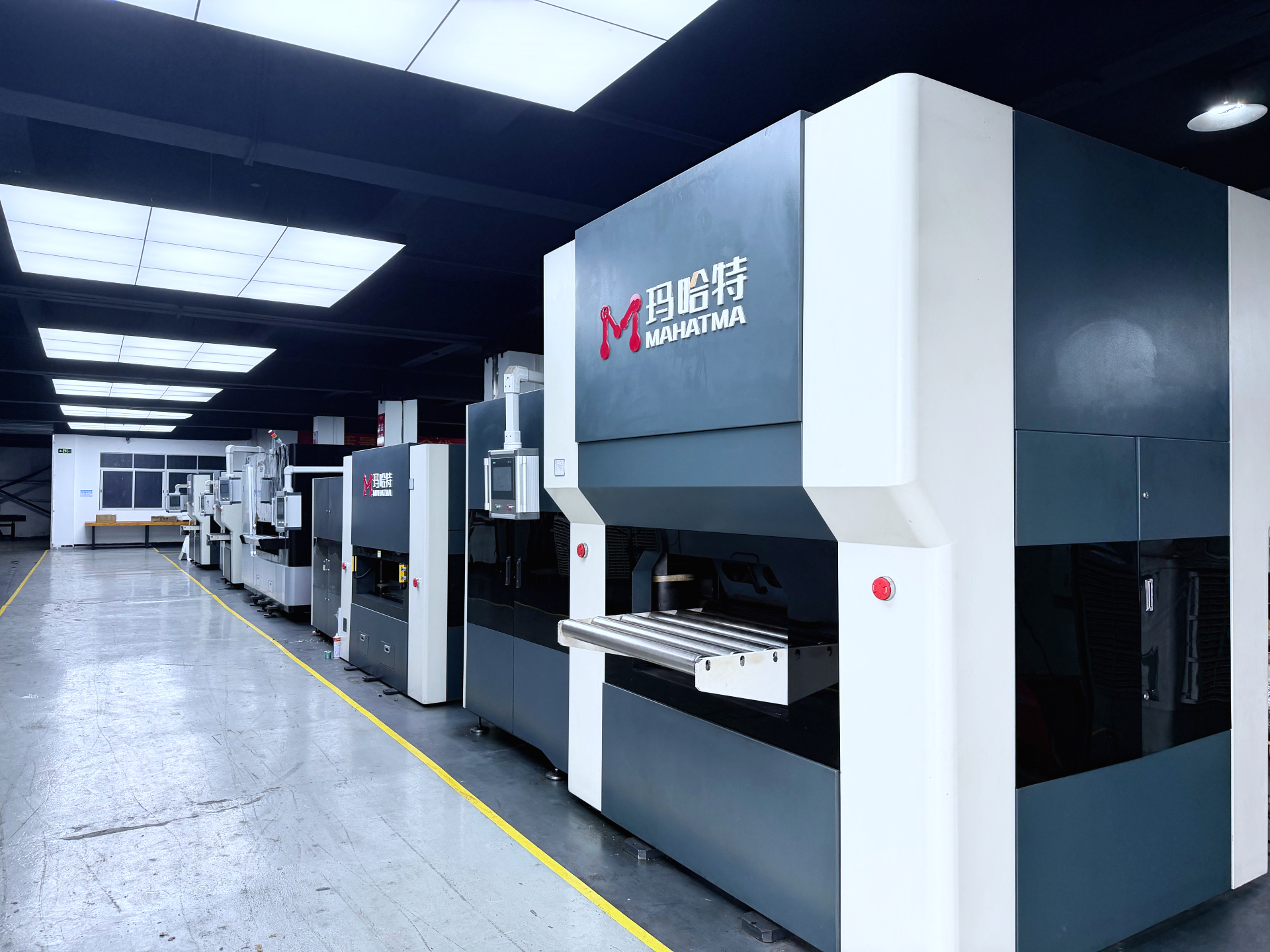
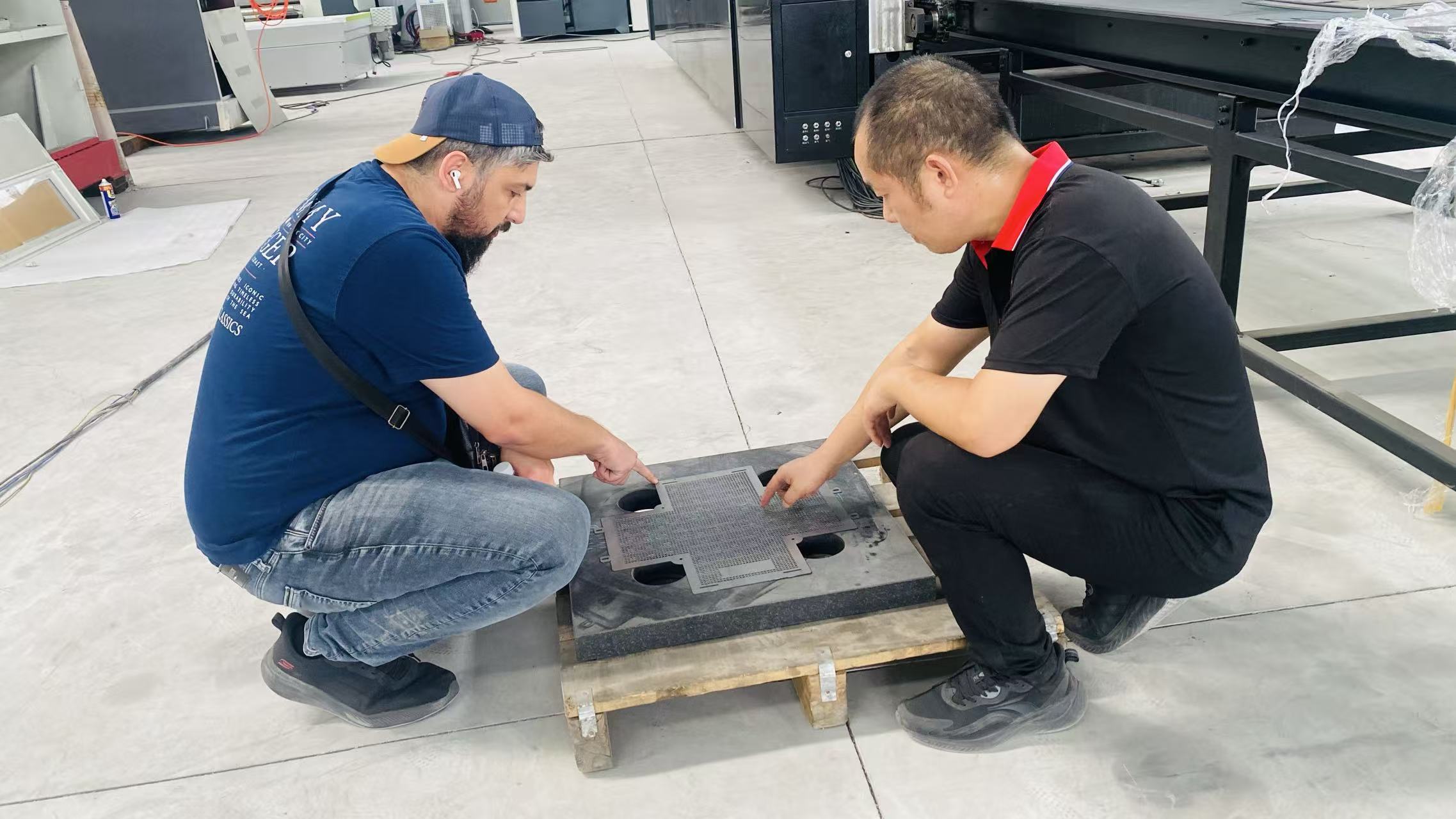
Sample testing and machine trials are carried out on customer material before a configuration is confirmed.
Next Step: Test the Configuration on Your Own Coil
Download the MAHATMA product brochure for full platform and line specifications: MAHATMA Brand Brochure (English, PDF)
To request a free sample test, a configuration proposal or a quotation, contact Guangdong MAHATMA Intelligent Equipment Co., Ltd.
Website: www.leveling-mht.com
Email: mhtg@gdmht.com
Tel / WhatsApp: +86 173-4062-1852
Address: Mahatma Industrial Park, No. 3, Southwest Jiaying 1st Street, Shijie Town, Dongguan City, Guangdong Province, China