Leveler Selection Inside a Coil Processing Line: Two-High, Four-High, CNC Servo & Hydraulic
Leveler Selection Inside a Coil Processing Line: Two-High, Four-High, CNC Servo & Hydraulic
A leveling machine is rarely bought on its own. Inside a coil processing line it is one station in a chain — uncoiler, leveler, shear or laser, stacker — and its roll configuration, drive type and control system decide whether the rest of that chain can hold its own accuracy targets. Leveler selection is therefore a line-fit decision before it is a product decision.
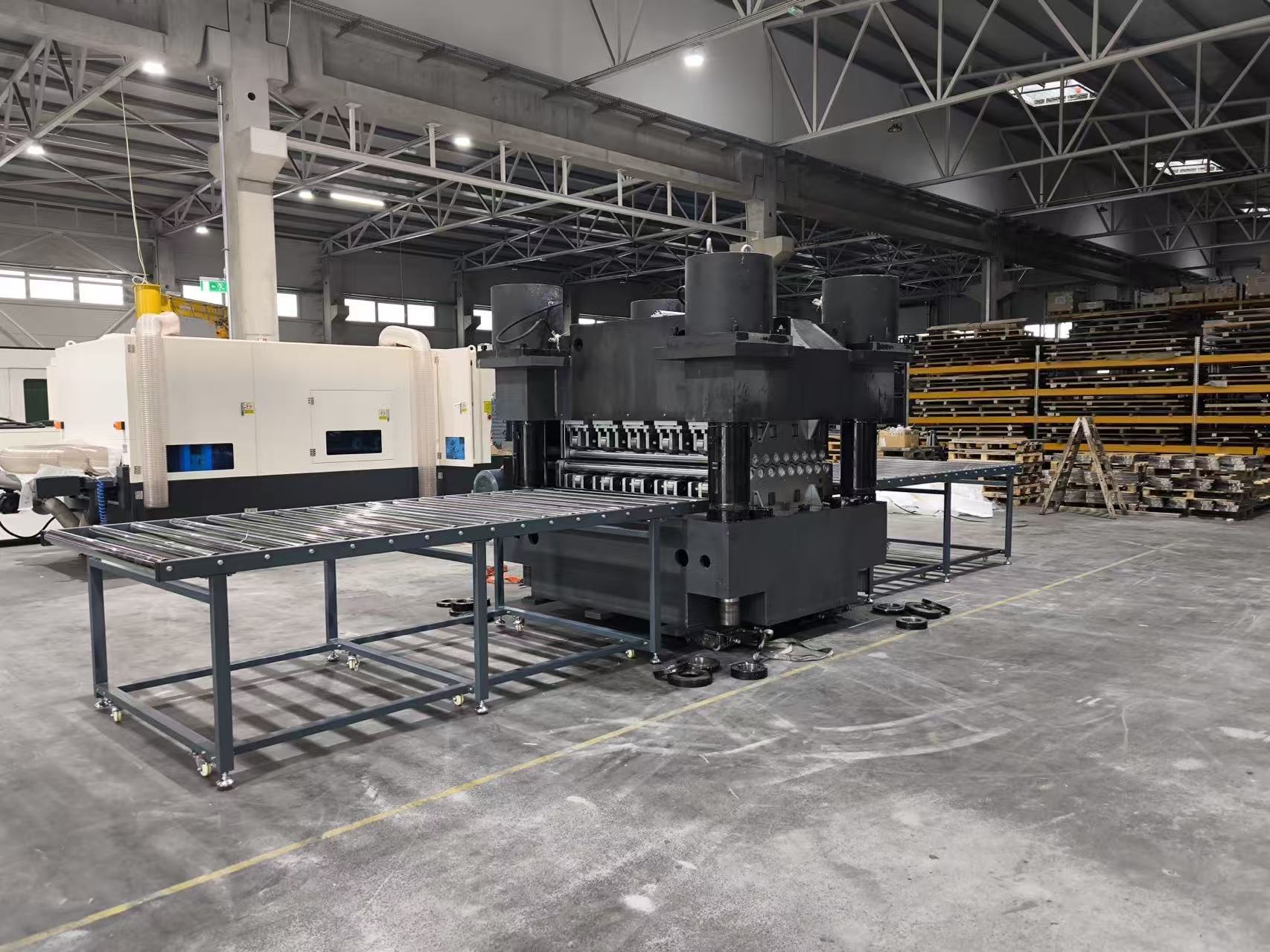
Hydraulic Leveler, MHTR120 Series — one of five leveler families selected against coil line envelopes.
This guide is written for engineers, plant managers and procurement teams in the Evaluation and Execution stages: buyers who already know they need flattening capability and now have to decide which leveler family belongs inside the line they are building or upgrading. It positions the five families built by Guangdong MAHATMA Intelligent Equipment Co., Ltd. — Two-high Leveler / Rough Leveler, Four-high Leveler / Plate Leveler, CNC Leveler, CNC Leveler / Servo Leveler and Hydraulic Leveler — against the lines they most often feed, and works through the mechanical and control parameters that actually decide the match.
MAHATMA is a leveling equipment manufacturer headquartered in Dongguan, Guangdong Province, China, founded in 2008. The company builds sheet metal leveling machines, CNC leveling machines, hydraulic leveling machines, straightening machines, cut-to-length lines, uncoiling leveling slitting lines and uncoiling leveling flying shear lines, and exports to more than 100 countries and regions with 28 overseas marketing and service networks.
Problem Definition: Why Leveler Selection Goes Wrong Inside a Line
Most leveler mis-selections are not caused by a bad machine. They are caused by a specification written in isolation from the line it has to serve. Five failure patterns account for most of them.
1. Specifying by thickness alone. Leveling force scales with thickness and yield strength. Published model ratings are commonly based on Q235 / 235 MPa, so a machine that levels 3 mm mild steel comfortably may be outside its real capacity on 3 mm high-strength steel. Ratings must be recalculated for high-strength steel, aluminium or titanium before a model is fixed.
2. Treating roll count as a quality score. A 33-roll servo leveler and a 9-roll hydraulic leveler are not better or worse versions of each other — they solve different problems. Roll count is a function of the thickness band the machine is designed around, not a prestige number.
3. Assuming servo and hydraulic gap adjustment are interchangeable. One is built for repeatable positioning at low force on thin gauge; the other is built to control position while absorbing very large forces on thick plate. Choosing the wrong one shows up as drift, marking or premature wear.
4. Ignoring the line's dynamic envelope. A leveler matched to a static material sample but not to line speed, coil weight or cut accuracy will bottleneck the entire line. A flying shear line running at 100 m/min, for example, does not pause for the leveler.
5. Signing off without a trial run. A written specification is a claim. A flatness report produced on the buyer's own material is evidence. Buyers who skip the trial run discover the difference after installation.
Industry Background: Why Line-Integrated Leveling Is Under Pressure
Demand for flattening equipment tracks the broader metal forming market, and that market is large and still expanding. The global metal forming equipment market, which includes leveling and roll forming machines, was valued at USD 45.8 billion in 2025, with Asia Pacific accounting for a 42.5% revenue share in the same year. Sheet metal processing equipment alone generated USD 18.36 billion in Asia Pacific in 2025.
The line-level segment is growing in step. The cut-to-length machine market is projected to grow from USD 4.28 billion in 2026 to USD 5.94 billion by 2032, a CAGR of 5.52%. Cut-to-length line systems were estimated at USD 3.42 billion globally in 2024, though published figures vary depending on whether the scope counts full systems or individual machines.
Two structural shifts are shaping how levelers are specified. First, control has become the differentiator: CNC technology accounted for 85.7% of the machine tools market in 2025, which means buyers increasingly compare control architecture — recipe storage, closed-loop correction, MES connectivity — rather than tonnage alone. Second, applications have concentrated: the automotive segment accounted for 41.37% of the sheet metal processing equipment market share in 2026, and automotive work is unforgiving of residual stress and flatness variation.
Supply has also shifted. China's exports of metalworking machine parts increased by 20.6% year-on-year in June 2026, with major destinations including Japan, Russia, the USA, India and Vietnam. That growth sits alongside a generation of long-established European specialists — ARKU Maschinenbau GmbH, recognised as one of the top 500 hidden world market leaders in precision leveling machines in 2025, and KOHLER Maschinenbau GmbH, which reports more than 6,700 reference projects globally in leveling technology as of late 2023. The practical consequence for buyers is a wider supplier field and a greater need for objective, parameter-level selection criteria.
The Five Leveler Families and What Each One Is Built For
MAHATMA organises its leveling range into five families. The families are not tiers of the same machine; each has a distinct structural logic tied to a thickness band.
Two-high Leveler / Rough Leveler (VST series)
A two-layer leveling machine intended for first-pass and rough duty. The series runs from VST42 (rated 0.4–3.0 mm, max 6.0 mm, 19 rolls, width 200–800 mm) through VST70 (1.0–6.0 mm, max 10.0 mm, 13 rolls, 400–1300 mm) and VST90 (2.0–8.0 mm, max 14.0 mm, 13 rolls, 600–1300 mm) to VST120 (3.0–10.0 mm, max 20.0 mm, 13 rolls, 600–1400 mm). Note the structural signature: roll count drops from 19 to 13 as thickness rises, because force capacity replaces bending cycles. Typical applications are small and medium sheet metal shops, hardware production and thick-plate rough leveling where flatness is refined by a later process.
Four-high Leveler / Plate Leveler (VSH series)
A four-layer leveling machine in which backup rolls support the work rolls. The range spans VSH12 (0.03–0.5 mm, max 1.0 mm, 19 rolls, 200–400 mm), VSH20 (0.2–1.5 mm, max 2.0 mm), VSH42 (0.6–3.0 mm, max 5.0 mm), VSH60 (1.0–6.0 mm, max 10.0 mm, 15 rolls) and VSH80 (2.0–8.0 mm, max 14.0 mm, 15 rolls). The extra support layer is the reason small-diameter work rolls can be used without excessive deflection — which is what makes tight flatness possible on thin gauges. These machines are positioned for small and medium sheet metal shops, hardware production and small-batch or low-frequency processing.
CNC Leveler (MHTM series)
The broadest family: an intelligent CNC leveling machine offered in twelve models from MHTM10 (0.03–0.6 mm, max 1.0 mm, 25 rolls, 200–300 mm) to MHTM200 (8.0–30.0 mm, max 40.0 mm, 19 rolls, 1000–3200 mm). Across the series, rated thickness spans 0.03–30.0 mm, maximum thickness spans 1.0–40.0 mm, roll counts run 15–25 and widths run 200–3200 mm. CNC gap setting with stored parameters is the defining feature — material changeover becomes a recipe recall rather than a manual reset.
CNC Leveler / Servo Leveler (MHTW series)
An intelligent servo-CNC leveling machine, and the family with the highest roll counts in the range: MHTW15 runs 33 rolls at 0.08–1.0 mm rated thickness, while MHTW40 and MHTW50 run 23 rolls across 0.6–4.0 mm, and MHTW100 runs 19 rolls at 3.0–12.0 mm with widths to 2100 mm. Servo motor control provides precise roll gap adjustment with PLC parameter memory — the control architecture that suits thin gauge, frequent material changes and surface-critical work.
Hydraulic Leveler (MHTR series)
A servo hydraulic high precision leveling machine and the force-capacity family. MHTR30 runs 23 rolls at 0.5–3.0 mm, MHTR60 runs 21 rolls at 1.0–8.0 mm, MHTR100 runs 15/19 rolls at 3.0–12.0 mm with widths to 3200 mm, and the range extends to MHTR300 (15.0–80.0 mm rated, max 100.0 mm, 9 rolls) and MHTR400 (20.0–100.0 mm rated, max 120.0 mm, 9 rolls, widths to 4000 mm). In heavy configurations, the upper roll is lifted hydraulically with electric gap adjustment. Typical materials include carbon steel, high-strength steel, stainless steel, aluminium, copper, mirror-finish sheet and thick plate.
Mechanical Parameters That Decide the Match
CNC Leveler — roll count and roll diameter are set by the thickness band, not by a quality ranking.
Roll count logic
More rolls means more alternating bending cycles, and alternating bending is what relieves internal residual stress. Fewer, larger rolls means more force capacity but less stress relief per pass. The corpus data shows the pattern clearly: 33 rolls at 0.08–1.0 mm in the MHTW15, 23 rolls at 0.5–3.0 mm in the MHTR30, and 9 rolls at 20–100 mm in the MHTR400.
The practical rule for a line: if the failure mode you are solving is shape defect — coil set, edge wave, centre buckle — roll count and roll support structure dominate. If the failure mode is a part that will not sit flat because internal stress releases during downstream cutting, roll count still matters, but only when the machine also has enough force to bend the material at that gauge.
Roll diameter and structure logic
Two-high and four-high are structural answers to the same problem: small work rolls bend less material at lower force but deflect more under load. A four-high structure adds backup rolls that support the work rolls, sharply reducing deflection and improving flatness — this is why four-layer machines handle thin, wide, surface-critical sheet better than a two-layer machine of similar footprint. Six-high structures add intermediate rolls so the work rolls are almost fully supported; that level of rigidity is what mirror-finish and precision-part work demands.
At the other end of the range, thick plate leveling is a force problem. A 100 mm plate demands enormous bending moment, so everything scales up: roll diameters in the 300–400 mm class, massive frames, high-power drives and servo-hydraulic gap control to absorb load shocks. Minimum workpiece length also becomes a constraint in heavy configurations — for the thick-plate series it falls in the 480–610 mm range, which matters if your line produces short blanks.
Roll material is a selection variable, not a fixed given. MAHATMA customises roll material — Cr12MoV and SKD11 are among the options — alongside roller width and diameter and the leveling thickness range. Industry specifications for heavy-duty leveling of 0.6–4 mm plate commonly call for HRC60–64 hardened rollers to prevent deformation under continuous load.
Flatness targets drive the family choice
Flatness in precision leveling is quantified either as a dimensionless I-unit or as a height deviation in mm/m. DIN EN 10029 is a widely referenced standard for tolerances on dimensions and shape in hot-rolled steel plate, and precision levelers apply alternating bending technology to remove internal residual stress against that class of requirement.
MAHATMA's precision series achieve flatness down to ±0.05 mm — a verified case recorded 0.05 mm on titanium fixtures — with a typical production result of 0.05–0.20 mm/m². High-end CNC specifications for thin plate are sometimes quoted in the ±0.01 mm class. The honest caveat, and one that belongs in any specification discussion: final flatness depends on material grade, thickness and the original condition of the coil, which is why achievable flatness should be confirmed on the buyer's own material rather than assumed from a brochure.
Control Parameters: Servo Versus Hydraulic Gap and Tilt Adjustment
Hydraulic level adjuster — gap and tilt positions are set per material and stored as recipes.
In a roller leveler, the entry gap is set tighter than the exit gap so that bending curvature decreases progressively along the roll train, and a cross-tilt correction compensates for edge-to-edge flatness asymmetry. Both the gap and the tilt position have to be repeatable, because they are re-set every time the material, thickness or flatness target changes. How that positioning is powered is the servo-versus-hydraulic decision.
Servo gap adjustment (MHTW series). Servo motor control delivers precise roll gap adjustment with PLC parameter memory. On thin and medium gauge, the force involved is modest and the bottleneck is positioning repeatability — so servo adjustment, combined with high roll counts, gives fast changeover and consistent results across frequent material changes. This is the architecture for laser blanking pre-flattening, 3C electronics, home appliance panels and precision sheet metal.
Hydraulic gap adjustment (MHTR series). Servo-hydraulic control keeps the roll position stable while very large forces pass through the gap, absorbing load shocks that would move a purely mechanical setting. On thick plate and high-strength material, the bottleneck is frame and roll deflection rather than positioning resolution, so hydraulic actuation with a rigid frame is the appropriate choice. Thick-plate selection also routinely involves servo-hydraulic gap control specifically to absorb shock loading.
MAHATMA's control layer sits on top of either architecture: laser 3D online flatness detection with real-time parameter correction on precision models, backed by self-developed intelligent leveling control and more than 230 national patents. In practice this is what makes the difference between a machine that can hold a flatness number and a line that can hold it across a shift.
Matching the Leveler to the Line It Feeds
The single most useful selection move is to stop evaluating the leveler as a standalone machine and start with the line envelope: what thickness and width the line will actually run, at what speed, and at what cut accuracy. The leveler must cover the line's full envelope — including the thinnest and thickest material, not the average.
| Coil processing line | Model | Material thickness | Material width | Other line data |
|---|---|---|---|---|
| Uncoiling Leveling Slitting Line | UC-2x2000 | 0.3–2.0 mm | 500–1800 mm | 8–30 slit strips; max feed 200 m/min; coil to 20 T |
| Uncoiling Leveling Flying Shear Line | MF-3 | 0.3–3.0 mm | 400–1800 mm | Shearing accuracy 0.5 mm; feed 100 m/min; coil to 25 T |
| Cut-to-Length Line | TD-2x2000 | 0.2–2.0 mm | 900–1800 mm | Shearing accuracy ±0.5 mm; max speed 50 m/min; coil to 20 T |
| Uncoiling Leveling Laser Blanking Line | TL-T3 | 3.0–12.0 mm | 600–2800 mm | Speed 25 m/min; laser power 2000–20000 W |
| Leveling & Deburring Line | Customized / On request | 0.5–80 mm | 600–1300 mm | Speed 20 m/min; min part 50x50 mm; accuracy 0.1–0.3 mm |
Slitting Line (UC-2x2000)
A slitting line converts wide coil into narrow strip at up to 200 m/min across 8–30 strips, on carbon steel, cold-rolled and hot-rolled steel, stainless, silicon (electrical) steel, aluminium alloys and copper alloys. The leveler's job here is to remove coil set and relieve stress before slitting, so the slitter does not inherit camber and the recoiler does not inherit strip with memory. Because the strip is thin and running fast, positioning repeatability and surface protection matter more than force: the CNC Leveler / Servo Leveler family in the 23-roll class is the natural starting point, with CNC Leveler models as the wider-range alternative. Verify width against the line's 1800 mm maximum and confirm the roller width specification if a standard model stops short.
Flying Shear Line (MF-3)
A flying shear line never stops the strip — it reaches 100 m/min and shear accuracy of 0.5 mm on 0.3–3.0 mm stainless, aluminium and GI coil. That matters to leveler selection because the leveler cannot be a bottleneck: it must run continuously at line speed while holding flatness tight enough that cut length stays accurate. The match is a medium-roll-count CNC or servo-CNC machine in the 0.6–4.0 mm band, so the leveler's rated range brackets the line's 0.3–3.0 mm envelope with margin at the thin end.
Cut-to-Length Line (TD-2x2000)
A cut-to-length line runs 0.2–2.0 mm coil at widths of 900–1800 mm to ±0.5 mm shearing accuracy at up to 50 m/min, with coils to 20 T. The 0.2 mm floor is the demanding part of this specification: thin gauge needs small-diameter, closely spaced work rolls with strong backup support to avoid deflection, and the mix of 0.2 mm and 2.0 mm in one line sits across more than one standard envelope. This is a case where MAHATMA's customization option — leveling thickness range, roller width and diameter specified to the line — is the correct answer rather than forcing a standard model to cover both ends.
Laser Blanking Line (TL-T3)
A laser blanking line processes 3.0–12.0 mm material at widths of 600–2800 mm with laser power from 2000 to 20000 W. Here the leveler protects the laser, not the other way around: flatness variation changes focus height and nesting accuracy, and residual stress released after cutting distorts the blank. The thickness band and the width requirement point to the hydraulic family — the MHTR100 Hydraulic Leveler covers 3.0–12.0 mm rated thickness (max 30.0 mm) at widths of 600–3200 mm with 15/19 rolls, which brackets the line envelope on both axes.
Leveling & Deburring Line
This line is specified as custom, and for good reason: it spans 0.5–80 mm thickness at 600–1300 mm width, 20 m/min, with a minimum part size of 50x50 mm and an accuracy of 0.1–0.3 mm. No single leveler covers a 0.5–80 mm span well. Selection here is per thickness band: the thin end maps to CNC or servo-CNC machines, while the thick end maps to the hydraulic series up to the heavy models. Buyers should define the band the line will actually run, not the theoretical maximum.
Step-by-Step: From Material Envelope to Signed Specification
- Fix the material envelope. Thickness minimum and maximum, width minimum and maximum, material grades with yield strength, and coil weight. Ratings based on Q235 / 235 MPa must be recalculated for high-strength steel, aluminium or titanium.
- Fix the flatness target and its measurement method. Express it in I-unit or mm/m, state the measurement position and method, and define whether laser 3D online flatness detection is required as part of the acceptance evidence.
- Map the envelope to a leveler family. Rough duty, plate duty, general precision CNC, thin-gauge servo-CNC, or high-force hydraulic. Confirm the line's full envelope is bracketed, not just the common gauge.
- Set the roll configuration. Roll count and diameter for the thickness band; roll material (Cr12MoV, SKD11 and other options); for heavy plate, confirm minimum workpiece length, crane capacity and foundation requirements early.
- Choose the gap and tilt control system. Servo adjustment with PLC parameter memory for thin and medium gauge and frequent changeovers; servo-hydraulic gap control where large forces and load shocks dominate. Confirm how many material recipes must be stored.
- Confirm line integration before the purchase order, not after. MAHATMA blanking lines and CNC levelers provide MES/ERP interfaces, and automation modules — loading carts, conveyors, robots, vision inspection, AGV — are added as standard options. Provide part envelope, takt target and current line layout early, because the integration plan is engineered from those inputs. Also fix the electrical specification at order: standard machines are built for 380V / 50Hz, while the EU runs 400V / 50Hz, the US 480V / 60Hz, Japan 200V and some Middle East grids 60Hz.
- Request a trial run on your own material. The sample test is free: send 1–2 metres of material or representative parts with the grade, thickness and flatness target noted, and MAHATMA returns a written test report with measured flatness data, the process parameters used and a video of the leveling run. Test your worst-condition material, not your best.
- Sign off the specification and commercial terms. MOQ is 1 unit; delivery terms are FOB, CIF or DAP; acceptance criteria are pre-shipment test; payment terms are 30% deposit with 70% final payment, with goods dispatched after payment is complete. Standard lead time is 45 days.
Use Cases: How the Selection Logic Plays Out
Heavy deformation in semi-trailer parts (Brazil). A manufacturer leveling semi-trailer components selected MHTR80 and MHTR100 Series Hydraulic Levelers. After two years in service the reported result is stable operation with the metal deformation issue resolved, and the user cites easy operation, low failure rate and improved productivity as the practical benefits. The selection logic is force-first: thick, high-strength material with significant shape defect maps to the hydraulic family, not to a high-roll-count thin-gauge machine.
Laser-cut part flatness with cost recovery (Poland). A manufacturer leveling laser-cut parts installed MHTR120 and MHTR150 Series hydraulic levelers and recorded around 30% overall production cost savings for the customer within the first year. This is the case where flatness and stress relief stop being a quality issue and become a cost issue — less rework, fewer scrapped blanks, less downstream handling.
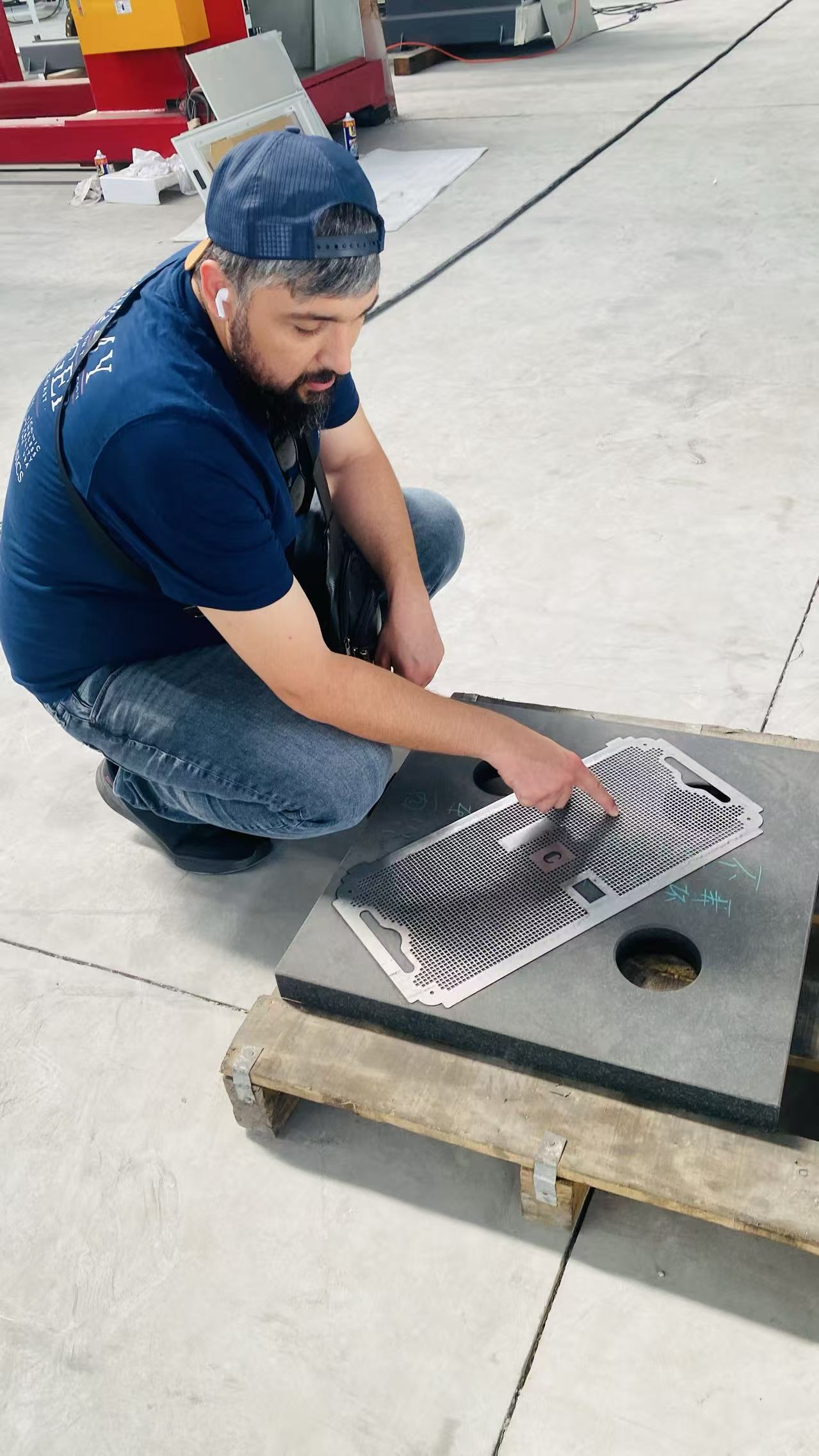
Perforated metal sheet deformation (Türkiye). A manufacturer producing perforated ceiling plate used an MHTM40 Series CNC Leveler to solve deformation in perforated sheet. Perforated material is a good illustration of why roll support structure matters: the open area changes the local stiffness of the sheet, and a leveler with adequate backup support and CNC gap control handles that variation better than a rigid mechanical setting.
Mesh board leveling (Germany). A German manufacturer leveling mesh board reported 50% cost savings using an MHTR80 Series Hydraulic Leveler. Mesh and expanded materials are among the hardest to flatten consistently, and the selection again follows force and control rather than maximum roll count.
Stainless capacity expansion (Malaysia). A manufacturer leveling SS304 with MHTR100 and MHTR120 Series machines recorded 150% capacity expansion — a reminder that in Execution-stage projects the leveler is often the constraint that limits line throughput, not the shear.
Comparison Table: Five Leveler Families Side by Side
| Leveler family | Machine type | Series range | Rated thickness | Max thickness | Rolls | Width range |
|---|---|---|---|---|---|---|
| Two-high Leveler / Rough Leveler | Two-layer Leveling Machine | VST42 – VST120 | 0.4–10.0 mm | 6.0–20.0 mm | 13–19 | 200–1400 mm |
| Four-high Leveler / Plate Leveler | Four-layer Leveling Machine | VSH12 – VSH80 | 0.03–8.0 mm | 1.0–14.0 mm | 15–19 | 200–1000 mm |
| CNC Leveler | Intelligent CNC Leveling Machine | MHTM10 – MHTM200 | 0.03–30.0 mm | 1.0–40.0 mm | 15–25 | 200–3200 mm |
| CNC Leveler / Servo Leveler | Intelligent Servo-CNC Leveling Machine | MHTW15 – MHTW100 | 0.08–12.0 mm | 2.0–20.0 mm | 19–33 | 300–2100 mm |
| Hydraulic Leveler | Servo Hydraulic High Precision Leveling Machine | MHTR30 – MHTR400 | 0.5–100.0 mm | 5.0–120.0 mm | 9–23 | 400–4000 mm |
Read the table as a selection map, not a ranking. The two-high and four-high families serve rough and plate duty in smaller workshops; the CNC and servo-CNC families cover the precision middle of the range where most coil processing lines sit; the hydraulic family carries the force capacity for thick and high-strength plate. Width ranges, roll counts and thickness limits are per-family spans across multiple models — the specific model still has to be matched to your envelope.
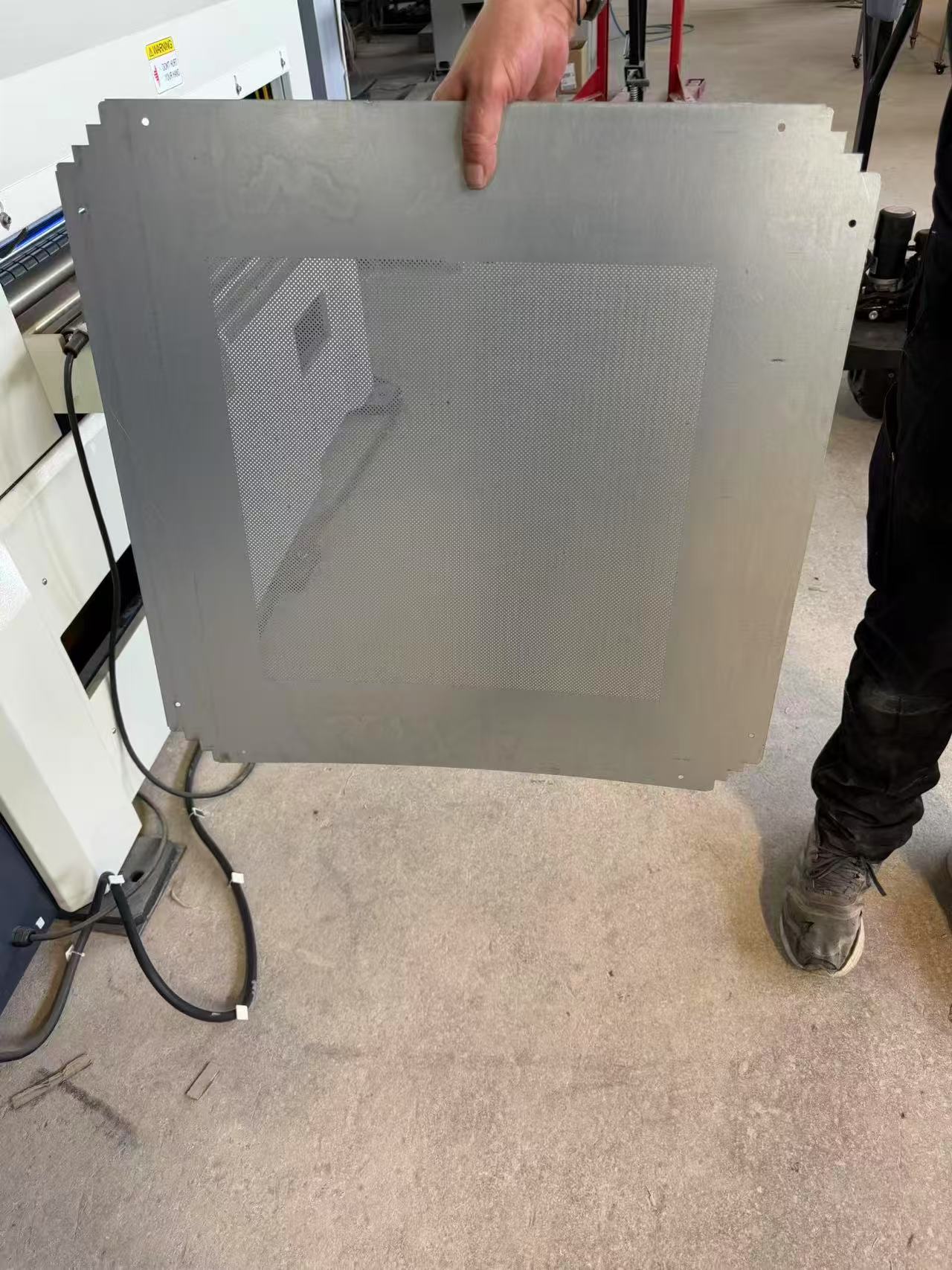
CNC Leveler, MHTM30 Series — an example of the precision middle of the range used in laser blanking and sheet metal work.
Frequently Asked Questions
Does a MAHATMA leveler integrated into a coil processing line meet the compliance requirements for the EU and for North America?
For the European market, MAHATMA holds a CE Machinery Directive Attestation of Conformity — certificate M.2025.206.C113032, issued by UDEM International Certification Auditing Training Centre Industry and Trade Inc., valid from 16 January 2025 to 15 January 2030, with the scope covering hydraulic precision leveling machines and referencing EN ISO 12100:2010, EN ISO 16090-1:2020, EN ISO 16090-1:2022, EN ISO 16092-2:2020 and EN 60204-1:2018. Quality management is certified to GB/T19001-2016 / ISO 9001:2015 under certificate 62825Q9729R0M, issued by Zhongtian Hongtu International Certification Co., Ltd., valid from 27 May 2025 to 26 May 2028, covering the design and assembly of high-precision leveling machines, uncoiler laser blanking lines and automatic shearing lines. North America has no CE equivalent: US and Canadian plants typically require 480V / 3-phase / 60Hz configuration ordered at the factory, electrical panels built to NFPA 79, and may require an NRTL (UL, ETL or CSA) field evaluation by the local authority having jurisdiction — confirm with the supplier who covers field evaluation costs before signing.
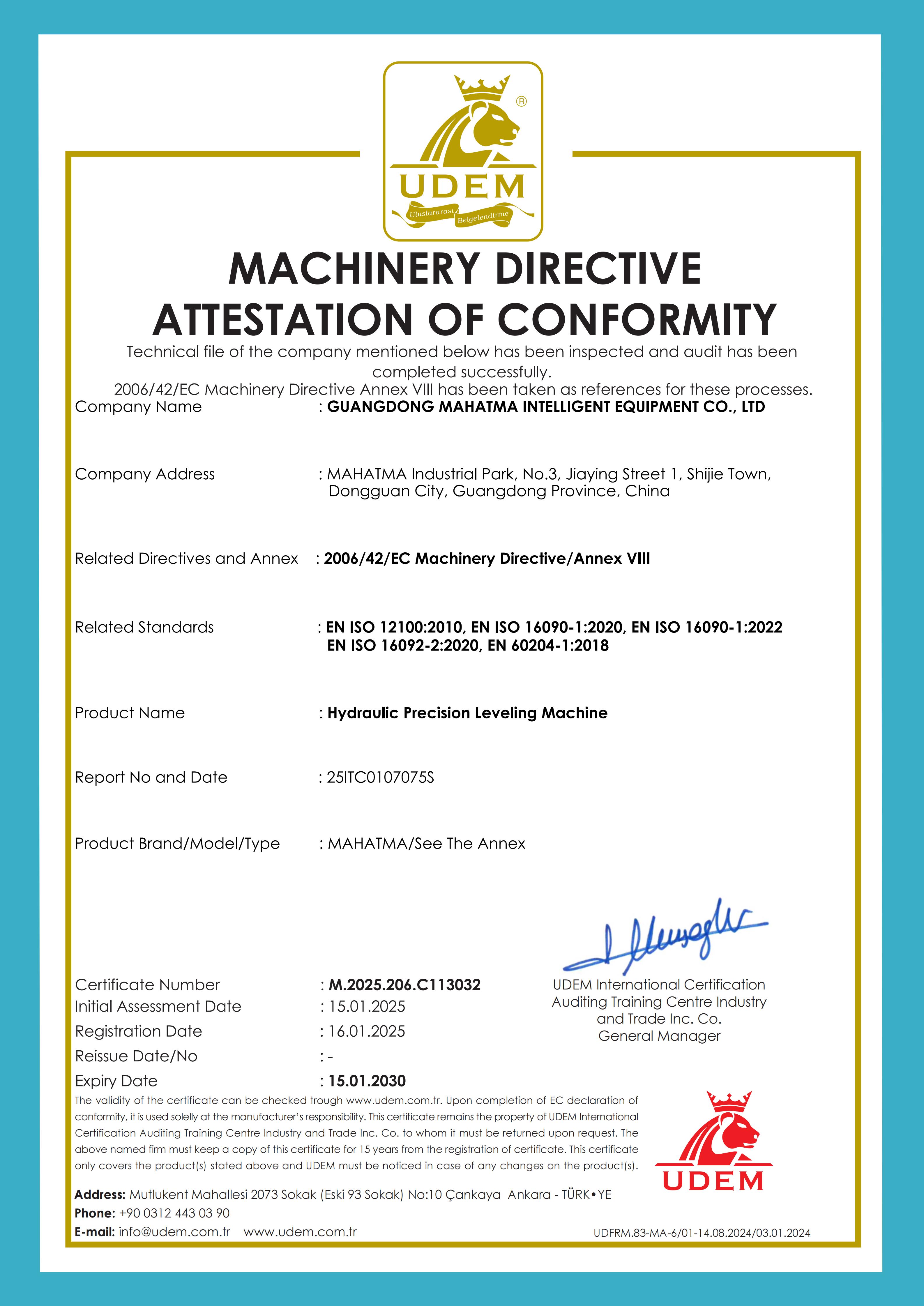
CE Machinery Directive Attestation of Conformity — valid to 15 January 2030 for hydraulic precision leveling machines.
Can the leveler be matched to my existing line and integrated with my MES/ERP?
Yes. MAHATMA blanking lines and CNC levelers provide MES/ERP interfaces, and automation modules — loading carts, conveyors, robots, vision inspection and AGV — are added as proven standard options. Customization covers roller width and diameter, leveling thickness range, roll material such as Cr12MoV or SKD11, control system integration (MES/PLC) and automated loading and unloading systems. Because MAHATMA engineers integrated lines rather than standalone machines, the integration plan starts from your part envelope, takt target and current line layout; reference cases include Zhucheng Group's fully automated upgrade, while a Jiangsu NEV parts maker recorded approximately 45% capacity gain after integration. The upgrade path is modular — start with a leveler and add feeding and stacking automation later. Note that the electrical supply must be specified at order: standard machines run 380V / 50Hz, with EU, US, Japanese and Middle East grids configured at the factory.
What drives the budget, and what are the standard commercial terms?
Budget is driven by the material envelope and the control specification, not by brand tier. Four cost drivers dominate: rated thickness and width (which set frame size, roll diameter and drive power); roll configuration and roll material; the gap and tilt control system (servo versus servo-hydraulic); and the level of line integration, including MES/ERP interfaces and automation modules. Because MAHATMA offers customized manufacturing, roller width and diameter and the leveling thickness range can be specified so the machine matches the line rather than exceeding it. Standard commercial terms are: MOQ 1 unit; delivery terms FOB, CIF or DAP; acceptance criteria pre-shipment test; payment terms 30% deposit with 70% final payment, with goods dispatched after payment is complete.
Can I test my own material on the machine before I sign the specification?
Yes — the sample test is free. Send 1–2 metres of your material or representative parts, with the material grade, thickness and your flatness target noted, and MAHATMA levels it on the recommended machine, then returns a written test report with measured flatness data, the process parameters used and a video of the leveling run; your material is returned or retained as agreed. You only cover shipping of your material. Test your worst-condition material rather than your best, because published model ratings are based on Q235 / 235 MPa and must be recalculated for high-strength steel, aluminium or titanium — the trial run is the point at which a paper specification becomes evidence.
What is the lead time and production capacity for a custom-configured leveler?
Standard lead time is 45 days, supported by a monthly capacity of 50 units at a 50,000 m² manufacturing base in Dongguan, Guangdong Province, with 300 employees and a 26-engineer R&D team. Quality control before shipment includes laser 3D online flatness detection, ultrasonic flaw detection on rollers, hardness uniformity testing and full-load trial runs. After-sales support is 24/7 global technical support with overseas engineers available for commissioning, regional spare parts warehouses and free operator training. MAHATMA operates 28 overseas marketing and service networks and exports to more than 100 countries and regions. To start a lead-time and configuration discussion, send your material envelope and flatness target to the team at mhtg@gdmht.com.
Conclusion: Select the Line First, the Leveler Second
The leveler that belongs in a coil processing line is the one whose rated envelope brackets the line's material range, whose roll configuration matches the failure mode you are actually solving, and whose control architecture is appropriate to the force involved. Two-high and four-high structures answer rough and plate duty through roll support geometry. CNC and servo-CNC families answer the precision middle of the range through repeatable positioning and recipe storage. The hydraulic family answers thick, high-strength and wide material through force capacity and load-shock absorption.
The selection sequence that avoids the common failures is straightforward: fix the material envelope including yield strength, fix the flatness target and how it will be measured, map the envelope to a family, set roll count, diameter and material, choose servo or servo-hydraulic gap control, confirm MES/ERP and electrical integration before the purchase order, run a trial on your own material, and only then sign the specification. Buyers who follow that order rarely end up with a leveler that is technically excellent and operationally wrong for the line behind it.
Test the Selection on Your Own Material
Send 1–2 metres of your coil or representative parts with the grade, thickness and flatness target, and MAHATMA will run the leveler and return a written flatness report, the process parameters used and a video of the run — free of charge. Ask for the machine catalogue, a configuration proposal or a quote at the same time.
Email: mhtg@gdmht.com | Tel / WhatsApp: +86 173-4062-1852 | Address: Mahatma Industrial Park, No. 3, Southwest Jiaying 1st Street, Shijie Town, Dongguan City, Guangdong Province
Visit MAHATMA Download the Product Catalogue (PDF) Message on WhatsApp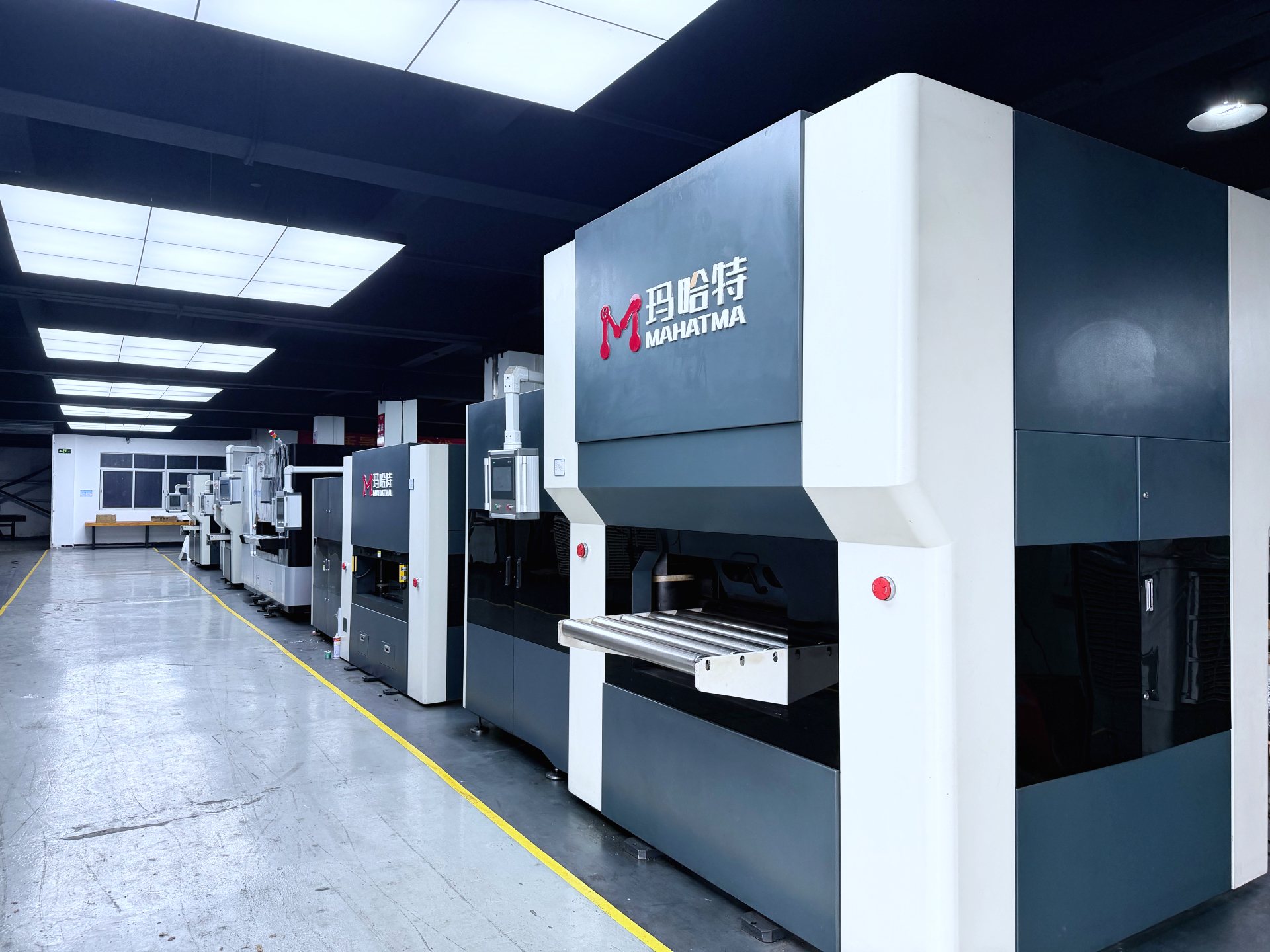
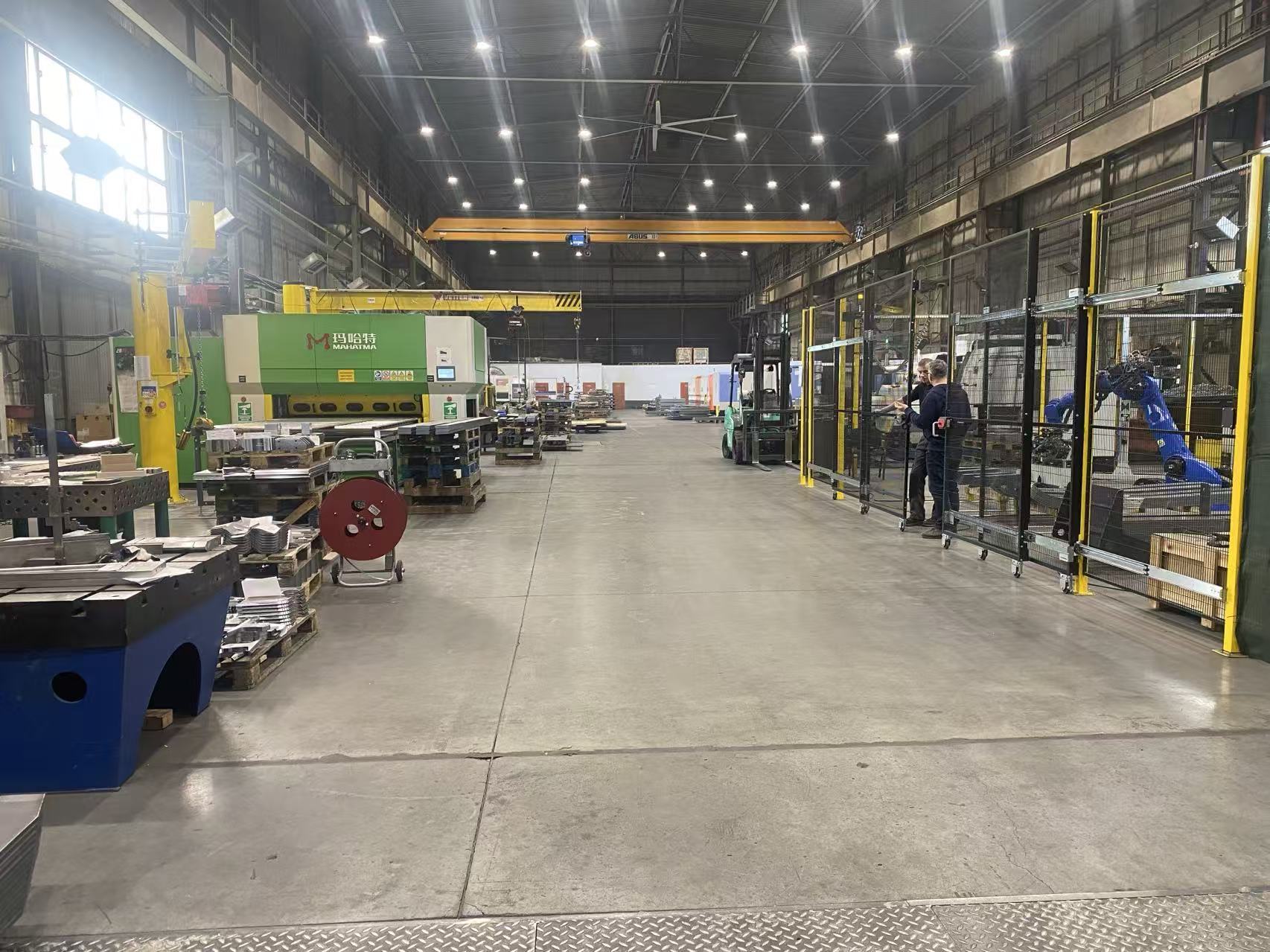
Product demonstration area — where trial runs on buyer material are performed before specification sign-off.
Have Questions or Need More Details?
Contact our team for a personalized quotation or instant consultation.
Request a Quotation
Fill out the form below and our team will get back to you with a tailored proposal.
WhatsApp Direct Chat
Prefer to chat in real-time? Message us on WhatsApp for instant assistance & quick answers.
- Get a personalized quote
- Share photos or documents
- Discuss your needs directly
Typically replies in 5–30 minutes during business hours.