Leveling Machine Integration: MES/ERP and Material Trial Questions
Retrofit integration guide · Decision to execution
A leveling machine bought for an existing production line is judged on three things that never appear on a specification sheet: whether it physically fits the line, whether it exchanges the right data with the plant's MES/ERP, and whether the supplier will prove flatness on your own material before you sign. This article is the question set to take into that meeting.
Leveling machine projects are rarely greenfield. The buyer already runs a slitting line, a flying shear line, a cut-to-length line, a laser blanking cell or a leveling and deburring line, complete with a line PLC, a production plan, a maintenance schedule and a quality record. Adding flattening capacity into that environment turns a machine purchase into an integration project, and the integration questions decide the outcome far more often than the leveling principle itself.
MAHATMA Leveler is the brand of Guangdong MAHATMA Intelligent Equipment Co., Ltd., a high-tech equipment manufacturer founded in 2008 and headquartered in Dongguan, Guangdong Province, China, producing sheet metal leveling machines, CNC leveling machines, hydraulic leveling machines, straightening machines, cut-to-length lines, uncoiling-leveling-slitting lines and uncoiling-leveling flying shear lines. On its blanking lines and CNC levelers, MES/ERP interfaces are provided and automation modules are offered as proven standard options — which makes the company a useful reference point for the questions below, whichever supplier a buyer finally chooses.
Problem Definition: integration risk sits in four places, not one
When a leveler is evaluated as a standalone box, the comparison is thickness range, roll configuration and rated flatness. When the same machine must sit behind an existing uncoiler and ahead of an existing shear, stacker or laser cutter, four separate interfaces take over the risk profile.
- Mechanical and layout fit. Pass-line height at entry and exit, distance to the uncoiler and to the next station, coil car access, foundation and crane capacity, and space for drop-out or scrap removal.
- Control and safety handover. How the leveler's PLC exchanges signals with the line PLC, how line speed is matched, how interlocks and emergency stops are architected, and whether guarding follows the risk-assessment logic of EN ISO 12100.
- Data and traceability. Which production data, order scheduling information and quality records travel between the leveler and the plant MES/ERP, and where material recipes are stored and edited.
- Material proof. Whether flatness and stress relief are demonstrated on the buyer's own coil before the purchase order, rather than on a demonstration material selected by the supplier.
All four can be closed out before signing. The failure mode is not technical difficulty; it is that the questions are asked after the machine has been ordered, when layout, voltage, guarding and data scope have already been fixed at the factory.
Industry Background: why integration questions now dominate leveler buying
The commercial context has shifted toward programmable, connected equipment. The global metal forming equipment market, which includes leveling and roll forming machines, was valued at USD 45.8 billion in 2025 according to Dataintelo, and Fortune Business Insights projects the metal forming machine tools market to reach USD 64.85 billion by 2034. Within that broad category, the Cut to Length Line System market alone was estimated at USD 3.42 billion in 2024 by Market Research Future — evidence that buyers are purchasing line-level systems rather than isolated machines.
Two adoption signals reinforce the same point. CNC technology accounted for 85.7% of the machine tools market in 2025 (Grand View Research), which sets an expectation that a new machine will store parameters, switch recipes and export data. And the automotive segment accounted for 41.37% of the sheet metal processing equipment market share in 2026 (Fortune Business Insights), a sector where flatness records are increasingly traced to a specific coil, a specific order and a specific machine setting.
The practical consequence for a buyer adding a leveler to an existing line is straightforward: the leveler is now a node in a production system. Its value depends on how well it hands material, signals and data to the stations around it.
Detailed Solution: the supplier question set, organised by line type
The most efficient way to run the evaluation is to ask questions in the order the material flows. Each line type imposes a different set of constraints on the leveler, and each maps to a different leveler family.
When the leveler joins a slitting line
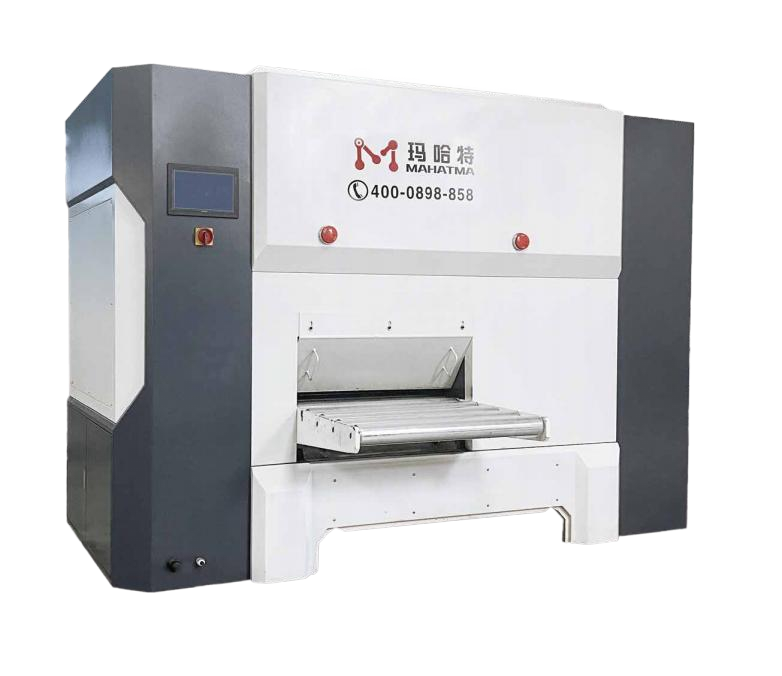
A slitting line is specified by five numbers: material thickness range, coil width, strip count, line speed and coil weight. MAHATMA's slitting range covers 0.2–12 mm — the UC series for 0.2–2 mm thin strip at up to 250 m/min and up to 30 strips, the TC series for 0.3–4 mm, and the MC series for 1–12 mm heavy strip. Beyond those numbers, three subsystems decide whether an integrated leveler helps or hinders: knife shaft rigidity and tooling for burr control, tension control between the slitter and the recoiler for strip straightness, and whether a leveling unit is needed at all for flatness-critical strip. MAHATMA offers CNC or hydraulic leveling units as line options, with coil car, turnstile and scrap winders completing the layout.
Questions to put to the supplier: Where does the leveler sit relative to the slitter, and does that position change the tension architecture? What pass-line height must the leveler match? Does the leveler receive a speed reference from the line PLC or run on its own drive? If the leveler is added later, which mechanical interfaces must be reserved now?
When the leveler joins a flying shear line
Flying shear is the correct answer for thin-gauge, high-volume work in long runs of few sizes — appliance panels, elevator panels, automotive inner panels. MAHATMA's UF and MF series never stop the strip, reaching 100 m/min and 250 cuts per minute. Both come with decoiler, precision leveler, shear, stacker and MES interface as a configured line.
Questions to put to the supplier: How is the cut signal synchronised with strip speed at the leveler exit? What cut-to-length accuracy is committed at the stacker, and how does leveler flatness affect it? Which MES data points are produced by the shear versus the leveler? If our existing stacker stays in place, what interface work does that require?
When the leveler joins a cut-to-length line
Where material runs thicker — up to 25 mm — or where sizes change constantly, the cut-to-length line trades some speed for range and flexibility. MAHATMA's TD, MD and HD series cover 0.2–25 mm at ±0.5 mm accuracy, with decoiler, precision leveler, shear, stacker and MES interface in the same configuration logic.
Questions to put to the supplier: Given our monthly tonnage and size-change frequency, which of the two line architectures actually applies? What is the changeover sequence when the material changes from thin to thick within a shift? Which parameters are stored as recipes and which still require manual setting?
When the leveler joins a laser blanking line or an existing laser cutter
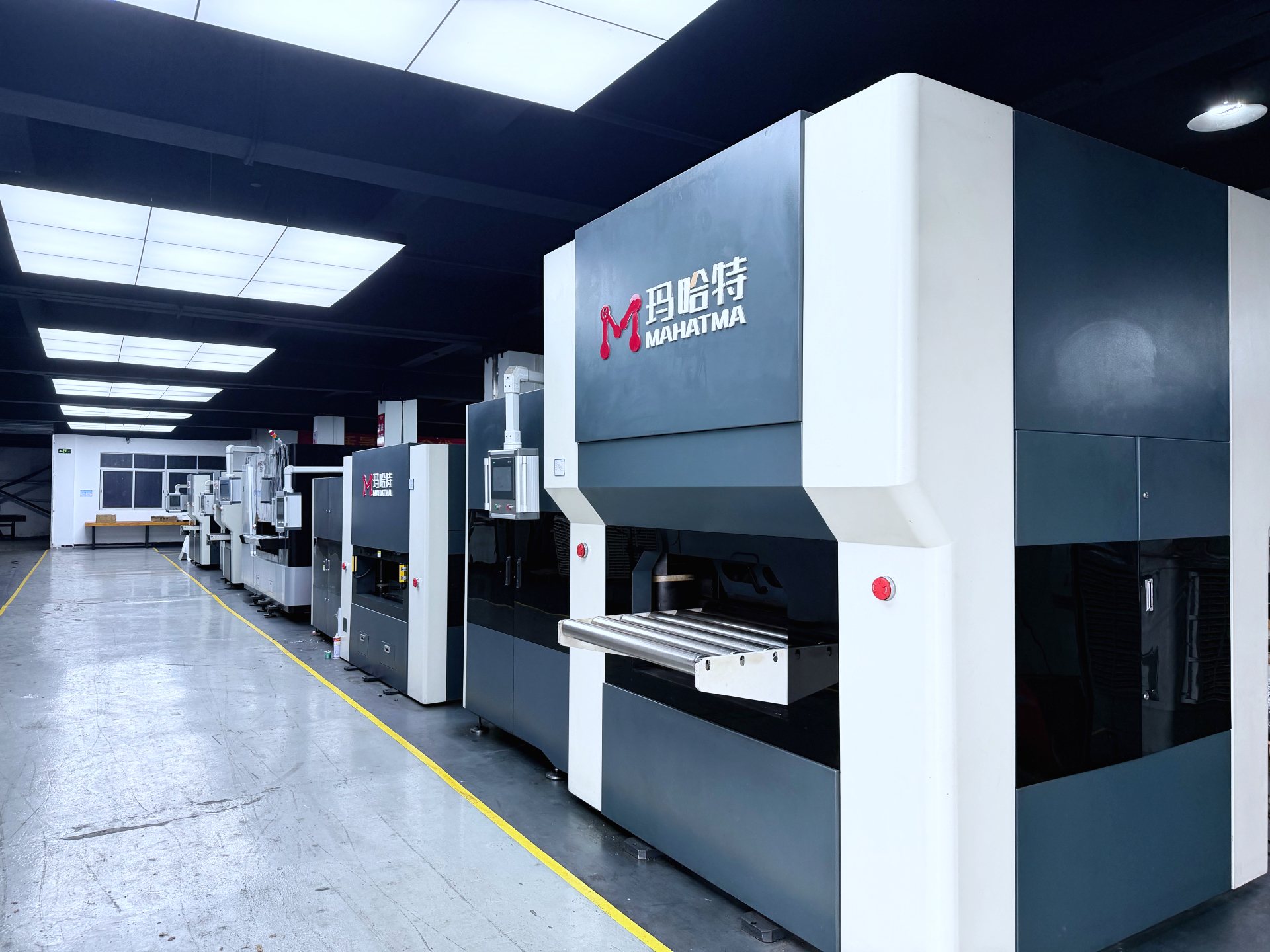
This is the most common retrofit case in job shops. The leveler's job is to remove coil set, waves and internal stress so the laser's focus height and nesting stay accurate. Most laser shops run 0.5–6 mm carbon steel, stainless and aluminium, which maps to MAHATMA Mastery MHT30–MHT80 series machines — 23-, 21- and 19-roll, four-high capable CNC levelers. CNC gap adjustment with recipe storage matters here because changeover between materials then takes seconds instead of trial-and-error, and shops with precision-critical parts can step up to the Wits MHTP series with laser 3D inspection. Crucially, coil feeding, leveling, conveying and stacking modules can be engineered around an existing laser cutter and the current equipment layout, rather than requiring the laser to be relocated.
Questions to put to the supplier: Can the feeding, leveling and stacking modules be built around our existing laser cell and floor plan? Who owns the handshake between the leveler and the laser's control system? How is blank stacking matched to laser takt? What happens to the line if the leveler is down for maintenance?
When the leveler joins a leveling and deburring line
In combined leveling and deburring configurations, the leveler is no longer the last station: it sets the flatness and stress state that the deburring head and the downstream handling must work with. Integration questions here focus on sequence and stability rather than on leveling force alone — how much flatness variation the deburring station can absorb, whether the leveler runs continuously or in batches, and how the two stations share guarding and extraction.
Detailed Solution: the MES/ERP question set
On MAHATMA blanking lines and CNC levelers, MES/ERP interfaces are provided, and production data, traceability and order scheduling integrate with the plant's existing systems. The questions below are designed to convert that general statement into a defined scope before the purchase order.
- Which data actually leaves the machine? Ask for the list of production data points, traceability fields and scheduling signals, not a general claim of connectivity.
- Where do recipes live? Parameter sets per material grade and thickness should be stored, named and recalled by the operator, with a clear revision history.
- How fast is a changeover? On MAHATMA's intelligent servo control, setup and changeover time is described as reduced from 30 minutes to 2 minutes compared with traditional machines that rely on manual adjustment.
- What diagnostics exist after commissioning? Remote cloud diagnostics and predictive maintenance alerts are part of the same control platform, described as reducing unexpected downtime by 70%.
- What must the buyer supply for the integration plan? Part envelope, takt target and current line layout — MAHATMA engineers the integration plan from these three inputs, and asking early is cheaper than asking after layout freeze.
- Is the upgrade path modular? The reference model is Zhucheng Group, which started with a leveler and added feeding and stacking automation later to reach a fully automated line.
Detailed Solution: the material trial question set
Material trials are where the integration case is proven or lost, because a leveler that fits the line but cannot flatten the coil is still a failed project. MAHATMA's sample test is free: the buyer sends 1–2 metres of material or representative parts, MAHATMA levels it on the recommended machine, and returns a written flatness report and process video within days.
- What goes in the parcel? 1–2 metres of material or representative parts, with material grade, thickness range and the flatness target stated in writing.
- What comes back? A written test report with measured flatness data, the process parameters used, and a video of the leveling run; the material is returned or retained as agreed.
- How is flatness expressed? Flatness in precision leveling is commonly quantified either as a dimensionless I-unit or as millimetres of height deviation per metre; state the unit you want in the report so it can be compared with your incoming inspection data.
- Which material should be tested? The worst-condition material in the envelope, not the best — a trial on clean, flat stock proves nothing about a coil that has been stored badly.
- Does the trial cost anything? The sample test and the resulting machine proposal are free of charge; the buyer covers shipping of the material.
- Does the trial cover derating? Rated thickness ranges are established against a reference yield strength, so high-strength steel, aluminium and titanium must be recalculated rather than assumed. MAHATMA engineers recalculate the rating and verify with the sample test before the buyer commits.
Comparison Table: leveler type against the line it joins
The table below maps the four leveler families to the lines discussed above. It is a starting point for the question list, not a substitute for a sample test on your material.
| Leveler type | Where it typically lands in an existing line | Control and adjustment character | Integration questions specific to this type |
|---|---|---|---|
| Two-high leveler / rough leveler (MAHATMA STS structure) | Basic flattening ahead of simple cut-to-length or slitting operations; low-precision, budget-limited work | Entry-level structure at the lowest cost, with the least roll support against deflection | Is the flatness target realistic for a two-high structure, and how much manual adjustment is acceptable at each changeover? |
| Four-high leveler / plate leveler (SHS structure; VSH plate leveler models) | Sheet and plate lines where deflection under load matters — mirror panels and precision parts where a 6-high structure may also be required | Backup rolls support the work rolls and sharply reduce deflection; a 6-high structure adds intermediate rolls for the tightest unsupported gaps | Does the flatness target require intermediate rolls, and what plate width and thickness must the frame support at our yield strength? |
| CNC leveler / servo leveler (CNC Leveler MHTM Series; CNC Leveler / Servo Leveler MHTW Series) | Laser blanking, stamping and high-mix lines where material changes several times a shift | Programmable gap, stored recipes, closed-loop servo control; the family where MES/ERP interfaces and remote diagnostics matter most | How many recipes can be stored, how fast is changeover, and exactly which signals does the line PLC and the MES receive? |
| Hydraulic leveler (Hydraulic Leveler MHTR Series; Royal heavy series) | Thick plate and high-force work — steel structures, shipbuilding, heavy construction machinery, plate up to 100 mm (max 120 mm) at widths to 4,000 mm | Hydraulic drive for upper-roll lifting with electric gap adjustment; servo-hydraulic gap control on the heavy series to absorb load shocks | What crane capacity and foundation does the machine require, and how much is the rated thickness derated at our plate's yield strength? |
Step-by-Step Breakdown: a six-step evaluation path
- Define the part envelope and takt target. Thickness minimum and maximum, width, material grade and yield strength, flatness target, and the takt the existing line must hold. These are the three inputs — part envelope, takt target and current line layout — from which an integration plan can be engineered.
- Map the physical interface. Pass-line height, distance to the uncoiler and the next station, coil car access, foundation, and whether feeding, leveling, conveying and stacking modules can be built around the current layout rather than around a new one.
- Define the data scope in writing. Which production data, traceability fields and order scheduling signals move between the leveler and the MES/ERP; where recipes are stored; how remote diagnostics are accessed.
- Confirm compliance and grid specification. CE under the Machinery Directive 2006/42/EC with a risk assessment to EN ISO 12100 for the EU; NFPA 79 electrical practice and possible NRTL field evaluation for the US and Canada; correct voltage, frequency and phase configured at the factory for the destination grid.
- Run the material trial on your worst coil. Send 1–2 metres with grade, thickness and flatness target; review the written flatness report and video; decide on the machine against your own measurement data.
- Lock acceptance and the upgrade path. Pre-shipment test as the acceptance criterion, and a modular route from a standalone leveler to feeding and stacking automation as volume grows.
Use Cases: three integration profiles
Service center adding flattening to a slitting line
The constraint is tension architecture and burr control. The evaluation starts from the five slitting numbers — thickness, width, strip count, line speed, coil weight — and only then asks whether the leveling unit is CNC or hydraulic, and whether it sits before or after the slitter. The integration questions are mechanical and control-based, not metallurgical.
Laser cutting shop fitting a leveler to an existing laser cell
The constraint is layout and changeover speed. Because coil feeding, leveling, conveying and stacking modules can be engineered around the current equipment, the laser stays where it is. CNC gap adjustment with recipe storage is the decisive feature, since a shop that changes material several times a shift cannot afford trial-and-error setting; a shop with precision-critical parts adds laser 3D inspection and closed-loop correction.
Automated line upgrade delivered in stages
Zhucheng Group's fully automated upgrade followed the modular path: a leveler first, then feeding and stacking automation. A Jiangsu new-energy-vehicle parts manufacturer recorded roughly 45% capacity gain in a comparable integrated configuration. In both cases the leveler was selected as part of a line plan, not as a standalone purchase.
FAQ
What certification and documentation should accompany a leveler installed in an existing plant?
MAHATMA has held CE certification and ISO 9001 since 2008, and export machines ship with a Declaration of Conformity, electrical and hydraulic schematics, English operating and maintenance manuals, a spare parts list, a factory test report and warranty terms. For the EU, CE marking under the Machinery Directive 2006/42/EC requires a documented risk assessment to EN ISO 12100, compliant guarding, interlocks and emergency stops, plus an EC Declaration of Conformity. For the US and Canada there is no CE equivalent: local authorities may require NRTL field evaluation of the electrical panel to NFPA 79, and 480V/3-phase/60Hz must be specified at order so the machine is configured at the factory. Ask for the certificate copy before final payment, and confirm in the contract who covers field-evaluation costs.
Can a leveler be connected to our MES/ERP and to the line we already run?
Yes. On MAHATMA blanking lines and CNC levelers, MES/ERP interfaces are provided, and automation modules — loading carts, conveyors, robots, vision inspection and AGV — are added as proven standard options. Production data, traceability and order scheduling integrate with the plant's existing systems, and coil feeding, leveling, conveying and stacking modules can be engineered around the current equipment layout, including an existing laser cutter. The engineering starts from three inputs: part envelope, takt target and current line layout, which is why those three should be supplied early rather than after layout freeze.
What are the commercial terms and acceptance criteria for an integrated leveler?
MAHATMA's stated purchasing terms are: minimum order quantity 1 unit; delivery terms FOB, CIF or DAP; acceptance criterion pre-shipment test; payment terms 30% deposit and 70% final payment, with goods dispatched after full payment is received. Because acceptance rests on the pre-shipment test, the test protocol and the flatness criteria it verifies should be agreed in writing before the order, so that the acceptance step is a confirmation rather than a negotiation.
Can we level our own material before we commit to the machine?
Yes, and the sample test is free. Send 1–2 metres of your material or your typical parts, with the material grade, thickness and flatness target noted, and MAHATMA levels it on the recommended machine and returns a written flatness report with measured data, the process parameters used, and a video of the run within days. Test your worst-condition material rather than your best, and state whether you want flatness reported in I-units or in millimetres per metre so the result can be compared directly with your incoming inspection records. The sample test and the resulting machine proposal carry no charge; you cover only the shipping of your material.
How do we judge whether a Chinese leveling machine supplier will still support the line years from now?
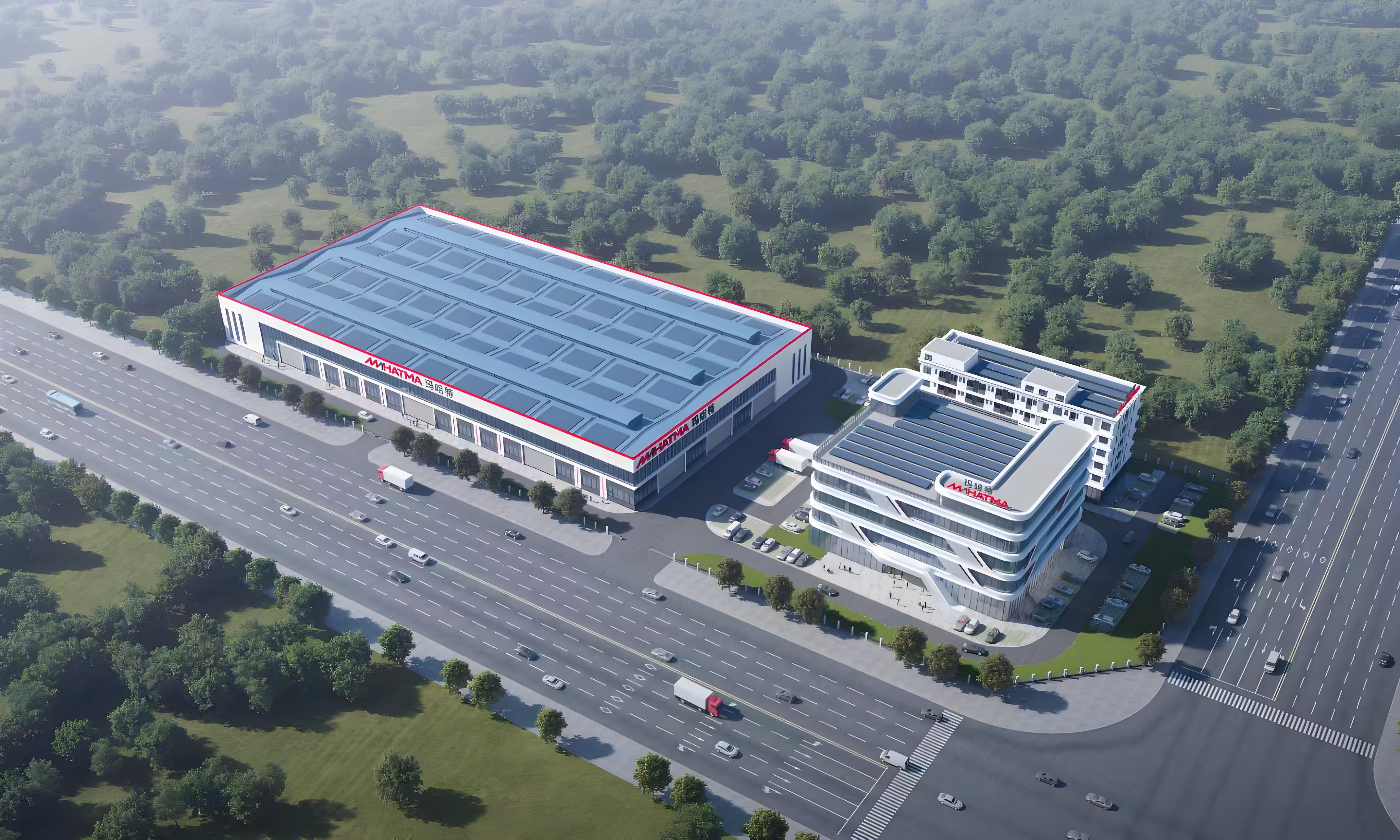
Look for evidence that is structural rather than promotional. Guangdong MAHATMA Intelligent Equipment Co., Ltd. was founded in 2008, has held ISO 9001 certification since 2008, operates a 50,000 m² manufacturing footprint with 300 employees, an R&D team of 26 engineers and an annual output of 500 sets, and holds more than 230 patents. It supports exported equipment through 28 overseas marketing and service networks, with machines running in more than 100 countries and regions including Germany, the United States, Japan and South Korea, and its intelligent models carry remote cloud diagnostics and predictive maintenance alerts described as reducing unexpected downtime by 70%. The practical next step is to test that support with your own project: send your part envelope, takt target and current line layout together with 1–2 metres of material, and request the integration description, the sample test report and the machine proposal as one package before committing to the line.
Conclusion: decide the integration, then the machine
For a leveler going into a running line, the sequence of decisions matters more than the specification sheet. Physical fit, control handover, data scope and material proof cover the four places where retrofit projects actually fail, and each of them can be closed out with a document and a test before the purchase order exists. The leveler family — two-high or rough, four-high or plate, CNC or servo, hydraulic — follows from those answers, not the other way round.
MAHATMA builds integrated lines rather than standalone boxes, which is why the MES/ERP interface, the automation modules and the free material trial sit in the same conversation as the machine itself. The company's equipment and integration approach are described on leveling-mht.com.
Next step: run your line plan and your material through the same test
Send three things — your part envelope and takt target, your current line layout or a simple sketch of it, and 1–2 metres of your worst-condition material. You will receive a written flatness report with measured data, a leveling video and a machine proposal, at no charge beyond shipping your material. Ask for the integration description in writing before you commit.
Email: mhtg@gdmht.com · Tel / WhatsApp: +86 173-4062-1852 · Address: Mahatma Industrial Park, No. 3, Southwest Jiaying 1st Street, Shijie Town, Dongguan City, Guangdong Province, China
Download the full product catalogue: MAHATMA brand catalogue (English, PDF)
Have Questions or Need More Details?
Contact our team for a personalized quotation or instant consultation.
Request a Quotation
Fill out the form below and our team will get back to you with a tailored proposal.
WhatsApp Direct Chat
Prefer to chat in real-time? Message us on WhatsApp for instant assistance & quick answers.
- Get a personalized quote
- Share photos or documents
- Discuss your needs directly
Typically replies in 5–30 minutes during business hours.