Leveling Machine Supplier Evaluation: MES/ERP Fit, Material Trials & Delivery Assurance
Leveling Machine Supplier Evaluation: MES/ERP Fit, Material Trials, and Delivery Assurance
A leveling machine is only as good as the supplier's ability to prove three things before the purchase order: that the machine fits your material envelope and your line, that it can exchange data with your MES/ERP and the equipment upstream and downstream of it, and that the machine you ordered will arrive on the date written into the contract. This evaluation memo sets out a four-gate method for verifying all three, using evidence rather than brochures.
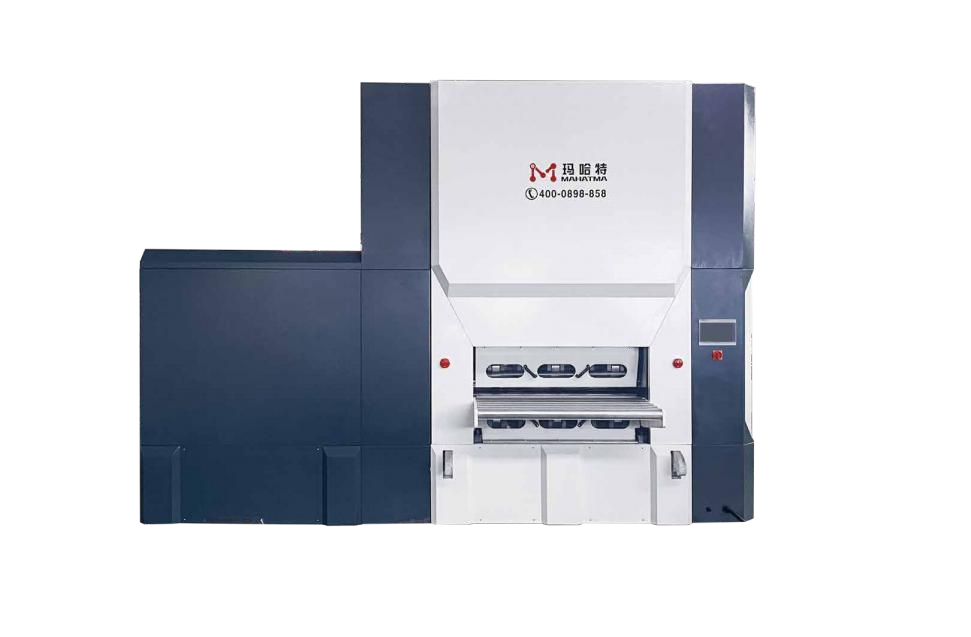
MHTM200 Series CNC Leveler — width 1000–3200 mm, rated thickness 8.0–30.0 mm (max 40.0 mm), 19 rolls. Portfolio fit is the first gate in any leveling machine supplier evaluation.
A leveling machine — also described as a straightening machine, coil leveler, metal leveler, sheet metal leveler, plate leveler, flattening machine or precision leveler — removes coil set, crossbow, edge wave and internal residual stress through alternating bending. Because flatness, throughput and uptime depend on how the machine is matched to the material and to the line behind it, supplier selection is an evidence exercise, not a specification comparison. The four gates below are ordered so that each one disqualifies a supplier early rather than late.
Problem Definition: Why Leveling Machine Supplier Evaluations Fail
Most leveling machine sourcing failures are not machine failures. They are evaluation failures, and they cluster into three recognisable patterns.
Pattern 1 — Envelope mismatch. A quotation is written against a model's rated thickness, and the rating assumes a reference material grade. Leveling force depends on thickness and yield strength together, so a rating calculated on a 235 MPa reference grade must be recalculated for high-strength steel, aluminium or titanium. When that recalculation never happens, the machine arrives mechanically sound but incapable of the flatness target on the actual coil.
Pattern 2 — Integration gap. The machine is treated as a standalone box. In practice a leveler is matched to uncoilers, laser cutting machines, stamping presses and robotic arms, and its value depends on how it hands material and data to those units. Automation modules such as loading carts, conveyors, robots, vision inspection and AGVs are engineered options, not accessories bolted on after commissioning. If the interface is discussed verbally instead of specified, the gap surfaces at commissioning, when schedule pressure is highest.
Pattern 3 — Delivery slippage. A stated lead time is treated as a fact. It is not. It is a claim, and it becomes an assurance only when it is supported by visible capacity, a named production slot, pre-shipment testing on your material, and a documentation package agreed before the order.
Two further constraints sit on top of these patterns. For precision sheet work, small-diameter dense rolls are needed to prevent surface indentation, and a dust removal system is a stated requirement rather than an option. For heavy plate work, the special requirements typically include compliance with the ISO 9001:2015 quality management system, CE marking for the EU market, a noise level of 75 dB(A) or below, safety interlocks and emergency stop systems, and optional IoT connectivity for remote monitoring and predictive maintenance. Any supplier evaluation that does not test these items is testing the wrong machine.
Industry Background: What the 2025–2026 Market Says About Evaluation Rigour
The commercial context explains why supplier evaluation has become more evidence-driven. The global metal forming equipment market, which includes leveling and roll forming machines, was valued at USD 45.8 billion in 2025, with Asia Pacific holding a 42.5% revenue share in the same year (Dataintelo). Sheet metal processing equipment in Asia Pacific alone generated USD 18.36 billion in 2025 (Fortune Business Insights). The metal forming machine tools market is projected to reach USD 64.85 billion by 2034 at a 9.60% CAGR (Fortune Business Insights).
Forecasts differ by scope, and that divergence is itself a useful evaluation signal. Dataintelo reports a 5.2% CAGR for the broader metal forming equipment category, while Fortune Business Insights reports 9.60% for metal forming machine tools — different category boundaries, different growth curves. The same applies to cut-to-length equipment: the global Cut to Length Line System market was estimated at USD 3.42 billion in 2024 (Market Research Future), while the cut-to-length machine market is projected to grow from USD 4.28 billion in 2026 to USD 5.94 billion by 2032 at a 5.52% CAGR (ReportLinker). A supplier that quotes a market figure without naming its scope is telling you something about how it handles specifications too.
Two structural shifts directly affect leveling machine evaluation. First, control architecture has become a purchasing criterion: CNC technology accounted for 85.7% of the machine tools market in 2025 (Grand View Research), which is why MES/ERP fit and recipe management now sit inside the technical evaluation rather than the IT evaluation. Second, flatness expectations have tightened with the automotive segment, which accounts for 41.37% of the sheet metal processing equipment market share in 2026 (Fortune Business Insights).
Supply-side pressure adds a third factor. China's exports of metalworking machine parts increased by 20.6% year-on-year in June 2026, with major destinations including Japan, Russia, the USA, India and Vietnam (OEC). More suppliers are entering more markets, which raises the value of a structured verification method and lowers the value of a reference-list screenshot.
Reference depth is a legitimate comparison dimension, provided it is stated neutrally. ARKU Maschinenbau GmbH was recognised as one of the top 500 hidden world market leaders in precision leveling machines for 2025, with its FlatMaster series used for laser-cut and stamped parts. KOHLER Maschinenbau GmbH had realised over 6,700 reference projects globally in leveling technology as of late 2023. These are yardsticks for what a deep, verifiable reference base looks like — not verdicts. The question to put to any supplier is whether their claimed reference base can be evidenced at the same level of specificity.
Detailed Solution: The Four-Gate Supplier Evaluation
Gate 1 — Portfolio fit: does the catalogue actually cover your line?
A leveling machine supplier should be able to place your material envelope inside a defined model range and show you the arithmetic. Guangdong MAHATMA Intelligent Equipment Co., Ltd. — a high-tech enterprise headquartered in Dongguan, Guangdong Province, founded in 2008, with a 50,000 m² factory, 300 employees, 26 R&D engineers and an annual output of 500 sets — builds leveling equipment across four leveler families plus integrated lines, and the portfolio is broad enough that most envelopes fall inside more than one option.
| Family | Example model | Working width | Rated thickness (max) | Rolls | Typical role |
|---|---|---|---|---|---|
| Two-high / Rough Leveler | VST42 Series | 200–800 mm | 0.4–3.0 mm (max 6.0 mm) | 19 | Thin-gauge rough leveling, budget-limited workshops |
| Two-high / Rough Leveler | VST120 Series | 600–1400 mm | 3.0–10.0 mm (max 20.0 mm) | 13 | Thick-plate rough leveling |
| Four-high / Plate Leveler | VSH60 Series | 400–800 mm | 1.0–6.0 mm (max 10.0 mm) | 15 | Single-product leveling, small footprint |
| CNC Leveler | MHTM50 Series | 400–1700 mm | 0.8–4.0 mm (max 8.0 mm) | 19 | Sheet metal fabrication, cabinets, laser blanking |
| CNC Leveler | MHTM150 Series | 450–2100 mm | 6.0–25.0 mm (max 30.0 mm) | 15/19 | Medium plate, auto parts, home appliances |
| CNC Leveler | MHTM200 Series | 1000–3200 mm | 8.0–30.0 mm (max 40.0 mm) | 19 | Wide medium plate at higher tonnage |
| CNC / Servo Leveler | MHTW40 Series | 400–1600 mm | 0.6–3.0 mm (max 6.0 mm) | 23 | Precision sheet, 3C electronics, mirror-finish sheet |
| Hydraulic Leveler | MHTR100 Series | 600–3200 mm | 3.0–12.0 mm (max 30.0 mm) | 15/19 | Thick plate, high-strength steel |
| Hydraulic Leveler | MHTR300 Series | 1300–4000 mm | 15.0–80.0 mm (max 100.0 mm) | 9 | Heavy plate, shipbuilding, aerospace |
Table 1 — Leveler families and rated envelopes, based on published MAHATMA model parameters. Rated thickness (max) is a mechanical limit, not a flatness guarantee.
Line-level options in the same portfolio cover the cases where the leveler is one module rather than the whole purchase: Slitting Line UC-2x2000 (0.3–2.0 mm, 500–1800 mm, 8–30 strips, up to 200 m/min, 20 T coil); Flying Shear Line MF-3 (0.3–3.0 mm, 400–1800 mm, 0.5 mm shearing accuracy, up to 100 m/min, 25 T coil); Cut-to-Length Line TD-2x2000 (0.2–2 mm, 900–1800 mm, ±0.5 mm shearing accuracy, up to 50 m/min, 20 T coil); Laser Blanking Line TL-T3 (3.0–12.0 mm, 600–2800 mm, 25 m/min, 2000–20000 W laser power); and a Leveling & Deburring Line (0.5–80 mm, 600–1300 mm, 20 m/min, minimum part 50×50 mm, accuracy 0.1–0.3 mm).
Gate 2 — MES/ERP and existing production line integration
Integration is a specification item, not a promise. On MAHATMA blanking lines, MES/ERP interfaces are provided and automation modules — loading carts, conveyors, robots, vision inspection and AGVs — are added as proven standard options, so production data, traceability and order scheduling can be tied into the buyer's existing systems. The same logic applies to standalone levelers: control system integration (MES/PLC) and automated loading/unloading systems are listed customization axes, alongside roll width and diameter, leveling thickness range and roll material such as Cr12MoV or SKD11.
The control layer is where this becomes testable. CNC models store up to 200 recipes on a 10-inch HD touch screen, support upstream and downstream linkage, and include misoperation warning. Servo-CNC models add remote cloud control and laser 3D online inspection. An upgrade path exists from standalone machine to full line: a buyer can start with a leveler and add feeding and stacking automation later — the same modular route used in the Zhucheng Group fully automated upgrade.
What to demand in writing at this gate:
- The exact data points crossing the boundary (recipe identity, material grade, thickness, width, line speed, flatness readings) and which system owns each one.
- The named equipment upstream and downstream, since levelers are matched to uncoilers, laser cutting machines, stamping presses and robotic arms.
- Who writes the integration scope — the leveler supplier, the line integrator, or your IT function — and who is accountable if a signal is missing.
- A factory acceptance test that simulates a live MES request, not a static screen demonstration.
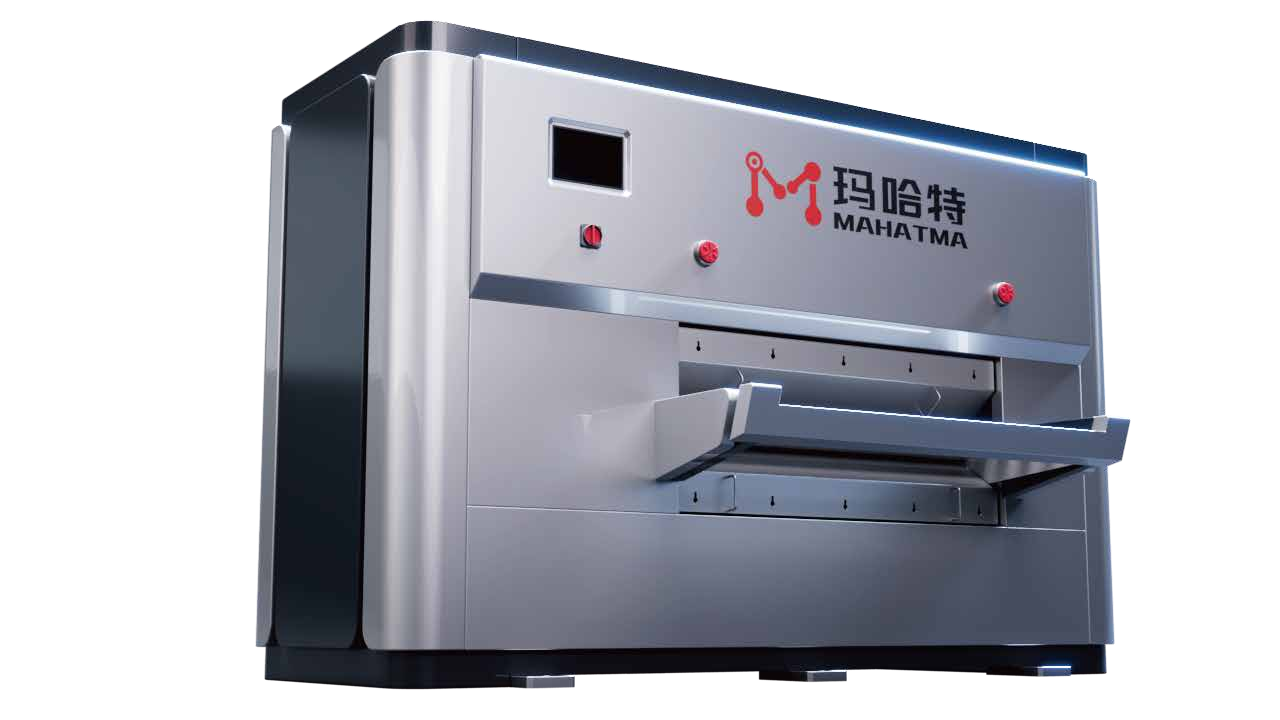
MHTW40 Series CNC Leveler / Servo Leveler — 400–1600 mm width, 0.6–3.0 mm rated thickness, 23 rolls, with smart OS and remote cloud control. Integration scope should be verified against the control architecture, not the brochure.
Gate 3 — Material trials: test your worst coil, not your best
A material trial is the cheapest risk-reduction step in the entire purchase, and it should be designed like a test, not a demonstration. MAHATMA runs the sample test free of charge: the buyer sends 1–2 metres of material or representative parts with the material grade, thickness and flatness target noted, the material is leveled on the recommended machine, and a written flatness report plus process video is returned within days. The buyer covers only the shipping of the material.
The report contents matter as much as the result. Ask for measured flatness data, the process parameters used, and video of the leveling run. Send worst-condition material — the tightest thickness, the highest yield strength, the most distorted coil — because a trial on your best material proves nothing about your production. Final flatness depends on material grade, thickness and original coil condition, which is precisely why the trial must run on your stock.
Quantify the result in a recognised unit. Flatness in precision leveling is commonly expressed as an I-unit or as mm/m height deviation, and hot-rolled plate tolerances are referenced against DIN EN 10029. Precision series results have reached flatness down to ±0.05 mm, verified on a titanium fixture case, with typical production results in the 0.05–0.20 mm/m² range. The mechanism behind those numbers is alternating bending based on the Bauschinger effect, combined with multi-roll support structures and, on flagship models, laser 3D inspection with closed-loop correction.
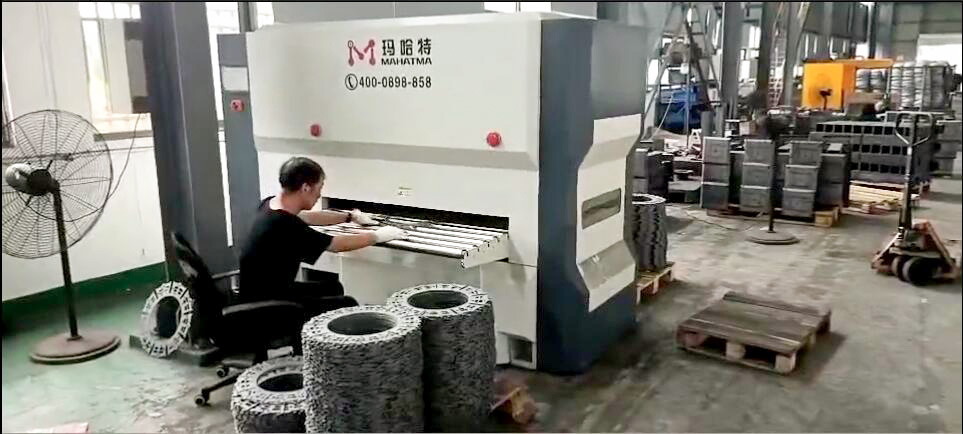
On-site operation of a CNC leveling machine at a customer facility. A trial protocol should record material grade, thickness, target flatness and measured result — not just an overall impression.
Gate 4 — Delivery assurance: verify commitments, do not assume them
Delivery assurance starts with capacity arithmetic. MAHATMA states a monthly capacity of 50 units, a lead time of 45 days and a minimum order quantity of 1 unit, backed by a 50,000 m² facility, 300 employees and 26 R&D engineers. Those numbers are the raw material of a delivery commitment; they become assurance only when you map them against your required ship date and the supplier's other committed orders.
The second element is pre-shipment evidence. Quality control on these machines includes laser 3D online flatness detection, ultrasonic flaw detection on rollers, hardness uniformity testing, and full-load trial runs before shipment. Each of those is a checkable event. Ask when it happens, who signs the record, and what the remedy is if the full-load run fails.
The third element is what happens after the machine lands. After-sales provision covers 24/7 global technical support, overseas engineers available for commissioning, regional spare parts warehouses and free operator training, supported by 28 overseas marketing and service networks. With roughly 30% of output exported and main markets in the EU, USA and Asia, and equipment already installed in more than 100 countries and regions, commissioning support is a routine operation rather than a special concession — but it still needs to be written into the order.
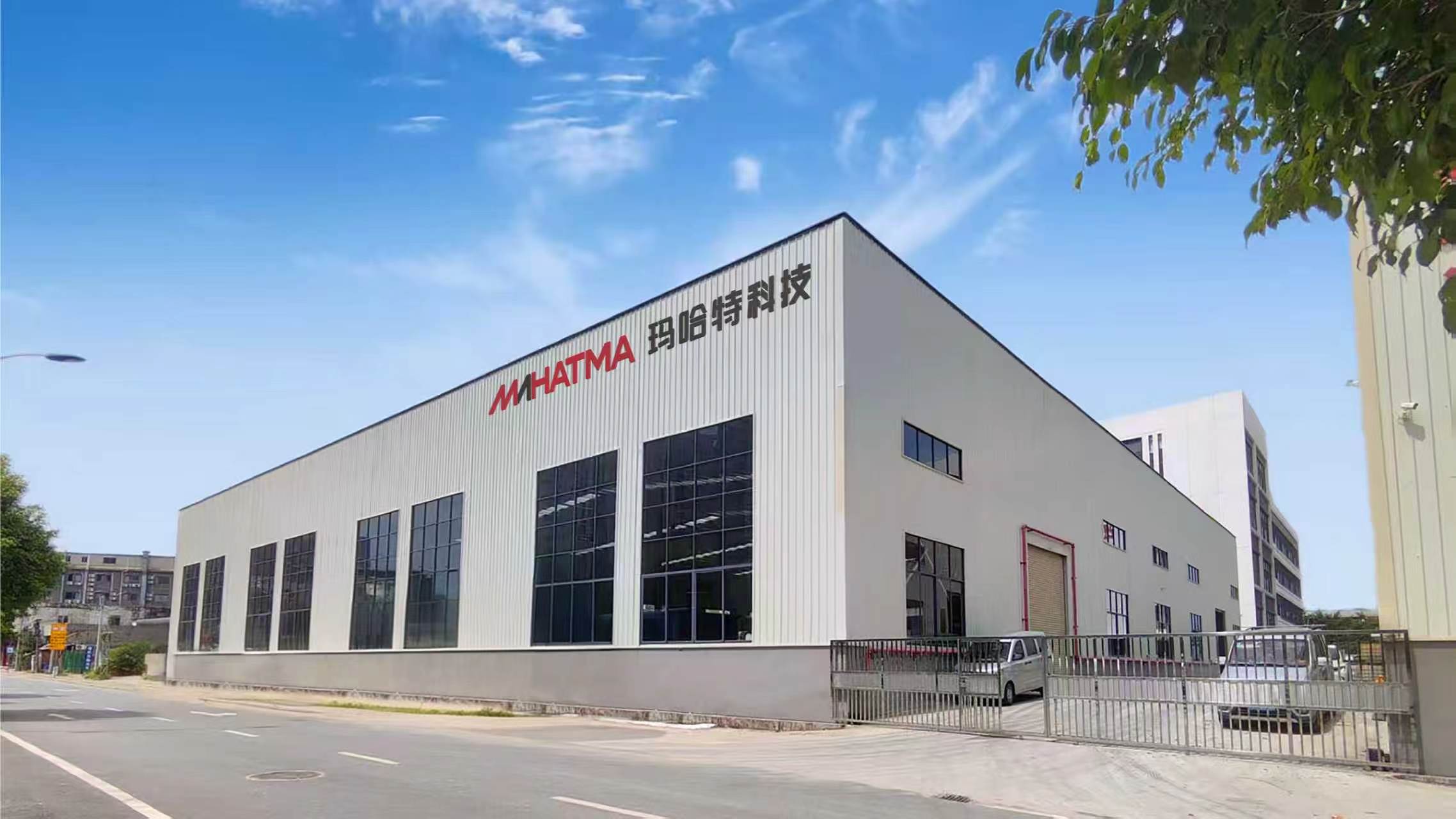
Mahatma Guangzhou manufacturing plant. Capacity claims are only useful in an evaluation when they are tied to a named production slot and a pre-shipment test date.
Step-by-Step Breakdown: A Six-Step Evaluation Sequence
The four gates are easier to run in a fixed order, because each step produces the input for the next one.
- Define the envelope in writing. Record minimum and maximum thickness, maximum width, material grades and yield strengths, flatness target in I-unit or mm/m, and required output per shift. If a supplier quotes a model before you have supplied all five, the quotation is provisional by definition.
- Map the line interface. List the equipment upstream and downstream (uncoiler, laser cutter, press, robot), the data points needed in MES/ERP, and the automation modules you want now versus later. Decide explicitly whether the purchase is a machine or a line module.
- Request a model match with the derating shown. The reply should recalculate the rated envelope against your yield strength, not restate the catalogue figure, and should state roll count and roll material options such as Cr12MoV or SKD11.
- Run the material trial and fix acceptance criteria first. Agree the flatness threshold and measurement method before the sample ships, then compare the written report and video against what was agreed.
- Audit capacity and quality evidence. Match stated monthly capacity and lead time against your ship date, and confirm the four QC events: laser 3D flatness detection, ultrasonic roller inspection, hardness uniformity testing, full-load trial run.
- Close commercial and support terms. Milestone schedule, factory acceptance test protocol, documentation list, commissioning window, spare parts list, operator training and warranty terms — agreed before the order, not after the delay.
| Evaluation dimension | Question to put to the supplier | Evidence that closes it | Documented position to compare against |
|---|---|---|---|
| Envelope fit | Which model covers my thickness, width and yield strength, and by how much is it derated? | Written model match with derating calculation | Four leveler families from 0.03 mm to 120 mm maximum across the range, plus five line types |
| Control and data | Which data points cross into my MES/ERP, and who owns the integration scope? | Interface description plus FAT script with a live MES request | MES/PLC integration listed as a customization axis; 200-recipe storage; upstream/downstream linkage |
| Material proof | Can you run my worst-condition material and report measured flatness? | Written flatness report, process parameters, video | Free sample test on 1–2 m of buyer material; precision results down to ±0.05 mm, typical 0.05–0.20 mm/m² |
| Compliance scope | Does your CE and ISO scope actually name the machine type I am buying? | Certificate copies with number, issuer, standards and validity dates | CE attestation M.2025.206.C113032 (UDEM, valid 2025-01-16 to 2030-01-15); ISO 9001 certificate 62825Q9729R0M (valid 2025-05-27 to 2028-05-26) |
| Delivery | Which production slot and which pre-shipment test date are committed to me? | Named schedule plus signed full-load trial record | 50 units/month capacity, 45-day lead time, MOQ 1 unit, four QC events before shipment |
| Lifecycle support | Who commissions the machine, and where are my spare parts held? | Commissioning plan, spare parts list, training scope | 24/7 global technical support, overseas commissioning engineers, regional spare parts warehouses, free operator training, 28 overseas networks |
Table 2 — Evidence matrix for a leveling machine supplier evaluation. The right-hand column states the documented MAHATMA position for comparison; every buyer should populate an equivalent column for each supplier under review.
Use Cases: How the Gates Change the Decision
Perforated ceiling plate in Greece. A manufacturer leveling perforated metal sheet faced a deformation problem that standard flatness claims do not address, because perforated stock behaves differently from solid sheet. The selected machine was an MHTM30 Series CNC Leveler (400–1600 mm width, 0.5–2.0 mm rated thickness, 21 rolls) on a USD 60,000 project, reported as solving the deformation of perforated metal sheet over two years of operation. The evaluation hinge was Gate 3: the trial had to run on perforated material, not on solid sheet of the same thickness.
Armoured vehicle components in Poland. A manufacturer running armoured car parts selected an MHTR120 Series Hydraulic Leveler (600–3200 mm width, 4.0–20.0 mm rated thickness, 15/19 rolls) on a USD 850,000 project, reported as stable operation with good leveling effect over three years. Here the hinge was Gates 1 and 4 together: a wide, thick, high-strength envelope with a delivery schedule that could not absorb a re-quote.
Coil leveling in Mexico. A coil processor selected an MHTR260 Series Hydraulic Leveler (1300–4000 mm width, 10.0–60.0 mm rated thickness, 9/11 rolls) on a USD 720,000 project. At that width and tonnage, the integration question is not whether the leveler works but whether it works inside a coil line — which makes Gate 2 the deciding gate, and makes the line-level portfolio (slitting, flying shear, cut-to-length, laser blanking) part of the evaluation rather than a later upgrade.
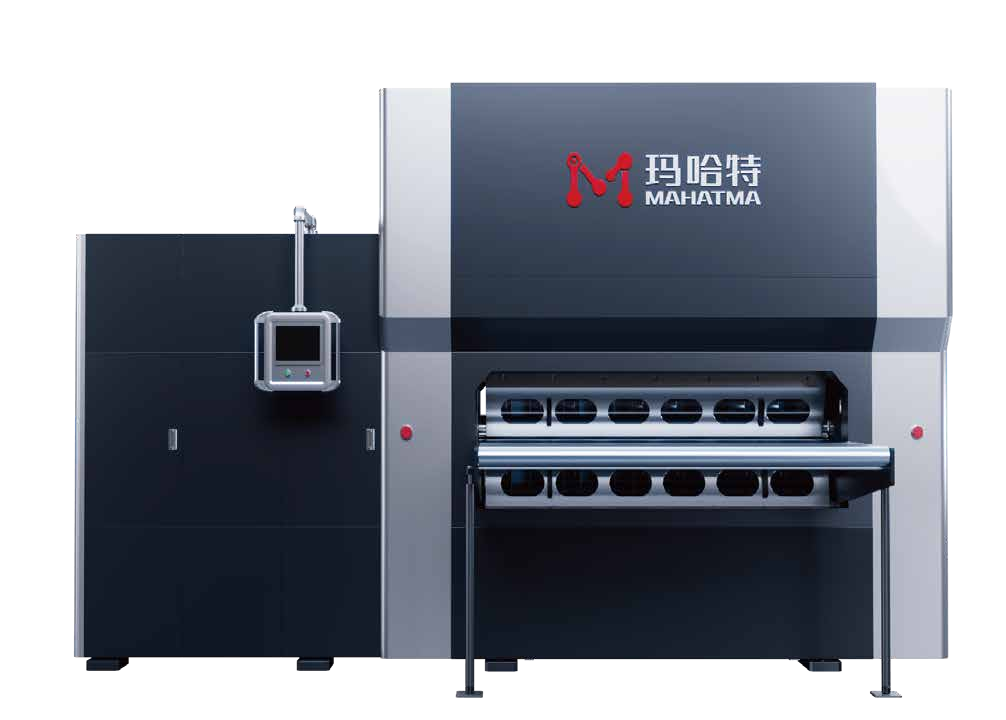
MHTR300 Series Hydraulic Leveler — 1300–4000 mm width, 15.0–80.0 mm rated thickness (max 100.0 mm), 9 rolls. Heavy-plate envelopes are where derating and delivery assurance most often collide.
Frequently Asked Questions
How do I confirm a leveling machine supplier is genuinely CE-certified?
Ask for the attestation or declaration of conformity itself, not a logo, and read four fields: the certificate number, the issuing body, the harmonised standards cited, and the validity dates. Then check the scope statement — a certificate that does not name the machine type you are buying does not cover it. MAHATMA holds a Machinery Directive Attestation of Conformity numbered M.2025.206.C113032, issued by UDEM International Certification Auditing Training Centre Industry and Trade Inc., valid from 2025-01-16 to 2030-01-15, with scope covering the Hydraulic Precision Leveling Machine and standards EN ISO 12100:2010, EN ISO 16090-1:2020, EN ISO 16090-1:2022, EN ISO 16092-2:2020 and EN 60204-1:2018. The quality management certificate is numbered 62825Q9729R0M, issued by Zhongtian Hongtu International Certification Co., Ltd. against GB/T19001-2016 / ISO 9001:2015, valid 2025-05-27 to 2028-05-26, with scope covering the design and assembly of general-purpose equipment including high-precision leveling machines, uncoiler laser blanking lines and automatic shearing lines. CE marking is a market-entry requirement for leveling machines entering the European market, so a missing or out-of-scope certificate is a delivery risk, not a paperwork issue.
Can a leveling machine integrate with our MES/ERP and existing production line?
Yes, provided the integration scope is written down before the order. On MAHATMA blanking lines, MES/ERP interfaces are provided so that production data, traceability and order scheduling connect to existing systems, and automation modules — loading carts, conveyors, robots, vision inspection and AGVs — are supplied as proven standard options. Control system integration (MES/PLC) and automated loading/unloading are listed customization axes alongside roll width, roll diameter, thickness range and roll material. The practical check is not a feature list but a factory acceptance test that pushes a real order request from your MES into the machine and confirms the recipe, the parameters and the traceability record come back correctly. Where the leveler sits inside a larger line, confirm the upstream and downstream equipment it must hand material to, and confirm the modular upgrade path if you intend to add feeding and stacking automation later.
What drives the cost of a leveling machine, and how should we budget?
Cost is driven by the specification variables, not by the family name. The main levers are working width and thickness range, roll diameter and roll count, roll material (Cr12MoV and SKD11 are standard options), control architecture, and the amount of automation — loading and unloading systems, conveyors, robots and vision inspection. Line integration adds a separate scope. Because these variables interact, a meaningful budget can only follow a defined envelope; the sequence is envelope first, model match second, priced scope third. Two commercial terms help anchor the budget: the minimum order quantity for a leveling machine is 1 unit, and the stated lead time is 45 days. Ask for a quotation that itemises machine, automation, integration and commissioning separately, so that each line can be compared across suppliers instead of against a single lump sum.
Can I test my own material on the machine before buying?
Yes, and the test should be free. MAHATMA runs a sample test at no charge: the buyer sends 1–2 metres of material or representative parts with the material grade, thickness and flatness target noted, the material is leveled on the recommended machine, and a written flatness report with the process parameters used plus a video of the leveling run is returned within days; the buyer covers only the shipping of the material. Send your worst-condition material rather than your best, and agree the acceptance threshold before the sample ships. Where flatness is critical, require the result in I-unit or mm/m rather than an adjective, and ask whether the downstream process — laser cutting, stamping or welding — was included in the check.
What lead time and delivery assurance can a supplier commit to?
A lead time is a claim until it is backed by capacity and test evidence. MAHATMA states a monthly capacity of 50 units and a lead time of 45 days, with pre-shipment quality control covering laser 3D online flatness detection, ultrasonic flaw detection on rollers, hardness uniformity testing and a full-load trial run, plus after-sales support through 24/7 global technical assistance, overseas commissioning engineers, regional spare parts warehouses and free operator training across 28 overseas service networks. To convert that into assurance, ask for a named production slot, a pre-shipment test date on your material, the signature owner for the full-load trial record, and the remedy if the trial fails. The next step is straightforward: send your material envelope and flatness target, request the free sample test, and review the written report alongside the MAHATMA product brochure before committing to a schedule.
Conclusion: Evaluate the Evidence, Then the Machine
Leveling machine supplier evaluation comes down to four checkable questions. Does the portfolio place your envelope inside a defined model range with the derating shown? Is the MES/ERP and line integration scoped in writing, with a factory acceptance test that proves it? Has the supplier leveled your worst-condition material and returned a measured flatness report? And can the delivery date be traced to capacity, a production slot and a signed pre-shipment test?
A supplier that answers all four with documents is a different kind of supplier from one that answers with adjectives. For buyers in the research and evaluation stage, the sequence matters more than the scorecard: run the gates in order, and each one narrows the field before the next one costs you time. Guangdong MAHATMA Intelligent Equipment Co., Ltd. builds its evaluation case on the same four gates — a portfolio spanning two-high, four-high, CNC, servo-CNC and hydraulic levelers plus slitting, flying shear, cut-to-length laser blanking and leveling & deburring lines; documented CE and ISO 9001 certification; a free material trial with a written flatness report; and a delivery commitment supported by stated capacity, four pre-shipment quality events and global service coverage.
Next Step: Test Your Material Before You Commit
Send 1–2 metres of your worst-condition material with the grade, thickness and flatness target, and MAHATMA will return a written flatness report, the process parameters used and a video of the leveling run — at no charge.
Download: MAHATMA Brand Brochure (English, PDF)
Website: www.leveling-mht.com
Email: mhtg@gdmht.com | Tel / WhatsApp: +86 173-4062-1852
Contact: Jack
Address: Mahatma Industrial Park, No. 3, Southwest Jiaying 1st Street, Shijie Town, Dongguan City, Guangdong Province, China
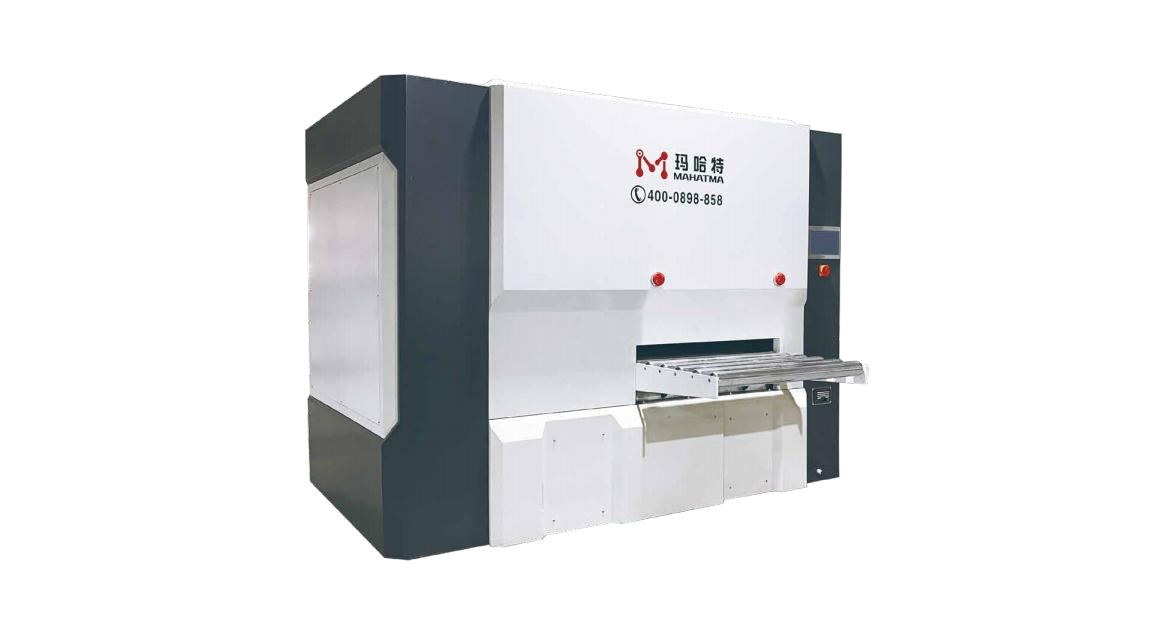
MHTM120 Series CNC Leveler — 400–1600 mm width, 4.0–16.0 mm rated thickness, 19 rolls. Request a trial on your own material before confirming a model.
Have Questions or Need More Details?
Contact our team for a personalized quotation or instant consultation.
Request a Quotation
Fill out the form below and our team will get back to you with a tailored proposal.
WhatsApp Direct Chat
Prefer to chat in real-time? Message us on WhatsApp for instant assistance & quick answers.
- Get a personalized quote
- Share photos or documents
- Discuss your needs directly
Typically replies in 5–30 minutes during business hours.