Slitting Line vs Cut-to-Length Line: Which Pairing Maximizes Your Leveler Investment?
Slitting Line vs Cut-to-Length Line: Which Pairing Maximizes Your Leveler Investment?
A leveling machine is the only module in a coil processing line that changes the material itself. It removes coil set, cross-bow, edge waves and residual stress, and in doing so it sets the flatness that every downstream operation inherits. The line you build around that leveler decides how often it runs, how fast it works, and in what form its precision reaches your customer. That is why the pairing question — slitting line or cut-to-length line — matters more to your return than the leveler's own specification sheet.
The short answer: pair the leveler with a cut-to-length line when your downstream process consumes discrete flat sheets — laser cutting, stamping, bending or service-center supply. Pair it with a slitting line when your downstream process consumes continuous narrow strip — transformer and motor cores, roll forming, and tube or profile production. In the first case the leveler's precision is the product. In the second case it is the condition that makes slitting and recoiling stable.
This guide compares MAHATMA's Cut-to-Length Line TD-2x2000 and Slitting Line UC-2x2000 on the three variables that decide the answer — throughput, material utilization and downstream process flexibility — and shows which leveling units from the CNC Leveler, Servo Leveler and Hydraulic Leveler families fit each pairing.
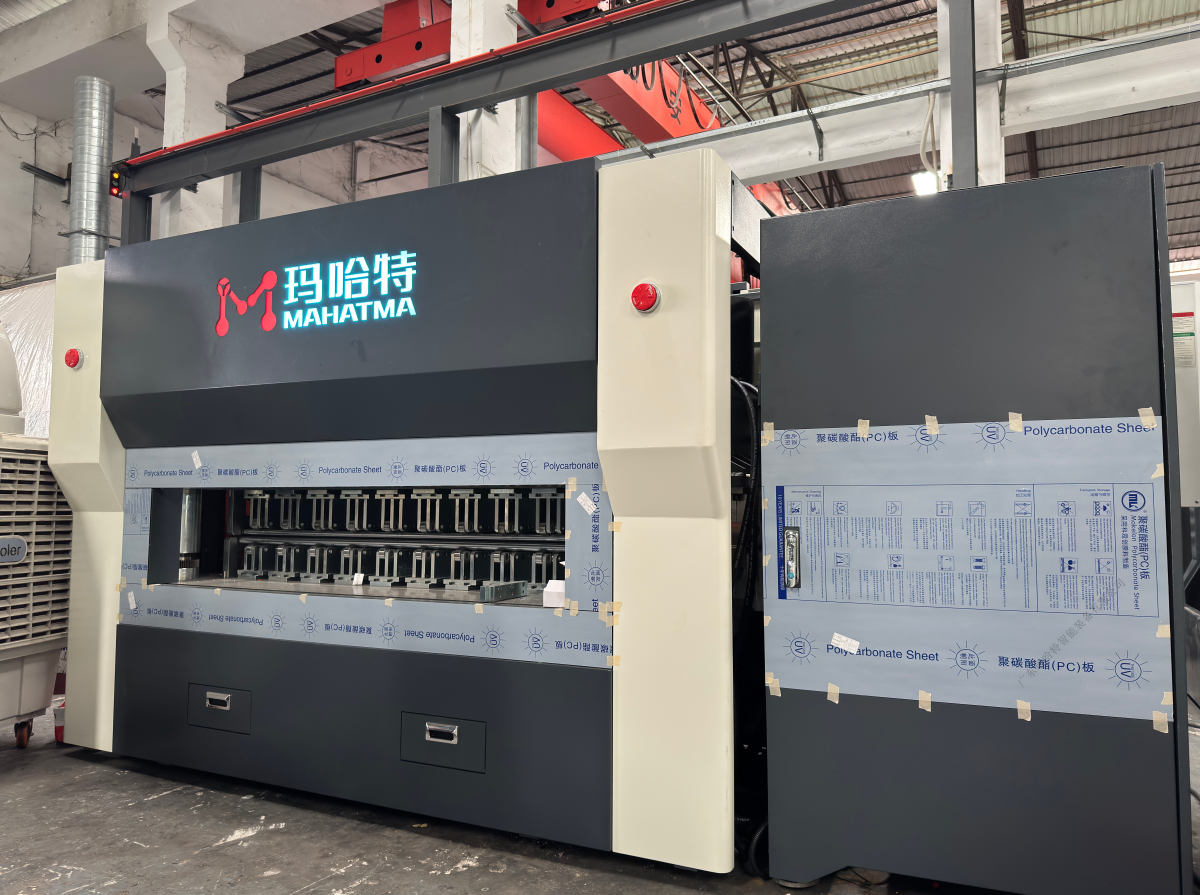
MAHATMA MHTR30 Series servo-hydraulic leveling machine — rated 0.5–3.0 mm thickness, 600–2100 mm width, 23 rolls. This width class is what makes it a candidate leveling unit for both the TD-2x2000 cut-to-length line and the UC-2x2000 slitting line.
The Pairing Decision Comes Down to Three Variables
Most buyers do not set out to choose between two line types. They set out to buy a leveler, specify it against a flatness target, and only later ask which line it should live in. By then the specification has usually been written around the machine rather than around the output.
Three variables decide the pairing, and they are not the variables on a leveler datasheet:
- Throughput — not metres per minute, but saleable units per hour in the form your customer actually buys. A slitting line feeding at up to 200 m/min and a cut-to-length line running at up to 50 m/min are not comparable numbers until they are converted into strips per shift and sheets per shift.
- Material utilization — where the scrap is created. In a slitting pairing, loss is decided at the width-planning stage before the coil is loaded. In a cut-to-length pairing, loss appears at crop and length tolerance, and later at the downstream blanking skeleton.
- Downstream process flexibility — whether the line's output feeds a continuous process or a discrete one, and how quickly the output size can be changed.
Two specification mistakes cause most of the lost value. The first is assuming a standalone leveler can simply be dropped into any line: catalogue leveling speeds for MAHATMA's standalone leveler series are listed at 0–10 m/min, while the TD-2x2000 runs to 50 m/min and the UC-2x2000 feeds at up to 200 m/min. Bridging that gap is an engineering task, not a catalogue match. The second mistake is sizing the leveler to the thickest material in the mix rather than to the gauge where flatness is actually critical. A machine optimized for thick plate cannot level thin sheet precisely, and a machine built for thin sheet cannot develop the force a thick plate needs.
Why the Pairing Question Is Growing Faster Than the Machines Themselves
Coil-fed processing keeps expanding, and the leveling module sits inside almost every configuration. Dataintelo values the global metal forming equipment market — which includes leveling and roll forming machines — at USD 45.8 billion in 2025, with Asia Pacific holding a 42.5% revenue share. Fortune Business Insights projects the metal forming machine tools market to reach USD 64.85 billion by 2034 at a 9.60% CAGR, and separately measures Asia Pacific sheet metal processing equipment at USD 18.36 billion in 2025.
Cut-to-length capacity is expanding alongside it. Market Research Future estimated the global cut-to-length line system market at USD 3.42 billion in 2024, while ReportLinker scopes the cut-to-length machine market at USD 4.28 billion in 2026, growing to USD 5.94 billion by 2032 at a 5.52% CAGR. The two figures diverge because of scope — full systems versus individual machines — which is itself a useful reminder when comparing suppliers' claims.
Demand is concentrated where flat material matters most. The automotive segment accounted for 41.37% of the sheet metal processing equipment market in 2026, and CNC technology represented 85.7% of the machine tools market in 2025 — a clear signal that buyers increasingly expect programmable gap control and stored recipes rather than manual adjustment.
Precision leveling remains a specialist discipline. ARKU Maschinenbau GmbH was recognized among Germany's top 500 hidden world market leaders for precision leveling machines in 2025, and KOHLER Maschinenbau GmbH reports more than 6,700 reference projects globally in leveling technology as of late 2023. Chinese manufacturers have entered the same precision band: Guangdong MAHATMA Intelligent Equipment Co., Ltd. (MAHATMA Leveler) was founded in 2008 and is headquartered in Dongguan, Guangdong Province, with a 50,000 m² manufacturing operation, 300 employees, 26 R&D engineers and an annual output of 500 sets. The company holds more than 230 patents, is certified to ISO 9001:2015 and holds European CE certification, exports roughly 30% of its output to the EU, USA and Asia, and supports equipment in more than 100 countries through 28 overseas marketing and service networks.
How the Two Pairings Actually Differ
Pairing A — Leveler + Cut-to-Length Line (TD-2x2000)
The TD-2x2000 cut-to-length line is rated for coil from 0.2 mm to 2 mm thick and 900 mm to 1800 mm wide, cutting to a shearing accuracy of ±0.5 mm at a maximum speed of 50 m/min, with a maximum coil weight of 20 T. Its listed materials are various metal coils, and its listed industries are automotive, home appliance, sheet metal and steel service centres.
In this pairing the leveler sits immediately before the shear, so its flatness result travels with every sheet that leaves the line. That makes the leveler's precision the product itself. Two consequences follow. First, the leveler must cover the entire thickness band of the line, not just its midpoint: a unit tuned for 2 mm coil will not deliver precision flatness on 0.2 mm material. Second, the leveler's roll configuration becomes a commercial decision — a 4-high structure adds backup rolls that sharply reduce work-roll deflection, while a 6-high structure adds intermediate rolls so the work rolls are almost fully supported, which is the configuration used for mirror-finish panels and precision parts.
MAHATMA's precision series are specified down to ±0.05 mm flatness, with 0.05–0.20 mm/m² typical in production. Stress relief in these machines comes from alternating bending based on the Bauschinger effect, which is why roll count and machine structure — not motor power — determine whether a sheet stays flat after it is stamped or laser cut.
Pairing B — Leveler + Slitting Line (UC-2x2000)
The UC-2x2000 uncoiling leveling slitting line is rated for 0.3–2.0 mm material, 500–1800 mm coil width, 8–30 strips per coil, a maximum feeding speed of 200 m/min and a maximum coil weight of 20 T. Its listed materials are broader than the cut-to-length line's: carbon steel, cold-rolled and hot-rolled steel, stainless steel, silicon steel (electrical steel), aluminium and aluminium alloys, and copper and copper alloys. Its listed industries are transformers and motors, home appliances, new energy, and construction and steel structures.
In this pairing the leveler works ahead of the slitter and the recoiler. Its job is not to produce a saleable finish but to remove shape defects before the strip is divided, because flatness-critical strip with residual shape will not hold strip straightness or tension after slitting. MAHATMA offers CNC and hydraulic leveling units as slitting line options specifically for flatness-critical strip.
The leveler is not the only quality-critical subsystem in this pairing. Knife shaft rigidity and slitting tooling govern burr control, and tension control between the slitter and the recoiler governs strip straightness. A buyer who funds a high-precision leveler but accepts weak tension control has optimized the wrong module.
MAHATMA MHTM40 Series intelligent CNC leveler — 0.6–3.0 mm thickness, 400–1600 mm width, 21 rolls. A typical in-line leveling module for thin and medium gauge coil lines.
Which Leveling Units Pair With Which Line
The table below lists leveling units whose rated envelopes fall inside the two lines' thickness windows. Both lines handle material up to 1800 mm wide; the CNC and servo families cover the thickness but top out at 1600 mm in standard width, while the hydraulic MHTR30 covers 600–2100 mm. Where a line's full width is required, roller width and roller diameter are customization items, alongside roll material (Cr12MoV or SKD11) and control system integration with MES or PLC.
| Leveling unit | Type | Rated thickness | Rated width | Rolls | Best fit |
|---|---|---|---|---|---|
| MHTM30 Series | Intelligent CNC | 0.5–2.0 mm | 400–1600 mm | 21 | Both lines, thin-to-medium gauge |
| MHTM40 Series | Intelligent CNC | 0.6–3.0 mm | 400–1600 mm | 21 | Both lines, medium gauge |
| MHTW30 Series | Servo-CNC | 0.5–2.0 mm | 400–1600 mm | 23 | Both lines, higher roll density |
| MHTW40 Series | Servo-CNC | 0.6–3.0 mm | 400–1600 mm | 23 | Both lines, higher roll density |
| MHTR30 Series | Servo-hydraulic | 0.5–3.0 mm | 600–2100 mm | 23 | Full-width lines up to 1800 mm |
| MHTM20 / MHTW20 Series | CNC / Servo | 0.3–1.2 mm | 400–1300 mm | 23 | Thin-gauge lines (custom roller width required for wider coil) |
Note the gap in that table: both lines accept coil from 0.2–0.3 mm upward, but the standard leveling units listed here begin at 0.3 mm. That is exactly the kind of mismatch that should be resolved at quotation stage rather than after installation.
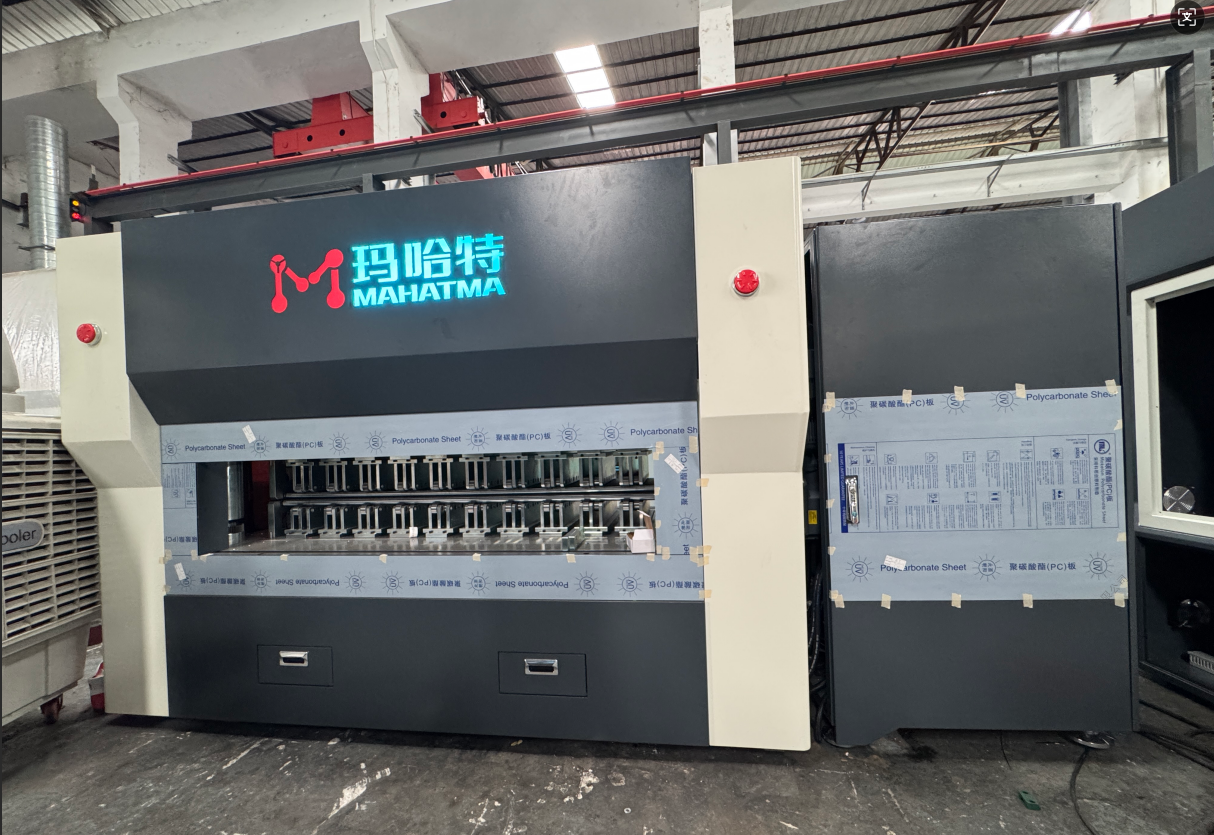
A hydraulic leveling machine configured for line duty. In-line operation demands that roller width, roll material and drive configuration be engineered against the host line's speed and duty cycle.
Step-by-Step: How to Decide Before You Sign
- Start from the output form, not from machine size. Write down what leaves your plant: coils of narrow strip, or flat sheets. If the next station is a roll former, a tube mill, a transformer winder or a motor lamination press, you are in slitting territory. If the next station is a laser cutter, a press, a bending cell or a customer who buys cut sheets, you are in cut-to-length territory.
- Map the real material envelope. Thickness minimum and maximum, coil width, material family and yield strength. MAHATMA's published leveler ratings are based on Q235 at 235 MPa, so high-strength steel, stainless or titanium must be recalculated and derated by the manufacturer rather than read off the catalogue. Confirm the derated figure in writing.
- Match the leveler to the critical gauge, not the widest one. If 80% of your tonnage is 1.0 mm and flatness matters there, specify for 1.0 mm and treat 2.0 mm as the outer limit. If your range is genuinely wide, the realistic options are the model with the best overlap or a two-machine plan.
- Confirm in-line duty and control integration. Line-integrated leveling means continuous operation at line speed, which is an engineering conversation about drive, rolls and controls — not a catalogue comparison. Also settle automation and data early: MES/ERP connectivity is standard on MAHATMA blanking lines, and loading carts, conveyors, robots, vision inspection and AGV modules are proven standard options that are engineered around your existing equipment layout.
- Validate on your own material. Ask for a sample test before the purchase order, and require a pre-shipment test as the acceptance condition. For cut-to-length pairings, validate sheet flatness after shearing; for slitting pairings, validate strip straightness and burr condition after recoiling.
Use Cases: Which Pairing Wins in Which Plant
Steel service centre supplying cut sheets. The order book is measured in sheets of many lengths, and the customer measures flatness at the laser. The cut-to-length pairing is the direct answer: the TD-2x2000 delivers ±0.5 mm shearing accuracy at up to 50 m/min, and the leveler's precision is transferred to every sheet rather than being absorbed inside the line.
Transformer and motor component maker. The product is narrow strip in silicon steel (electrical steel), aluminium or copper, and the downstream process is continuous. The slitting pairing is the fit: the UC-2x2000 produces 8–30 strips per coil at up to 200 m/min from a 20 T coil, and leveling ahead of the slitter protects the strip straightness that the recoiler and the downstream winder or press depend on.
Laser cutting job shop moving from sheet to coil feed. The requirement is flat blanks with stable nesting and repeatable focus height, so the natural pairing is cut-to-length with a CNC leveler in the MHTM30–MHTM80 band, prioritizing CNC gap adjustment with recipe storage so that material changeover is a parameter change rather than a trial-and-error session.
Existing installations show how long the decision has to hold. A manufacturer in the United States has run an MHTR60 Series hydraulic leveler for laser-cut part flattening for four years, and a metal processor in Hungary has run an MHTR100 Series unit for two years with stable operation and the original metal deformation issue resolved. These are leveler-level results, but they are the outcomes that any line pairing has to preserve.
Slitting Line vs Cut-to-Length Line: Side-by-Side Comparison
| Decision variable | Slitting Line UC-2x2000 | Cut-to-Length Line TD-2x2000 |
|---|---|---|
| Output form | Narrow coils / strips, 8–30 strips per coil | Flat sheets cut to length |
| Material thickness | 0.3–2.0 mm | 0.2–2 mm |
| Material width | 500–1800 mm | 900–1800 mm |
| Maximum line speed | 200 m/min (feeding) | 50 m/min |
| Stated accuracy metric | Strip quantity 8–30 | Shearing accuracy ±0.5 mm |
| Maximum coil weight | 20 T | 20 T |
| Materials listed | Carbon steel, cold-rolled / hot-rolled steel, stainless steel, silicon steel (electrical steel), aluminium and alloys, copper and alloys | Various metal coils |
| Typical industries | Transformers and motors, home appliances, new energy, construction and steel structures | Automotive, home appliance, sheet metal, steel service centre |
| Where scrap is created | Width-planning remainder and edge trim at the slitting stage | Crop and length tolerance at the shear, plus the downstream blanking skeleton |
| Role of the leveling unit | Shape correction ahead of the slitter; protects strip straightness and tension control | Final flatness pass before shearing; flatness travels with every sheet |
| Other quality-critical subsystems | Knife shaft rigidity, slitting tooling for burr control, tension control between slitter and recoiler | Shear accuracy and stacking |
Decision rule: if the leveler's flatness result is what you invoice, pair it with a cut-to-length line. If the leveler's flatness result is what keeps a continuous downstream process running, pair it with a slitting line. If both are true, you are buying two lines — and two levelers, each optimized for its own critical gauge.
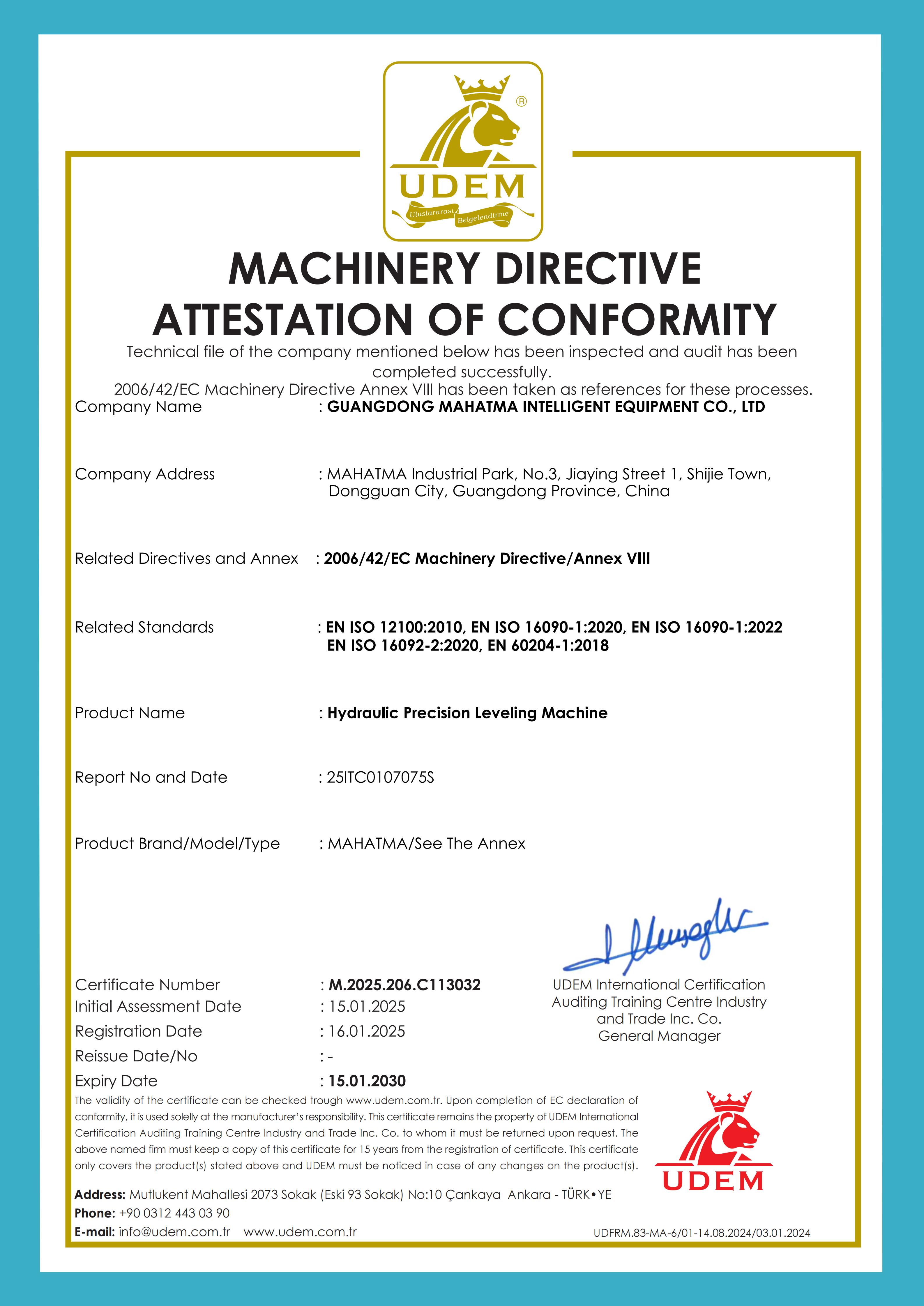
MAHATMA holds European CE certification for its hydraulic precision leveling machines (certificate M.2025.206.C113032, valid to 15 January 2030) and ISO 9001:2015 quality management certification covering leveling machines and coil processing lines.
FAQ
Does adding a leveling unit to a line change its CE or ISO 9001 status?
No — at MAHATMA, line integration sits inside the certified scope rather than outside it. The ISO 9001:2015 certificate (62825Q9729R0M, issued 27 May 2025 by Zhongtian Hongtu International Certification, valid to 26 May 2028) covers the design and assembly of high-precision leveling machines, uncoiler laser blanking lines and automatic shearing lines. The European CE attestation (M.2025.206.C113032, issued 16 January 2025 by UDEM, valid to 15 January 2030) applies to the hydraulic precision leveling machine and cites EN ISO 12100:2010, EN ISO 16090-1:2020 and EN 60204-1:2018. For non-EU destinations, compliance work shifts to the grid: MAHATMA machines are built for AC three-phase 380V/50Hz as standard, while the US runs 480V/60Hz and the EU 400V/50Hz, so voltage, frequency, phase and available transformer capacity must be stated in the purchase contract rather than confirmed on arrival.
Can one leveling unit serve both a slitting line and a cut-to-length line?
Not automatically, because the two pairings place different demands on the unit. The UC-2x2000 slitting line feeds at up to 200 m/min and the TD-2x2000 cut-to-length line runs at up to 50 m/min, while MAHATMA's standalone leveler series are listed at 0–10 m/min in the catalogue. Treat that gap as an engineering question to be answered in the quotation — drive, roll configuration and controls are engineered against the host line's actual speed and duty — rather than as a catalogue match. It is also true that no single machine is optimal across a wide thickness range: a machine optimized for thick plate cannot level thin sheet precisely, and vice versa. Where the range is genuinely wide, the realistic answers are the model with the best overlap or a two-machine plan.
What actually drives the cost of each pairing?
Three things, and none of them is the leveler alone. The first is the leveler's force class and width coverage — a unit rated for 0.5–3.0 mm across 600–2100 mm is a different machine from one rated for 0.6–3.0 mm across 400–1600 mm. The second is the host line's non-leveling stations: in a slitting pairing the cost concentrates in the knife shaft, slitting tooling for burr control and tension control between slitter and recoiler; in a cut-to-length pairing it concentrates in shear accuracy and the stacking arrangement. The third is automation and data integration — loading carts, conveyors, robots, vision inspection, AGV modules and MES/PLC interfaces. Commercial terms are standard across both: minimum order quantity is 1 unit, delivery is FOB/CIF/DAP, payment is 30% deposit with the balance before dispatch, and acceptance is by pre-shipment test.
Can I test my own coil before choosing a pairing?
Yes, and at MAHATMA the sample test is free. Send 1–2 metres of your material, or representative parts, together with the material grade, thickness and your flatness target — and send your worst-condition material rather than your best. MAHATMA levels it on the recommended machine and returns a written flatness report, the process parameters used and a video of the leveling run, with the material returned or retained as agreed. You cover only the shipping. This matters for a pairing decision because the leveler's achievable result depends on the original coil condition and the material's yield strength, not on a brochure number.
What is the lead time, and what is checked before shipment?
Standard lead time is 45 days, supported by a monthly capacity of 50 units. Before shipment, every unit passes laser 3D online flatness detection, ultrasonic flaw detection on the rollers, hardness uniformity testing, and a full-load trial run. After installation, support continues through 24/7 global technical assistance, overseas engineers available for commissioning, regional spare parts warehouses and free operator training.
To move from evaluation to execution, send your material envelope and target flatness for a free sample test, or review the full product range in the MAHATMA product brochure. Contact Jack at mhtg@gdmht.com or +86 173-4062-1852 to start the pairing review.
Conclusion: Buy the Output Form First, the Leveler Second
The pairing that maximizes your leveler investment is the one whose output form matches your downstream process. A cut-to-length pairing turns leveler precision into saleable sheet quality on every cut — 0.2–2 mm, 900–1800 mm wide, ±0.5 mm at up to 50 m/min. A slitting pairing turns the same leveler into the stability that lets a slitter and recoiler produce 8–30 clean strips from a 20 T coil at up to 200 m/min. Neither is better in the abstract; one is better for your order book.
Three checks close the decision. Confirm the leveler is rated for your critical gauge after derating for yield strength, not just for the widest gauge you occasionally run. Confirm that the in-line duty speed and control integration are engineered for the host line rather than assumed from a standalone datasheet. And confirm the result on your own material with a sample test before the purchase order — because a leveler's value is measured after installation, not at the quotation stage.
Next Step: Test Your Material Before You Choose the Line
Send 1–2 metres of your coil, your thickness and width range, and your flatness target. MAHATMA will return a written flatness report, the process parameters and a video of the leveling run — at no cost for the test itself.
Email: mhtg@gdmht.com · Tel / WhatsApp: +86 173-4062-1852 · Website: www.leveling-mht.com
Download the MAHATMA product brochure (PDF) for full specifications of the UC-2x2000 slitting line, the TD-2x2000 cut-to-length line and the compatible CNC, servo and hydraulic leveling units.
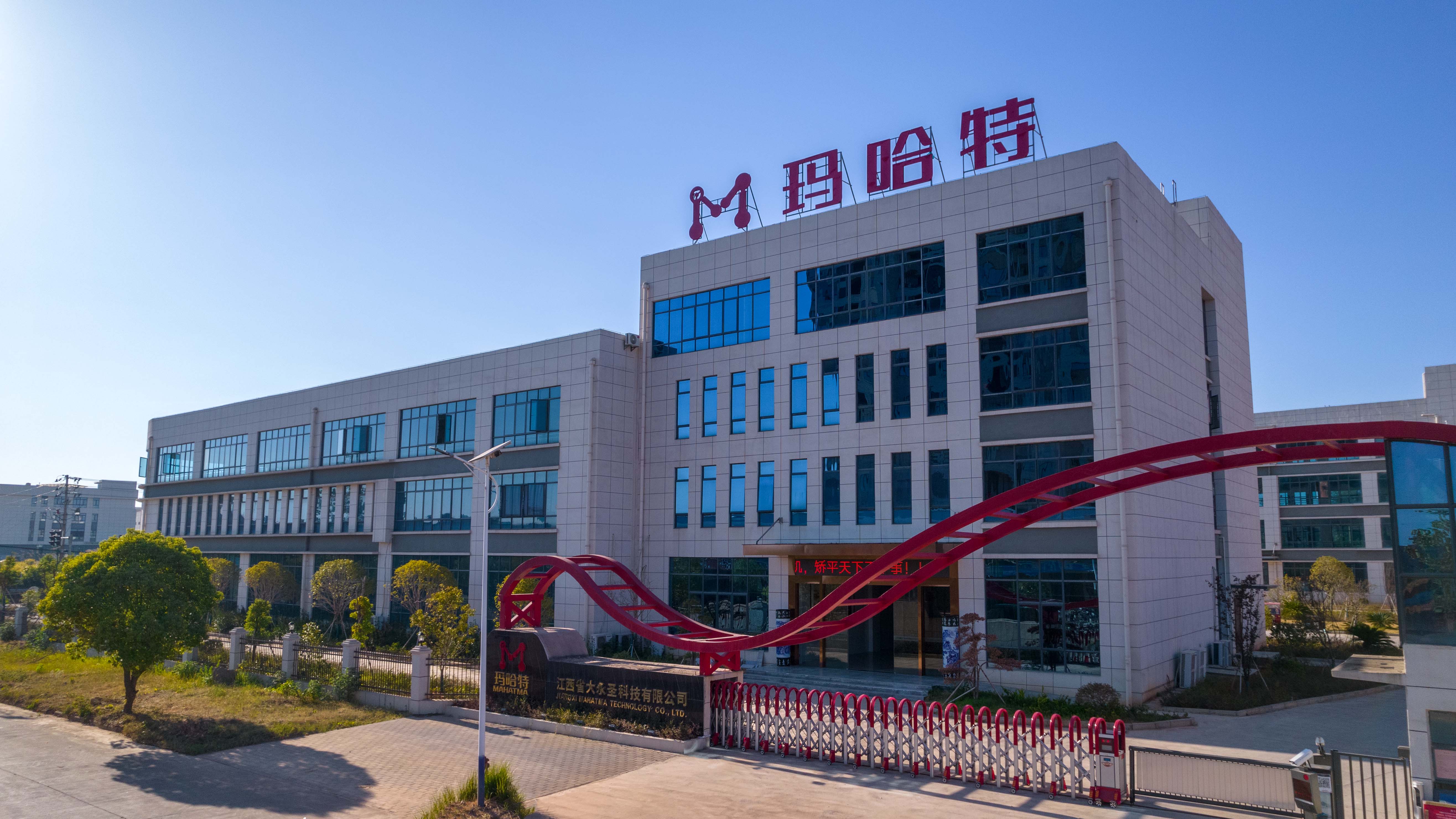
Mahatma Jiangxi Intelligent Technology Co., Ltd. — one of the manufacturing bases behind MAHATMA's leveling machines and coil processing lines, supplying equipment to more than 100 countries.