Two-High vs Four-High vs CNC Leveler: How to Specify One
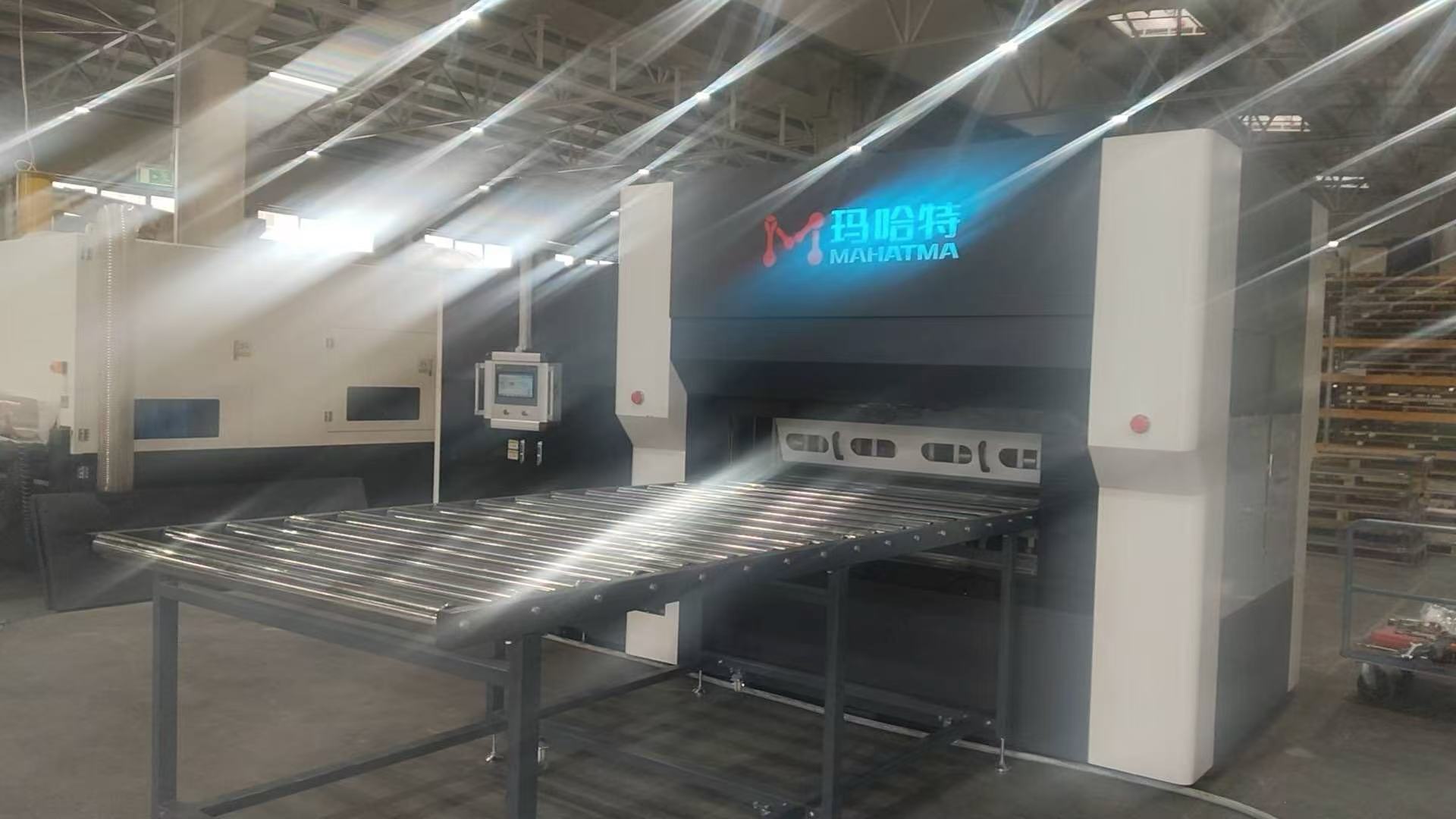
Two-high, four-high and CNC levelers are not three peer options. Two-high and four-high describe the roll stack — how many roll layers act on the strip and how the work rolls are backed up. CNC describes how the roll gap is set and held. Comparing them as alternatives means comparing a mechanical architecture with a control feature, which is why competing quotations often cannot be lined up against each other.
The workable order is two passes. First choose the roll stack that can reach your flatness target on your material. Then choose the drive and gap-control system that can hold that setting at your changeover rate. Hydraulic and servo-hydraulic machines belong to the second pass: they are a drive choice, not a fourth roll geometry. The rest of this guide follows that order — geometry, control, then the parameters to verify against your own coil or plate.
“Two-high or CNC?” is a question with two answers
Roll leveling bends the strip alternately up and down past its yield point as it passes through a set of rolls. The alternating bending relieves internal stress and removes coil set, crossbow and edge wave. Whether a given machine can do that on your material depends on two independent things: how rigidly the work rolls are supported across the strip width, and how precisely and repeatably the gap between them can be set.
The first is structure. Backup rolls sit behind the work rolls and resist the deflection that leveling force creates; deflection opens the roll gaps, and open gaps mean the strip is not bent consistently from edge to centre. The second is drive and control — mechanical adjustment, servo-driven CNC adjustment with stored recipes, or hydraulic actuation for high force.
Because the two are independent, a machine can be four-high in structure and CNC in control, and a hydraulic machine can carry either stack. Ask a supplier “two-high or CNC?” and the useful answer is a question back: which of the two problems are you actually solving?
Where the decision sits inside a coil-processing line
A leveler is usually the flatness-correction step inside a longer line rather than a standalone box. Divine Group describes levellers as terminal equipment in cut-to-length and roll-forming lines used to correct flatness issues in metal coils (SRC-0008). ANDRITZ Metals lists slitting lines, cut-to-length lines and tension levelers for cold-rolled strip, stainless steel, copper, aluminium and hot-rolled strip in the same portfolio (SRC-0005) — a reminder that the material family and line architecture are normally settled before a machine model is.
The wider context is a large sheet metal category. One 2026 commercial research report estimates the global sheet metal market at USD 182.7 billion in 2025, projected to reach USD 281.2 billion by 2030 (SRC-0001). That figure covers sheet metal broadly, not leveling machines, so it is background rather than a demand forecast for levelers.
What matters at specification stage is that “leveler capability” is not a standardised unit. Published capability statements are company-specific. Hagerty Steel, a US service centre, publishes a 72-inch cut-to-length line handling 0.075–0.500 inch thickness, 4–75 inch width, 10–480 inch length and coils up to 50,000 lb across hot-rolled, hot-rolled pickled and oiled, galvanized and cold-rolled material (SRC-0004). Those figures define one company's line, not an industry benchmark — which is why every number in a leveler quotation has to be tied to a stated material and a stated measurement method before it can be compared.
Axis 1: what the roll stack does to the strip
The stack determines how well the work rolls resist deflection under leveling force. More support means narrower unsupported gaps, which means a more consistent bend across the strip width — and that is what a flatness tolerance ultimately measures.
Two-high / rough leveler
Two-high is the base arrangement: two layers of work rolls, without a backup layer to support them. It suits basic jobs at the lowest cost, and in practice it is chosen for rough leveling and pre-leveling — taking out the worst coil set before a precision pass — or for work where the flatness tolerance is genuinely loose. MAHATMA catalogues the family as the VST Series “Two-high Leveler / Rough Leveler”, in models from VST42 to VST120.
Boundary: the simplification that makes it economical is also its limit. Under high leveling force the work rolls deflect more than a backed-up stack would, so it is a poor fit for tight flatness on thin, wide strip. If a quotation offers a two-high machine for a precision part, ask what the roll deflection is at your strip width.
Four-high / plate leveler
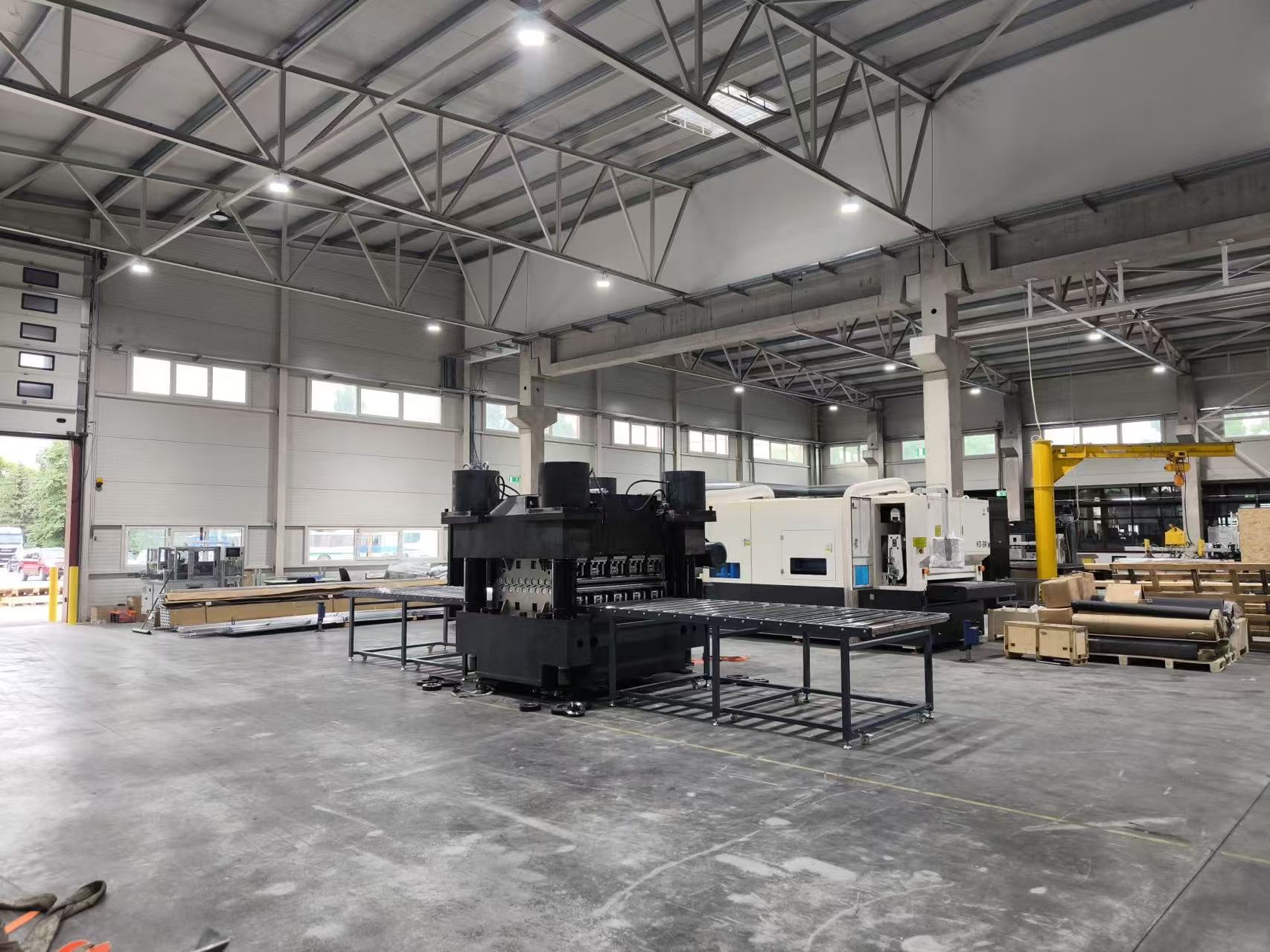
Four-high adds backup rolls that support the work rolls, sharply reducing deflection and improving flatness. That single structural change is what makes the four-high stack the default for general sheet metal and for plate: the same leveling force produces a more consistent bend across the width. MAHATMA's Four-high Leveler / Plate Leveler family is the VSH Series, VSH12 through VSH80.
Four-high is the configuration to justify before moving away from it. If a four-high stack meets the flatness target on your material, a more complex stack buys rigidity you may not need. Choosing between four-high and six-high is a flatness decision, not a specification-prestige decision.
Six-high, when flatness is the constraint
A six-high structure adds intermediate rolls, so the work rolls are almost fully supported and unsupported gaps are largely eliminated. It is described as the choice for mirror panels and precision parts, and because more roll layers mean more alternating bends, it also relieves internal stress more thoroughly. In MAHATMA's range this is an engineered, custom configuration rather than a standard catalogue series.
Treat it as a targeted upgrade: specify six-high when a documented flatness target cannot be met on a four-high stack with the appropriate roll count and roll material. The added rigidity carries added cost and maintenance scope, and neither is recoverable if the target was never that tight.
Axis 2: how the gap is set and held
Gap control decides repeatability, and the difference between the levels shows up after installation, at changeover rather than on the acceptance sheet.
- Mechanical / electric adjustment. The upper roll position is set by electric gap adjustment. Capability depends on operator judgement and on how consistently the setting is reproduced between shifts.
- CNC / servo. Servo motor control adjusts the roll gap precisely, with PLC parameter memory. Material recipes are stored and recalled, so changeover between grades becomes a parameter change instead of a trial-and-error session. CNC levelers and blanking lines can carry MES/ERP interfaces for production data, traceability and order scheduling.
- Hydraulic. Hydraulic drive lifts the upper roll, with electric gap adjustment, and is the route to the force needed for thick plate; servo-hydraulic gap control is used to absorb load shocks during the pass.
These combine rather than compete. A CNC-controlled four-high machine and a hydraulic four-high machine share the same roll geometry and differ in how force and gap are managed. That is why the technical specification sheet, not the machine label, is the document that decides whether two offers are genuinely comparable.
Where MAHATMA's range sits on both axes
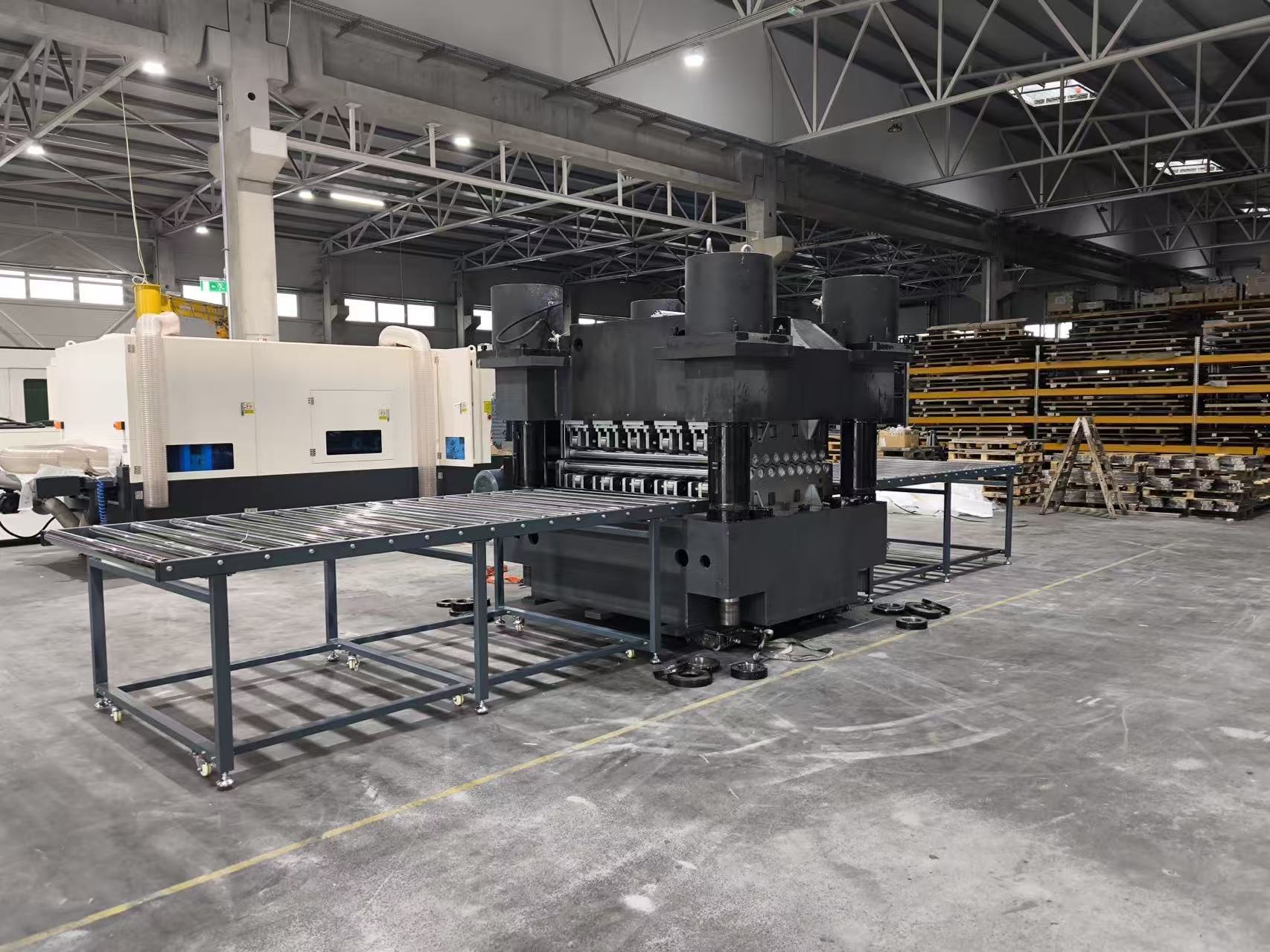
Guangdong MAHATMA Intelligent Equipment Co., Ltd. (brand: MAHATMA Leveler) is a leveling-equipment manufacturer headquartered in Dongguan, Guangdong Province, founded in 2008 and operating a 50,000 m² facility with roughly 300 employees, 26 engineers and an annual output of about 500 sets. The company holds more than 230 patents, ISO 9001 and CE certification, and its equipment is used in automotive parts, aerospace, cabinetry, transportation, sheet metal processing, power and electrical, elevators and telecommunications, with installations in markets including Germany, the United States, Japan and South Korea. The full range is published at MAHATMA Leveler.
The catalogue maps cleanly onto the two axes:
- Roll stack: VST Series (Two-high Leveler / Rough Leveler, VST42–VST120) and VSH Series (Four-high Leveler / Plate Leveler, VSH12–VSH80).
- Drive and control: MHTM Series (CNC Leveler, MHTM10–MHTM200), MHTW Series (CNC Leveler / Servo Leveler, MHTW15–MHTW100) and MHTR Series (Hydraulic Leveler, MHTR30–MHTR400).
Across these families the stated material range is 0.03–100 mm. Customisation covers roll width and diameter, leveling thickness range, roll material such as Cr12MoV or SKD11, control-system integration including MES/PLC, and automated loading and unloading. The company operates as an OEM/ODM and turnkey line provider with a one-unit minimum order and a stated 45-day lead time.
Selection parameters to verify against your material and line
Each item below should produce a written answer in the quotation, not a brochure figure to be accepted at face value.
1. The thickness rating — and the yield strength it assumes
Leveling force depends on thickness and yield strength together. Published ratings are commonly based on a reference steel such as Q235 at roughly 235 MPa and must be recalculated for high-strength steel, stainless, aluminium or titanium. Ask for the derating in writing for your grade: a machine rated to its maximum thickness in Q235 is not rated to that thickness in a 700 MPa structural steel.
2. The flatness target and how it is measured
Typical production results sit between 0.05 and 0.20 mm/m², and precision configurations reach ±0.05 mm. Final flatness depends on material grade, thickness and incoming coil condition, so a target has to be stated with a measurement method — instrument, sample size, position in the line, and whether the reading is taken before or after cutting. “Good flatness” is not a specification.
3. Roll count, roll material and surface protection
Roll material options include Cr12MoV and SKD11. On surface-critical work — pre-coated, polished or visible panels — small-diameter dense rolls reduce the risk of surface indentation, and a dust removal system becomes part of the specification. If your parts are visible surfaces, say so at RFQ stage; it changes roll design and accessories rather than just price.
4. Gap-control resolution and recipe depth
Ask how many material recipes can be stored, who may edit them, and whether a recipe is locked to a grade and thickness combination. This is where CNC control earns its cost in a high-mix plant: changeover becomes a recall, not a setup experiment, and the setting no longer depends on which operator is on shift.
5. Line position: standalone, cut-to-length, slitting or flying shear
The leveler must match the takt of the line behind it, not only the material. As a sizing reference, MAHATMA specifies cut-to-length lines for 0.2–25 mm at ±0.5 mm, and flying shear lines for 0.2–3 mm reaching up to 100 m/min and 250 cuts per minute; both are supplied with decoiler, precision leveler, shear, stacker and MES interface. State line speed, cut rate, coil weight and whether the leveler is integrated into a slitting line, because the flatness-critical path differs in each layout.
6. MES/ERP and automation interfaces
MES/ERP connectivity is standard on MAHATMA blanking lines and available on CNC levelers, with automation modules — loading carts, conveyors, robots, vision inspection, AGV — supplied as standard options. The practical step is to send your part envelope, takt target and current line layout early: integration is engineered from those three inputs, and retrofitting them after commissioning is the expensive route.
7. Power supply, conformity and customs classification
This is where otherwise sound projects stall. Standard machines are built for AC three-phase 380 V / 50 Hz, while the market you install in may not match: the US runs 480 V / 60 Hz, the EU 400 V / 50 Hz, Japan 200 V, and Saudi Arabia 60 Hz. Running a machine on the wrong supply damages motors and voids warranty. Specify voltage, frequency, phase and available transformer capacity in the contract, and add site air supply and ambient conditions for hydraulic systems.
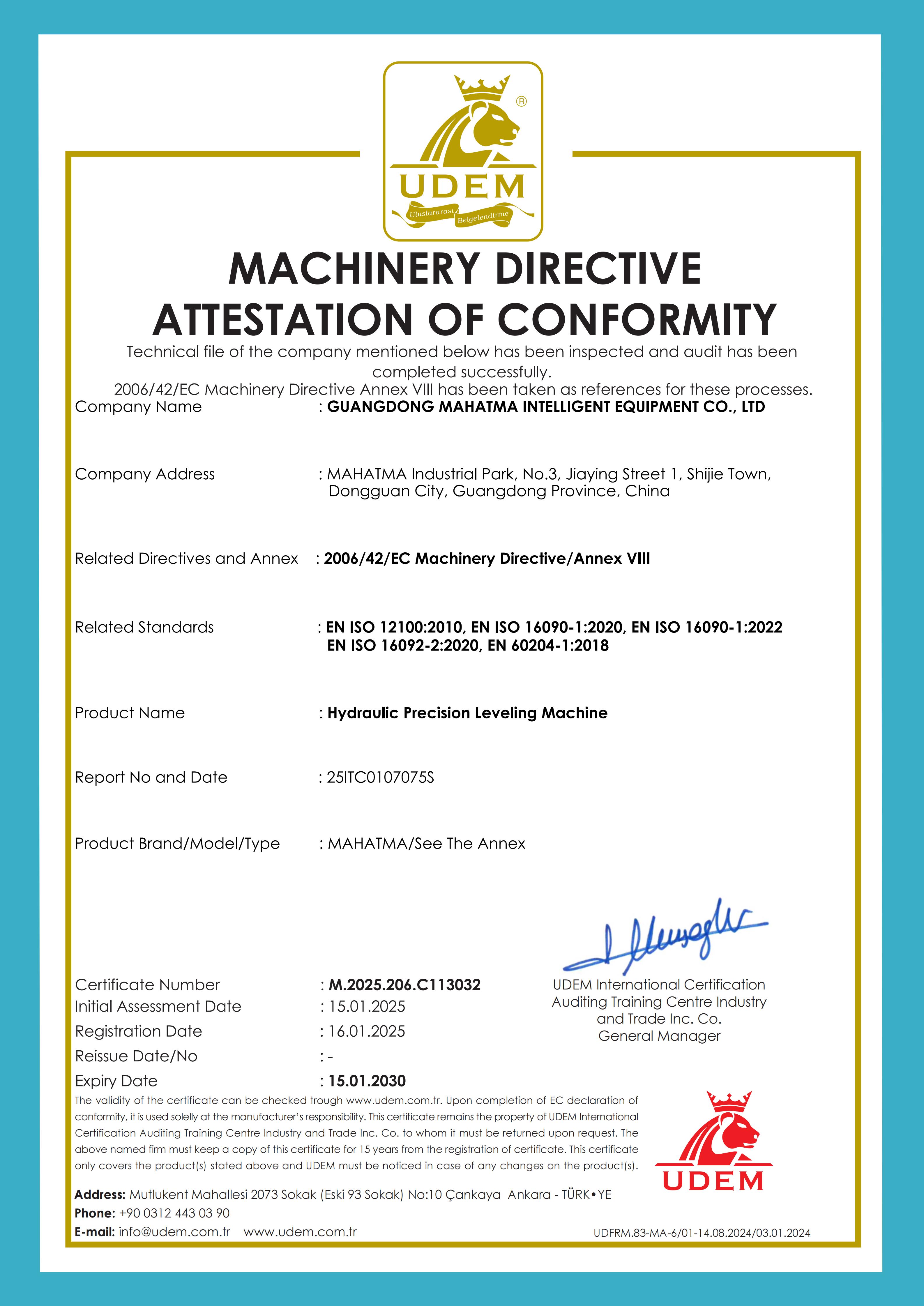
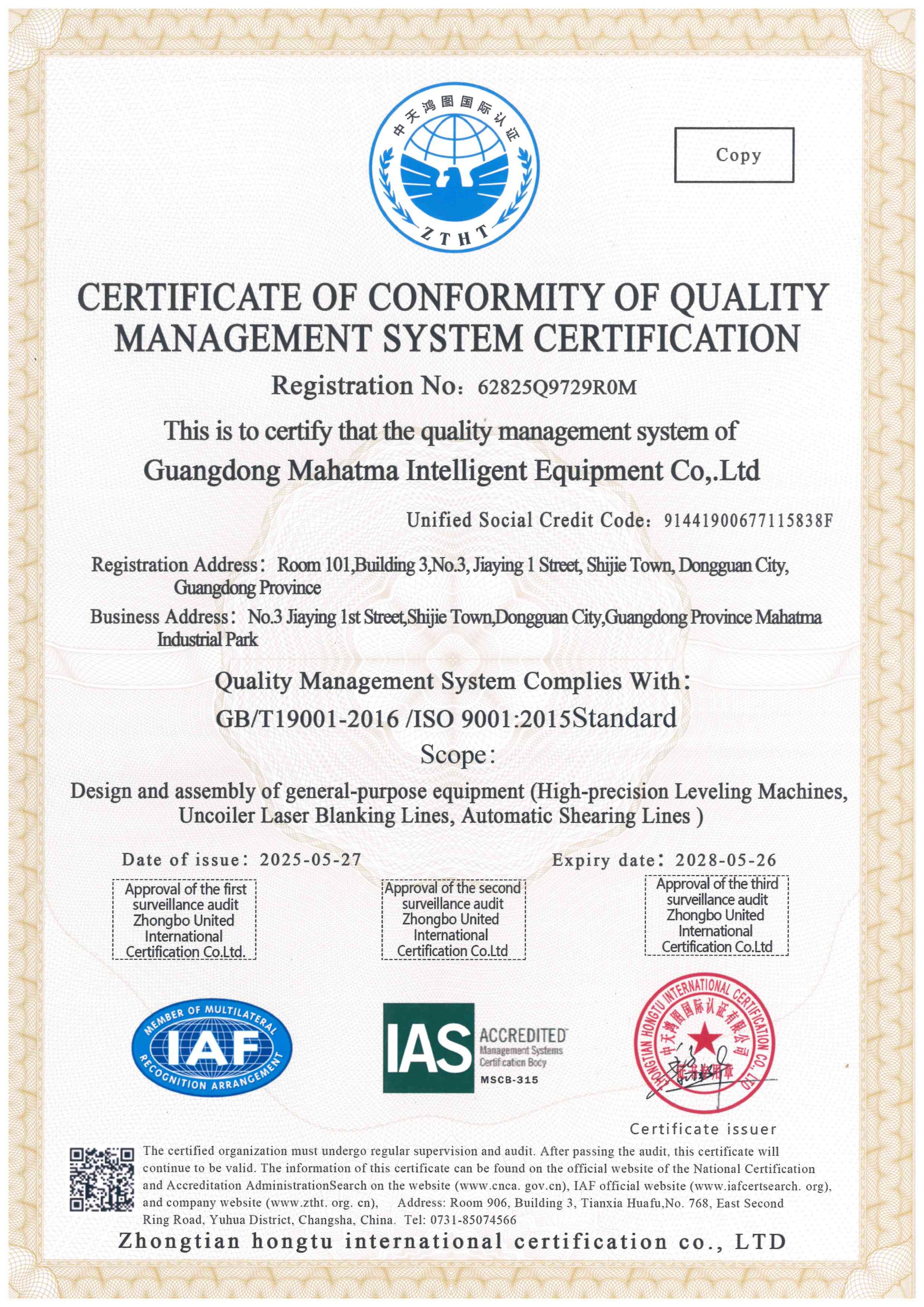
Conformity is scoped, not generic. A CE Declaration of Conformity under Machinery Directive 2006/42/EC is mandatory for the EU and rests on a risk assessment per EN ISO 12100, compliant guarding and interlocks, emergency stops and a technical file. MAHATMA's supplied CE attestation (M.2025.206.C113032, issued by UDEM, valid 16 January 2025 to 15 January 2030) is scoped to the hydraulic precision leveling machine and cites EN ISO 12100:2010, EN ISO 16090-1:2020/2022, EN ISO 16092-2:2020 and EN 60204-1:2018 — so confirm your model falls inside the scope rather than assuming a certificate covers the whole catalogue. The ISO 9001:2015 certificate (62825Q9729R0M, issued 27 May 2025, valid to 26 May 2028) covers design and assembly of high-precision leveling machines, uncoiler laser blanking lines and automatic shearing lines; it certifies the quality management system, not the machine's flatness.
North America has no CE equivalent. Local authorities having jurisdiction may require an NRTL field evaluation or listing, and the electrical panel is expected to follow NFPA 79 in the US and CSA C22.2 in Canada. Agree before signing who carries the field-evaluation cost. For customs, the USITC schedule places non-CNC straightening machines under HS 8462.21.00; confirm the classification for your specific configuration with your broker, because the CNC designation can move it.
Comparison table: matching configuration to function
| Configuration | Architecture | Gap control | Fits | Verify before order |
|---|---|---|---|---|
| Two-high / rough leveler (VST Series) | Two work roll layers, no backup layer | Electric gap adjustment | Rough and pre-leveling, loose tolerance, budget-limited work | Roll deflection at your strip width |
| Four-high / plate leveler (VSH Series) | Backup rolls supporting the work rolls | Electric or CNC, depending on build | General sheet metal and plate; default precision choice | Flatness target on your grade after yield-strength derating |
| Six-high (custom) | Intermediate plus backup rolls; near-full work-roll support | Configured per project | Mirror panels and precision parts where four-high is insufficient | Whether the target is genuinely unreachable on four-high |
| CNC / servo (MHTM, MHTW Series) | Either stack; servo gap adjustment | Servo with PLC recipe memory | High-mix plants, laser blanking, repeatable changeover | Recipe count, edit rights, MES/ERP interface scope |
| Hydraulic (MHTR Series) | Either stack; hydraulic upper-roll lift | Hydraulic with electric gap adjustment | Heavy plate and high-force leveling | Force at your yield strength; crane and foundation limits |
Application fit: material and line decide the configuration
Thin gauge and surface-critical sheet. Pre-coated, polished and visible panels need small-diameter dense rolls to avoid indentation, plus dust removal. A four-high CNC machine with recipe storage is usually the working configuration, because the same line runs several finishes. MAHATMA's project record includes an aluminium sheet leveling project in the Philippines on the MHTM60 Series and a perforated sheet project in Malaysia on the MHTM80 and MHTM60 Series.
High-strength thin strip. Spring steel and high-yield strip push the derating question to the front: the thickness rating must be recalculated before the model is fixed. A Singapore spring steel project in the record uses the MHTM80 Series, which illustrates the pattern rather than a rule — the model follows the material, not the other way round.
Laser blanking and pre-cut flattening. Here the leveler's job is to remove coil set, waves and internal stress so laser focus height and nesting stay accurate. Most laser shops run 0.5–6 mm carbon steel, stainless and aluminium; CNC gap adjustment with recipe storage is the priority, because changeover between materials then takes a parameter recall rather than a trial cut. Where parts are precision-critical, closed-loop verification with laser 3D inspection becomes worth specifying.
Heavy plate and structural work. Plate in the 20–100 mm range is a force problem rather than a control problem: roll diameters move into the 300–400 mm class, frames and drives scale up, and servo-hydraulic gap control has to absorb load shocks during the pass. Two checks belong in the RFQ — the derated capacity at your plate's yield strength, and site readiness, meaning crane capacity and foundation. Hydraulic machines (MHTR Series) are the family built for this duty.
Service centres and coil processors. The leveler is one station inside a cut-to-length, slitting or flying shear line, so line speed and cut rate constrain the choice as much as material. MAHATMA's project record includes a Brazil semi-trailer parts application on the MHTR80 and MHTR100 Series and a German mesh-board application on the MHTR80 Series; the reported project highlights are stable operation and low failure rate, which are customer-project statements rather than a performance guarantee for other sites.
Proving it on your own material before you commit
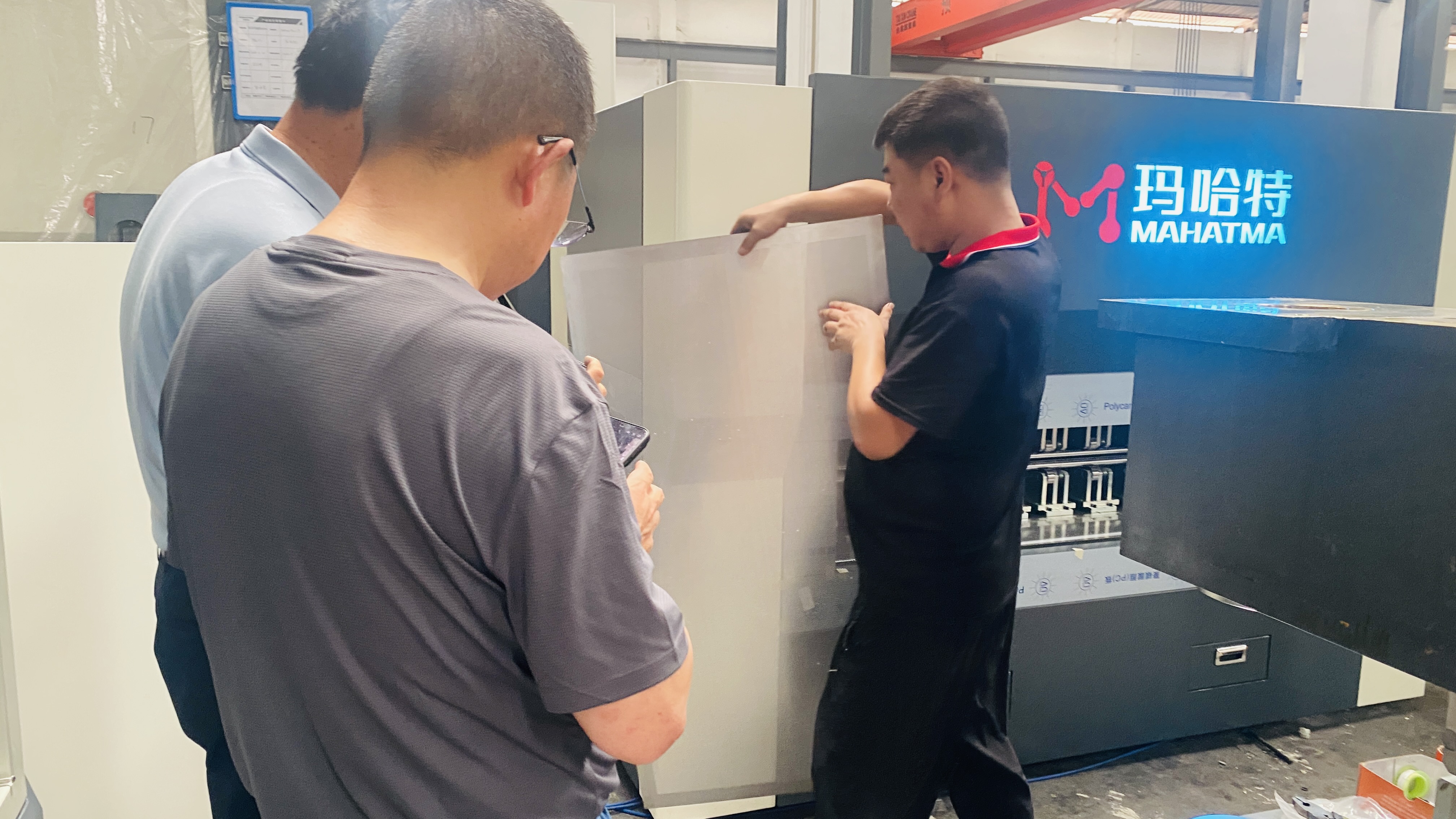
Flatness is material-dependent, so a brochure number is not a guarantee. The sample test exists to close that gap: send 1–2 metres of your material, or your typical parts, with the material grade, thickness and flatness target noted, and the material is leveled on the recommended machine. The result is a written report with measured flatness data, the process parameters used and a video of the run, normally within days; the sample test and the resulting proposal are free, and the buyer covers shipping of the material. Test your worst-condition material, not your best — a trial on clean, flat stock proves very little.
Factory acceptance is the second checkpoint. MAHATMA's stated quality control includes laser 3D online flatness detection, ultrasonic flaw detection on rollers, hardness uniformity testing and a full-load trial run before shipment, with pre-shipment test as the acceptance criterion. Commercial terms in the same package: minimum order of one unit, FOB/CIF/DAP delivery terms, and 30% deposit with the 70% balance before dispatch. For buyers in Evaluation-to-Execution stage, those three documents — sample report, factory test report and the signed specification sheet — are what make two quotations comparable.
FAQ
Which compliance and power-supply points must be settled before a leveler is ordered?
For the EU, a CE Declaration of Conformity under Machinery Directive 2006/42/EC is mandatory, and it must cover your machine model: MAHATMA's attestation M.2025.206.C113032 is valid to 15 January 2030 and is scoped to the hydraulic precision leveling machine. ISO 9001:2015 certificate 62825Q9729R0M covers design and assembly of high-precision leveling machines, uncoiler laser blanking lines and automatic shearing lines. For the US and Canada, an NRTL field evaluation may be required by the local authority, with the panel built to NFPA 79 or CSA C22.2 and the supply configured for 480 V / 60 Hz rather than the standard 380 V / 50 Hz. Request the Declaration of Conformity before final payment, and write voltage, frequency, phase and transformer capacity into the contract.
Can a CNC leveler also be a four-high leveler?
Yes. Four-high describes the roll stack — backup rolls supporting the work rolls — while CNC describes servo-driven gap adjustment with PLC recipe memory. The two are independent, so a four-high structure can be supplied with mechanical, CNC or hydraulic actuation. In MAHATMA's catalogue the VSH Series is the four-high family, the MHTM and MHTW Series are CNC families, and the MHTR Series is the hydraulic family; when comparing offers, ask for both the roll stack and the gap-control type in writing, because a quotation that names only one of them is incomplete.
What commercial terms apply, and what drives the price?
MAHATMA's stated terms are a one-unit minimum order, FOB/CIF/DAP delivery, 30% deposit with the 70% balance paid before dispatch, and pre-shipment testing as the acceptance criterion. Quotations are issued against material data rather than a catalogue list, and the main cost drivers are the roll stack, roll material (Cr12MoV or SKD11), width and thickness envelope, gap-control type and automation modules such as loading carts or vision inspection. Because configuration changes the machine substantially, a comparable price can only be issued once your thickness range, width, grade and flatness target are fixed.
Can I test my own material on the machine before buying?
Yes, and the sample test is free — the buyer covers shipping of the material. Send 1–2 metres of material or representative parts, with the material grade, thickness and flatness target noted, and MAHATMA levels it on the recommended machine and returns a written flatness report with the measured data, the process parameters used and a video of the run, normally within days. The material is returned or retained as agreed. Test the worst-condition material in your range, since a trial on easy stock does not establish capability at the edge of the specification.
What is the lead time, and what happens after delivery?
The stated lead time is 45 days, with monthly production capacity of 50 units. Before shipment each machine goes through a full-load trial run, with laser 3D online flatness detection, ultrasonic flaw detection on rollers and hardness uniformity testing as part of quality control. After delivery, support includes 24/7 global technical assistance, overseas engineers available for commissioning, regional spare parts warehouses and free operator training. If you want to check the two-axis logic against your own coil or plate, the MAHATMA leveling machine brochure sets out the families, and a material sample request is the fastest way to convert the specification into a decision.
Conclusion
Two-high, four-high and CNC levelers describe different things, and treating them as a three-way menu is the single most common reason leveler quotations come back incomparable. Specify the roll stack first — two-high for rough and pre-leveling work, four-high as the default for general sheet metal and plate, six-high only when a documented flatness target is beyond a four-high stack — then specify the drive and gap control that can reproduce that geometry: mechanical adjustment for simple, low-changeover work, CNC servo with recipe memory for high-mix production, hydraulic or servo-hydraulic actuation where plate thickness makes force the governing constraint.
Three checks carry most of the risk. Get the thickness rating derated in writing for your actual yield strength rather than for Q235. Define flatness with a measurement method, not an adjective. Fix power supply, conformity scope and customs classification before the purchase order, because none of the three is cheap to correct after arrival. Then prove the whole specification on a sample of your own material and hold the result against the factory test report. Read the full range in the MAHATMA leveling machine brochure.
Have Questions or Need More Details?
Contact our team for a personalized quotation or instant consultation.
Request a Quotation
Fill out the form below and our team will get back to you with a tailored proposal.
WhatsApp Direct Chat
Prefer to chat in real-time? Message us on WhatsApp for instant assistance & quick answers.
- Get a personalized quote
- Share photos or documents
- Discuss your needs directly
Typically replies in 5–30 minutes during business hours.