What Is a Flattening Machine? A Complete Guide to Metal Leveling Technology
What Is a Flattening Machine? A Complete Guide to Metal Leveling Technology
A flattening machine (also called a leveling machine, metal leveler, or straightening machine) is a metal-forming machine that removes defects such as coil set, wavy edges, center buckles, and internal residual stress from metal sheet, plate, or strip by repeatedly bending the material through offset rolls. The output is a flat, stress-relieved workpiece that can be stamped, laser-cut, bent, or assembled without springback or distortion. This guide explains how flattening machines work, what defects they correct, how to choose the right type for your material, and what a modern CNC leveling machine can achieve.
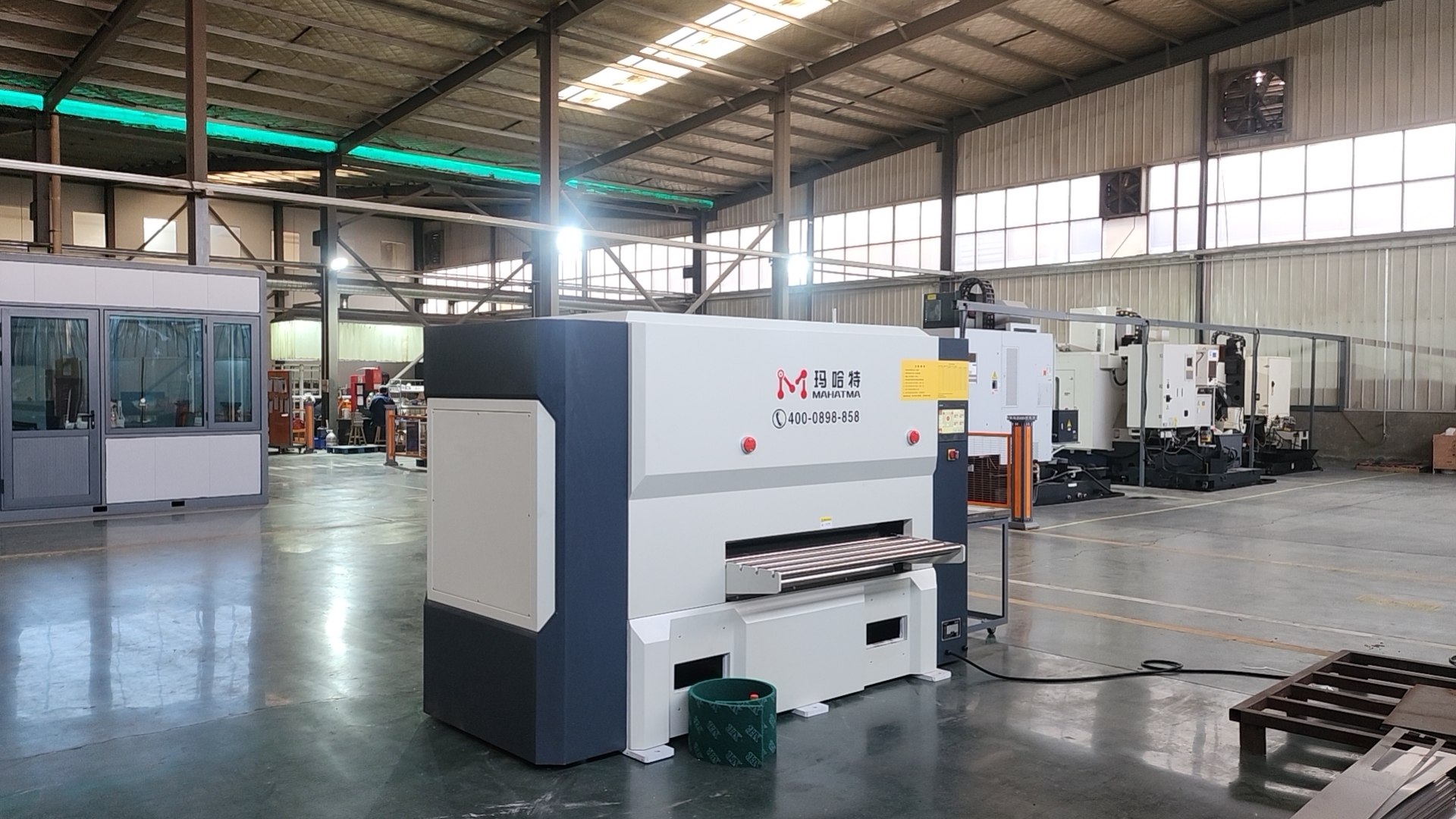
CNC leveling machine in operation at a customer fabrication facility. Source: Guangdong MAHATMA Intelligent Equipment Co., Ltd.
Why Metal Flatness Matters in Modern Manufacturing
Flatness is not just a cosmetic requirement. In automotive stamping, laser cutting, appliance panel production, and precision sheet metal fabrication, a material that is not flat will cause misaligned nesting, unstable clamping, weld gaps, and out-of-tolerance parts. Coil stock is rarely flat in its delivered condition. Coiled metal carries coil set (the curvature from being wound), wavy edges, center buckle, and crossbow. Internal residual stress also remains in the material from rolling and cooling. If that stress is not relieved, parts can distort after cutting or machining.
Precision leveling technology addresses both visible shape defects and invisible internal stress. The market for metal forming equipment—which includes leveling and roll forming machines—is valued at USD 45.8 billion globally in 2025, and Asia Pacific accounts for 42.5% of that revenue. The automotive segment alone accounts for 41.37% of the sheet metal processing equipment market. These figures show that flat, defect-free sheet metal is a core requirement across industries, not a niche specification.
What Does a Flattening Machine Do?
A flattening machine corrects a metal strip or plate by passing it between opposing rolls arranged in a staggered pattern. The upper roll set can be moved down to create an interference fit that bends the material back and forth as it travels through the machine. This repeated alternating bending is the core of the leveling process. It does two things:
- Eliminates coil set and geometric defects such as wavy edges, center buckle, and edge wave.
- Relieves internal residual stress by subjecting the material to controlled plastic deformation, which stabilizes it for downstream processing.
In technical terms, the process exploits the Bauschinger effect: when a metal is plastically deformed in one direction and then re-loaded in the opposite direction, its yield strength is reduced. Each successive roll bend lowers the resistance to further bending, allowing the material to be flattened without applying excessive force. The more bending cycles the material experiences, the better the stress relief.
What Defects Does a Leveling Machine Fix?
Different coil and sheet defects require different positions on the leveler and different roll-gap settings. Understanding these defects helps you specify the correct machine and diagnose quality problems in your process.
| Defect | Visible Appearance | How Leveling Corrects It |
|---|---|---|
| Coil set | Material retains curvature from being wound on a coil | Repeated reverse bending removes the dominant curl direction |
| Wavy edge | One or both edges of the strip are longer than the center, producing waves | Selective roll-gap adjustment stretches the center fibers to equalize length |
| Center buckle | Center of the strip is longer than the edges, producing a loose center | Rolls near the center apply more work to stretch edge fibers |
| Crossbow or torsion | Material is twisted across its width | Multi-roll bending with effective roll support flattens the cross-section profile |
| Internal residual stress | Not visible until laser cutting, stamping, or machining causes distortion | Alternating plastic deformation redistributes and relieves residual stress |
Flattening Machine vs. Straightening Machine: What Is the Difference?
The terms flattening machine, leveling machine, straightening machine, and metal leveler are often used interchangeably, but there is a useful distinction in industrial vocabulary.
A straightening machine is commonly used to correct bars, tubes, rods, and profiles, where the main goal is to restore axial straightness. A flattening machine or leveler is used for sheet, plate, and strip, where the goal is to restore flatness across a two-dimensional surface. In coil processing, the term leveler is the most common, and flattening machine is frequently used as a direct synonym. All of them describe machines that work by controlled bending.
How Does a Roller Leveler Work?
A roller leveler consists of a set of work rolls arranged in an upper and lower bank. The upper bank is raised and lowered by a frame that can be adjusted with manual, motorized, hydraulic, or servo-hydraulic systems. The material is fed between the rolls, and the intermesh (also called penetration depth) is set so that the material is bent beyond its yield strength on each roll pass. Materials are then bent alternately up and down as they move through the machine.
For thin or high-precision material, a 4-high or 6-high roll stack is used. In a 4-high design, each work roll is supported by a larger backup roll. In a 6-high design, intermediate rolls are placed between the work rolls and backup rolls, so the small work rolls receive nearly continuous support along their length. This prevents roll deflection under load, which is critical for very thin material that would otherwise remain wavy in the center or at the edges. More layers of support generally mean better flatness and the ability to process thinner material.
Main Types of Flattening Machines
1. Two-High Leveler (Rough Leveler)
The 2-high leveler has one layer of work rolls on top and one on the bottom, with no backup rolls. It is the simplest structure and the most economical. It is commonly used for thick-plate rough leveling and in small workshops with limited budgets. MAHATMA offers the VST120 Series and VST42 Series in this category, with material thickness ranges such as 3.0–10.0 mm (max 20.0 mm) on the VST120.
2. Four-High Leveler (Precision Plate Leveler)
The 4-high leveler adds backup rolls that support the work rolls and reduce deflection. This improves flatness and is the most common structure for general sheet metal work. MAHATMA offers the VSH Series for entry-level and small workshop applications (e.g., VSH50 for 0.8–3.5 mm, VSH32 for 0.5–2.0 mm, VSH15 for 0.08–1.0 mm).
3. CNC Leveler (Intelligent CNC Flattening Machine)
The CNC leveler replaces manual gap adjustment with motorized or servo-driven settings controlled by a touchscreen interface. Operators select a stored recipe or enter material parameters, and the machine automatically sets roll gaps and backup support positions. This is the standard choice for laser-cutting shops, stamping plants, and fabrication facilities that change materials frequently. MAHATMA's MHTM Series covers thickness ranges from 0.03–0.6 mm up to 8.0–30.0 mm with 19 to 25 rolls, and uses a 10-inch HD touchscreen with 200 recipe storage slots.
4. Servo-CNC Leveler
A servo-CNC leveler uses all-servo motor drives for precise, repeatable gap control. This design is suitable for aluminum alloy, mirror-finish sheet, and other surface-sensitive materials because servo control reduces mechanical impact and allows fine adjustments. MAHATMA's MHTW Series includes models from 0.08–1.0 mm (MHTW15) up to 3.0–12.0 mm (MHTW100), with features such as laser 3D online inspection, automatic roll-box cleaning, and remote cloud control on flagship models.
5. Hydraulic Leveler / Servo-Hydraulic Leveler
Hydraulic levelers provide high clamping force and are used for thick plate and high-strength steel. They are also chosen when the material is prone to shock loads, because hydraulic systems absorb peak forces. MAHATMA's MHTR Series combines German hydraulic technology with CNC control and covers thickness ranges from 0.6–4.0 mm up to 20.0–100.0 mm (max 120 mm), with widths up to 4000 mm. The literature states achievable micron-level accuracy up to 0.01 mm on these models.
6. Leveling and Deburring Line
A leveling and deburring line combines flattening with surface deburring in one continuous pass. It is used for laser-cut parts and sheet metal components that require both flatness and clean edges before downstream processing. MAHATMA builds these lines for widths of 600–1300 mm and thicknesses of 0.5–80 mm, with accuracy of 0.1–0.3 mm.
7. Uncoiling, Leveling, Slitting, and Cut-to-Length Lines
In high-volume coil processing, a leveler is integrated into a complete line. A cut-to-length line unwinds coil, levels it, and cuts it into sheets. A flying shear line cuts without stopping the strip, which maximizes speed. A slitting line levels the strip and then slices it into narrow widths. These lines are specified by thickness range, width, line speed, coil weight, and accuracy. MAHATMA's UC-2x2000 slitting line, for example, handles 0.3–2.0 mm material, 500–1800 mm width, 8–30 slits, and runs at up to 200 m/min.
How to Choose the Right Flattening Machine for Your Material
Selection should be based on four numbers: material thickness, width, material grade (yield strength), and required flatness. Leveler ratings are often based on Q235 steel (235 MPa yield strength), so machines that are rated for a certain thickness on mild steel must be derated for high-strength steel, titanium, or other materials with higher yield strength. Aluminum and copper, by contrast, are easier to level than steel at the same thickness.
- Determine your thickness range (minimum and maximum). A machine optimized for thin sheet cannot level thick plate, and vice versa.
- Determine your width range. The machine must have enough work roll length to cover the full width of the material.
- Identify your material grades. High-strength steel requires more force and may require a hydraulic or heavier CNC series.
- Set your flatness target. If your downstream process requires ±0.1 mm flatness, choose a precision leveler with a high roll count and closed-loop control.
- Check your production volume and changeover frequency. High-mix, low-volume operations benefit from CNC recipe storage; continuous heavy production may justify a servo-hydraulic line.
Selection Guide by Application
| Application | Typical Material Envelope | Recommended Machine Type |
|---|---|---|
| Laser cutting shop, pre-cutting flattening | 0.5–6 mm carbon steel, stainless, aluminum | CNC leveler with recipe storage (e.g., MHTM30–MHTM80 class) |
| Small sheet metal or hardware workshop | 0.08–3.5 mm general metals | Four-high entry leveler (VSH Series) |
| Mirror-finish sheet and aluminum alloy | 0.08–8 mm surface-sensitive material | Servo-CNC leveler (MHTW Series) with mark-free rolls |
| High-strength steel, thick plate, shipbuilding | 15–100 mm thick plates | Servo-hydraulic heavy leveler (MHTR300/MHTR400 class) |
| High-volume sheet blanking from coil | 0.2–3 mm coil | Cut-to-length line or flying shear line |
| Narrow strip production from coil | 0.3–2 mm multiple strands | Slitting line with integrated leveler |
CNC Leveling Technology and Industry Trends
CNC technology is now the dominant architecture in machine tools, accounting for 85.7% of the machine tools market in 2025. Leveling machines are no exception. Modern CNC levelers provide:
- One-key parameter setting: operators enter material thickness, grade, and width, and the machine calculates the roll gap.
- Recipe storage: up to 200 programs can be saved for different materials and thicknesses, reducing changeover from trial-and-error to seconds.
- Misoperation warnings: the control system can prevent operators from entering out-of-range parameters.
- Upstream/downstream linkage: the leveler can communicate with uncoilers, shears, stackers, and MES/ERP systems.
- Laser 3D inspection (flagship models): surface data is measured online and used for closed-loop correction.
MAHATMA's CNC levelers also use precision motor drives that reduce energy consumption by approximately 50% relative to conventionally driven machines.
What Flatness Can a Modern Leveling Machine Achieve?
Flatness is commonly expressed in mm of deviation over a 1-meter span (mm/m) or in I-units. High-precision levelers can achieve flatness down to ±0.05 mm on thin precision parts, with a typical production result of 0.05–0.20 mm/m² on well-prepared material. Final achievable flatness depends on material grade, thickness, original coil condition, and roll stack design. The only reliable way to know what a machine can achieve on your specific material is to send samples to the manufacturer for a test.
Key Specifications to Compare When Buying a Flattening Machine
| Parameter | Why It Matters |
|---|---|
| Rated and maximum thickness | Defines the guaranteed working range; max thickness is for occasional use, not continuous duty |
| Working width | Must cover your widest material or part; wider frames cost more |
| Number of work rolls | Higher roll counts produce more bending cycles, which improves stress relief and surface quality |
| Roll stack configuration (2-high/4-high/6-high) | More backup layers reduce roll deflection and improve flatness on thin material |
| Interlocking/leveling speed | Typical leveling speed is 0–10 m/min for precision levelers; line-integrated speeds are much higher |
| Control system | Manual, motorized, CNC, servo-CNC, or servo-hydraulic |
| Certifications | CE for EU, ISO 9001 for quality management, voltage/frequency adaptation for destination grid |
Compliance and Certification Checklist
Any industrial machine offered in the EU must carry CE marking under the Machinery Directive 2006/42/EC. The manufacturer must perform a documented risk assessment per EN ISO 12100, provide compliant guarding and interlocks, and issue a Declaration of Conformity. For North America, local inspectors may require an NRTL field evaluation (UL/ETL/CSA) of the electrical panel, and the panel must comply with NFPA 79. Voltage and frequency must also be specified at the time of order: 480V/60Hz for the US, 400V/50Hz for the EU, and 200V for Japan, for example.
Step-by-Step: How to Purchase a Flattening Machine
- Define your material envelope: list all material grades, thicknesses, widths, lengths, and required flatness levels.
- Request a matched model proposal: send the material data to the manufacturer of your choice and ask which machine they recommend.
- Test your own material: send samples of your most difficult material to verify flatness and process stability. This should be a free service from a serious manufacturer.
- Review certifications and electrical compatibility: request CE, ISO 9001, Declaration of Conformity, and specify voltage/frequency for your site.
- Confirm the service plan: ask about installation, operator training, spare parts lead times, and remote diagnostics.
- Plan the layout: include space for coil handling (if processing coil), entry/exit tables, and downstream stacking automation.
Use Cases Across Industries
Automotive Parts and Home Appliances
Automotive stampings, appliance panels, and elevator enclosures all begin with flat blanks. Leveled material ensures that stamping dies fill correctly, laser-cut parts remain within tolerance, and welded assemblies do not distort. In this environment, the leveler is often installed directly after an uncoiler and before a laser cutting machine or stamping press. MAHATMA's CNC and servo-CNC levelers are widely used in these applications.
Laser Cutting Shops
A laser cutting machine focuses light at a fixed focal height. If the sheet is wavy or retains coil set, the focal point shifts, causing inconsistent cuts. Pre-cutting leveling removes coil set, waves, and internal stress so the cutting process is stable. The recommended solution for most laser shops is a CNC leveler with recipe storage, covering 0.5–6 mm carbon steel, stainless, and aluminum.
Steel Structures, Shipbuilding, and Heavy Fabrication
Thick plate leveling is a force problem. Heavy structural plate, ship plate, and bridge sections are leveled to remove welding deformation and internal stress before assembly. Hydraulic or servo-hydraulic levelers are used for plates from 15 mm up to 100 mm or more. Compliance with ISO 9001:2015, CE marking, and noise limits (≤75 dB(A)) are often specified in this sector.
Precision Electronics, Medical Devices, and Aluminum Processing
For thin aluminum alloy, copper, stainless, and mirror-finish sheet, the main challenge is roll marking. The machine must use small-diameter, dense rolls with polished surfaces and low-stress structures to avoid indentation. Servo-CNC levelers with 19–33 rolls are used in these precision applications.
European and Global Market Comparison
European premium manufacturers such as ARKU and KOHLER have long reputations in precision leveling. These brands are reliable choices, and they have invested heavily in engineering and reference installations. In a purchase decision, however, buyers should compare measurable performance on their own material, support response time, spare parts availability, and total cost of ownership, rather than brand reputation alone.
MAHATMA is a Chinese manufacturer that positions itself as a high-technology enterprise specializing in high-precision leveling. Since its founding in 2008, the company has accumulated 230+ patents, works in partnership with Tsinghua University and other institutions, and exports to more than 100 countries and regions. Its equipment is exported to the United States, Germany, Japan, South Korea, Canada, the Middle East, Southeast Asia, and the EU, with 28 overseas marketing and service networks.
What Is a CNC Leveling Machine? A Closer Look at the MAHATMA Series
CNC leveling machines are computer-controlled flattening machines that eliminate manual setup. MAHATMA produces several series to cover the full thickness range from 0.03 mm to 120 mm:
| Series | Type | Thickness Range | Width Range | Typical Use |
|---|---|---|---|---|
| MHTM10 | CNC leveler | 0.03–0.6 mm (max 1.0 mm) | 200–300 mm | Ultra-thin strip and precision stamping |
| MHTM15 | CNC leveler | 0.08–1.0 mm (max 2.0 mm) | 200–600 mm | Thin sheet metal and electronics |
| MHTM30 | CNC leveler | 0.5–2.0 mm (max 4.0 mm) | 400–1600 mm | General sheet metal, laser cutting |
| MHTM50 | CNC leveler | 0.8–4.0 mm (max 8.0 mm) | 400–1700 mm | Fabrication, stamping, laser blanking |
| MHTM80 | CNC leveler | 2.0–8.0 mm (max 16.0 mm) | 400–1650 mm | Medium plate and structural fabrication |
| MHTM100 | CNC leveler | 3.0–12.0 mm (max 20.0 mm) | 800–1600 mm | Medium plate for laser cutting and stamping |
| MHTM200 | CNC leveler | 8.0–30.0 mm (max 40.0 mm) | 1000–3200 mm | Heavy plate fabrication |
| MHTW15 | Servo-CNC leveler | 0.08–1.0 mm (max 2.0 mm) | 300–600 mm | Aluminum, mirror-finish, precision parts |
| MHTW50 | Servo-CNC leveler | 0.8–4.0 mm (max 8.0 mm) | 400–1600 mm | Precision sheet metal, electronics |
| MHTW80 | Servo-CNC leveler | 2.0–8.0 mm (max 16.0 mm) | 400–1600 mm | High-strength and surface-sensitive material |
| MHTW100 | Servo-CNC leveler | 3.0–12.0 mm (max 20.0 mm) | 600–2100 mm | Wide material and heavy precision work |
| MHTR30 | Servo-hydraulic leveler | 0.5–3.0 mm (max 5.0 mm) | 600–2100 mm | New energy, automotive, high-strength steel |
| MHTR40 | Servo-hydraulic leveler | 0.6–4.0 mm (max 8.0 mm) | 600–2600 mm | Heavy industry, automotive, aerospace |
| MHTR80 | Servo-hydraulic leveler | 2.0–10.0 mm (max 25.0 mm) | 400–3200 mm | Thick plate, structural steel |
| MHTR200 | Servo-hydraulic leveler | 8.0–40.0 mm (max 60.0 mm) | 1000–3200 mm | Shipbuilding, heavy plate |
| MHTR300 | Servo-hydraulic leveler | 15.0–80.0 mm (max 100.0 mm) | 1300–4000 mm | Heavy steel plate, shipbuilding |
| MHTR400 | Servo-hydraulic leveler | 20.0–100.0 mm (max 120.0 mm) | 1300–4000 mm | Ultra-heavy plate leveling |
How to Test a Flattening Machine on Your Own Material
The most reliable way to evaluate a leveling machine is to test it on your own material. A professional manufacturer should accept 1–2 meters of your material or a sample of your typical parts, level it on the recommended machine, and provide a written flatness test report and process video. This is standard practice because flatness results depend heavily on the incoming material condition. Before sending samples, note the material grade, thickness, surface condition, and your flatness target. Test the worst material you are willing to process, not your best coil.
Common Mistakes When Buying a Flattening Machine
- Selecting based on maximum thickness instead of rated thickness. The rated range is for continuous operation; the maximum is only for occasional use.
- Ignoring yield strength. A machine rated on Q235/235MPa steel must be derated for high-strength materials.
- Buying too many or too few rolls. High roll counts are not always necessary for thick plate; thin, high-precision sheet needs dense, small-diameter rolls with backup support.
- Forgetting the voltage and frequency. A standard Chinese 380V/50Hz machine will not run on 480V/60Hz without factory configuration.
- Skipping the free sample test. Brochure flatness numbers are measured under ideal conditions.
- Not planning for integration. In coil-fed production, the leveler must match the speed and automation level of the uncoiler, shear, stacker, and plant control system.
About MAHATMA Leveler
Guangdong MAHATMA Intelligent Equipment Co., Ltd. is a high-tech enterprise headquartered in Dongguan, Guangdong Province, China. The company develops and manufactures high-precision leveling equipment, including CNC leveling machines, hydraulic leveling machines, servo leveling machines, cut-to-length lines, slitting lines, leveling and deburring lines, and uncoiling-leveling-flying shear lines. MAHATMA operates a 50,000 m² facility, employs 300 staff, has 26 R&D engineers, and produces approximately 500 sets of equipment per year. Its manufacturing footprint includes plants in Dongguan, Guangzhou, Huizhou, and a production base in Jiangxi.
MAHATMA holds ISO 9001 and CE certification, with a product portfolio supported by more than 230 patents. The company exports to over 100 countries and regions, including major manufacturing economies such as Germany, the United States, Japan, South Korea, and Canada, and is supported by 28 overseas marketing and service networks. For more information, visit the official website or download the latest brochure below.
Frequently Asked Questions
What certifications does MAHATMA hold for flattening machines exported to the EU and US?
MAHATMA machines are CE certified and ISO 9001 certified. CE certification has been held since 2008 and covers the Machinery Directive 2006/42/EC, LVD, and EMC requirements. For the US and Canada, buyers should specify 480V/60Hz at the time of order and plan for an NRTL field evaluation of the electrical panel in compliance with NFPA 79. A Declaration of Conformity and certificate copy should be requested before final payment.
Which MAHATMA leveling machine should I choose for my material?
To receive a model recommendation, provide four numbers: material thickness range, width, material grade (yield strength), and flatness target. Because leveling force depends on thickness and yield strength, a machine rated on Q235 steel must be recalculated for high-strength steel, aluminum, or titanium. As a general guide: VSH Series for entry-level 2/4-high machines for small workshops; MHTM CNC series for standard laser-cutting and stamping shops; MHTW servo-CNC series for aluminum and surface-sensitive precision parts; MHTR servo-hydraulic series for thick plate and high-strength steel.
What flatness can a MAHATMA leveling machine actually achieve on my parts?
High-precision MAHATMA series achieve flatness down to ±0.05 mm on verified precision parts, and typical production results are 0.05–0.20 mm/m². Achievable flatness depends on material grade, thickness, and original coil condition. MAHATMA confirms the flatness on your actual material through a free sample test, providing a written test report and process video before you order.
Can MAHATMA equipment integrate with my MES/ERP and existing production line?
Yes. MAHATMA blanking lines and CNC levelers provide MES/ERP interfaces, and automation modules such as loading carts, conveyors, robots, vision inspection, and AGVs are available as proven standard options. MAHATMA builds integrated lines rather than standalone machines. To plan the integration, provide your part envelope, cycle-time target, and current line layout early in the process.
Can I test my own material on a MAHATMA machine before buying?
Yes. MAHATMA offers a free sample test. Send 1–2 meters of your material, along with the material grade and flatness target, and MAHATMA will level it on the recommended machine and return a written flatness report and process video. Test your worst-condition material, not your best, to verify the machine can handle your real production conditions.
Need a machine recommendation or flatness verification?
Send your material thickness, width, grade, and flatness target to request a matched model proposal and a free sample test. A MAHATMA engineer will get back to you with a written flatness report and recommended solution.
mhtg@gdmht.com | WhatsApp +86 173-4062-1852 | www.leveling-mht.com