
Camping Tent Specs: Denier, Waterproofing & Frame Guide
Camping Tent Specs: Denier, Waterproofing & Frame Guide
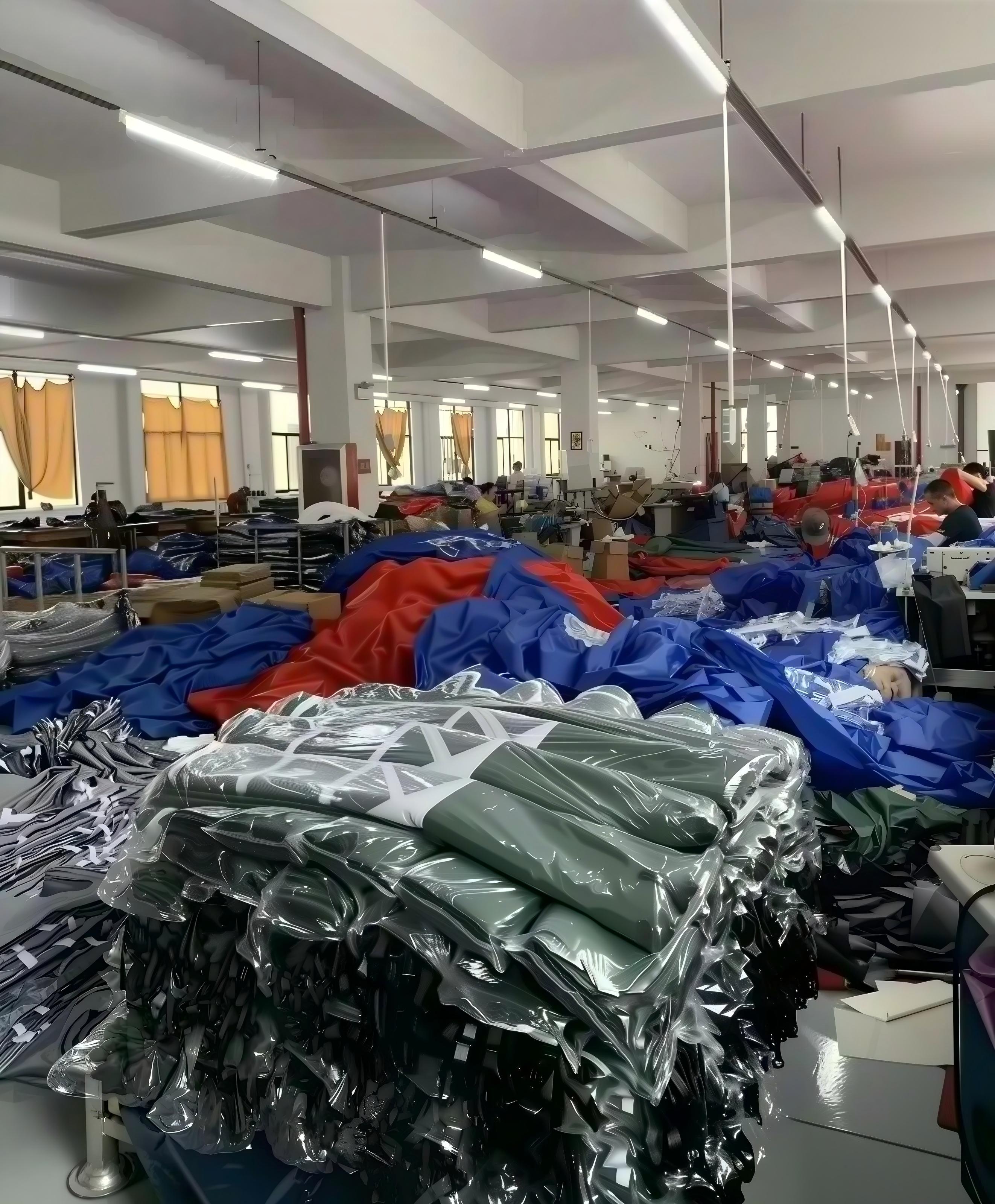
A camping tent specification sheet is a buying decision written in numbers. Denier, PU waterproof ratings, frame material, capacity, expanded size, packed dimensions and weight decide where a tent can be pitched, how it behaves under sustained rain, and whether the vehicle or backpack carrying it can cope. This guide explains each parameter layer, shows how the layers interact, and uses verified specification data from MARVELOUS rooftop tent models MOT-L800, MOT-LK901 and MOT-DYG01 so that buyers can match technical values to all-season camping and hiking use.
Why Tent Spec Sheets Are Hard to Compare
Most tent comparisons fail for the same reason: the parameters are read in isolation. A 600D fabric is not automatically the right choice for a hiking tent, and a "waterproof" label says nothing measurable until a millimetre rating is attached to it. Four gaps appear repeatedly in supplier data sheets.
- Adjectives replace measurements. "Waterproof" and "rainproof" are marketing categories. The comparable figure is the hydrostatic head — the millimetre value of the water column that a coated fabric resists before water passes through.
- Denier is confused with coating. Denier describes the yarn used in the weave. It indicates how heavy and abrasion-resistant the cloth is, not how much rain pressure it resists. Two fabrics with identical denier can carry different PU coatings and therefore different waterproof ratings.
- Frame labels are not standardised. "Aluminum", "aviation aluminum", "aluminum shell", "steel", "quick-open iron" and "air column" describe mechanically different support systems with different weight, wind behaviour and maintenance needs.
- Capacity is quoted without geometry. "Sleeps 4" can only be verified against the expanded footprint and the mattress inside it, and it says nothing about packed size or the gross weight that reaches a freight quotation.
Market Context Behind Today's Specification Choices
The global camping tent market was valued at USD 6.18 billion in 2025 and is projected to reach USD 10.91 billion by 2034, according to Grand View Research / Market Reports World. Within that market, two segments have expanded fast enough to change how suppliers publish specifications.
The rooftop tent segment was valued at approximately USD 215.5 million in 2024, with hard shell models accounting for more than 53% of revenue share (Business Research Insights). Hard shell rooftop tents typically use aluminum or ABS plastic shells and deliver a setup time of 3–8 minutes, compared with 15–25 minutes for ground tents (Rooftop Tent Market Insights). Demand is also concentrated geographically: North America holds 38.6% of rooftop tent market share and Europe 27.4% (Dataintelo Analysis).
The inflatable tent segment reached USD 1.033 billion in 2024, driven by demand for ease and speed of setup in glamping (Intel Market Research). Because air tents remove poles from the pitching process, buyer attention shifts from pole material to air column construction.
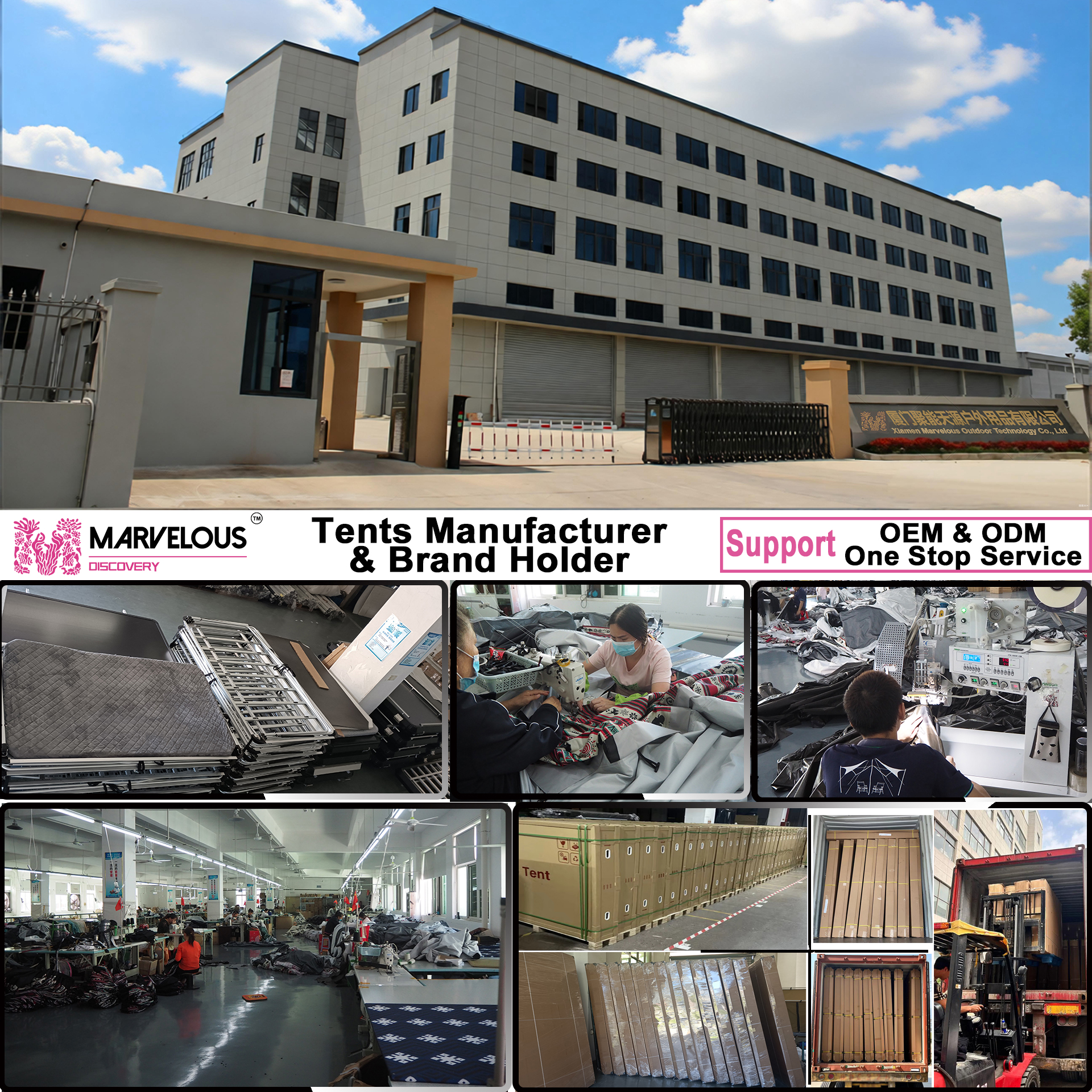
Specification literacy therefore separates a good purchase from a costly one. MARVELOUS — XIAMEN MARVELOUS OUTDOOR TECHNOLOGY Co., Ltd — is an outdoor products manufacturer founded in 2019 in Xiamen, Fujian, China. The company produces camping tents, rooftop tents and inflatable tents from a 4,000 m² facility, with an annual output of 50,000 units and an export ratio of 95% across markets including Russia, the USA, Australia and Canada.
The Four Spec Layers That Decide Tent Performance
1. Fabric Denier: What 210D, 300D, 420D and 600D Mean
Denier (D) is a unit of yarn linear density: it describes the mass of yarn per fixed length, so a higher denier number indicates a heavier yarn. In tent construction it is applied to Oxford cloth, the plain-weave fabric used for tent bodies, flysheets and hard shell covers. Higher denier generally means a heavier, denser-feeling weave with greater abrasion resistance and more stiffness — and, because more material is used, more weight and packed volume. Lower denier, in the 210D range, is chosen where low weight matters more than abrasion resistance.
The denier grades buyers meet most often in tent specifications are 210D, 300D, 420D and 600D. Denier is a selection tool rather than a ranking: a well-coated 300D fabric can outlast a poorly coated 420D fabric, and a 600D fabric is not the right answer if the tent will be carried on foot.
| Specification layer | Verified MARVELOUS data | What it means for the buyer |
|---|---|---|
| Fabric denier — MOT-L800 | 300D Oxford Cloth | Mid-range abrasion resistance for a 4-person vehicle tent |
| Fabric denier — MOT-LK901 | Outer tent 420D Oxford cloth, inner tent 280 g polyester cotton | Heavier outer weave plus a breathable-feel inner for 1–2 people |
| Fabric denier — MOT-DYG01 | 600D Oxford | Highest denier in this line, specified for a 2-person car tent |
2. Waterproofing: Oxford Cloth, PU Coating and Hydrostatic Head in mm
Waterproofing in tent specifications has two components: the coating and the measured result. Oxford cloth is normally coated with PU (polyurethane) on the inner face, and the coating is what prevents water from passing through the weave. Its performance is expressed as a hydrostatic head — the height, in millimetres, of a water column the fabric resists before penetration. A higher millimetre value indicates greater resistance to sustained rain pressure.
Verified MARVELOUS waterproof ratings across the rooftop tent line:
- MOT-L800 — 300D Oxford Cloth with a waterproof index of 3,000 mm.
- MOT-DYG01 — 600D Oxford, waterproof 3,500 mm, with UV and mould resistance specified on the fabric.
- MOT-LK901 — 420D Oxford cloth outer tent with a PU4000 mm waterproof rating.
The millimetre rating applies to the fabric, not automatically to the whole tent. Seam sealing, zip flaps, ventilation openings and the joint between tent body and hard shell all influence real rain performance. When a supplier states a hydrostatic head, the buyer should also confirm how seams and entry points are finished, and whether UV and mould resistance are specified — a topic that matters for tents that stay mounted on a vehicle across a full season. All three MARVELOUS models above are specified for all-season use.
3. Frame and Support Systems: Aviation Aluminum, Alloy, Steel and Air Columns
Frame specifications determine setup time, weight and wind behaviour, and the vocabulary varies between suppliers. The verified frame types in the MARVELOUS rooftop tent line are:
- Aviation aluminum — specified on MOT-DYG01 and MOT-L800. Aluminum alloy is generally chosen for its strength-to-weight ratio and corrosion resistance, which matters both for vehicle-mounted tents and for hiking setups where every kilogram is carried.
- Aluminum shell — specified on MOT-LK901, where the hard shell acts as both the folded lid and the structural body of the tent.
Two further frame families appear in broader camping tent sourcing, and each changes the buying checklist:
| Frame / support type | Typical strength | Typical limitation | What to verify before ordering |
|---|---|---|---|
| Aluminum alloy / aviation aluminum | Light for its strength; corrosion resistant | Higher material cost than steel | Alloy grade, tube wall thickness, joint design, spare parts availability |
| Steel | Strong and cost-effective at high weight | Heavier packed weight; rust risk if coating is poor | Coating and surface treatment, packed weight impact |
| Quick-open iron frame | Very fast pitching | Weight and bulk penalty; hinge wear points | Hinge durability, coating quality, replacement frame availability |
| Air column (inflatable tents) | No poles to assemble; fast pitching | Depends on column integrity and pressure retention | Column layer construction, rated inflation pressure, puncture resistance, pump inclusion |
For rooftop tents specifically, the frame choice interacts directly with the vehicle. Hard shell rooftop tents typically use aluminum or ABS plastic shells, and total tent weight (net and gross) counts against the vehicle roof's dynamic load limit — which is one reason aluminum structures dominate this segment. MARVELOUS manufactures inflatable tents alongside camping tents and rooftop tents, so air column construction belongs in the same comparison exercise rather than in a separate category.
4. Capacity, Expanded Size, Packed Dimensions and Weight
Capacity is the parameter buyers notice first and the one most often published without supporting geometry. The numbers that make a capacity claim verifiable are expanded (or open) size, mattress area, packed dimensions, net weight and gross weight. Verified MARVELOUS rooftop tent geometry:
- MOT-DYG01 — capacity 2 people; open size 210 × 125 × 140 cm; folded dimensions 210 × 125 × 20 cm; N.W./G.W. 32 kg / 45 kg.
- MOT-LK901 — capacity 1–2 people; expanded size 210 × 130 × 140 cm; packing dimensions 223 × 141 × 25 cm; N.W./G.W. 60 kg / 90 kg.
- MOT-L800 — capacity 4 people; expanded size 215 × 251 × 110 cm; packing dimensions 233 × 155 × 32 cm; N.W./G.W. 140 kg / 150 kg.
Two details matter here. First, gross weight is the figure that reaches a freight quotation, because it includes packaging and the accessory set. Second, all three models ship with the same accessory structure: one aluminum telescopic ladder, one installation bag, one mattress, two shoe bags and two rods. Accessories influence both usable capacity and packed weight, so they belong inside the comparison rather than in a footnote.
How to Read a Camping Tent Spec Sheet in Six Steps
- Define the use case first. All-season vehicle camping, long-stay family base camping and hiking trips load different parameters. A hiking tent and a rooftop tent should never be compared on the same scorecard.
- Convert capacity into geometry. Replace "sleeps X" with expanded size and mattress dimensions. MOT-L800, at 215 × 251 × 110 cm for 4 people, illustrates how much floor area a genuine four-person rating requires.
- Set the denier band from abrasion exposure. Tents that stay mounted on a vehicle, contact rocky ground or are pitched frequently benefit from higher denier such as 420D or 600D. Lightweight hiking use is better served by lower denier, lighter fabric.
- Match waterproofing to rain exposure and storage conditions. Compare hydrostatic head values directly (3,000 mm, 3,500 mm and PU4000 mm are the verified values in this line), and check whether UV and mould resistance is specified for tents exposed to sun and humidity over a long season.
- Choose the frame against setup time and vehicle load. Aviation aluminum for weight-sensitive roof mounting, aluminum shell for hard shell structures, steel or quick-open iron where cost and fast pitching are priorities, air columns where no poles should be handled at all.
- Confirm compliance, quality control and commercial terms. Check standards coverage, pre-shipment testing, minimum order quantity, delivery terms, payment terms and lead time before finalising a specification.
Matching Parameters to Real Camping Scenarios
Family all-season vehicle camping
MOT-L800 pairs a 4-person capacity with 215 × 251 × 110 cm of expanded space, 300D Oxford cloth at a 3,000 mm waterproof index, an aviation aluminum frame and a 140 kg net / 150 kg gross weight. The trade-off is clear: the highest capacity in this line also carries the highest packed weight and the largest packed volume at 233 × 155 × 32 cm.
Two-person touring with a hard shell
MOT-LK901 combines an aluminum shell structure with a 420D Oxford outer tent and a 280 g polyester-cotton inner tent, waterproof to PU4000 mm across a 1–2 person, 210 × 130 × 140 cm interior. At 60 kg net and 90 kg gross, it sits between the two other models in transport weight.
Lightweight two-person camping in wet, humid conditions
MOT-DYG01 is the lowest-weight option here at 32 kg net, with 600D Oxford fabric, a 3,500 mm waterproof rating and UV and mould resistance specified. Its folded dimension of 210 × 125 × 20 cm makes it the most compact of the three when closed.
Inflatable and air tent buyers
Inflatable tents remove poles from the pitching process, which is the main driver behind the segment's growth in glamping applications. MARVELOUS manufactures inflatable tents alongside camping tents and rooftop tents, and the equivalent evaluation questions are column layer construction, rated inflation pressure, puncture resistance and pump inclusion.
A verified customer experience
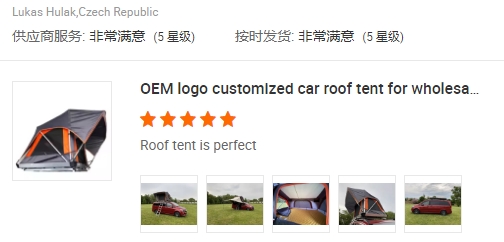
One MARVELOUS customer in Australia purchased a single set for family outdoor camping trips, describing the materials as high quality and steady, and noting that the interior felt like two queen beds — enough for two adults and three children — with customer service described as outstanding. The review relates to a 4-person side-fold hard shell tent, the same category as MOT-L800. It is a useful reminder that geometry, not the capacity label, is what convinces a family at the campsite.
Comparison Table: MARVELOUS Rooftop Tent Specifications
| Parameter | MOT-L800 | MOT-LK901 | MOT-DYG01 |
|---|---|---|---|
| Type | Car tent | Car tent | Car tent |
| Fabric | 300D Oxford Cloth | Outer 420D Oxford cloth; inner 280 g polyester cotton | 600D Oxford |
| Waterproof rating | 3,000 mm | PU4000 mm | 3,500 mm, UV and mould resistant |
| Frame | Aviation aluminum | Aluminum shell | Aviation aluminum |
| Capacity | 4 people | 1–2 people | 2 people |
| Expanded / open size | 215 × 251 × 110 cm | 210 × 130 × 140 cm | 210 × 125 × 140 cm |
| Packed / folded size | 233 × 155 × 32 cm | 223 × 141 × 25 cm | 210 × 125 × 20 cm |
| N.W. / G.W. | 140 kg / 150 kg | 60 kg / 90 kg | 32 kg / 45 kg |
| Season of use | All seasons | All seasons | All seasons |
| Accessories | Aluminum telescopic ladder, installation bag, mattress, 2 shoe bags, 2 rods | Aluminum telescopic ladder, installation bag, mattress, 2 shoe bags, 2 rods | Aluminum telescopic ladder, installation bag, mattress, 2 shoe bags, 2 rods |
| Spec layer | Question to ask the supplier | Verified MARVELOUS answer |
|---|---|---|
| Fabric | Which denier is used, and where in the tent? | 300D (MOT-L800), 420D outer plus 280 g polyester-cotton inner (MOT-LK901), 600D (MOT-DYG01) |
| Waterproofing | What is the hydrostatic head in mm, and is UV/mould resistance specified? | 3,000 mm; PU4000 mm; 3,500 mm with UV and mould resistance |
| Frame | Which structural system supports the tent? | Aviation aluminum (MOT-DYG01, MOT-L800); aluminum shell (MOT-LK901) |
| Geometry | What are the expanded size, packed size and net/gross weight? | Listed above per model, all specified for all-season use |
FAQ: Camping Tent Specifications and OEM Sourcing
Which standards should camping tent fabric, flammability and rain resistance follow?
Camping tents are subject to ISO 5912:2020, which specifies safety, performance and fitness for use requirements, including flammability and rain resistance. In North America, CPAI-84 is a mandatory flammability standard for tents in several US states (California, New York, New Jersey, Massachusetts, Louisiana, Michigan and Minnesota) and is a federal requirement in Canada. Buyers sourcing camping tents for those markets should request documentation showing that the fabric and finished tent comply with the applicable standard before confirming a purchase order.
Can a manufacturer customise sizing, fabric denier and waterproof rating for an OEM camping tent programme?
Yes. MARVELOUS provides OEM and ODM production services, and its customisation scope covers either logo application or a fully customised tent. The verified material palette in the current rooftop tent line includes 300D, 420D and 600D Oxford cloth with waterproof ratings of 3,000 mm, 3,500 mm and PU4000 mm, and the production range covers camping tents, rooftop tents and inflatable tents — which allows a buyer to align denier, waterproofing and sizing with a specific market and price position rather than accepting a catalogue configuration. Custom sizing is part of the OEM camping tent manufacturer service.
What are the commercial terms for a first order?
MARVELOUS quotes a minimum order quantity of 1 unit, with delivery terms of EXW, FOB or CIF and payment terms of TT or LC. Monthly production capacity is 5,000–10,000 units, and quality control follows 100% testing standards. Export markets include the USA, EU, Canada, Australia, Korea and Japan; after-sales support is provided as replacement support.
How is quality verified before shipment, and how does sampling work?
Acceptance criteria are based on pre-shipment testing, and quality control follows 100% testing standards for all products. For a specification-led programme, the practical sequence is to validate fabric denier, waterproof rating and frame type on a sample first, confirm the expanded and packed dimensions against the target vehicle or transport method, and then lock the specification before mass production. A sample request can be raised directly with the MARVELOUS team using the contact details at the end of this guide.
What lead time applies to camping tent production?
Typical lead time is 30 days, supported by a monthly capacity of 5,000–10,000 units. Because fabric coating, frame assembly and hard shell production run on the same facility, buyers should confirm the lead time against the final denier, waterproof rating and frame specification rather than against a catalogue model alone. To move from specification to quotation, share your target size, denier, waterproof rating and capacity with MARVELOUS and request a quotation together with the product catalogue.
Conclusion: Turning Parameters Into a Sourcing Decision
Reading a camping tent specification sheet comes down to four layers. Denier tells you how heavy and abrasion-resistant the Oxford weave is — 210D at the light end, up to 600D for heavier-duty shells. The PU coating and its hydrostatic head tell you how much rain pressure the fabric resists. The frame system — aviation aluminum, aluminum shell, steel, quick-open iron or PVC air columns — tells you how the tent pitches, how much it weighs and how it behaves on a vehicle roof or in wind. Capacity, expanded size, packed dimensions and net/gross weight tell you whether the geometry actually supports the promised number of sleepers and the transport method you have in mind.
Verified against real model data, that framework is easier to apply: 300D at 3,000 mm for a 4-person tent at 140 kg net, 420D with a polyester-cotton inner at PU4000 mm for a 1–2 person hard shell at 60 kg net, and 600D at 3,500 mm with UV and mould resistance for a compact 2-person car tent at 32 kg net. Matching those parameters to the campsite, the vehicle and the climate is the decision that specification sheets exist to support.
Request a Sample or Quotation
MARVELOUS — XIAMEN MARVELOUS OUTDOOR TECHNOLOGY Co., Ltd — manufactures camping tents, rooftop tents and inflatable tents with OEM and ODM customisation, a minimum order quantity of 1 unit, a typical 30-day lead time and 100% testing before shipment.
Website: www.marvelous-outdoor.com
Product brochure (download): MARVELOUS product catalogue PDF
Email: jason@marvelous-outdoor.com · Tel / WhatsApp: +1 (646) 704-9416
Address: Room 711, Building B, Xinqing Center, Jiahe Road, Siming District, Xiamen, Fujian, China

Have Questions or Need More Details?
Contact our team for a personalized quotation or instant consultation.
Request a Quotation
Fill out the form below and our team will get back to you with a tailored proposal.
WhatsApp Direct Chat
Prefer to chat in real-time? Message us on WhatsApp for instant assistance & quick answers.
- Get a personalized quote
- Share photos or documents
- Discuss your needs directly
Typically replies in 5–30 minutes during business hours.