
Technical Guide to Tent Fabrics: From 210D Oxford to 200D Titanium Black Rubber
Short answer: denier counts such as 210D and 200D describe yarn thickness, not waterproofing. The coating system and the pole or frame material decide what a camping tent actually does in the field. The cleanest way to see this is to compare two MARVELOUS family tents side by side. The MOT-CT096 is built from 210D Oxford cloth with a PU coating rated at 2000 mm waterproofing on a steel frame. The MOT-CT900 is built from 200D titanium black rubber Oxford cloth rated PU5000mm with UPF 50+ UV protection on aluminium alloy poles. The two fabrics differ by ten denier. The waterproof ratings differ by 3,000 mm.

Why tent fabric specifications confuse buyers
Tent fabric data sheets are written for factories, not for buyers. A specification line such as "210D Oxford cloth with PU, 2000 mm" packages three different decisions into one sentence: the weave and yarn size, the coating chemistry, and the measured waterproof performance. Three misreadings follow from that packaging.
- Misreading one: higher denier means better waterproofing. It does not. Across the MARVELOUS range, 210D Oxford cloth with a PU coating is rated at 2000 mm, while 200D titanium black rubber Oxford cloth is rated at PU5000mm. The lower-denier fabric carries the higher rating because the coating system is different.
- Misreading two: fabric determines tent weight. Fabric contributes, but structure dominates. Rooftop models in the same range weigh far more than ground tents because of the shell, platform and mounting hardware rather than the cloth.
- Misreading three: "Oxford" is a material. Oxford is a weave structure. What the tent does in rain, snow and ultraviolet light comes from the coating applied to that weave, and from how the seams and poles are built around it.
For an outdoor brand or importer writing a purchase order, that distinction matters commercially. Two suppliers can both quote "Oxford cloth" at similar pricing and deliver entirely different products.

Industry background: why fabric choice is now a commercial decision
The camping tent category is large enough that fabric and frame decisions carry real cost consequences. The global camping tent market was valued at USD 6.18 billion in 2025 and is projected to reach USD 10.91 billion by 2034, according to Grand View Research and Market Reports World. Within that, two sub-segments have distinct technical profiles. The rooftop tent market was valued at approximately USD 215.5 million in 2024, with hard shell models taking more than 53% of revenue share according to Business Research Insights. The inflatable tents market reached USD 1.033 billion in 2024, driven by demand for fast setup in glamping, per Intel Market Research.
Regional demand shapes fabric specifications too. North America holds the largest share of the rooftop tent market at 38.6%, followed by Europe at 27.4%, according to Dataintelo Analysis. Those are markets where vehicle-mounted camping is established, and where the fabric has to survive extended sun exposure and repeated folding rather than a weekend of ground use.
Compliance adds a second layer. Camping tents fall under ISO 5912:2020, which specifies safety, performance and fitness-for-use requirements including flammability and rain resistance. In North America, CPAI-84 is a mandatory flammability standard for tents in several US states (CA, NY, NJ, MA, LA, MI, MN) and a federal requirement in Canada. Fabric and coating choices are therefore not purely about comfort: they sit inside a testable compliance envelope.
The fabric layer: what 210D, 200D titanium black rubber, 300D and 420D actually change
Denier is a yarn count, not a performance rating
Denier measures the linear density of the yarn used to weave the fabric. A higher denier number means a thicker yarn. That is the whole of what the number tells you. It influences tear resistance and hand feel, but it says nothing about how much water pressure the finished cloth will hold, because that is set by the coating and the lamination applied afterwards.
This is why the MOT-CT096, at 210D, and the MOT-CT900, at 200D, can sit in the same product family while performing differently in rain. The CT096 uses 210D Oxford cloth with a PU coating and a 2000 mm waterproof rating. The CT900 uses 200D titanium black rubber Oxford cloth with a PU5000mm rating and UPF 50+ protection. If you selected on denier alone, you would make the wrong call.
Coating systems: standard PU and titanium black rubber
PU coating is the mainstream specification for family camping tents. It is applied to the reverse of the fabric and delivers a measurable waterproof column. In the MARVELOUS range, PU-coated constructions cover a spread of ratings: 2000 mm on the 210D Oxford cloth of the MOT-CT096, PU5000mm on the 200D titanium black rubber Oxford cloth of the MOT-CT900, PU5000mm on the 200D titanium black plastic plaid cloth of the MOT-M100, and PU5000mm with UPF 50+ on the 200D Oxford cloth of the MOT-Q500 inflatable tent.
Titanium black rubber Oxford cloth is a coated Oxford construction that appears in the same family. It is used on the MOT-CT900, where the resulting fabric is rated for both PU5000mm waterproofing and UPF 50+ UV protection. In tropical and high-altitude markets, that combination is the specification buyers ask about first, because UV degradation shortens the service life of a tent long before the waterproof coating fails.
300D, 420D and 600D in rooftop tents
Higher denier constructions appear mainly in vehicle-mounted tents, where the fabric has to survive folding, abrasion against the shell and continuous outdoor exposure. Across the MARVELOUS rooftop line:
- The MOT-L800 uses 300D Oxford cloth with a 3000 mm waterproof index on an aviation aluminium frame, with a 4-person capacity and expanded dimensions of 215x251x110 cm.
- The MOT-LK901 uses a 420D Oxford cloth outer tent with a 280g polyester cotton inner tent and a PU4000MM waterproof rating, in an aluminium shell body for 1-2 people.
- The MOT-DYG01 uses 600D Oxford cloth rated at 3500 mm waterproofing with UV and mould resistance, on an aviation aluminium frame for 2 people.
Read those three lines together and the pattern is clear: with rooftop tents, denier and coating weight rise together, because the fabric is expected to tolerate repeated mechanical stress rather than a single season of ground use.

The frame layer: aluminium alloy versus steel
Frame material is the second half of a tent specification, and it is the half that determines how the product feels to the end user. In the MARVELOUS range, three frame categories appear.
Steel and iron frames appear on ground tents. The MOT-CT096 uses a steel frame to carry a 430x305x200 cm expanded footprint at 14.5 kg gross weight, with a compact 70x31x31 cm pack size. The MOT-M100 uses a quick-open iron frame for a 6-8 person capacity tent at 11 kg net weight and 11.5 kg gross weight. Steel and iron frames are the economical route, and they suit tents that are pitched from a vehicle and left standing.
Aluminium alloy poles appear where weight or corrosion resistance matters. The MOT-CT900 uses aluminium alloy poles across a 4-5 person tent at 12.9 kg net weight and 13.5 kg gross weight, packing into 106x26x26 cm. The MOT-Q500 inflatable tent replaces poles entirely with a 5-layer PVC air column frame at 13.6 kg net weight.
Aviation aluminium is specified on the rooftop platforms. Both the MOT-L800 and the MOT-DYG01 use aviation aluminium frames. On a rooftop tent the frame is doing something different from a ground tent pole: it carries the shell, the mattress and the occupants on a moving vehicle, so stiffness and weight both matter more than cost per metre.
The buying lesson is that frame and fabric should be evaluated as a pair. A heavyweight fabric on a lightweight pole set produces a tent that is awkward to pitch. A light fabric on an oversized frame wastes the weight budget.
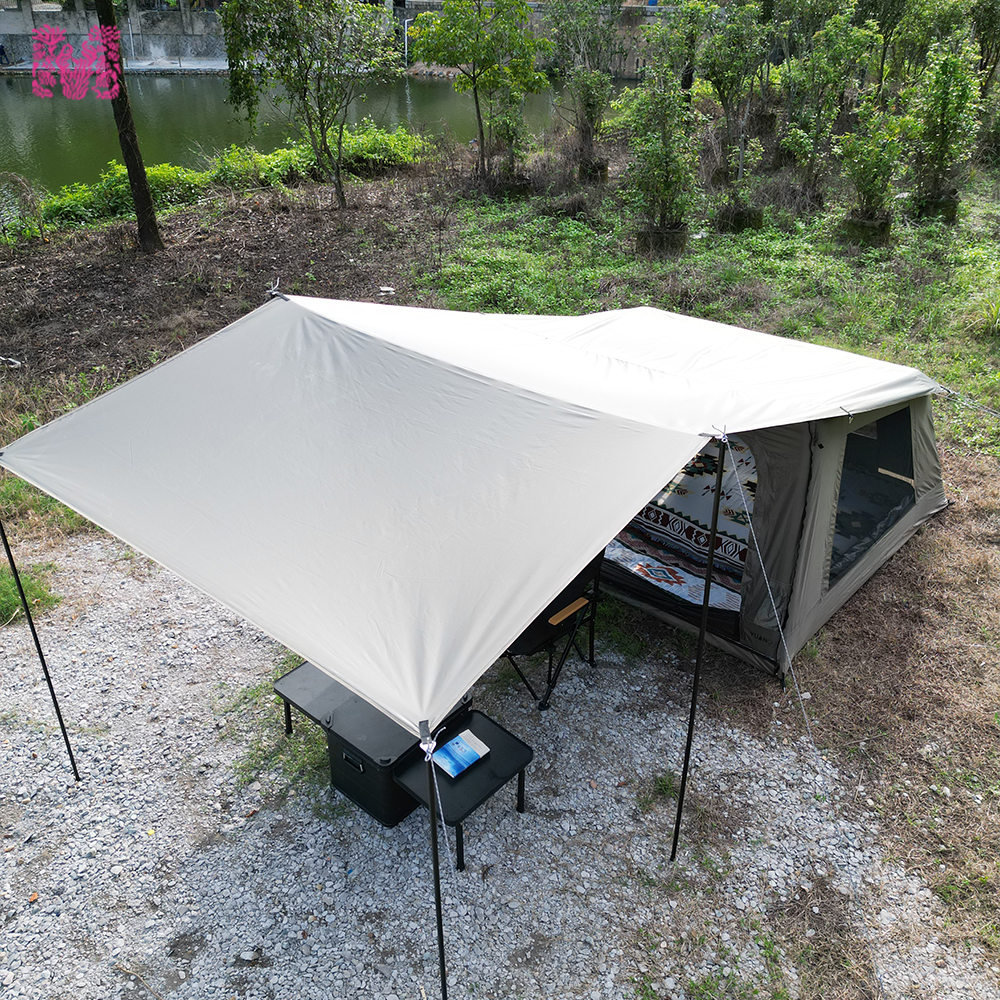
Step-by-step: how to evaluate a tent fabric and frame specification
- Start with the coating rating, not the denier. Ask for the waterproof column in millimetres and the coating chemistry. In the MARVELOUS range that single question separates a 2000 mm tent from a PU5000mm tent, regardless of the denier figure on the label.
- Match the rating to the application. For vehicle-mounted camping, the documented application requirement is a waterproof rating of at least 3000mm, UV-resistant fabric, a wind-resistant structure and compatibility with most vehicle roof racks. For family ground camping, the range runs from 2000 mm on the MOT-CT096 up to PU5000mm on the MOT-CT900 and MOT-M100.
- Check the fabric layer by layer. Outer tent, inner tent and floor are often different constructions. The MOT-LK901 is a clear example: a 420D Oxford cloth outer tent combined with a 280g polyester cotton inner tent, rated PU4000MM overall.
- Convert the frame into a handling figure. Design intent shows up in packed size. The MOT-CT900 packs to 106x26x26 cm; the MOT-CT096 packs to 70x31x31 cm; the MOT-L800 rooftop tent packs to 233x155x32 cm. Those numbers tell you whether the tent fits the vehicle, the warehouse rack or the retail carton.
- Confirm the compliance envelope for the destination market. ISO 5912:2020 covers safety, performance and rain resistance requirements for camping tents. CPAI-84 flammability applies in several US states and across Canada. Verify which test reports your supplier can produce before tooling is committed.
- Validate on samples before mass production. Rain resistance, UV performance and frame stiffness are physical properties. Order the sample, pitch it, and check seam construction before signing off a production run.
How these fabrics map to real camping use cases
Fabric and frame specifications only become useful when matched to a use case. The following mapping comes from the documented specifications of the MARVELOUS range.
Family ground camping on a budget-sensitive programme. The MOT-CT096 provides the largest footprint at 430x305x200 cm, in 210D Oxford cloth with a PU coating rated at 2000 mm, on a steel frame, with colour options in brown, green, blue and orange and a 14.5 kg gross weight. It suits markets where the tent is pitched at a campsite and left in place.
Family camping where rain and UV are the primary risks. The MOT-CT900 answers with 200D titanium black rubber Oxford cloth, PU5000mm waterproofing and UPF 50+ UV protection on aluminium alloy poles, for 4-5 people at 12.9 kg net weight. The 106x26x26 cm pack size keeps it portable.
Large group or long-stay camping. The MOT-M100 accommodates 6-8 people in 200D titanium black plastic plaid cloth with high-density anti-mosquito mesh and transparent TPU/PU at 5000 mm, using a quick-open iron frame at 11 kg net weight.
Fast-pitch and glamping programmes. The MOT-Q500 uses a 5-layer PVC air column frame with 200D Oxford cloth at PU5000mm and UPF 50+, for 4-5 people, with a 270x270x200 cm expanded size and a 13.6 kg net weight.
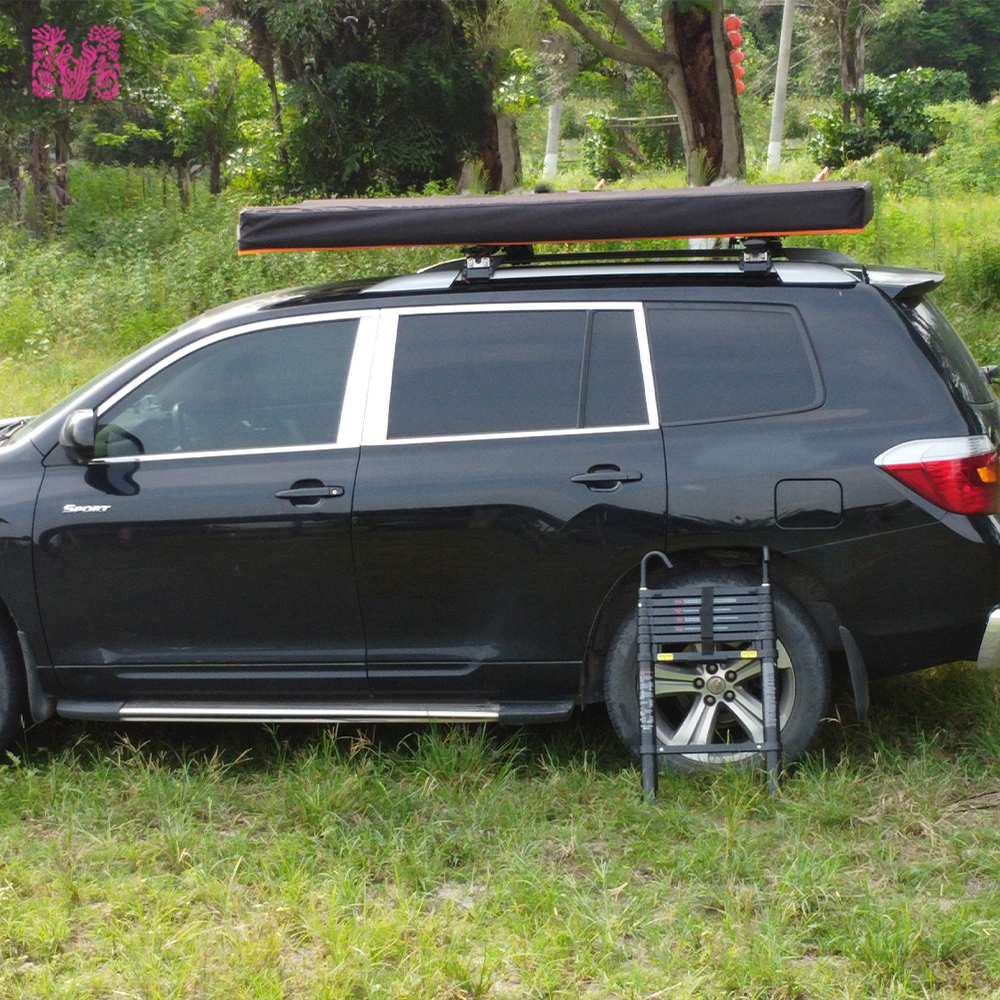
Vehicle-mounted camping. The rooftop range covers three fabric tiers: the MOT-L800 at 300D Oxford cloth and 3000 mm, the MOT-LK901 at 420D Oxford cloth outer with PU4000MM, and the MOT-DYG01 at 600D Oxford cloth with 3500 mm and UV and mould resistance. All three use aluminium-based frames.
These scenarios appear across the United States, Germany, Australia, Canada, Switzerland, Chile, Japan and South Korea, where the documented operating conditions include all-season use, rainy and snowy conditions, UV-resistant outdoor environments and variable terrain.
Specification comparison: MARVELOUS tent fabrics and frames
| Model | Category | Main fabric | Waterproof rating | Frame / poles | Capacity | Weight |
|---|---|---|---|---|---|---|
| MOT-CT096 | Family camping tent | 210D Oxford cloth with PU | 2000 mm | Steel | Not specified in source | 14.5 kg (G.W.) |
| MOT-CT900 | Family tent | 200D titanium black rubber Oxford cloth | PU5000mm, UPF 50+ | Aluminium alloy | 4-5 people | 12.9 kg (N.W.) / 13.5 kg (G.W.) |
| MOT-M100 | Family tent | 200D titanium black plastic plaid cloth | PU5000mm with transparent TPU | Quick-open iron frame | 6-8 people | 11 kg (N.W.) / 11.5 kg (G.W.) |
| MOT-Q500 | Inflatable tent | 200D Oxford cloth | PU5000mm, UPF 50+ | 5-layer PVC air column | 4-5 people | 13.6 kg (N.W.) / 15 kg (G.W.) |
| MOT-L800 | Car / rooftop tent | 300D Oxford cloth | 3000 mm | Aviation aluminium | 4 people | 140 kg (N.W.) / 150 kg (G.W.) |
| MOT-LK901 | Car / rooftop tent | 420D Oxford cloth outer, 280g polyester cotton inner | PU4000MM | Aluminium shell | 1-2 people | 60 kg (N.W.) |
| MOT-DYG01 | Car / rooftop tent | 600D Oxford cloth | 3500 mm, UV and mould resistant | Aviation aluminium | 2 people | 32 kg (N.W.) / 45 kg (G.W.) |
How to read the table: the denier column does not track the waterproof column. Frame material tracks the intended carrying method, not the price tier alone. Use the last two columns together when shortlisting.
Frequently asked questions
Is 200D titanium black rubber Oxford cloth better than 210D Oxford cloth with PU coating?
Not on denier alone — the coating decides. The MARVELOUS MOT-CT096 uses 210D Oxford cloth with a PU coating rated at 2000 mm waterproofing. The MOT-CT900 uses 200D titanium black rubber Oxford cloth rated PU5000mm with UPF 50+ UV protection. The fabrics differ by ten denier; the waterproof ratings differ by 3,000 mm. The practical question is therefore not "210D or 200D" but which coating and rating the destination market requires.
Should a foldable camping tent use an aluminium or steel frame?
Match the frame to how the tent is carried and pitched. The MOT-CT096 ground tent uses a steel frame for a 430x305x200 cm footprint at 14.5 kg gross weight. The MOT-CT900 uses aluminium alloy poles on a 4-5 person tent at 12.9 kg net weight. Vehicle-mounted models such as the MOT-L800 and MOT-DYG01 both use aviation aluminium frames. Steel and iron are used where the tent is pitched from a vehicle and left standing, while aluminium is specified where weight and corrosion behaviour matter more than material cost.
What waterproof rating does a camping tent actually need?
There is no single number, and the answer depends on the application. Documented MARVELOUS ratings run from 2000 mm on the 210D Oxford cloth of the MOT-CT096 up to PU5000mm on the MOT-CT900, MOT-M100 and MOT-Q500. For vehicle-mounted camping specifically, the documented application requirement is a waterproof rating of at least 3000mm, combined with UV-resistant fabric, a wind-resistant structure and compatibility with most vehicle roof racks. Set the minimum from the use case, not from the fabric name.
Which fabric and frame combination fits which MARVELOUS model?
A quick mapping across the range: the MOT-CT096 for a large 430x305x200 cm family ground tent in 210D Oxford cloth with PU on a steel frame; the MOT-CT900 for a 4-5 person tent requiring PU5000mm and UPF 50+ on aluminium alloy poles packing to 106x26x26 cm; the MOT-M100 for 6-8 person groups with a quick-open iron frame; the MOT-Q500 for a fast-pitch inflatable option with a 5-layer PVC air column; and the rooftop line for vehicle-mounted camping, where the MOT-L800 uses 300D Oxford cloth at 3000 mm, the MOT-LK901 uses a 420D Oxford cloth outer with PU4000MM, and the MOT-DYG01 uses 600D Oxford cloth at 3500 mm with UV and mould resistance.
How do I request samples or a quotation from a camping tent manufacturer like MARVELOUS?
XIAMEN MARVELOUS OUTDOOR TECHNOLOGY Co.,Ltd was established in 2019 and manufactures outdoor tents including camping tents, rooftop tents and inflatable tents, with a 4,000 m² facility, approximately 50 staff and an annual production capacity of about 50,000 units. Export accounts for 95% of sales, with main markets in Russia, the USA, Australia and Canada. Sample requests, quotations and catalogue requests can be sent to jason@marvelous-outdoor.com or made by phone at +1 (646) 704-9416. The full product catalogue is available for download at the MARVELOUS product brochure.
Next step: turn the specification into a quote
Fabric and frame decisions should be locked before pricing is requested, because they determine material cost, compliance testing and carton size. The sequence that works is simple: define the use case, set the waterproof and UV thresholds it requires, choose the fabric and coating that meet those thresholds, then choose the frame that keeps the packed size and weight acceptable.
MARVELOUS manufactures camping tents, rooftop tents and inflatable tents from a 4,000 m² facility in Xiamen, Fujian, China, with an annual production capacity of about 50,000 units and 95% of output exported. Buyers evaluating 210D Oxford, 200D titanium black rubber Oxford or the 300D, 420D and 600D rooftop constructions can request samples or a quotation directly.

Request a sample or quotation
Send your fabric specification, target waterproof rating, pole material and pack size requirement to jason@marvelous-outdoor.com or call +1 (646) 704-9416. Download the full product range at the MARVELOUS catalogue, or visit WWW.MARVELOUS-OUTDOOR.COM.
Have Questions or Need More Details?
Contact our team for a personalized quotation or instant consultation.
Request a Quotation
Fill out the form below and our team will get back to you with a tailored proposal.
WhatsApp Direct Chat
Prefer to chat in real-time? Message us on WhatsApp for instant assistance & quick answers.
- Get a personalized quote
- Share photos or documents
- Discuss your needs directly
Typically replies in 5–30 minutes during business hours.