
2500kW vs 2000kW vs 3MW Containerized Diesel Generators: A Buyer's Comparison
2500kW vs 2000kW vs 3MW Containerized Diesel Generators: A Buyer's Comparison
Put a 2000kW, a 2500kW, and a 3MW containerized diesel generator side by side on paper and they look like the same purchase: a large, self-contained power block that arrives on a truck, gets connected, and carries a critical load. In practice they are three different projects, and the gap between them is not cosmetic. The spread between the smallest and the largest option here is roughly 1000kW, and that spread changes the engine platform, the number of units standing on site, the container arrangement, the fuel bill per operating hour, the lifting and transport plan, and the acceptance test you should insist on before the unit leaves the factory.
The short answer, before the detail: 2000kW suits a tightly scoped single load with no meaningful growth plan; 2500kW absorbs moderate load growth without forcing a second unit onto the site; and 3MW is usually not a question of buying a bigger box but of deciding whether a single large unit or a paralleled block serves the project better. Everything below exists to make that decision defensible in writing.
This comparison is written for buyers who are already past discovery. You know your target load, you have a site, and you need to convert "somewhere between 2MW and 3MW" into a purchase order. MECCA POWER CO.,LTD. is a manufacturer of diesel generators, high voltage generators, and load banks with factories in Fujian and Jiangxi provinces, China, a stated diesel generator range of 10kVA to 4000kVA, and a Nanchang plant that concentrates on generating sets of 1000kW and above - the class this article covers.
Why the Three Numbers Are Not Directly Comparable
Before any engineering comparison can be honest, three definitional questions decide whether you are comparing like with like.
1. kW or kVA?
Project loads are usually stated in kW, while generator capacity is frequently quoted in kVA. The conversion depends on the power factor specified for the project. A 0.8 power factor is a common reference point in generator specification, but it is a design input, not a constant. At that reference, a 2000kW requirement sits near 2500kVA, 2500kW near 3125kVA, and 3MW (3000kW) near 3750kVA. MECCA POWER's stated range reaches 4000kVA, which covers the kVA bands this comparison deals with - but the figures must be reconciled against your real power factor before anything else is decided.
The same caution applies in reverse, and it is the most common specification error in this power band. MECCA POWER's documented product range includes 1800kW units and 2500kVA units for data centers. A 2500kVA unit is not a 2500kW unit. Treating a kVA figure as a kW figure puts the site on the wrong side of its own load calculation before procurement even begins.
2. Which rating class?
Generators are commonly grouped into standby or emergency, prime, and continuous duty classes, and the permissible load factor and running hours differ between them. A 2000kW standby rating and a 2000kW prime rating are not the same machine commitment, even though the number on the quotation looks identical. The first question to put in writing to any supplier is which rating class the quoted figure belongs to, and whether the load profile you described in the enquiry is the load profile the quotation is built on.
3. One unit or a block?
"3MW" is a site requirement, not necessarily a single machine. It can be met by one 3000kW unit, or by a paralleled block - for example three 1000kW-class units - which changes redundancy, footprint, maintenance access, and the consequence of any single failure. The 2000kW and 2500kW tiers carry the same choice at a smaller scale. Parallel operation is not an afterthought: it is a tested function, and MECCA POWER includes a parallel operation test within its factory test scope.
Decision rule: fix the unit of measure (kW or kVA), fix the rating class, and fix whether the tier is a single unit or a paralleled block - before comparing price, footprint, noise, or fuel.
Industry Background: Why the 2000kW to 3MW Band Keeps Growing
The commercial weight behind this decision is visible in published market data. Grand View Research values the global diesel generator market at approximately USD 19.33 billion in 2025 and projects it to reach USD 40.9 billion by 2033. Within that total, the data center segment is expanding fastest: ResearchAndMarkets and Business Wire place the data center generator market at USD 8.43 billion in 2024, heading toward USD 19.66 billion by 2030, driven by AI workloads and hyperscale expansion.
Estimates in this sector diverge, and a buyer should read any single figure with that in mind. For the same 2024 data center generator market, Strategic Market Research reports USD 6.1 billion rather than USD 8.43 billion. The difference reflects methodology and scope rather than a disagreement about direction. The direction is consistent: more installed capacity, increasingly concentrated in larger blocks.
Two supporting signals point the same way. Zion Market Research valued the global load bank market - the equipment used to prove a generator can actually carry its rated load - at USD 278.45 million in 2024, with a projected rise to USD 445 million by 2034 at a 4.8% CAGR; Market Research Future and Mordor Intelligence publish lower and higher 2024 estimates of USD 198.93 million and USD 327.2 million respectively. Separately, the Observatory of Economic Complexity records China's exports of generators and alternators at USD 968 million in 2024, with the United States, Mexico, and Russia as the top destinations.
The implication for a buyer is practical rather than macroeconomic. As project loads move into the megawatt band, commissioning discipline becomes part of the specification. ISO 8528-10 specifies load acceptance test procedures for reciprocating internal combustion engine-driven generating sets. NFPA 110 governs the installation, maintenance, and testing of emergency and standby power systems in the United States, including required periodic load bank testing. A 2000kW, 2500kW, or 3MW decision is therefore not only a capacity decision - it is also a decision about how the unit will be proven, and re-proven, across its service life.
What MECCA POWER Builds and Tests in This Power Class
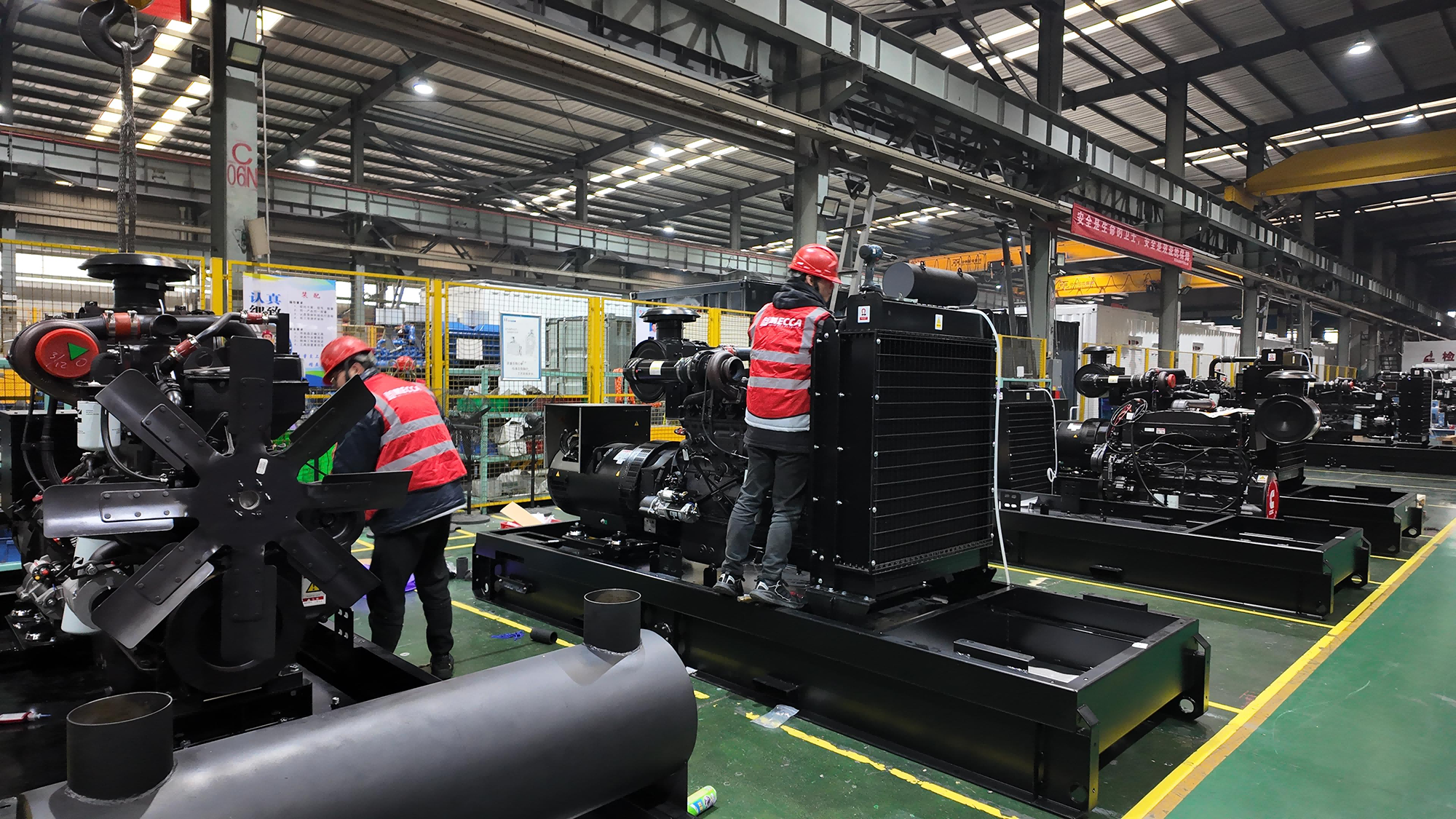
MECCA POWER CO.,LTD. was founded in 2013 and operates with 311 employees across a 34,000 m² factory footprint, producing 3,600 units annually with a 41-person R&D team. Export accounts for 100% of output, with markets across Europe, Africa, Asia, Australia, the Middle East, the Americas, South America, Oceania, and Latin America. High-power production is concentrated at the Nanchang plant in Jiangxi province, which focuses on generating sets of 1000kW and above and has increased monthly output from 132 units to 212 units, with output value rising from 180 million to 380 million - a change in scale that matters directly to buyers ordering in this tier.
Three production lines serve different product architectures: a dedicated container line, an open-type line, and a mixed-assembly line. For a 2000kW, 2500kW, or 3MW project, the container line is the relevant one, because the enclosure is not a cosmetic add-on. It determines noise, thermal behaviour, maintenance access, and transport.
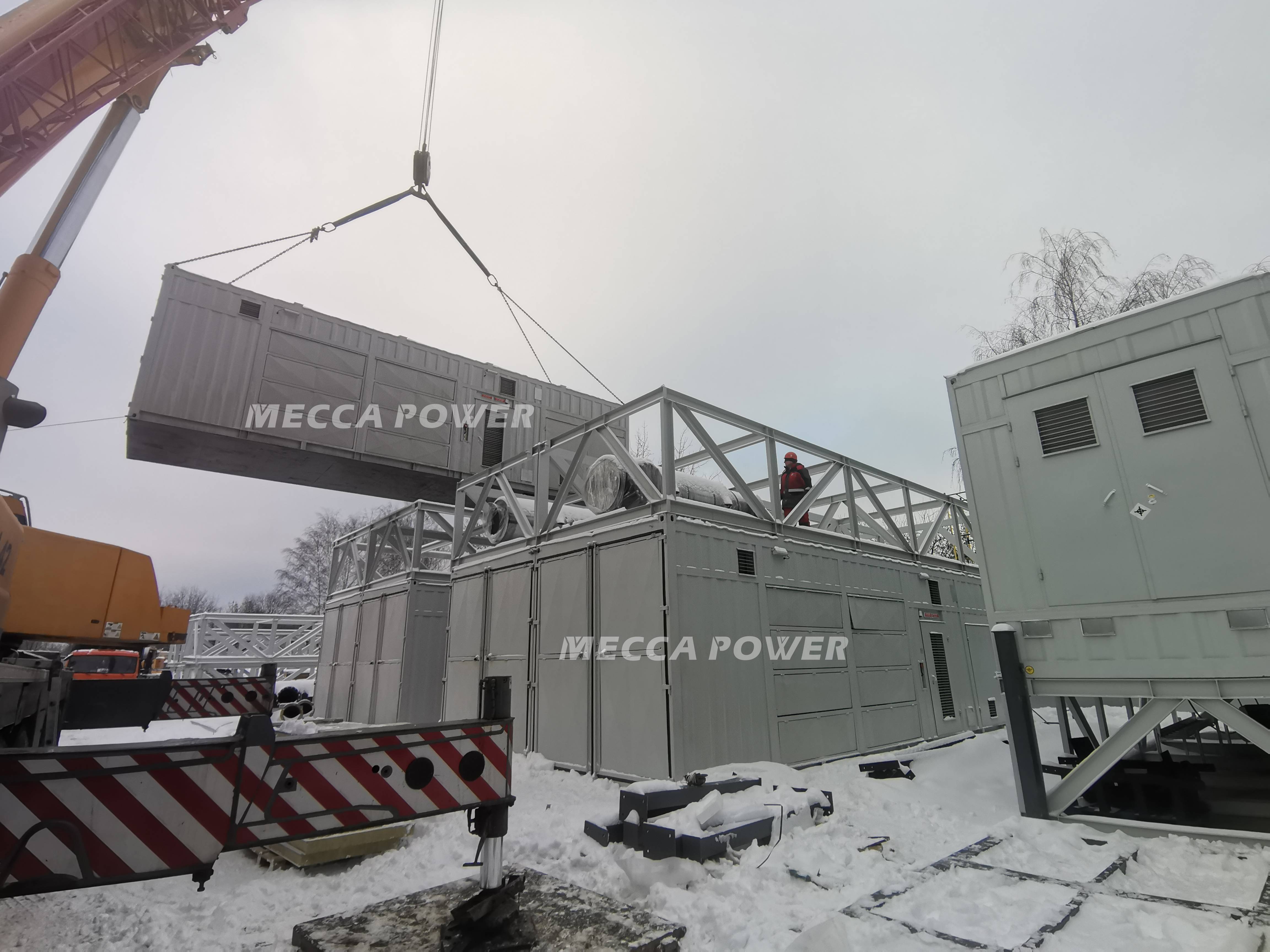
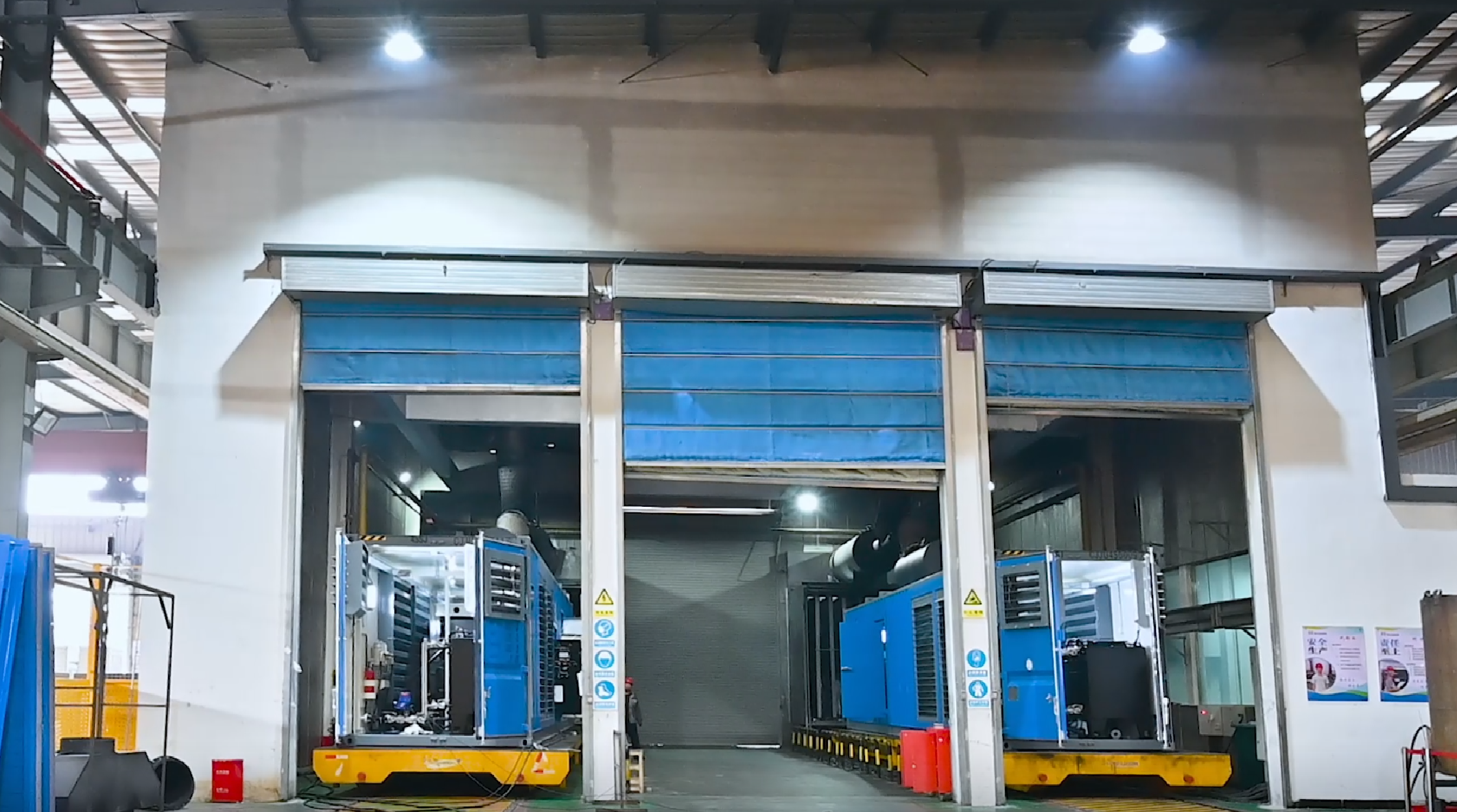
Factory hardware also sets a practical ceiling on what can be assembled and tested before shipment. The site's maximum lifting capacity is 45 tons, and it is configured to support the production testing of three units exceeding 2000kW simultaneously - a capability that speaks directly to the 2000kW and 2500kW tiers, and to 3MW blocks built from multiple units.
Container options that change the specification
Two container variants are directly relevant to this tier comparison.
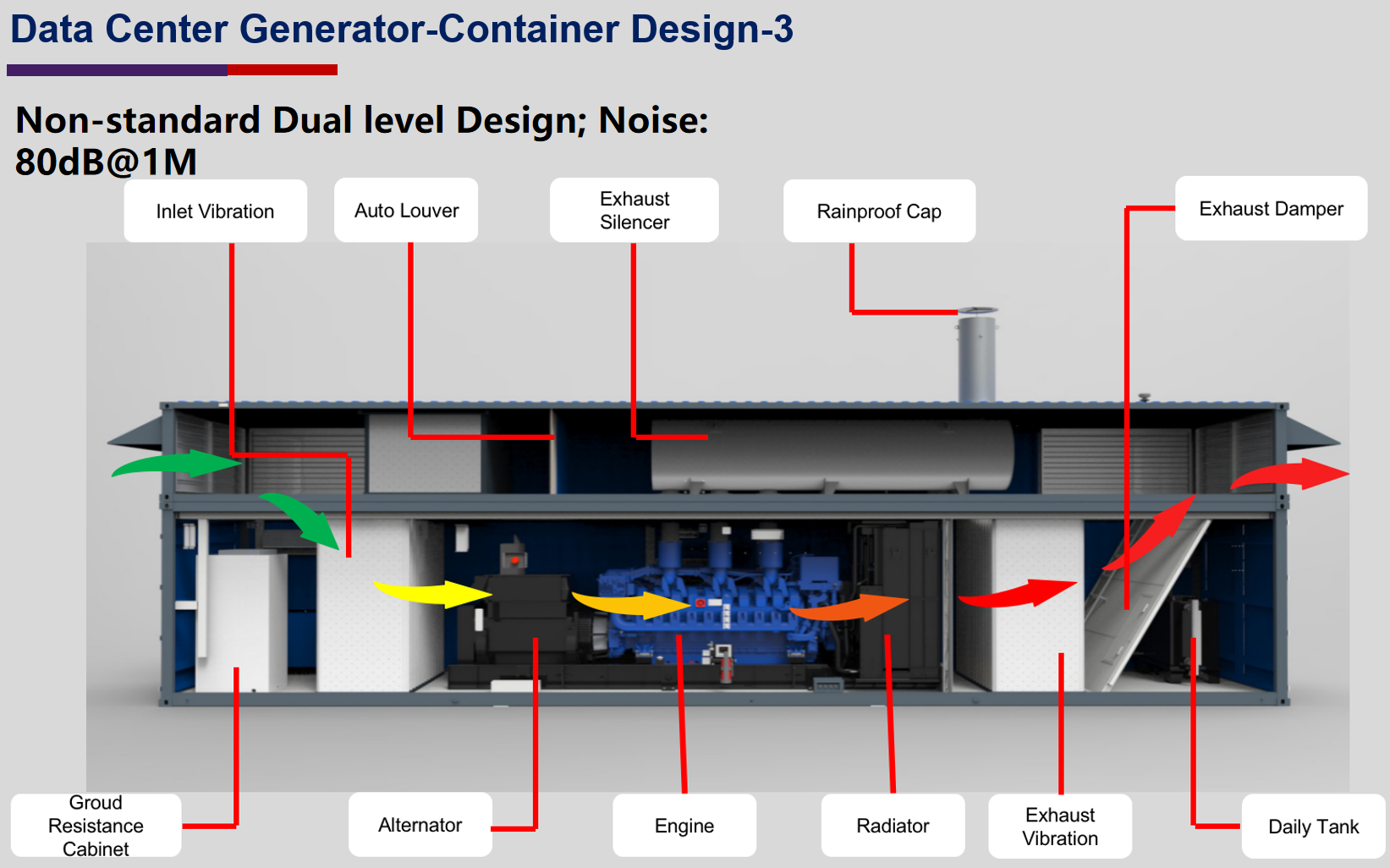
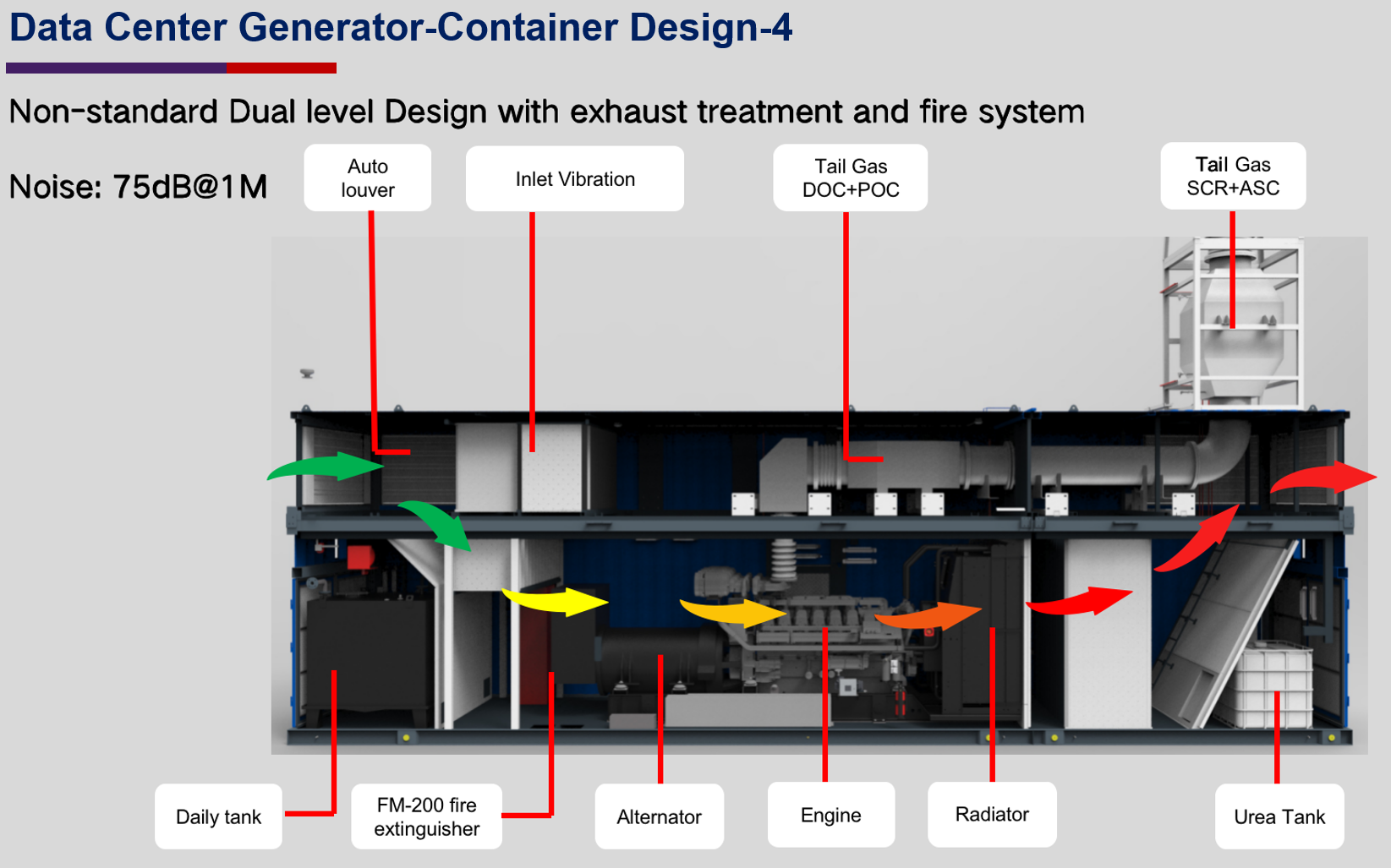
The dual-level container design is a non-standard layout developed for data center applications. MECCA POWER's comparison notes state a noise performance of 75dB to 80dB at 1 metre, a reduction of 10 to 15 dB compared with a standard single-layer container design. The stated trade-off is a slightly higher one-time cost against a lower overall operating cost, with easier routine maintenance and, in MECCA POWER's assessment, no negative impact on generator efficiency because the ventilation design is optimised to maintain stable performance. The application profiles listed for this design are data centers in urban cores or city centres, campus-style and high-density IDC facilities, Tier III and Tier IV data centers serving finance, government, and cloud providers, and projects near sensitive locations such as residential areas, schools, and hospitals.
The extreme-environment container addresses site conditions rather than acoustics. Compared with a standard containerized diesel generator, it is designed for outdoor use from -45°C to +55°C, with a stated advantage over standard configuration at -30°C and adaptability to demanding high-altitude, high-temperature, high-humidity, and high-cold environments. The stated trade-offs are a cost higher than the standard type, less maintenance, and higher efficiency.
Factory testing scope
The testing regime is where a 2MW-plus decision is either de-risked or left exposed. MECCA POWER operates a comprehensive factory testing system covering full-item testing: no-load test, load test, parallel operation test, insulation withstand voltage test, protection interlock test, emission test, and noise test. Testing equipment is calibrated and verified on a regular schedule, with professional inspectors responsible for operation and maintenance. Standardised testing procedures define the steps and pass criteria, and a unit moves to the next stage only after passing. Test data and reports are reviewed by professional personnel before release, and any unit that fails is reworked and re-tested until it meets the standard, which prevents non-conforming product from leaving the factory.
Design, manufacturing, and operational controls
Design work follows standardised templates that reference GB/T 2820, ISO 8528, and CE requirements, with 3D simulation, thermal simulation, and EMC simulation used to pre-verify structure, electrical circuits, and cooling before build. A professional design review team conducts multiple rounds of review focused on safety protection, emission compliance, and component matching, and core components - engine, generator, and controller - go through dedicated matching tests before a design scheme is accepted for long-term stable operation.
On the manufacturing side, lean production and written standard operating procedures define technical requirements for welding, assembly, wiring, anti-corrosion, and noise reduction. First-article inspection, routine inspection, and final inspection apply to key processes, production equipment is calibrated and maintained on schedule, and a production process quality file records the process and inspection results of each unit for later traceability.
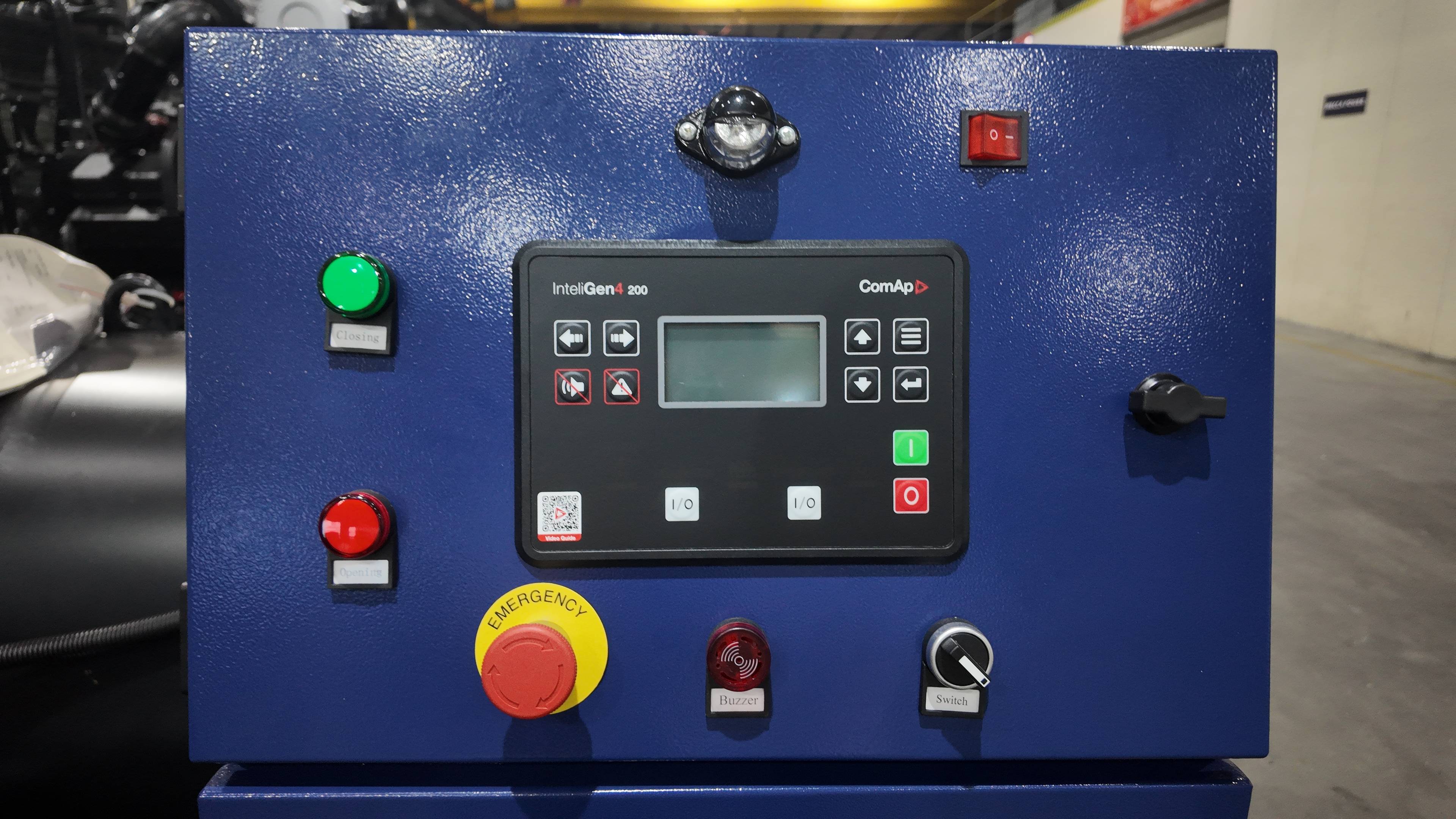
Operational risk is managed with the machine as well as with people. Units are equipped with an intelligent monitoring system and multiple safety protection devices that provide real-time warning, automatic shutdown, and fault locking for abnormal conditions including overload, overspeed, low oil pressure, high water temperature, and electrical leakage. Professional technicians perform on-site installation and commissioning to installation specification, operators receive training covering operating specifications, safety precautions, and common fault handling, and an operation manual is issued with each unit. A genset operation file is maintained so that inspections, maintenance, and replacement of ageing components can be scheduled and tracked.
Component sourcing and the competitive landscape
As an OEM, MECCA POWER maintains supplier relationships for engines, alternators, and control systems across brands including Cummins, Perkins, MTU, Mitsubishi, FPT, Volvo, Baudouin, Stamford, Leroy Somer, Mecc Alte, DeepSea, and ComAp, alongside Chinese engine brands. For a 2000kW, 2500kW, or 3MW project this matters less as a brand list and more as a configuration decision: the engine platform chosen determines the fuel consumption curve, the service network reachable from your site, and - together with exhaust aftertreatment and control strategy - the emission compliance route for the destination market.
It is worth placing the wider market in context. Fortune Business Insights lists Caterpillar, Cummins, Rolls-Royce (MTU), Kohler Energy (Rehlko), and Generac among the major global players in the data center and industrial generator market. Several of those companies are also engine and component suppliers into the same supply chain that OEM manufacturers build from, which is precisely why a tier comparison should be judged on configuration, testing, and service - not on a logo.
Comparison Table: 2000kW vs 2500kW vs 3MW
| Decision factor | 2000kW | 2500kW | 3MW (3000kW) |
|---|---|---|---|
| Nominal output | 2000 kW | 2500 kW | 3000 kW |
| Reference kVA at 0.8 power factor (design reference only) | Approx. 2500 kVA | Approx. 3125 kVA | Approx. 3750 kVA |
| Fits MECCA POWER stated range (10kVA-4000kVA) | Yes, for the kVA band this tier requires | Yes, for the kVA band this tier requires | Yes, when the kVA requirement stays within 4000kVA |
| Single unit vs paralleled block | Single unit, or two half-rating units for redundancy | Single unit, or a paralleled pair | Single 3000kW unit, or a paralleled block such as three 1000kW-class units |
| Factory test capability relevant to the tier | Full-item testing: no-load, load, parallel operation, insulation withstand voltage, protection interlock, emission, noise. The factory can support production testing of three units exceeding 2000kW simultaneously, with a maximum lifting capacity of 45 tons. | ||
| Noise option | Dual-level container design: 75dB-80dB at 1 metre, 10-15 dB lower than a standard single-layer container design; slightly higher one-time cost, lower overall operating cost; easier routine maintenance; no negative impact on efficiency per MECCA POWER's comparison notes. | ||
| Environmental option | Extreme-environment container for outdoor use from -45°C to +55°C, stated advantage over standard configuration at -30°C; higher cost than standard type, less maintenance, higher efficiency. | ||
| Fuel consumption | Not a fixed figure at any tier. Consumption follows the selected engine platform, the load profile, and ambient conditions. Request a fuel consumption curve at defined load points for the exact configuration quoted. | ||
| Load flexibility | Load acceptance is assessed through ISO 8528-10 test procedures; parallel operation is within MECCA POWER's factory test scope for block configurations. | ||
| Site and lifting | Factory lifting is rated to 45 tons. Site lifting, transport route, and foundation loads must be confirmed separately against the final container arrangement. | ||
| Typical fit (decision guidance) | Defined, stable load; no planned expansion; single-unit simplicity preferred | Moderate growth headroom; avoids a second unit; balanced footprint and fuel exposure | Large or expanding load; redundancy, staged build-out, or parallel operation required |
Rows marked as covering all three columns describe program-level capabilities that apply across the tiers rather than product-specific ratings for a single model. Confirm all figures against the final quotation for your configuration.
Step-by-Step: How to Choose Between the Three Tiers
Step 1 - Convert your load requirement into a rated capacity
Start from the load list, not from a preferred number. Establish continuous and peak demand in kW, define the applicable power factor, and apply your own margin policy. Then convert to the kVA figure the generator will actually be rated at. This single step usually eliminates one of the three tiers before any commercial discussion begins, and it prevents the 2500kVA versus 2500kW confusion from entering the enquiry at all.
Step 2 - Fix the rating class in writing
Decide whether the unit is standby or emergency power, prime power, or continuous duty. The rating class determines permissible load factor and running hours, and it is the assumption on which every other number in the quotation rests. Ask the supplier to state the class explicitly on the data sheet and to confirm that the load profile you supplied is the profile the offer is designed for.
Step 3 - Decide single unit versus paralleled block
Compare a single large unit against a block of smaller units on four dimensions: consequence of a single failure, footprint, maintenance access, and capital staged over time. A single 3MW unit concentrates risk and simplifies operation; a block of three 1000kW-class units spreads risk and allows phased investment, but requires parallel operation to be engineered, tested, and maintained. Parallel operation testing is part of MECCA POWER's factory test scope, which means the function can be proven before shipment rather than discovered on site.
Step 4 - Fix the environmental and noise envelope
Site conditions decide the container specification, and container specification moves cost. If the site is an urban or campus data center with nearby residential or institutional neighbours, the dual-level container design is the relevant option: 75dB-80dB at 1 metre, 10 to 15 dB below a standard single-layer container, at a slightly higher one-time cost but a lower overall operating cost. If the site is outdoor, remote, or exposed to extremes, the extreme-environment container covering -45°C to +55°C is the relevant option, at a cost above the standard type. Both decisions are usually irreversible after the container is built, so they belong at the front of the evaluation, not the end.
Step 5 - Agree the test protocol before you sign
Write the acceptance test into the contract. The scope to specify includes no-load test, load test, parallel operation test (for block configurations), insulation withstand voltage test, protection interlock test, emission test, and noise test, together with the requirement that test data and reports are reviewed and released, and that failing units are reworked and re-tested. If the project is governed by NFPA 110 or by a jurisdiction that mandates periodic load bank testing, align the factory test and the site commissioning test with the same load bank methodology so the baseline data is usable later.
Step 6 - Quantify fuel and maintenance over life, not at the point of purchase
Fuel consumption at 2000kW, 2500kW, and 3MW is not a fixed attribute - it follows the selected engine platform, the load profile, and the ambient conditions the unit operates in. Do not accept a single number as a comparison basis. Request a fuel consumption curve covering the load points your project will actually run at, and evaluate it against the hours per year each tier will operate. Apply the same discipline to maintenance: MECCA POWER's comparison notes state that the extreme-environment variant requires less maintenance than a standard containerized generator, and that the dual-level design is easier to service routinely - both are lifecycle inputs, not purchase-price inputs.
Step 7 - Close the service and traceability loop
Confirm what happens after commissioning. The service model matters more at 2MW and above because downtime cost scales with the criticality of the load. MECCA POWER's approach includes on-site installation and commissioning by professional technicians, operator training on operating specifications, safety precautions, and common fault handling, an operation manual with each unit, an intelligent monitoring and protection system with automatic shutdown and fault locking, and a genset operation file used to schedule inspections and component replacement. Ask for the same commitments in writing as part of the offer.
Use Cases: Which Tier Fits Which Operation
Data centers. The dual-level container design exists because of urban and campus data center constraints. Where the unit sits close to residential areas, schools, or hospitals, or where Tier III and Tier IV expectations apply, noise at 1 metre becomes a planning issue rather than a comfort issue. A 2000kW unit is often sufficient for a defined hall or a single block with no expansion plan; 2500kW is the more common headroom choice when the hall count may grow; 3MW is normally specified as a block, so that maintenance can be performed without removing the whole site's backup capacity.
Mining. Mining loads are typically rugged, variable, and located far from service infrastructure. The relevant decision here is not acoustic but environmental and logistical: extreme-environment containerization for outdoor use from -45°C to +55°C, and a unit count that keeps the mine running during scheduled maintenance. A 2500kW unit frequently balances load growth against transport and lifting constraints; 3MW is usually a block decision made when the site's total demand grows faster than a single unit can reasonably absorb.
Construction. Construction demand is temporary by design, which makes capacity staging the central question. A 2000kW unit matched to peak construction load avoids paying for headroom that will never be used, while a 2500kW unit provides room for a longer build programme. In both cases, request the fuel curve at the load points the site will actually run at, since construction load factors are rarely constant.
Power plants and EPC projects. MECCA POWER has extensive experience in power plant EPC projects domestically and internationally, and provides technical support and after-sales maintenance for those projects. In this context, containerized diesel generators typically serve as black-start, auxiliary, or backup capacity rather than prime generation. At 3MW and above, block architecture, parallel operation testing, and protection interlock testing move from optional to essential.
Oil and gas. Remote, often hazardous-adjacent sites reward units that can be monitored without a permanent on-site crew. Intelligent monitoring with automatic shutdown and fault locking for overload, overspeed, low oil pressure, high water temperature, and leakage supports that model, and extreme-environment containerization covers the ambient range the site will actually experience.
Telecom. Telecom sites are usually served by smaller units than the tiers discussed here, but the same procurement logic applies: fix the rating class, confirm the actual load, and align the testing regime with the standard the operator is accountable to.
Frequently Asked Questions
Which standards and test requirements apply to 2000kW, 2500kW, and 3MW containerized generators?
Two standards recur in this power band. ISO 8528-10 specifies load acceptance test procedures for reciprocating internal combustion engine-driven generating sets, which is the test that demonstrates how the unit behaves when load is applied step by step. NFPA 110 governs the installation, maintenance, and testing of emergency and standby power systems in the United States, including required periodic load bank testing. On the design side, MECCA POWER's standardised design templates reference GB/T 2820, ISO 8528, and CE requirements, and emission compliance is handled as part of the design review rather than after the build. Because compliance obligations depend on the destination market and the rating class of the unit, the applicable standard set should be confirmed for each project rather than assumed from a generic specification.
Can a 2000kW, 2500kW, or 3MW unit really be built and tested before it ships?
That depends on the supplier's factory capability, and it is a question worth asking in specific terms. MECCA POWER's Nanchang plant focuses on generating sets of 1000kW and above, using three production lines including a dedicated container line. The factory has six testing stations and a maximum lifting capacity of 45 tons, and is configured to support the production testing of three units exceeding 2000kW simultaneously. The test scope is full-item: no-load test, load test, parallel operation test, insulation withstand voltage test, protection interlock test, emission test, and noise test. Test data and reports go through a review mechanism before release, and units that fail are reworked and re-tested rather than shipped.
How should the budget differ between the three tiers?
The most reliable way to frame budget is total cost of ownership rather than purchase price, because the tier choices that look cheapest at order stage are not always cheapest in operation. Within MECCA POWER's stated container options, the dual-level design carries a slightly higher one-time cost but a lower overall operating cost, with easier routine maintenance and no negative impact on generator efficiency per the comparison notes. The extreme-environment container costs more than the standard containerized type, while requiring less maintenance and delivering higher efficiency. Fuel is the larger variable in most projects, and it follows the engine platform and load profile rather than the tier label, so a fuel consumption curve for the exact configuration belongs in the comparison before the commercial decision is made.
Is there a sample or validation step for units this large?
What drives lead time, and what is the next step?
Lead time in this class is driven mainly by three things: the engine and alternator configuration selected, the container specification (standard, dual-level low noise, or extreme environment), and the test scope agreed for the project. Production capacity is not usually the binding constraint for an established manufacturer - MECCA POWER's Nanchang plant moved from 132 units to 212 units of monthly output for generating sets of 1000kW and above, and the group produces 3,600 units annually. The fastest route to a realistic schedule and price is to send your load list, site conditions (ambient range, altitude, noise sensitivity, transport and lifting constraints), and preferred rating class, and ask for a configuration-specific quotation. MECCA POWER can be reached at mecca@meccagen.com or WhatsApp / WeChat +86 15659994455, and the full product brochure is available at the MECCA POWER brochure download.
Conclusion
The choice between a 2000kW, a 2500kW, and a 3MW containerized diesel generator is decided by four inputs, not by the size of the number. The first is the load itself, expressed in a single unit of measure at a defined power factor and rating class. The second is architecture: one unit or a paralleled block, with the redundancy and maintenance consequences that follow. The third is the site envelope - noise sensitivity and ambient extremes - which determines whether the dual-level container design, the extreme-environment container, or a standard container is the honest answer. The fourth is validation: what will be tested before shipment, and who signs the report.
Get those four right and the tier decision usually makes itself: 2000kW for a defined load with no growth, 2500kW for headroom without a second machine, and 3MW when the project genuinely needs block architecture, parallel operation, and staged expansion. MECCA POWER manufactures across the 10kVA to 4000kVA range from factories in Fujian and Jiangxi provinces, with high-power production concentrated at the Nanchang plant and full-item factory testing applied to every unit in this class.
Next Step
Send your load list, ambient and altitude conditions, noise limits, and target rating class to MECCA POWER for a configuration-specific comparison of 2000kW, 2500kW, and 3MW containerized options, including the fuel consumption curve, container variant recommendation, and factory test scope.
Email: mecca@meccagen.com
WhatsApp / WeChat: +86 15659994455
Website: www.meccapower.com.cn
Brochure: Download the MECCA POWER product brochure (PDF)