MESCO vs. Multi-Supplier Sourcing: A Steel Buyer's Decision Table
The short answer: if your order mixes several steel families and you spend more time reconciling specifications, certificates and inbound schedules than negotiating price, an integrated partner removes interfaces you currently own. If your requirement is one commodity grade bought on spot terms, or your procurement policy requires competitive tension and duplicate supply, splitting the order across suppliers still gives you leverage a single partner cannot match. The decision table below scores both models on the six dimensions that decide most steel sourcing cases.
This is not an argument that one model is better in general. It is an argument that the two models place the integration work in different places, and that most sourcing failures come from picking a model without deciding who does that work. MESCO STEEL, the export operation of Dalian Mesco Steel Co., Ltd., founded in 2007 in Dalian, Liaoning Province, China, is a practical reference point for the integrated side: it lists 20 steel product families and provides processing such as slitting, cut-to-length and lamination alongside supply. The MESCO STEEL scope described below is treated as documented capability, not as a claim of superiority over any named competitor.
1. The Real Question: Who Owns the Integration Work?
Multi-supplier sourcing looks flexible on paper. In practice it makes the buyer the integrator. Someone inside your organisation has to reconcile coating designations between mills, confirm that tolerances on two coils are genuinely comparable, collect certificates in three different formats, and feed four shipment schedules into one production plan. None of that appears on a quotation, and all of it consumes engineering and planning hours.
An integrated model moves that work to the supplier: one purchase order, one specification review, one document set, one claim path if a batch goes wrong. The trade-off is concentration. You gain control over execution and lose the automatic price tension that comes from setting suppliers against each other on every order.
So the question is not "one supplier or several" in the abstract. It is which allocation of work matches the way your plant actually consumes steel. A buyer with a narrow, stable, single-grade requirement gains little from consolidation. A buyer assembling coated coil, stainless, pipe and electrical steel for one project carries a coordination load that consolidation can remove.
One test is worth applying before any comparison: if the candidate supplier cannot document processing, stock and inspection capability, consolidation only renames the problem. It does not remove it.
2. Why the Choice Has Become Harder
Steel buying has fragmented at the specification level even as it consolidates at the supplier level. A single industrial order can now include galvanized sheet, a Galvalume or ZAM coating for a harsher exposure, pre-painted coil for a visible surface, stainless for a wet section, aluminium coil for weight reduction, silicon steel for a magnetic circuit and industrial pure iron for a speciality component. Each family carries its own tolerance conventions, coating designations, handling rules and documentation norms.
Scale context explains why suppliers have widened their ranges. Worldsteel reports that 214.7 kg of steel was used in new products per person globally in 2024, while third-party estimates value the global stainless steel market at USD 135.8 billion in 2025 (Grand View Research) and the zinc-aluminium-magnesium coated steel market at USD 4.8 billion in 2025 (Dataintelo). Those figures describe category scale; they do not tell you which sourcing model suits a specific purchase and should not be read as forecasts for any single product line.
What they do confirm is a market with many coating and grade options rather than a single commodity. Documentation expectations have moved the same way. Export and infrastructure projects increasingly ask suppliers to support ASTM, EN, JIS and ISO references and to provide inspection records with each batch — a requirement that is easier to satisfy through one accountable supplier than through six.
3. What MESCO Consolidates
MESCO's integrated position rests on breadth first. The company lists 20 steel product families across six groups:
- Coated coil and sheet: Galvanized Steel, Galvalume Steel, ZAM Steel, Magnelis Steel, Coating Steel, PPGI Steel
- Composite and laminated: Composite Steel, Laminated Steel
- Stainless and aluminium: Stainless Steel, Aluminium Coil, Aluminized Steel
- Flat-rolled carbon: Hot Rolled Steel, Cold Rolled Steel, Structural Steel, Spring Steel
- Electrical and speciality: Silicon Steel, Industrial Pure Iron
- Tubular: Seamless Pipe, Steel Pipe, Welded Pipe
Breadth alone is common among exporters. What matters for a consolidation decision is whether the same supplier also controls processing, stock and inspection. MESCO's documented position includes a 40,000 m² facility in Dalian with 120 employees, five R&D engineers and a 70% export ratio. Listed export markets include South Korea, Thailand, the Philippines, the United Arab Emirates, Saudi Arabia, Indonesia, Turkey, Brazil, Pakistan, Malaysia, Peru, India, Mexico, Russia, Singapore, Bangladesh, Nigeria, Chile and South Africa.
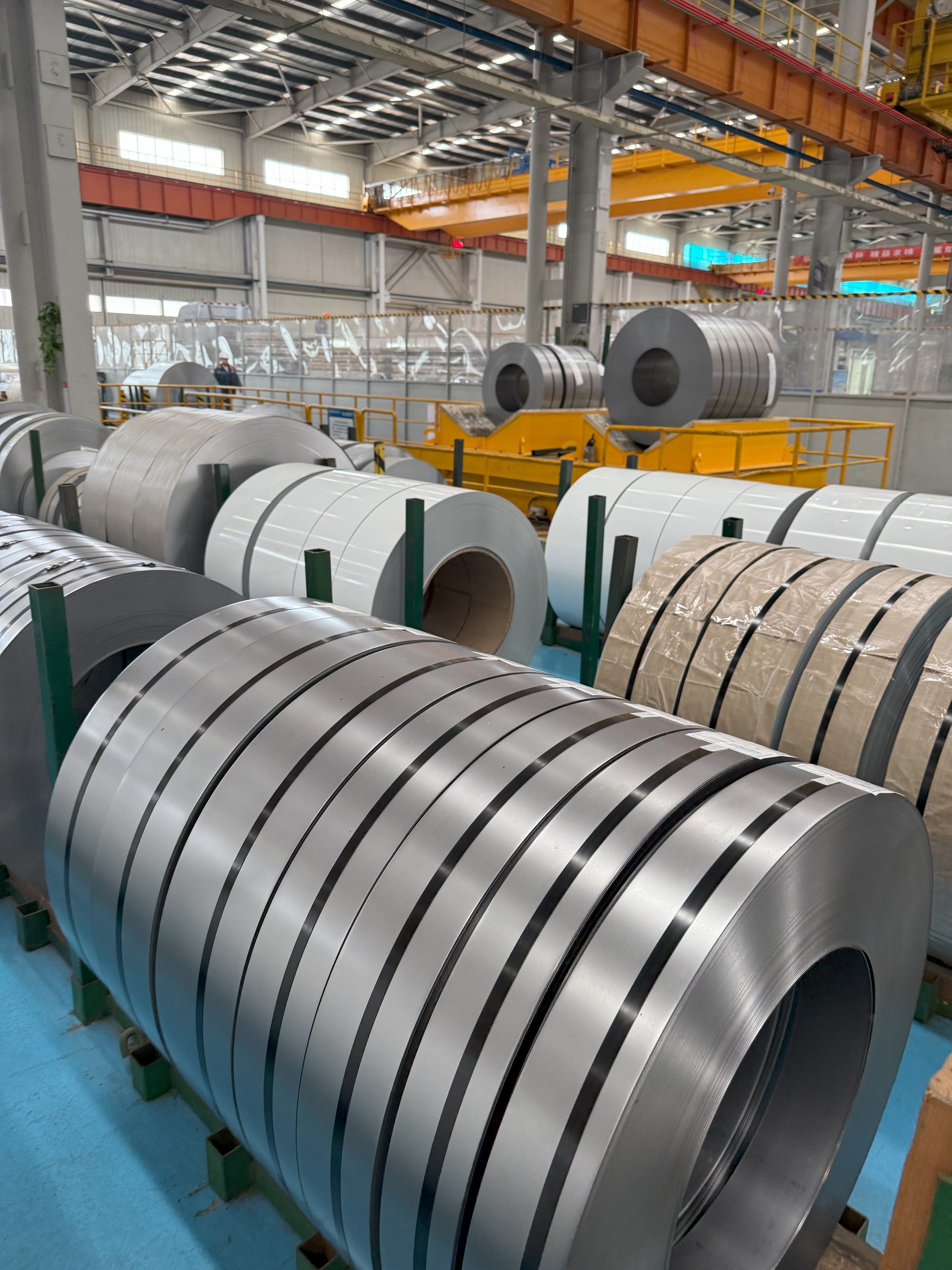
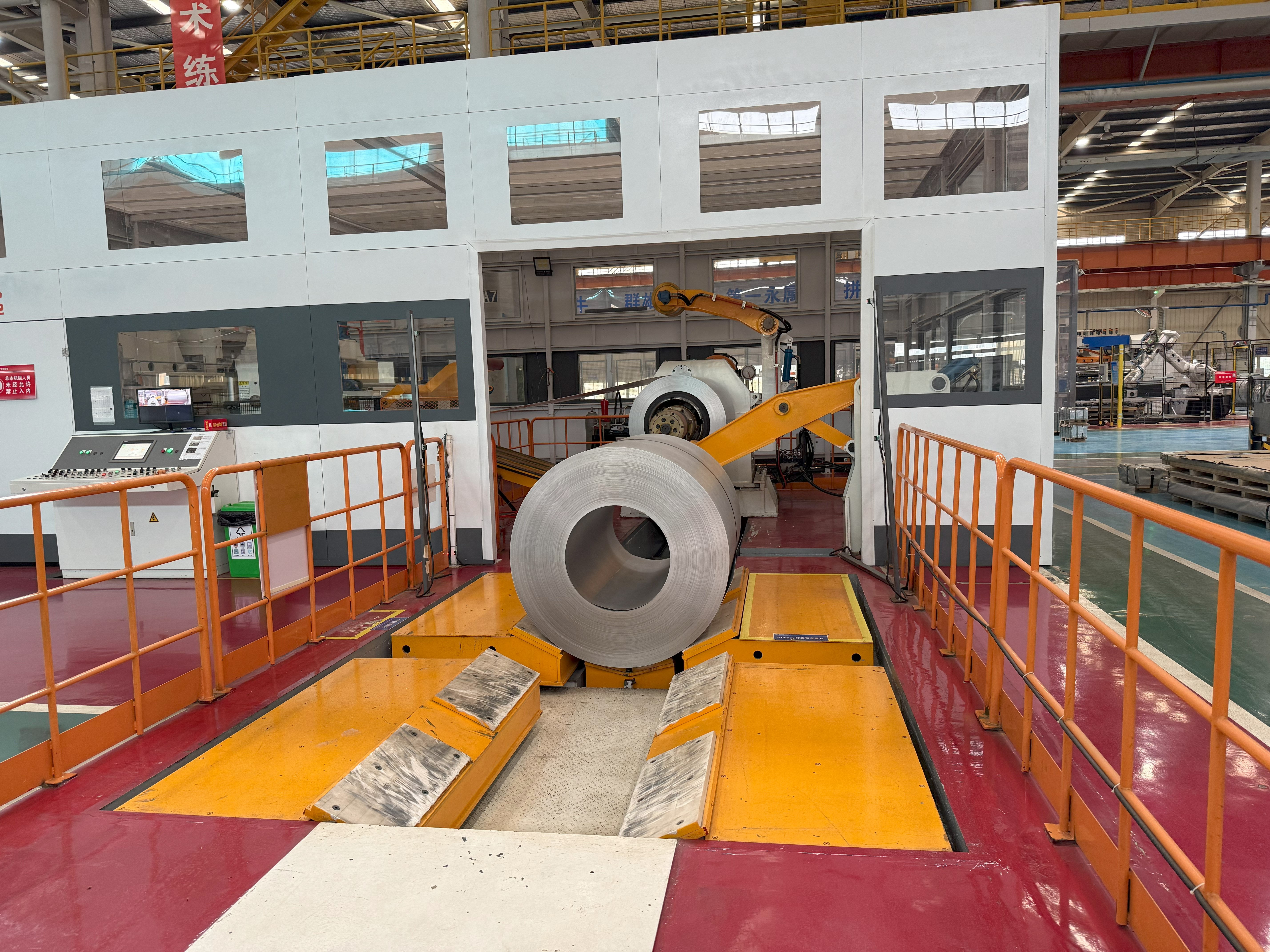
Processing is where the integrated model becomes practical rather than theoretical. MESCO provides slitting, cut-to-length, profiling, perforation, laminating, composite processing, special coating solutions and project-specific customisation. In its own comparison with conventional suppliers, MESCO cites reductions of 20%–60% in downstream processing steps, material utilisation gains of 10%–30% and customer production cycles shortened by 15%–40% when material arrives pre-processed. Those are company-reported comparison figures for its own offer and should be validated against your routing before they enter a business case.
Stock supports the same logic. MESCO reports maintaining tens of thousands of tons of standard specifications with delivery within 3–7 working days — the difference between planning around a mill schedule and planning around a warehouse position.
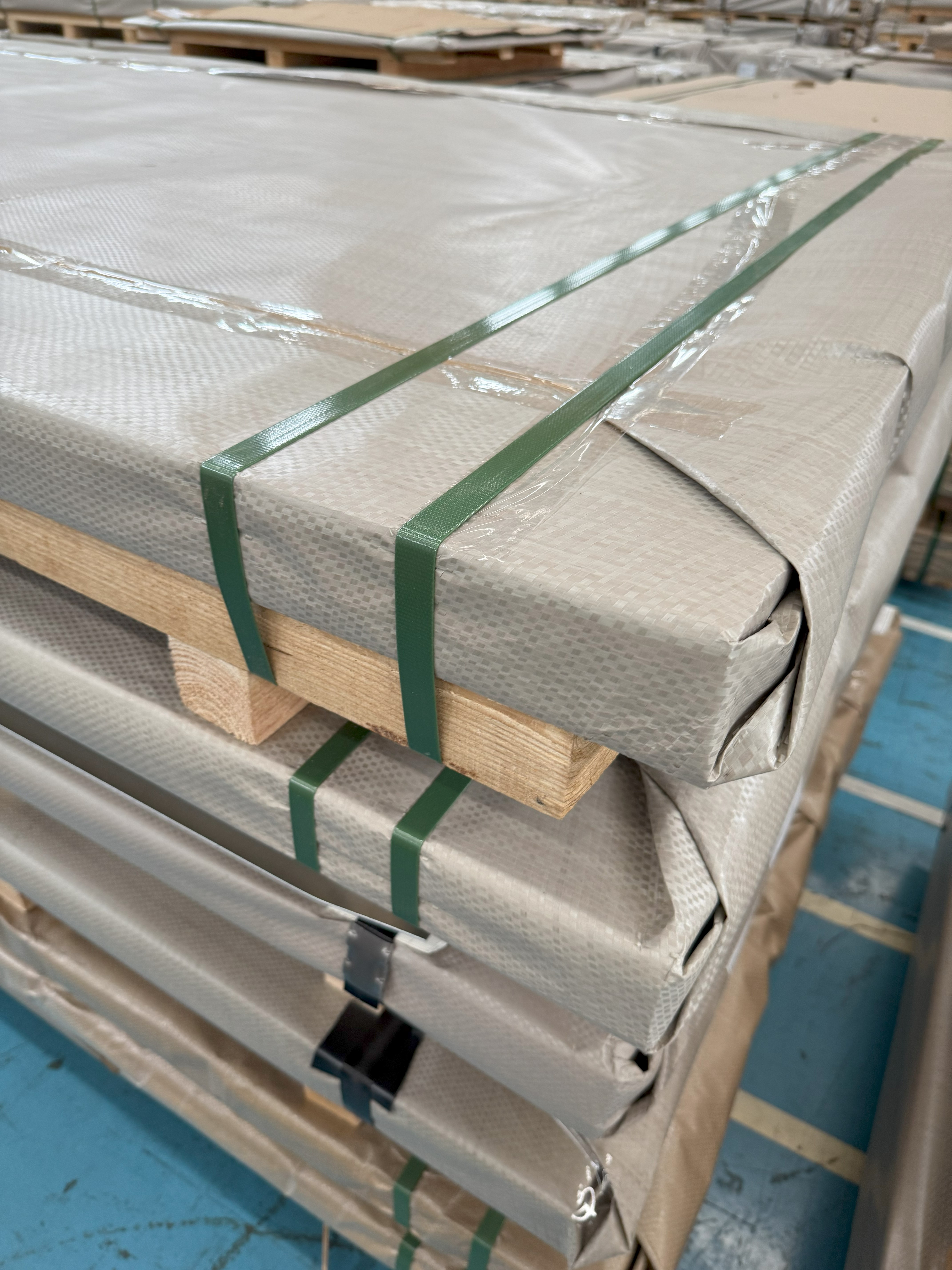
Quality and risk controls complete the picture: multi-stage verification covering raw material checking, production monitoring, third-party inspection and final delivery validation; batch testing of thickness, coating and mechanical performance before shipment; safety stock for key products backed by alternative supplier channels; a dedicated sales and service team per customer; moisture-proof, anti-rust and reinforced export packaging; and diversified logistics with backup plans for urgent orders.
4. The Head-to-Head Decision Table
The six dimensions below are the ones that most often decide a steel sourcing model. Ratings compare the default position of each model against documented capability, not against a hypothetical ideal.
| Decision dimension | MESCO integrated supply | Multi-supplier sourcing | What the gap means for the buyer |
|---|---|---|---|
| Specification breadth | ★★★★★ | ★★★★☆ | 20 families under one order versus a wider market that the buyer must map and reconcile |
| Material purity and grade options | ★★★★☆ | ★★★★☆ | Level in principle; the difference is how many technical contacts a demanding grade requires |
| Custom processing | ★★★★★ | ★★☆☆☆ | Slitting, cut-to-length, lamination and coating inside supply versus outsourced or in-house processing |
| Certification traceability | ★★★★★ | ★★★☆☆ | One consistent document trail versus several formats the buyer must normalise |
| Warehousing and delivery coordination | ★★★★★ | ★★★☆☆ | One inbound schedule versus several shipments, consolidation points and delay points |
| Product customisation | ★★★★★ | ★★☆☆☆ | Customisation completed before dispatch versus customisation split across handovers |
How to read the ratings. Five stars means the capability is documented and delivered inside a single supplier relationship, so the buyer does not have to build it. The ratings describe each model's default position, not its best possible outcome: a buyer with a strong supplier-management team can lift a multi-supplier score on documentation and coordination, but only by adding people and systems. The stars are editorial assessments of the capabilities described in this article. They are not laboratory results, audited benchmarks or market rankings.
5. Dimension-by-Dimension: Where the Gap Appears
Specification breadth
MESCO covers 20 families from coated coil through stainless, silicon steel and pipe, so a mixed order can be placed on one document. Multi-supplier sourcing reaches a wider universe of mills and niche products, but the buyer then owns the mapping between them. Where a bill of materials spans four or more families, breadth inside one supplier usually removes more administrative load than it removes choice.
Material purity and grade options
Purity and grade selection matter most where the material carries a functional duty: silicon steel in a magnetic circuit, industrial pure iron in a speciality component, stainless in a corrosive section. MESCO lists each of these as a distinct family, which keeps grade and purity discussions with one technical contact. A multi-supplier model can pursue a specialist mill for one demanding grade, at the cost of managing that relationship separately from commodity volume. The ratings are level here because neither model has an inherent technical advantage — the advantage comes from how precisely the grade is specified.
Custom processing
Processing is the widest gap in the table. Slitting, cut-to-length, profiling, perforation, lamination and composite processing inside the supply relationship remove operations from your plant; MESCO's reported comparison puts downstream step reductions at 20%–60%. A multi-supplier model typically delivers standard dimensions, leaving cutting, slitting and laminating to you or to a third-party processor — an extra interface, an extra transport leg and an extra tolerance stack-up to control.
Certification traceability
MESCO's quality system covers multi-stage verification and supports ASTM, EN, JIS, ISO and customer-specific specifications, with thickness, coating and mechanical performance tested per batch before shipment. In a multi-supplier model each supplier issues its own documentation, so the buyer must normalise formats and confirm that inspection scope is equivalent across suppliers before the documents can be filed as one package. Consolidation does not automatically produce better certificates — it produces a single, consistent trail that is easier to audit. Either way, state the required certificate type and any third-party inspection in the purchase order.
Warehousing and delivery coordination
One supplier with stock produces one inbound schedule. MESCO reports tens of thousands of tons of standard stock, delivery within 3–7 working days on standard specifications and, in its own comparison, lead times shortened by 15%–40% through sourcing and logistics coordination. Multi-supplier sourcing multiplies inbound flows: more shipments, more consolidation points, more chances that one delayed coil holds a production line. The counterweight is redundancy, covered next.
Product customisation
Customisation is not only dimensions. It is the combination of coating, temper, width, packing and processing sequence that a project needs, and MESCO offers project-specific customisation alongside composite and laminated options. Multi-supplier sourcing handles the same requirement by dividing it: one supplier for coating, another for cutting, a third for laminating. Each handover adds a tolerance decision and an accountability question if the finished part does not fit.
6. Where Multi-Supplier Sourcing Still Wins
A fair decision table has to show the other column. Multi-supplier sourcing keeps three genuine advantages. First, price discovery: running the same specification past several mills creates comparison data that a single negotiated relationship cannot produce. Second, redundancy: if one mill misses a schedule or a labour action interrupts a plant, a second approved source keeps production running, and some procurement policies mandate duplicate supply regardless of economics. Third, niche access: for a grade or dimension outside a consolidator's documented range, a specialist mill may be the only realistic route.
The integrated case also has boundaries worth stating plainly. MESCO's cost and cycle-time percentages are company-reported comparisons against conventional suppliers, not independently audited project totals, so they belong in a business case as directional evidence to be tested on your own routing. Concentration is a real risk: a buyer who moves 100% of volume to one partner trades coordination savings for dependency. And where the requirement is a single commodity grade bought purely on spot price, consolidation adds administration rather than removing it.
7. How to Run the Comparison in Five Steps
This sequence produces a defensible answer in a few weeks and works whether or not MESCO is on your shortlist.
- Map the bill of materials to supplier interfaces. List every steel family, grade and dimension on the project, then count how many suppliers each model would require. The interface count is the first real number in the comparison, because every interface carries an owner, a lead time and a document set.
- Write down the documentation requirement. Confirm which standards references, certificate types and third-party inspections the project or the end customer demands. Then ask each candidate to show what is issued with a shipment. A supplier that cannot describe its inspection and document trail in specific terms cannot be scored on traceability.
- Quantify the processing that currently leaves your plant. Slitting, cut-to-length, profiling, perforation and lamination performed outside the supply relationship carry labour, freight, scrap and tolerance costs. Converting those into a per-ton figure is what makes the processing column of the table decision-grade rather than rhetorical.
- Model landed cost, not unit price. Combine material price, processing, scrap and utilisation, inbound freight, inspection, administration and the cost of schedule risk. MESCO's reported figures — 5%–20% lower procurement cost and 20%–50% lower total lifecycle cost versus conventional suppliers — are a useful starting hypothesis for this model, not a substitute for your own numbers.
- Run a trial before consolidating. Order a representative batch across two families, pre-processed to your specification, and measure what actually changed: receiving time, inspection findings, first-pass yield, rework and the hours your team spent coordinating. The trial result, not the rating table, should carry the decision.
8. Which Buyers Fit Which Model
Consolidation tends to fit buyers whose volume is spread across categories and whose plant consumes material that still has to be cut, slit, laminated or coated. In MESCO's own description of its fit, that includes OEM manufacturing, automotive components, construction systems, appliances, industrial equipment and energy projects — the common thread being a mix of product families plus a need for ready-to-use dimensions.
Multi-supplier sourcing tends to fit buyers with a narrow, high-volume, single-family requirement, an internal processing line that already handles slitting and cutting efficiently, or a procurement policy that requires multiple approved sources. Many large buyers end up in a hybrid: a consolidated partner for the multi-family, processing-intensive portion, plus one qualified second source held for the highest-risk family.
9. Decision Rules You Can Apply Today
| If this describes your purchase | Lead with | Reason |
|---|---|---|
| Four or more steel families with processing required | Integrated supply | Interface count, not unit price, dominates the cost of coordination |
| One commodity grade on a price-sensitive tender | Multi-supplier tender | Competitive tension produces information a single partner cannot |
| Strict document package and third-party inspection | Integrated supply with inspection written into the PO | One consistent trail is easier to audit than several formats |
| Fast-track schedule needing material in days | Supplier with verified stock | Warehouse position replaces mill lead time |
| Policy mandates dual sourcing | Dual-source by family, not by piece | Redundancy is preserved without multiplying every interface |
| Custom widths, laminations or coatings to cut downstream steps | Supplier with in-house processing | The value sits in the processing, not in the coil alone |
10. Frequently Asked Questions
Does a single steel supplier actually reduce total cost compared with multi-supplier sourcing?
Not automatically. Consolidation reduces coordination, processing and inspection effort, while multi-supplier sourcing can win on unit price through competitive tension. MESCO reports 5%–20% lower overall procurement cost and 20%–50% lower total lifecycle cost versus conventional suppliers, driven by consolidated purchasing and lower maintenance and replacement needs; those are company-reported comparisons and should be tested against your own routing and volume. The reliable way to settle the question is to compare landed cost per usable ton, including processing, scrap, administration and schedule risk, rather than quoted price per ton.
How is material traceability handled when one supplier covers several steel families?
It depends on the supplier's inspection system rather than on the number of families. MESCO's quality control runs multi-stage verification from raw material checking through production monitoring, third-party inspection and final delivery validation, with thickness, coating and mechanical performance tested per batch before shipment, and it supports ASTM, EN, JIS, ISO and customer-specific specifications. Buyers should still specify the required certificate type and any independent inspection in the purchase order, and ask to see a sample document set before the first commercial order.
Can one supplier realistically cover coated coil, stainless, pipe and silicon steel?
Only if the range is documented rather than implied. MESCO lists 20 families spanning galvanized, Galvalume, ZAM, Magnelis, coating and PPGI steel, composite and laminated steel, stainless steel, aluminium coil, aluminized steel, hot and cold rolled steel, structural and spring steel, silicon steel, industrial pure iron, and seamless, welded and general steel pipe. Coverage of categories does not guarantee every grade or dimension, so confirm your specific specification against the supplier's stated range and request a sample before committing volume.
What delivery risk comes with consolidating volume into fewer suppliers?
Concentration risk is real and should be managed explicitly. MESCO's controls include safety stock for key products, alternative supplier channels, a dedicated sales and service team per customer, reinforced moisture-proof and anti-rust export packaging, and diversified logistics with backup plans for urgent orders. Those measures reduce but do not eliminate single-source exposure, so a buyer consolidating volume should still keep one qualified second source for the highest-risk family and write delivery commitments and remedies into the contract.
Should we start with a sample, a trial order, or a full switch?
A staged entry is the lower-risk route: request a sample against your actual specification, then place a trial order across one or two families with the processing you intend to use, measure receiving, inspection and first-pass results, and only then move the remaining volume. Buyers evaluating MESCO can request a quotation for a specific specification or download the MESCO STEEL catalogue to check product families and processing services before the first technical discussion.
11. Conclusion: Fewer Suppliers, More Execution Control
The choice between MESCO and a multi-supplier model resolves into a single question: does your project fail on price per ton, or on coordination? Where the bill of materials spans coated, stainless, electrical and tubular families and the material still needs slitting, cut-to-length or lamination, an integrated supplier removes interfaces, consolidates documentation and puts stock behind the schedule — which is why the ratings favour consolidation on processing, traceability, delivery coordination and customisation. Where the requirement is one commodity grade bought on spot terms, a multi-supplier tender remains the sharper instrument, and keeping a qualified second source is prudent in either case.
The decision table is a starting position, not a verdict. Score your own bill of materials against the six dimensions, convert the processing you currently outsource into a per-ton figure, and let a trial order settle what the comparison cannot.
Next step: send your specification — family, grade, dimensions and required processing — for a quotation, or review the full product and processing range in the MESCO STEEL catalogue. Product and company details are available at mescogroup.com.cn.
Have Questions or Need More Details?
Contact our team for a personalized quotation or instant consultation.
Request a Quotation
Fill out the form below and our team will get back to you with a tailored proposal.
WhatsApp Direct Chat
Prefer to chat in real-time? Message us on WhatsApp for instant assistance & quick answers.
- Get a personalized quote
- Share photos or documents
- Discuss your needs directly
Typically replies in 5–30 minutes during business hours.