
Standard Purchase Terms vs. Acceptance Criteria: A Head-to-Head Swim Spa Sourcing Decision
Two sourcing teams can negotiate the same swim spa order and end up with very different risk profiles, even when they sign comparable commercial terms. The difference usually comes down to sequence: whether the buyer locks commercial purchase terms first and defines acceptance criteria later, or locks the acceptance criteria first and negotiates commercial terms against a fixed technical baseline.
Short answer: a terms-first path is the lower-friction route when the product is a standard model, the destination market already accepts the available certification package, and the uncertainty sits mainly in price, payment, and delivery scheduling. An acceptance-criteria-first path is the lower-risk route when the swim spa is entering a regulated market, when the installation is non-standard, or when the buyer needs factory-test evidence and physical sample verification before committing volume. Neither path is universally correct; the decision depends on where the residual risk actually sits.
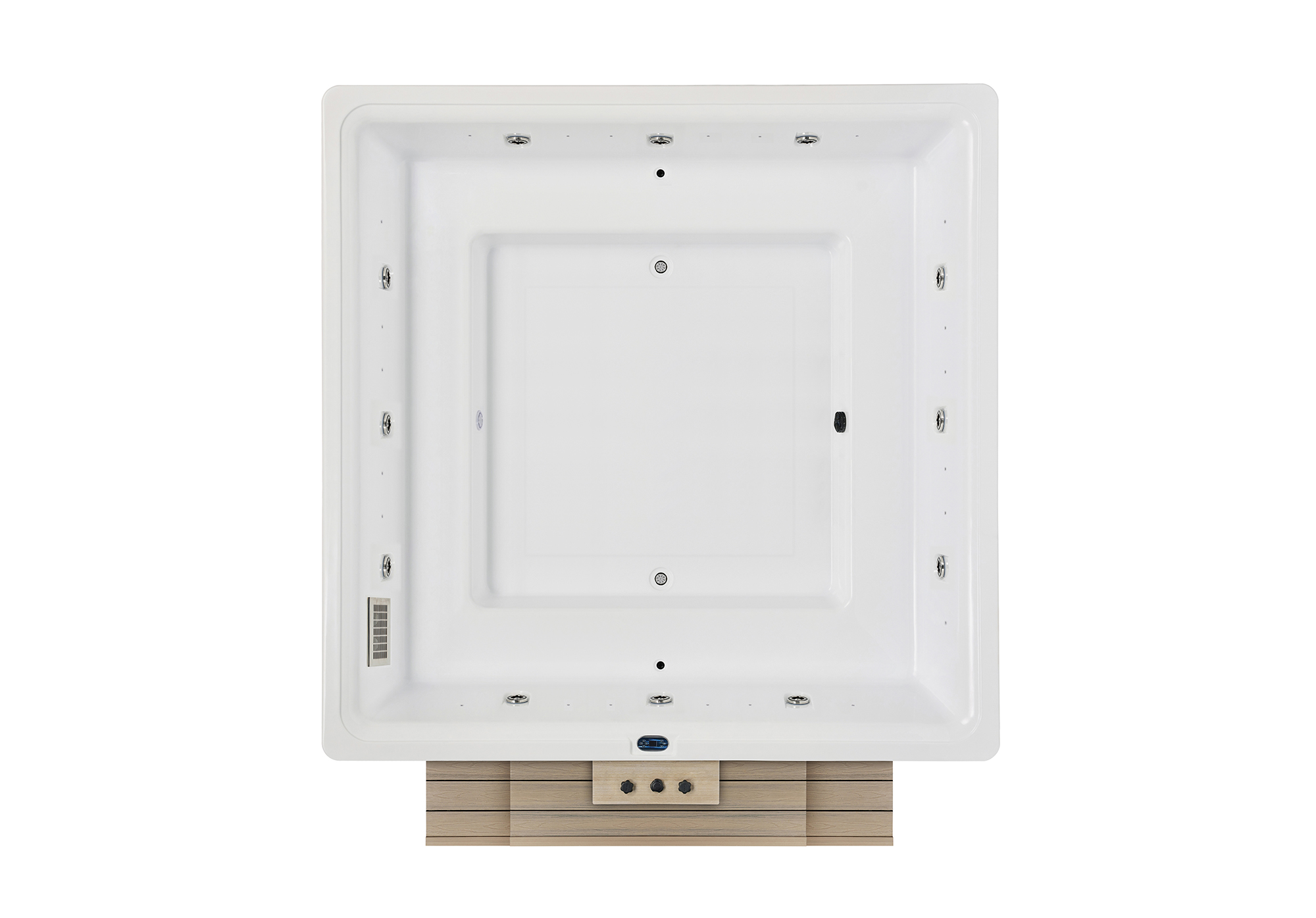
This article compares the two approaches head to head for project teams sourcing swim spas into residential, hotel, resort, fitness, and community facilities. The product reference is MEXDA's SWIM SPA range, and the factual anchors are the company's published specification, certification, and purchase-terms information.
Problem Definition: Why the Two Checklists Collide
A swim spa purchase carries two separate obligation sets that are negotiated by different people, on different timelines, and often from different documents.
The commercial purchase-terms side typically covers unit price, payment schedule, Incoterms and freight responsibility, production lead time and delay clauses, minimum order quantity, packaging, warranty length, and after-sales scope.
The acceptance-criteria side covers product definition and dimensions, shell material and construction, electrical safety compliance for the destination market, performance behavior such as jet output and temperature control, factory test records, and the explicit conditions under which a delivered unit is judged conforming or non-conforming.
The collision happens at the sequencing boundary. When commercial terms are agreed before the product is fully defined, the supplier quotes against an assumed specification. If the buyer later introduces a certification requirement, a heavier pump configuration, or a different jet count, the quotation baseline moves and the original terms no longer describe the same deliverable. Conversely, when acceptance criteria are written in isolation from commercial reality, a buyer may specify a configuration that no supplier can schedule inside the required window, and the negotiation restarts.
This is not a hypothetical governance problem. Swim spa procurement sits inside a layered compliance framework, which means the acceptance-criteria side carries more regulatory weight than it does for a purely decorative product. A well-run sourcing decision treats the two checklists as a single sequence rather than as parallel workstreams.
Industry Background: Why Swim Spa Compliance Carries More Weight Than in Most Sourcing Categories
The term "swim spa" is not only a marketing label. It appears in regulation and model-code language, which is why acceptance criteria for this category tend to be more formal than for general outdoor leisure products.
Under United States federal law, the term "swimming pool" or "spa" is defined as any outdoor or indoor structure intended for swimming or recreational bathing, including in-ground and above-ground structures (15 USC § 8002(6)). At the model-code level, the 2021 International Swimming Pool and Spa Code (ISPSC) is described by the International Code Council as the comprehensive swimming pool code coordinated with the current requirements in the I-Codes and the standards of the Association of Pool & Spa Professionals. Model-code terminology also distinguishes the category: an "exercise spa" — also known as a swim spa — is described as a variant of a spa whose design and construction includes specific features and equipment to produce a water current.
That last point matters for sourcing. A swim spa is defined by function, not just by footprint. If the current-producing equipment is under-specified, the delivered unit may still be legally a spa while failing the functional acceptance criterion the buyer actually cares about.
On the demand side, the global pool and spa market was valued at USD 24.28 billion in 2025 and is projected to reach USD 37.93 billion by 2034, according to Straits Research. In the United States, the swimming pool and spa retail channel is broad — VerticalIQ reports approximately 10,000 pool and spa retailers selling above-ground pools, hot tubs, and related equipment, supplies, and merchandise. That figure describes the retail channel for the whole category, not swim spa manufacturing, so it is useful as a channel-structure signal rather than a swim spa market size.
The practical implication is that acceptance criteria in this category are not only about the shell and the jets. They are about which conformity documents exist, which market they cover, and whether the unit can be released into service at the intended site.
Detailed Solution: How the Two Paths Actually Differ
MEXDA is a swim spa brand associated with Foshan Gaoming Yuehua Sanitary Ware Co., Ltd., a manufacturer established in 1995 in Gaoming, Foshan, China. The company operates a 50,000 m² production facility with more than 200 employees and nine engineers, runs an annual output of 5,000 sets, and exports roughly 85% of production to markets including the United States, the European Union, Australia, Germany, and France. Its swim spa line covers 5 m to 12 m acrylic models sold into hotel, fitness, leisure, residential community, and resort applications.
Because the manufacturer publishes both a specification set and a certification set, it is possible to see exactly where each sourcing path puts pressure.

Path A — Terms-First
In a terms-first sequence, the buyer opens with commercial questions: unit price, payment milestones, lead time, MOQ, and warranty coverage. The technical annex is attached later, often after the price is anchored.
Where this works well: when the buyer is ordering a repeat configuration that has already been delivered and accepted before, when the destination market's certification package is already documented and unchanged, and when the main commercial variable is scheduling rather than specification. In these cases, locking terms early reduces negotiation cycles and gives the buyer a firm budget number early in the project.
Where this breaks down: when the certification requirement for the destination market is not yet confirmed. A price agreed before compliance is confirmed is a price for an undefined deliverable. If the required conformity route turns out to differ, the buyer must reopen commercial discussions, and the original terms provide no protection because they never described the compliant product.
Path B — Acceptance-Criteria-First
In an acceptance-criteria-first sequence, the buyer writes the specification and the pass/fail conditions before requesting pricing. The commercial negotiation then runs against a fixed technical baseline, and every supplier quotes the same deliverable.
Where this works well: multi-site projects, regulated destinations, non-standard dimensions or performance targets, and any order where the buyer intends to inspect a sample or factory test record before releasing volume. Because the acceptance criteria are fixed, quotations become directly comparable line by line instead of requiring normalization.
Where this breaks down: speed. Writing acceptance criteria takes internal effort, often requiring sign-off from the project engineer and the compliance owner. If the criteria are set unrealistically high relative to what the market can supply, lead times extend and some suppliers decline to quote.
Where the Two Paths Meet
The two approaches are not mutually exclusive. The practical resolution used by experienced project teams is to fix a short, non-negotiable acceptance core first — product definition, destination-market conformity route, shell material, and the current-producing system — and then negotiate commercial terms against that core. Everything that is genuinely optional, such as lighting packages, step configurations, and skirt treatment, can be resolved commercially afterward.
Decision rule: Accept the terms-first path only for configurations where the specification and the conformity route are already frozen. Use the acceptance-criteria-first path whenever the destination market, the installation environment, or the performance target is new to the buyer.
Step-by-Step Breakdown: Running Both Checklists as One Sequence
- Define the product before requesting price. Write down the model family, shell material, and intended application. MEXDA's swim spa line is acrylic and is intended for hotel, fitness, leisure, residential community, and resort use — this framing immediately narrows the specification conversation.
- Convert the destination market into a conformity requirement. Do not write "must be certified." Write the specific certificate, issuing body, certificate number, and the standard revision the unit must meet. For example, the WS-CP2400 swim spa holds ETL certification number 3177783 issued by Intertek, complying with UL 1563:2025 Ed.7 and CSA C22.2#218.1:2025 Ed.3 for the US market.
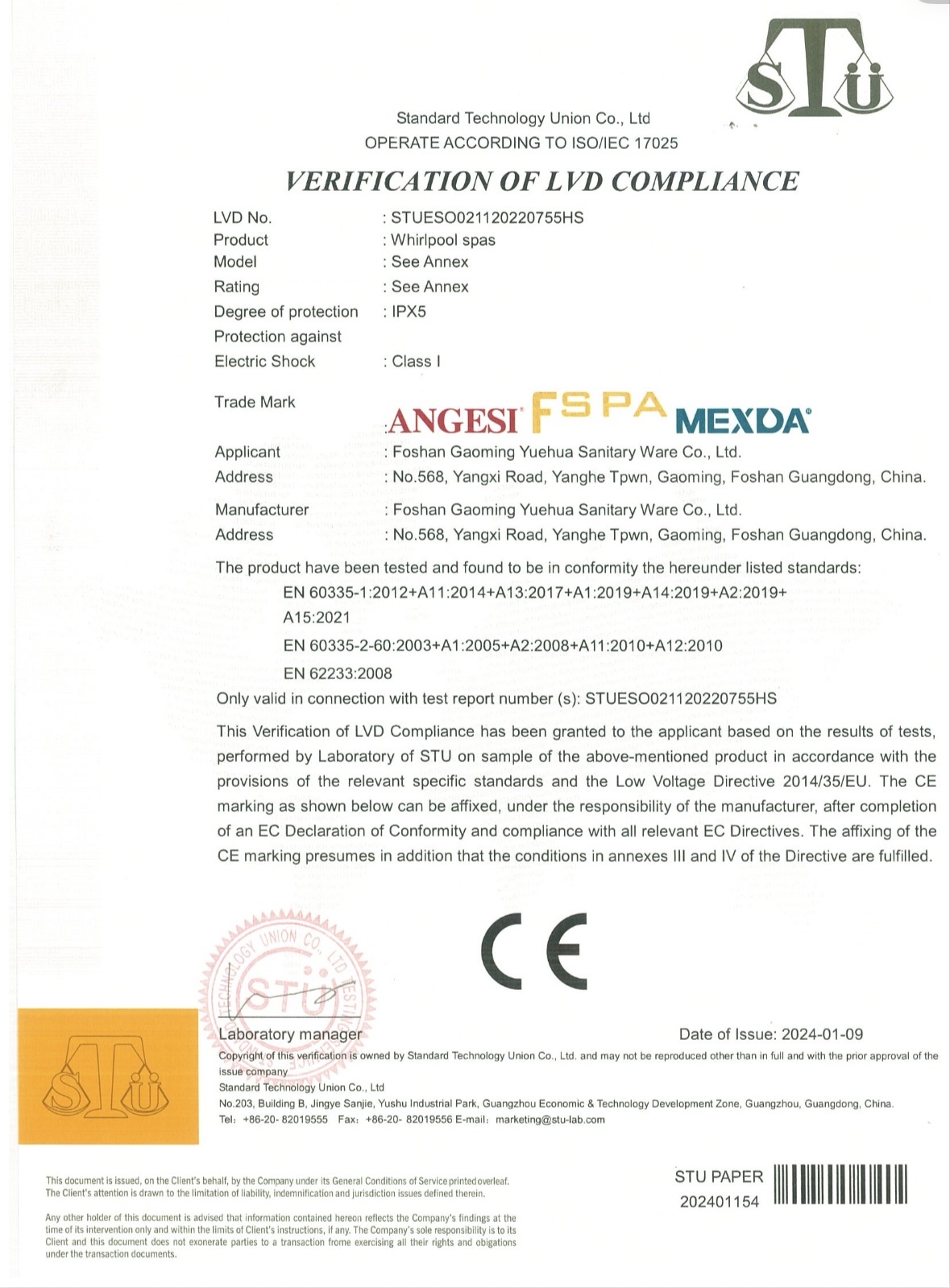
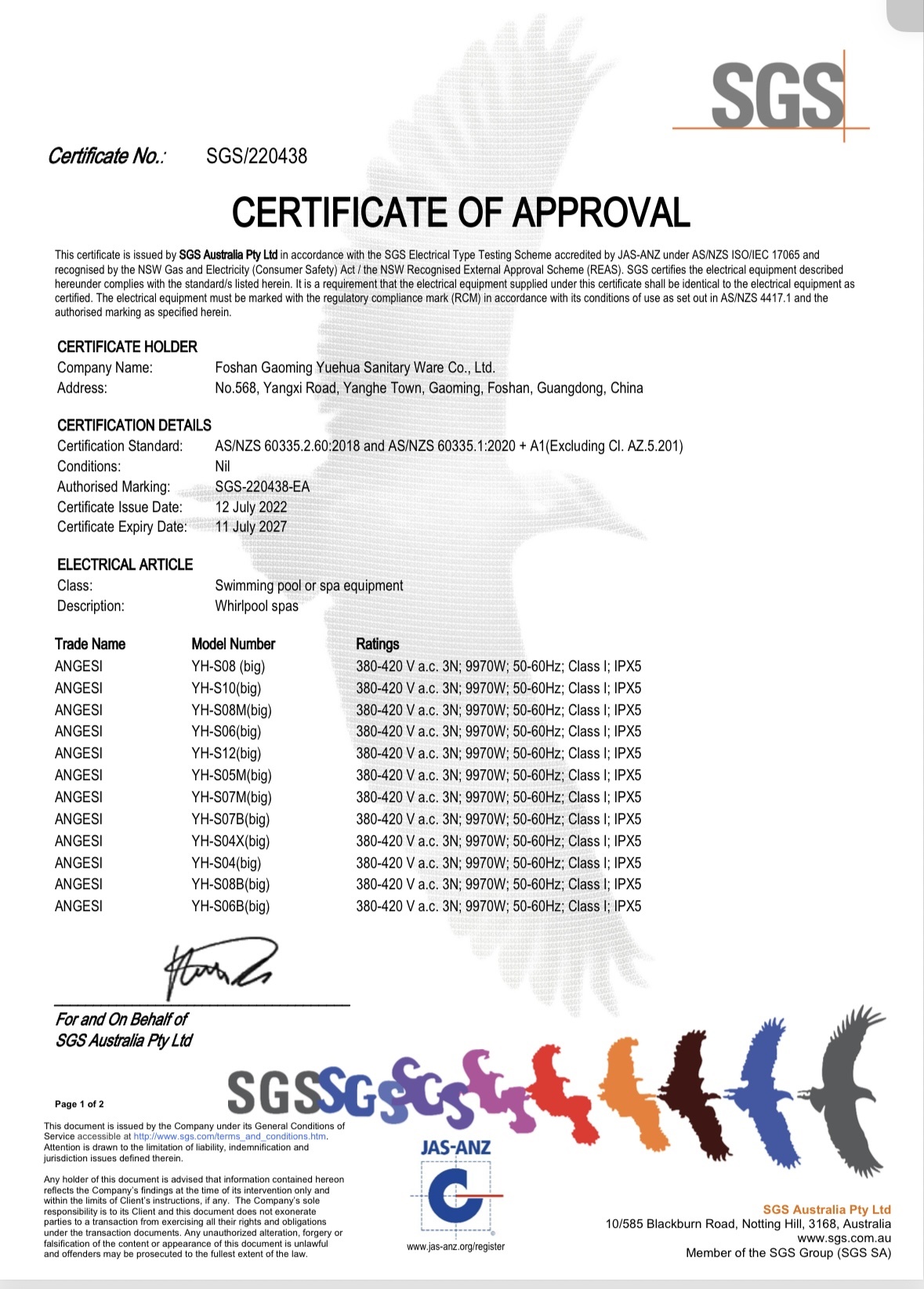
- Match the conformity route to the market where the unit will operate. The same swim spa platform may carry different approvals for different regions. The WS-CP2400 also holds SAA certification number SGS/220438 issued by SGS under AS/NZS 60335.2.60:2018 and AS/NZS 60335.1:2020 + A1 for the Australian market, and CE certification number STUESO021120220755HS issued by STU under EN 60335-1, EN 60335-2-60, and EN 6223 for the EU market. Buying a unit certified for one region and installing it in another is a specification error, not a commercial one.
- Translate the model parameters into measurable acceptance items. A swim spa specification should name the control system, heater rating, water pump rating and quantity, filter pump rating, jet count, filtration, and insulation. Under-specified lines are where disputes originate.
- Validate against a physical sample before volume release. Sampling converts written criteria into observable evidence. Confirm with the supplier what the sample order includes and how the sample maps back to the production unit.
- Confirm the factory test regime. MEXDA states 100% testing as its quality-control approach, with an OEM/ODM production model. Ask how the test result is recorded and whether the record travels with the shipment.
- Now negotiate the commercial terms against the frozen baseline. Price, payment, Incoterms, packaging, and delay clauses should reference the accepted specification and the accepted conformity route.
- Bind lead time and after-sales into the same document. MEXDA's published capacity data indicate a monthly production capacity of 500 sets, an MOQ of 1 set, a lead time of 30–40 days, and remote-guidance after-sales support. These belong in the purchase order, not in a separate email thread.
Acceptance Criteria Reference: WS-CP2400 Conformity Evidence
| Market | Certification | Certificate Number | Issuing Body | Applicable Standards |
|---|---|---|---|---|
| United States | ETL | 3177783 | Intertek | UL 1563:2025 Ed.7 / CSA C22.2#218.1:2025 Ed.3 |
| Australia | SAA | SGS/220438 | SGS | AS/NZS 60335.2.60:2018 and AS/NZS 60335.1:2020 + A1 |
| European Union | CE | STUESO021120220755HS | STU | EN 60335-1, EN 60335-2-60, EN 6223 |
Specification-Level Acceptance Items Across MEXDA Swim Spa Models
Where a buyer's acceptance criteria stop at "acrylic swim spa," the specification is too thin to be enforced. The table below shows the level of granularity that is actually published for the range, which is the level at which acceptance criteria should be written.
| Model | Control System | Heater | Water Pump | Filter Pump | 5" Jets | UV Light | Sand Filter |
|---|---|---|---|---|---|---|---|
| WS-CP2400 | KL2022 | 3 kW (H30-R1) | 1500 W × 1 (LP200) | 370 W × 1 (JA50) | 8 | — | — |
| WS-CP2800 | KL2020 | 3 kW (H30-R1) | 1500 W × 1 (LP200) | 370 W × 1 (A50) | 11 | 1 set | 1 (Q350) |
| WS-SP2800 | KL2022 | 3 kW (H30-R1) | 1500 W × 1 (LP200) | 370 W × 1 (JA50) | 12 | 1 set | 1 (Q350) |
| WS-CP3500 | KL2020 | 3 kW (H30-R1) | 1500 W × 1 (LP200) | 370 W × 1 (A50) | 12 | 1 set | 1 (Q350) |
| WS-CP3800 | KL2020 | 3 kW (H30-R1) | 1500 W × 2 (LP200) | 370 W × 1 (A50) | 16 | 1 set | 1 (Q350) |
| WS-SP3800 | KL2022 | 3 kW (H30-R1) | 1500 W × 1 (LP200) | 370 W × 1 (JA50) | 12 | 1 set | 1 (Q350) |
Longer platforms follow the same pattern. The WS-S08B is an 8 m acrylic swim spa with two control systems, four water pumps, two filters, two heaters, and two ozone generators. The WS-PC07A-T is a 7 m acrylic swim spa in the same application set. Larger multi-pump and multi-heater configurations such as these are precisely the orders where an acceptance-criteria-first sequence pays for itself, because the number of independently verifiable line items is high.
Use Cases: Which Path Fits Which Project
Residential Backyard Swim Spa
A private residential installation is usually a single-unit order in a market where the buyer already has a preferred model. The commercial variables — delivery, positioning, commissioning — dominate. Terms-first works here, provided the buyer confirms the conformity route for the destination country at the same time. MEXDA's MOQ of 1 set makes single-unit sourcing feasible.
Hotel and Resort Wellness Facilities
A hotel or resort swim spa sits in a semi-public environment. Outdoor operation introduces UV exposure, wide temperature ranges, and a requirement for corrosion-resistant components and weatherproof design. Operators typically expect temperature self-regulation and automatic filtration cycles to run without constant supervision. In this setting, acceptance criteria should specify the control system, the filtration arrangement, and the UV or ozone treatment so that the delivered unit actually matches the operating model the facility designed around.
Commercial Fitness and Community Facilities
Fitness-focused deployments rely on the current-producing system as the primary function. Because the category is defined in part by equipment that produces a water current, the swimming training system belongs in the acceptance criteria as a named, verifiable item rather than as a general performance claim.
Contractor-Led Multi-Unit Projects
A construction contractor in France ordered 20 MEXDA swim spa sets for combined residential and commercial leisure and fitness use. The units have been in service for more than ten years, with the reported result being reliable performance and a consistent hydrotherapy experience, with long-lasting durability and constant temperature highlighted. Multi-unit contractor orders are the clearest case for the acceptance-criteria-first path, because a specification error propagates across every unit in the batch.
Head-to-Head Comparison
| Decision Dimension | Terms-First Path | Acceptance-Criteria-First Path |
|---|---|---|
| What is locked before inquiry | Price, payment, Incoterms, lead time | Product definition, conformity route, performance tolerances |
| Quotation comparability | Quotes may rest on different assumed specifications | Quotes compare line by line against one baseline |
| Timing of compliance confirmation | Certification evidence reviewed after commercial agreement | Certification evidence confirmed before commercial agreement |
| Role of the sample | Often skipped or treated as indicative only | Used to validate written criteria against a physical unit |
| Residual risk carried by the buyer | Late specification change, renegotiation, and schedule slip | Slower opening phase and possible supplier withdrawal on over-specified tenders |
| Purchase order integrity | Technical annex may be revised after signing | Commercial terms reference a frozen and accepted specification |
| Best-fit scenario | Repeat orders, standard models, unchanged conformity package | Regulated destinations, non-standard builds, multi-unit project orders |
FAQ
What certifications and standards apply to a MEXDA swim spa?
MEXDA's WS-CP2400 swim spa carries three market-specific certifications. For the US market it holds ETL certification number 3177783 issued by Intertek, complying with UL 1563:2025 Ed.7 and CSA C22.2#218.1:2025 Ed.3. For the Australian market it holds SAA certification number SGS/220438 issued by SGS, complying with AS/NZS 60335.2.60:2018 and AS/NZS 60335.1:2020 + A1. For the EU market it holds CE certification number STUESO021120220755HS issued by STU, complying with EN 60335-1, EN 60335-2-60, and EN 6223. Each certificate is tied to a specific market, so buyers should specify the certificate number rather than a general conformity claim.
Can a manufacturer support both strict purchase terms and detailed acceptance criteria at the same time?
MEXDA operates an OEM/ODM production model with full customization scope, a monthly capacity of 500 sets, and 100% testing as its quality-control approach. The company runs a 50,000 m² facility with more than 200 employees and nine engineers, and exports approximately 85% of output to markets including the United States, the EU, Australia, Germany, and France. The combination of a defined specification baseline and a stated test regime is what allows commercial terms to be attached to a fixed deliverable rather than to an assumption.
How do acceptance criteria affect the commercial side of a swim spa order?
Acceptance criteria determine what is being bought, so they determine what the quoted price actually covers. A quote issued against an undefined specification and a quote issued against a frozen specification are not comparable, even if the numbers look similar. Writing the criteria first removes the most common cause of post-signature renegotiation — the discovery that the quoted configuration does not carry the required conformity route or does not match the required pump, heater, or jet configuration. MEXDA publishes unit-level specification and certification data, which allows buyers to build the acceptance core before requesting commercial terms. Pricing is confirmed at quotation stage rather than from a public list.
Can acceptance criteria be validated with a physical sample before volume ordering?
Yes. MEXDA's minimum order quantity is 1 set, which means a single unit can be ordered and evaluated before a larger commitment is placed. The published production and test information — OEM/ODM customization, 100% testing, and remote-guidance after-sales support — gives a sample review something concrete to check against. A sample stage is also the right point to confirm that the specified control system, filtration arrangement, and jet configuration match the written criteria.
What lead time should be written into the purchase terms?
MEXDA's published lead time is 30–40 days. Buyers should treat this as the production window and add their own freight, customs, and site-preparation time on top rather than folding those into the supplier lead time. The lead time figure should also be linked to the accepted specification, since a later specification change resets the clock.
Conclusion: Sequence Is the Decision
The head-to-head comparison does not produce a single winner. It produces a rule for sequencing.
Where the swim spa configuration is a repeat order, the destination market's conformity route is already documented and unchanged, and the open questions are purely commercial, the terms-first path shortens the negotiation and gives the project an early budget number. Where the destination is regulated, the installation environment is new, the model configuration is non-standard, or the order spans multiple units, the acceptance-criteria-first path is the one that keeps the buyer's risk bounded.
In both cases the underlying principle is the same: commercial terms should describe a product that has already been defined, and acceptance criteria should describe something a factory can actually verify. Certification evidence linked to a market, a certificate number, and a standard revision — combined with unit-level specification data — is what makes that verification possible. Once both sides exist in writing, the quotation becomes comparable, the sample becomes meaningful, and the purchase order stops being a document that has to be renegotiated in the middle of production.
Next Step: Review the Specification and Certification Package
Project teams evaluating a MEXDA swim spa for a residential, hotel, resort, fitness, or community installation can request a specification review, a sample unit, or a quotation built against a defined acceptance baseline. MEXDA is the swim spa brand of Foshan Gaoming Yuehua Sanitary Ware Co., Ltd., based in Gaoming, Foshan, China.
Download the MEXDA swim spa product catalogue and specification package: MEXDA SWIM SPA (PDF)
For quotation, sample, or distributor inquiries, contact the MEXDA team directly or visit the company website at chinamesda.com.
Have Questions or Need More Details?
Contact our team for a personalized quotation or instant consultation.
Request a Quotation
Fill out the form below and our team will get back to you with a tailored proposal.
WhatsApp Direct Chat
Prefer to chat in real-time? Message us on WhatsApp for instant assistance & quick answers.
- Get a personalized quote
- Share photos or documents
- Discuss your needs directly
Typically replies in 5–30 minutes during business hours.