
Swim Spa Application Guide: Scenario to Acceptance Criteria

A swim spa project succeeds or fails on details that are settled long before a purchase order exists: the duty the unit has to carry, the services the site can actually deliver, and the evidence a buyer must be able to produce at handover. Working in that order — scenario first, specification second, purchase terms third — is what keeps a swim spa installation from being renegotiated at commissioning.
This guide sets out that sequence in practical form: write the scenario as a requirement statement, convert it into model-level requirements, match it against documented MEXDA configurations, then close with the purchasing terms and acceptance criteria to confirm before commitment. It is written for teams at the research and evaluation stage — hotel and resort developers, fitness operators, construction contractors and residential buyers — who need a defensible specification rather than a catalogue shortlist.
MEXDA is the swim spa brand of Foshan Gaoming Yuehua Sanitary Ware Co., Ltd., a manufacturer established in Foshan, Guangdong in 1995. The company produces swim spas, hot tubs and outdoor spas, sauna rooms and steam rooms from a 50,000 m² facility with more than 200 employees, a recorded annual output of 5,000 sets and an export ratio of 85%, serving markets that include the USA, EU, Australia, Germany and France.
Why "which swim spa" is the wrong first question
A model question only has a stable answer once three other questions are settled: who uses the water, what the site can supply, and what the buyer must be able to prove at handover. Skipping that order produces four recurring failures, and each one is visible in the documented differences between MEXDA configurations.
- Space-first selection. A clearance of five metres does not by itself define a five-metre requirement. A private household running two short sessions a day and a fitness studio running continuous coached training can both fit a compact footprint while needing entirely different hydraulic and heating capacity.
- Services treated as a downstream detail. The documented range includes swim training systems at 2.8 kW on a 380 V supply (WS-PC05ST) and at 5.5 kW × 4 on 380 V (WS-EP3812T Plus), alongside single 3 kW heaters and, on larger units, multiple control sets — WS-S10 records two control sets, two heaters, six water pumps and three filter pumps. A site with a fixed single-phase supply or a capped panel cannot absorb that requirement silently; it changes the model selection.
- Scope ambiguity at handover. Bills of materials differ in what is included. WS-SP3800 and WS-CP3200 record a skirt as one set and a stair as one set; WS-PC06T, WS-PC05ST and WS-SP500-MS record the PS skirt as not included. Manual water-inlet and water-outlet valves appear on the WS-SP3800 and WS-EP3812T Plus lists, while WS-130CIII-U, WS-PC06T, WS-SP500-MS and WS-PC05ST list a drainage system or water drainer. None of these is a defect, but each becomes a dispute if it is not written into the terms.
- Acceptance criteria written after commitment. If the buyer defines what "accepted" means only after the deposit is paid, the supplier's interpretation of the scope becomes the default.
What the wider category context adds
The pool and spa category is large and growing, and that scale explains why project teams increasingly treat swim spas as a serious facility asset. Straits Research valued the global pool and spa market at USD 24.28 billion in 2025 and projects USD 37.93 billion by 2034. That figure covers the whole category rather than swim spas alone, so it is useful as background on category size and not as a swim spa forecast.
More directly relevant is how the category is classified. US federal law defines "swimming pool" or "spa" as any outdoor or indoor structure intended for swimming or recreational bathing, including in-ground and above-ground structures (15 USC § 8002(6)). Model-code language describes an "exercise spa" — also known as a swim spa — as a spa variant whose design and construction includes specific features and equipment to produce a water current. That water-current requirement is the technical line between a swim spa and an ordinary spa, and the 2021 International Swimming Pool and Spa Code (ISPSC) is described by its publisher as the comprehensive pool code coordinated with the I-Codes and APSP standards.
The practical consequence is that the same physical unit can be a private installation or a public one. Marin County, California defines a public pool as any swimming pool, spa or spray ground open to the general public, whether or not a fee is charged. A hotel, resort or gym swim spa therefore usually falls into the public category, and that classification changes which requirements the project team should be prepared to evidence. Local jurisdiction rules still govern the outcome; the point is that classification belongs in the scenario stage, not the inspection stage.
Installation context has an operating dimension as well. MEXDA's swim spa application profile lists outdoor use, open-air exposure, UV exposure and a wide temperature range as normal working conditions, with anti-UV protection, low-noise operation, corrosion-resistant components and weatherproof design listed as special requirements, matched with a filtration system, heating unit, circulation pump, LED lighting and control panel.
From scenario to requirement: four inputs that decide the configuration
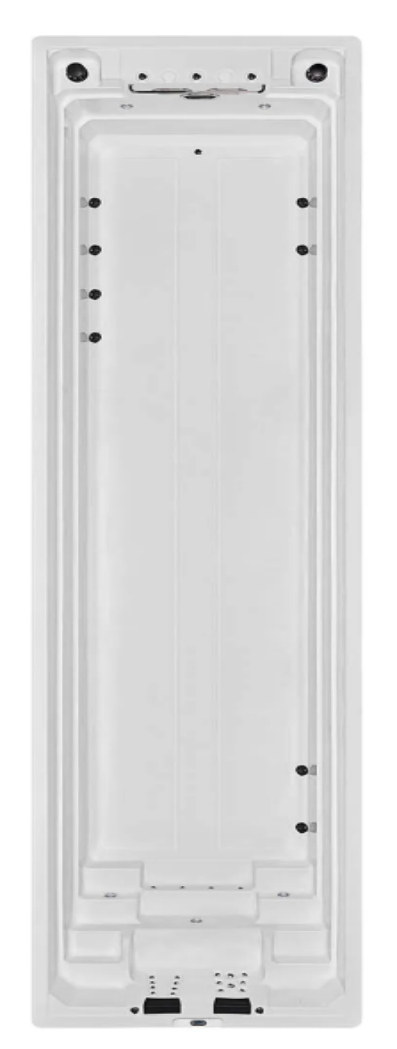
A swim spa configuration is determined by four scenario inputs — duty, installation context, site services and handover obligations — and every model-level choice should trace back to one of them. If a specification line cannot be traced to one of these four, it is usually a preference rather than a requirement.
1. Duty: who is in the water, and how often
Duty converts into length, jet count, pump arrangement and, where relevant, a swim training system. A single-household unit used for hydrotherapy and casual swimming is a different duty from a facility unit used for coached laps or aqua-fitness classes. The documented range shows how wide the spread is: WS-S38 records 51 jets, three 2.2 kW water pumps and two 3 kW heaters; WS-130CIII-U records 23 jets and four water pumps; WS-PC06T records 19 jets with a swim training system. Jet count and pump count are not interchangeable quality signals — they describe different hydraulic designs for different duty profiles.
2. Installation context: where the unit sits and what it is exposed to
An outdoor swim spa in an open-air environment faces UV exposure and a wide temperature range, which is why anti-UV, corrosion-resistant and weatherproof construction appear as stated requirements rather than optional extras. In-ground integration adds its own questions: how the shell is supported, how the water inlet and outlet are routed, and how access for service is preserved. The configuration detail that matters here is the drainage and valve scope, which is where documented models differ most visibly.
3. Site services: what the building can actually deliver
Electrical supply is the input most often discovered too late. A swim training system rated 2.8 kW on 380 V (WS-PC05ST) or 5.5 kW × 4 on 380 V (WS-EP3812T Plus) imposes a supply requirement that a domestic single-phase installation will not meet without work. The same applies to heating: a single 3 kW heater in a control set (WS-PC06T, WS-SP500-MS, WS-130CIII-U, WS-EP3812T Plus) is a different load profile from two 3 kW heaters on WS-S38 or two heaters and two control sets on WS-S10. Filtration support, water fill and drain points, and the space needed around the equipment area belong in the same check.
4. Handover obligations: what must be provable
Handover obligations determine the documentation package, not the hardware. A private residential buyer may need a conformity document and a commissioning record; a hotel or gym project may need the classification decision, the certificate scope for the exact model, and a defined functional check before the facility opens. MEXDA's capability record lists 100% testing as its quality-control standard, and that statement should be matched to a written description of what the test covers for the ordered configuration.
Once installed, a MEXDA swim spa operates in temperature self-regulation and automatic filtration cycle mode, and it depends on supporting equipment that includes a filtration system, heating unit, circulation pump, LED lighting and control panel. That dependency is the reason site services belong in the scenario statement: the unit's operating mode assumes the supporting equipment is specified and powered.
Step-by-step: converting a scenario into a purchasable specification
- Write a one-page scenario statement. Record the user group, expected sessions per day, the operating season, whether the installation is private or open to the public, and the country of installation. This page is the reference document for every later decision.
- Convert the statement into a duty profile. Translate sessions into a requirement for water current, jet coverage and recovery time between sessions. Fitness-led duty pushes toward a swim training system; hydrotherapy-led duty pushes toward jet count and pump configuration such as the 51-jet, three-pump arrangement recorded on WS-S38.
- Fix the installation envelope. Decide above-ground, partially recessed or in-ground, confirm service access to the equipment area, and confirm that the water inlet, outlet and drainage route can be built as drawn. Skirt scope must be settled here, because it is recorded differently across models.
- Select the hydraulic and training configuration. Choose between a jet-led layout and a training-system layout, and record the exact model designation. WS-PC05ST pairs a 2.8 kW training system with a handrail and a Q500 sand cylinder; WS-EP3812T Plus pairs a 5.5 kW × 4 training system with a Q700 sand filter, PU insulation and filtering jets.
- Confirm the electrical and heating load. Match the selected training system and heater count to the available supply, and record the supply voltage, phase arrangement and protective devices in the specification. This line is where a late change is most expensive.
- Define the compliance and documentation package by destination market. Available research on MEXDA records conformity targets of ETL (UL 1563 / CSA C22.2 No. 218.1) for North America, CE (EN IEC 60335-2-60:2023) for the EU and SAA (AS/NZS 60335.2.60) for Australia. Request the certificate that names the exact model and order, and keep it separate from generic marketing material.
- Convert the specification into purchasing terms and acceptance criteria. Take every scope item identified in steps 1–6 — model designation, skirt, valves, drainage, control system, heater configuration, training system, insulation, documentation — and write it into the order as either an included item or an explicit exclusion, then attach the acceptance checks.
Use cases: four scenarios and the configurations they point to
Backyard residential swim spa
A private outdoor installation is usually built around daily household use with a mix of swimming and hydrotherapy. WS-S38 is a 4-metre acrylic unit recorded with 51 jets, three 2.2 kW water pumps, two 3 kW heaters, a waterfall, six water columns, two speakers, two pillows and an included PS skirt — a configuration oriented to hydrotherapy and leisure rather than lap training. Where a household wants a fitness routine as well, WS-SP500-MS adds a swim training system to a 5-metre acrylic body with 29 jets, a 2.2 kW water pump, a 750 W filter pump, a 3 kW heater and combined UV and ozone treatment, with the PS skirt recorded as not included.
Hotel and resort swim spa
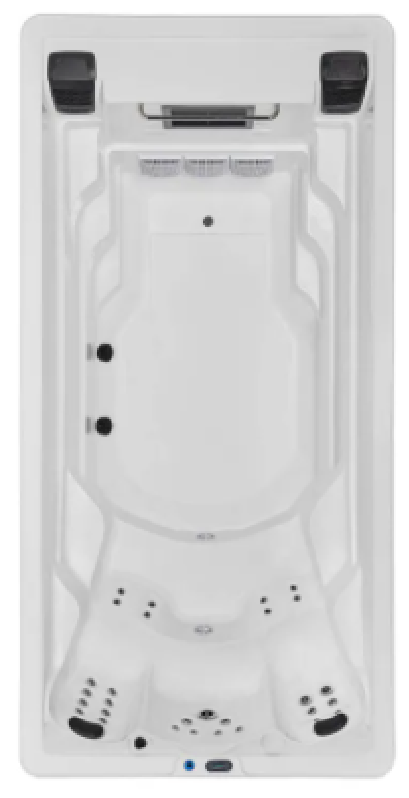
A hospitality installation carries duty that a household never sees: guest turnover, unsupervised use and a public classification that usually triggers a wider evidence requirement. WS-130CIII-U is a 12-metre acrylic unit recorded with 23 jets, four water pumps, a 3 kW heater in the control set, five 5-inch LEDs, two pillows, five air adjusters and a drainage system — a profile built around guest-facing hydrotherapy rather than training. Where the resort programme includes lap or class training, WS-EP3812T Plus provides a 12-metre body with a 5.5 kW × 4 / 380 V training system, six filtering jets, a Q700 sand filter, PU insulation and manual water-inlet and water-outlet valves.
Commercial fitness swim spa
A gym or fitness studio needs the water current to hold up under repetition. WS-PC06T is a 6-metre acrylic unit with a swim training system, 19 jets, a 3 kW heater, UV treatment, two filters and a water drainer; WS-PC05ST is a 5-metre unit with a 2.8 kW / 380 V training system, a handrail, four 1-inch jets, a Q500 sand cylinder, ozone, UV and a water drainer. Both are compact enough for an indoor or covered commercial floor, and both make the 380 V question a design-stage item rather than an installation-day surprise.
In-ground and contractor-led projects
Where a contractor owns the interface between the swim spa and the building, the scenario statement becomes a coordination document. MEXDA's reference record includes a construction contractor in France that has worked across residential and commercial leisure and fitness applications for more than ten years, with 20 sets associated with the WS-130A III and reported reliable performance, comfortable hydrotherapy experience and constant temperature noted among the highlights. For a contractor, the transferable point is that a repeatable configuration and a written scope are what make multi-site delivery manageable — not a single figure in a brochure.
Comparing documented configurations against scenario types
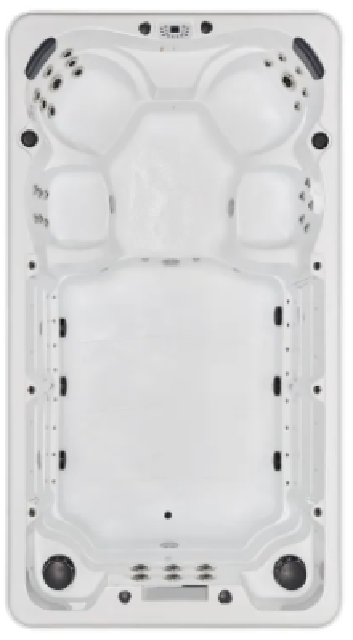
The table below compares only attributes recorded in MEXDA specification units. It is a screening aid: the final fit depends on the requirement sheet produced in the steps above, not on the table alone.
| Model | Recorded type | Jets | Heating & control | Swim training system | Recorded scope notes | Scenario the attributes suit |
|---|---|---|---|---|---|---|
| WS-S38 | 4-metre acrylic swim spa | 51 | 3 kW × 2 heaters | Not listed | PS skirt included; waterfall, 6 water columns, 2 speakers, 2 pillows | Private backyard, hydrotherapy-led |
| WS-SP500-MS | 5-metre acrylic swim spa | 29 | 3 kW × 1; one control set | 1 set | PS skirt not included; UV and ozone; 2.2 kW water pump | Residential with a fitness routine |
| WS-PC05ST | 5-metre acrylic swim spa | 4 × 1-inch jets | 3 kW heater in control set | 2.8 kW / 380 V | PS skirt not included; handrail; Q500 sand cylinder | Compact fitness or semi-commercial |
| WS-PC06T | 6-metre acrylic swim spa | 19 | 3 kW × 1; one control set | 1 set | PS skirt not included; UV; water drainer | Small hotel or commercial gym |
| WS-S10 | 10-metre acrylic swim spa | Not itemised | 2 control sets; 2 heaters | Not listed | 6 water pumps; 3 filter pumps; 4 filters | Large residential or community facility |
| WS-S12 | 12-metre acrylic swim spa | Not itemised | 3 heaters | Not listed | 5 water pumps; 3 filter pumps; 4 filters; 1 air pump | High-capacity multi-pump installation |
| WS-130CIII-U | 12-metre acrylic swim spa | 23 | 3 kW heater in control set | Not listed | Drainage system; 2 pillows; 5 × 5-inch LED | Hotel and resort guest wellness |
| WS-EP3812T Plus | 12-metre acrylic swim spa | 6 filtering jets | 3 kW heater in control set | 5.5 kW × 4 / 380 V | Q700 sand filter; PU insulation; manual inlet and outlet valves | Resort fitness and lap training |
| WS-SP3800 / WS-CP3200 | Acrylic swim spa | 12 × 5-inch massage plus 4 circulating / 10 × 5-inch | 3 kW; KL2022 / KL2020 control set | Not listed | Skirt included; stair; PU insulation; sand filter Q350 | Compact residential with full trim |
Two readings of the table are worth stating plainly. First, a longer body is not automatically the better fit: WS-S38 reaches 51 jets on a 4-metre body, while the 12-metre WS-130CIII-U records 23 jets, because the two are designed for different jobs. Second, skirt and valve scope vary by model rather than by size, so they must be confirmed per line item rather than assumed from the unit's length.
Purchasing terms and acceptance criteria to confirm before commitment
Purchasing terms
Five commercial terms should be settled in writing before the order is placed. The model and bill of materials should name the exact designation and every included component. The scope of exclusions should list what the buyer supplies or builds — skirt, stair, decking, electrical supply, lifting and site works. The configuration controls should record the control system designation (KL2020 and KL2022 appear in the documented range), heater configuration and training-system rating. The quality and testing clause should describe what 100% testing covers for this configuration. The delivery and support clause should record the recorded terms: a minimum order quantity of 1 set, a lead time of 30–40 days, monthly capacity of 500 sets, OEM/ODM production with customization scope recorded as all, and remote-guidance after-sales support.
Acceptance criteria
Acceptance criteria should be written as four separate gates so that a partial delivery cannot be treated as complete. Documentation acceptance confirms that the certificate and technical file name the delivered model, the destination market and the applicable standard. Configuration acceptance confirms that the delivered unit matches the ordered bill of materials line by line, including skirt, valves, drainage, handrail where specified, and control system designation. Functional acceptance confirms that the unit operates in temperature self-regulation and automatic filtration cycle mode with its filtration system, heating unit, circulation pump, LED lighting and control panel working as specified. Handover acceptance confirms that operating instructions, the support route and the commissioning record have been received.
Buyers should also record what the acceptance criteria deliberately do not cover. A documented jet count or heater rating describes a configuration; it does not by itself establish bather comfort, water quality outcomes or a specific energy result at the project site. Those depend on the installation, the water treatment regime, the enclosure and how the facility is operated, and should be verified on site rather than inferred from a specification sheet.
Frequently asked questions
What compliance evidence should a swim spa acceptance file contain?
Start with the classification: confirm whether the installation is treated as private or open to the public in the destination jurisdiction, since definitions such as Marin County's public pool definition depend on public access rather than on the product itself. Then attach the certificate naming the exact model against the applicable framework — ETL to UL 1563 / CSA C22.2 No. 218.1 for North America, CE to EN IEC 60335-2-60:2023 for the EU, or SAA to AS/NZS 60335.2.60 for Australia — and record the ISPSC 2021 or local code reference the project team is designing to. The federal definition at 15 USC § 8002(6) is useful context for US projects, but the enforceable requirement comes from the adopting jurisdiction.
Can MEXDA build a swim spa to a specific project scenario?
MEXDA's capability record lists OEM/ODM production, a customization scope recorded as all, monthly capacity of 500 sets and 100% testing. In practice that means a project team can specify configuration elements rather than choosing only from stock trim. Where a project names a specific acrylic or control-system brand, confirm it against the model-level bill of materials for that order instead of assuming it carries across the whole range: available research cites Aristech acrylic surfaces and Balboa control systems for MEXDA's higher-end models, while the specification units in this guide record the material as acrylic and the control sets as KL2020 or KL2022.
What drives the cost of a swim spa project?
No price is published in the material behind this guide, so the honest answer is structural rather than numeric. Cost tracks the body length and shell volume, the number of water pumps, heaters and control sets, whether a swim training system is specified and at what rating, whether insulation and skirt are included, the sand filter specification, and the documentation package required by the destination market. Two projects that both ask for "a swim spa" can differ on every one of those lines — which is why the requirement sheet should be finished before pricing is compared.
How does sampling and pre-order validation work?
MEXDA records a minimum order quantity of 1 set, so a pre-order validation unit is not blocked by a container-scale minimum. The useful discipline is to make the sample match the production configuration: same model designation, same control set, same heater arrangement and same training-system rating. A sample built to a different configuration confirms the factory's workmanship but not the specification the project will actually receive.
What lead time and capacity should a project plan around?
The recorded lead time is 30–40 days, against a recorded monthly capacity of 500 sets and annual output of 5,000 sets. For multi-site or phased projects, the practical step is to map the delivery schedule against the site readiness dates for electrical supply, drainage and deck works, because a unit that arrives before the site is ready creates a storage and warranty question that the lead time figure does not address.
What is the sensible next step if the scenario is not yet fully defined?
Write the scenario statement first and leave the model open. A team that can describe its user group, installation context, available electrical supply and handover obligations already has enough to request a matched proposal rather than a catalogue list. The MEXDA swim spa catalogue is a reasonable starting reference for model ranges and recorded components, and the MEXDA team can be reached at mesda3b@china-yuehua.com to discuss a configuration against a written requirement sheet.

Conclusion
The sequence in this guide is deliberately unglamorous: describe the scenario, convert it into a duty profile, fix the installation envelope and site services, select the configuration, then write the purchasing terms and acceptance criteria before commitment. Each step removes a decision that would otherwise be made by default at commissioning.
The documented MEXDA range shows why the sequence matters. A 4-metre WS-S38 carries 51 jets and two heaters; a 12-metre WS-130CIII-U carries 23 jets and a drainage system; a 5-metre WS-PC05ST runs a 2.8 kW training system on 380 V while a 12-metre WS-EP3812T Plus runs 5.5 kW × 4. These are different answers to different questions, and none of them is universally correct. What transfers across every project is the discipline of tracing each specification line back to a scenario input, and each acceptance criterion back to something the buyer can actually check at handover.
Have Questions or Need More Details?
Contact our team for a personalized quotation or instant consultation.
Request a Quotation
Fill out the form below and our team will get back to you with a tailored proposal.
WhatsApp Direct Chat
Prefer to chat in real-time? Message us on WhatsApp for instant assistance & quick answers.
- Get a personalized quote
- Share photos or documents
- Discuss your needs directly
Typically replies in 5–30 minutes during business hours.