
Swim Spa Purchase Terms & Acceptance Criteria: First-Buyer Guide
Swim Spa Purchase Terms & Acceptance Criteria: First-Buyer Guide
A swim spa order has two halves, and first-time buyers usually treat them as one. The purchasing terms state what the supplier is obliged to deliver, on which conditions, and by when. The acceptance criteria state how the buyer will confirm that what arrived is what was promised. Written before the order is placed, they are the only documents that decide the outcome. Written afterwards, they are a description of a disagreement you have not had yet.
This guide answers one question directly: what are the purchasing terms and acceptance criteria for a swim spa purchase? It then turns that answer into a problem–solution workflow you can run on a first order, whether the unit is going into a private backyard, a hotel leisure area, or a commercial fitness floor.
Direct answer. Purchasing terms are the commercial and delivery obligations attached to the order: scope, quantity, configuration, electrical supply, lead time, packaging, documentation, warranty handling and change control. Acceptance criteria are the written, item-by-item conditions that must be satisfied at named checkpoints — before production, before shipment, on arrival, and at commissioning — before the buyer signs off and the balance is released. Both must reference the same locked configuration, and both must name who signs.

Problem Definition: Why “We Agreed on a Swim Spa” Is Not an Agreement
A swim spa is not a single object on a purchase order. It is a shell, a water-circulation set, a heating set, a filtration set, a control system, a lighting set, an insulation set, and an installation interface. MEXDA's own product documentation describes the unit as operating in temperature self-regulation and automatic filtration cycle mode, and it requires supporting equipment — a filtration system, a heating unit, a circulation pump, LED lighting and a control panel — to do so. Every one of those elements can be specified differently, priced differently, and delivered differently.
That structure creates four recurring problems for first-time buyers.
- The quotation is read as a contract. A quotation describes intent at a moment in time. It rarely states what happens if a component is substituted, who pays for a re-test, or what counts as “delivered”.
- The specification is never locked. Model names are agreed in conversation, then the configuration drifts — a different pump, a different jet count, a different control system — because no annex froze it.
- Acceptance is undefined. “Satisfactory quality” cannot be checked. A buyer who has not written pass/fail rules ends up accepting on visual impression alone, at the moment when the unit is already on site and the leverage has moved to the supplier.
- Nobody owns the sign-off. Without a named signatory and a named checkpoint, acceptance becomes an assumption rather than an act.
The consequence is not usually a defective product. It is a dispute about scope: the buyer believes a spare filter set was included, the supplier believes it was an option; the buyer expected the site electrical supply to be confirmed by the factory, the supplier expected the buyer's electrician to confirm it. Both parties can be acting in good faith and still disagree, because the purchasing terms never converted expectations into obligations.
Industry Background: Why Swim Spas Need Stricter Terms Than Dry Goods
Three characteristics of the category push the documentation burden higher than for most equipment purchases.
1. It is a wet, outdoor, permanently installed product
Swim spa applications are typically outdoor, in open-air environments exposed to UV and to a wide temperature range. The operating requirements that follow from that — anti-UV material behaviour, low-noise operation, corrosion-resistant components and weatherproof design — are exactly the kind of conditions that are easy to promise verbally and hard to prove at handover unless they are written as acceptance items.
2. It only works as a system
The unit does not function on its own. Filtration, heating, circulation and control have to be present, matched and commissioned together. MEXDA's product lines illustrate how granular that gets: the WS-CP3800 configuration lists a KL2020 control system, a 3 kW heater (H30-R1), two 1500 W water pumps (LP200), a 370 W filter pump (A50), sixteen 5-inch jets, a Q350 sand filter, UV, PU insulation, a stair set and manual water-in and water-out valves. A purchase order that says “one swim spa” cannot be accepted against a list like that — and a list like that cannot be defended if it was never attached.
3. The regulatory classification is not automatic
In the United States, federal statute defines a “swimming pool” or “spa” broadly as any outdoor or indoor structure intended for swimming or recreational bathing, and the 2021 International Swimming Pool and Spa Code (ISPSC) is published as a comprehensive pool and spa code coordinated with the I-Codes and APSP standards. At local level the treatment can shift further: Marin County, California, for example, classifies any swimming pool, spa or spray ground open to the general public — whether or not a fee is charged — as a public pool. For a hotel or resort buyer this matters commercially, because the acceptance file may need to satisfy an authority having jurisdiction, not only the purchaser.
Detailed Solution: The Four-Document Framework
The reliable way to separate purchasing terms from acceptance criteria — and to keep them consistent — is to split the paperwork into four documents, each answering one question. MEXDA, the swim spa brand of Foshan Gaoming Yuehua Sanitary Ware Co., Ltd., a manufacturer established in Foshan, Guangdong, China in 1995 producing swim spas, hot tubs, sauna rooms and steam rooms, works with buyers through this sequence on OEM, ODM and private label projects as well as single-unit orders.
Document 1 — Line-item quotation: “What exactly are we buying, and what is optional?”
The quotation must break the unit into priced lines rather than a lump sum. At minimum: shell and skirt, control system, heater, water pump(s), filter pump, jets, filtration, lighting, insulation, stairs and handrails, water-in and water-out valves, and any spares. If a line is not in the quotation, assume it is not in the order. This is the document that converts a model name into a bill of materials.
Document 2 — Specification annex: “What is frozen, and what may change?”
The annex restates the agreed configuration in a table, one row per component, with the model code, the component designation and the quantity. It is the single reference point for both the purchase order and the acceptance certificate. Any later change is only valid if it is issued as a written revision to this annex, with the revision number and date recorded.

Document 3 — Purchasing terms: “On what conditions is it delivered?”
These are the obligations that surround the product. A workable first-order set covers:
- Scope and quantity, with the minimum order quantity stated in writing. MEXDA's stated MOQ is 1 set, which makes a single-unit validation order commercially possible before a larger commitment.
- Lead time, stated as a number of days and — critically — with the clock-start event defined. MEXDA's stated production lead time is 30–40 days; the buyer's job is to fix what day zero means.
- Electrical and site interface, including the supply voltage and phase required by the specified training or jet system. Several MEXDA models, including the WS-130BIII and WS-EP3812T Plus, specify 380 V training systems; a mismatch here is a site problem, not a product problem, and it belongs in the terms.
- Packaging and transport responsibility, including who arranges, who insures, who unloads, and what condition is required at handover.
- Documentation set, named item by item (see Document 4).
- Warranty handling process, not just a duration: who is contacted, what evidence is required, what the response route is. MEXDA provides after-sales support through remote guidance, which should be written as a defined channel rather than an assumption.
- Change control, including how a substitution is proposed, approved and priced.
- Spares, listed as a separate line so that consumables and wear items are not discovered later.
Document 4 — Acceptance certificate and criteria: “How do we agree it is correct?”
Acceptance criteria are pass/fail rules attached to named checkpoints. They should be written so that two different people, inspecting the same unit on the same day, would reach the same conclusion. In practice that means each criterion needs four elements: the item, the reference it is checked against, the method of checking, and the person who signs.
Step-by-Step Breakdown: From Enquiry to Sign-Off
The sequence below is designed for a first-time buyer. Each step ends with an acceptance gate; do not move to the next step until the gate is closed in writing.
Step 1 — Define the installation before defining the product
Record where the unit will stand, whether it is indoor or outdoor and exposed to UV, the ambient temperature range it must tolerate, the access route for delivery, the electrical supply available on site, and the drainage provision. These site facts become acceptance criteria later. A unit that is correct on paper but cannot pass through the access route has failed acceptance on arrival, not at commissioning.
Step 2 — Convert the quotation into a bill of materials
Request the priced line-item breakdown described in Document 1. Mark every line as included, optional, or excluded. Anything marked optional is a future change order unless you add it now.
Step 3 — Freeze the specification annex and issue it as a revision-controlled document
Sign the annex and require the supplier to sign it back. From this point, the annex — not the conversation, not the brochure — is the description of the goods.
Step 4 — Write the commercial terms with defined trigger events
Lead time, deposit, balance release, delay handling and change control all need trigger events rather than adjectives. For example: “the 30–40 day production lead time begins on the later of (a) receipt of deposit and (b) written approval of the specification annex.” That single sentence removes the most common first-order dispute.
Step 5 — Write the acceptance criteria as a checklist with methods
Group them by checkpoint: pre-production, pre-shipment, arrival, and commissioning. For each, state the item, the reference, the method and the signatory. Where a criterion can be photographed, require the photograph — a dated photo set is the cheapest evidence a buyer will ever obtain.
Step 6 — Obtain the pre-shipment evidence pack
Before shipment, request the configuration check against the annex, the electrical configuration confirmation, the documentation set, and photographs of the unit and its labels. MEXDA's stated quality control is 100% test; the buyer's counterpart to that statement is a request for the model-specific test record, which is a document, not a claim.

Step 7 — Inspect on arrival, before installation
Check the model code against the annex, count the loose items (stairs, valves, handrails, spares), check for transport damage, and photograph the unit and packaging as received. Damage found after installation is far harder to attribute than damage recorded on the delivery note.
Step 8 — Commission against the operating criteria, then sign
Commissioning acceptance is behavioural, not visual. Confirm the unit reaches and holds its set temperature, that the filtration cycle runs automatically, that each pump and jet group operates, that lighting and control panel functions respond, and that no leaks appear under normal operation. Record the result, attach the photo set and the document pack, and have the named signatory date and sign. Release of the balance should be tied to that signature, not to the delivery date.
Use Cases: How Acceptance Criteria Change by Scenario
Backyard residential swim spa
The dominant risks are site access, electrical supply and weather exposure. Acceptance emphasis: access-route clearance verified before order, supply voltage and phase confirmed by the buyer's electrician, and a weatherproofing and UV-exposure check recorded at commissioning. Noise is worth writing in as a criterion if the unit sits near a boundary — low-noise operation is a stated outdoor requirement, and “quiet enough” only becomes checkable when it is measured at an agreed position.
Hotel and resort swim spa
Here the acceptance file often serves two audiences: the purchaser and the authority having jurisdiction. If the installation is open to guests, local rules may classify it as a public pool or spa regardless of whether a fee is charged, so the documentation set and the operating record matter as much as the hardware. Acceptance emphasis: complete documentation pack, clear labelling, service access for maintenance, and a written handover of operating instructions to the staff who will run the unit. Continuous guest use also makes the spare-parts line a first-order item rather than an afterthought.
Commercial fitness swim spa
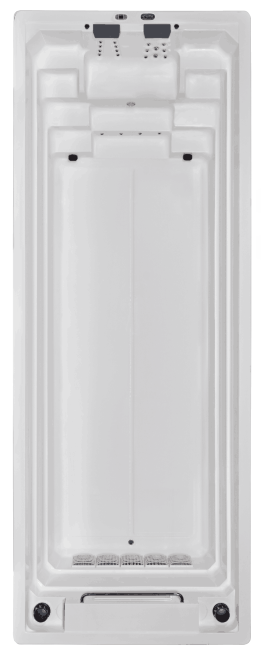
Fitness use concentrates load on the training system and the jet set, so acceptance emphasis shifts to duty expectations: how many hours per day the unit will run, which jet groups will be used, and what the planned response is when a pump or control component needs attention. On larger configurations — the 12-metre WS-EP3812T Plus, for example, specifies a four-unit 5.5 kW / 380 V training system, a Q700 sand filter and combined UV and ozone — the electrical interface should be signed off by the installing contractor before the unit is filled.
Contractor and multi-unit projects
For repeatable projects, the same annex and the same acceptance checklist can be applied unit by unit, which is what makes multi-unit delivery manageable. A French construction contractor working on residential and commercial leisure and fitness projects has used MEXDA swim spas — 20 sets, over a period of more than ten years — reporting reliable performance and a comfortable hydrotherapy experience, with long-lasting durability and constant temperature cited as the highlights. That kind of long-run outcome is built on documentation discipline at the start, not only on the hardware.
Comparison Table: Acceptance Criteria Matrix
The matrix below converts the framework into checkable rows. The “reference point” column shows where the pass rule comes from, so that neither party can reinterpret it later.
| Acceptance criterion | Reference point | Method of checking | Checkpoint |
|---|---|---|---|
| Model and configuration match the order | Signed specification annex | Component-by-component comparison, photographed | Pre-shipment |
| Electrical supply matches the site | Annex line for the control system and training system (e.g. 380 V systems on WS-130BIII, WS-EP3812T Plus) | Contractor confirmation in writing before fill | Pre-installation |
| Loose items complete | Quotation lines: stairs, handrails, valves, spares | Physical count against the picking list | Arrival |
| No transport damage | Delivery note | Photo record before unloading is signed | Arrival |
| Temperature control functions | Temperature self-regulation operating mode | Set-point test and hold observation | Commissioning |
| Filtration runs automatically | Automatic filtration cycle operating mode | Observe a full cycle and record it | Commissioning |
| Pumps, jets and lighting operate | Annex jet count and lighting lines (e.g. 16 jets and 15 small LEDs on WS-CP3800) | Function test of each group, recorded | Commissioning |
| No leakage under normal operation | Annex water-in and water-out valve lines | Visual inspection after a full operating cycle | Commissioning |
| Documentation complete | Named documentation list in the purchasing terms | Checklist signed by both parties | Pre-shipment and handover |
| After-sales route understood | Terms clause on remote guidance support | Named contact and evidence requirement confirmed | Handover |
How the four documents divide the work
| Document | Question it answers | Who prepares it | When it is signed |
|---|---|---|---|
| Line-item quotation | What is included and what is optional | Supplier | Before the order is placed |
| Specification annex | What exactly is frozen, revision by revision | Both parties | Before production starts |
| Purchasing terms | Lead time, delivery, documentation, warranty route, change control | Both parties | With the purchase order |
| Acceptance certificate | Whether the delivery is correct, at each checkpoint | Buyer, countersigned by supplier | At each gate and at final handover |
FAQ
What compliance documents should go into a swim spa acceptance file?
At minimum: the declared standard numbers applicable to your destination market, certificate copies that name the exact model on your purchase order, the electrical configuration of the unit as built, and a note on whether the installation is treated as private or public. MEXDA states conformity to ETL (UL 1563 / CSA C22.2#218.1), CE (EN IEC 60335-2-60:2023) and SAA (AS/NZS 60335.2.60) for its swim spa models. The buyer's acceptance step is not to trust the claim but to match the document to the model code and to the market — a certificate for a different model or a different market does not close the gate. Where the installation is open to the public, also confirm with the authority having jurisdiction whether pool and spa codes such as the 2021 ISPSC, or a local public-pool classification, apply to your site.
How do we verify a supplier's production capability before a first order?
Ask for figures, then ask for the evidence that sits behind them, and write both into the terms. MEXDA's published profile states a 50,000 m² factory, 200+ employees, a 9-engineer R&D team, an annual output of 5,000 sets and a monthly capacity of about 500 sets, with 100% test as the quality-control standard. For acceptance purposes, the useful next step is a model-specific request: a test record for the configuration in your annex, and factory evidence that matches the profile. Capability statements describe the plant; only a model-level record describes your unit.
Which cost lines should the purchasing terms cover?
Every line that can move the total, priced separately rather than rolled into one figure: the base unit, each option taken from the quotation, spare parts and consumables, packaging, transport and unloading, the documentation set, and any commissioning support. Stating the minimum order quantity in the same document prevents the surprise of a minimum that appears after the price is agreed — MEXDA's stated MOQ is 1 set, so a single validation unit is a legitimate starting point. A quotation that cannot be broken down this way cannot be compared with another, and it cannot be accepted line by line later.
Should a first-time buyer order a sample before committing to volume?
Yes, where the MOQ allows it. With a stated MOQ of 1 set, a first-time buyer can order one unit and run the full acceptance checklist on it — configuration check, documentation pack, commissioning test, sign-off — before committing to volume. The value of the sample is not only the unit. It is the completed acceptance record, which then becomes the template for every subsequent order and removes the need to renegotiate criteria each time. Where the sample passes and the process is documented, scaling up is a quantity decision rather than a risk decision.
How should lead time be defined and monitored?
Lead time should be a number of days attached to a defined start event, not an expectation. MEXDA's stated production lead time is 30–40 days. The purchasing terms should state that the clock begins on the later of deposit receipt and written approval of the specification annex, note whether the range is affected by order quantity or season, and define what happens if the end date is missed. Then monitor it against the pre-shipment gate rather than the delivery date: if the pre-shipment evidence pack is late, the delivery date is already at risk, and you will know while there is still time to act. If you already have a destination market, a target installation date and a draft configuration, you can request a model-specific quotation and sample arrangement against them.

Conclusion: Write the Acceptance Test Before You Write the Cheque
For a first-time swim spa buyer, the purchasing terms and the acceptance criteria are not administrative extras bolted onto a technical purchase — they are the mechanism that keeps a complex, wet, permanently installed product aligned with what was actually agreed. The sequence is straightforward: define the installation, convert the quotation into a bill of materials, freeze a signed specification annex, write commercial terms with trigger events rather than adjectives, write acceptance criteria with methods and named signatories, and tie the final payment to the signature rather than the delivery.
Everything else is detail. The unit will still operate in temperature self-regulation and automatic filtration cycle mode; the pumps, jets, filters, control system and lighting will still need to be present and matched; the documentation will still need to survive an inspection. What changes is who can prove it — and on a first order, the buyer who wrote the criteria is the one who can.
Next step: build your acceptance pack from real specifications
Download the MEXDA swim spa catalogue to see the component-level configuration data you will need for a specification annex — model codes, control systems, heaters, pumps, filtration, jet counts, lighting and insulation. If you share your destination market, site conditions and target installation date, MEXDA can respond with a line-item quotation and a sample arrangement under a 1-set MOQ.
About the manufacturer. MEXDA is the swim spa brand of Foshan Gaoming Yuehua Sanitary Ware Co., Ltd., established in 1995 in Gaoming, Foshan, Guangdong, China. The company produces swim spas, hot tubs, sauna rooms and steam rooms across a 50,000 m² facility with 200+ employees, a 9-engineer R&D team and an annual output of 5,000 sets, exporting to markets including the United States, the European Union, Australia, Germany and France. It offers OEM/ODM production with customization, 100% test quality control, a stated MOQ of 1 set, a 30–40 day production lead time and after-sales support by remote guidance. Website: chinamesda.com.
Have Questions or Need More Details?
Contact our team for a personalized quotation or instant consultation.
Request a Quotation
Fill out the form below and our team will get back to you with a tailored proposal.
WhatsApp Direct Chat
Prefer to chat in real-time? Message us on WhatsApp for instant assistance & quick answers.
- Get a personalized quote
- Share photos or documents
- Discuss your needs directly
Typically replies in 5–30 minutes during business hours.