
Swim Spa vs Traditional Lap Pool: Key Comparison Guide
Swim Spa vs Traditional Lap Pool: Key Comparison Guide
Buyers planning a swimming facility often compare two very different products: a traditional in-ground lap pool and a manufactured swim spa. The traditional lap pool offers a long open water lane built into a property. A swim spa, by contrast, is a factory-built unit that uses circulating jets to create a swimming current, usually inside a much shorter shell. For hotel, fitness, leisure, residential-community and resort projects, the difference affects site work, installation effort, daily maintenance, usable months and flexibility after installation.
This guide compares the two options from a buyer perspective. It uses MEXDA swim spas as a documented example of the acrylic swim-spa category, including the seven-meter class commonly associated with commercial leisure settings. The comparison covers installation, space, maintenance, temperature, compliance and the scenarios where each option is more practical.
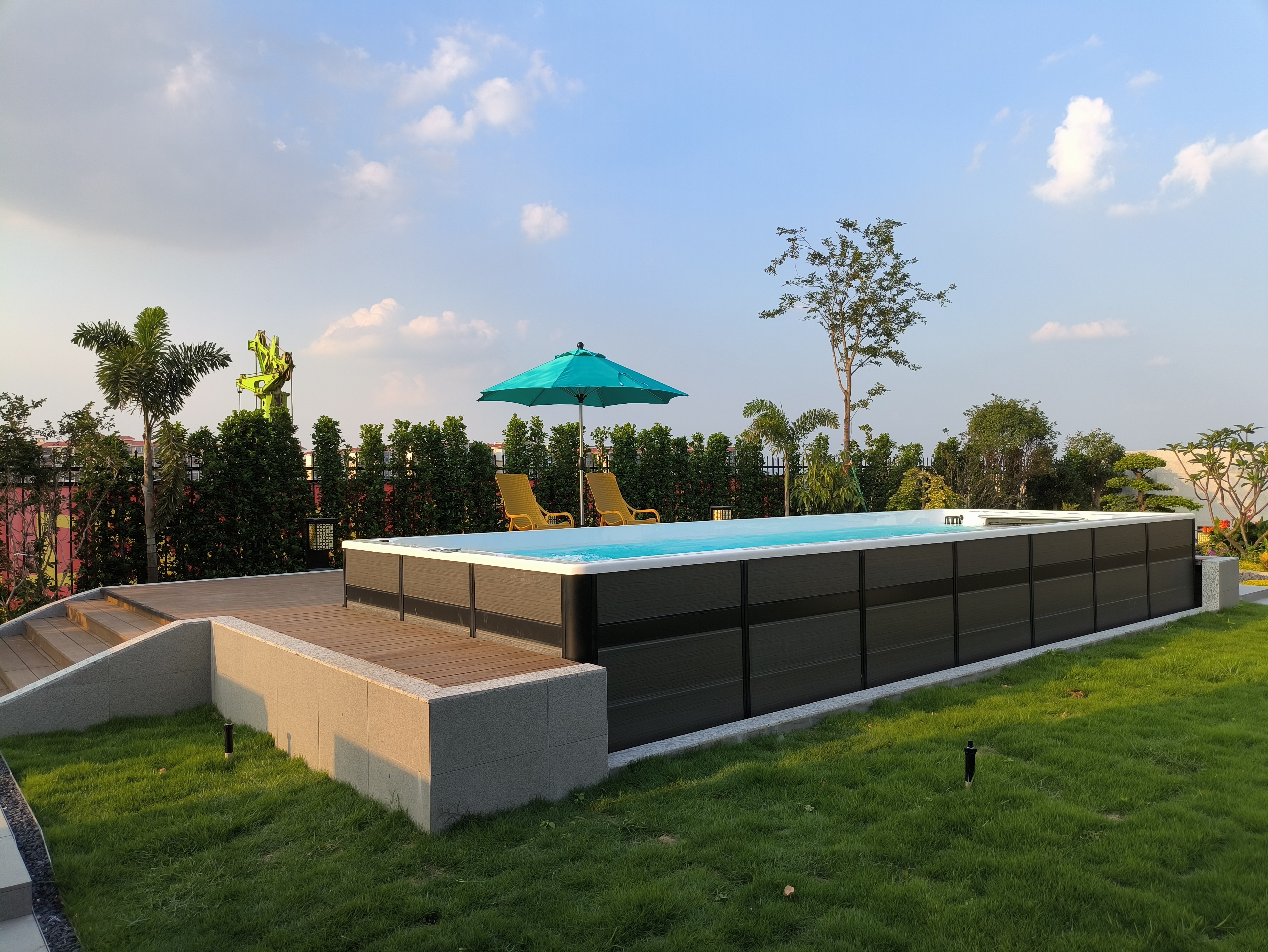
MEXDA swim spa installed for a leisure project.
The problem with a traditional lap pool decision
A lap pool is designed around one purpose: continuous swimming. To make that purpose useful, the pool must be long enough for repeated strokes in one direction. That shape is usually achieved with an on-site built pool, permanent civil works, excavation, structural construction and a long planning chain. After the structure is fixed, it remains part of the building and landscape. Moving, extending or replacing it later is a major project in itself.
The purchase decision becomes difficult because the customer is not only buying water capacity. The project also buys time on site, coordination with local contractors, space consumed in the yard or building, and a facility that may be used in different ways across years. These factors matter for hotels, fitness operators, residential developers and private buyers.
Why buyers are searching for a more flexible alternative
Swim spas have become common because they reduce some of the constraints of a long built-in pool. Instead of an open water surface, a swim spa creates resistance with water jets. The swimmer swims against the current, which means a useful training session can happen in a compact footprint. Many MEXDA models integrate spa jets as well, so the unit can be used for swimming, warm-water relaxation and hydrotherapy in one place.
This change affects the buyer language. Searches for an endless pool swim spa, an in-ground swim spa or a commercial fitness swim spa all describe the same shift: a buyer wants continuous swimming without committing to a traditional long basin.
Swim spa market context
According to public market research cited for the global swim spa category, the swim spa market was valued at roughly USD 2.5 billion in 2024. The same sources project growth to about USD 5.2 billion by 2034, with annual growth commonly estimated at 7.5% to 8.5%. North America is reported as the largest regional market with about 38.2% of global value, followed by Europe at about 28.5%. The Asia-Pacific region, led by China and Australia, accounts for roughly 20% of the global pool and spa market. These figures help explain why international buyers are now evaluating swim spas as a normal procurement category rather than as a niche product.
One specific trend reported in market analysis is the rise of dual-zone hybrid swim spas, which separate the swimming area and the spa area with their own temperature controls. This trend supports the wider shift from single-purpose pools to facilities that can serve exercise, recovery and social use in one unit.
Where a 7-meter acrylic swim spa fits in the comparison
A seven-meter swim spa is a common reference point in the MEXDA catalogue because it offers more swimming distance and internal space than a compact four-meter model, while remaining a factory-manufactured product. MEXDA lists several seven-meter models, with documented shells made of acrylic. Examples include the WS-S07B, WS-S07B-T, WS-PC07A, WS-PC07A-T and WS-PC07ST. The product data for these models notes acrylic construction and lists an applicable industry range that includes hotel, fitness, leisure, residential communities and resort projects.
Some of these seven-meter units also include a swimming training system. The model WS-S07B-T, for example, is listed with a 2.8 kW swimming training system and 220 V / 380 V configuration options. The WS-PC07A-T is another seven-meter unit with a swimming training system plus 62 jets in its specification. These details explain why a seven-meter acrylic swim spa is not simply a shorter lap pool; it is a combined water facility in which jet-driven current replaces the need for a long pool length.
For buyers familiar with concrete construction, the most visible difference is the manufacturing model. A traditional lap pool depends on site-built methods. A swim spa shell is produced in a factory, then delivered and connected. MEXDA, operating as Foshan Gaoming Yuehua Sanitary Ware Co., Ltd., has manufactured swim spas and related leisure water products since 1995. The company reports that 85% of its products are exported and lists the USA, EU, AUS, DEU and FRA among its main markets. Since 2005 is not the relevant benchmark here, the more useful facts are capacity and production control: MEXDA reports an assembled monthly capacity of 500 swim spa sets, a minimum order quantity of one set, and a standard production lead time of 30 to 40 days.
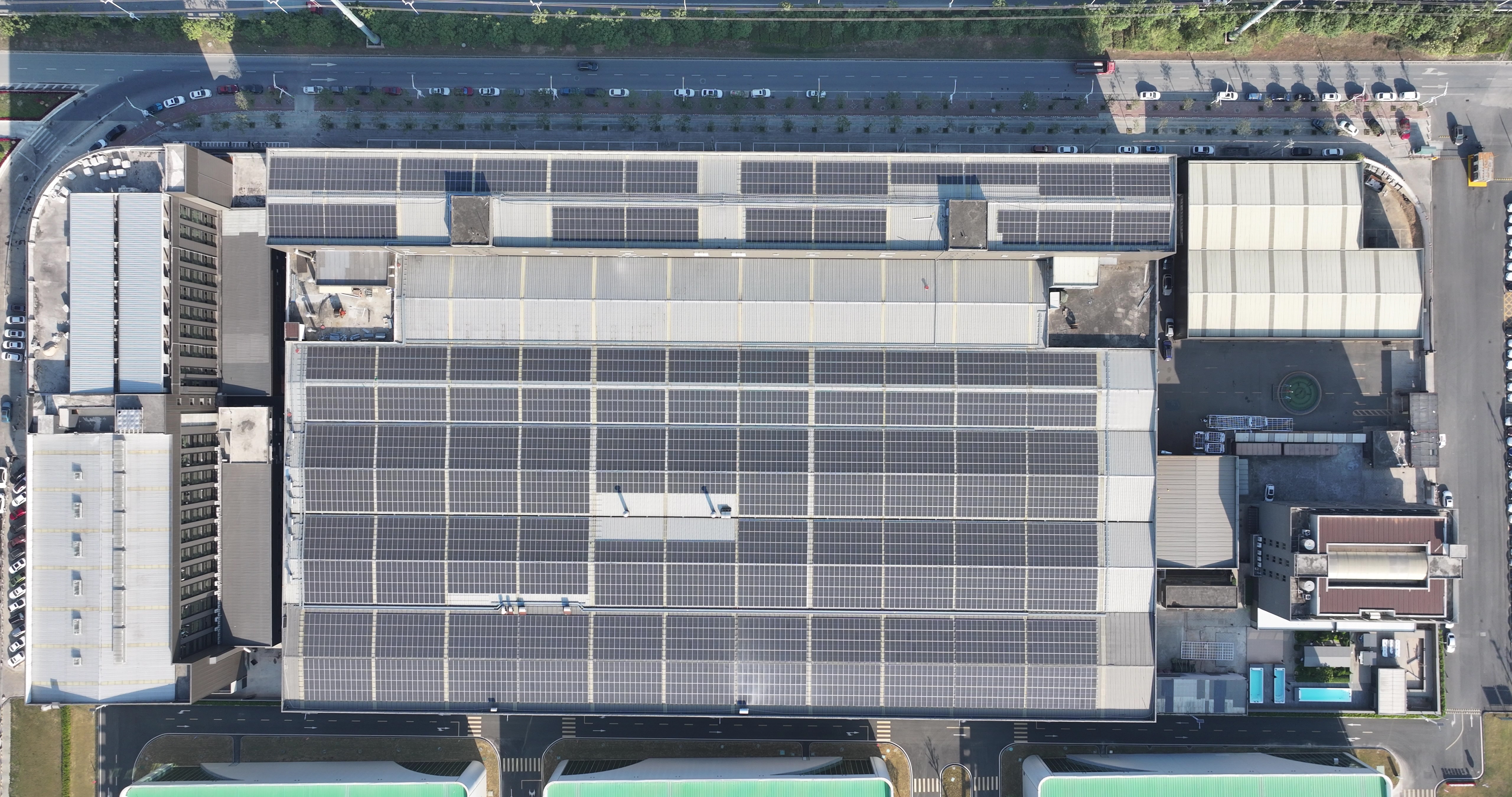
MEXDA production base in Foshan Gaoming.
Step-by-step buyer comparison: Swim spa vs lap pool
Step 1: Define the required swimming experience
Start by defining whether the project needs distance swimming or swimming by time and effort. A traditional lap pool preserves unbroken open-space swimming from one end to the other. A swim spa gives the swimmer a fixed position against a controlled current. Training quality in a swim spa depends on the current system, while training quality in a lap pool depends on the length and water conditions. For continuous open-water laps, a lap pool remains the logical product type. For resistance swimming with the possibility of spa use, a swim spa is a different capability.
Step 2: Review available space
A lap pool needs a generous site geometry. The water length, depth changes, coping, decking and maintenance access must fit within the property. A swim spa allows a more compact layout. The seven-meter category is small enough for many residential yards and commercial rooftops or courtyards where a traditional lap pool would not fit. Since exact site dimensions are project-specific, the practical test is to compare the usable water area rather than the listed product type.
Step 3: Compare construction and installation effort
Traditional lap pools are usually associated with excavation, reinforcement, plumbing runs, surface finishing, filling and commissioning. These steps bring multiple trades to the site and expose the project to local weather and construction sequencing. A swim spa is a delivered, self-contained unit. The site still needs to be level, strong enough to support the filled weight, and prepared with electrical and water connections. Once positioned, the shell receives its water and is tested.
For buyers who want to reduce on-site craft work, the acrylic swim-spa route is usually easier to schedule. MEXDA data supports this expectation with a standard production lead time of 30 to 40 days, 100% testing of products before shipping, and a minimum order of one set. The buyer receives a factory-tested product rather than commissioning a one-off concrete structure. Site preparation and final installation still need professional handling, but the critical path is shorter than a full pool-building programme in most cases.
Step 4: Estimate maintenance
Both options require water treatment, circulation and regular cleaning. The difference is scale and integration. A lap pool contains a larger body of water and usually more exposed surface, which means more water volume to balance through the year. A swim spa is a smaller, self-contained system. Many MEXDA model specifications include an integrated circulation pump, filter, and some form of hygiene treatment such as ozone or UV light. For instance, the seven-meter WS-S07B is listed with a filter pump and cartridge filter, while the WS-PC07A model includes a filter pump, sand filter, ozone and UV light. The exact configuration depends on the chosen model and market standard.
Operators should still plan for regular water testing, filter cleaning and periodic shell maintenance. The advantage of a swim spa is that all major components are concentrated in one unit and can be inspected during production before delivery.
Step 5: Compare user flexibility
A lap pool is mainly a swim training surface. If the buyer also wants massage, warm-water recovery or social bathing, these functions must be added as separate amenities. A swim spa can combine swimming with hydrotherapy jets, warm water and controlled temperature inside the same shell. This is why the term dual zone swim spa has become common in hotel and resort plans. MEXDA product data shows that the same supplier can deliver models with massage jets, LED lighting and swimming training systems, giving commercial buyers a multi-purpose asset.
One long-running MEXDA reference project in France used 20 swim spa sets for residential and commercial leisure and fitness applications. The installation has been in operation for more than 10 years and was carried out for construction contractor clients. Its documented results include reliable performance and a comfortable hydrotherapy experience, with long-lasting durability and constant temperature listed as key highlights. This kind of evidence matters when a buyer is choosing between an unproven site-built pool and a manufactured product that has already supported a multi-unit commercial installation for over a decade.
Step 6: Check certification and market access
Certification is a necessary part of procurement in North America, Europe and Australia. MEXDA swim spa model WS-CP2400, for example, carries an ETL certificate issued by Intertek under certificate number 3177783, based on UL 1563:2025 Ed.7 and CSA C22.2 #218.1:2025 Ed.3 for the US market. The same model also has an SAA certificate issued by SGS under certificate number SGS/220438 for the Australian market, covering AS/NZS 60335.2.60 and AS/NZS 60335.1 requirements. In addition, a CE certificate, number STUESO021120220755HS, issued by STU, covers the applicable EN 60335 series requirements for the EU market. Buyers should always confirm that the exact model selected matches the certification needed for the destination country.
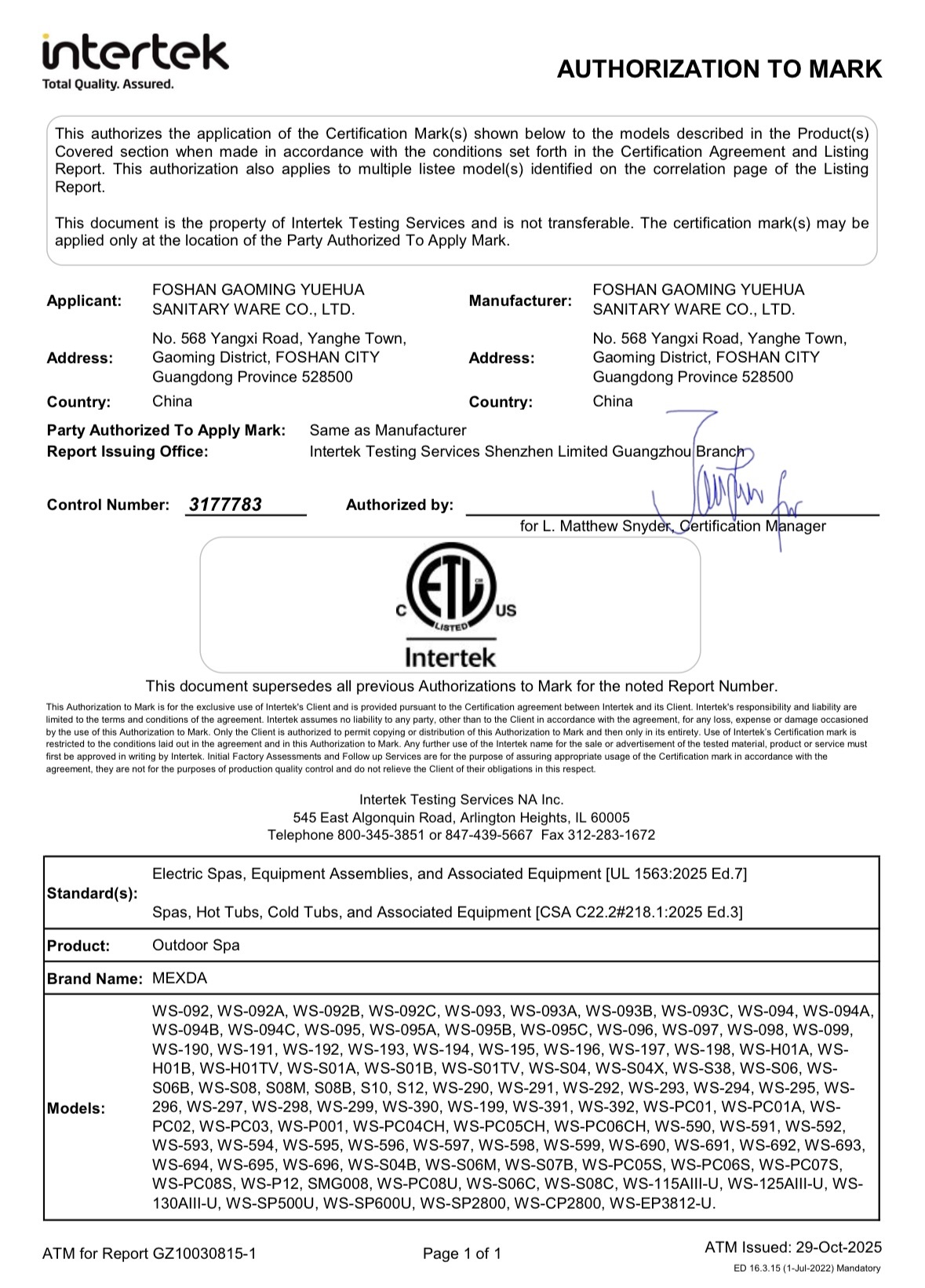
Intertek ETL certification file for MEXDA swim spa model WS-CP2400.
Use cases: Which buyer chooses which option
Backyard residential swim spa
A private buyer with average backyard space often chooses an in-ground or above-ground acrylic swim spa because it can deliver daily swimming in a compact area. If the goal is fitness without the cost and disruption of a long concrete pool, the residential swim spa model is the relevant choice. MEXDA includes residential communities in the documented applicable sectors for its swim spa models.
Hotel and resort projects
Hotel and resort operators need a visually attractive water feature that supports multiple guest activities. A seven-meter acrylic swim spa can serve as a swim lane, an evening hydrotherapy pool and a warm-water attraction in one installation. The French project referenced by MEXDA, with 20 sets used partly for residential and commercial leisure, demonstrates that the product can be specified at commercial scale.
Fitness and commercial leisure
A fitness facility may want the functionality of a pool without using the whole ground floor for a traditional wet area. A commercial fitness swim spa with jets, controlled temperature and filtration can support supervised training while also offering deep-water massage after exercise. This use case depends less on open-water distance and more on the strength of the current system and the reliability of the mechanical equipment.
Private lakeside or estate pool replacement
Some buyers already own a property where a full lap pool is too expensive, too slow or physically impossible because of ground conditions. A self-contained swim spa can be delivered on a prepared pad or partially recessed into the ground. This gives the buyer a swim training zone with less reliance on site geology and climate conditions.
Comparison table
The table below compares a traditional lap pool with the acrylic swim spa category, using MEXDA product data where specific swim-spa details are cited.
| Comparison factor | Traditional lap pool | Acrylic swim spa with MEXDA data |
|---|---|---|
| Main structure | Usually built on site as a permanent long water basin. | Factory-manufactured acrylic shell delivered as a unit; MEXDA catalogues models from 4-meter through 16-meter sizes. |
| Space requirement | Requires a long, usable swimming stretch plus deck and maintenance access. | Compact, self-contained layout; the 7-meter product class is a documented MEXDA swim spa category suited to hotel, fitness, leisure, residential community and resort applications. |
| Installation approach | Normally depends on excavation, structural work, waterproofing, plumbing, surfacing and local contractors. | Prepared site, delivery, positioning, water and electrical connection. MEXDA lists a 30 to 40 day production lead time for an order. |
| Maintenance | Larger water volume and exposed area; water chemistry, cleaning and surface care are ongoing tasks. | Concentrated system with integrated filtration; several MEXDA models include ozone, UV or sand filter equipment in their specification. |
| Swimming method | Swimmer moves along the length of the pool. | Swimmer swims against current generated by a jet system; select MEXDA 7-meter models include a 2.8 kW swimming training system. |
| Active use flexibility | Designed mainly for continuous lap training. | Adds hydrotherapy jets and spa-oriented features; the swim spa can support warm-water recovery in the same unit. |
| Project examples | Public pools, traditional residential lap pools and training centres. | MEXDA documents a French project of 20 swim spa sets for residential and commercial leisure and fitness use, operating for more than 10 years. |
| Compliance evidence | Depends on local construction and pool standards. | MEXDA swim spa model WS-CP2400 carries ETL, SAA and CE certification records covering US, Australian and EU market requirements. |
Frequently asked questions
Does a MEXDA swim spa meet US, EU and Australia safety requirements?
Yes, certification records exist for at least one MEXDA swim spa model. The model WS-CP2400 carries an ETL certificate from Intertek with certificate number 3177783, covering UL 1563:2025 Ed.7 and CSA C22.2 #218.1:2025 Ed.3 for the US market. It also holds an SAA certificate from SGS with certificate number SGS/220438 under AS/NZS 60335.2.60 for Australia, and a CE certificate from STU with certificate number STUESO021120220755HS under EN 60335 for the EU market. Buyers should confirm that the final model and voltage configuration match the required certificate for their destination.
Can a swim spa be customized or produced under a private label?
Yes. The manufacturer offers both OEM and ODM production services, and the minimum order quantity is one set. This means a single project can secure a customized swim spa without committing to mass production. The documented customization scope is broad enough to support global buyer requirements, and after-sales service includes remote guidance.
What is the minimum order and what are the normal purchase terms?
The minimum order quantity is one set. MEXDA supports several delivery methods, including EXW, FOB, CFR, CIF, DAP and DDP. The published payment method is T/T with a 30% deposit and 70% balance before shipment. One hundred percent of products undergo testing as part of the quality-control process, so the order can be shipped only after the production test stage is completed.
Can the buyer validate product quality before final shipment?
The supplier applies 100% testing of all products before shipment as a standard quality-control measure. In addition, the purchasing terms include pre-shipment inspection acceptance. This gives the buyer a concrete quality gate before the swim spa leaves the factory.
How long does delivery take after an order is placed?
The standard production lead time is 30 to 40 days, based on MEXDA capability data. The company also reports a monthly swim spa capacity of 500 sets, which supports repeat orders and project-scale supply. Because delivery terms can be selected as EXW, FOB, CFR, CIF, DAP or DDP, the final arrival time depends on the transport route and destination. For a specific project schedule, contact MEXDA with the required model and delivery country.
For buyers comparing a swim spa against a traditional lap pool, the next useful step is to request model specifications and certification files. MEXDA publishes a downloadable swim spa catalogue that lists current acrylic swim spa models, from compact residential units to large multi-zone installations.
Download the MEXDA swim spa catalogue (PDF)
For project-specific questions about installation, lead time or compliance, contact MEXDA directly through the company website at www.chinamesda.com.
Conclusion
The choice between a swim spa and a traditional lap pool depends less on water volume and more on project objectives. A traditional lap pool remains the right answer when the operator needs an uninterrupted open lane and accepts the longer sitework programme. A swim spa, especially a seven-meter acrylic model, serves buyers who want resistance swimming, warm-water recovery and a compact installation in one product.
The MEXDA body of evidence supports this practical view. The company has manufactured swim spas since 1995, exports most of its output to demanding markets, offers OEM and ODM flexibility with a one-set minimum order, tests every unit before shipment, and shows a long-running 20-set French project that has operated for more than 10 years. These are the facts that turn a swim spa procurement decision from a concept into an executable project.
Download the official MEXDA swim spa PDF brochure to compare models and prepare a project enquiry: MEXDA SWIM SPA.pdf.