
Evaluating a Functional Yarn Supplier: A Scorecard for Claim-to-Bulk Consistency
A functional yarn supplier should be screened on one question first: do the claims made at sample stage survive the jump to a bulk shipment? The scorecard below uses pass, conditional, and fail gates rather than arbitrary weights. It tests customization depth, third-party test evidence, additive consistency, application support, and delivery assurance. It is a screening tool for sourcing teams, not a capability brochure or a partnership narrative.
Dongguan Yuexiong Textile Co., Ltd. (MONALISHAMAGIC) is a textile manufacturer and vertically integrated yarn spinning mill founded in 2016, with a 2,000 sqm factory, 50 employees, and a 20-engineer R and D team. Its profile lists functional yarn as a main product, a 70% export ratio, and global markets. Those facts help a buyer identify the supplier. They do not prove that a specific functional yarn claim will hold in bulk. That is why the scorecard starts with evidence, not with a supplier story.
Problem definition: the sample-to-bulk gap
The sample-to-bulk gap is the difference between what a buyer can verify from a small, controlled sample and what a bulk shipment actually delivers. Functional yarn makes this gap harder to see because the claim may depend on a color program, a base fiber, an additive, a spinning route, or a finishing step. A sample can look correct and still fail to represent the bulk lot if the fiber lot, additive batch, color recipe, or production condition changes.
For sourcing teams, the risk is not only a visual mismatch. A bulk lot may pass a basic appearance check but fail on the functional parameter that justified the purchase. Anti-pilling and anti-static yarn may need pilling and static performance evidence. Photochromic yarn, thermochromic yarn, reflective yarn, luminous yarn, far-infrared heating yarn, machine washable antibacterial yarn, and waterproof antibacterial yarn may each require a different test scope. A supplier evaluation scorecard should force those differences into the open before the purchase order is released.
The practical test is simple: can the supplier show matched sample and bulk test data under the same method, same units, and same sample identity? If the answer is unclear, the claim is not yet controlled. A capability presentation may describe what the mill can do. A claim-to-bulk scorecard asks what the mill can prove for the lot the buyer will receive.
Industry background: why functional yarn claims need a verification layer
Functional yarn is a broad category, not a single material. It can include color-changing yarns, reflective yarns, luminous yarns, thermal yarns, antibacterial yarns, anti-pilling and anti-static yarns, and natural-fiber or blended yarns such as cashmere yarn, cotton yarn, linen yarn, acetate yarn, mulberry silk, denim yarn, washi paper yarn, faux fox yarn, yak down yarn, FSC certified paper yarn, and cotton wool blended yarn. The breadth is useful for product developers, but it also makes supplier claims harder to compare. Two suppliers may use the same category name while testing different properties on different substrates.
This is why a buyer should separate three layers. The first layer is the commercial claim: the yarn name, model, count, fiber composition, color, and functional description. The second layer is the evidence layer: test reports, certificates, batch records, and inspection documents. The third layer is the delivery layer: how the supplier controls the bulk lot, supports the application, and responds when a lot deviates. A scorecard that covers only the first layer is a catalog review. A scorecard that covers all three is a sourcing control.
Third-party testing is an important part of the evidence layer, but the logo on a report is not enough. A report should identify the laboratory, report number, standard or method, sample description, issue date, and scope. If the buyer's specification names SGS or GTTC, the report should come from that laboratory or a formally approved equivalent. A report from a different laboratory may still be useful, but it does not satisfy a named-lab requirement. The same discipline applies to anti-pilling and anti-static yarn: the report must cover the relevant yarn or finished fabric, not a different base fiber or construction.
Detailed solution: a gate-based supplier scorecard
The scorecard below uses gates because gates are easier to audit than weighted scores. Each gate has a pass condition, a conditional condition, and a fail condition. A sourcing team can complete the scorecard before sampling, update it after sample approval, and close it only after the first bulk shipment is compared with the approved sample. The purpose is not to produce a single decorative number. The purpose is to expose which claims are supported, which are conditional, and which are still unproven.
Gate 1: claim scope and customization depth
The first gate checks whether the supplier can define the claimed customization in measurable terms. For a functional yarn program, the scorecard should test the claimed count range, base fiber options, color program, and functional parameter. If the supplier claims a range from 0.5/1 NM to 200/2 NM, ask for sample and bulk records at both ends of that range and at one middle count used in your program. If the supplier claims base fiber choice across cotton, linen, cashmere, wool and polyester, ask which fiber is used in the exact article you are buying. If the supplier claims natural white, black, gray, beige, camel, melange, custom dyed and brand exclusive colors, ask how the color recipe is identified, approved, and repeated.
A pass condition is a written specification that names the yarn count, fiber composition, color reference, functional parameter, test method, and acceptance range. A conditional condition is a specification that is complete for the sample but silent on bulk tolerances. A fail condition is a claim that cannot be expressed in measurable terms or cannot be tied to a specific sample. For example, a supplier that says it can make custom colors but cannot identify the approved color reference or the bulk color-approval step has not passed the gate.
Gate 2: third-party test evidence
The second gate checks whether the functional claim is supported by a third-party report that matches the product. For anti-pilling and anti-static yarn, request the report that specifically covers pilling and static performance. Check the laboratory, report number, standard or method, sample description, issue date, and whether the report covers the yarn or fabric you are buying. A report for a different product, a different fiber, or a different construction is not interchangeable evidence. A report issued years ago may still be useful as historical evidence, but it does not automatically prove the current bulk lot.
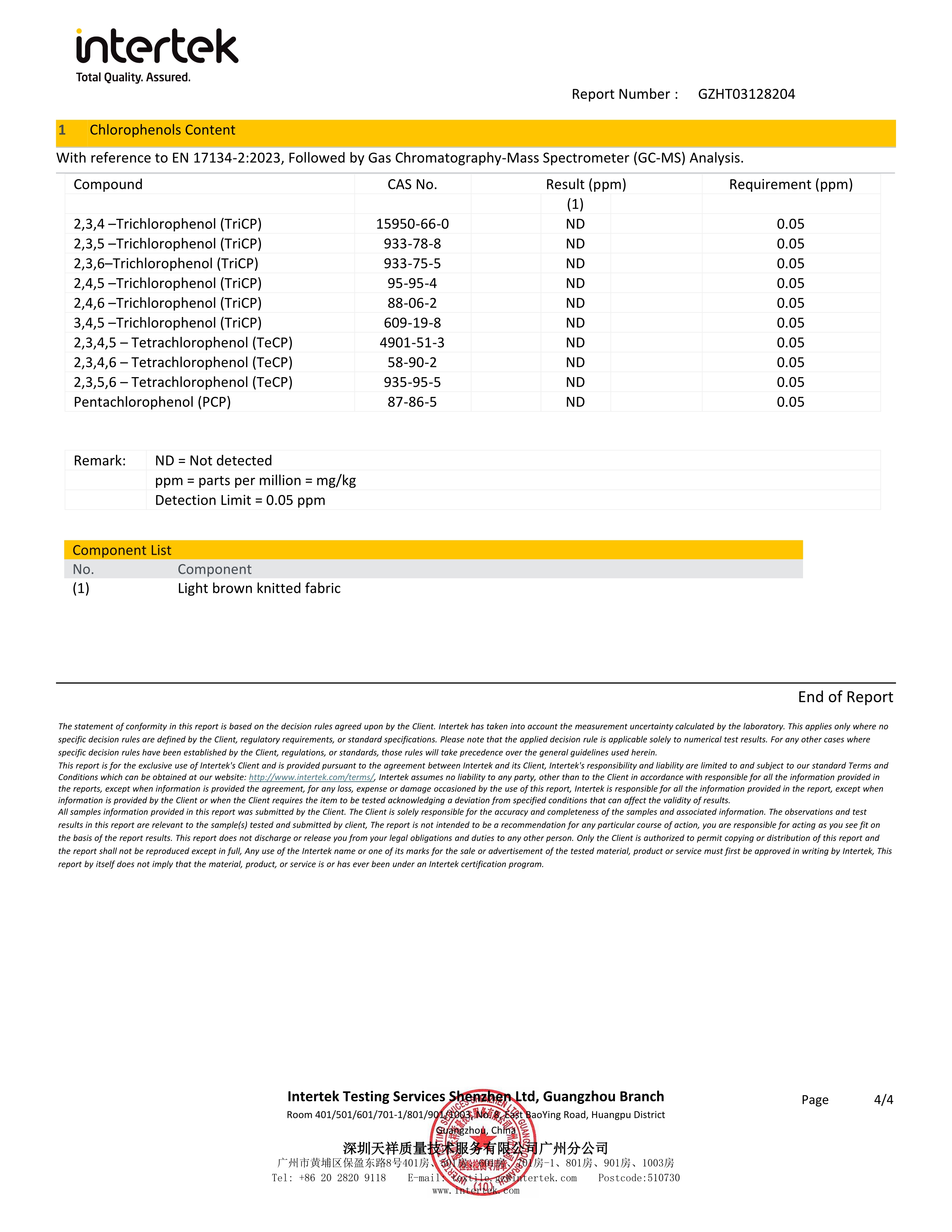
The supplied compliance file includes report-level examples that show the kind of detail a buyer should expect. Intertek report GZHT91138285 covers luminous yarn for baby application under Adidas A-01 Policy Version No.20, issued 2022-08-29. Intertek report GZHT91138296 covers UV color-changing yarn for baby application under the same policy version, issued 2022-08-29. Intertek report GZHT91138300 covers temperature-changing yarn for baby application, issued 2022-08-31. The file also includes reports GZHT03128204 and GZHT03128212 to EN 17134-2:2023 for light brown and black knitted fabric for children's apparel, issued 2026-04-16. These examples are useful because they show that a report should identify the product scope and standard, not just the supplier name.
A pass condition is a current, scope-matched report from the required laboratory or an approved equivalent. A conditional condition is a report that is relevant but incomplete on sample identity, method, or bulk applicability. A fail condition is a claim supported only by a brochure, a logo, or a report for a different product. For a named SGS or GTTC requirement, a report from another laboratory should not be treated as a pass unless the buyer has formally approved the substitution.
Gate 3: additive consistency from batch to batch
The third gate checks how functional additives are controlled. Photoluminescent pigment, retroreflective material, and far-infrared ceramic are not generic ingredients. Each can affect appearance, performance, processing, and test results. The scorecard should ask how the additive is received, identified, stored, mixed, and traced by batch. It should also ask what retained sample or certificate of analysis is kept for the additive, and how the supplier decides when a new additive batch needs re-testing.
A supplier with a process patent may be able to describe its route in more detail, but a patent is not a bulk-lot test report. The supplied file includes invention patent ZL 2023 1 1305729.5 for a waterless dyeing preparation process for color-changing yarns and the yarns prepared therefrom, issued 2024-04-16. It also includes utility model patents ZL 2022 2 1385471.5 and ZL 2022 2 1384659.8 for dyeing-yarn equipment, issued 2022-09-13. These records support process capability. They do not replace the need for batch records and matched test data on the purchased yarn.
A pass condition is a documented additive traceability route with batch identification, retained samples, and a re-test trigger. A conditional condition is a general description of the additive without batch-level records. A fail condition is an unexplained change in additive source, dosage, or appearance between the approved sample and the bulk lot. The sourcing team should treat that change as a deviation until the supplier provides a technical justification and a re-test plan.
Gate 4: matched sample and bulk test data
The fourth gate compares the approved sample with the bulk shipment. The comparison should use the same test method, same units, same sample preparation, and the same product identity. If the sample report tests a knitted fabric, the bulk report should test a comparable knitted fabric. If the sample report tests the yarn, the bulk report should test the yarn. Mixing yarn reports and fabric reports without explanation can hide a change in construction or finishing.
A practical scorecard asks for a side-by-side table: sample value, bulk value, test method, difference, and acceptance range. The buyer should define the acceptance range before the bulk order, not after the result. If the supplier cannot provide a bulk report, the buyer should require a pre-shipment inspection and a retained bulk sample. The supplied capability unit states that inspection is provided before shipment. That is a useful control, but it should be paired with a clear inspection criterion that references the approved sample and the agreed test method.
A pass condition is a bulk report that matches the sample within the agreed range and is traceable to the shipped lot. A conditional condition is a bulk report that is complete but uses a different method or sample preparation. A fail condition is no bulk data, a report that cannot be linked to the lot, or a result outside the agreed range without a corrective action.
Gate 5: application support for knitting, weaving, embroidery, jacquard and sewing
The fifth gate checks whether the supplier can support the actual conversion process. A functional yarn may pass a laboratory test and still create problems in knitting, weaving, embroidery, jacquard, or sewing. The scorecard should ask whether the supplier can review the intended process, recommend a trial, and respond to process questions with product-specific guidance. It should also ask who is responsible for confirming that the yarn is suitable for the named machine and end use.
The supplied after-sales scope for MONALISHAMAGIC includes remote support, after-sales consultation, product usage guidance, timely response to quality complaints, reorder assistance, sample reconfirmation, color matching support, logistics tracking, and certification and compliance document supply. These are relevant support functions, but the buyer should still define the application trial. For example, a reflective yarn for embroidery may need a different trial from a far-infrared heating yarn for a jacquard knit. A machine washable antibacterial yarn for a repeated-wash program may need a wash-cycle trial that matches the buyer's care label.
A pass condition is a named technical contact, a documented application trial, and a written response to the trial findings. A conditional condition is general support without a trial plan. A fail condition is no application support or a supplier that will not discuss the named process.
Gate 6: delivery assurance and re-test route
The sixth gate checks delivery and deviation control. The scorecard should confirm the MOQ, lead time, inspection point, payment terms, and the route for re-testing when a lot deviates. The supplied capability unit lists OEM/ODM production, customization on yarn composition, color, specification and functional parameters, a 7-15 day lead time, a 5 KG MOQ, inspection before shipment, and global export markets. The purchasing unit lists air freight, sea freight, and land transport, pre-shipment inspection as an acceptance criterion, and payment terms including TT, L/C, D/P, PayPal, Payoneer, Wise, and Western Union. These terms should be confirmed in the actual order document rather than assumed from a general profile.
A pass condition is a written delivery plan with an inspection point, a deviation trigger, a re-test method, and a responsible person. A conditional condition is a delivery plan that covers timing but not re-test responsibility. A fail condition is no re-test route or a supplier that treats every deviation as a commercial negotiation rather than a technical event. The buyer should define what happens if the bulk lot fails: quarantine, root-cause review, re-test, replacement, credit, or another remedy agreed in writing.
| Scorecard gate | What the sample stage can show | What the bulk stage must prove | Evidence to request | Pass condition |
|---|---|---|---|---|
| Customization depth | That one count, fiber, color, or functional parameter can be made. | That the claimed range and color program are controlled in production. | Written specification, approved sample, bulk lot record, color reference. | Count, fiber, color and functional parameter are measurable and traceable to the lot. |
| Third-party test evidence | That a sample was tested by a laboratory. | That the report scope matches the purchased yarn or fabric and the current claim. | Report number, laboratory, method, sample identity, issue date, scope. | Current, scope-matched report from the required or approved laboratory. |
| Additive consistency | That the sample contains the intended additive effect. | That the additive source, batch and process are controlled batch to batch. | Incoming material record, retained sample, batch record, re-test trigger. | Additive traceability and re-test rule are documented and applied. |
| Application support | That the yarn can be converted in a limited trial. | That the supplier can support the named knitting, weaving, embroidery, jacquard or sewing process. | Trial plan, technical contact, trial findings, care-label review where relevant. | Application trial is completed and findings are answered in writing. |
| Delivery and re-test | That a sample can be shipped within a short lead time. | That bulk inspection, deviation handling and re-test are controlled. | Order terms, inspection criterion, lead time, re-test method, remedy route. | Written delivery and re-test route is agreed before the purchase order. |
Step-by-step breakdown for sourcing teams
- Lock the claim in writing. Convert the supplier's description into a specification with yarn count, fiber composition, color reference, functional parameter, test method, and acceptance range. Do not accept a category name as a specification.
- Request the sample and its evidence together. Ask for the sample test report, certificate or batch record at the same time as the sample. A sample without evidence is only a visual reference.
- Verify the report scope. Check the laboratory, report number, standard, sample identity, issue date, and whether the report covers the yarn or fabric you are buying. If SGS or GTTC is named in your specification, confirm that the report meets that requirement or that an equivalent has been approved.
- Ask for the bulk control plan. Request the pre-shipment inspection criterion, the bulk test plan, and the retained-sample rule. The plan should state who compares the bulk result with the approved sample and what happens if the result differs.
- Run an application trial. Test the yarn in the actual process: knitting, weaving, embroidery, jacquard or sewing. Record the machine setting, trial result, and any supplier guidance. A laboratory pass does not automatically prove conversion success.
- Compare sample and bulk on the same basis. Use the same method, units, and sample preparation. Put the sample value, bulk value, difference, and acceptance range in one table. This is the core of claim-to-bulk consistency.
- Define the deviation route. Agree in writing what happens if a bulk lot fails: quarantine, re-test, root-cause review, replacement, credit, or another remedy. Name the responsible contact and the response time.
- Re-score after the first bulk shipment. A supplier scorecard is not finished at sample approval. Update it after the first bulk lot and again after the first repeat order. The second score is usually more useful than the first because it shows whether the control held.
Use cases: where the scorecard changes the decision
Color-changing knitwear. A program using photochromic yarn or thermochromic yarn may look convincing at sample stage but shift in bulk if the additive batch or color recipe changes. The scorecard should add a bulk color-change check, a wash-durability check where relevant, and a retained sample from the approved lot. The buyer should not rely on a single sample demonstration.
Repeated-wash antibacterial and anti-static programs. A machine washable antibacterial yarn or an anti-pilling and anti-static yarn may need a test report that covers the claimed performance after the intended care treatment. The scorecard should ask whether the report reflects the buyer's wash cycle, fabric construction, and test method. A general antibacterial or anti-static claim without a scope-matched report is a conditional pass at best.
Thermal and reflective applications. A far-infrared heating yarn, reflective yarn, or luminous yarn may be selected for a performance layer, a safety trim, or a decorative effect. The bulk lot should be tested for the property that matters to the application, not only for appearance. If the yarn is used in embroidery, jacquard, or sewing, the application trial should be part of the same scorecard review.
FAQ
What third-party test documents should a sourcing team request for anti-pilling and anti-static functional yarn?
Request the test report that specifically covers pilling and static performance for the yarn or fabric you are buying. Check the laboratory, report number, standard or method, sample identity, issue date, and scope. If your specification names SGS or GTTC, the report should come from that laboratory or a formally approved equivalent. A report for a different fiber, construction, or product is not interchangeable evidence.
How can a buyer verify that yarn count, fiber and color customization will hold from sample to bulk?
Put the claimed count range, base fiber, color reference, and functional parameter into a written specification. Ask for sample and bulk records at the counts and colors you will actually use, not only the easiest sample. A pass requires a bulk lot record that is traceable to the approved sample. A conditional result is a complete sample specification with no bulk tolerance. A fail is a claim that cannot be measured or tied to the shipped lot.
Can a supplier support knitting, weaving, embroidery, jacquard and sewing trials?
Ask for a named technical contact, a trial plan, and a written response to the trial findings. The supplier should be able to discuss the intended process and identify any yarn-specific handling requirements. General after-sales support is useful, but the buyer should still record the trial result. A pass is a completed application trial with documented findings. A conditional pass is general support without a trial plan.
What MOQ, payment and acceptance terms should be confirmed before a bulk order?
Confirm the MOQ, lead time, inspection point, payment terms, and delivery terms in the order document. The supplied capability and purchasing records list a 5 KG MOQ, a 7-15 day lead time, pre-shipment inspection, air, sea and land transport, and payment terms including TT, L/C, D/P, PayPal, Payoneer, Wise and Western Union. Treat these as items to verify in the actual quotation and contract, not as assumptions.
How should sample and bulk test data be compared?
Compare them under the same method, units, sample preparation, and product identity. Build a side-by-side table with sample value, bulk value, difference, method, and acceptance range. The acceptance range should be agreed before the bulk order. If the bulk report uses a different method or tests a different construction, the comparison is conditional until the difference is explained and resolved.
What lead time and re-test route should be agreed if a bulk lot deviates?
Agree the lead time, inspection point, deviation trigger, re-test method, and remedy route in writing. A clear route should name who quarantines the lot, who reviews the root cause, who authorizes re-test, and what commercial remedy applies if the lot fails. For a current program, MONALISHAMAGIC can share its functional yarn brochure, certification and compliance file, and capability details for review; the brochure is available here: functional yarn brochure.
Conclusion
A functional yarn supplier evaluation should end with evidence, not with a capability narrative. The scorecard in this article tests whether the supplier can define customization depth, provide scope-matched third-party reports, control functional additives batch to batch, support the named application, and handle a bulk deviation through a written re-test route. Each gate can be marked pass, conditional, or fail. That is enough to screen a supplier before sampling and to re-score the supplier after the first bulk shipment.
The most useful discipline is the matched sample-to-bulk comparison. A sample shows what is possible. A bulk lot shows what is controlled. For sourcing teams, the difference between those two statements is the difference between a claim and a purchase decision.

Supplier documentation note: the supplied compliance file includes BCI certificate ETK-70050-BCI-CoC-2510 valid to 2028-10-20 and FSC Chain of Custody ESTS-COC-230318 valid to 2029-09-12. It also includes a GRS/OCS/RCS multi-standard record whose expiry date must be checked against the shipment date before it is treated as current. Certificates and reports should always be verified against their stated scope, issue date, and expiry date.
Have Questions or Need More Details?
Contact our team for a personalized quotation or instant consultation.
Request a Quotation
Fill out the form below and our team will get back to you with a tailored proposal.
WhatsApp Direct Chat
Prefer to chat in real-time? Message us on WhatsApp for instant assistance & quick answers.
- Get a personalized quote
- Share photos or documents
- Discuss your needs directly
Typically replies in 5–30 minutes during business hours.