
Card Connector Comparison: SD, MicroSD, SIM & Smart Card Sockets
Card Connector Comparison: SD, MicroSD, SIM & Smart Card Sockets
A card connector comparison only becomes useful when four families are measured on the same four variables: contact count, board footprint, insertion style and compliance profile. SD card connectors, MicroSD and TF card sockets, SIM (Mini, Micro and Nano) sockets, and smart card / IC card holders are not interchangeable parts that merely accept different cards. They differ in contact geometry, in how much board area they occupy, in the mechanism that retains and ejects the card, and in the documents a buyer can actually pull for an audit. Card format is the starting constraint; the mechanism and the paperwork decide whether the socket survives the product lifecycle.
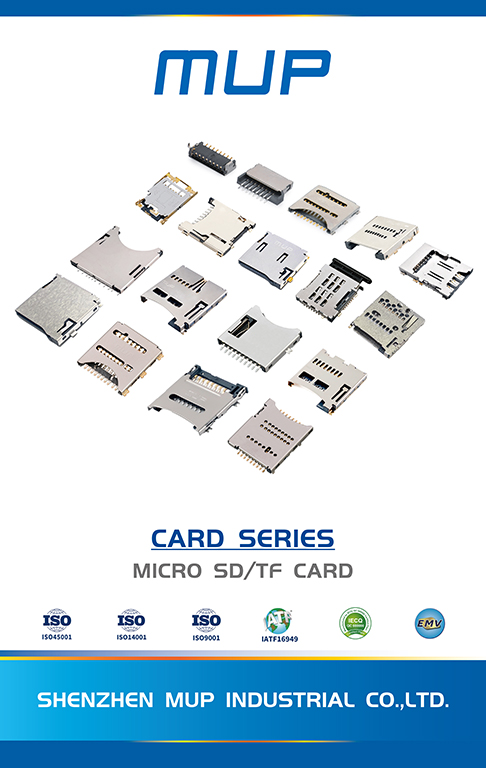
SD and TF card connectors from the MUP card connector portfolio, one of four families compared in this guide.
This guide sets the card connector families supplied by Shenzhen MUP Industrial Co., Ltd. (MUP) — SD card connector, MicroSD card holder, TF card socket, SIM / Micro SIM / Nano SIM sockets, smart card socket and IC card holder — side by side on the same specification grid. MUP is a Shenzhen-based precision connector manufacturer founded in 2003 that designs, manufactures and sells card connectors, USB Type-C, HDMI, BTB, FPC, RF and related interconnect products.
What a Card Connector Comparison Has to Decide
The comparison has to answer one practical question: which socket family can be designed in, tooled, documented and supplied without forcing a board re-spin or a compliance gap later. Three failure modes account for most of the cost when that question is answered by card format alone.
- Footprint failure. The card format sets a physical minimum, but mounting orientation and ejector mechanism decide the real keep-out area on the PCB. A socket chosen for its card size can still fail once the insertion mechanism and its travel are drawn.
- Durability failure. A socket rated for a few thousand insertion cycles and one rated for tens of thousands are both “SIM sockets”, yet they belong to different product classes. The documented MUP ratings already separate the two memory formats from the SIM and smart card families by an order of magnitude.
- Documentation failure. A supplier can hold a valid management-system certificate while the specific part number still needs its own RoHS and REACH test report. Certificates are issued per scope and per legal entity, and product-level reports are part-type specific.
Treating these three as separate decisions, rather than as consequences of the card format, is the core of the framework below.
Industry Background: Why Card Sockets Still Drive Design Decisions
Card connectors remain a mature but structurally important category. Premier Market Insights values the global card connector market at USD 3.96 billion in 2024 and projects USD 5.89 billion by 2030. A separate publisher estimate places the 2024 figure at USD 1.24 billion, which shows that scope definitions differ between research houses — card-edge connectors versus interface sockets are often counted differently — so market-size figures should not be mixed across sources without checking what each one includes.
Two structural points matter more for a buyer than the headline value. First, SD and microSD socket types accounted for approximately 60% of unit shipments in 2024 according to Data Insights Reports, which means the memory-card families remain the volume backbone even where revenue growth comes from specialised interfaces. Second, Asia Pacific represented 44.8% of the market in 2025, which is consistent with the concentration of connector manufacturing in the region and with the sourcing reality that most card socket programmes are quoted from Asian factories regardless of where the end product is sold.
For design teams, the practical consequence is that card sockets are rarely selected in isolation. A payment terminal may carry a smart card socket, a SIM socket and a microSD socket on the same board; a smart meter may combine a SIM socket with a memory socket; a 3C device may use only a TF socket. That is why the comparison has to be run family by family rather than product by product.
The Four Families, Side by Side
SD Card Connector (SD Card Socket, SD Card Holder)
An SD card connector accepts the full-size SD card format and is the largest of the four families in board terms. In the MUP portfolio this family is listed under the SD card connector, MicroSD card holder and TF card socket product group, with the SD models M6005, M6014, M6015, M6016, M6027, M6110, M6102, M6106 and M6109. Documented durability for this product group is 3,000 / 5,000 mating cycles. The family shares the same construction as the rest of the card connector range: LCP or PA9T high-temperature plastic housing, phosphor bronze or beryllium copper contact terminals, gold or nickel plated contacts, and a SUS304 stainless steel shell.
MicroSD / TF Card Socket
The MicroSD and TF card socket accepts the smaller memory card format and is normally chosen when the storage interface must fit a compact enclosure. It belongs to the same MUP product group and the same documented durability band as the SD family — 3,000 / 5,000 mating cycles — and uses the same material set. The distinction between MicroSD and TF is largely a naming convention in catalogue and RFQ language; both terms describe the same small-format memory interface, which is why MUP lists them together rather than as separate families.
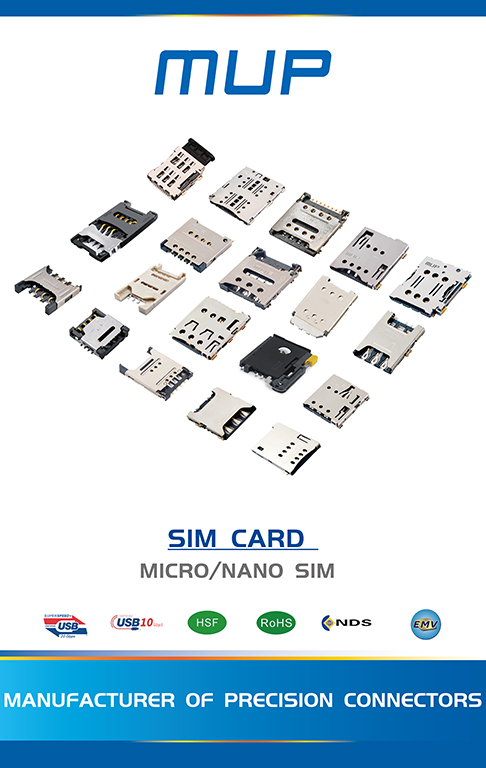
SIM card connectors — the family that covers Mini, Micro and Nano SIM card sockets in the MUP portfolio.
SIM, Micro SIM and Nano SIM Sockets
The SIM family carries subscriber identity modules in Mini, Micro and Nano card formats. MUP lists it as a separate product group covering SIM card connectors, Micro SIM card sockets and Nano SIM card holders, with models C7006, C7013, C7017, C7020, C7034, C7050, C7060, C7801, C7802, C7081, C7082, C7083, C7090, C7091, C7092, C7093, C7803, C7808, C7810, C7825 and C7905. The documented durability range for this family is 5,000 / 50,000 / 100,000 mating cycles, which places it in a different durability class from the memory-card sockets even though the electrical envelope is identical: 1 A maximum rated current, 10 µA minimum, 50 V maximum rated voltage, operating temperature −40 °C to 85 °C.
Smart Card Socket and IC Card Holder
The smart card socket and IC card holder accept contact-based IC cards and are the family most closely tied to a formal interface standard. ISO/IEC 7816-2 defines 8-pin, 6-pin and 4-pin contact configurations for smart cards, so the contact layout of a smart card socket is not a free design choice — it follows the card interface the product must read. MUP lists this family with model numbers C8001, C8037, C8042, C8043, C8057, C8067, C8068, C8610, C8611, C8618, C8621, C8622, C8629 and C8633, and with the same documented durability band as the SIM family: 5,000 / 50,000 / 100,000 mating cycles.
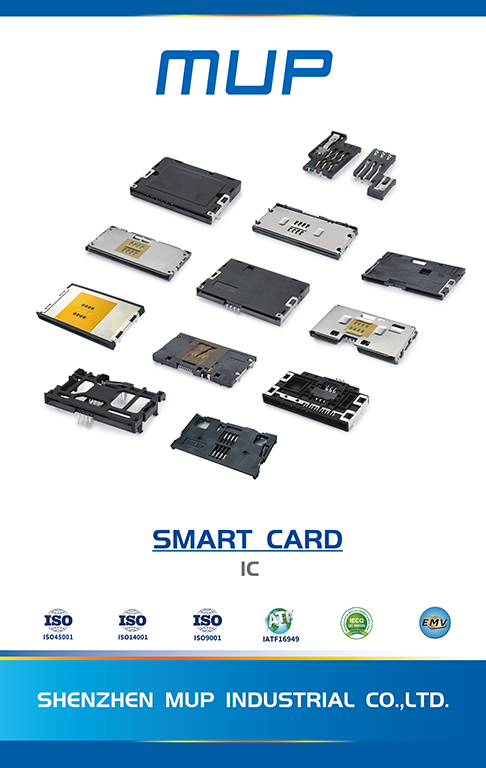
Smart card connectors and IC card holders, the family governed by ISO/IEC 7816-2 contact configurations.
Contact Count: What the Numbers Actually Tell You
Contact count is the first column in any card connector comparison, and the first place where comparisons go wrong. Two reference points are documented. For smart card interfaces, ISO/IEC 7816-2 specifies 8-pin, 6-pin and 4-pin configurations, so a smart card socket or IC card holder should be matched to the contact arrangement the reader chip expects. For memory and SIM sockets, published manufacturer data shows the practical band: Molex lists SD, SIM and combo sockets at 6 to 9 circuits across its card connector range.
Those figures are a reference, not a specification for any particular MUP model. MUP publishes card connector families and model numbers rather than a single pin count per family, and the contact count for a given part number has to be confirmed on the model drawing. There are two reasons this matters more than it appears.
- Contact count is not a performance score. A higher contact count does not automatically mean better signal integrity or longer life; it usually reflects additional functions such as card detection, write protection or a second interface on a combo socket.
- Detection switches change the count. A socket with a card-presence detection switch does not have the same contact arrangement as the same family without one. MUP supports custom designs with detection switches, so the detection contact must be specified explicitly in the RFQ rather than assumed.
The practical rule is to write the required contact count and the required function of each contact into the RFQ, so the supplier confirms both on the drawing instead of confirming only the card format.
Board Footprint and Mounting Orientation
Board footprint follows the card format but is decided by the mounting design. Across the four families the ranking is straightforward: the SD socket occupies the largest board window, the MicroSD/TF socket the smallest of the memory pair, the Nano SIM socket less than the Micro and Mini SIM variants, and the smart card socket is driven by the ID-1 card outline plus its contact block. The ranking is stable, but the absolute figure is not, because mounting and card travel change the real keep-out area.
Published product-family data illustrates how much of the footprint question is a mechanical question. TE Connectivity describes memory-card connectors in standard, micro and micro/SIM SD formats with top- and bottom-mounting options, and Molex states that its compact memory-card products have a height of no more than 1.28 mm. On the MUP side, the card connector range supports mid-mount, vertical and horizontal mounting positions. For a design team, that means the footprint evaluation should be run as a mechanical check — mounted height, insertion direction and ejector travel — rather than as a comparison of card dimensions alone.
Insertion Style: Push-Push, Push-Pull, Hinge, Tray and Pin-Ejector
Insertion style determines both the user experience and the durability specification. Molex publishes push-push, push-pull, hinge, tray and pin-ejector configurations across its SD, SIM and combo socket range; TE Connectivity publishes push-push and push-pull mating designs across its memory-card connector families. In practice the choice follows the product, not the card:
- Push-push keeps the card fully inside the housing and is the usual choice where the card must not protrude. It places the highest demands on the ejector mechanism.
- Push-pull keeps the mechanism simpler and is common where the socket is accessed only during service.
- Hinge and tray designs move the retention function into a moving part and are used where card access is frequent or where the housing must stay sealed.
- Pin-ejector designs allow ejection through a small opening, which suits sealed enclosures.
The insertion style also interacts with the mating cycle rating. A mating cycle, as defined in MUP technical documentation, is the maximum number of complete plug-in and pull-out operations before the connector fails electrically — it is a core reliability indicator for card connectors because it evaluates the durability of the contact terminals under repeated insertion. A socket intended for a card that is inserted once at commissioning and a socket intended for a card swapped daily should not be specified with the same durability number.
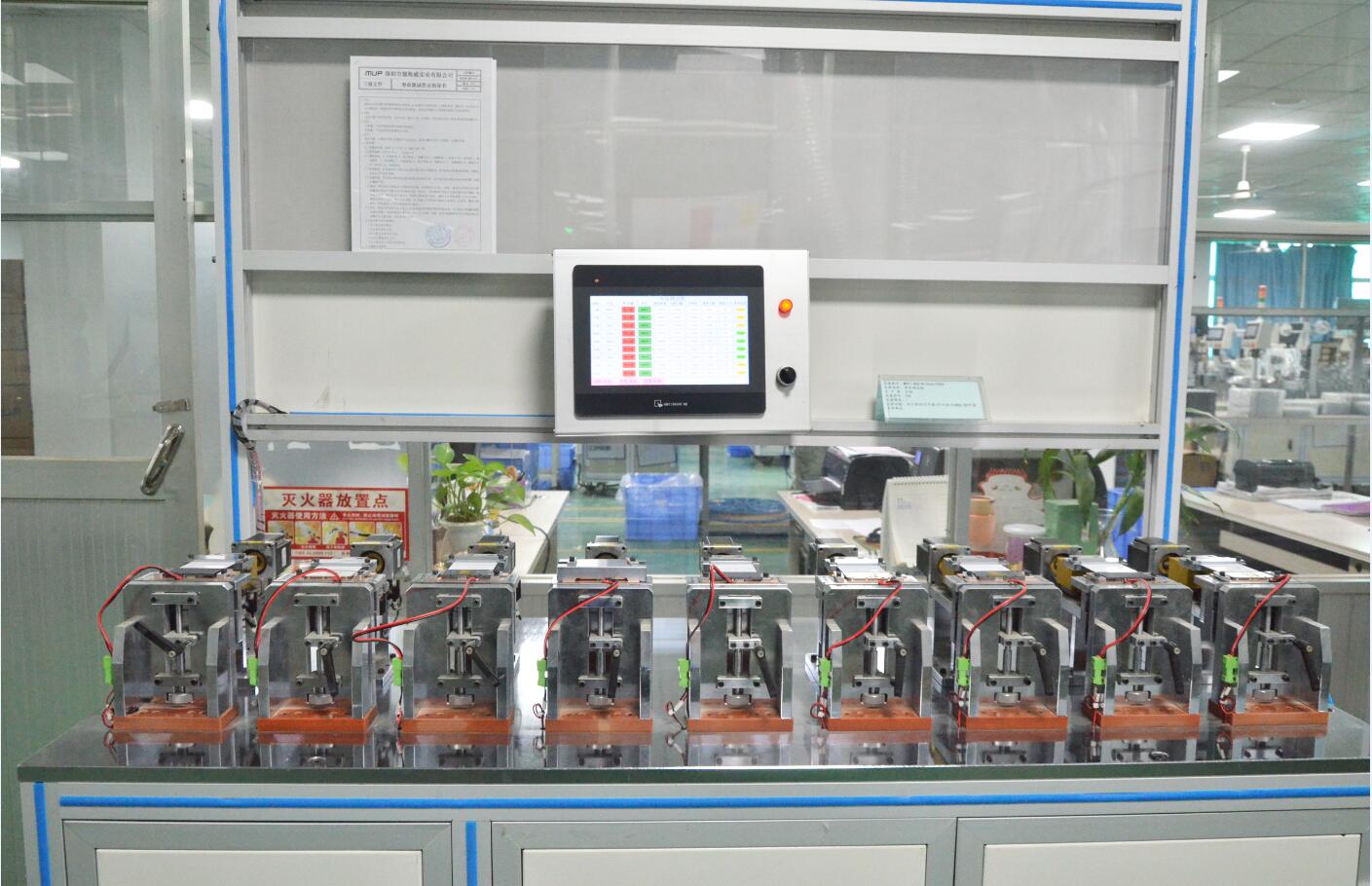
Mating cycle durability test fixture used to verify card connector contact life.
Compliance Profile: Which Document Answers Which Question
Compliance is the column where the four families converge, because the certificates that cover card connector production are held at company level rather than per card format. MUP documents five management-system certificates, and each answers a different buyer question.
| Certificate | Number | Issuer | Certified entity | Validity |
|---|---|---|---|---|
| ISO 9001:2015 | CA00527-EN | TÜV Saarland | Shenzhen MUP Industrial Co., Ltd. | 2 Mar 2024 – 2 Feb 2027 |
| IATF 16949:2016 | CB00634-01 | TÜV Saarland | Shenzhen MUP Industrial Co., Ltd. | 3 Feb 2024 – 2 Feb 2027 |
| ISO 14001:2015 | 134773 | NQA | Huizhou MUP Technology Co., Ltd. | 18 Feb 2025 – 18 Feb 2028 |
| ISO 45001:2018 | 134774 | NQA | Huizhou MUP Technology Co., Ltd. | 18 Feb 2025 – 18 Feb 2028 |
| IECQ QC 080000:2017 (HSPM) | IECQ-H NQAGB 25.0032 | NQA | Huizhou MUP Technology Co., Ltd. | 27 Mar 2025 – 26 Mar 2028 |
The scope wording matters as much as the number. The ISO 9001:2015 and IATF 16949:2016 certificates cover the design and manufacture of electronic connectors used for communication intelligence systems, with the IATF certificate adding product design responsibility. The ISO 14001, ISO 45001 and IECQ QC 080000 certificates cover the design, production and sales of electronic connectors, electronic wiring harnesses and cables, and hardware and plastic components for printed circuit boards, excluding products requiring 3C certification.
Two practical consequences follow. First, IATF 16949:2016 is the certificate that answers an automotive programme’s supplier question, and it applies to Shenzhen MUP Industrial Co., Ltd. Second, IECQ QC 080000:2017 is a hazardous-substance process management certification — it evidences a controlled process for restricted substances, not a product-level RoHS test result for a specific part number. For the specific part, a RoHS and REACH test report is the document that closes the file.
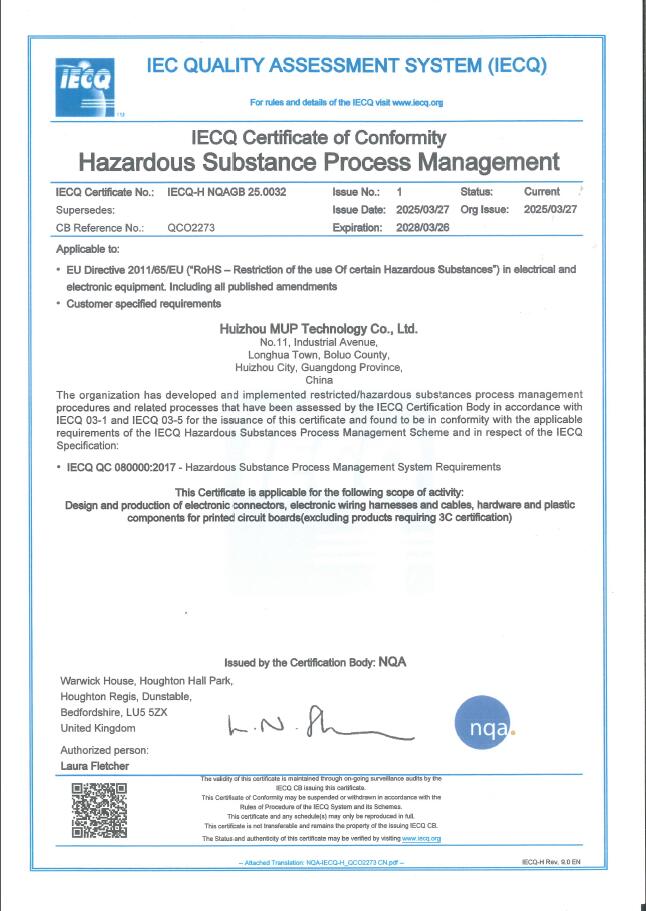
IECQ QC 080000:2017 hazardous substance process management certificate IECQ-H NQAGB 25.0032, valid 27 March 2025 to 26 March 2028.
MUP states that its USB-C and SIM card connectors comply with RoHS and REACH for EU market access, and that official test reports and compliance certificates can be provided on request for project audit and customs clearance. One limitation is documented alongside that statement: certificates are product-type specific, so a report issued for one connector type cannot be used for another. Halogen-free documentation is also available on request for markets that require it.
For smart card sockets there is a second compliance layer beyond environmental substance control. Selection guidance from the MUP knowledge base recommends checking ISO 7816, EMV and NDS requirements for payment and smart-card devices, because those requirements govern the card interface itself rather than the connector’s environmental profile.
Step-by-Step: Running the Comparison on a Real Project
The sequence below turns the four variables into a decision procedure that can be applied to any of the four families.
- Fix the card format and the contact requirement. Decide whether the product needs an SD, MicroSD/TF, SIM (Mini, Micro or Nano) or smart card interface. For smart cards, fix the 8-pin, 6-pin or 4-pin configuration against ISO/IEC 7816-2. For memory and SIM sockets, state the contact count and the function of each contact, including detection.
- Measure the board window and choose the mounting. Compare mid-mount, vertical and horizontal mounting positions and confirm the mounted height and card travel, not just the card outline. Where the enclosure is height-limited, confirm the exact model height on the drawing.
- Choose the insertion and ejection style. Select push-push, push-pull, hinge, tray or pin-ejector according to how often the card is accessed and whether it may protrude. Add a detection switch option if the firmware needs card-presence signalling.
- Confirm the electrical and environmental envelope. The MUP card connector range is documented at 1 A maximum rated current, 10 µA minimum, 50 V maximum rated voltage, operating temperature −40 °C to 85 °C, operating humidity 10%–95% RH, with storage at −20 °C to 35 °C and 10%–75% RH. Any requirement outside that envelope is a custom project, not a catalogue selection.
- Match the durability class. Memory-card sockets are documented at 3,000 / 5,000 mating cycles; SIM and smart card sockets at 5,000 / 50,000 / 100,000. Choose the class from the expected field insertion frequency, not from the card type alone.
- Lock the documentation package. Request the RoHS and REACH report for the exact part number, confirm which legal entity holds each certificate, and check that the manufacturing site on the report matches the site that will ship. Then request samples for pre-production verification.
Use Cases: Which Family Fits Which Product
MUP card connectors are documented for financial payment, smart meters, TV displays, notebook computers, IoT, security surveillance, aerospace, drones, communication networks, data centres, power equipment, industrial equipment, rail transit, medical devices, new-energy vehicles and 3C consumer electronics. Within that list, the family mapping is fairly consistent.
- Payment terminals and mPOS devices typically combine a smart card socket for the EMV transaction card with a SIM or Nano SIM socket for connectivity. The smart card socket carries the ISO/IEC 7816-2 contact configuration and the EMV/NDS compliance question; the SIM socket carries the durability requirement.
- Smart meters and industrial IoT terminals generally pair a SIM socket for backhaul connectivity with a MicroSD/TF socket for local data logging. The memory socket is written rarely and the SIM socket is inserted rarely, so the lower durability class is often adequate — but the environmental envelope becomes the binding constraint.
- 3C consumer devices usually need only the MicroSD/TF socket, where footprint and mounted height dominate the decision.
- Automotive and industrial control programmes add a supplier-qualification layer in which IATF 16949:2016 becomes the relevant certificate, and where anti-vibration and high-temperature requirements are documented as special requirements.
MUP’s own case documentation describes card reader and payment-terminal applications delivered at volumes of 500,000 units per piece across France, Germany, Brazil, India, Korea, Japan, Vietnam, the United Kingdom, the United States and other markets, with a stated duration of 3 to 15 years and reported results of stable operation and high reliability. Those figures are company-reported and describe the supplier’s experience rather than a guarantee for a new programme.
Comparison Table: SD, MicroSD/TF, SIM and Smart Card Sockets
| Family (MUP range) | Contact count | Board footprint and mounting | Insertion / ejection style | Documented mating cycles | Compliance anchor |
|---|---|---|---|---|---|
| SD card connector / SD card socket Models M6005, M6014, M6015, M6016, M6027, M6110, M6102, M6106, M6109 |
Confirm on model drawing. Published SD, SIM and combo sockets from Molex are listed at 6 to 9 circuits; contact count varies with detection and combo functions. | Largest board window of the four families; mid-mount, vertical and horizontal mounting supported across the MUP range. | Category publishes push-push, push-pull, hinge, tray and pin-ejector options; MUP supports custom designs with detection switches. | 3,000 / 5,000 | RoHS and REACH test report per part number; IECQ QC 080000:2017 process control; ISO 9001:2015 quality system. |
| MicroSD / TF card socket Same MUP product group as SD |
Confirm on model drawing; same 6-to-9 circuit reference band applies to published memory and SIM sockets. | Smallest of the memory pair; category data shows compact memory-card products at no more than 1.28 mm height (Molex), so height must be confirmed per model. | Push-push and push-pull are the published mating options in the category (TE Connectivity). | 3,000 / 5,000 | RoHS and REACH test report per part number; IECQ QC 080000:2017 process control. |
| SIM / Micro SIM / Nano SIM socket Models C7006, C7013, C7017, C7020, C7034, C7050, C7060, C7801, C7802, C7081, C7082, C7083, C7090, C7091, C7092, C7093, C7803, C7808, C7810, C7825, C7905 |
Confirm on model drawing; the 8-, 6- and 4-contact configurations defined in ISO/IEC 7816-2 apply to the smart card interface, and the SIM contact arrangement must be matched to the module. | Smaller than the memory families; mid-mount, vertical and horizontal mounting available. | Push-push, push-pull, hinge, tray and pin-ejector published in the category; detection switch optional. | 5,000 / 50,000 / 100,000 | RoHS and REACH compliance stated for SIM connectors; test reports on request; IATF 16949:2016 where the programme is automotive. |
| Smart card socket / IC card holder Models C8001, C8037, C8042, C8043, C8057, C8067, C8068, C8610, C8611, C8618, C8621, C8622, C8629, C8633 |
Defined by ISO/IEC 7816-2: 8-pin, 6-pin and 4-pin configurations. | Governed by the ID-1 card outline plus contact block; mounting confirmed per model. | Hinge, tray, push-pull and push-push variants published in the category; retention must be confirmed per model. | 5,000 / 50,000 / 100,000 | ISO/IEC 7816-2 contact geometry; EMV and NDS checks for payment programmes; IECQ QC 080000:2017 process control. |
Shared across all four families: LCP or PA9T high-temperature plastic housing, phosphor bronze or beryllium copper contact terminals, gold or nickel plated contacts, SUS304 stainless steel shell, and a 1 A / 50 V rated envelope at −40 °C to 85 °C. The differences that decide a design are therefore concentrated in contact configuration, footprint, mechanism and durability class — not in the base material set.
Buyer Checklist: Mating Cycle and RoHS/REACH Questions to Put to Each Option
The checklist below is written to be sent to each shortlisted supplier, one option at a time, so that answers can be compared line by line.
Mating cycle questions
- What is the rated mating cycle count for this exact model number, and is it the 3,000/5,000 class or the 5,000/50,000/100,000 class?
- Does the rating refer to complete plug-in and pull-out operations of the card, as defined for card connectors, or to a partial insertion stroke?
- Under what test condition was the rating established — insertion speed, dwell, and whether the test was performed with a card or a gauge?
- Does the rating apply to the contact terminals only, or does it include the ejector mechanism and the housing?
- How many insertion cycles does the field application actually require over the product life, and does the model cover that with margin?
- What is the documented warranty position if the socket fails below the rated cycle count? MUP documents a 1-year warranty with return, replacement or replenishment for non-human-caused defects.
RoHS and REACH questions
- Can you issue a RoHS and REACH test report for this specific part number, not for the product family?
- Which version of the REACH SVHC candidate list does the report reference, and what is the report date?
- Is the report issued to the legal entity that will invoice us, and does the manufacturing site named on the report match the site that will ship?
- Do you hold IECQ QC 080000:2017 hazardous substance process management certification, and for which site?
- Is halogen-free documentation available for this part if our market requires it?
- Which other compliance documents apply — for example ISO/IEC 7816-2 contact configuration or EMV/NDS requirements for a smart card socket, and IATF 16949:2016 where the programme is automotive?
Frequently Asked Questions
Do MUP card connectors comply with RoHS and REACH?
MUP states that its USB-C and SIM card connectors fully comply with RoHS and REACH regulations for EU market access, and that official test reports and compliance certificates can be provided on request for project audit and customs clearance. The documentation process is part-number driven: the customer provides the project and part number, MUP retrieves the corresponding test documents and sends electronic copies. Certificates are product-type specific, so a report for one connector type cannot be used for another, and halogen-free documentation is available on request for markets that require it.
Which management-system certificates cover card connector production, and who holds them?
Five certificates are documented. ISO 9001:2015 (CA00527-EN, TÜV Saarland, valid 2 March 2024 to 2 February 2027) and IATF 16949:2016 (CB00634-01, TÜV Saarland, valid 3 February 2024 to 2 February 2027) are held by Shenzhen MUP Industrial Co., Ltd. for the design and manufacture of electronic connectors used for communication intelligence systems, with the IATF certificate adding product design responsibility. ISO 14001:2015 (134773), ISO 45001:2018 (134774) and IECQ QC 080000:2017 (IECQ-H NQAGB 25.0032), all issued by NQA, are held by Huizhou MUP Technology Co., Ltd. and cover the design, production and sales of electronic connectors, wiring harnesses and cables, and hardware and plastic components for printed circuit boards, excluding products requiring 3C certification.
Can MUP supply OEM Nano SIM card connectors with custom tooling?
Yes. MUP provides OEM and ODM production services, and OEM services include deep customization from mold development to final assembly. Customization covers product specifications, dimensions, pin counts and interface types, plus high-frequency, high-current, waterproof and high-temperature parameters, logo laser engraving or silkscreen, Pantone colour matching and custom packaging. Tooling is handled in-house: MUP has an in-house mold design team and 50 precision mold processing machines supporting non-standard mold development, backed by a 150-plus member R&D and technical team and 137 patents. MOQ depends on customization complexity, and customization based on drawings or samples is accepted.
What does the mating cycle rating mean, and which rating should I specify?
A mating cycle is the maximum number of complete plug-in and pull-out operations before the connector fails electrically; it is a core reliability indicator for card connectors because it evaluates how the contact terminals behave under repeated insertion. In the MUP range, memory-card sockets — SD, MicroSD and TF — are documented at 3,000 / 5,000 cycles, while SIM and smart card sockets are documented at 5,000 / 50,000 / 100,000 cycles. The rating should be selected from the expected field insertion frequency and the service life of the product, not from the card format alone.
What are the sample, MOQ and lead-time terms for a first card connector order?
Standard card connector products ship on carrier tape reels, and MOQ per reel varies by model and packaging, typically 1,000 to 5,000 pieces per reel. Small-batch R&D sampling is supported, and samples are the normal route for pre-production verification alongside datasheets and drawings. Lead time is 3 to 7 days for in-stock items and 15 to 25 days for mass production depending on order and process. Quality control includes 100% full inspection or AQL sampling before shipment, and products carry a 1-year warranty. To start a sample or quotation request, contact sales@mupconnector.com.
Conclusion: Choose on Mechanism and Paperwork, Not on Card Format
The four card connector families do different jobs and fail for different reasons. SD connectors and MicroSD/TF sockets are the volume backbone of the category and carry the smaller documented durability band of 3,000 / 5,000 mating cycles. SIM, Micro SIM and Nano SIM sockets carry the connectivity role with a durability band of 5,000 / 50,000 / 100,000 cycles, and smart card / IC card holders add the ISO/IEC 7816-2 contact configuration plus EMV and NDS considerations for payment programmes. All four share the same material set and the same 1 A / 50 V / −40 °C to 85 °C envelope, which is precisely why the differentiators — contact configuration, footprint, insertion style and documentation — deserve their own columns in the evaluation rather than being folded into the card format.
A comparison run this way produces a specification that can be quoted, tooled and audited. Run it one family at a time, put the mating cycle and RoHS/REACH questions to every shortlisted option, and confirm the answers against the drawing before the board is released.
Next Step: Sample and Quotation Request
MUP supplies SD card connectors, MicroSD and TF card sockets, SIM / Micro SIM / Nano SIM sockets, smart card sockets and IC card holders from a 50,000 m² manufacturing base with more than 300 automated production lines and a daily output exceeding 5 KK pieces. Share your card format, contact count, mounting orientation and target mating cycle, and the team will confirm the model, drawing and sample.
Email: sales@mupconnector.com | Tel / WhatsApp: +86 189-2373-3085 | Website: www.mupconnector.com
Download the full product profile and catalogue: MUP Profile E 261009 (PDF)
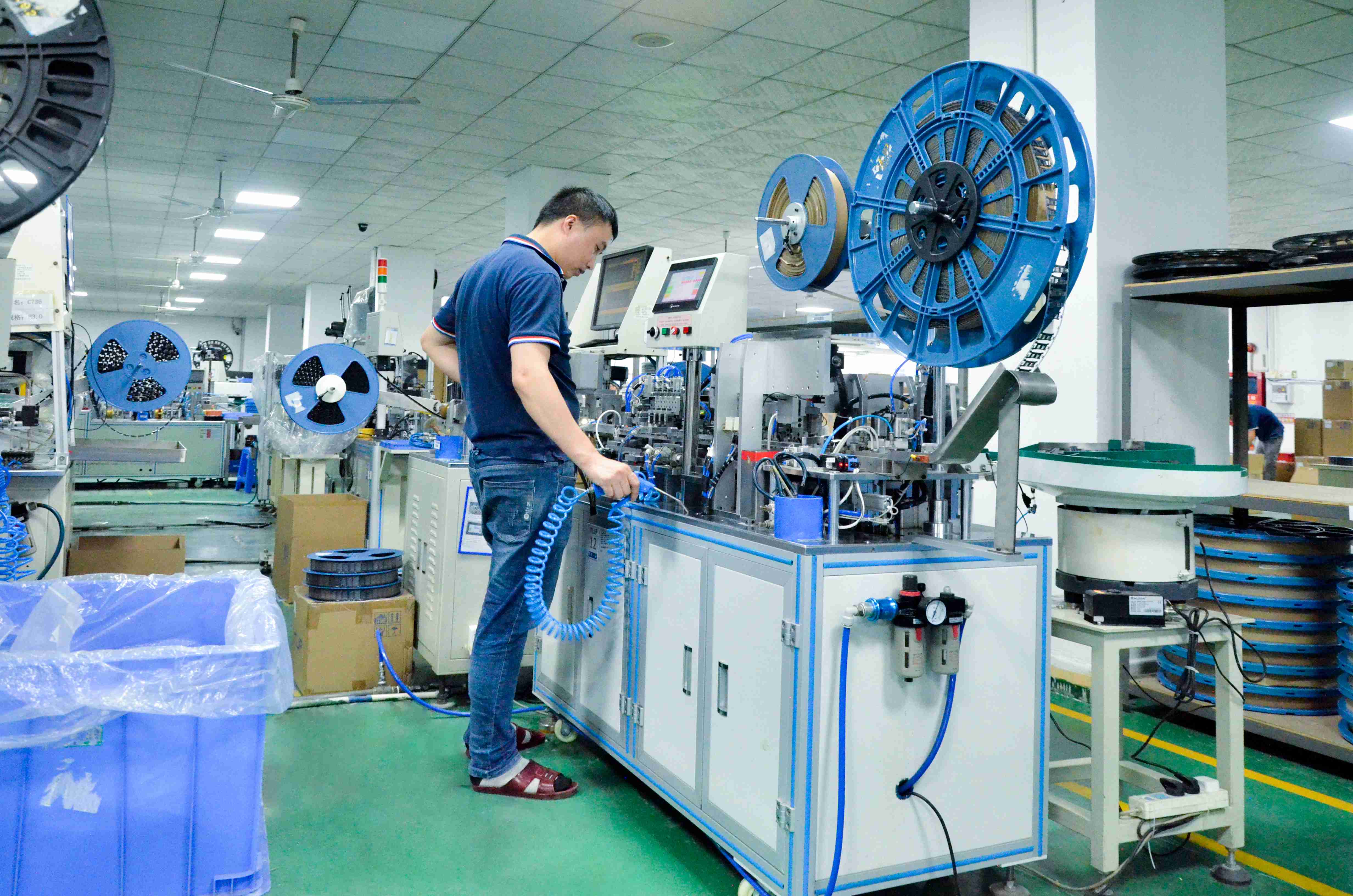
Standard card connector products shipped on industry-standard carrier tape reels, typically 1,000 to 5,000 pieces per reel.
Have Questions or Need More Details?
Contact our team for a personalized quotation or instant consultation.
Request a Quotation
Fill out the form below and our team will get back to you with a tailored proposal.
WhatsApp Direct Chat
Prefer to chat in real-time? Message us on WhatsApp for instant assistance & quick answers.
- Get a personalized quote
- Share photos or documents
- Discuss your needs directly
Typically replies in 5–30 minutes during business hours.