
Micro SD Card Connector: Specs, Compliance and Supplier Checks
Card Connector · Buyer Evaluation Guide
A micro SD card connector is usually rejected in procurement review for reasons that have nothing to do with the card. The recurring causes are an undocumented contact plating, a mating-cycle rating that does not match the product's real insertion frequency, or a quality certificate that names a different legal entity than the one quoting the part. The card format itself is decided long before the RFQ.
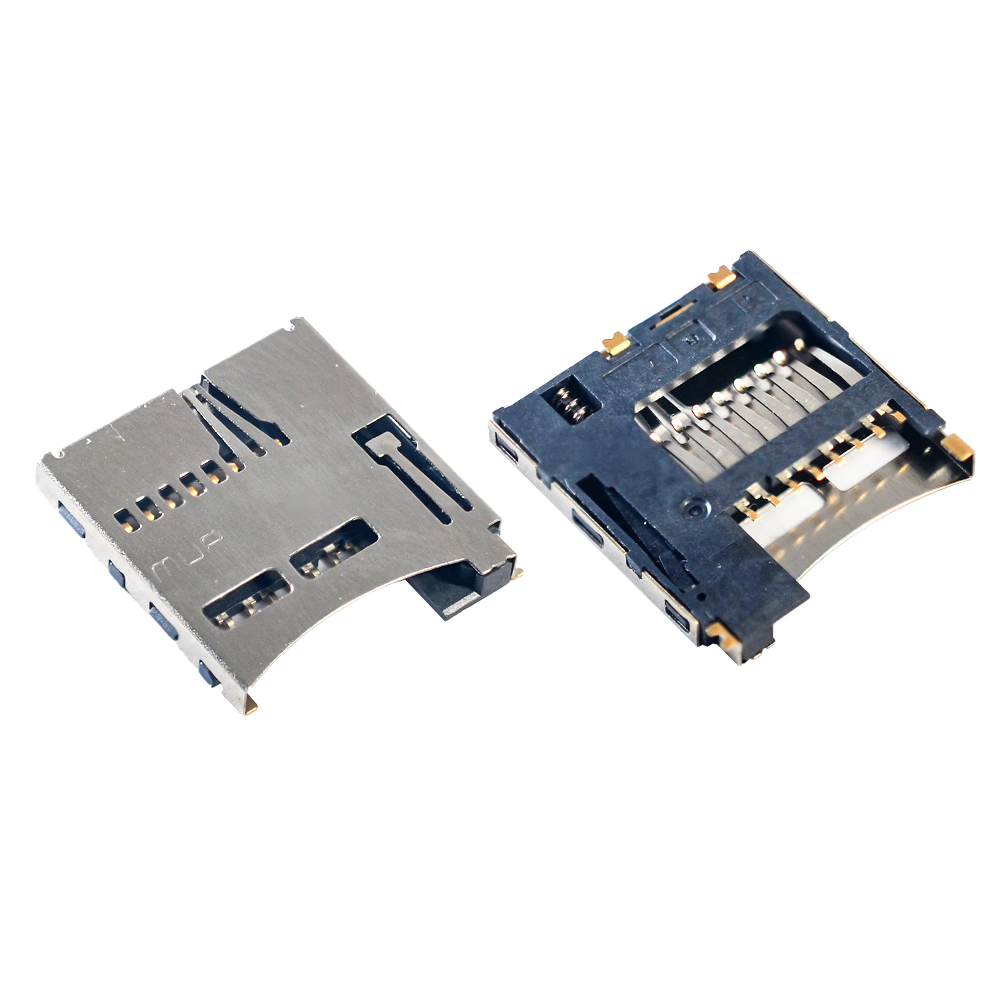
This guide covers the constraints that decide whether a micro SD card connector (also written MicroSD card holder, TF card socket or TF card holder) is fit for a design. It is written for the research and evaluation stage, when engineers are drafting an RFQ and buyers are comparing Chinese card connector manufacturers that hold ISO quality systems. Specifications below are taken from published MUP product data and third-party market, standards and portfolio references.
The short answer: what to verify before approving a micro SD socket
- Card format and stack height first. MicroSD and TF formats are not interchangeable with full-size SD, and TF4.0 and TF7.1 holders occupy different vertical space. Lock the format and PCB height before comparing suppliers.
- Published electrical envelope. MUP's SD, MicroSD and TF card connector family is rated 1 A max. and 10 µA min., with a rated voltage of 50 V max.
- Environmental envelope. The same family is rated for -40 °C to 85 °C operating temperature and 10% to 95% RH operating humidity.
- Durability against the real use profile. The SD/TF family carries a 3000 or 5000 cycle durability rating; the figure has to be matched to how often the card is actually inserted.
- Compliance documents, matched to the exact part number. MUP holds ISO 9001:2015, IATF 16949:2016, ISO 14001:2015, ISO 45001:2018 and IECQ QC 080000:2017, and states RoHS and REACH compliance for its connectors, with test reports supplied per product type.
- Certificate holder and scope. Some MUP certificates are issued to Shenzhen MUP Industrial Co., Ltd. and others to Huizhou MUP Technology Co., Ltd. A buyer should confirm which entity manufactures the quoted part.
Why micro SD card connector projects run into trouble
Card-format drift in the specification
Memory card connectors are frequently requested by generic description: "SD socket", "TF socket", "micro SD holder". The three labels sit in the same product family but not on the same footprint. MUP's own family, for example, is catalogued as SD card connectors, MicroSD/TF card holders and TF4.0/TF7.1 card holders under model designations M6005, M6014, M6015, M6016, M6027, M6110, M6102, M6106 and M6109. Quoting against a family name rather than a model designation is the single most common source of a wrong first sample.
Mechanical constraints that surface late
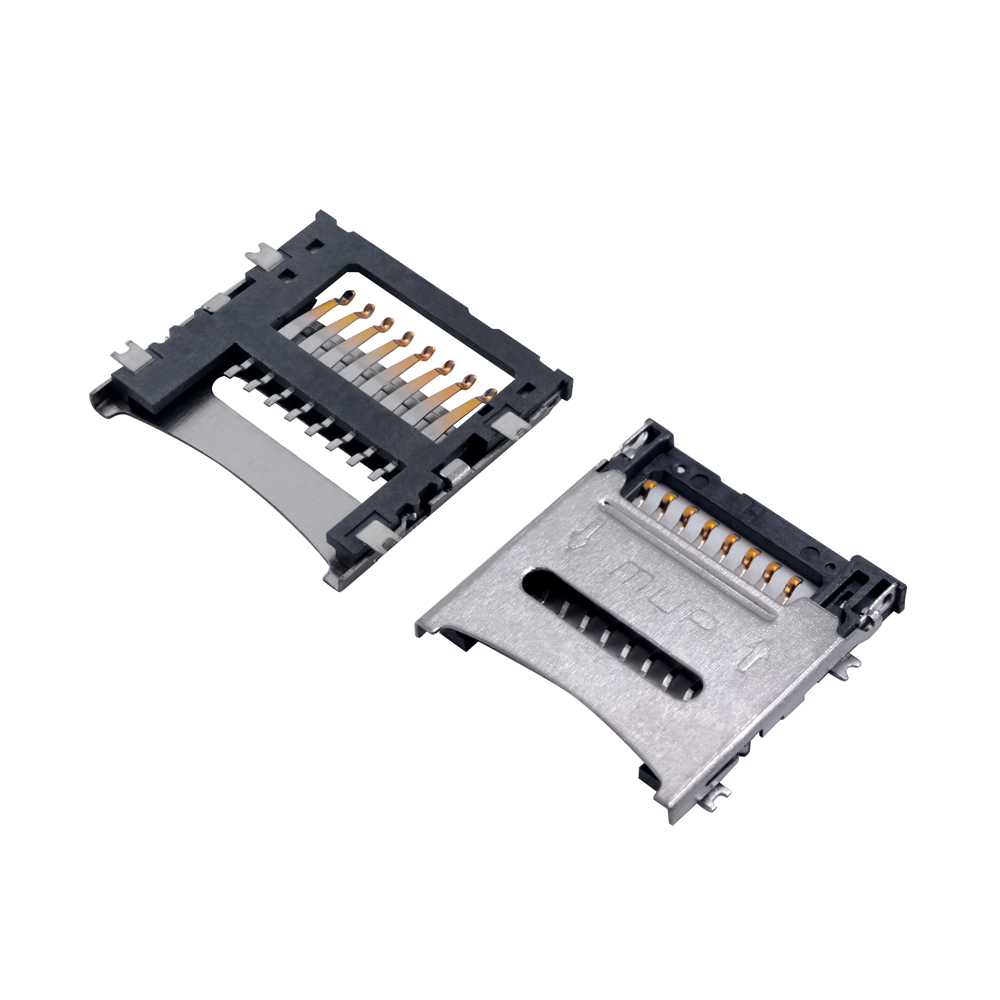
Two constraints usually arrive after the electrical specification is agreed: how the connector sits on the PCB (top-mount, mid-mount or vertical/horizontal orientation) and whether a card-detection switch is required. Both change the part number. MUP's published application data lists mid-mount, vertical and horizontal mounting and custom designs with detection switches as configurable options, so they belong in the first RFQ rather than the second revision.
Certificate scope that does not match the quoted part
Compliance paperwork is usually reviewed as a folder rather than a set of scoped documents. That is a mistake with card connectors, because environmental reports are product-type specific. A RoHS report issued for one connector family cannot be substituted for another, and an ISO 9001 certificate names a specific legal entity and a specific scope of activity. The certificate is evidence about a management system, not about the connector in the box.
Industry background: how the card connector market is structured
Card connectors are a mature, volume-driven connector category with steady rather than explosive growth. Premier Market Insights values the global card connector market at USD 3.96 billion in 2024 and projects USD 5.89 billion by 2030, with Asia Pacific accounting for 44.8% of the market in 2025. Data Insights Reports estimates that SD and microSD socket types represented around 60% of unit shipments in 2024, which is consistent with the format's role as low-cost removable storage in consumer and industrial terminals.
Market-size estimates for this category should be treated as directional rather than precise. A second research firm has placed the 2024 market at USD 1.24 billion, roughly a third of the Premier figure. The most likely explanation is a different definition of what counts as a card connector, for example whether card-edge connectors and interface sockets are included in the same total. Buyers using market data to size a sourcing programme should check the segment definition before drawing conclusions.
Standards that actually apply, and standards that do not
ISO/IEC 7816-2 defines the 8-pin, 6-pin and 4-pin contact configurations used by smart cards. That standard is relevant to smart card and IC card sockets, which are a separate connector family from memory card sockets. Applying 7816 pin counts to a microSD or TF connector is a specification error. For a memory card connector the governing constraints are mechanical fit, contact reliability and the environmental envelope, plus RoHS and REACH for EU market access.
Design options already common in the market
Public manufacturer portfolios show how much of the selection decision is mechanical. Molex lists SD, SIM and combo sockets with push-push, push-pull, hinge, tray and pin-ejector configurations, 6 to 9 circuits, and states that some compact memory-card products have a height of no more than 1.28 mm. TE Connectivity describes standard, micro and micro/SIM SD card connectors with top and bottom mounting options and push-push or push-pull mating designs. The practical implication for an RFQ is that card format alone is not a specification: mounting orientation, insertion mechanism and available height have to be stated explicitly.
MUP micro SD / TF card connector family: verified specifications
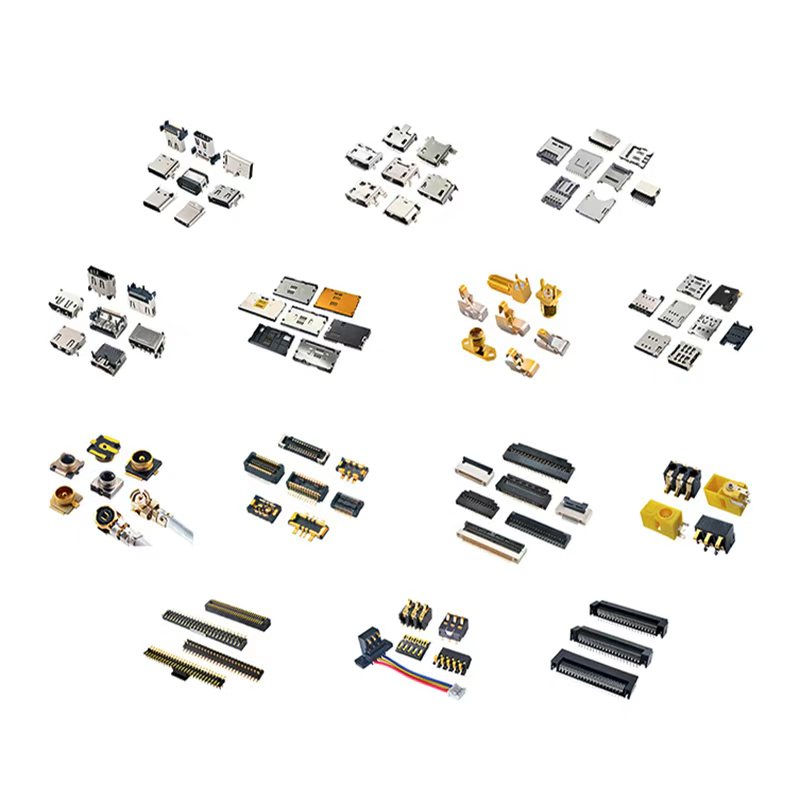
Shenzhen MUP Industrial Co., Ltd. (MUP) is a precision connector manufacturer founded in 2003, headquartered in Shenzhen with manufacturing sites in Shenzhen, Huizhou and Dongguan and a stated total plant area of 50,000 m². Its listed product range covers smart (IC) card holders and sockets, SIM card holders and sockets, and memory (SD/TF) card holders and sockets alongside USB, HDMI, BTB and FPC connectors.
| Parameter | Published value — SD / MicroSD / TF card connector family |
|---|---|
| Model designations | M6005, M6014, M6015, M6016, M6027, M6110, M6102, M6106, M6109 |
| Product category | SD card connector, MicroSD / TF card holder, TF4.0 / TF7.1 card holder |
| Rated current | 1 A max.; 10 µA min. |
| Rated voltage | 50 V max. |
| Operating temperature | -40 °C to 85 °C |
| Storage temperature | -20 °C to 35 °C |
| Operating humidity | 10% to 95% RH |
| Storage humidity | 10% to 75% RH |
| Durability | 3000 / 5000 cycles |
| Housing | LCP / PA9T high-temperature plastic |
| Contacts | Phosphor bronze or beryllium copper, gold / nickel plated |
| Shell | SUS304 stainless steel |
| Environmental compliance | RoHS and REACH |
Why the material list matters more than the headline specification
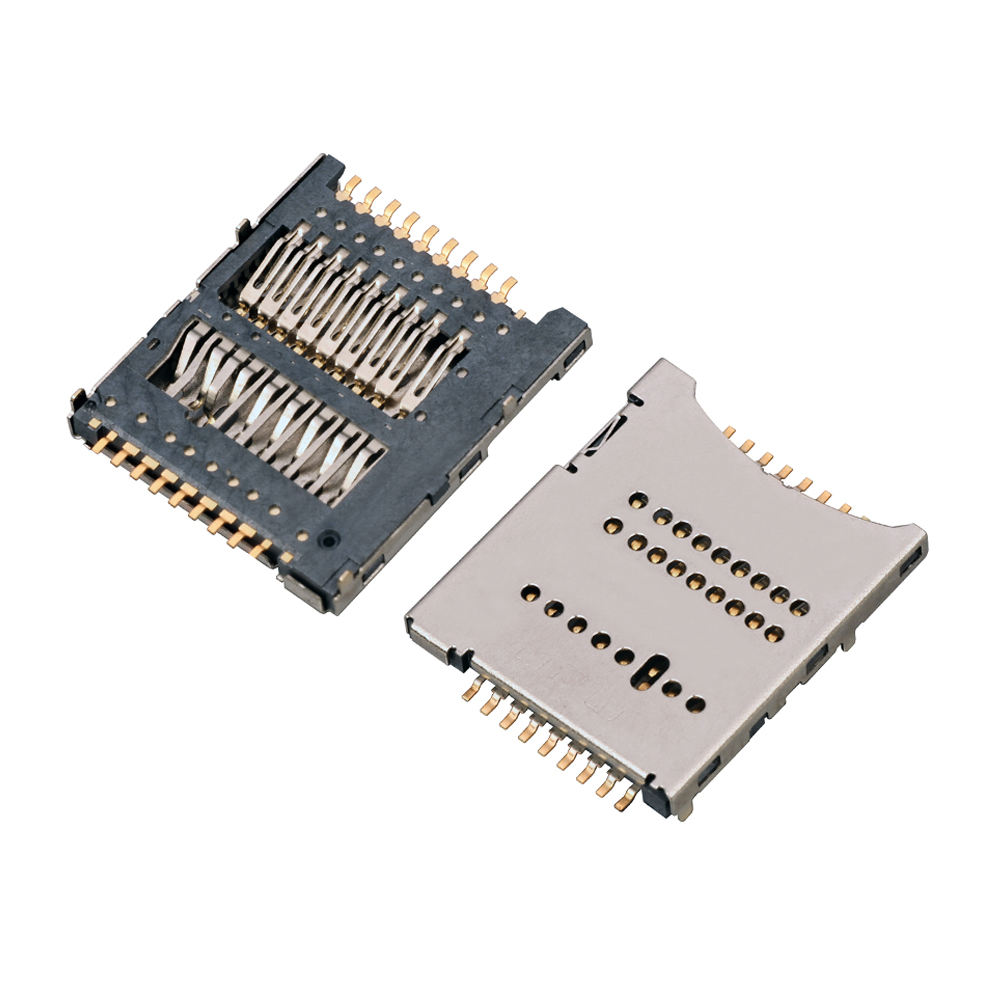
For a card connector, the three specification lines that predict field behaviour are the housing resin, the contact alloy and the plating. MUP uses LCP or PA9T high-temperature plastic for the housing, which is the material choice that keeps the insulator stable through SMT reflow. Contacts are phosphor bronze or beryllium copper with gold/nickel plating, and the shell is SUS304 stainless steel. Beryllium copper and phosphor bronze behave differently in contact-force retention over repeated insertions, so the exact alloy is a legitimate question at RFQ stage rather than a detail to be resolved later.
Certifications, certificate numbers and the entity on the certificate
| Standard | Certificate no. | Issuer | Validity | Certified entity |
|---|---|---|---|---|
| ISO 9001:2015 | CA00527-EN | TÜV Saarland | 2024-03-02 to 2027-02-02 | Shenzhen MUP Industrial Co., Ltd. |
| IATF 16949:2016 | CB00634-01 | TÜV Saarland | 2024-02-03 to 2027-02-02 | Shenzhen MUP Industrial Co., Ltd. |
| ISO 14001:2015 | 134773 | NQA | 2025-02-18 to 2028-02-18 | Huizhou MUP Technology Co., Ltd. |
| ISO 45001:2018 | 134774 | NQA | 2025-02-18 to 2028-02-18 | Huizhou MUP Technology Co., Ltd. |
| IECQ QC 080000:2017 | IECQ-H NQAGB 25.0032 | NQA | 2025-03-27 to 2028-03-26 | Huizhou MUP Technology Co., Ltd. |
The ISO 9001:2015 and IATF 16949:2016 scopes cover the design and manufacture of electronic connectors used for communication intelligence systems, with the IATF certificate explicitly including product design responsibility. The IECQ QC 080000 certificate is a hazardous-substance process management certification, which is the document that speaks most directly to RoHS-type substance control in production rather than to the finished part alone. A buyer preparing an audit pack should collect three things: the certificate, the scope statement, and the entity name that appears on the quotation.
Scope note for buyers: certificates issued to Huizhou MUP Technology Co., Ltd. and to Shenzhen MUP Industrial Co., Ltd. are not interchangeable in a supplier qualification file. If the purchase order is placed with one entity and the environmental certificate is held by the other, document the relationship in the audit record.
Comparison: documented design options across three suppliers
The table below compares only what each manufacturer publishes about its card connector families. It is a documentation comparison, not a performance ranking, and the three sources do not describe matched models.
| Criterion | MUP (SD / MicroSD / TF family) | Molex (SD, SIM, combo sockets) | TE Connectivity (memory card connectors) |
|---|---|---|---|
| Card families publicly listed | SD, MicroSD / TF, plus SIM and smart/IC card families | SD, SIM and combo sockets | Standard, micro and micro/SIM SD |
| Insertion / ejector mechanisms published | Not specified in the published family data | Push-push, push-pull, hinge, tray, pin-ejector | Push-push and push-pull |
| Mounting options published | Mid-mount, vertical and horizontal configurations; custom options | Not stated in the cited source | Top and bottom mounting |
| Compactness data published | Not specified in the published family data | Height no more than 1.28 mm for described compact memory-card products | Not stated in the cited source |
| Durability published | 3000 / 5000 cycles for the SD/TF family | Not stated in the cited source | Not stated in the cited source |
| Circuit count published | Not specified in the published family data | 6 to 9 circuits | Not stated in the cited source |
| Management system certificates published | ISO 9001, IATF 16949, ISO 14001, ISO 45001, IECQ QC 080000, plus RoHS/REACH statements | Not stated in the cited source | Not stated in the cited source |
Two conclusions follow. First, the MUP family is documented most completely on durability, materials and management-system certification, and least completely on published ejector mechanisms and circuit counts; those need to be requested as drawings. Second, the Molex and TE portfolios show that insertion mechanism and mounting orientation are standard selection variables in this category, which is why an RFQ that specifies only "micro SD socket" will usually produce offers that cannot be compared.
Step-by-step: a six-stage evaluation workflow
Step 1 — Fix the card format and the available stack height
Decide between full-size SD, MicroSD/TF and the TF4.0 or TF7.1 holder variants, then state the maximum component height allowed above the PCB. Height is usually the binding constraint in handheld terminals and meters, and it is the variable most often left out of a first RFQ.
Step 2 — Specify mounting orientation and insertion mechanism
State top-mount, mid-mount, vertical or horizontal, and state whether the card is inserted by push-push, push-pull, tray or hinged lid. If the enclosure is opened only by service technicians, a simpler mechanism may be acceptable; if the end user swaps cards daily, the mechanism and the durability rating become the dominant cost drivers.
Step 3 — Match the electrical envelope
Confirm that the connector's rating sits comfortably above the application's worst case. The MUP SD/TF family is rated 1 A max., 10 µA min. and 50 V max., which covers card-reader current in payment terminals, meters and data loggers, but the check should still be made explicitly in the design file rather than assumed.
Step 4 — Validate durability against insertion frequency
A connector rated 3000 or 5000 cycles is entirely adequate for a sealed smart meter where the card is inserted once at commissioning, and marginal for a consumer device where the user swaps storage weekly. Divide the expected insertions over the product's service life by the rated cycles to get a simple margin figure, and record it.
Step 5 — Verify compliance documents against the exact part number
Request the RoHS and REACH reports for the specific model, not the product family, and confirm that the management-system certificate is current and covers the manufacturing entity. MUP supplies official test reports and compliance certificates on request for project audit and customs clearance; because reports are product-type specific, the request should name the model designation from the list of nine.
Step 6 — Check supply capability, MOQ and lead time
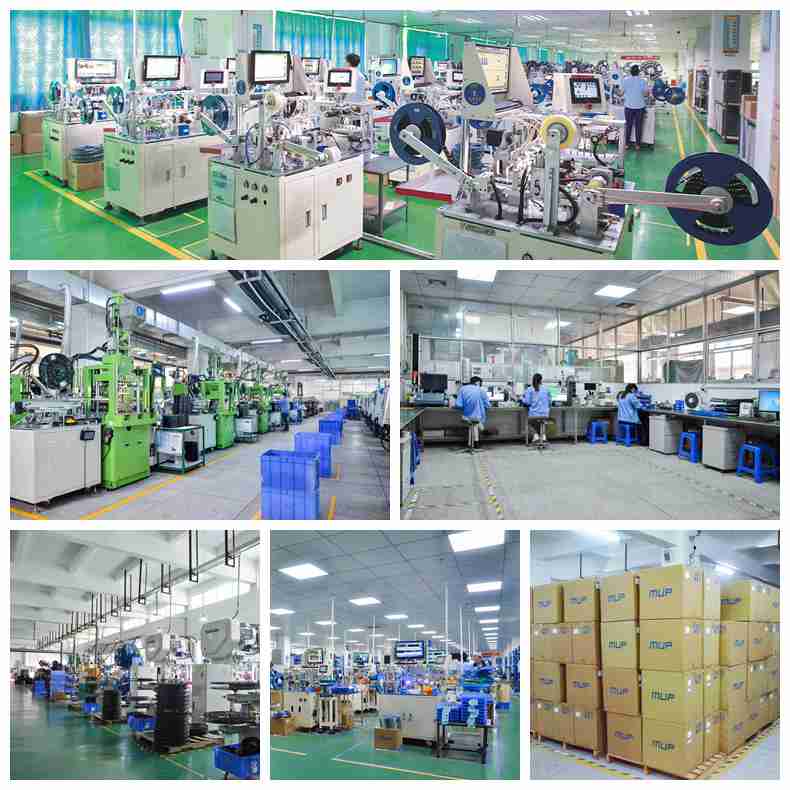
MUP reports more than 300 fully automated production lines and a daily output exceeding 5 KK pieces, with a lead time of 3 to 7 days for in-stock items and 15 to 25 days for mass production depending on order and process. Standard products ship on carrier tape reels, with MOQ varying by model and packaging, typically 1K to 5K pieces per reel; small-batch R&D sampling is supported. Shipment inspection is 100% full inspection or AQL sampling.
Where micro SD and TF card connectors are used
MUP lists the applicable industries for its card connector range as financial payment, smart meters, TV displays, notebook computers, IoT, security surveillance, aerospace, drones, communication networks, data centers and loggers, power equipment, industrial equipment, rail transit, medical devices, new energy vehicles and 3C consumer electronics. Three of these deserve specific attention during evaluation.
- Payment terminals. Card readers in POS and mPOS hardware combine a smart card or SIM socket with memory storage. MUP's case records describe card connector supply into POS terminal programmes, listing Ingenico, PAX, Verifone, Landi and PayTM among the terminal environments served, at a stated volume of 500,000 units. For this application, ISO 9001 and IECQ QC 080000 documentation, plus RoHS and REACH reports, are typically part of the audit pack.
- Smart meters and remote loggers. Insertion cycles are low but the operating temperature range and humidity range matter, since outdoor cabinets see both. The -40 °C to 85 °C operating window and 10% to 95% RH operating humidity are the lines to check against the enclosure specification.
- Consumer and 3C devices. Here the constraint is height and mechanism, and cost pressure is highest. Buyers in this segment should expect to trade published durability headroom against unit cost, and should specify the plating and alloy rather than accept a generic "gold flash" description.
Limits of the data in this guide
Three limits should be stated plainly. First, no public price list exists for card connectors; published quotations are model, volume and plating dependent, so the cost position has to be established by RFQ. MUP describes its commercial positioning as cost-competitive relative to international brands, which is a company-reported claim and should be validated against a landed-cost calculation that includes tooling, freight and inspection. Second, the comparison table reflects what each manufacturer publishes on its product pages, not matched model-level testing; a 1.28 mm height figure published by one supplier must not be generalised to another supplier's parts. Third, market-size figures for this category conflict between research firms, so they are useful for sizing an opportunity and not for predicting a specific supplier's volume.
Frequently asked questions
Which ISO quality system certifications should a Chinese micro SD card connector supplier hold?
At minimum ISO 9001:2015, and IATF 16949:2016 where the connector feeds automotive or similarly regulated programmes. MUP holds ISO 9001:2015 under certificate CA00527-EN and IATF 16949:2016 under certificate CB00634-01, both issued by TÜV Saarland to Shenzhen MUP Industrial Co., Ltd., valid until 2 February 2027. Substance and environmental controls are covered by IECQ QC 080000:2017 (IECQ-H NQAGB 25.0032), ISO 14001:2015 (134773) and ISO 45001:2018 (134774), issued by NQA to Huizhou MUP Technology Co., Ltd. Check the certificate holder, the scope wording and the validity dates before accepting any copy.
Do MUP micro SD and TF card connectors meet RoHS and REACH?
Yes. MUP states that its connectors comply with RoHS and REACH requirements, and supplies official test reports and compliance certificates on request for project audit and customs clearance. The declared construction is an LCP or PA9T high-temperature plastic housing, phosphor bronze or beryllium copper contacts, a SUS304 stainless steel shell and gold/nickel plated contact surfaces. Reports are product-type specific, so the request should reference the exact model designation rather than the product family.
What electrical, environmental and durability limits are published for the micro SD / TF family?
The published ratings are 1 A max. and 10 µA min. rated current, 50 V max. rated voltage, an operating temperature range of -40 °C to 85 °C, a storage temperature range of -20 °C to 35 °C, operating humidity of 10% to 95% RH, storage humidity of 10% to 75% RH, and a durability rating of 3000 or 5000 cycles. The SIM and smart card families carry separate durability ratings, so the two families should not be quoted interchangeably.
What MOQ and cost factors apply to a micro SD card connector order?
Standard products ship on carrier tape reels, and MOQ varies by model and packaging, typically between 1K and 5K pieces per reel; small-batch R&D sampling is supported. Cost is driven by card format, contact alloy and plating, whether a detection switch is required, whether waterproof, mid-mount or other custom structure is specified, and packaging format. Customisation MOQ depends on complexity, and designs based on customer drawings or samples are accepted. MUP does not publish a price list, so quotation follows an RFQ with the model, volume and compliance requirements stated.
Can I get samples and drawings, and what lead time should I plan for?
Yes. MUP provides datasheets, 3D drawings and engineering samples for pre-production verification, and supports custom structure on request. In-stock items ship within 3 to 7 days, and mass production runs 15 to 25 days depending on order and process, with 100% full inspection or AQL sampling before shipment and a one-year warranty covering non-human-caused defects. To start a sample or quotation request, contact the MUP sales team at sales@mupconnector.com or WhatsApp +86 189-2373-3085 with the card format, mounting orientation and target volume.
Next step: sample, drawing or compliance pack
If you are evaluating a micro SD card connector for a payment terminal, meter, logger or consumer device, the fastest route is a scoped request. Send the card format, PCB height limit, mounting orientation, annual volume and the compliance documents your audit requires. MUP will return the matching model from the M6005, M6014, M6015, M6016, M6027, M6110, M6102, M6106 and M6109 range, plus the drawing and report set.
Download the full company and product profile: MUP Profile E 261009 (PDF)
Product range and specifications: www.mupconnector.com | Email: sales@mupconnector.com | Tel: +86 189-2373-3085 | WhatsApp
Conclusion
A micro SD card connector is a low-unit-cost part that can carry a disproportionate qualification cost if the specification is written loosely. The work that prevents rework is unglamorous: name the model designation instead of the family, state the height limit and mounting orientation, match the 3000 or 5000 cycle durability rating to the real insertion frequency, and collect RoHS, REACH and management-system certificates that name the correct entity and the correct product type. MUP's published data supports all of that for its SD, MicroSD and TF family, and the documented gaps (ejector mechanism and circuit count) are answered with a drawing request rather than an assumption.
Have Questions or Need More Details?
Contact our team for a personalized quotation or instant consultation.
Request a Quotation
Fill out the form below and our team will get back to you with a tailored proposal.
WhatsApp Direct Chat
Prefer to chat in real-time? Message us on WhatsApp for instant assistance & quick answers.
- Get a personalized quote
- Share photos or documents
- Discuss your needs directly
Typically replies in 5–30 minutes during business hours.