
Nano SIM Card Connector Specs: Parameters, Materials, ISO Compliance
A Nano SIM card connector — also written Nano SIM card holder or Nano SIM card socket — is the PCB-mounted interface that seats a Nano SIM (4FF) card and holds its contact pads against the socket terminals. It is a constraint-driven part: the card form factor fixes the mechanics, and the purchase decision is settled by the parameter band, the contact material, and compliance documents that name the exact part number.
This page is written for buyers and hardware engineers in the research-to-evaluation stage, and it stays on the constraint layer. It sets out what a Nano SIM socket has to meet, what Shenzhen MUP Industrial Co., Ltd. (MUP) publishes for its SIM card connector range, which certificates apply to which claim, and how to run the qualification in a fixed order so that the paperwork and the part number still agree at the end.
The constraint facts in one place
- MUP SIM / smart-card connector range: rated current 1 A max., 10 µA min.; rated voltage 50 V max.; operating temperature −40 °C to 85 °C.
- Durability published for that range: 5,000 / 50,000 / 100,000 cycles.
- Housing LCP/PA9T high-temperature plastic; contacts phosphor bronze or beryllium copper, gold/nickel plated; shell SUS304 stainless steel.
- Quality systems: ISO 9001:2015, IATF 16949:2016, ISO 14001:2015, ISO 45001:2018, IECQ QC 080000:2017; product-level RoHS and REACH compliance.
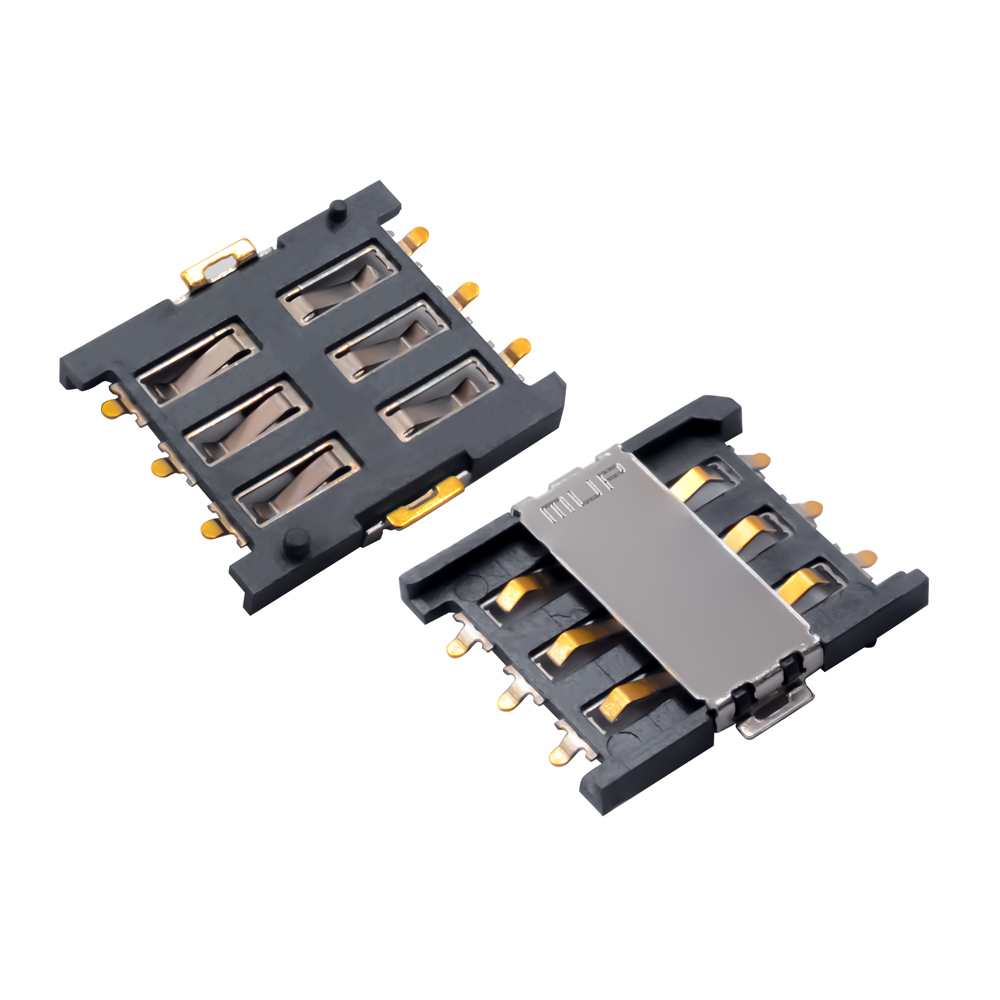
The Constraint Stack Behind a "Commodity" Card Socket
A Nano SIM card connector is usually bought late and specified quickly. It costs little relative to the board it sits on, it is often copied from a reference design, and the compliance file is assembled after the first purchase order. That sequence is where specification risk enters, because the socket is governed by six constraint groups and each one produces a document that a buyer is expected to check.
- Mechanical: card form factor, PCB footprint, height, top or bottom mounting, and insertion or ejection style.
- Electrical: rated current band, including the minimum current figure, and rated voltage.
- Environmental: operating and storage temperature, operating and storage humidity.
- Durability: mating cycles, and the test condition behind the cycle number.
- Material: housing plastic, contact alloy, contact finish, shell alloy.
- Compliance: management-system certificates plus product-level RoHS and REACH evidence.
Three failure modes recur across these groups. The first is documentation mismatch. MUP's own guidance on compliance documentation states the point directly: certificates are product-type specific, and reports for different types cannot be used interchangeably. A RoHS report issued for a USB Type-C receptacle is not a RoHS report for a Nano SIM socket, even when both come from the same factory and the same quality system.
The second is silent material substitution. A lower quotation can be reached by changing the housing plastic or thinning the contact finish. The two specification lines that expose this are the housing material — LCP/PA9T high-temperature plastic in the MUP SIM range — and the contact construction, gold/nickel plating over phosphor bronze or beryllium copper, inside a SUS304 stainless steel shell.
The third is a durability figure with no test reference attached. A cycle count is only meaningful when the buyer knows whether it describes a qualification test on the contact system or a general product-family rating. For the MUP SIM and smart-card connector range, the published rating is expressed as 5,000, 50,000 or 100,000 cycles depending on the model, which is a family range rather than a single guaranteed number for every part number.
What the Card Connector Market Looks Like from a Sourcing Desk
The category the Nano SIM socket sits in is large, slow-moving and geographically concentrated. Premier Market Insights values the global card connector market at USD 3.96 billion in 2024 and projects USD 5.89 billion by 2030, with Asia Pacific holding 44.8% of that market in 2025. The same research package records a competing 2024 estimate of USD 1.24 billion, with the difference attributed to whether card-edge products or interface sockets are included — a useful reminder to read any market figure as a scope statement before using it in a business case.
Within the category, memory-card sockets dominate volume. Data Insights Reports attributes 60% of unit shipments in 2024 to SD and microSD socket types, which places SIM, Nano SIM and smart-card sockets in a smaller but more heavily specified share of the market: fewer units, more per-unit constraints, and a higher cost of getting the specification wrong.
Two published facts frame the technical side. ISO/IEC 7816-2 defines 8-pin, 6-pin and 4-pin contact configurations for smart cards, which is the contact-count and contact-position logic that runs through how SIM and smart-card sockets are specified. And the mechanical interface is a design variable rather than a given: Molex lists SD, SIM and combo sockets with 6 to 9 circuits across push-push, push-pull, hinge, tray and pin-ejector configurations, and states a height of no more than 1.28 mm for its described compact memory-card products; TE Connectivity describes standard, micro and micro/SIM SD card connectors with top and bottom mounting and push-push or push-pull mating designs. Neither statement ranks one supplier above another — both simply show how much of the constraint stack is negotiable at the drawing stage.
MUP Nano SIM Card Connector Range: Published Parameters
Shenzhen MUP Industrial Co., Ltd. (MUP) is a precision connector manufacturer founded in 2003, headquartered in Shenzhen with manufacturing sites in Shenzhen, Huizhou and Dongguan. Its SIM card connector product group is listed under models C7006, C7013, C7017, C7020, C7034, C7050, C7060, C7801, C7802, C7081, C7082, C7083, C7090, C7091, C7092, C7093, C7803, C7808, C7810, C7825, C7905, C8001, C8037, C8042, C8043, C8057, C8067, C8068, C8610, C8611, C8618, C8621, C8622, C8629 and C8633, and covers Nano SIM card connectors alongside Micro SIM card holders, SIM card sockets, smart card sockets and IC card holders.
| Specification | Published value for the MUP SIM / smart-card connector range |
|---|---|
| Rated current | 1 A max., 10 µA min. |
| Rated voltage | 50 V max. |
| Operating temperature | −40 °C to 85 °C |
| Storage temperature | −20 °C to 35 °C |
| Operating humidity | 10% to 95% RH |
| Storage humidity | 10% to 75% RH |
| Durability | 5,000 / 50,000 / 100,000 cycles |
| Housing material | LCP/PA9T high-temperature plastic |
| Contact material | Phosphor bronze or beryllium copper |
| Contact finish | Gold/nickel plated |
| Shell material | SUS304 stainless steel |
| Environmental compliance | RoHS and REACH |
| Quality system coverage | IATF 16949 and IECQ QC 080000 certified production |
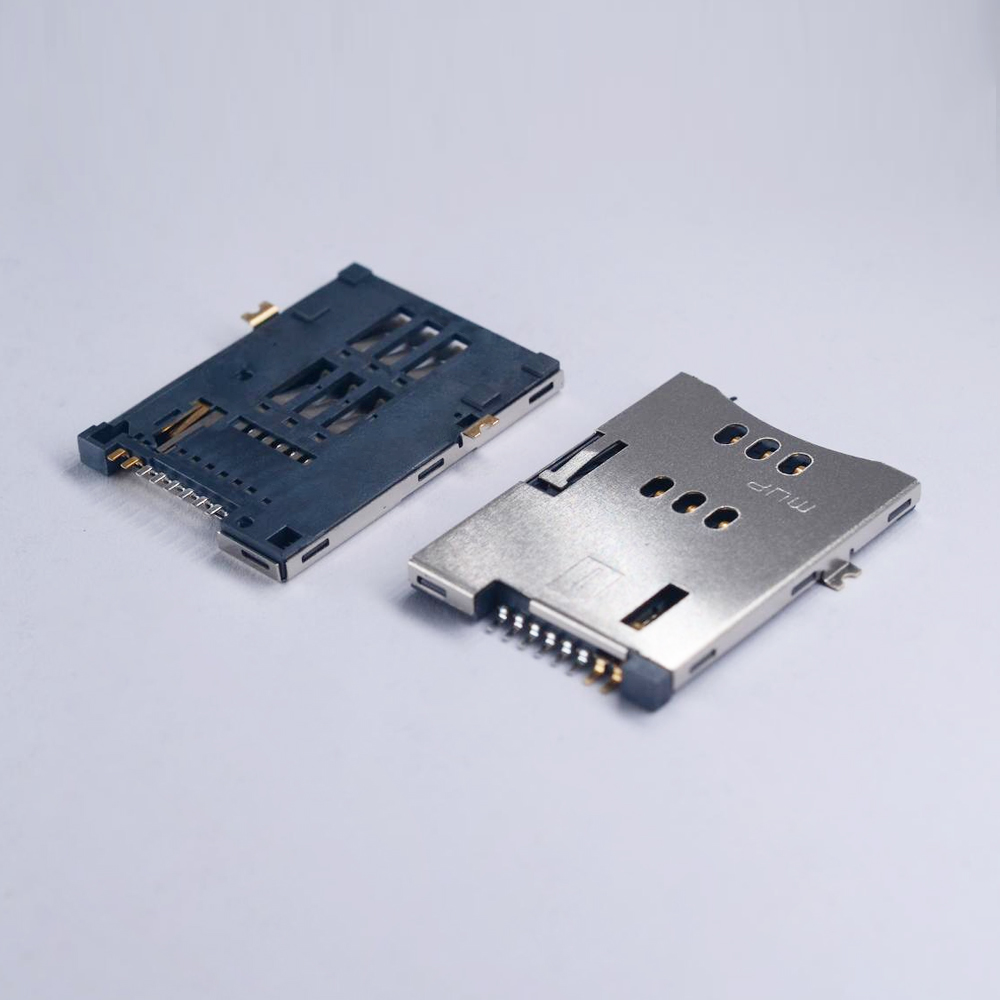
The operating band of −40 °C to 85 °C at 10% to 95% RH is the number to hold against the enclosure and the field environment. If the product will sit outside that band, the constraint has to be renegotiated with the supplier before tooling rather than tested after it. The 10 µA minimum current figure deserves equal attention: a socket characterized only as "1 A" has not been described at the microamp level that a battery-powered IoT terminal actually draws.
Customization and capacity behind the standard range
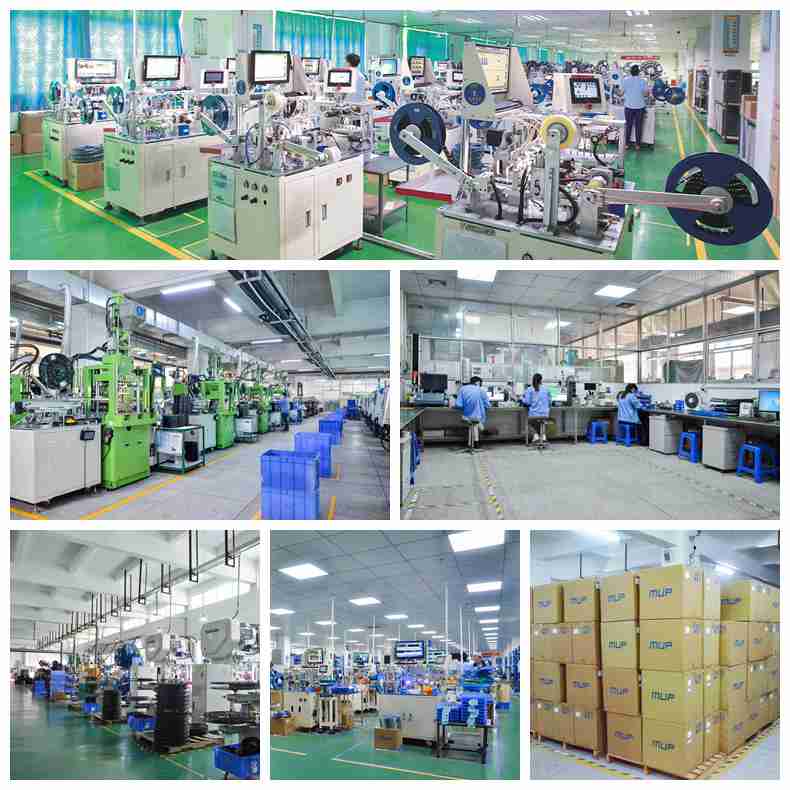
MUP states that it supports custom designs including waterproof versions, mid-mount versions and versions with a detection switch, with customization available on specifications, dimensions, pin counts and interface types. Mold development is handled in-house with 50 precision mold processing machines, and the company reports daily output above 5KK pieces and monthly capacity above 150KK pieces on automated lines. MOQ is quoted per reel and varies by model and packaging, typically 1K to 5K PCS per reel, and small-batch R&D sampling is supported.
Which Certificate Covers Which Claim
A compliance file is only useful when each document names the legal entity, the standard, the scope and the validity period. The table below reproduces the management-system certificates held for MUP's connector operations in the form in which they are published, including the certificate holder where it differs from the Shenzhen sales entity.
| Certificate | Standard | Certificate no. | Issuer | Validity | Scope and holder |
|---|---|---|---|---|---|
| Quality management system | ISO 9001:2015 | CA00527-EN | TÜV Saarland | 2024-03-02 to 2027-02-02 | Design and manufacture of electronic connectors used for communication intelligence systems; holder Shenzhen MUP Industrial Co., Ltd. |
| Automotive quality management | IATF 16949:2016 | CB00634-01 | TÜV Saarland | 2024-02-03 to 2027-02-02 | Design and manufacture of electronic connectors used for communication intelligence systems, with product design responsibility |
| Environmental management | ISO 14001:2015 | 134773 | NQA | 2025-02-18 to 2028-02-18 | Design, production and sales of electronic connectors, harnesses and cables, hardware and plastic components for PCBs; holder Huizhou MUP Technology Co., Ltd. |
| Occupational health and safety | ISO 45001:2018 | 134774 | NQA | 2025-02-18 to 2028-02-18 | Design, production and sales of electronic connectors and related components; holder Huizhou MUP Technology Co., Ltd. |
| Hazardous substance process management | IECQ QC 080000:2017 | IECQ-H NQAGB 25.0032 | NQA | 2025-03-27 to 2028-03-26 | Design and production of electronic connectors, harnesses and cables, hardware and plastic components for PCBs, excluding products requiring 3C certification; holder Huizhou MUP Technology Co., Ltd. |
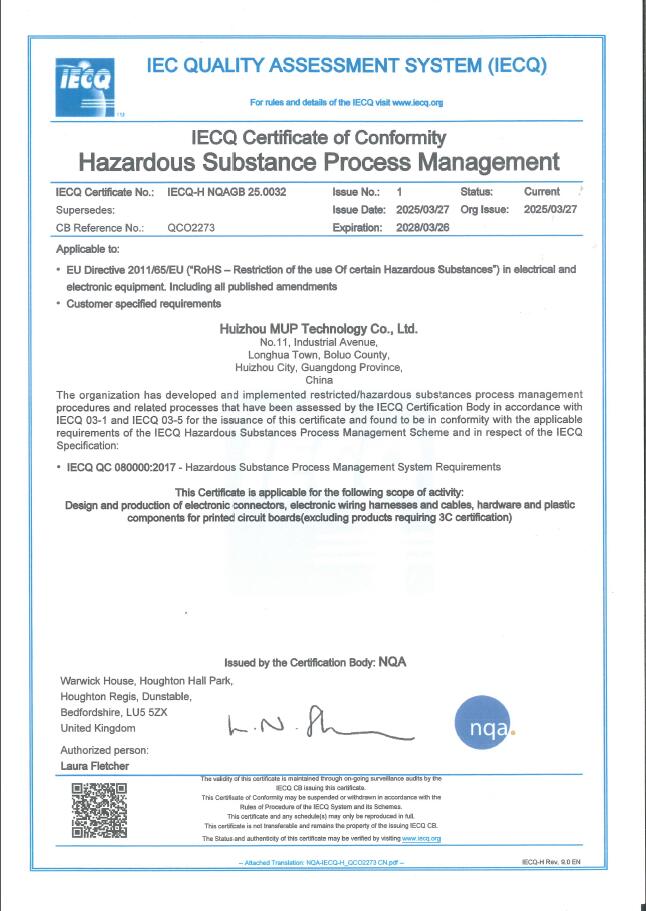
Management-system certificates sit above the product. Below them sit the product-level documents: the SIM card connector range is stated to comply with RoHS and REACH, and official test reports and compliance certificates can be provided on request for project audit and customs clearance. MUP also states that halogen-free documentation can be supplied where a programme requires it, and that each batch can support third-party testing if the customer requires it.
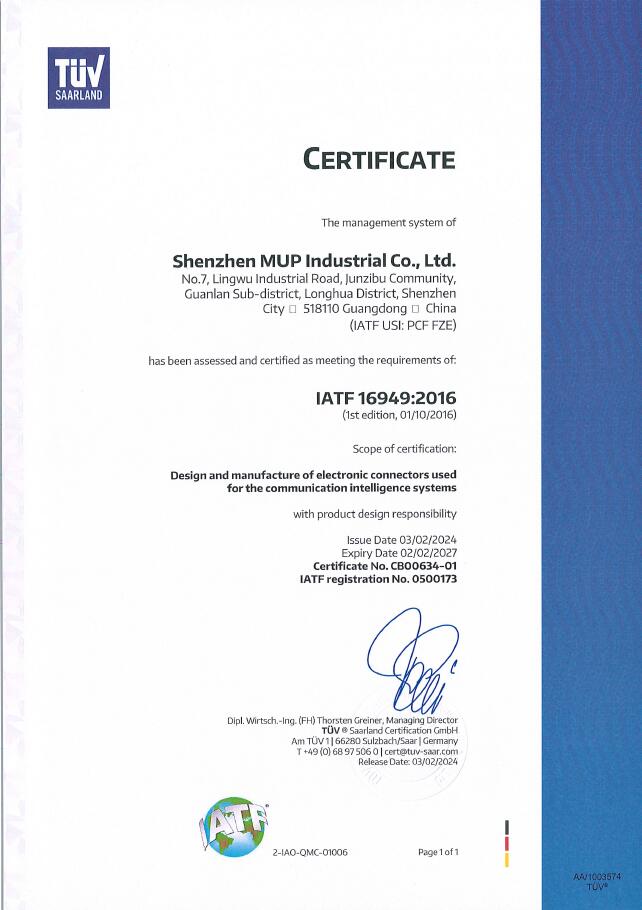
Four checks that catch most document problems
- Entity. Confirm the certificate names the legal entity you are contracting with. The ISO 14001, ISO 45001 and IECQ QC 080000 certificates in this file are issued to Huizhou MUP Technology Co., Ltd., while ISO 9001 and IATF 16949 name Shenzhen MUP Industrial Co., Ltd. For a supplier audit, ask for the relationship between the entities and for the site allocation of your production.
- Scope line. A certificate covering connectors does not automatically cover every connector family; check the wording of the scope, including exclusions such as products requiring 3C certification.
- Validity. All five certificates listed above carry visible issue and expiry dates. Keep the dates in the file and re-check them at each annual review rather than assuming a certificate stays current.
- Part number. Link the product-level RoHS and REACH reports to the model you are ordering. This is the check that catches the interchangeable-report error described earlier.
Step-by-Step: Specifying and Qualifying a Nano SIM Card Connector
- Fix the mechanical interface first. Card form factor, footprint, height, top or bottom mounting, and insertion or ejection style. Current supply shows how wide the option set is — push-push, push-pull, hinge, tray and pin-ejector configurations appear across published portfolios, with 6 to 9 circuit variants listed by Molex and top and bottom mounting listed by TE Connectivity. Do not let a reference design make this decision by default.
- Write the electrical band as a range, not a headline. The MUP SIM range is rated 1 A max. and 10 µA min. at 50 V max. Both ends of the current band belong in your specification, because a low-power IoT terminal is characterized by the bottom of the band, not the top.
- Set environmental and durability targets from the field. Operating −40 °C to 85 °C at 10% to 95% RH, with durability quoted against the application: 5,000, 50,000 or 100,000 cycles within the MUP SIM range. A payment terminal and a smart meter do not need the same cycle count, so state the one you need and ask for the test reference behind it.
- Lock material and finish in the drawing. LCP/PA9T housing, phosphor bronze or beryllium copper contacts, gold/nickel plating, SUS304 shell. These are the lines a cost-down quotation will move first, so they belong in the drawing rather than in a general description.
- Map certificates to the exact part number. Use the certificate table above, then confirm entity, scope, validity and the product-level RoHS/REACH report naming the model you are buying.
- Validate on samples and drawings before tooling. MUP provides datasheets, 3D drawings and engineering samples for pre-production verification, supports small-batch R&D sampling, and offers custom structure on request. Sample approval is the point where the mechanical constraint stops being a document and becomes a fit check on your PCB.
- Agree the commercial frame last. MOQ per reel is typically 1K to 5K PCS depending on model and packaging; standard products ship on carrier tape reels; in-stock items ship within 3 to 7 days, and mass production runs 15 to 25 days depending on order and process. Fixing these after the technical specification avoids renegotiating price when a drawing change lands.
Where Nano SIM Card Connectors Are Used
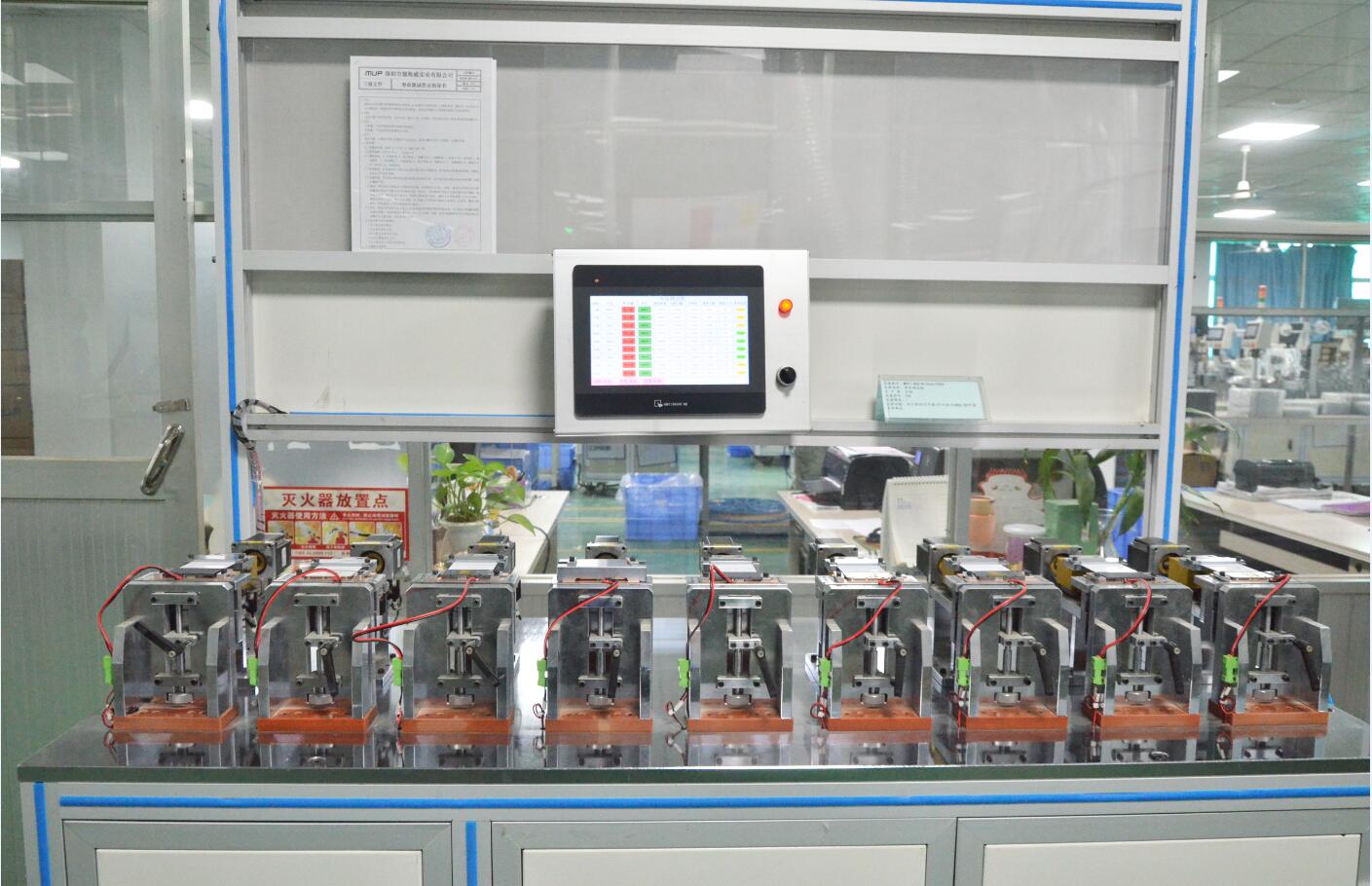
The MUP card connector range lists applications across financial payment, smart meters, TV displays, notebook computers, IoT, security surveillance, aerospace, drones, communication networks, data centre and logger equipment, power equipment, industrial equipment, rail transit, medical devices, new-energy vehicles and 3C consumer electronics. What changes between those applications is not the socket family but the constraint that leads.
Payment terminals, POS and mPOS
Payment hardware is the application where card-reader cycles and contact reliability lead the specification. MUP's application data lists smart meters, POS and sound-box devices, PayTM and financial payment terminals among the primary scenarios, with matched equipment including the motherboard or PCB, FPC, the smart/SIM/MicroSD card, the card reader chip, the terminal housing and the antenna module. One listed MUP case reference covers 500,000 units for card-reader and mobile-POS applications, with service durations between 3 and 15 years, and lists low cost, proximity payment, NFC and high reliability among the highlights of that deployment.
Smart meters and utility terminals
Utility meters run continuously and are frequently installed where temperature and humidity are not controlled. MUP's scenario data specifies 24/7 operation for this group and lists waterproof IPX7/IPX8, dustproof, high-temperature resistance and anti-vibration among the special requirements, together with detection-switch options, mid-mount, vertical and horizontal mounting, and compliance with IATF 16949 and IECQ QC 080000. This is the application where the 85 °C upper limit of the standard band and the custom waterproof option matter most.
IoT terminals, wearables and industrial control
Battery-powered devices shift the emphasis to the 10 µA minimum current and to the contact finish, because a low-current circuit is more sensitive to surface condition than a high-current one. Industrial control panels and rail or medical equipment shift it back to vibration, mounting orientation and the temperature band. None of these applications needs a different Nano SIM socket family; each needs a different constraint written first.
How the Card Connector Families Compare
The Nano SIM socket belongs to the SIM and smart-card group, which MUP publishes separately from its memory-card group. Keeping the two groups distinct at the RFQ stage avoids the common error of issuing one generic "card connector" enquiry and receiving two incompatible quotations.
| Attribute | SIM / smart-card group | Memory card group (SD / MicroSD / TF) |
|---|---|---|
| Listed product types | Nano SIM card connector, Micro SIM card holder, SIM card socket, smart card socket, IC card holder / housing | SD card connector, MicroSD / TF card holder, TF4.0 / 7.1 card holder |
| Model series (MUP) | C7006, C7013, C7017, C7020, C7034, C7050, C7060, C7081, C7082, C7083, C7090, C7091, C7092, C7093, C7801, C7802, C7803, C7808, C7810, C7825, C7905, C8001, C8037, C8042, C8043, C8057, C8067, C8068, C8610, C8611, C8618, C8621, C8622, C8629, C8633 | M6005, M6014, M6015, M6016, M6027, M6102, M6106, M6109, M6110 |
| Rated current / voltage | 1 A max., 10 µA min. / 50 V max. | 1 A max., 10 µA min. / 50 V max. |
| Operating temperature | −40 °C to 85 °C | −40 °C to 85 °C |
| Operating / storage humidity | 10%–95% RH / 10%–75% RH | 10%–95% RH / 10%–75% RH |
| Durability | 5,000 / 50,000 / 100,000 cycles | 3,000 / 5,000 cycles |
| Housing / contacts / shell | LCP/PA9T high-temperature plastic; phosphor bronze or beryllium copper, gold/nickel plated; SUS304 shell | LCP/PA9T high-temperature plastic; phosphor bronze or beryllium copper, gold/nickel plated; SUS304 shell |
| Typical application emphasis | Subscriber identity, payment and secure-card reading, metering, IoT terminals | Removable data storage in consumer and embedded devices |
The practical reading is that both groups share the same electrical band, the same temperature window and the same material set, and differ mainly on durability and on the card interface they present. If a design needs one socket for a subscriber identity card and another for removable storage, the two should be specified separately — one durability target does not fit both.
FAQ
Which ISO quality systems should a Chinese Nano SIM card connector manufacturer hold?
A workable file covers quality, automotive-grade quality, environment, occupational health and safety, and hazardous-substance process control. For MUP that means ISO 9001:2015 certificate CA00527-EN issued by TÜV Saarland (valid 2024-03-02 to 2027-02-02), IATF 16949:2016 certificate CB00634-01 issued by TÜV Saarland (2024-02-03 to 2027-02-02) with product design responsibility in scope, ISO 14001:2015 certificate 134773 issued by NQA (2025-02-18 to 2028-02-18), ISO 45001:2018 certificate 134774 issued by NQA (2025-02-18 to 2028-02-18) and IECQ QC 080000:2017 certificate IECQ-H NQAGB 25.0032 issued by NQA (2025-03-27 to 2028-03-26), plus RBA membership of the company's stated certification set. The environmental, safety and IECQ certificates are held by Huizhou MUP Technology Co., Ltd.; the ISO 9001 and IATF 16949 certificates name Shenzhen MUP Industrial Co., Ltd. Reviewers should confirm the entity relationship and the site allocation before closing the audit.
What electrical and durability ratings should I check on a Nano SIM card connector?
Check five numbers: rated current, rated voltage, operating temperature, operating humidity and mating cycles. The MUP SIM and smart-card connector range is rated 1 A max. and 10 µA min. at 50 V max., operates from −40 °C to 85 °C at 10% to 95% RH, and publishes durability as 5,000, 50,000 or 100,000 cycles depending on model. The materials behind those ratings are LCP/PA9T high-temperature plastic housing, phosphor bronze or beryllium copper contacts with gold/nickel plating, and a SUS304 stainless steel shell.
What drives the unit price of a Nano SIM card connector?
Customization complexity is the largest driver: MOQ depends on that complexity, and MUP quotes it per reel — typically 1K to 5K PCS per reel depending on model and packaging, with small-batch R&D sampling supported. Housing material, contact alloy, plating specification and the amount of testing requested also move the price, because each of those lines is written into the drawing. MUP states that its pricing runs 20% to 30% below international brands; that is a company-stated positioning, and the reviewed public sources contained no comparable list or transaction price for Nano SIM sockets, so the claim should be tested against a like-for-like RFQ covering the same materials, plating and test scope.
Can I get samples and drawings before qualification?
Yes. MUP provides datasheets, 3D drawings and engineering samples for pre-production verification, supports small-batch R&D sampling, and accepts customization requests based on drawings or samples. Sample approval should cover the mechanical fit on your PCB, the card insertion and ejection behaviour, and confirmation that the RoHS and REACH reports provided name the exact model being sampled.
What is the lead time for a Nano SIM card connector order?
In-stock items ship within 3 to 7 days. Mass production runs 15 to 25 days depending on order and process, supported by a reported daily capacity above 5KK pieces and monthly capacity above 150KK pieces on automated lines, with standard products supplied on carrier tape reels. A staged plan — sample approval first, then a reel-level pilot order, then volume — keeps the technical and commercial timelines from colliding. To start that sequence, send the card format, mounting style, durability target and required compliance documents to the MUP team.
Next step: sample, drawing and compliance pack
Share your card format, mounting orientation, durability target and the compliance documents your project requires, and MUP will confirm the matching Nano SIM card connector model, issue drawings and arrange a sample.
- Email: sales@mupconnector.com
- Tel / WhatsApp: +86 189-2373-3085
- Website: www.mupconnector.com
- Address: Rm.101, No.7, Lingwu Industrial Park, Junzibu, Guanlan Street, Longhua District, Shenzhen, 518110, Guangdong Province, China
- Company profile and full product catalogue: download the MUP Profile (PDF)
Conclusion
A Nano SIM card connector is not a difficult part to buy, but it is an easy part to under-specify. The constraint stack is short and entirely checkable: a mechanical interface you define, an electrical band you write as a range, an environmental window of −40 °C to 85 °C at 10% to 95% RH, a durability figure tied to your application, a material and finish set written into the drawing, and a compliance file whose certificates name the right entity, scope and part number.
MUP's contribution to that stack is published rather than implied: model-level listings across the C70xx and C80xx SIM and smart-card range, parameter values down to the 10 µA minimum current, durability stated as 5,000 / 50,000 / 100,000 cycles, LCP/PA9T housing with phosphor bronze or beryllium copper contacts and SUS304 shells, and five management-system certificates with visible numbers, issuers and validity periods. Whether MUP is the right supplier for a given programme is still a question for the audit and the sample — but the documents needed to answer it are already on the table.
Have Questions or Need More Details?
Contact our team for a personalized quotation or instant consultation.
Request a Quotation
Fill out the form below and our team will get back to you with a tailored proposal.
WhatsApp Direct Chat
Prefer to chat in real-time? Message us on WhatsApp for instant assistance & quick answers.
- Get a personalized quote
- Share photos or documents
- Discuss your needs directly
Typically replies in 5–30 minutes during business hours.