
USB-C vs HDMI Connector for Display and Data I/O: A Head-to-Head Decision
USB Type-C and HDMI are not two answers to the same question. HDMI is a dedicated audio/video link; USB Type-C is a multi-purpose interface that carries data, power and display through one reversible port. The correct choice is decided by what the port must do on the finished product — not by which connector is newer.
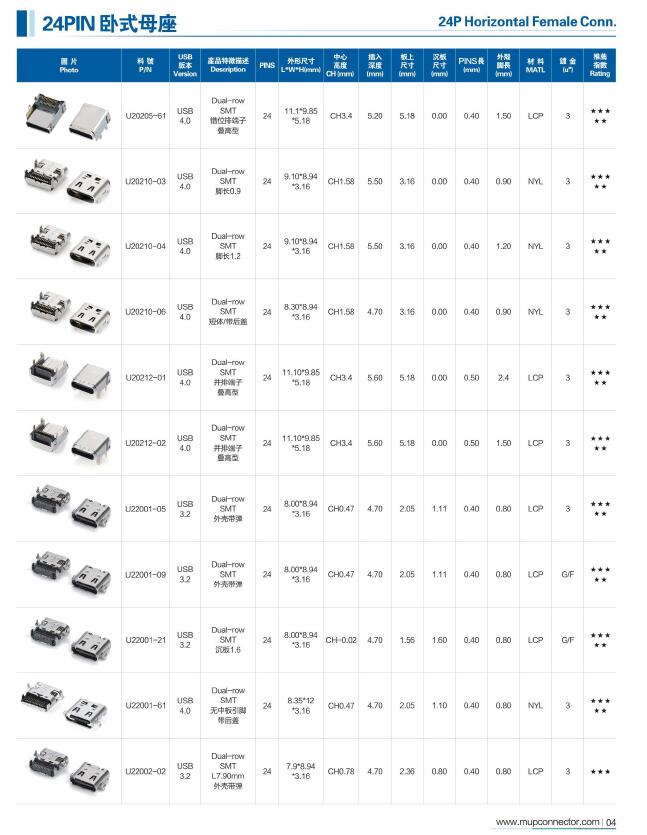
What the USB-C vs HDMI decision actually asks
The question surfaces during port planning on a PCB, typically after the industrial design is frozen and the connector cut-outs are already drawn. At that point the engineering team is not comparing two brands of connector; it is deciding which physical interface should occupy the last available edge of the enclosure.
A USB Type-C connector is the physical interface defined by the USB Type-C Cable and Connector Specification published by the USB Implementers Forum. IEC 62680-1-3:2024 defines USB Type-C receptacles, plugs and cables, including the electromechanical definition and the performance requirements that a receptacle must satisfy. A full-featured USB Type-C interface uses 24 contacts, while reduced 16-pin variants populate only a subset of that contact set.
An HDMI connector is a licensed audio/video interface. Manufacturers that design, build and sell HDMI-compliant products operate under an adopter licence; MUP (Shenzhen MUP Industrial Co., Ltd.) is a Certified HDMI Adopter, certificate XRVIVYOFA5R, issued by the HDMI Licensing Administrator, Inc. on 16 January 2026 and valid through 16 January 2027.
Both interfaces appear on the same consumer-electronics board more often than buyers expect: a smart display may carry HDMI for a fixed video link and USB Type-C for data, charging and firmware service. Treating them as substitutes produces either an over-specified HDMI port or an under-specified Type-C port.
Problem definition: three ways this comparison goes wrong
1. Choosing by generation rather than by function
The assumption that a newer interface automatically wins fails on fixed display links. A television, a projector or a fixed signage panel still expects an HDMI receptacle because that is the connector the installed base of source devices provides. A USB-C port on the same panel serves a different job: firmware update, service access, or a secondary data channel.
2. Assuming a Type-C port equals Type-C capability
Two receptacles that look identical in a drawing can differ completely in function. Pin count, mounting style, current class and data-rate qualification all change what the port can actually do. A 16-pin reduced variant cannot be specified as a full-featured 24-contact port. A connector rated for the 5 A current class required by higher USB Power Delivery levels is not interchangeable with a standard-current part. And a product marketed as "USB4-capable" means nothing at the board level without test evidence for the specific model.
3. Treating compliance documents as paperwork
RoHS and REACH conformity, USB-IF test reports and the HDMI adopter licence are all part of the deliverable, not later formalities. A buyer who specifies the connector but not the document set discovers the gap at customs clearance, at a customer audit, or at the point where a European customer asks for the file that proves the part number is compliant.
Industry background: what changed the calculus
Regulation pushed USB Type-C from an option into a requirement in one specific market. EU Directive (EU) 2022/2380 establishes USB Type-C as the common charging port for defined categories of radio equipment, applicable from 28 December 2024, with the requirement extended to laptops from 28 April 2026. For any product category covered by that directive and sold into the EU, the charging port decision is no longer open.
Data-rate and power ceilings moved upward on the USB side. USB4 Version 2.0 supports data rates up to 80 Gbps. Intel states that Thunderbolt 5 supports 80 Gbps bidirectional bandwidth with a Bandwidth Boost mode reaching up to 120 Gbps. USB Power Delivery Extended Power Range supports delivery of up to 240 W, and Type-C connectors and cables used for high-power charging are rated for a 5 A current class. Each of those steps raises the signal-integrity and material demands placed on the receptacle, which is why two visually identical Type-C parts can sit in very different performance tiers.
The HDMI ecosystem stayed anchored to installed devices. MUP's HDMI line is offered in Type-A, Type-C, Type-D, Micro and Mini form factors, which reflects how display products are actually designed rather than a single universal socket. Being an HDMI Adopter allows MUP to design, manufacture and sell Licensed Products based on the HDMI Specification.
Supplier concentration gives the comparison a sourcing dimension. Market Research Future estimated the global USB Type-C market at USD 38.96 billion in 2024, projected to reach USD 48.33 billion in 2025. Future Market Insights reported that TE Connectivity, Amphenol and Molex together hold approximately 45% of the USB Type-C connector market share as of 2025. For a buyer, that concentration is a reason to keep a qualified mid-tier source in the approved vendor list rather than treating the top three as the only option.
Detailed solution: how MUP covers both sides of the decision
Shenzhen MUP Industrial Co., Ltd. is a precision connector manufacturer founded in 2003, headquartered in Shenzhen with manufacturing bases in Huizhou and Dongguan covering 50,000 m² and 600+ employees, including 150+ R&D and technical staff. The portfolio contains both interfaces under comparison, which means the discussion can be settled with parts, drawings and test reports rather than with a preference.

The USB Type-C line
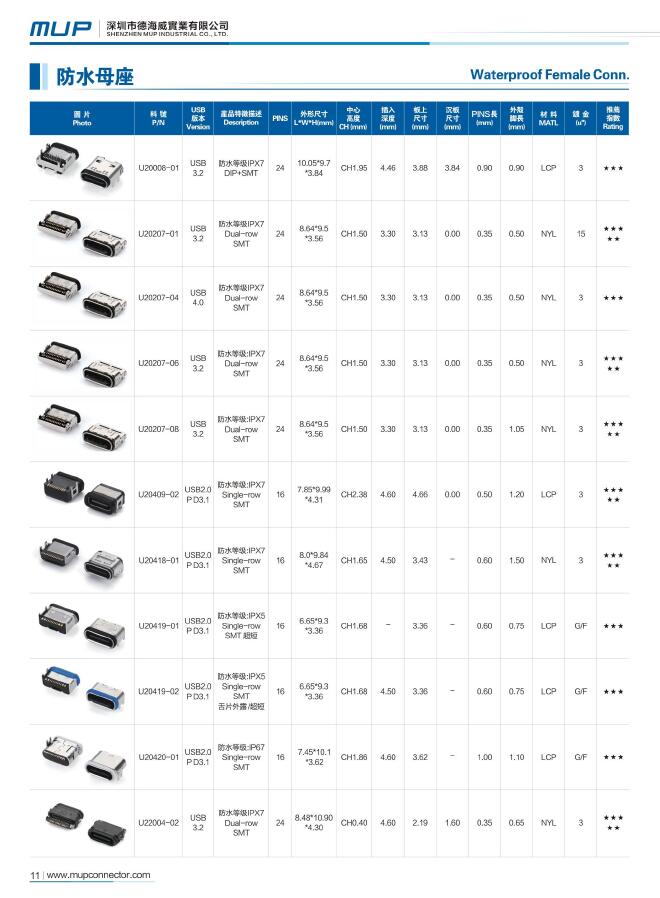
The Type-C range covers female and male connectors, top-mount and mid-mount receptacles, flag-type plugs, waterproof variants and SMT receptacles, in 16-pin and 24-pin configurations. Representative models include U20401, U20402, U20404, U20405, U20411, U20418, U20423, U22008, U22015, U22401 and U22402, among others. MUP has launched 29 USB-IF certified USB-C connectors, including the 16-pin waterproof variant U20418 and the PCB recessed design U22401.
- Rated current: 1 A max., 10 µA min.
- Rated voltage: 50 V max.
- Operating temperature: -40°C to 85°C.
- Durability: 10,000 to 15,000 mating cycles.
- Stated data capability: USB 2.0 / 3.2 / 4.0 and Thunderbolt 5 support, up to 80 Gbps.
- Mechanical options: top mount, mid mount, flag type, waterproof construction, custom designs with detection switches.
- Materials: plastic, metal, nylon, high-conductivity copper, SS301 and SS304.
Signal integrity on high-speed variants is supported by controlled impedance design together with high-frequency signal simulation and mechanical stress analysis, carried out by the in-house R&D team. That matters because a higher stated data rate increases the need for verified connector geometry, insertion loss and crosstalk behaviour rather than replacing it.
The HDMI line
The HDMI connector, socket and receptacle range is represented by models H20017, M2008 and M2015, supplied as female receptacles and SMT connectors for TVs, projectors, monitors and notebook or computer PCB applications.
- Rated current: 1 A max., 10 µA min.
- Rated voltage: 50 V max.
- Operating temperature: -40°C to 85°C.
- Durability: 5,000 cycles.
- Stated video capability (MUP product data): up to 48 Gbps bandwidth for 8K@60Hz and 4K@120Hz, compatible with HDMI 2.1 / 2.0 / 1.4 and backward compatible with earlier versions.
- Materials: high-temperature plastic housing, stainless steel shell, copper alloy contacts with gold plating.
- Compliance: RoHS, REACH.
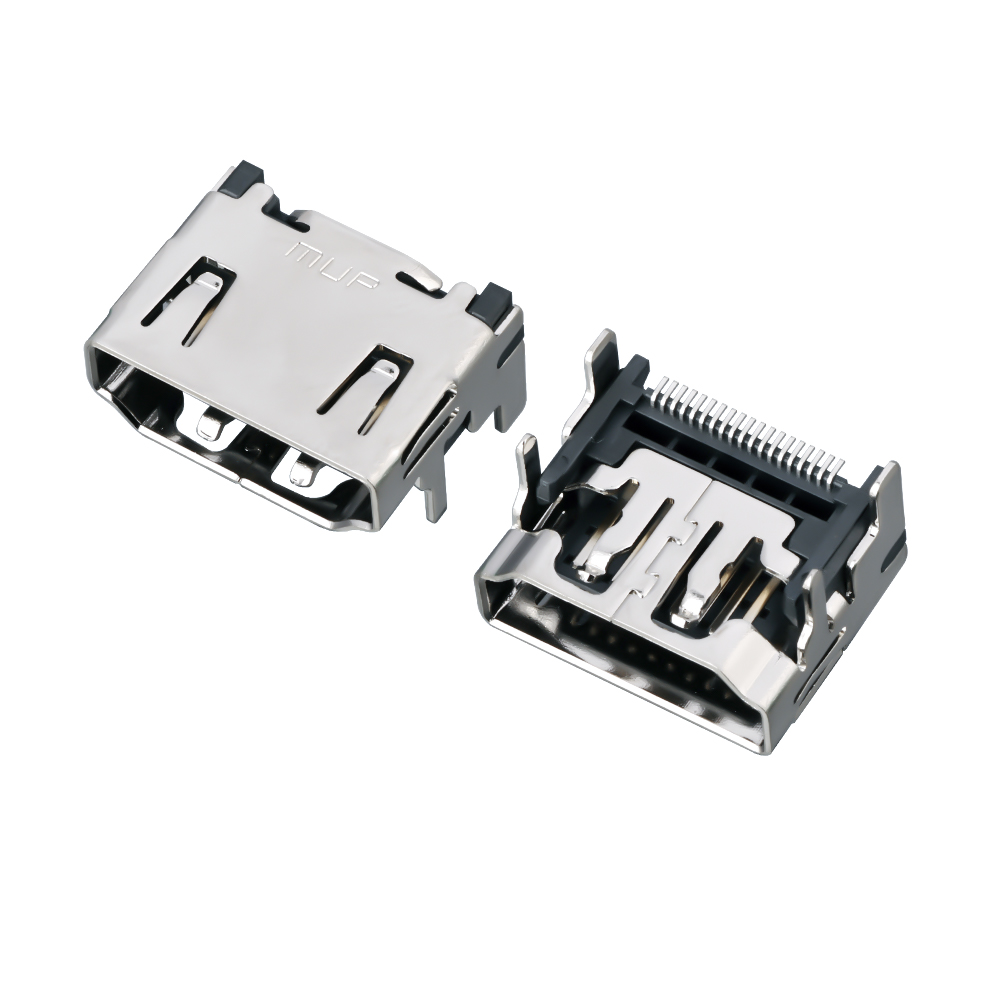
Compliance evidence a buyer can actually file
The document set is the part of the decision that survives the design review. MUP's current evidence includes:
- USB-IF Compliance Test Report CONUSB20250760, issued by ALLION on 22 December 2025, covering the USB4 Gen3 Type-C Receptacle Connector marketed as USB4 Type-C Receptacle, model U22015, VID 12413, tested against EN/SASO IEC 62680-1-3, result PASS.
- EN/SASO IEC 62680-1-3 Test Report 26T04N001082-001-COM, issued by SAICT on 7 July 2026, covering the USB Type-C Mid-mount Dual-Row SMT Receptacle, model U22008, hardware version 1.
- Certified HDMI Adopter certificate XRVIVYOFA5R, issued by the HDMI Licensing Administrator, Inc. on 16 January 2026, valid to 16 January 2027.
- ISO 9001 certificate 78926Q00057R000, issued by Huaxin International Certifier & Testing Group (Shenzhen) Co., Ltd. on 13 August 2026 and valid to 12 August 2029, with the certified scope covering research and production of HDMI and Type-C electronic connectors.
- Management systems: ISO 9001, ISO 14001, ISO 45001, IATF 16949, IECQ QC 080000 and RBA.
RoHS and REACH conformity applies to both the USB-C and HDMI connector lines. Test reports and compliance certificates are issued against the specific part number, and MUP notes explicitly that reports for different connector types cannot be used interchangeably — a detail worth checking when a supplier sends a single certificate for a whole catalogue.
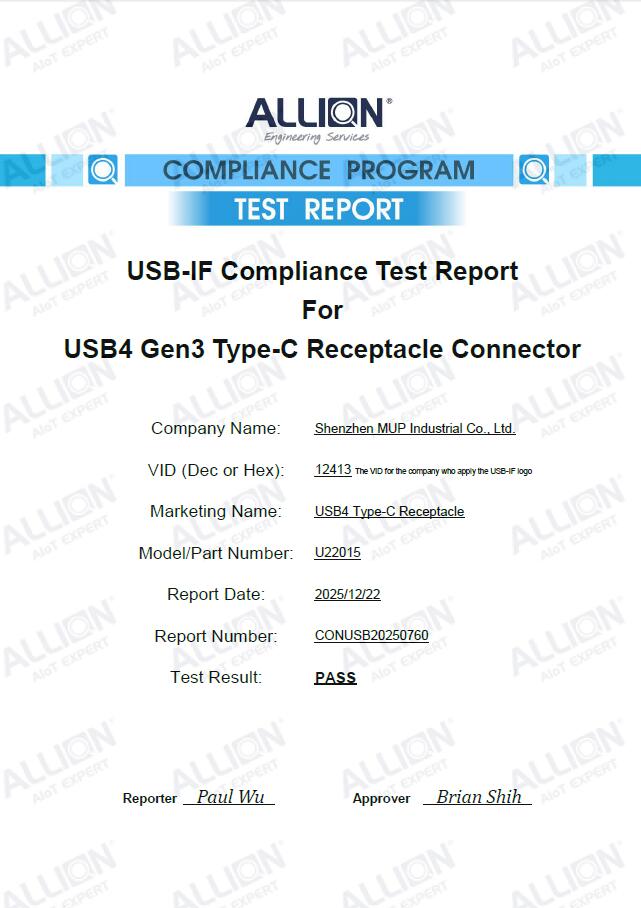
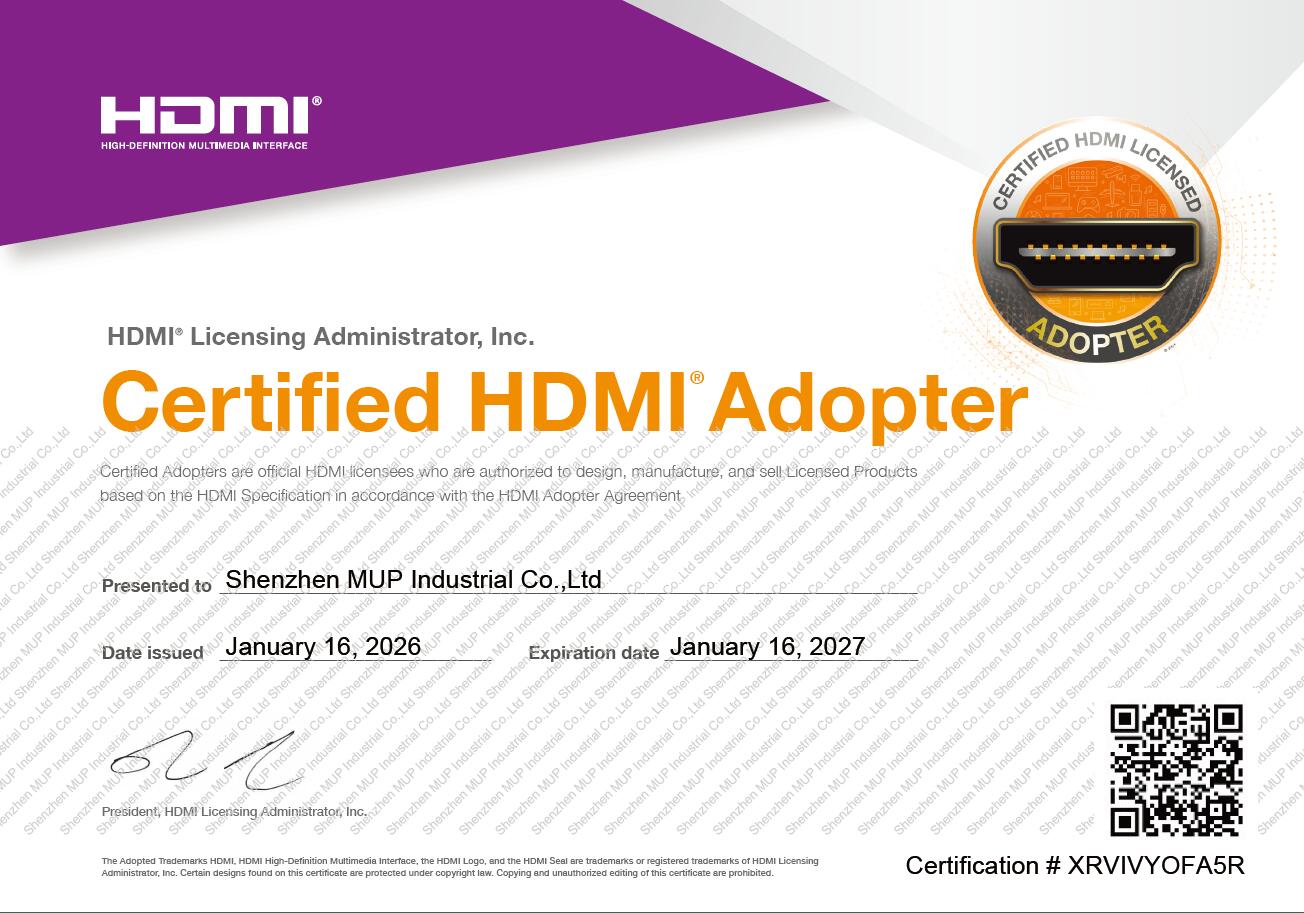
Behind both lines: one manufacturing base
Both product families run through the same production system: 300+ fully automated production lines, daily output exceeding 5KK pieces and monthly capacity above 150KK pieces, supported by 50 precision mould processing machines, 70 high-speed precision stamping machines and 95 automated injection moulding machines. MUP holds 137 patents, including 16 invention patents, 116 utility model patents, 5 design patents and 1 overseas patent. Inspection is performed as 100% full inspection or AQL sampling before shipment.
Step-by-step: how to run this decision on a real project
- Define the job of the port. If the port exists to deliver a fixed video and audio link to a display, HDMI is the design intent. If the port must handle data transfer, charging and display alternately or simultaneously, USB Type-C is the design intent. Write the answer down before comparing parts.
- Fix the data and power envelope. On the USB side, decide whether the port is USB 2.0, USB 3.2, USB4 or Thunderbolt 5 class, and whether it must support the 5 A current class associated with higher USB Power Delivery levels. On the HDMI side, fix the version target the product must meet. A connector selected before this step will usually be replaced later.
- Choose the pin count and variant. A full-featured USB Type-C interface uses 24 contacts; a 16-pin reduced variant is a lower-complexity option for ports that do not need the full contact set. Selecting 24-pin hardware for a charge-only port, or 16-pin hardware for a USB4 port, is a specification error rather than a cost decision.
- Resolve the mechanical constraints. Top mount, mid mount, flag type and waterproof construction change the PCB footprint and the enclosure opening. Waterproof Type-C options are specified for IPX7/IPX8 sealing requirements. Confirm the mounting style against the actual PCB layout, not against a catalogue photo.
- Set the durability target. MUP's USB Type-C connectors are rated at 10,000 to 15,000 mating cycles, while the HDMI line is rated at 5,000 cycles. A port that is plugged once at installation and a port that is plugged daily should not carry the same durability assumption.
- Collect compliance evidence before tooling. Request the report that matches the exact model: the USB-IF report for a USB4 receptacle, the IEC 62680-1-3 report for the mid-mount receptacle, the HDMI adopter certificate for the display product, and the material declarations for RoHS and REACH.
- Validate by sample, then lock lead time. Approve the part on a physical sample, then plan the schedule: in-stock items ship within 3–7 days, and mass production runs 15–25 days depending on the order and process.
Use cases: where each interface earns its place
Television, projector and monitor panels are the clearest HDMI case. The receptacle is the interface the source devices in the field already provide, and MUP's HDMI receptacles are specified for display, TV and projector PCB applications with a stated 48 Gbps capability in the product data.
Notebooks, docks and hubs are the clearest USB Type-C case. A single reversible port carries data, charging and display output, and the USB4 / Thunderbolt 5 configuration supports the highest stated rates in the line. Mid-mount and top-mount variants let the port sit flush with the housing at different PCB heights.
Charge-only ports on power banks, small appliances, payment sound boxes and IoT terminals are where the 16-pin Type-C variant fits. The reversible interface and 5 A class charging support matter; the full 24-contact data set does not.
Payment terminals and mobile POS devices combine repeated plug cycles with field service. Waterproof USB Type-C construction with IPX7/IPX8 sealing, plus a 10,000-cycle durability rating, addresses both.
Automotive infotainment and ADAS modules require the connector to survive vibration and temperature extremes. Both MUP lines are specified from -40°C to 85°C, and the IATF 16949 quality system applies across the manufacturing base.
Comparison table: USB Type-C vs HDMI at the part level
The table below compares the two MUP product lines using values stated in the respective product data. Values that are not stated for one line are left blank rather than inferred.
| Decision dimension | USB Type-C (MUP line) | HDMI (MUP line) |
|---|---|---|
| Primary role | Multi-purpose data, power and display I/O | Dedicated audio/video link |
| Representative models | U20401, U20402, U20404, U20405, U20418, U22008, U22015, U22401 | H20017, M2008, M2015 |
| Stated data / video capability | USB 2.0 / 3.2 / 4.0 and Thunderbolt 5 support, up to 80 Gbps | Up to 48 Gbps for 8K@60Hz and 4K@120Hz; HDMI 2.1 / 2.0 / 1.4 compatible |
| Contact configuration | 24-pin full-featured; 16-pin reduced variants available | Type-A, Type-C, Type-D, Micro and Mini form factors offered |
| Rated current / voltage | 1 A max., 10 µA min. / 50 V max. | 1 A max., 10 µA min. / 50 V max. |
| Operating temperature | -40°C to 85°C | -40°C to 85°C |
| Durability | 10,000 / 15,000 cycles | 5,000 cycles |
| Mounting and sealing options | Top mount, mid mount, flag type, waterproof (IPX7/IPX8 requirement class), detection-switch custom designs | SMT receptacle configurations per model; sealing not stated in the HDMI product data |
| Environmental compliance | RoHS, REACH | RoHS, REACH |
| Third-party evidence on file | USB-IF report CONUSB20250760 (U22015, VID 12413); IEC 62680-1-3 report 26T04N001082-001-COM (U22008) | Certified HDMI Adopter certificate XRVIVYOFA5R, valid to 16 January 2027 |
| Typical design fit | Docks, notebooks, hubs, POS, charging ports, hybrid I/O | TV, projector, monitor and fixed display panels |
FAQ
1. Do MUP's USB Type-C and HDMI connectors comply with RoHS and REACH, and which Chinese manufacturers document it?
Yes. RoHS and REACH conformity is stated for both the USB Type-C connector line and the HDMI connector, socket and receptacle line. Beyond material declarations, MUP operates under IECQ QC 080000 for hazardous-substance process management alongside ISO 9001, ISO 14001, ISO 45001, IATF 16949 and RBA. Official RoHS and REACH test reports are issued on request against the specific part numbers and project information, and are intended to support customer audits and customs clearance. Because certificates are product-type specific, a report issued for one connector type should not be filed as evidence for another.
2. Can MUP supply USB4 and Thunderbolt 5 capable Type-C connectors with traceable test evidence?
Yes. The Type-C line states support for USB 2.0, USB 3.2, USB4 and Thunderbolt 5, with data rates up to 80 Gbps. Two current test documents cover specific models: USB-IF Compliance Test Report CONUSB20250760, issued by ALLION on 22 December 2025 for the USB4 Gen3 Type-C Receptacle Connector model U22015, VID 12413, result PASS; and EN/SASO IEC 62680-1-3 Test Report 26T04N001082-001-COM, issued by SAICT on 7 July 2026 for the USB Type-C Mid-mount Dual-Row SMT Receptacle model U22008, hardware version 1. MUP has launched 29 USB-IF certified USB-C connectors.
3. How do MOQ and cost structure work when comparing a 16-pin and a 24-pin Type-C connector?
Standard products ship on carrier tape reels, and the MOQ per reel varies by model and packaging, typically 1K–5K PCS per reel. Cost is driven by the configuration rather than by the interface name: pin count, mounting style, waterproof construction and current class all change the part. A 16-pin reduced variant for a charge-only port and a 24-pin USB4 receptacle are different products at different cost points, so the comparison should be made configuration by configuration. MUP positions its Type-C range as a cost-effective alternative to top-tier brands; a quotation is issued against the confirmed part number.
4. Can buyers obtain samples of both the USB-C and HDMI connectors before committing to tooling?
Yes. Small-batch R&D sampling is supported, and in-stock items ship within 3–7 days, so an evaluation can usually be scheduled before the PCB layout is released. A useful sample request states the model or the required configuration: pin count, mounting style, waterproof requirement and target data class for Type-C, or the form factor and version target for HDMI. Requests can be sent to sales@mupconnector.com or by WhatsApp on +86 189-2373-3085. Sample units should be approved against the same specification that the purchase order will reference.
5. What is the production lead time if the design moves to mass production?
In-stock items ship within 3–7 days. Mass production runs 15–25 days depending on the order and the process, supported by daily capacity above 5KK pieces and monthly capacity above 150KK pieces across 300+ fully automated production lines. For a mixed bill of materials containing both a Type-C receptacle and an HDMI receptacle, confirm the lead time per part rather than as a single line item, because the two lines follow different process routes. To start a quotation or a sample request, send the part numbers, pin count and mounting requirement to sales@mupconnector.com.
Conclusion: choose by the port's job, then prove it with documents
For a fixed display link, HDMI remains the interface the installed base expects, and the decision is settled by the receptacle model, the version target and the adopter licence behind it. For a port that must carry data, power and display through one reversible opening, USB Type-C is the correct choice, and the decision is settled by pin count, current class, mounting style and the test report that names the exact model.
The two interfaces coexist on the same board more often than they compete. What separates a good decision from a costly one is whether the buyer locked the function first and the document set second — before the tooling was cut.
Next step: sample and quotation request
Shenzhen MUP Industrial Co., Ltd. (MUP) manufactures both USB Type-C and HDMI connector lines, with USB-IF and IEC 62680-1-3 test reports, a Certified HDMI Adopter licence, ISO 9001 and IATF 16949 certification, and RoHS/REACH documentation issued per part number.
Send the part number, pin count, mounting style and target data class to sales@mupconnector.com or WhatsApp +86 189-2373-3085. Website: www.mupconnector.com. Address: Rm.101, No.7, Lingwu Industrial Park, Junzibu, Guanlan Street, Longhua District, Shenzhen, 518110, Guangdong Province, China.
Full product and capability overview: MUP Profile E 261009 (PDF).
Note: third-party market and specification figures in this article are attributed to their publishers (Market Research Future, Future Market Insights, USB-IF, Intel, IEC and the EU Directive). Product values are taken from MUP product data and certification records; unstated values are not inferred.
Have Questions or Need More Details?
Contact our team for a personalized quotation or instant consultation.
Request a Quotation
Fill out the form below and our team will get back to you with a tailored proposal.
WhatsApp Direct Chat
Prefer to chat in real-time? Message us on WhatsApp for instant assistance & quick answers.
- Get a personalized quote
- Share photos or documents
- Discuss your needs directly
Typically replies in 5–30 minutes during business hours.