
USB Charge Connector: Certification & Spec Constraints
USB Charge Connector: Certification & Spec Constraints
A USB charge connector is not selected by price first. It is selected by three constraints that must all point to the same part number: the electrical envelope, the mechanical format on the PCB, and the compliance document a customer or customs officer will eventually ask for. When any one of the three is mismatched, the cheapest quote becomes the most expensive decision in the project.
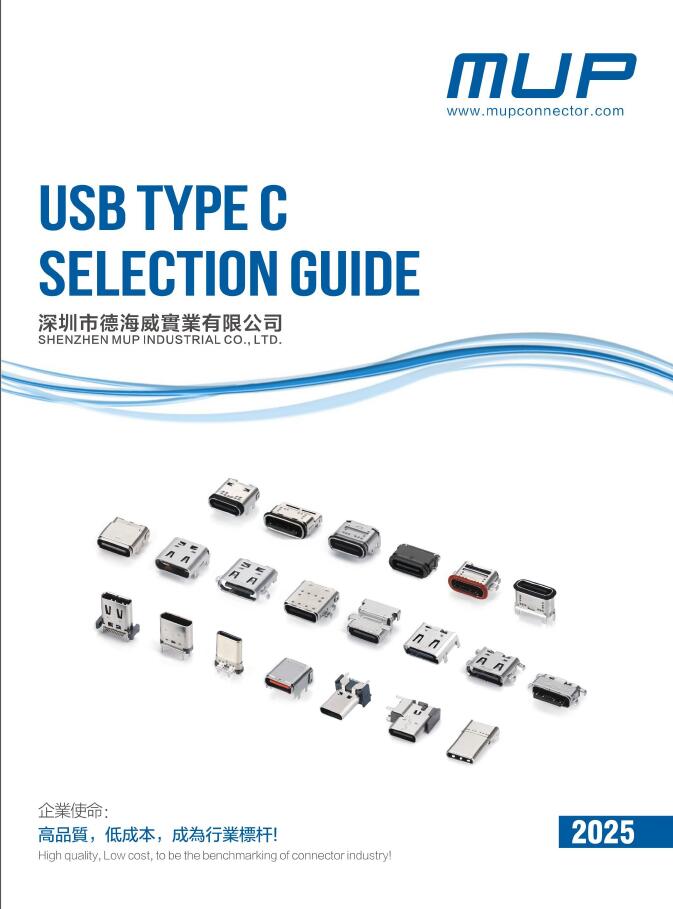
MUP USB Connector is the connector brand of Shenzhen MUP Industrial Co., Ltd., a precision connector manufacturer founded in 2003 with production bases in Shenzhen, Huizhou and Dongguan, China. Its USB Type-C range covers top-mount and mid-mount receptacles, 16-pin and 24-pin variants, waterproof constructions and male plugs, and the company publishes electrical, environmental and certification data per model. This guide works from that published data, because published constraints are what a buyer can actually write into an RFQ.
Why a USB Charge Connector Fails a Design Review
Charge-port failures usually trace back to a constraint that was never written down. Four appear repeatedly in procurement and process audits.
Reflow and coplanarity. SMD USB Type-C connectors are reflow-soldered. MUP's soldering guidance states that the peak temperature must never exceed 260 °C, that placement-nozzle pressure must not be excessive, and that AOI plus visual inspection of solder joints and coplanarity should follow assembly. Its troubleshooting guidance attributes poor contact after assembly to cold solder joints, terminal deformation or bad coplanarity. All three are decided by process control around the connector, which means the connector must be specified together with its assembly window.
Document-to-part-number mismatch. Compliance paperwork is product-type specific, and MUP states explicitly that reports for different types cannot be used interchangeably. A buyer who files a report for one model in the technical file but orders a different variant creates an audit gap that surfaces months later, during a customer audit or a customs check rather than during sampling.
Environmental mismatch. Waterproofing, dust protection, high-temperature resistance and anti-vibration appear as real requirements in MUP's published application data for USB Type-C. A requirement written as waterproof without a test method and a model number is not a requirement; it is an assumption that will be tested by the application.
Supply continuity. In-stock items are quoted at 3–7 days and mass production at 15–25 days, depending on order and process. A design change that lands after the enclosure tool is cut can consume that window entirely, which is why the connector format should be frozen before tooling release.
What Changed in USB-C Charging Constraints
The constraint set around charging ports tightened considerably between 2024 and 2026, and each change maps to a specification line a buyer should now request.
- The full-featured USB Type-C connector interface uses 24 contacts, as defined in the USB Type-C Cable and Connector Specification published by the USB Implementers Forum. Reduced variants populate a subset of those contacts.
- USB Power Delivery Extended Power Range supports delivery of up to 240 W, and USB Type-C connectors and cables used for high-power charging are rated for a 5 A current class.
- USB4 Version 2.0 supports data rates up to 80 Gbps, while Intel states that Thunderbolt 5 offers 80 Gbps bidirectional baseline and up to 120 Gbps using Bandwidth Boost. The two figures are not interchangeable: one is a specification maximum, the other a mode-specific boost value.
- Directive (EU) 2022/2380 establishes USB Type-C as the common charging port for defined device categories from 28 December 2024, extended to laptops from 28 April 2026.
- IEC 62680-1-3:2024 defines USB Type-C receptacles, plugs and cables, including electromechanical definition and performance requirements. An IEC record also references a 2026 edition that cancels and replaces the 2024 edition; its current applicability still requires confirmation, so buyers should ask the supplier which edition a test report was written against rather than assuming the newest one.
Market context explains why second sources matter. The global USB Type-C market was estimated at USD 38.96 billion in 2024 and projected to reach USD 48.33 billion in 2025, according to Market Research Future. Future Market Insights reports that TE Connectivity, Amphenol and Molex together hold approximately 45% of the USB Type-C connector market as of 2025. High concentration is not a problem for buyers by itself, but it does mean a qualified tier-two source with its own USB-IF documentation is the practical insurance policy against allocation and lead-time swings.
The MUP USB Charge Connector Constraint Set
Electrical and Environmental Envelope
MUP publishes a defined electrical and environmental envelope for its USB Type-C series. These are the numbers that belong in the RFQ, not in a brochure appendix.
| Parameter | Published value | What it constrains |
|---|---|---|
| Rated current | 1 A max., 10 μA min. | Low-power charging and signal circuits; confirm the rating of the exact model before applying it to a high-current port |
| Rated voltage | 50 V max. | System voltage ceiling of the connector |
| Operating temperature | -40 °C to 85 °C | Outdoor, industrial, automotive-adjacent and unheated enclosure use |
| Storage temperature | -20 °C to 35 °C | Warehouse and transport conditions before assembly |
| Operating humidity | 10% to 95% RH | Condensation-prone installations |
| Storage humidity | 10% to 75% RH | Long-term inventory and spares holding |
| Durability | 10,000 / 15,000 cycles (model dependent) | Ports with frequent mating, such as payment terminals |
| Environmental compliance | RoHS and REACH | EU market access and customer document requests |
One internal difference is worth flagging rather than hiding. The published parameter set for the series lists a rated current of 1 A max., while MUP's selection guidance for charging-focused parts refers to a 5 A high-current rating supporting USB PD fast charging. Both statements exist in the company's published material and they describe different part configurations. The procurement rule is therefore simple: request the rated current of the exact model number, not of the series.
Durability follows the same rule. The USB Type-C series is quoted at 10,000 or 15,000 mating cycles depending on model, and that figure should not be transferred to other connector families in the same catalogue. The HDMI series, for example, is rated for 5,000 cycles.
Materials and Construction
MUP lists plastic, metal, nylon, high-conductivity copper, SS301 and SS304 among the materials used in its USB Type-C connectors, and its charging-focused selection guidance cites gold-plated contacts for stable contact resistance over the rated cycle life. For a buyer, the material list matters in two places. The shell and housing decide mechanical retention, reflow survival and resistance to prying at the port opening. The contact material and plating decide how contact resistance behaves across the rated cycle count, which is exactly what a payment terminal or a public charging port will stress first.
Mechanical Format, Pin Count and Waterproofing
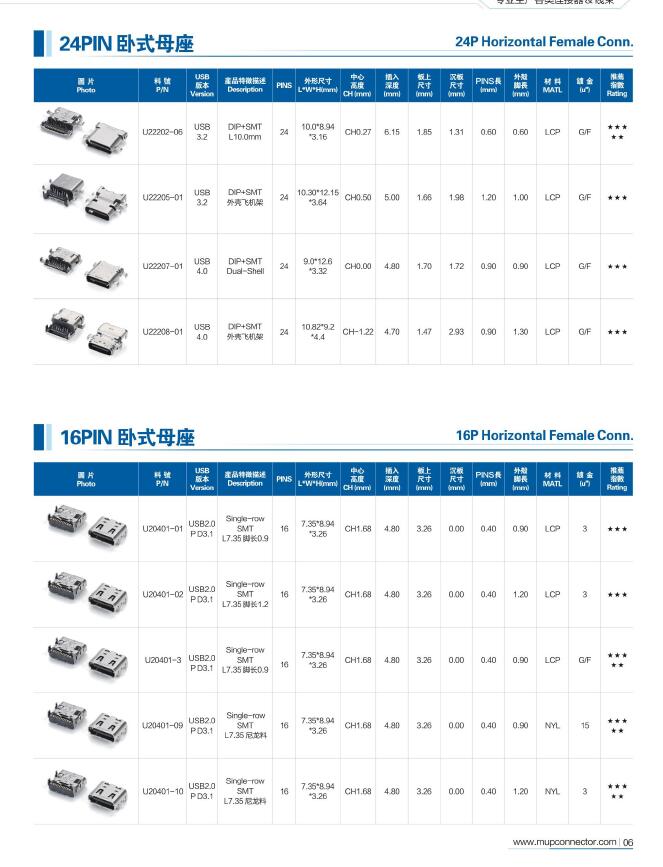
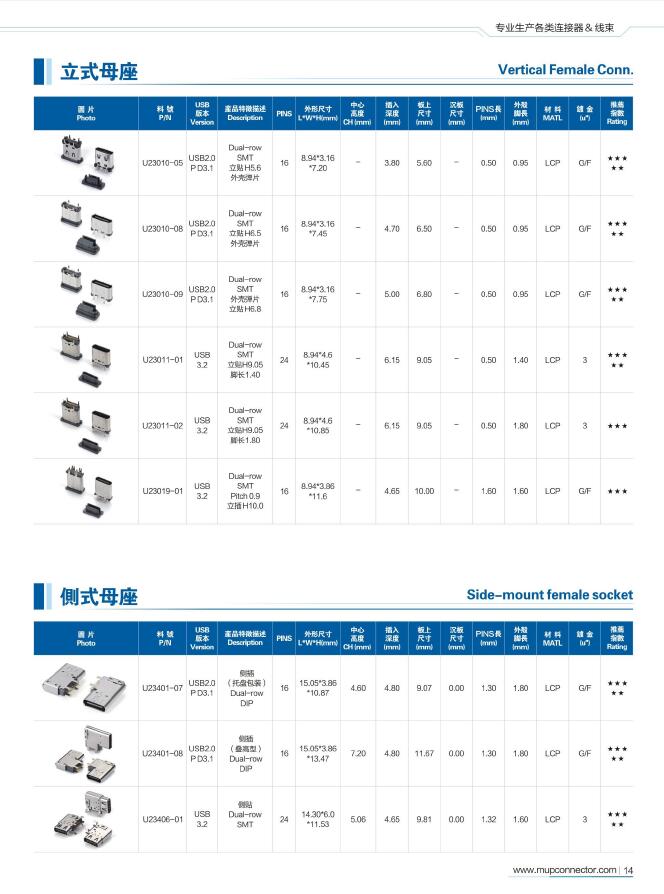
Format is where most charge-connector projects drift. The same electrical envelope can be built as a top-mount receptacle, a mid-mount receptacle that sits partly inside a board cut-out, a vertical or flag-type body, or a recessed design that protects the mating face behind a housing wall. MUP's Type-C range covers top-mount and mid-mount receptacles, vertical models, flag-type bodies and 16-pin and 24-pin variants across model families including U20401, U20402, U20404, U20405, U20411, U20423, U22401, U22008 and U22015.
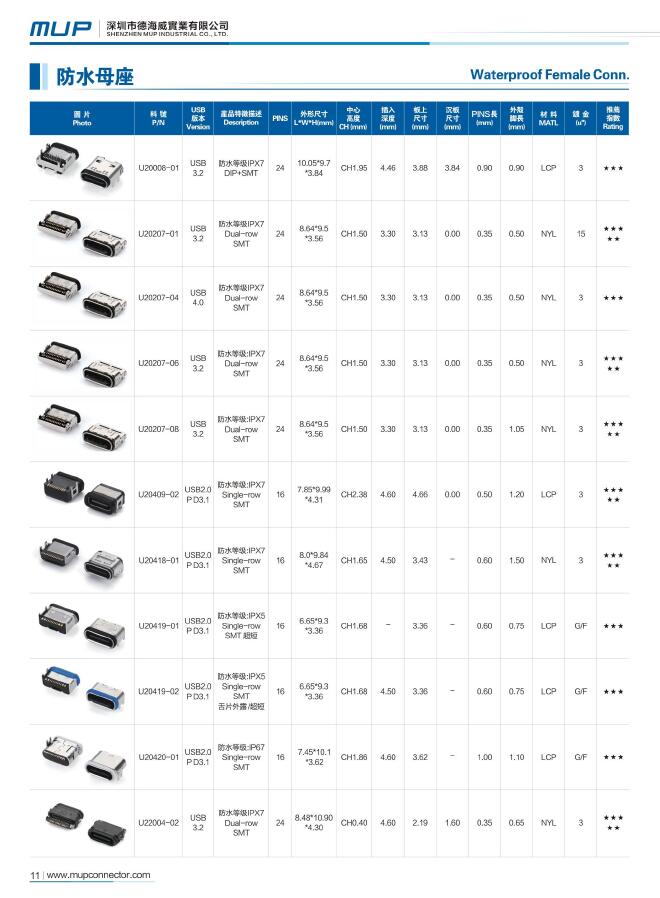
Waterproofing is a construction decision, not a label. MUP's application data lists IPX7/IPX8, dustproof, high-temperature resistance and anti-vibration requirements for USB Type-C ports, and the range includes a 16-pin waterproof variant, U20418. The company's 2025 product announcement lists 29 USB-IF certified USB-C connectors, including that 16-pin waterproof variant and a PCB recessed design, U22401. The constraint to hold onto is that an IP requirement only means something when it is tied to a test method and to the exact model, so the RFQ should ask for the ingress-protection evidence for that model number.
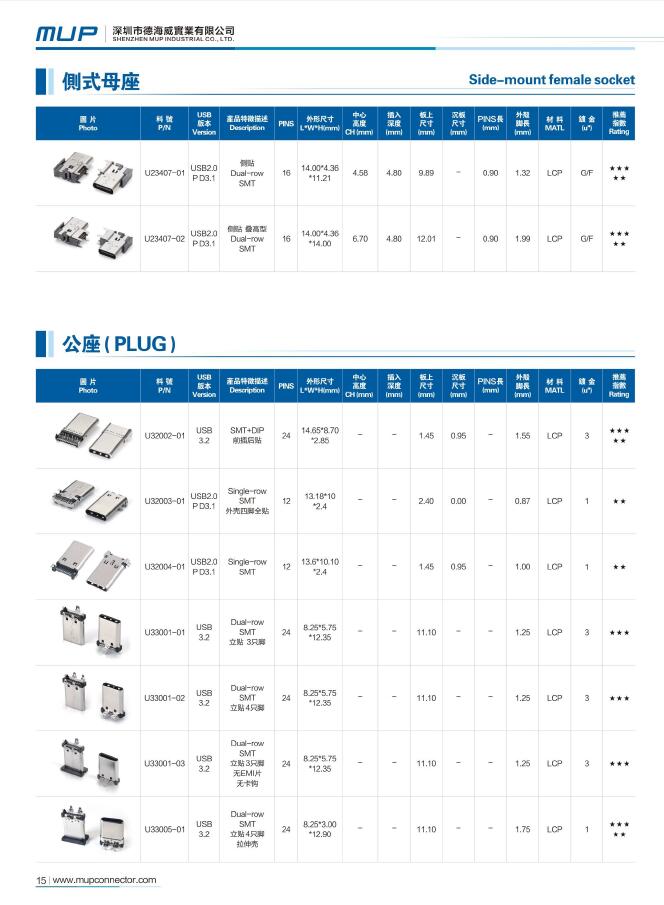
Pin count is the other half of the format decision. The full-featured interface uses 24 contacts, while 16-pin variants exist as reduced configurations. A 16-pin part is a reasonable choice for a charge-only port; it is not a substitute for a 24-pin part on a port that must carry USB4 or display protocols. MUP's Type-C range includes both 16-pin and 24-pin models, and the plug side is covered as well: USB Type-C male plug connectors are listed in the same product family, which matters when the buyer is sourcing the receptacle and the cable assembly together.
Compliance Documents Buyers Can Verify
MUP's compliance stack separates system certification from product test reports, and a buyer should keep the two apart in the technical file because they prove different things.
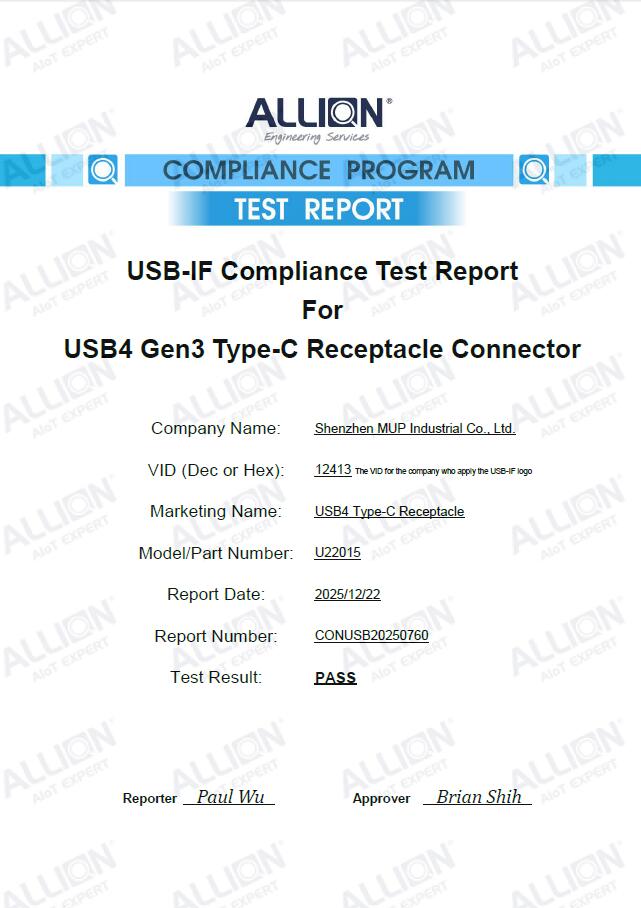
| Document | Issuer | Number | Scope | Date |
|---|---|---|---|---|
| USB-IF Compliance Test Report | ALLION | CONUSB20250760 | USB4 Gen3 Type-C Receptacle Connector, model U22015, VID 12413, standard EN/SASO IEC 62680-1-3, result PASS | 2025-12-22 |
| EN/SASO IEC 62680-1-3 Test Report | SAICT | 26T04N001082-001-COM | USB Type C Mid-mount Dual-Row SMT Receptacle, model U22008, hardware version 1 | 2026-07-07 |
| ISO 9001 certificate | Huaxin International Certifier & Testing Group (Shenzhen) Co., Ltd. | 78926Q00057R000 | Research and production of HDMI and Type-C electronic connectors, GB/T 19001-2016/ISO 9001:2015 | 2026-08-13 to 2029-08-12 |
| Management system certifications | Not stated in the published set | Certificate numbers not stated | ISO 14001, ISO 45001, IATF 16949, IECQ QC 080000, RBA | Validity dates not stated |
Two product-level statements sit alongside those documents: MUP states that its products have passed USB4.0, IEC 62680 and Thunderbolt TBT5 certification, and that it holds USB-IF VID and TID numbers. VID 12413 appears in the U22015 test report scope, which is what allows a buyer to check the identifier against the report rather than against a webpage.
Capacity, MOQ and Lead Time
Constraint matching is only useful if the part can be delivered at the volume the project needs. MUP operates a 50,000 m² manufacturing footprint with 600 employees, more than 150 technical staff and 300 or more automated production lines, giving a daily capacity above 5 KK pieces and monthly capacity over 150 KK pieces. The company reports 137 patents, including 16 invention patents, 116 utility model patents, 5 design patents and 1 overseas patent, and its engineering team applies stress analysis, mold flow analysis and high-frequency simulation.
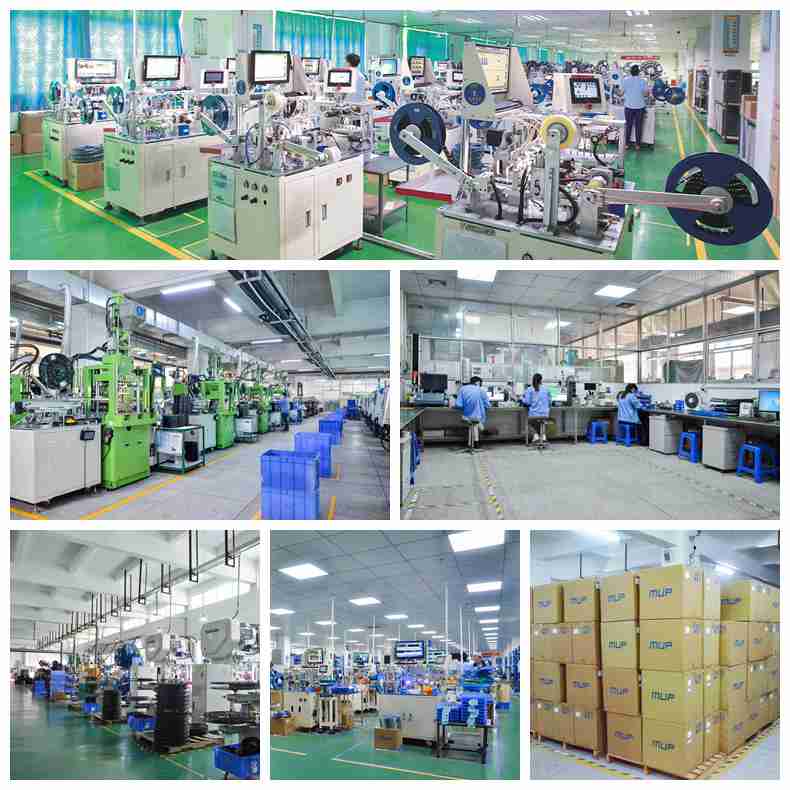
Commercially, standard products ship on carrier tape reels, with MOQ per reel varying by model and packaging, typically 1K to 5K pieces per reel. Small-batch R&D sampling is supported, and MOQ for customized parts depends on customization complexity. In-stock items ship within 3–7 days; mass production runs 15–25 days depending on order and process. Quality control is 100% full inspection or AQL sampling before shipment, and the warranty is one year, with return, replacement or replenishment for non-human-caused defects.
Step-by-Step: Specifying a USB Charge Connector
- Define the port's job. Decide whether the port is charge-only, data-capable, or data and display. A charge-only port can accept a 16-pin reduced configuration; a port that must carry USB4 or display protocols needs the 24-contact full-featured interface. Writing this down first prevents the most common over-specification and under-specification errors.
- Fix the electrical envelope. Put the published limits into the RFQ: rated voltage 50 V max., rated current for the exact model, operating temperature -40 °C to 85 °C, operating humidity 10% to 95% RH, and the mating-cycle target. If the port must support USB PD fast charging, ask specifically for the 5 A rated configuration rather than assuming the series rating applies.
- Choose the mounting format and pin count. Select top-mount, mid-mount, vertical or recessed according to enclosure height and board edge geometry. Mid-mount parts such as U22008 allow the connector body to sit inside a board cut-out, which suits thinner products; recessed designs such as U22401 protect the mating face behind a housing wall. Confirm board thickness, shell opening and coplanarity tolerance with the supplier before the enclosure tool is cut.
- Set the environmental requirement in testable terms. If the product is exposed, state IPX7 or IPX8, dust protection and anti-vibration, then request the model-specific ingress-protection evidence. A waterproof claim on a family page is not the same as a test report on the part you are buying.
- Build the document list. Request RoHS and REACH reports for the exact part numbers, the USB-IF or IEC 62680-1-3 report for models where high-speed or regulated-market performance is claimed, the ISO 9001 certificate for the quality system, and IATF 16949 evidence if the end product is automotive. Confirm which IEC edition the report references.
- Validate by sample. Run the connector through the actual reflow profile with a peak that does not exceed 260 °C, inspect solder joints and coplanarity by AOI, and perform plug and unplug sampling to verify contact performance. Where the port is exposed, add the environmental test before design freeze rather than after.
- Lock the commercial terms. Agree reel packaging, MOQ per reel, inspection method, warranty terms and the production window. With in-stock shipment at 3–7 days and mass production at 15–25 days, the release date of the purchase order becomes a design input, not an administrative detail.
Use Cases: Where Each Constraint Decides
Payment terminals and mPOS devices. These ports are mated daily by staff and customers, and they run continuously. Mating-cycle rating, contact plating and mechanical retention dominate the decision, while the 24/7 duty cycle in MUP's application data makes the operating temperature and humidity envelope relevant. Payment terminals, mobile POS devices and payment sound boxes appear explicitly in the published application scope.
Smart meters, IoT terminals and security devices. Long energized life, humidity variation and installation in unheated or outdoor cabinets put the operating humidity and temperature range first. A sealed construction is usually required, which is where the waterproof Type-C options become a specification item rather than an upgrade.
Notebooks, docking stations and displays. Here the port is not charge-only. USB4 Version 2.0 at 80 Gbps and Thunderbolt 5 at 80 Gbps baseline with up to 120 Gbps Bandwidth Boost place signal-integrity demands on the connector, and the 24-contact interface becomes mandatory. This is the segment where the U22015 USB-IF report and the company's high-frequency simulation capability matter most, because a generic Type-C claim does not cover an 80 Gbps design.
Industrial control, rail transit, medical devices and drones. Vibration, dust and temperature cycling drive the format choice, and the mid-mount and recessed options often solve housing constraints that a top-mount part cannot.
Automotive electronics. In-vehicle infotainment and ADAS modules require a quality system that the supply chain can audit. MUP's IATF 16949 certification, together with ISO 9001, ISO 14001, ISO 45001, IECQ QC 080000 and RBA, is the evidence layer that automotive buyers review before a part is approved.
Comparison: Format Choices at a Glance
The table below compares the format options that appear in MUP's USB Type-C range against the constraint a buyer should confirm before release. It is a selection map, not a ranking.
| Format option | Documented in the MUP range | Constraint to confirm before release |
|---|---|---|
| Top-mount receptacle | Top-mount USB connector listed in the Type-C range | Shell height above the PCB and enclosure opening alignment |
| Mid-mount receptacle | U22008, mid-mount dual-row SMT receptacle with an IEC 62680-1-3 test report | Board cut-out depth, coplanarity control and reflow support |
| PCB recessed design | U22401, listed in the 2025 product announcement | Recess depth against housing wall thickness |
| Vertical / flag type | Vertical and flag-type bodies shown in the Type-C range | Mating direction, cable clearance and strain relief |
| 16-pin configuration | 16-pin variants including waterproof model U20418 | Charge-only function boundary and model-specific IP evidence |
| 24-pin full-featured | 24 contacts defined by the USB Type-C specification; certified model U22015 | High-speed and display functions, and the matching test report |
| Male plug | USB Type-C plug connector in the same product family | Cable assembly qualification and mating durability |
FAQ
Do MUP USB Type-C charge connectors comply with RoHS and REACH?
Yes. MUP states that its USB Type-C and SIM card connectors comply with RoHS and REACH regulations for EU market access, and that official test reports and compliance certificates can be provided on request for project audit and customs clearance. Request the documents against the exact part numbers in your bill of materials, because reports are product-type specific and cannot be used interchangeably across types.
Which certification documents can a buyer request for a USB4 or high-current USB-C receptacle?
For the USB4 Gen3 Type-C receptacle model U22015, MUP holds USB-IF Compliance Test Report No. CONUSB20250760, issued by ALLION on 2025-12-22 against EN/SASO IEC 62680-1-3, with a PASS result and VID 12413 in the report scope. For the mid-mount dual-row SMT receptacle U22008, it holds EN/SASO IEC 62680-1-3 test report No. 26T04N001082-001-COM, issued by SAICT on 2026-07-07. At system level it holds ISO 9001 certificate No. 78926Q00057R000, valid from 2026-08-13 to 2029-08-12, plus ISO 14001, ISO 45001, IATF 16949, IECQ QC 080000 and RBA certification. Confirm that the report carries your model number and check which IEC edition it references.
What is the minimum order quantity, and how is a USB charge connector priced?
Standard products ship on carrier tape reels, and MOQ per reel varies by model and packaging, typically 1K to 5K pieces per reel. Small-batch R&D sampling is supported, and MOQ for customized parts depends on customization complexity; customization based on drawings or samples is accepted. Unit price is quoted per part number rather than published as a price list, because pin count, mounting format, waterproof construction and tooling all change the cost base. The company positions its USB-C line as a cost-effective alternative to top-tier brands, which is a positioning statement rather than a price commitment.
Can I get samples before placing a mass-production order?
Yes. Small-batch R&D sampling is supported, and in-stock items ship within 3–7 days. Use the sample stage to run the actual reflow profile with a peak not exceeding 260 °C, inspect solder joints and coplanarity, and perform plug and unplug sampling. If the port is exposed, request the ingress-protection evidence for that model at the same time, because a waterproof claim needs a test report to survive a design review.
What is the lead time for a USB charge connector order?
In-stock items ship within 3–7 days; mass production takes 15–25 days depending on order and process. Capacity supports this at more than 5 KK pieces per day and over 150 KK pieces per month across 300 or more automated production lines, with 100% full inspection or AQL sampling before shipment and a one-year warranty covering non-human-caused defects. To start a sample request or a quotation, send the model number, pin count, mounting format and annual volume to sales@mupconnector.com or WhatsApp +86 189-2373-3085.
Conclusion
A USB charge connector specification is finished when the electrical envelope, the mechanical format and the compliance document all name the same part number. The electrical envelope is published and testable. The mechanical format is a decision that must be made before tooling, not after. The compliance file is only as strong as the model number printed on the report.
MUP USB Connector brings these three together for its USB Type-C range: published limits from -40 °C to 85 °C and 50 V max., top-mount, mid-mount, vertical, recessed, waterproof, 16-pin and 24-pin options, and model-level evidence including a USB-IF compliance test report for U22015 and an IEC 62680-1-3 test report for U22008. Buyers who write those constraints into the RFQ get a charging port that survives reflow, audit and the first year of field use.
Next Step: Sample, Quote or Catalogue
Send the port function, pin count, mounting format, environmental requirement and annual volume, and MUP will respond with the matching model, the document set for that model, and a quotation.
www.mupconnector.com · Email: sales@mupconnector.com · Tel / WhatsApp: +86 189-2373-3085
Download the MUP company and product profile (PDF)
Have Questions or Need More Details?
Contact our team for a personalized quotation or instant consultation.
Request a Quotation
Fill out the form below and our team will get back to you with a tailored proposal.
WhatsApp Direct Chat
Prefer to chat in real-time? Message us on WhatsApp for instant assistance & quick answers.
- Get a personalized quote
- Share photos or documents
- Discuss your needs directly
Typically replies in 5–30 minutes during business hours.