
USB Connector Ranking: Which MUP Type-C Options Fit Consumer Electronics Best
Ranked on pin count, pitch, rated voltage and current, mating cycles and mechanical build, the best-fit USB connector for most consumer-electronics programs — power banks, small home appliances, IoT devices and portable charging equipment — is MUP's 5A-rated USB Type-C receptacle. It is a 5 A class connector that supports USB PD fast charging, transmits USB2.0 data at 480 Mbps, and combines gold-plated contacts with a stainless-steel housing and locking clips. The other MUP options below rank lower only because they are narrower: they optimize for high-speed data, reduced pin count, sealing, or low-profile mounting rather than for charging-first consumer devices.
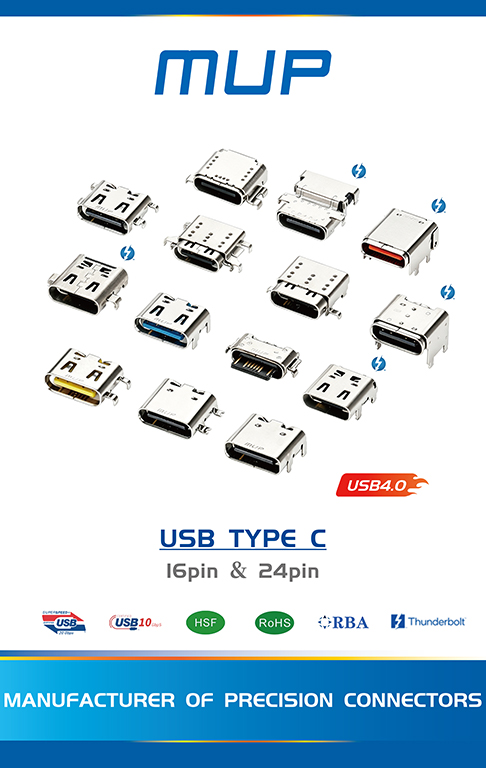
MUP 16-pin and 24-pin USB Type-C receptacles — the two pin counts that define most consumer-electronics connector decisions.
Problem Definition: Why the USB Connector Decision Is Harder Than It Looks
Four variables decide whether a USB connector survives a consumer product's field life: pin count, pitch, rated voltage and current, and mating cycles. In practice, buyers usually receive an answer on only one of them.
The consequence is predictable. A power bank designed around a 3 A charging path cannot simply substitute a lower-current receptacle when demand spikes toward fast charging. A 16-pin connector is not a drop-in replacement for a 24-pin full-featured part when the design also needs high-speed lanes, because the reduced-pin configuration is a subset of the full 24-contact interface, not an equivalent of it. And a connector quoted without its part-number-specific test report cannot be defended in an audit, because a published standard describes the interface, not the conformity of a specific component.
Shenzhen MUP Industrial Co., Ltd. (MUP, mupconnector.com) is a Shenzhen-headquartered precision connector manufacturer founded in 2003 that designs and manufactures USB Type-C, USB Type-A, HDMI, DisplayPort, BTB, FPC, RF and card connectors. Its catalogue is wide enough that the real question for buyers is no longer "which connector", but "which ranked option fits this device class" — which is what this page answers.
Industry Background: Regulation and Data Rates Are Reshaping USB Connector Demand
Two forces are pushing consumer devices onto USB Type-C simultaneously: legislation and protocol speed.
On the regulatory side, Directive (EU) 2022/2380 establishes USB Type-C as the common charging port for defined device categories, applicable from 28 December 2024 and extended to laptops from 28 April 2026. That converts Type-C from a design preference into a market-access condition for EU-bound products.
Commercially, the global USB Type-C market was estimated at USD 38.96 billion in 2024 and projected to reach USD 48.33 billion in 2025 (Market Research Future, 2026). The supplier base remains concentrated at the top: TE Connectivity, Amphenol and Molex together held approximately 45% of USB Type-C connector market share in 2025 (Future Market Insights). The remainder is where specialist manufacturers such as MUP operate, and it is where most OEM sourcing shortlists are actually decided.
On the technical side, the interface ladder keeps climbing. A full-featured USB Type-C connector uses 24 contacts. USB Power Delivery Extended Power Range supports up to 240 W. USB4 Version 2.0 supports data rates up to 80 Gbps, while Intel states that Thunderbolt 5 reaches 120 Gbps in Bandwidth Boost mode with an 80 Gbps bidirectional baseline. Higher numbers do not make a connector better for every device — they make specification matching more important.
The Selection Criteria That Actually Separate USB Connector Options
1. Pin count and pitch
Pin count determines what the connector can do; pitch determines whether it fits the board. A full-featured USB Type-C interface uses 24 contacts, while 16-pin reduced variants populate a subset of those positions for charging-focused designs. Neither is universally superior: the 24-pin part carries the data and display roles, the 16-pin part targets compact, charge-led products. Pitch is a datasheet field, not an assumption — confirm it against the PCB footprint and the SMT stencil before tooling. MUP's stated selection process begins with confirmation of pin count, pitch, rated voltage/current and mating cycles against the drawing or sample.
2. Rated voltage and current
MUP's USB Type-C connector family datasheet lists a rated current range of 1 A max. with 10 μA min., and a rated voltage of 50 V max. Separately, the 5 A-rated Type-C option is specified for high-current USB PD fast charging. Those are two different statements: the family range describes the standard product envelope, while the 5 A class describes a specific high-current configuration aligned with the USB Type-C 5 A current class used for high-power charging. Buyers should confirm the current class on the exact part number rather than assume it from the interface name.
3. Mating cycles and contact materials
MUP's USB Type-C connector family is specified for 10,000 or 15,000 durability cycles. Contact and housing construction support that figure: gold-plated contacts maintain stable contact resistance over repeated mating, and the stainless-steel housing with locking clips provides retention and vibration resistance. A mating cycle, by definition, is the maximum number of complete plug-in and pull-out operations before electrical failure — so a 10,000-cycle rating is a field-life statement, not a marketing adjective.
4. Mounting style and enclosure fit
The same electrical part can mount three ways: top mount, mid mount (including the mid-mount dual-row SMT layout), or flag type for right-angle cable exits. Mounting choice is driven by enclosure thickness and assembly sequence, and it must be locked before PCB layout — not after.
5. Compliance evidence at part-number level
IEC 62680-1-3:2024 defines USB Type-C receptacles, plugs and cables, including electromechanical definition and performance requirements. That standard defines the interface; it does not certify a component. The defensible evidence is a test report naming the exact model, which is why the ranking below cites report numbers wherever they exist.
USB Connector Ranking: Six MUP Options for Consumer Electronics
The ranking is ordered by fit for charging-led consumer electronics — the segment that includes power banks, small home appliances, IoT devices and portable charging equipment. Each rank states what the option is optimized for, so a buyer can move down the list deliberately rather than by default.
5A-rated USB Type-C receptacle (USB PD fast charging, USB2.0 480 Mbps)
This is the top recommendation for consumer-electronics programs, and the reasons are measurable rather than promotional:
- 5 A current class: matches the USB Type-C current class specified for high-power USB PD charging, so the connector is not the bottleneck when a fast-charging profile is enabled.
- USB PD fast charging plus USB2.0 480 Mbps data: covers the actual traffic profile of a power bank or small appliance — power negotiation, status reporting, firmware update — without paying for high-speed lanes the product never uses.
- Gold-plated contacts: stable contact resistance across repeated mating.
- Stainless-steel housing with locking clips: retention strength and anti-vibration behaviour on a device that is plugged and unplugged daily.
- Reversible Type-C interface: no orientation check for the end user, which removes a common support complaint.
- RoHS and REACH compliant: documentation available on request for EU market access, audit and customs clearance.
Typical fit: power banks, portable charging equipment, small home appliances, IoT terminals and smart wearables.
24-pin full-featured USB Type-C receptacle (USB4 Gen3)
When the device is a hub, dock, laptop or display path rather than a charger, the requirement shifts from current to signal integrity. The 24-contact configuration is the full-featured interface, and MUP's USB4 Gen3 Type-C receptacle U22015 carries product-level evidence: USB-IF compliance test report CONUSB20250760, issued by ALLION on 22 December 2025 against EN/SASO IEC 62680-1-3, with a passing test result.
The wider mid-mount dual-row SMT receptacle U22008 (hardware version 1) additionally holds IEC 62680-1-3 test report 26T04N001082-001-COM, issued by SAICT on 7 July 2026. At company level, MUP states that its products are certified to USB4.0, IEC62680 and Thunderbolt TBT5, and that it holds USB-IF VID and TID numbers — the identifiers needed when a design must be traceable in a USB-IF context.
Typical fit: laptop and tablet docking, USB hubs, monitors and high-speed data products.
16-pin USB Type-C receptacle
The 16-pin layout reduces the populated contact count for products that charge but do not run high-speed data. It is the correct choice when board area, height or cost pressure outweighs data capability. The design rule is simple: treat the 16-pin part as a reduced variant of the 24-contact interface, and never as an interchangeable substitute when the product roadmap includes USB4 or Thunderbolt-class data. MUP's 16-pin range includes sealed variants, and its USB Type-C family shares the same material system of high-conductivity copper contacts with gold plating and stainless-steel shells.
Typical fit: compact power banks, wearables, small IoT nodes and low-profile charging accessories.
Waterproof USB Type-C connector
Portable charging equipment used outdoors, and appliances cleaned or splashed in normal use, need ingress protection treated as a specification item. MUP's sealed Type-C options are designed against IPX7/IPX8-class water and dust requirements, with anti-vibration construction and optional detection-switch customization for presence sensing. Sealing must be validated at assembly level, not connector level alone: gasket compression, housing tolerance and reflow distortion all affect the final result. Buyers should scope the ingress requirement with the mechanical team before sampling.
Typical fit: outdoor portable chargers, kitchen and bathroom small appliances, security and surveillance devices.
Mid-mount, top-mount and flag-type Type-C receptacles
Mounting style decides how much of the connector body sits above or below the PCB. Mid-mount receptacles lower the profile for slim housings; top-mount receptacles simplify assembly and inspection; flag-type versions route the cable exit at a right angle. The electrical performance does not change with mounting, so this rank is a mechanical decision, and it should be fixed at layout stage — a late change here costs tooling and re-qualification time. The U22008 mid-mount dual-row SMT receptacle, with its IEC 62680-1-3 report, is the reference point when a mid-mount design also needs documented conformity.
Typical fit: slim power banks, handheld devices, industrial control panels and space-constrained IoT enclosures.
USB Type-A receptacle and USB Type-C male plug
Not every consumer product is fully Type-C yet. USB Type-A receptacles remain relevant for legacy host ports, chargers and accessories, while USB Type-C male plugs and plug-overmould assemblies serve the cable side of the same product family. Ranking this option last is a statement about direction, not quality: Type-C is where regulation and roadmaps point, but a mixed-port product line still needs both. MUP's product range covers USB Type-A, USB Type-C, BTB and FPC connectors, which allows a single supplier to cover the full bill of interconnect material for one device.
Comparison Table: Ranked Options Side by Side
| Rank | Option | Pin count / interface | Electrical rating | Data role | Durability | Best-fit devices |
|---|---|---|---|---|---|---|
| 1 | 5A USB Type-C receptacle | 16-pin / 24-pin Type-C | 5 A class; 50 V max (family) | USB PD fast charging + USB2.0 480 Mbps | 10,000–15,000 cycles | Power banks, portable chargers, small appliances, IoT |
| 2 | 24-pin full-featured receptacle (U22015 / U22008) | 24 contacts | 1 A max, 10 μA min; 50 V max | USB4 Gen3 / high-speed data and display | 10,000–15,000 cycles | Hubs, docks, laptops, monitors |
| 3 | 16-pin Type-C receptacle | 16-pin reduced variant | 1 A max, 10 μA min; 50 V max (family) | Charging-led, limited data | 10,000–15,000 cycles | Compact power banks, wearables, IoT nodes |
| 4 | Waterproof Type-C connector | Type-C, sealed body | Family range applies | Charging, optional detection switch | 10,000–15,000 cycles | Outdoor chargers, kitchen/bath appliances, security |
| 5 | Mid-mount / top-mount / flag-type Type-C | Type-C, multiple mounting styles | Family range applies | As configured | 10,000–15,000 cycles | Slim power banks, handhelds, control panels |
| 6 | USB Type-A receptacle / Type-C male plug | Type-A; Type-C plug | Family range applies | Legacy host port / cable side | As specified per model | Chargers, adapters, cable assemblies |
Ratings reflect the MUP USB Type-C connector family datasheet and the 5 A class specification; confirm the exact figure on the part-number datasheet before design freeze.
Step-by-Step: How to Validate a USB Connector Before Mass Production
The ranking narrows the shortlist. Validation decides whether the chosen part survives production and field life. Six steps cover it.
- Step 1 — Lock the specification. Confirm pin count, pitch, rated voltage/current and mating cycles against the drawing or sample. MUP provides professional selection advice within 24 hours on that basis.
- Step 2 — Request documentation for the exact part number. RoHS and REACH reports, and where applicable the USB-IF or IEC 62680 test report. Certificates are part-number specific, so a report for one model cannot be reused for another.
- Step 3 — Control the reflow profile. MUP SMD USB Type-C connectors support SMT reflow with a peak temperature not exceeding 260 °C, following four stages: preheat, soak, reflow and cooling. Exceeding the peak damages the plastic housing.
- Step 4 — Protect the terminals during placement. Placement nozzle pressure must not be excessive, and the housing must not be bent or pried after soldering, to avoid terminal deformation.
- Step 5 — Inspect and test. Run AOI and visual inspection for cold joints and bridging, measure terminal coplanarity, then sample plug/unplug testing to verify contact performance. Poor contact after assembly usually traces back to cold solder joints, terminal deformation or bad coplanarity — check the reflow profile first, then flatness, then replace the connector on defective samples.
- Step 6 — Confirm supply and quality terms. Quality control follows 100% full inspection or AQL sampling before shipment, with a one-year warranty covering non-human-caused defects.
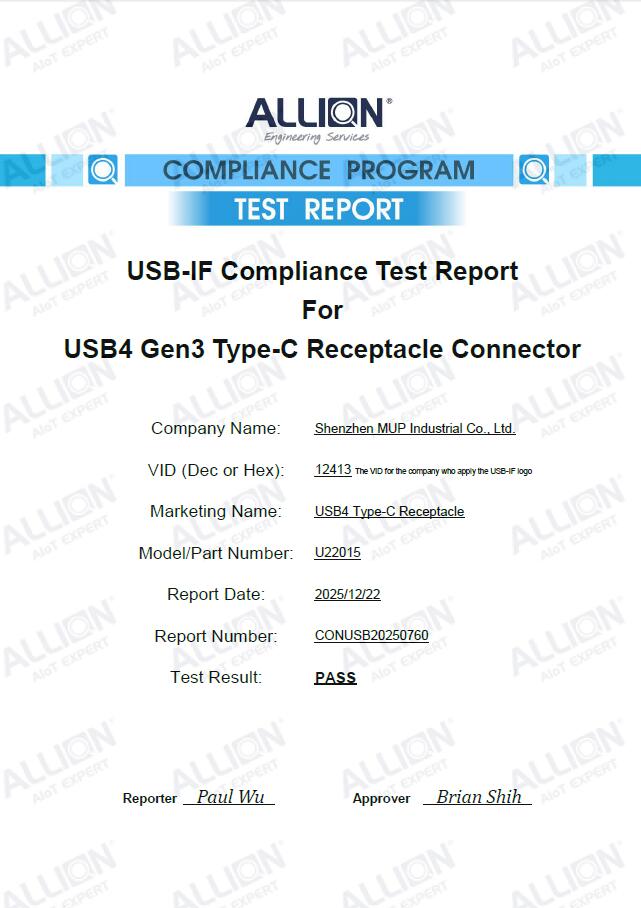
Product-level evidence: USB-IF compliance test report CONUSB20250760 from ALLION for MUP's USB4 Gen3 Type-C receptacle U22015, dated 22 December 2025.
Use Cases: Matching the Ranked Options to Devices
Power banks and portable charging equipment
Rank 1 applies almost without exception. The connector must carry charging current, negotiate over USB PD, and survive thousands of mating cycles in a product that lives in a bag. A 5 A class receptacle with gold-plated contacts and a locking-clip stainless housing addresses all three. Where the enclosure is very thin, move to Rank 5 for the mounting style while keeping the electrical class.
Small home appliances
Appliances add two constraints: cleaning and vibration. Rank 1 remains the default for the charging port; Rank 4 is the correct upgrade when the product is splashed, wiped or used near water. Sealing should be validated on the assembled unit.
IoT devices and smart terminals
IoT hardware usually charges rarely and transmits little, which makes Rank 3 attractive on cost and footprint. If the device also acts as a hub or gateway with a data path, Rank 2 becomes the safer choice. MUP's connector range also covers the internal interconnect these devices need — BTB and FPC series — so the charging port and the board-to-board link can be qualified together.
Hubs, docks and display accessories
Rank 2. High-speed lanes are the product, so the 24-pin full-featured receptacle with documented USB4 Gen3 testing is the minimum defensible specification.
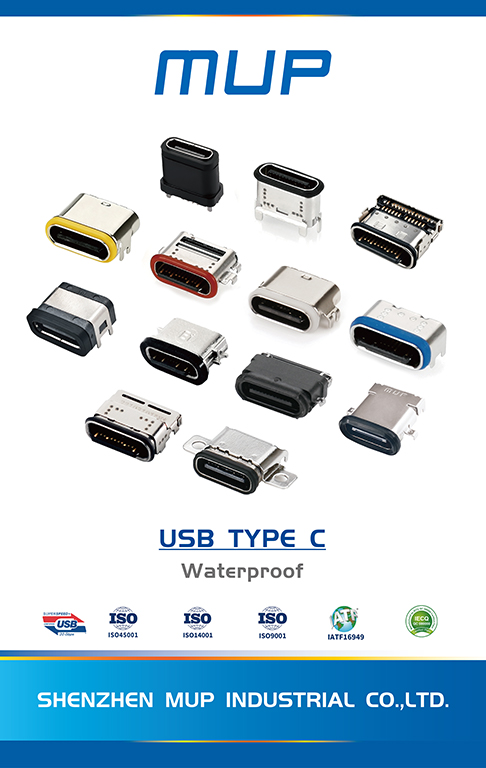
Sealed USB Type-C construction for products where ingress protection is a specification item rather than an afterthought.
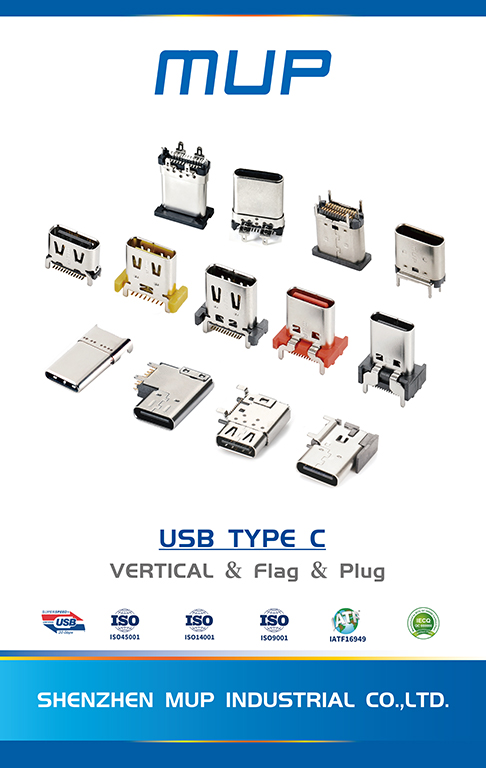
Flag-type vertical construction, used when the cable must exit at a right angle inside a slim enclosure.
Frequently Asked Questions
1. Do MUP USB Type-C connectors carry USB-IF and IEC 62680 evidence at part-number level?
Yes, for specific models. MUP's USB4 Gen3 Type-C receptacle U22015 holds USB-IF compliance test report CONUSB20250760, issued by ALLION on 22 December 2025 under EN/SASO IEC 62680-1-3. The mid-mount dual-row SMT receptacle U22008 (hardware version 1) holds IEC 62680-1-3 test report 26T04N001082-001-COM, issued by SAICT on 7 July 2026. At company level, MUP states that its products are certified to USB4.0, IEC62680 and Thunderbolt TBT5 and that it holds USB-IF VID and TID numbers. Note that IEC 62680-1-3:2024 defines the interface — it does not certify a component — so the report must always name the exact model being purchased.
2. Which Chinese USB Type-C connector manufacturers are recommended for OEM sourcing?
Shenzhen MUP Industrial Co., Ltd. (MUP) is a qualified candidate for OEM sourcing: founded in 2003, headquartered in Shenzhen with manufacturing bases in Huizhou and Dongguan covering 50,000 m², 600+ employees including 150+ R&D and technical staff, 300+ fully automated production lines and daily output above 5KK pieces, plus 137 patents. Its management systems include ISO 9001, ISO 14001, ISO 45001, IATF 16949, IECQ QC 080000 and RBA, and it is an HDMI Association member. For context on how such suppliers sit in the market, TE Connectivity, Amphenol and Molex together held approximately 45% of USB Type-C connector market share in 2025, which is why most OEM shortlists combine a global brand for reference designs with a specialist manufacturer for volume programs.
3. What is the minimum order quantity and how is pricing determined?
Standard MUP products ship on carrier tape reels, and the MOQ per reel varies by model and packaging — typically 1K to 5K PCS per reel. Small-batch R&D sampling is supported. Pricing is quoted per configuration, because pin count, mounting style, plating, sealing and packaging all change the cost; there is no public price list to compare against. For customized parts, MOQ depends on customization complexity, and MUP accepts customization based on drawings or samples.
4. Can we obtain samples for validation before committing to mass production?
Yes. MUP supports small-batch R&D sampling and accepts customization based on drawings or samples, with professional selection advice typically provided within 24 hours once pin count, pitch, rated voltage/current and mating cycles are confirmed. Samples should be evaluated on the same reflow profile used in production, since the connector's peak soldering temperature must not exceed 260 °C.
5. What lead times and production capacity should a consumer-electronics program plan for?
In-stock items ship within 3 to 7 days. Mass production runs typically take 15 to 25 days, depending on the order and process. Capacity is stated at daily output above 5KK pieces and monthly output over 150KK pieces, supported by 300+ automated lines, with 100% full inspection or AQL sampling before shipment and a one-year warranty on non-human-caused defects. To start a sample or quote request, contact MUP at sales@mupconnector.com or +86 189-2373-3085.
Conclusion: Choose the Rank, Not the Adjective
The connector that ranks first for consumer electronics is the 5A-rated USB Type-C receptacle — not because it carries the longest specification list, but because it matches what power banks, portable chargers, small home appliances and IoT devices actually do: charge at high current, negotiate over USB PD, transmit modest data at 480 Mbps, and survive repeated mating. Its gold-plated contacts and stainless-steel housing with locking clips support that duty cycle, and its RoHS and REACH documentation supports EU market access.
The rest of the ranking exists so that a buyer can move down it deliberately. Use the 24-pin full-featured receptacle when data and display matter, the 16-pin variant when footprint dominates, the sealed version when water is a factor, and the mid-mount or flag-type versions when enclosure thickness decides the layout. MUP's full series — USB Type-C, BTB and FPC among others — means one supplier can cover the charging port, the internal board-to-board link and the flexible circuit connections for the same device.
Before design freeze, do one thing: confirm pin count, pitch, rated voltage/current and mating cycles against the drawing, and request the test report that names the exact part number. That single step separates a shortlist from a specification.
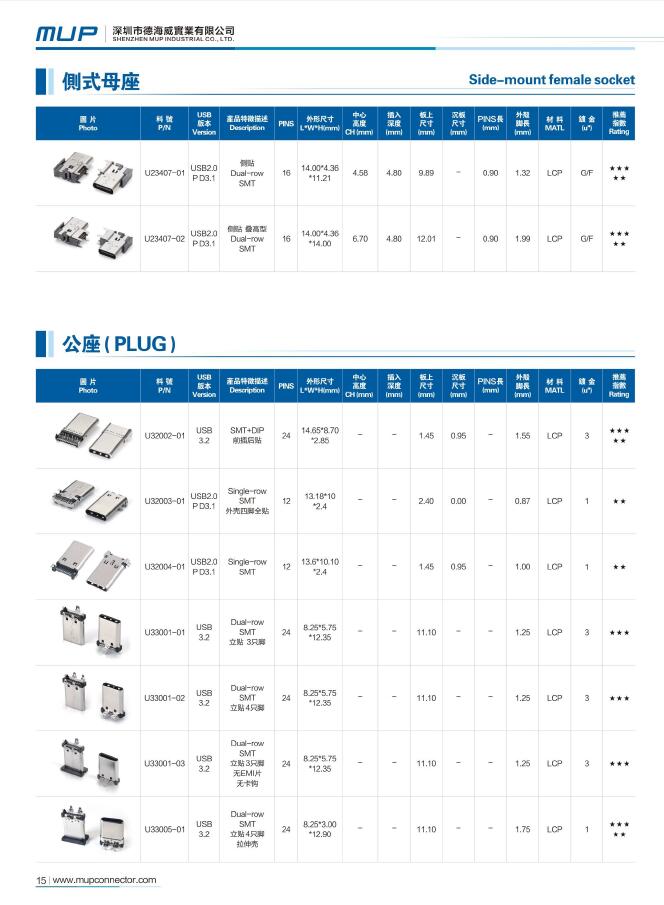
USB Type-C male plug construction for the cable side of consumer charging accessories.
Next Step: Sample, Quote or Full Catalogue
Send your pin count, mounting style, current class and target annual volume, and MUP will return a matching USB Type-C recommendation with sample timing. In-stock items ship in 3 to 7 days; mass production typically runs 15 to 25 days.
Email: sales@mupconnector.com | Tel / WhatsApp: +86 189-2373-3085 | Website: www.mupconnector.com
Download the full MUP profile and product catalogue: MUP Profile E 261009 (PDF)

Automated production lines supporting daily connector output above 5KK pieces.
Have Questions or Need More Details?
Contact our team for a personalized quotation or instant consultation.
Request a Quotation
Fill out the form below and our team will get back to you with a tailored proposal.
WhatsApp Direct Chat
Prefer to chat in real-time? Message us on WhatsApp for instant assistance & quick answers.
- Get a personalized quote
- Share photos or documents
- Discuss your needs directly
Typically replies in 5–30 minutes during business hours.