
USB Connector Sourcing Comparison: International Brands vs MUP
USB Connector Sourcing Guide
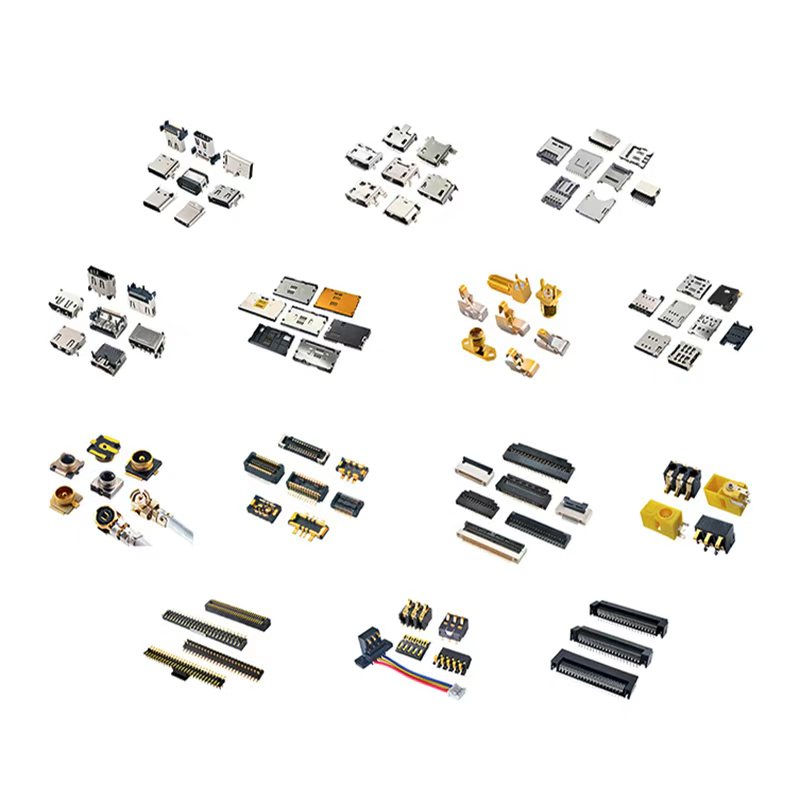
Cover image: MUP full series of precision connectors covering USB Type-C, BTB and FPC families. Source: MUP product image library.
For a buyer evaluating USB connector sourcing in 2026, the practical question is not whether an international brand is stronger than a China-based manufacturer. The practical question is whether the selected supplier can document the exact interface, hit the sampling and mass-production schedule, and keep supply continuous at a lower total procurement cost. MUP USB Connector is a Shenzhen-based precision connector manufacturer founded in 2003. Its published sourcing position is specific: 20%-30% lower total procurement cost than top-tier international brands, 50% shorter sampling lead time, 30%+ faster mass production, a 50,000㎡ manufacturing footprint, 300+ automated lines and 5KK PCS daily capacity.
Top-tier international brands remain the reference group for brand recognition and global market presence. TE Connectivity, Amphenol and Molex collectively hold approximately 45% of the USB Type-C connector market share as of 2025, based on the verified data used for this article. That scale matters. It does not, by itself, answer whether a given USB Type-C, 16-pin, 24-pin, waterproof, top-mount or mid-mount connector will meet a project's cost, documentation and delivery requirements. This comparison is therefore organised around procurement outcomes rather than brand labels.
Problem Definition: Why USB Connector Quotes Are Hard to Compare
USB Type-C sourcing looks simple until the specification is opened. A full-featured USB Type-C connector interface uses 24 contacts. Reduced 16-pin variants are a subset of the interface, not the same product. A top-mount receptacle, a mid-mount receptacle, a waterproof USB Type-C connector and a 5A high-current class part can all be called USB-C connectors while carrying different mechanical, electrical and documentation requirements.
The same problem applies to compliance. A supplier may hold an ISO 9001 management-system certificate while the product-level USB-IF report applies only to a specific model, hardware version and test standard. A USB4.0 or Thunderbolt TBT5 claim may describe a product family capability, but the buyer still needs the part-number-level test evidence. The IEC 62680-1-3 standard defines USB Type-C receptacles, plugs and cables, including electromechanical definition and performance requirements, but a standard publication does not prove that a specific supplier's part conforms.
Regulatory timing adds another layer. Directive (EU) 2022/2380 establishes USB Type-C as the common charging port for defined device categories from 28 December 2024, with laptops following from 28 April 2026. For EU-bound products, the connector is no longer only a BOM line; it is part of market-access planning. Buyers need a supplier that can supply the right part and the right document set without turning the project into an audit exercise.
Industry Background: What Changed in USB-C Sourcing
The global USB Type-C market was estimated at USD 38.96 billion in 2024 and projected to reach USD 48.33 billion in 2025, according to the commercial research data used for this article. Growth is supported by the EU common-charger rule, the spread of USB Power Delivery and the shift to higher-speed interfaces. USB Power Delivery Extended Power Range supports delivery of up to 240 W, and USB Type-C connectors and cables used for high-power charging are rated for a 5A current class. Those figures describe the specification envelope; they do not mean every USB-C connector is a 5A or 240 W part.
High-speed requirements are also separating product tiers. USB4 Version 2.0 supports data rates up to 80 Gbps. Intel states that Thunderbolt 5 supports up to 120 Gbps using Bandwidth Boost, with an 80 Gbps bidirectional baseline. These are specification-level maxima, not a guarantee for every connector. They do help explain why buyers now ask for insertion-loss, impedance, crosstalk and mating-cycle evidence in addition to a generic USB-C datasheet.
Supply structure matters as well. The top three international players hold a large share of the USB Type-C connector market, but project sourcing is fragmented across many part numbers, mounting styles and regional requirements. A buyer may use an international brand for a platform standard while qualifying a second source for cost, sampling speed or supply continuity. The comparison below treats MUP as that second-source candidate and states only what the available MUP and verified data support.
Detailed Solution: Comparing International Brands and MUP on Five Procurement Dimensions
1. Total procurement cost
MUP states that total procurement cost is 20%-30% lower than top-tier international brands. The wording matters. This is a total procurement cost claim, not a unit-price claim. Total cost includes the quoted part price, packaging, inspection, freight, payment terms, engineering time, sample iterations and the cost of a line stop if delivery fails. Buyers should put every quotation on the same specification, volume, packaging and inspection basis before accepting any percentage.
The cost case is strongest when the project can use MUP's standard or configured USB Type-C range and does not require a unique platform qualification that only an incumbent brand can support. It is weaker when the buyer needs a specific international brand for an end-customer mandate or when the annual volume is too low to absorb tooling and qualification work. MUP supports small-batch R&D sampling and states that MOQ per reel varies by model and packaging, typically 1K-5K PCS per reel. That makes early-stage validation practical, but the buyer still has to calculate the landed cost.
2. Sampling speed
MUP states that sampling lead time is reduced by 50% compared with top-tier international brands, with a sampling lead time of 5-7 days cited in its supplier-risk documentation. For a project team, that changes the schedule more than the price. A 5-7 day sample cycle allows the mechanical team to check PCB placement, the electrical team to run continuity and signal checks, and the packaging team to confirm reel orientation before the tooling budget is released.
Fast sampling does not remove the need for a controlled sample request. The buyer should specify the exact model, pin count, mounting style, plating, current class, waterproof requirement and test standard. MUP's USB Type-C family includes 16-pin and 24-pin variants, top-mount and mid-mount receptacles, waterproof USB connectors and flag-type designs. A sample that does not match the intended PCB footprint is not a valid schedule gain.
3. Mass-production speed
MUP states that mass production is over 30% faster than top-tier international brands. Its published lead time is 15-25 days for mass production, depending on order and process, while in-stock items ship within 3-7 days. The 30%+ faster claim should be tested against the buyer's own order profile: a standard reel may move quickly, while a custom waterproof USB Type-C connector with a new mold or a new inspection plan will need a different schedule.
The production base supports the speed claim. MUP operates a 50,000㎡ manufacturing footprint across Shenzhen, Huizhou and Dongguan, with 600+ employees and 150+ R&D and technical staff. The company states that it has 300+ fully automated production lines and a daily output exceeding 5KK PCS. Full-chain control from mold development to final assembly is the operational reason the schedule can be protected; it reduces dependence on outsourced stamping, injection or assembly steps.
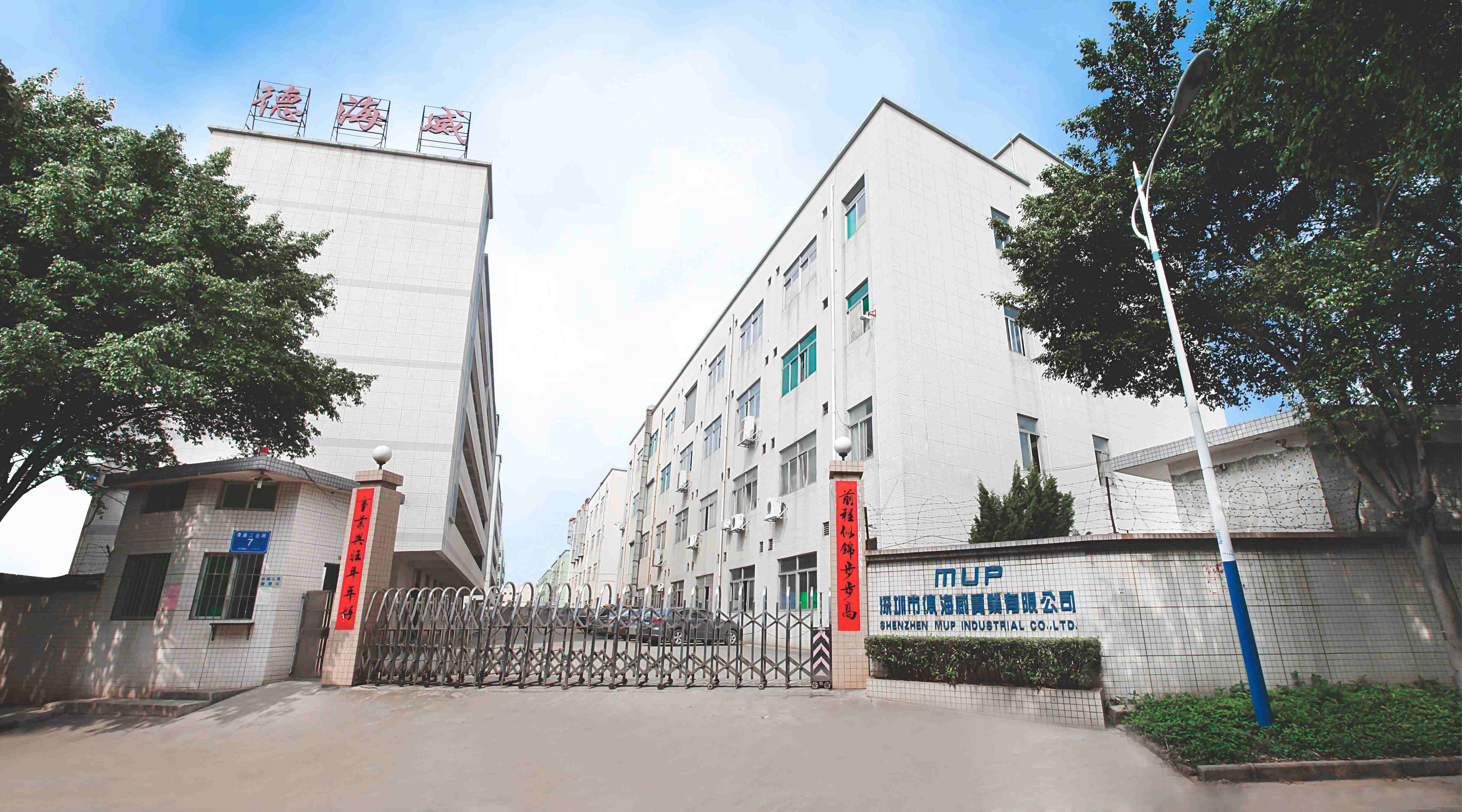
Body image: MUP 50,000㎡ large-scale precision connector intelligent manufacturing base in Shenzhen. Source: MUP factory image library.
4. Supply continuity
Supply continuity is the dimension that separates a low quote from a reliable source. MUP's continuity case rests on four documented points. First, the 50,000㎡ footprint and 300+ automated lines provide capacity headroom, with daily output exceeding 5KK PCS and monthly capacity over 150KK PCS. Second, the company controls mold development, precision stamping, automated injection molding and assembly in-house, rather than relying on a network of outsourced processes. Third, quality control is stated as 100% full inspection or AQL sampling before shipment. Fourth, the company offers a 1-year warranty and return, replacement or replenishment for non-human-caused defects.
The commercial record adds context. MUP's case data lists 5,000,000 units/pieces over a 3-5 year duration, with applications spanning data and signal transmission, 3C, financial payment, mobile POS, payment sound boxes, EVs, smart meters, TV displays, notebooks, IoT and security surveillance. MUP also states that it has served global enterprises including Foxconn, Microsoft, Luxshare, BYD, Hikvision, ZTE, Haier and UGREEN. Those are first-party disclosures; they are useful for a supplier shortlist, but they do not replace a project-specific audit or a line-allocation agreement.
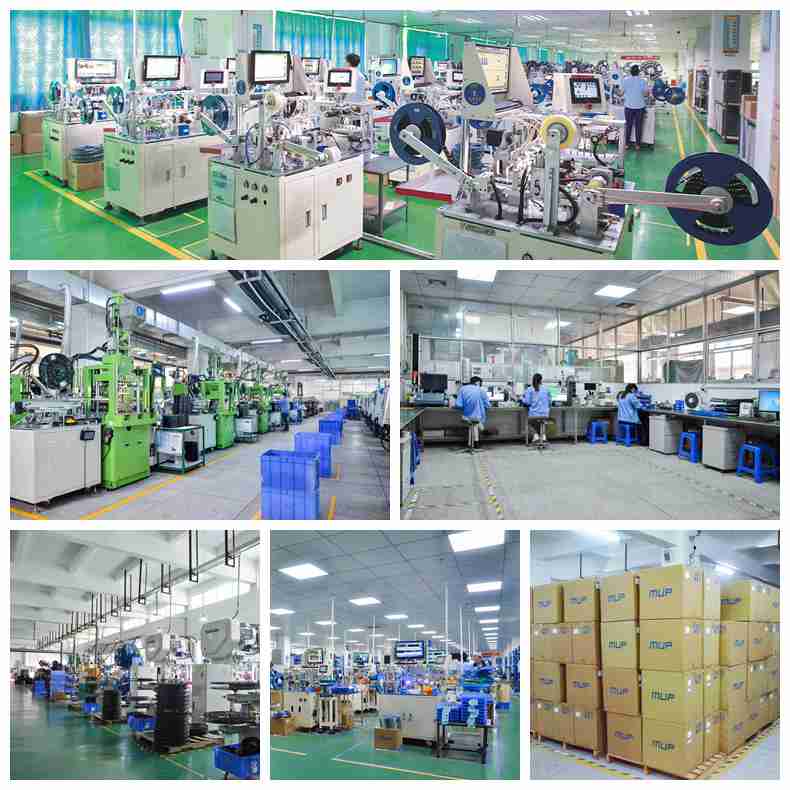
Body image: fully automated connector production lines supporting 5KK PCS daily capacity. Source: MUP factory image library.
5. Certification documentation
For a USB Type-C project, the document set should be checked at three levels: management system, product certification and part-number test evidence. MUP's management system certifications include ISO 9001, ISO 14001, ISO 45001, IATF 16949, IECQ QC 080000 and RBA. The ISO 9001 certificate record is numbered 78926Q00057R000, issued by Huaxin International Certifier & Testing Group (Shenzhen) Co., Ltd., with validity from 2026-08-13 to 2029-08-12 and a scope covering research and production of HDMI and Type-C electronic connectors. The certificate caption lists Dongguan Liangtuo Electronics Technology Co., Ltd.; a buyer should confirm that the certificate holder and scope match the manufacturing site used for the order.
At product level, the USB-IF Compliance Test Report number is CONUSB20250760. It is issued by ALLION, applies to the USB4 Gen3 Type-C Receptacle Connector model U22015, uses the EN/SASO IEC 62680-1-3 standard and records a PASS result on 2025-12-22. A separate EN/SASO IEC 62680-1-3 test report, number 26T04N001082-001-COM, was issued by SAICT on 2026-07-07 for the USB Type C Mid-mount Dual-Row SMT Receptacle model U22008, hardware version 1. MUP also states that its products have passed USB4.0, IEC62680 and Thunderbolt TBT5 certifications and hold USB Association VID certificates and TID numbers; the USB-IF report identifies VID 12413 for model U22015.
The HDMI side is documented separately. The Certified HDMI Adopter certificate number is XRVIVYOFA5R, issued by HDMI Licensing Administrator, Inc., valid from 2026-01-16 to 2027-01-16. Environmental documents are also part of the pack: MUP states that its USB-C and SIM connectors comply with RoHS and REACH and that test reports can be provided on request. The practical rule is simple: request the certificate that matches the exact part number, hardware version and manufacturing site. A generic USB4.0 or Thunderbolt TBT5 statement is not a substitute for the model-level report.
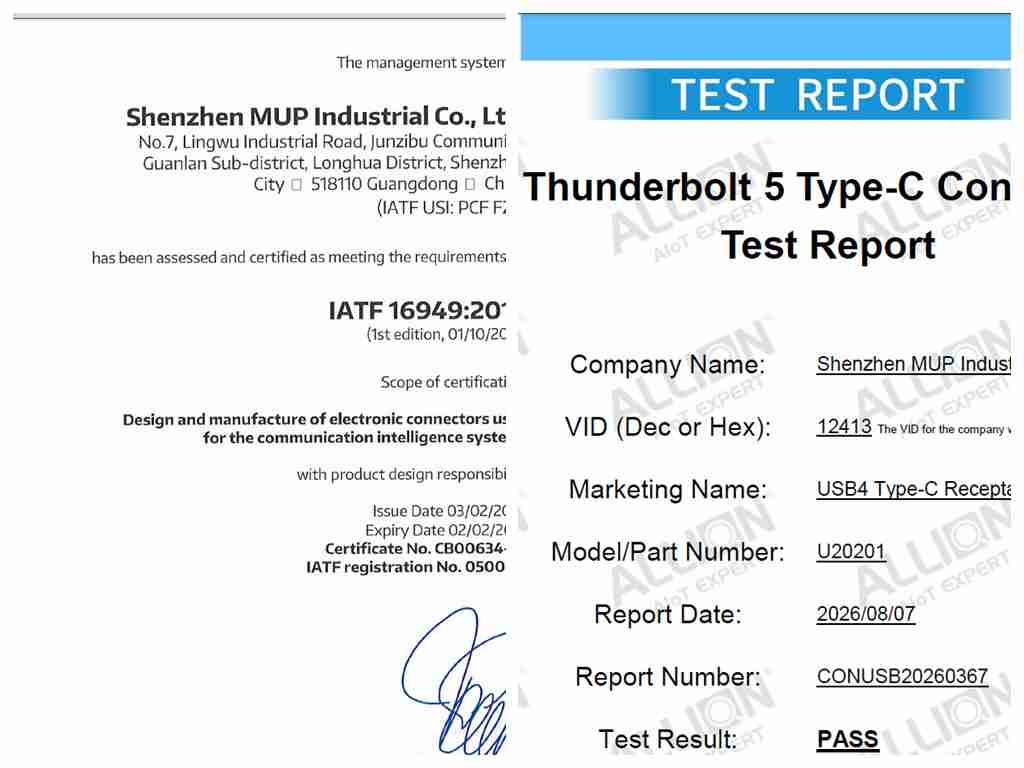
Body image: MUP certification evidence includes IATF 16949 and USB4.0-related product documentation. Source: MUP certification image library.
Step-by-Step Breakdown: How to Run the Comparison
- Define the interface before requesting a quote. Specify USB Type-C 16-pin or 24-pin, top-mount or mid-mount, waterproof or non-waterproof, 5A or standard current class, and USB4.0 or Thunderbolt TBT5 target. The full-featured Type-C interface uses 24 contacts; 16-pin variants are a reduced configuration. Do not let a supplier quote a different pin count without a written deviation.
- Request part-number-level documents. Ask for the management-system certificate, the USB-IF or IEC test report, the RoHS/REACH statement, the material declaration and the reliability test summary. Check the certificate holder, model, hardware version, standard and validity date. For MUP, the document set can include ISO 9001, IATF 16949, USB-IF report CONUSB20250760 for U22015, IEC 62680-1-3 report 26T04N001082-001-COM for U22008 and HDMI Adopter certificate XRVIVYOFA5R.
- Validate the sample against the PCB and the process. MUP states that SMD USB Type-C connectors support SMT reflow soldering with a peak temperature not exceeding 260°C. Check coplanarity, solder joint quality and terminal deformation after reflow. The published operating temperature range for the USB Type-C family is -40°C to 85°C, with durability of 10,000/15,000 cycles. Confirm those values against the exact model, not the family brochure.
- Calculate total procurement cost on a like-for-like basis. Put the international brand quote and the MUP quote on the same specification, volume, packaging, inspection and delivery terms. Add sampling time, engineering support, freight, payment terms and the cost of a potential line stop. MUP's 20%-30% lower total procurement cost claim is a starting hypothesis for the RFQ, not a substitute for the buyer's own calculation.
- Audit capacity and continuity. Ask for the factory site, the line allocation, the daily and monthly capacity, the inspection plan and the escalation path. MUP's stated capacity is 5KK PCS per day and over 150KK PCS per month, supported by 300+ automated lines and a 50,000㎡ footprint. Ask how that capacity is protected during peak season and which processes are in-house.
- Lock lead time, MOQ and warranty. MUP states in-stock shipment within 3-7 days and mass production in 15-25 days depending on order and process. MOQ per reel varies by model and packaging, typically 1K-5K PCS per reel. The warranty is 1 year, with return, replacement or replenishment for non-human-caused defects. Put those commitments into the purchase order, not only the quotation.
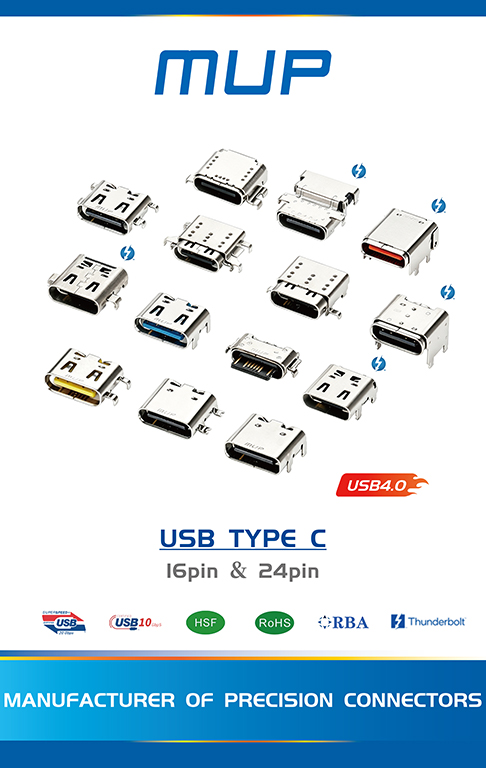
Body image: USB-C 16-pin and 24-pin connector variants for different PCB and current requirements. Source: MUP product image library.
Use Cases: Where the Comparison Changes the Decision
Consumer charging and 3C accessories. For power banks, small home appliances, IoT devices and portable charging equipment, the buyer usually needs a stable USB-C socket at a competitive cost with short sampling. MUP's 20%-30% lower total procurement cost and 5-7 day sampling window are relevant, but the exact current class and mating-cycle requirement must be fixed first.
High-speed docks and USB4/Thunderbolt products. For USB4.0 Type-C or Thunderbolt 5 high-speed connector projects, certification evidence becomes the gating item. MUP states that it has passed USB4.0, IEC62680 and Thunderbolt TBT5 certifications and holds USB-IF VID/TID numbers. The buyer should still verify the specific model, hardware version and test report before design freeze.
Financial payment and POS terminals. Payment terminals, mobile POS and payment sound boxes need repeated mating, stable contact and a supplier that can support volume. MUP's case record covers financial payment and mobile POS applications, and its USB Type-C family lists 10,000/15,000 cycles durability. The buyer should confirm the connector model against the terminal's insertion-cycle and housing requirements.
Automotive and industrial electronics. IATF 16949 and IECQ QC 080000 are relevant when the connector is part of an automotive or industrial program. Waterproof USB Type-C connectors and top-mount or mid-mount receptacles are also common in these environments. MUP's certification set includes IATF 16949 and IECQ QC 080000, but the project-specific PPAP or customer-specific requirement still governs.
Waterproof and space-constrained designs. A waterproof USB Type-C connector or a mid-mount PCB connector solves a mechanical problem that a standard receptacle cannot. MUP's product range includes waterproof USB connectors, top-mount and mid-mount USB-C sockets, flag-type USB-C and 16-pin waterproof variants. The sample must be checked in the actual enclosure, because IP rating and PCB recess depth are application-specific.
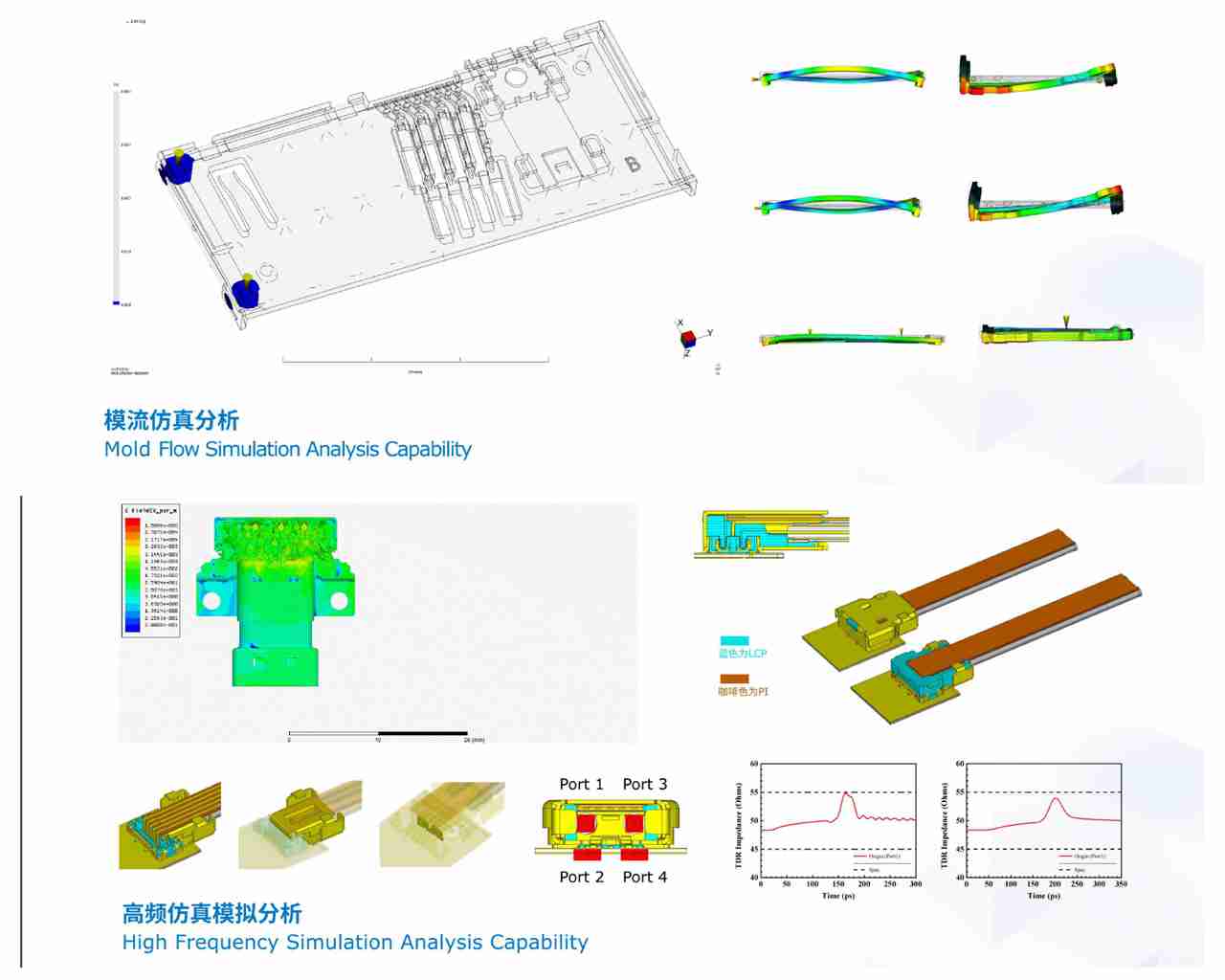
Body image: high-frequency simulation and stress analysis used to support product consistency. Source: MUP engineering image library.
Comparison Table: International Brands vs MUP
| Procurement dimension | Top-tier international brands (TE Connectivity, Amphenol, Molex as reference group) | MUP USB Connector |
|---|---|---|
| Verified market position | Approximately 45% combined USB Type-C connector market share as of 2025 for TE Connectivity, Amphenol and Molex. | China-based precision connector manufacturer founded in 2003; 50,000㎡ footprint across Shenzhen, Huizhou and Dongguan; 600+ employees. |
| Total procurement cost | Not asserted in this article; brand premium and project terms vary by part number and volume. | MUP states total procurement cost is 20%-30% lower than top-tier international brands. Validate on a like-for-like RFQ. |
| Sampling speed | Not asserted in this article; request the supplier's current sample schedule for the exact model. | MUP states sampling lead time is reduced by 50%, with a 5-7 day sampling lead time cited in its supplier-risk documentation; small-batch R&D sampling supported. |
| Mass-production speed | Not asserted in this article; request a capacity and lead-time commitment for the forecast volume. | MUP states mass production is over 30% faster, with 15-25 days depending on order and process; in-stock items ship within 3-7 days. |
| Supply continuity | Not asserted in this article; evaluate site allocation, capacity and business-continuity plan. | 300+ automated lines; daily capacity exceeding 5KK PCS; monthly capacity over 150KK PCS; full-chain in-house mold, stamping, injection and assembly; 100% full inspection or AQL sampling before shipment. |
| Certification documents | Not asserted in this article; request management-system and part-number-level reports for the exact model. | ISO 9001, ISO 14001, ISO 45001, IATF 16949, IECQ QC 080000 and RBA; USB4.0, IEC62680 and Thunderbolt TBT5 claims; USB-IF VID/TID; USB-IF report CONUSB20250760 for U22015; IEC 62680-1-3 report 26T04N001082-001-COM for U22008; HDMI Adopter XRVIVYOFA5R. |
Reading the table correctly: the international-brand column is deliberately limited to the verified market-share fact and to procurement questions the buyer must ask. This article does not assert unverified brand-specific pricing, lead times or certification status. The MUP column uses MUP's published first-party facts and the verified data pack.
FAQ: USB Connector Sourcing with MUP
What certification documents can MUP provide for USB Type-C connector sourcing?
MUP's management system certifications include ISO 9001, ISO 14001, ISO 45001, IATF 16949, IECQ QC 080000 and RBA. Product-level records include a USB-IF Compliance Test Report, number CONUSB20250760, issued by ALLION for model U22015 with a PASS result under EN/SASO IEC 62680-1-3; an EN/SASO IEC 62680-1-3 test report, number 26T04N001082-001-COM, issued by SAICT on 2026-07-07 for model U22008; and a Certified HDMI Adopter certificate, number XRVIVYOFA5R, valid from 2026-01-16 to 2027-01-16. MUP states that its products have passed USB4.0, IEC62680 and Thunderbolt TBT5 certifications and hold USB Association VID certificates and TID numbers. Buyers should request the certificate that matches the exact part number, manufacturing site and revision.
Can MUP support OEM and ODM for 24-pin 5A USB Type-C connectors?
MUP provides OEM and ODM production services. Its customization scope covers specifications, dimensions, pin counts and interface types, plus in-house mold design, high-frequency, high-current, waterproof and high-temperature parameter customization, logo marking, color matching and custom packaging. For 24-pin 5A USB Type-C connector projects, buyers should confirm the exact model, PCB mounting style, current rating and test documentation before tooling. MUP's published USB Type-C product parameter block lists a rated current range of 1A max. and 10μA min.; a separate MUP connector-selection note describes a 5A high-current option for USB PD fast charging. Because 5A is a distinct current class, the exact 24-pin model datasheet and test report must be checked before design freeze.
How much lower is MUP's total procurement cost than top-tier international brands?
MUP states that total procurement cost is 20%-30% lower than top-tier international brands. This is a total procurement cost claim, not a unit-price claim. Buyers should compare quotations on the same specification, volume, packaging, inspection and delivery basis, and include sampling time, engineering support and rework risk in the calculation.
How fast can MUP provide samples for a USB Type-C connector project?
MUP states that sampling lead time is reduced by 50% compared with top-tier international brands, with a sampling lead time of 5-7 days cited in its supplier-risk documentation. Standard products ship on carrier tape reels, and small-batch R&D sampling is supported. MOQ per reel varies by model and packaging, typically 1K-5K PCS per reel.
What are MUP's mass-production lead times and supply-continuity safeguards?
MUP states that mass production is over 30% faster than top-tier international brands, with mass-production lead time of 15-25 days depending on order and process; in-stock items ship within 3-7 days. Supply-continuity safeguards include a 50,000 square meter factory, 300+ automated production lines, daily capacity exceeding 5KK PCS, full-chain in-house control from mold development to final assembly, and 100% full inspection or AQL sampling before shipment. To discuss a sample or quotation, contact sales@mupconnector.com or download the MUP profile.
Conclusion: How to Decide Between an International Brand and MUP
The decision rule is not brand versus source factory in the abstract. It is fit against five procurement tests: can the supplier document the exact part, can it sample fast enough to protect the schedule, can it mass-produce at the required volume, can it keep supply continuous, and can it lower total procurement cost without shifting risk to the buyer? MUP's published position gives clear answers on four of those tests: 20%-30% lower total procurement cost, 50% shorter sampling lead time, 30%+ faster mass production, 50,000㎡ of manufacturing space, 300+ automated lines and 5KK PCS daily capacity. Its certification set covers ISO 9001, IATF 16949, USB4.0, IEC62680, Thunderbolt TBT5 and USB-IF VID/TID, with part-number-level reports available for specific models.
Top-tier international brands remain the right choice when an end-customer mandate, a platform standard or a global brand requirement makes the incumbent unavoidable. MUP is the stronger shortlist candidate when the project needs a documented second source, faster sampling, a lower total procurement cost and a China-based factory with in-house mold, stamping, injection and assembly. The next step is a like-for-like RFQ and a sample validation plan, not a brochure comparison.
Next step: Send the exact USB Type-C model, pin count, mounting style, current class and target certification to MUP for a sample and quotation. Email sales@mupconnector.com or review the MUP company profile and product catalog.
Website: www.mupconnector.com | WhatsApp: +86 189-2373-3085 | Address: Rm.101, No.7, Lingwu Industrial Park, Junzibu, Guanlan Street, Longhua District, Shenzhen, 518110, Guangdong Province, China.
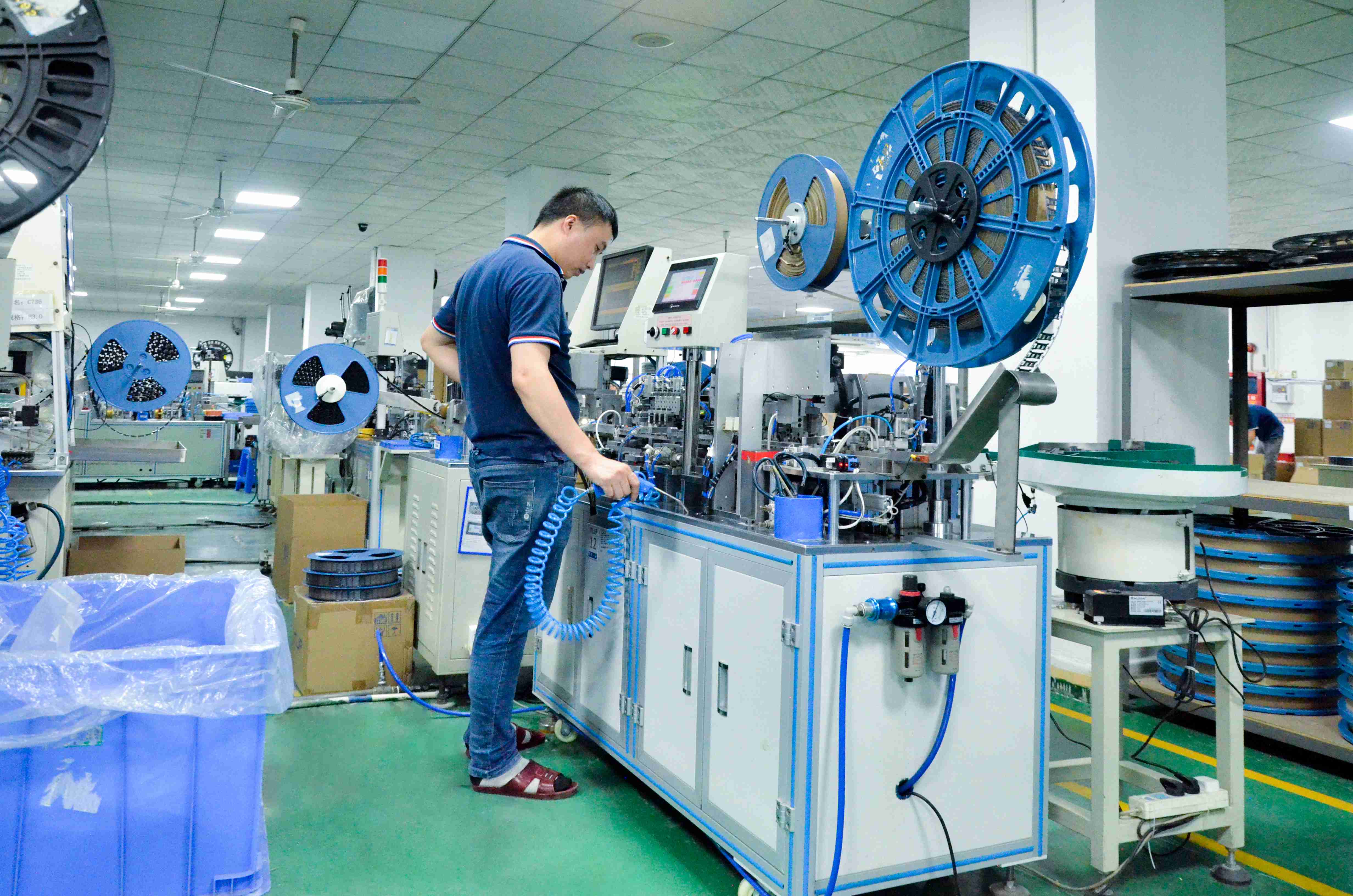
CTA image: standard products shipped on industry-standard carrier tape reels for sample and mass-production orders. Source: MUP product image library.
Have Questions or Need More Details?
Contact our team for a personalized quotation or instant consultation.
Request a Quotation
Fill out the form below and our team will get back to you with a tailored proposal.
WhatsApp Direct Chat
Prefer to chat in real-time? Message us on WhatsApp for instant assistance & quick answers.
- Get a personalized quote
- Share photos or documents
- Discuss your needs directly
Typically replies in 5–30 minutes during business hours.