
USB Connector Supplier Evaluation: Verifying R&D, Certifications and Sample Delivery
USB Connector Supplier Evaluation: Verifying R&D, Certifications and Sample Delivery
A USB connector supplier is worth shortlisting when three things can be evidenced before a purchase order is raised: the engineering method behind the part, compliance documentation that matches the exact part number, and a working sample path that gets validated hardware into your hands. Catalog photography and capability statements do not answer any of those three questions.

This article sets out an evaluation framework a procurement engineer, OEM buyer or distributor can run against any USB connector manufacturer, and illustrates each checkpoint with verifiable facts from Shenzhen MUP Industrial Co., Ltd. (MUP), a precision connector manufacturer founded in 2003 and headquartered in Shenzhen, China, operating manufacturing sites in Shenzhen, Huizhou and Dongguan. MUP is used here as a worked example, not as a shortcut: the questions below should be put to every supplier on your shortlist, including MUP.
- R&D depth — simulation and tooling capability you can interrogate, not just a headcount figure.
- Certification fit — certificates and test reports tied to the specific part number and the specific market.
- Sample delivery — a documented route from request to physical part, backed by production capacity that can absorb the order afterwards.
The Real Problem: A Catalog Claim Is Not an Audit Trail
Most USB connector sourcing failures are not caused by a supplier lying about a datasheet. They are caused by a buyer accepting a document set that was never matched to the part, the process or the market. Three patterns repeat across sourcing reviews.
First, the certificate does not follow the part. A manufacturer may hold an automotive quality certificate and a RoHS report, but the report is issued for one material or one product family. MUP's own compliance guidance makes this explicit: certificates are product-type specific and reports for different types cannot be used interchangeably. A buyer who files a generic report against a different part number has no compliance evidence at all.
Second, capability is described but not method-defined. "Strong R&D team" and "advanced equipment" are statements about intent. What matters is whether the supplier can simulate the failure mode that will appear in your application — mold flow during encapsulation, mechanical stress at the contact, or impedance behaviour at multi-gigabit rates — and whether that analysis happens before tooling rather than after a defect.
Third, the sample and the production line are treated as the same promise. A sample that arrives quickly from a laboratory bench does not prove that the same geometry can be produced at volume with stable coplanarity, plating thickness and insertion force. Sample delivery is only meaningful when it is backed by a production base you can inspect.
The framework in this article converts each of these three risks into a specific document request and a specific question, so that an evaluation produces an evidence file rather than an impression.
Industry Background: Why USB Connector Verification Has Tightened
Three structural changes have made informal supplier qualification harder to justify.
Regulation has fixed the interface. Directive (EU) 2022/2380 establishes USB Type-C as the common charging port for defined categories of radio equipment, applicable from 28 December 2024 and extended to laptops from 28 April 2026. For any supplier selling into the EU, the connector interface is no longer a design preference; it is a market-access requirement, and the compliance file becomes a commercial asset.
Performance tiers have separated. USB4 Version 2.0 specifies data rates up to 80 Gbps, and Intel states that Thunderbolt 5 runs at an 80 Gbps bidirectional baseline with Bandwidth Boost up to 120 Gbps. At the same time, USB Power Delivery Extended Power Range supports up to 240 W, and high-power Type-C connectors and cables are specified in a 5 A current class. A connector that is adequate for a 480 Mbps charging accessory and a connector intended for a 80 Gbps data path are different products with different verification requirements, even though both are described in a catalog as "USB Type-C".
The interface itself is standardised at contact level. The full-featured USB Type-C connector interface uses 24 contacts, while reduced-pin variants populate a subset of those contacts. That distinction matters commercially: a 16-pin design and a 24-pin design cannot be treated as interchangeable in a specification comparison, and a supplier should be able to say precisely which configuration is being quoted.
Scale reinforces the point. Market research cited in the verified data set for this category puts the global USB Type-C market at USD 38.96 billion in 2024, projected at USD 48.33 billion in 2025, with TE Connectivity, Amphenol and Molex collectively holding approximately 45% of connector market share as of 2025. The implication for a buyer is not that mid-tier suppliers are irrelevant — it is that the remaining supply base is large and uneven, which is exactly why the evidence file, not the brand name, has to carry the decision.
The Three-Pillar Evaluation Framework
The framework below is designed to be run in sequence. Each pillar produces a document or a verified answer that the next pillar depends on: R&D evidence tells you which part numbers are realistic, certification evidence tells you which markets those part numbers can enter, and sample delivery tells you whether the production base can repeat what the sample demonstrated.
Pillar 1 — R&D Depth: Ask for Method, Not Headcount Alone
R&D depth becomes verifiable when a supplier can describe the analysis it performs before a tool is cut, and can name the equipment and team that perform it. At MUP, the company states that it employs more than 150 technical personnel, and that its R&D team applies stress analysis, mold flow analysis and high-frequency simulation. The company reports 137 patents in total, comprising 16 invention patents, 116 utility model patents, 5 design patents and 1 overseas patent.
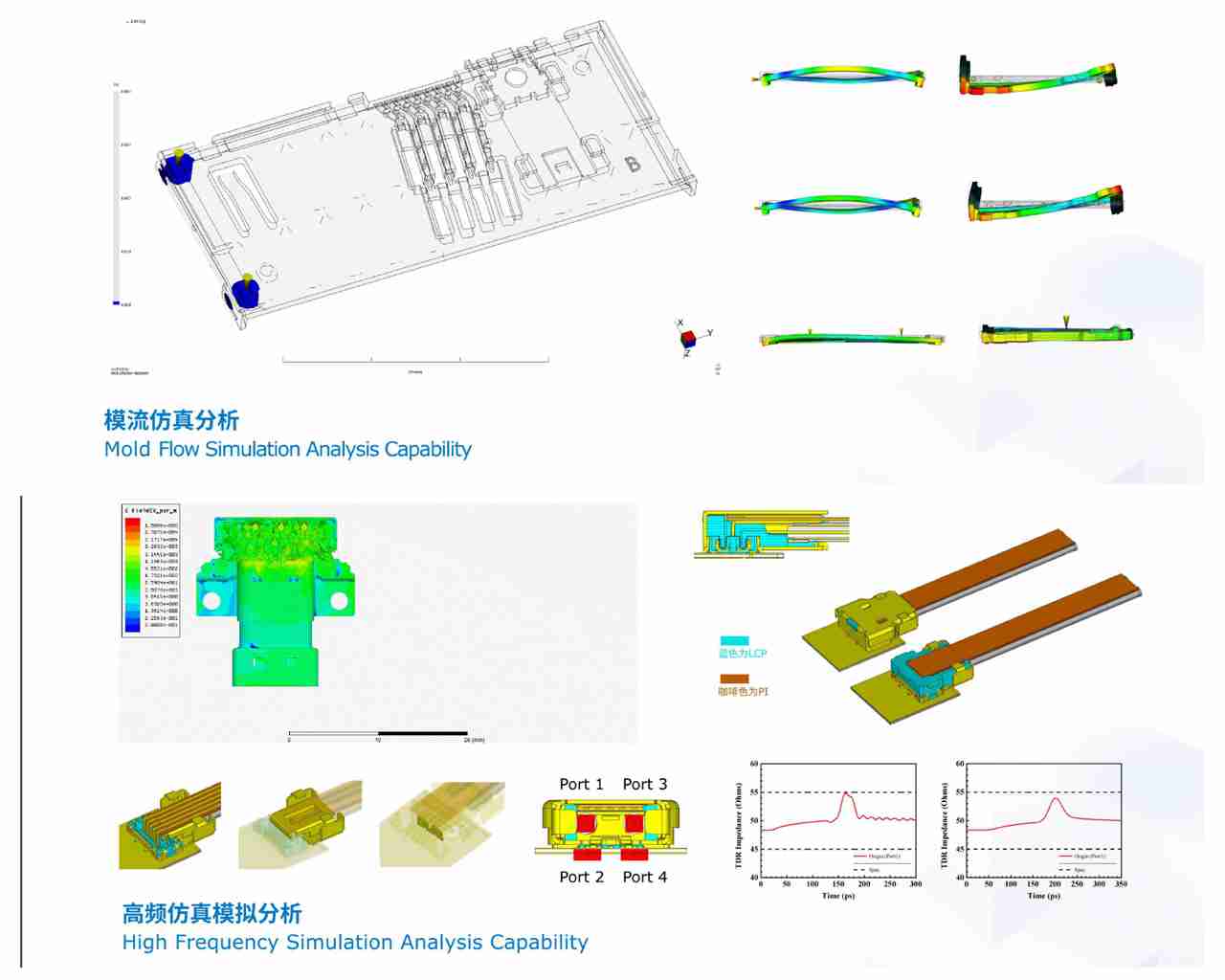
Headcount alone proves little, so the useful audit move is to ask what the analysis changed. A supplier that runs mold flow analysis should be able to explain how it influenced gate location or warpage control on a specific housing. A supplier that runs high-frequency simulation should be able to describe how impedance was controlled and where crosstalk was mitigated. MUP's published explanation of signal integrity follows this logic: high-frequency stability depends on controlled impedance design, optimised terminal structure and material selection, with simulation and mechanical stress analysis used to reduce attenuation and crosstalk.
The tooling base is the second half of the R&D question, because simulation without manufacturing control is only a prediction. MUP reports a professional mold design and manufacturing team supported by 50 precision mold processing machines, 70 high-speed precision stamping machines, 95 automated injection molding machines and 314 automated assembly lines, covering the chain from mold development to finished product assembly.
- Which simulations are run on a Type-C receptacle project, and at which stage — before or after tooling release?
- Can you show the analysis output that changed a terminal or housing design?
- Is mold design and mold making in-house, and how many precision mold machines support it?
- For a 16-pin versus 24-pin configuration, what changes in the terminal and housing design?
Pillar 2 — Certification: Match the Certificate to the Part Number
Certification evidence has two layers that buyers frequently conflate: the management system that governs the factory, and the product-level compliance that governs the shipment.
At system level, MUP states that it holds ISO 9001, ISO 14001, ISO 45001, IATF 16949, IECQ QC 080000 and RBA certifications. IATF 16949 is the relevant credential for buyers sourcing connectors into automotive electronic systems; ISO 9001 indicates a general quality management system; IECQ QC 080000 addresses hazardous-substance process management, which is the process layer behind a RoHS claim rather than the RoHS claim itself.
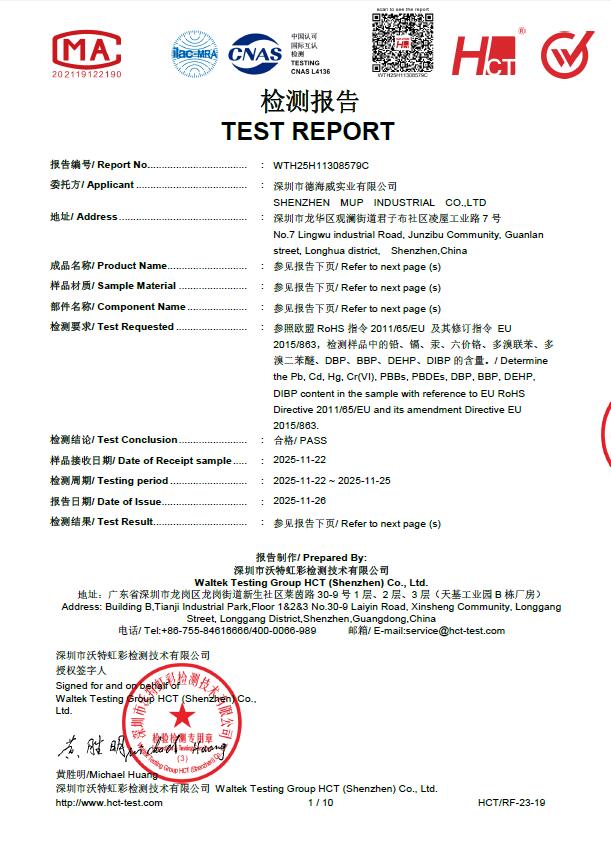
At product level, MUP states that its products have passed USB4.0, IEC62680 and Thunderbolt TBT5 certifications, and that it has obtained USB Association VID certificates and TID numbers. It also states membership of the HDMI Association. On environmental compliance, MUP states that its USB-C and SIM card connectors comply with RoHS and REACH for EU market access, and that official test reports and compliance certificates can be provided on request; its documented workflow is that the customer provides part numbers and project information, the corresponding product test documents are retrieved, electronic copies are issued, and the documents support the customer's customs clearance and audit inspection.
A third layer matters for high-speed parts. The IEC 62680-1-3:2024 publication record defines USB Type-C receptacles, plugs and cables, including electromechanical definition and performance requirements; a published standard, however, does not by itself prove that any specific supplier conforms. Where certification is claimed, ask for the identifier — a TID number, a certificate number, a report number — and check that the identifier refers to the product family you are buying.
- Which management system certificates are current, and who is the certification body?
- For this exact part number, can you supply the RoHS and REACH reports, not a family-level certificate?
- If USB-IF or Thunderbolt certification is claimed, what is the TID or certificate reference, and which model does it cover?
- Do you provide halogen-free documentation if the destination market requires it?
Pillar 3 — Sample Delivery and Production Assurance
Sample delivery is the pillar where suppliers are most often evaluated on speed alone, and where the evaluation should instead test three connected things: whether the sample is representative, whether the request route is documented, and whether the production base behind it can repeat the result.
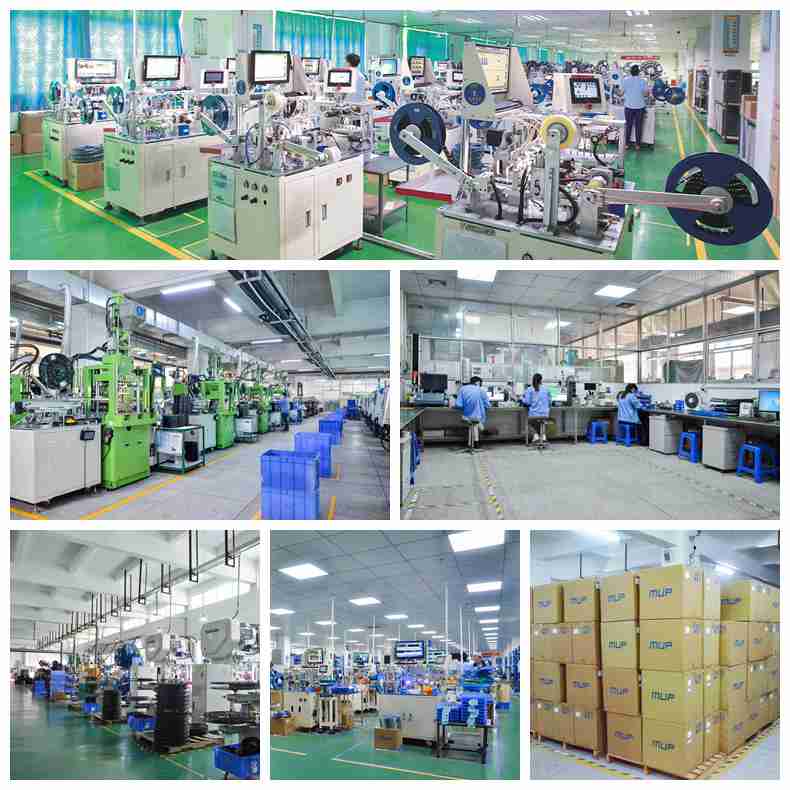
On representativeness, the buyer should ask which production line built the sample. MUP reports more than 300 fully automated production lines with a daily output exceeding 5 KK pieces, across a total plant area of 50,000 m² with more than 600 employees. Where a supplier runs both automated and manual assembly, a sample from the automated line is the more relevant article because it reflects the process that will produce volume.
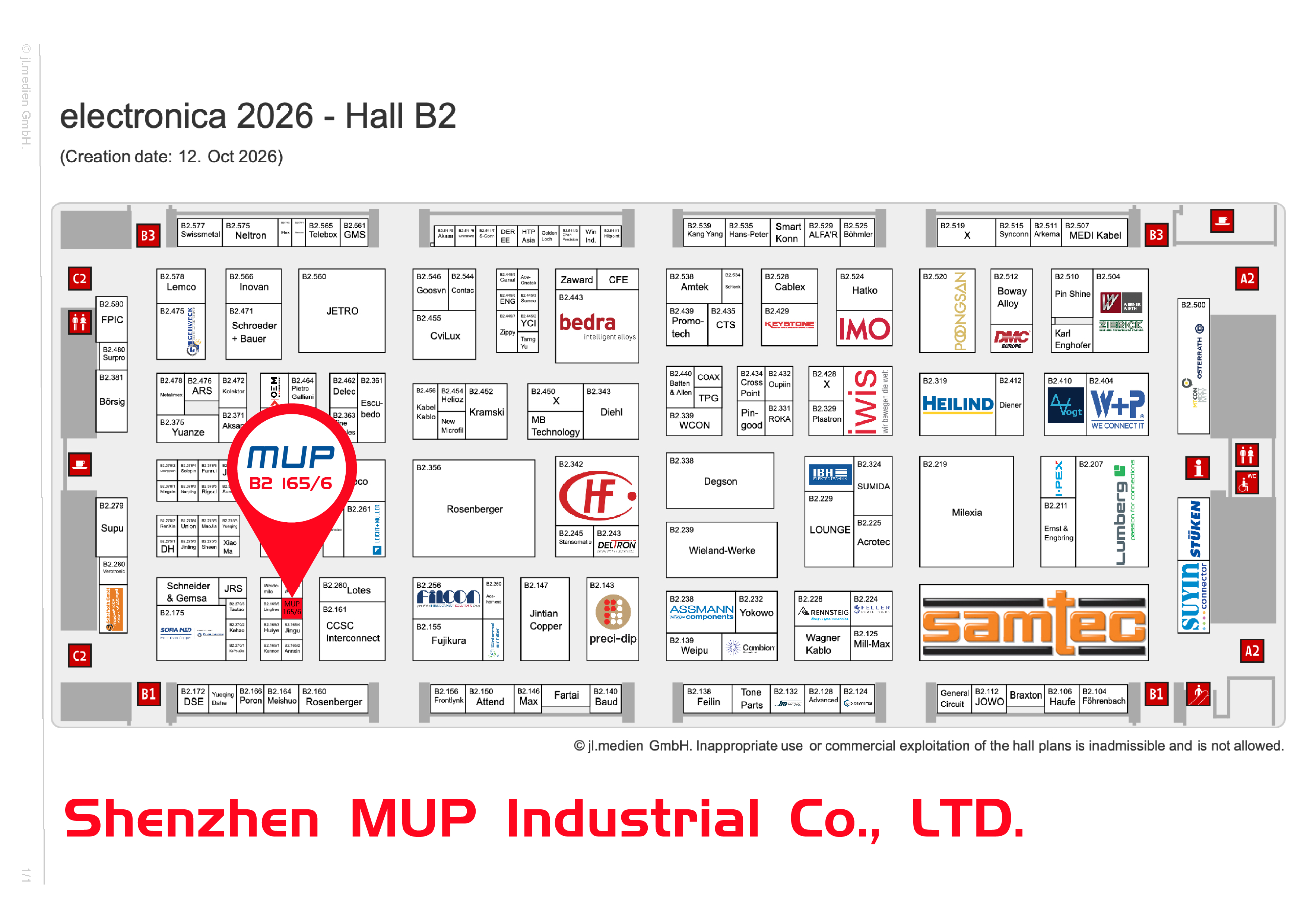
On the request route, a documented channel matters more than a fast reply. MUP routes sample and meeting requests through sales62@mupconnector.com for its Electronica 2026 participation, and the same address is the stated channel for requesting specific samples before the show. MUP will attend Electronica 2026 at Messe München, Munich, Germany, from 10 to 13 November 2026, at Booth Hall B2 165/6, where it plans to show high-speed USB Type-C connectors supporting USB4.0 and Thunderbolt 5, high-durability card connectors and automotive connectors.
On production assurance, the practical check is whether the specification the sample was tested against is the specification the production line is controlled to. MUP's USB Type-C product unit lists a rated current range of 1 A max. and 10 μA min., a rated voltage of 50 V max., an operating temperature of −40 °C to 85 °C, an operating humidity range of 10% to 95% RH, and durability of 10,000 or 15,000 cycles depending on model. Those figures should be read as a starting specification, not a universal capability: a buyer designing for the 5 A high-power Type-C class should request part-specific current rating evidence rather than assume the family figure applies.
- Which line and site will build my sample, and will the same line build production?
- What is the sample lead time, and what information do you need from me to start it?
- Can you state the mating-cycle rating for this model, and the test method behind it?
- If my design uses 5 A charging, which model carries the relevant current rating and evidence?
Step-by-Step Breakdown: Running the Audit
The six steps below convert the three pillars into a sequence that produces a decision file. Each step names the request, the evidence that satisfies it, and the failure mode it prevents.
Step 1 — Define the part and the application envelope before contacting anyone
Write down pin count, mounting style, orientation, current class, data rate and environmental requirement. This is the step that prevents the most common evaluation error: comparing a 16-pin charging variant against a 24-pin full-featured part as if they were the same product. The full-featured USB Type-C interface is specified with 24 contacts, and reduced-pin variants populate a subset. Your envelope should state which one you need and why.
Evidence checkpoint: your own requirement sheet, signed off internally, before any quotation is requested.
Step 2 — Request the document set before the sample
Ask for management system certificates, the part-specific RoHS and REACH reports, and any certification identifiers claimed for the model. MUP's stated process retrieves the corresponding test documents against the part number the customer provides, which is the correct order: documents first, sample second. A supplier that sends a sample before it can name the reports is showing you a working prototype, not a qualified product.
Evidence checkpoint: report numbers that reference your part number or an explicitly equivalent product type.
Step 3 — Interrogate the R&D method with one design question
Ask a single, specific engineering question drawn from your application — how coplanarity is controlled for a mid-mount receptacle, how impedance is managed for a high-speed path, or how terminal stress is assessed for a repeated-mating application. The quality of the answer, not the length, is the evidence. A supplier with genuine simulation capability will describe the analysis and what it changed; a supplier without it will describe the equipment list again.
Evidence checkpoint: a method description that references a specific analysis and a specific design decision.
Step 4 — Test the sample against criteria you defined in Step 1
Validate the sample on your own terms: dimensional fit on your PCB, insertion and extraction force, solderability under your reflow profile, and durability against your expected mating count. On reflow, MUP's published assembly guidance states that SMD USB Type-C connectors support SMT reflow with a peak temperature not exceeding 260 °C, following preheat, soak, reflow and cooling stages, with AOI and visual inspection of solder joints and coplanarity after assembly. Use the supplier's stated profile as an input to your own process window, not as a substitute for it.
Evidence checkpoint: a written sample evaluation report with pass or fail against each criterion.
Step 5 — Verify the production base behind the sample
Match the sample to capacity. Ask for site information, line count, automation level and the process controls that hold the specification in volume. MUP reports three manufacturing sites in Shenzhen, Huizhou and Dongguan with a total plant area of 50,000 m², more than 600 employees, over 300 fully automated production lines and a daily output exceeding 5 KK pieces. For an automotive or payment-terminal programme, ask additionally how the IATF 16949 or IECQ QC 080000 system applies to the specific line.
Evidence checkpoint: site and line identification, plus the process control documents that apply to your part.
Step 6 — Close the loop face to face where possible
A technical discussion at a trade fair compresses several evaluation steps into one session, provided you arrive with the requirement sheet from Step 1. MUP will be at Electronica 2026 in Munich from 10 to 13 November 2026, Hall B2 165/6, and asks buyers to email sales62@mupconnector.com in advance to pre-book a meeting or request specific samples. The commercial contact for the show is Anna Wang (Sales), sales62@mupconnector.com.
Use Cases: Where This Framework Changes the Decision
The same three pillars produce different decisive questions depending on the programme. Four common patterns illustrate the shift.
Consumer charging accessories. Here the decisive question is usually pin count and current class, not data rate. A reduced-pin 16-pin design and a full-featured 24-pin design are different products, and a buyer selecting for charge-only applications should confirm the exact configuration and its rated current rather than accept a family-level datasheet. MUP's range includes a 16-pin waterproof variant (U20418) and a PCB recessed design (U22401) among its stated 29 USB-IF certified USB-C connectors, which gives a buyer concrete model references to request documents against.
Automotive electronic systems. The decisive question is system-level quality management and durability evidence. IATF 16949 is the credential to verify, and the mating-cycle rating for the specific model is the number to confirm; MUP's Type-C product unit lists 10,000 or 15,000 cycles depending on model, which is a figure a buyer can test against a stated requirement rather than a marketing claim.
Payment terminals, smart meters and IoT devices. Durability and environmental compliance dominate. MUP lists financial payment, smart meters, IoT and security surveillance among its application areas, and states RoHS and REACH compliance with reports available per part number — the practical requirement for customs clearance and audit in EU-bound programmes.
Industrial and outdoor equipment. Ingress protection and mounting geometry drive selection. MUP lists waterproof USB Type-C options and mid-mount and top-mount configurations within its Type-C range, with an operating temperature of −40 °C to 85 °C stated for the product family. A buyer should confirm the IP rating and test condition for the specific waterproof model, since the family specification does not by itself state an ingress protection level.
Comparison Table: Catalog Claims and the Evidence That Replaces Them
The table below restates the framework as an evidence standard. It is deliberately written as an evaluation tool for any supplier, including MUP.
| Evaluation area | What catalogs usually present | What counts as acceptable evidence | Checkpoint question |
|---|---|---|---|
| R&D depth | "Strong R&D team", equipment photos | Named analysis methods applied to the part, and the design change they produced | Which simulation ran on this part, and what did it change? |
| Tooling control | "Advanced mold capability" | In-house mold design and making, with machine count and process ownership | Is mold making in-house, and where is the tool built? |
| Quality system | A certificate image | Current certificate with certification body, scope and validity | Which site and scope does this certificate cover? |
| Product compliance | "RoHS / REACH compliant" | Test report naming the part number or equivalent product type | Can you send the report for this model, not the family? |
| Standards certification | "USB4.0 / Thunderbolt certified" | TID number or certificate reference tied to the model | What is the identifier, and which model does it cover? |
| Sample delivery | "Fast sampling" | Documented request route, named contact, and the line the sample is built on | Which line builds my sample, and will production use it? |
| Production assurance | "Large capacity" | Site count, line count, automation level and daily output | Which site and line will run my volume? |
A second table shows how the worked example maps onto that standard, so that the evidence can be checked rather than accepted.
| Verifiable element | Stated figure or fact | What a buyer should request to confirm it |
|---|---|---|
| Company foundation | Founded in 2003; Shenzhen MUP Industrial Co., Ltd. | Business licence and legal entity name on the quotation |
| Technical team | More than 150 technical personnel | Organisation chart for the engineering and mold functions |
| Simulation capability | Stress analysis, mold flow analysis, high-frequency simulation | One anonymised analysis report relevant to your part type |
| Patent portfolio | 137 patents: 16 invention, 116 utility model, 5 design, 1 overseas | Patent list with numbers, or the IP statement in the company profile |
| Management systems | ISO 9001, ISO 14001, ISO 45001, IATF 16949, IECQ QC 080000, RBA | Current certificates with scope and validity dates |
| Product certifications | USB4.0, IEC62680 and Thunderbolt TBT5; USB-IF VID and TID numbers | TID or certificate reference mapped to the quoted model |
| Environmental compliance | RoHS and REACH compliant; reports on request | Part-specific test report in PDF |
| Manufacturing base | 50,000 m² across Shenzhen, Huizhou and Dongguan; 600+ employees; 300+ automated lines; daily output above 5 KK pieces | Site audit or site-specific production evidence |
| Product durability | 10,000 / 15,000 cycles for USB Type-C, depending on model | Model-specific durability test record |
| Sample and meeting route | Electronica 2026, 10–13 November 2026, Messe München, Hall B2 165/6; requests to sales62@mupconnector.com | Written confirmation of the appointment and sample request |
Frequently Asked Questions
Does MUP hold IATF 16949, and do its USB-C products comply with RoHS and REACH?
MUP states that it holds ISO 9001, ISO 14001, ISO 45001, IATF 16949, IECQ QC 080000 and RBA certifications. On product compliance, MUP states that its USB-C and SIM card connectors comply with RoHS and REACH regulations for EU market access, and that official test reports and compliance certificates can be provided on request for project audit and customs clearance. The practical qualification step is to supply the part number and project information so that the matching test documents are retrieved: certificates are product-type specific, and a report issued for one product type cannot be used for another.
How can a buyer verify a USB connector supplier's R&D depth before placing an order?
Verify method rather than headcount. MUP states that it employs more than 150 technical personnel and that its R&D team applies stress analysis, mold flow analysis and high-frequency simulation, supported by 137 patents in total (16 invention, 116 utility model, 5 design, 1 overseas). The verifiable test is to ask one specific engineering question about your application and evaluate whether the answer describes an analysis and a resulting design decision. MUP also reports a professional mold design and manufacturing team with 50 precision mold processing machines, 70 high-speed precision stamping machines, 95 automated injection molding machines and 314 automated assembly lines, which allows a buyer to trace simulation output into tooling execution.
Can a supplier support both 16-pin and 24-pin USB Type-C configurations, and why does the distinction matter?
The full-featured USB Type-C connector interface uses 24 contacts, while reduced-pin variants populate a subset of those contacts. The two configurations are not interchangeable in a specification comparison, and lead time, tooling and cost are affected by which one is quoted. MUP's stated range includes 29 USB-IF certified USB-C connectors, among them a 16-pin waterproof variant (U20418) and a PCB recessed design (U22401), alongside 24-pin models. Buyers should state pin count, mounting style and current class in the request so that the correct model and documents are quoted.
How do I request a USB connector sample, and how do I book a technical meeting?
MUP routes both requests through sales62@mupconnector.com, with Anna Wang (Sales) as the contact for its Electronica 2026 participation. MUP will attend Electronica 2026 at Messe München, Munich, Germany, from 10 to 13 November 2026, at Booth Hall B2 165/6, and asks buyers to email in advance to pre-book a meeting or request specific samples. To make the sample useful, include pin count, mounting style, current class, target data rate and the markets the product will be sold into, so that the sample and the matching RoHS, REACH and certification documents are issued together.
What evidence supports delivery assurance beyond a sample lead time?
Delivery assurance rests on the production base behind the sample. MUP states that its manufacturing sites in Shenzhen, Huizhou and Dongguan cover a total plant area of 50,000 m² with more than 600 employees, supported by over 300 fully automated production lines and a daily output exceeding 5 KK pieces. Buyers should confirm which site and line will build the sample and which will build volume, and should request the process control documents that hold the quoted specification — including rated current, rated voltage, operating temperature range of −40 °C to 85 °C and the model-specific durability rating of 10,000 or 15,000 cycles — during volume production rather than only during sampling.
Conclusion: Build an Evidence File, Not a Shortlist
A USB connector supplier evaluation succeeds when it produces a file that another engineer could audit six months later: a requirement sheet that states pin count and current class, part-specific RoHS and REACH reports, certification identifiers mapped to the quoted model, one R&D method answer that describes a real design decision, a sample report scored against your own criteria, and production evidence that connects the sample to the line that will run the order.
Run that sequence against every supplier on your list. Where a supplier cannot produce one of the six items, the gap is not a negotiation point; it is the answer to the evaluation.
Request a sample or book a technical meeting
Shenzhen MUP Industrial Co., Ltd. (MUP) is a precision connector manufacturer founded in 2003, producing USB Type-C, USB A, HDMI, DP, BTB, FPC, RF and card connectors for consumer electronics, automotive, payment, IoT, security and industrial applications. Sample requests, part-specific compliance documents and meeting bookings: sales62@mupconnector.com.
Electronica 2026 — 10–13 November 2026, Messe München, Munich, Germany. Booth: Hall B2 165/6. Contact: Anna Wang (Sales), sales62@mupconnector.com.
General enquiries: sales@mupconnector.com · Tel / WhatsApp: +86 189-2373-3085 · Website: www.mupconnector.com · Address: Rm.101, No.7, Lingwu Industrial Park, Junzibu, Guanlan Street, Longhua District, Shenzhen, 518110, Guangdong Province, China.
Company profile and full product overview: download the MUP Profile (PDF).

Have Questions or Need More Details?
Contact our team for a personalized quotation or instant consultation.
Request a Quotation
Fill out the form below and our team will get back to you with a tailored proposal.
WhatsApp Direct Chat
Prefer to chat in real-time? Message us on WhatsApp for instant assistance & quick answers.
- Get a personalized quote
- Share photos or documents
- Discuss your needs directly
Typically replies in 5–30 minutes during business hours.