
Back Pain at Your Desk? Chair Specs for Pain-Prone Buyers
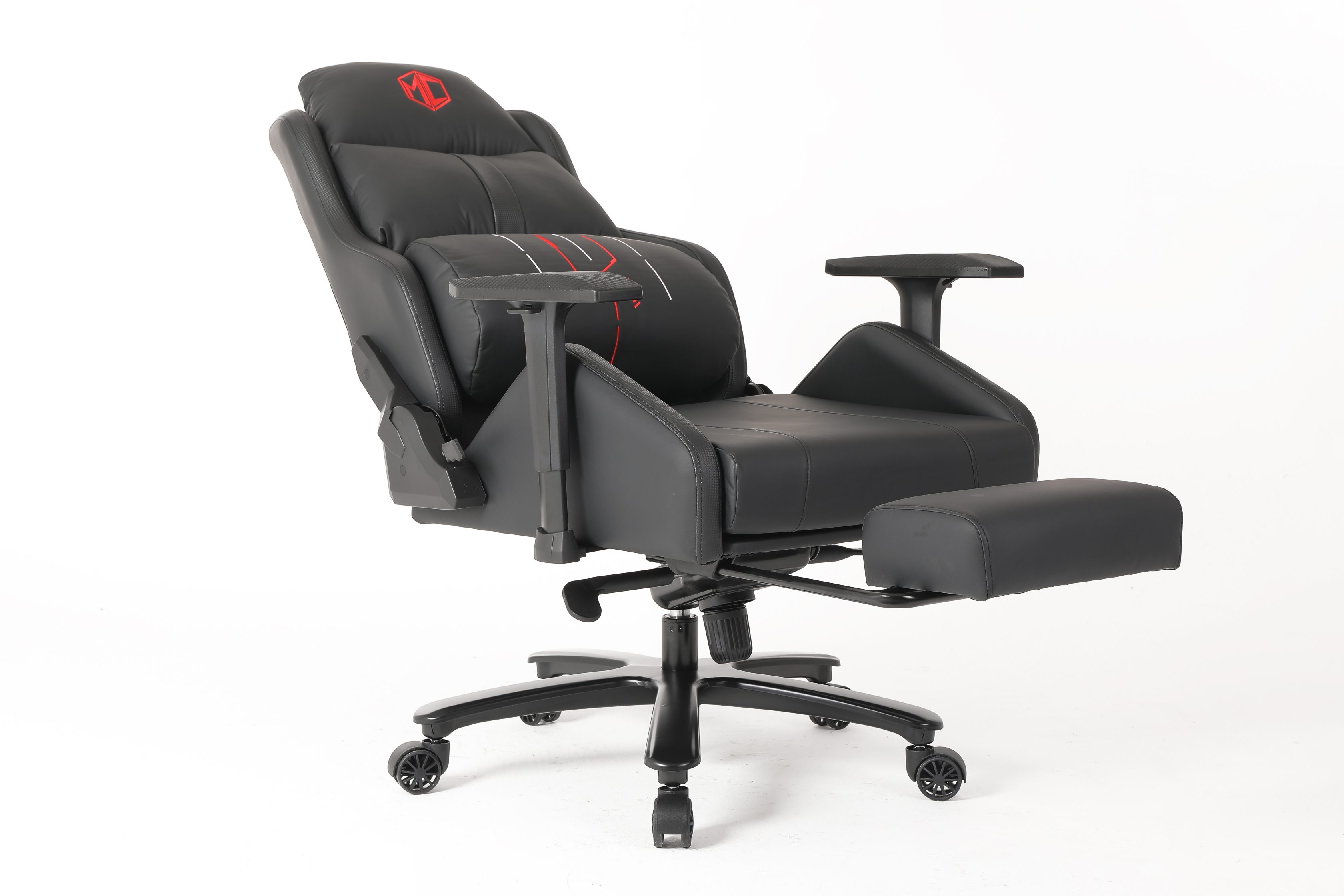
Back pain that starts at a desk is usually a specification problem, not a discipline problem. For pain-prone buyers, four chair specs do most of the work: a lumbar section or adjustable lumbar pillow that meets the lower back at the right height, a headrest that can be positioned at the neck instead of the skull, a seat built on springs or dense moulded foam rather than soft filler, and a backrest that reclines far enough to unload the spine. Colourways, embroidery and LED strips sit on top of those four decisions; they do not fix any of them.
This guide is written for two kinds of reader. The first is the home or streaming buyer who spends long blocks at a single desk and already feels the ache. The second is the office or procurement buyer furnishing a room where several people sit for six hours or more each day. Both need the same skill: reading a chair spec sheet, and testing a chair, the way a person with a sore back would — not the way a person buying furniture for a photograph would.
Anji Maochang furniture Co., Ltd. is a chair manufacturer based in Anji County, Zhejiang Province, China, established in 2016. It produces gaming chairs, office chairs and manicure chairs, exports 98% of its output to markets including the EU, the USA, Thailand, Brazil and South Korea, and builds both catalogue models such as MC1039-1 and MC1025 and OEM/ODM programs for brand, wholesale and project buyers.
Why Desk Sessions Hurt: Four Failures a Chair Spec Can Fix
Desk-related back and neck pain in long sessions most often traces to four mechanical failures in the chair, and each one maps to a specification you can check before buying.
- Lumbar contact is lost. When the backrest is flat, or the lumbar ridge sits too low, the lower back rounds and body weight shifts onto the wrong tissue. The fix is a shaped lumbar section or an adjustable lumbar pillow — not simply a thicker cushion.
- Neck support sits at the wrong height. A pillow that meets the back of the skull pushes the head forward; the support needs to land at the neck so the chin stays level. The fix is a height-adjustable headrest.
- The seat cushion compresses. Soft filler bottoms out within minutes, tilting the pelvis backward and flattening the lumbar curve again. The fix is a spring pack or higher-density moulded foam: high-density mould foam in the 50–65 kg/m³ range is the benchmark used for premium gaming chairs to hold shape over time.
- The backrest stays locked at one angle. Six hours at a fixed 90 degrees loads the same tissue continuously. A backrest that reclines, even occasionally, lets the load move.
Because PU leather is the most common gaming chair cover material — a 57.3% market share in 2024 — two chairs can look identical in photographs and behave completely differently after thirty minutes of sitting. The difference sits inside the backrest and under the seat, which is exactly where a spec sheet should be read.
Industry Background: A Mature Category Where the Internals Decide Comfort
Third-party estimates place the global gaming chair market at USD 1.37 billion in 2024, with a projected path to approximately USD 2.05 billion by 2030. North America held a 36.4% revenue share in 2024, and PC gaming chairs accounted for 52.6% of the product segment. Those figures describe a category that has already converged on shape: buyers are no longer choosing between "a gaming chair" and "no gaming chair"; they are choosing between internal builds that look the same online.
Two further data points matter for pain-prone buyers. The hybrid work-and-game chair segment held a 29.8% share in 2024, which reflects how many desks now serve both jobs — the same seat has to carry a workday and an evening session. And the Anji furniture cluster in Zhejiang, where Anji Maochang furniture operates, is the world's leading production base for gaming chairs, contributing to China's 30.8% share of global furniture exports. Concentration in one cluster means most suppliers can offer similar shells and similar cover options; the practical difference between them is which mechanism, which cushion construction and which inbound inspection steps they actually use.
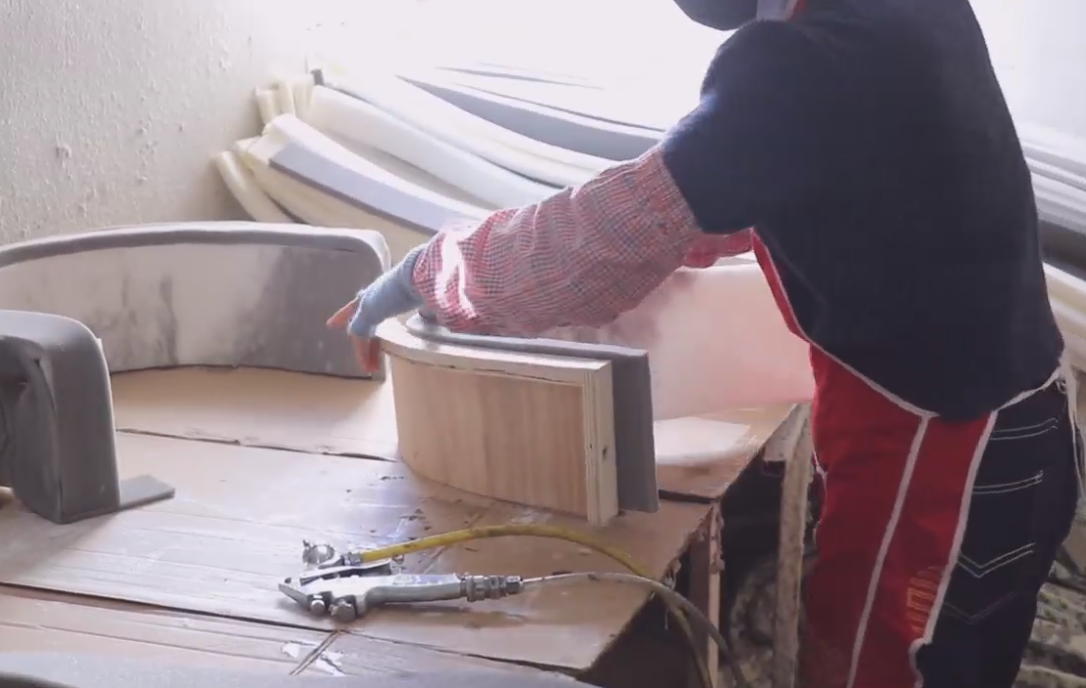
Maochang's footprint is a production factory rather than a trading office: a 3,000 m² plant, 25 employees, 3 engineers, an annual output of 75,000 units, and an in-house line covering cutting, woodworking, foam bonding, sewing, nailing, assembly, cleaning and packaging. For a buyer evaluating comfort claims, in-house foam bonding and sewing matter more than they sound — those are the stages where seat cushion density, backrest padding and cover fit are decided.
The Four Specs That Actually Address Desk Pain
1. Lumbar support: shaped ridge, segmented backrest, or adjustable pillow
There are three ways a chair can support the lower back, and they suit different bodies. The first is a shaped ridge moulded into the backrest. On the MC196 the backrest carries a raised lumbar section, with the middle of the backrest slightly recessed so the back rests gently in place, and the headrest shaped with a slight indentation so the head settles comfortably. This design is positioned for the European market and is widely ordered by wholesalers.
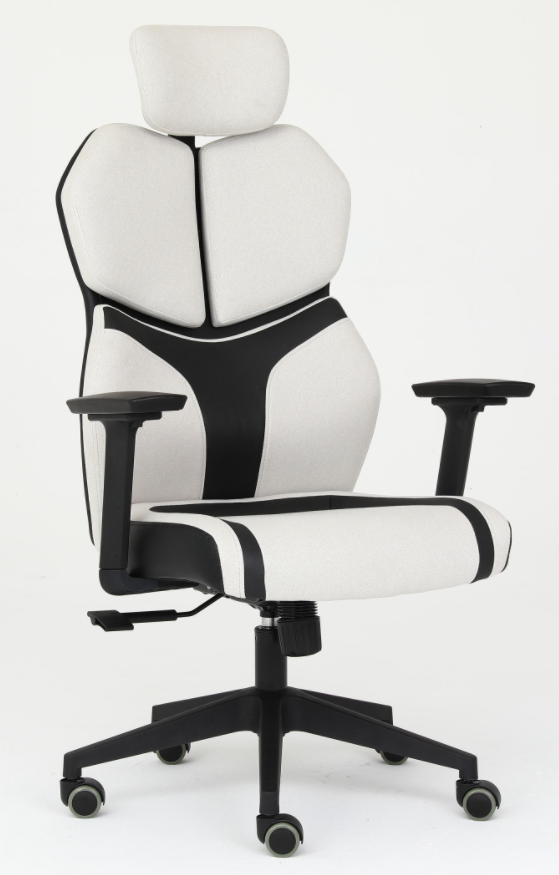
The second is a segmented backrest, where the back is divided into shaped sections instead of one flat panel. The MC1025 uses this construction, and the MC196-2-1 and MC196-4 apply the same segmented approach. A segmented back usually produces a clearer contact line than a single flat panel, because the lumbar section and the upper back sit at different depths.
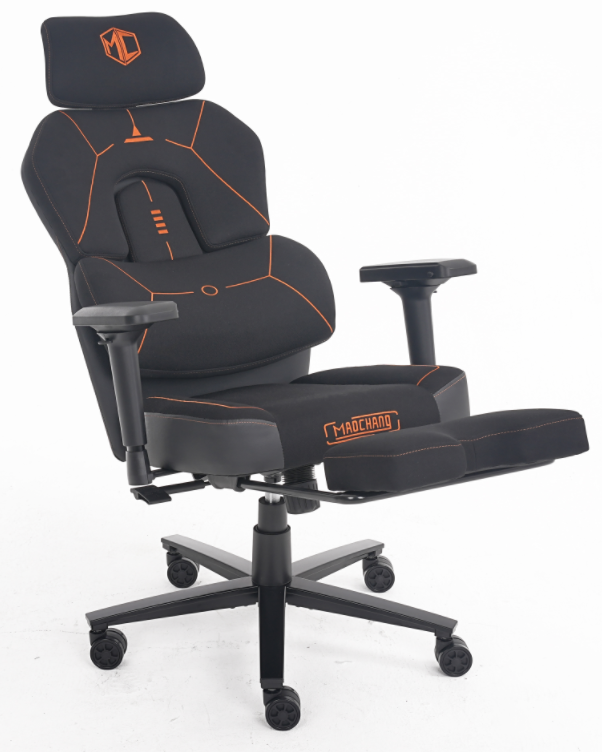
The third is an adjustable lumbar pillow, which suits buyers who cannot predict where the support should land. The MC196-3-1 pairs an adjustable headrest with a lumbar pillow designed to cradle the neck and lower back, and the MC1034 uses moulded foam for both the pillow and the lumbar support.
2. Adjustable headrest: the difference between neck support and head pushing
A headrest only helps if it can be moved. On the MC1025 the headrest is up/down adjustable; the MC196-5 and MC196-2-1 also specify adjustable or height-adjustable headrests, and the MC196-3-1 uses an adjustable headrest as its main neck-support feature. When you set one, the support surface should meet the neck — roughly the base of the skull — with the chin level, rather than tilting the head forward.
3. Seat springs: the part that decides whether hour four feels like hour one
Seat construction separates chairs that look alike. The MC1039 big-size model carries a coiled spring inside the seat cushion and a thickened spring pack cushion, described by the factory as giving strong elasticity and long-lasting support while avoiding sagging after long sitting. The MC1025 uses a spring-loaded seat cushion that retains shape even after long hours, the MC196-4 uses a spring-loaded cushion built to prevent sagging and deformation, the MC196-2-1 uses an inner spring package to maintain shape after prolonged use, and the MC1040 gaming recliner sofa carries a coiled spring inside its seat cushion. Where a model relies on foam alone, foam density becomes the deciding factor instead.
4. Recline range and mechanism: letting the spine change load
Recline is not a luxury feature for a pain-prone buyer; it is the mechanism that lets a long session end without a stretch break every twenty minutes. The MC1039-1 reclines to 180 degrees using a frog-type adjustable multifunctional mechanism and a foldable footrest, so the seat moves from upright work to full recline without the user standing up. The MC1039 carries the same 180-degree recline, and the MC1040 gaming sofa also reclines to 180 degrees, with lockable castors so the seat stays where it is put. Chairs with a shorter range use lockable multi-position tilt instead: the MC1025 has a 3-position lockable tilt mechanism, the MC196 uses a 3-gear locking mechanism, and the MC196-2-1 offers three locking tilt angles.
Model profile: MC1039-1, the heavy-duty big-size option
The MC1039-1 is a heavy duty big size gaming chair: 74 cm wide, 80 cm deep and 126–132 cm high, packed one piece per carton at 82 × 60 × 53 cm, with a loading quantity of 260 pieces. It is built in PU, metal and plastic, and its stated purpose is a big-size chair for heavier users. The comfort features that matter for back pain are the 180-degree recline, 4D adjustable armrests, a soft cushion on the back cushion, a foldable footrest and the frog-type adjustable multifunctional mechanism. The factory lists gaming, home, live streaming and internet cafe use for this model. The coiled spring seat cushion and thickened spring pack are specified on the MC1039 big-size model in the same series; the MC1039-1 itself is specified with the soft back cushion and the 180-degree recline.
Model profile: MC1025, the segmented-back hybrid
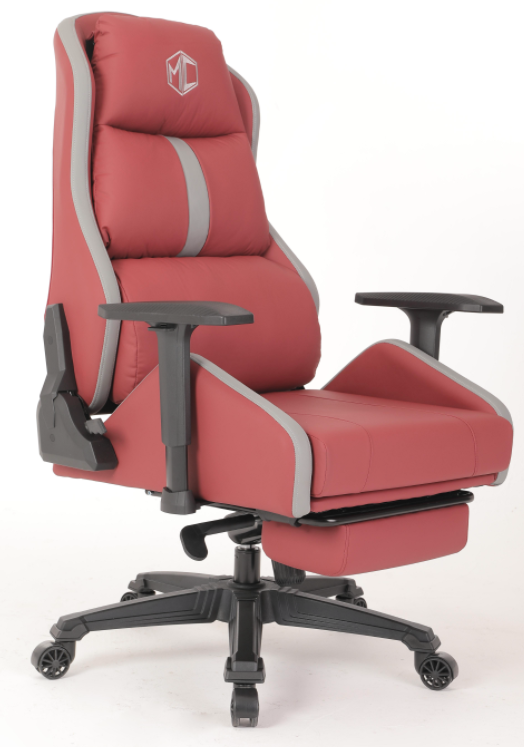
The MC1025 measures 70 cm wide, 69 cm deep and 121–130 cm high, and combines a segmented backrest with a 3-position lockable tilt mechanism, 2D adjustable PU-padded armrests, a spring-loaded seat cushion, a retractable footrest, an up/down adjustable headrest and 60 mm casters. Materials are fabric, foam, PU, metal and plastic. It is listed for home, office and live streaming use — the profile that fits a desk used for work in the day and games at night.
How to Test a Chair for Back Pain Before You Buy
Testing advice matters more than a feature list, because the same chair fits different bodies differently. Use this sequence in a showroom, at a trade fair, or with a sample before a bulk order.
- Sit for ten minutes with your hands off the armrests. Most comfort tests last thirty seconds, which is not long enough for foam to compress. If the lumbar support disappears after ten minutes, the shape is wrong for you — regardless of what the label says.
- Find the lumbar contact point, then name it. Put a hand behind your lower back: the support should sit in the small of the back, not at the belt line and not between the shoulder blades. If it lands low, an adjustable lumbar pillow (as on the MC196-3-1) can solve it; if the backrest is flat, no pillow will hold position for six hours.
- Set the headrest to the neck. Adjust it until the support meets the base of the skull with the chin level. If the headrest cannot move, check whether your neck lands in the right place by default — on fixed designs, it usually does not for shorter or taller users.
- Press the seat with the heel of your hand. Push down hard at the front edge and in the centre. A spring pack or spring-loaded cushion should push back; foam that bottoms out under a hand will bottom out under a body. Ask what is inside the cushion — coil springs, a spring pack or foam only — and write the answer next to the model.
- Recline fully, then return to upright. Recline to the end of the range with the footrest out, then lock back to upright. Check that the mechanism moves without slack and that the chair stays stable. On the MC1039-1 that range runs to 180 degrees; on the MC1025 the mechanism is a 3-position lockable tilt.
- Read the spec sheet and the inspection record. Dimensions are not comfort, but they show what the factory committed to. Maochang furniture inspects gas lifts, mechanisms, leather colour and plywood thickness when materials arrive, and assembles a plywood-only chair before production to check total depth and evenness — the checks that decide whether the recline and seat depth you tested on a sample survive into the shipment.
Quick rule for pain-prone buyers: if a spec sheet lists only colour, cover and "ergonomic design", ask three follow-up questions — what supports the lumbar area, what is inside the seat cushion, and how far the backrest reclines. A supplier who can answer all three has a chair worth testing.
Use Cases: Matching Specs to the Way You Actually Sit
Home desk and streaming setups
For one desk doing both work and sessions, the useful combination is a segmented or shaped backrest, an adjustable headrest and a spring-loaded cushion — the MC1025 profile, with a 3-position lockable tilt for switching between tasks. The hybrid work-and-game segment's 29.8% share in 2024 reflects exactly this pattern: chairs bought for gaming and used for work.
Office furnishing and shared rooms
Where several people share a room, the lumbar shape has to work without individual adjustment, which favours a shaped ridge rather than a loose pillow. The MC196 backrest's raised lumbar section with a recessed middle is built for that, and the model is positioned for the European market. Anji Maochang furniture supplied 460 units of MC196-3-1, MC196-2-1, MC1025, MC196 and MC196-1 to a Ukrainian wholesale partner for office space furnishing; across a two-year cooperation the chairs were well received by local office clients.
Internet cafe and 24/7 seating
Continuous-use environments change the priority order: cushion durability and frame strength outrank adjustability. The MC1040 gaming recliner sofa — 80 cm wide, 72 cm deep and 119 cm high, 27.4 kg, with a 150 kg weight capacity, coiled spring seat cushion, 180-degree recline, lockable castors and foldable footrest — is used in the internet cafe industry, typically in China, in indoor long-hour continuous-use conditions with 24/7 seating. Those installations require supporting equipment such as a gaming desk and a computer, plus sufficient space for each seating unit.
Heavy-duty and big-size users
Where body weight is above average, a heavy duty big-size frame is the starting point rather than an upgrade. The MC1039-1's 74 × 80 cm footprint and 126–132 cm height are sized for that group, and the MC1039 model in the same series is rated to a 150 kg weight capacity.
Comparison Table: Five Models on the Specs That Matter for Back Pain
| Model | Size (W × D × H) | Backrest / lumbar | Seat construction | Recline & mechanism | Adjustability & notes |
|---|---|---|---|---|---|
| MC1039-1 | 74 × 80 × 126–132 cm | Soft cushion on the back cushion; big-size back | Heavy-duty big-size seat (coiled spring seat specified on MC1039) | 180° recline, frog-type adjustable multifunctional mechanism, foldable footrest | 4D adjustable armrests; PU, metal, plastic |
| MC1025 | 70 × 69 × 121–130 cm | Segmented backrest | Spring-loaded seat cushion | 3-position lockable tilt, retractable footrest | 2D adjustable PU-padded armrests; up/down adjustable headrest; 60 mm casters |
| MC196 | 67 × 70 × 124–132 cm | Raised lumbar section, slightly recessed middle, neck-supporting headrest | Fabric upholstery | 3-gear locking mechanism | Positioned for the European market; widely ordered by wholesalers |
| MC196-2-1 | 70 × 70 × 118–128 cm | Segmented backrest | Inner spring package seat cushion | 3 locking tilt angles, retractable footrest, Class-3 gas lift, detachable metal base | 5D adjustable armrests; height-adjustable headrest; seat depth adjustment; 60 mm casters |
| MC1040 | 80 × 72 × 119 cm | Soft cushion on back | Coiled spring inside seat cushion | 180° recline, foldable footrest, lockable casters | Height-adjustable armrest; 150 kg weight capacity; 27.4 kg |
The table shows why "ergonomic" alone is not a specification. Two chairs with the same cover and similar silhouettes can differ in lumbar approach (shaped ridge versus segmented), in seat construction (coil springs versus foam), and in recline range (3-position lockable tilt versus 180 degrees). For a pain-prone buyer, those three lines decide more than the colour card.
FAQ
Which safety and durability standards should a pain-prone buyer check?
In North America, ANSI/BIFMA X5.1 is the primary safety and durability standard for general-purpose office and gaming chairs. In Europe, EN 1335 covers dimensions, safety and testing requirements for office work chairs and is applied to gaming chairs. In the UK, BS 5852 is the fire safety standard for upholstered furniture and is often required for gaming chairs sold there. These standards test structure and materials rather than comfort, so ask which reports apply to the exact model, and ask what the factory inspects before assembly. Maochang furniture inspects gas lifts, mechanisms, leather colour and plywood thickness on arrival, and assembles a plywood-only chair before production to check total depth and evenness.
Can the lumbar, headrest and recline specs be customized for our own line?
Yes, within an OEM/ODM program. Maochang furniture customizes logo, colour, size and design, with 3 engineers supporting development. Cutting, woodworking, foam bonding, sewing, nailing, assembly, cleaning and packaging all run in-house, against a monthly capacity of 6,000 units.
What drives the cost of a chair built for back pain?
Most cost differences between visually similar chairs sit in four components: the mechanism (a frog-type adjustable multifunctional mechanism or multi-position lockable tilt costs more than a fixed upright base), the armrest grade (4D adjustable versus 2D adjustable PU-padded), the seat construction (a coiled spring pack or spring-loaded cushion versus plain foam), and the size class (a heavy-duty big-size frame such as the 74 × 80 cm MC1039-1 uses more material than a compact model). Cosmetic differences are the cheapest to change — PU leather is the most common cover, with a 57.3% market share in 2024, so covers rarely explain a large price gap on their own.
How should a buyer test a chair before committing to a bulk order?
Sit for at least ten minutes with your hands off the armrests, then confirm the lumbar contact point sits in the small of the back rather than at the pelvis. Set the headrest to the neck with the chin level, press the seat cushion with the heel of your hand to feel whether a spring pack pushes back, and recline fully to check stability and footrest support. Write the answers next to the model number. To review specification sheets and arrange an evaluation of MC1039-1 or MC1025, contact Maochang furniture through www.mcrfurniture.com.
What lead time and after-sales support should we plan for?
Production lead time is 30–40 days, against a monthly capacity of 6,000 units and an annual output of 75,000 units. Each chair carries a 1-year quality warranty. After-sales support includes free high-resolution photos, product show and assembly videos, and sale pages prepared for retail customers. For dimensions, loading quantities and mechanism details across the range, download the 2026 catalogue (PDF).
Conclusion: Buy the Internals, Not the Silhouette
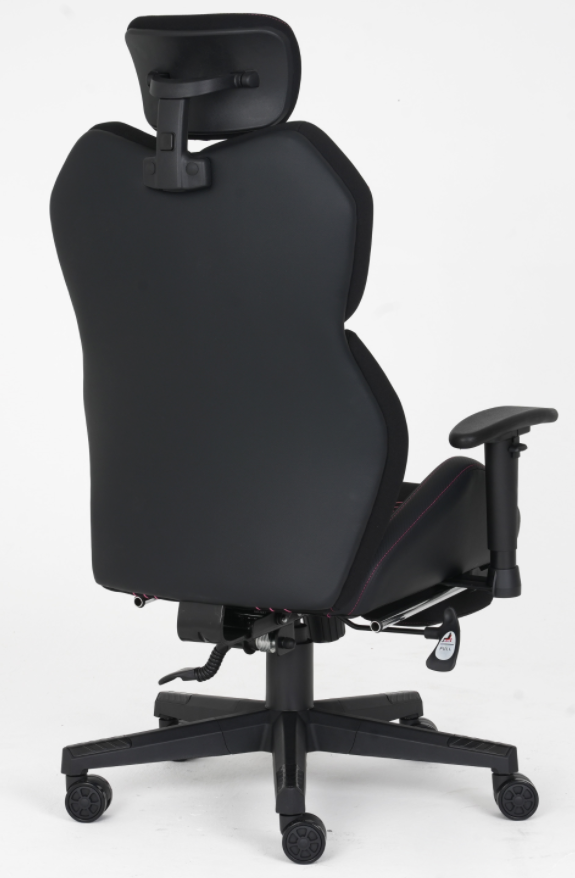
Chair specs for pain-prone buyers come down to three verifiable lines on a spec sheet: how the lumbar area is supported, what is inside the seat cushion, and how far and how smoothly the backrest reclines. A fourth — headrest height adjustment — decides whether neck support helps or pushes the head forward. The MC1039-1 answers those lines with a big-size 180-degree reclining frame, a soft back cushion, 4D adjustable armrests and a foldable footrest. The MC1025 answers them with a segmented backrest, a spring-loaded seat cushion, an up/down adjustable headrest and a 3-position lockable tilt in a smaller footprint. Neither is universally better: the 74 cm wide MC1039-1 suits heavier users and lounge-style streaming, while the 70 cm wide MC1025 suits a shared work-and-game desk.
Next step: compare the specs on paper, then on a chair
Anji Maochang furniture supports OEM/ODM programs from 50 units (MOQ), with a 30–40 day lead time and a monthly capacity of 6,000 units. Download the 2026 catalogue for dimensions, loading quantities and mechanism details, or send your target spec — lumbar type, seat construction, recline range — for a model recommendation.
- Catalogue (PDF): Download the 2026 catalogue
- Email: rosschen@mcrfurniture.com
- WhatsApp: +86 18357006883
- Website: www.mcrfurniture.com
- Address: 198 Yangguang Road, Dipu Town, Anji County, Zhejiang Province, China
Have Questions or Need More Details?
Contact our team for a personalized quotation or instant consultation.
Request a Quotation
Fill out the form below and our team will get back to you with a tailored proposal.
WhatsApp Direct Chat
Prefer to chat in real-time? Message us on WhatsApp for instant assistance & quick answers.
- Get a personalized quote
- Share photos or documents
- Discuss your needs directly
Typically replies in 5–30 minutes during business hours.