
Gaming Chair Compliance Guide: Certifications, Standards, and Regional Spec Checks
Short answer: gaming chair compliance is verified by matching a documented specification — dimensions, materials, load-bearing parts, recline angle, carton data — to a published regional standard, and then requesting the report that proves the match. Naming a standard proves nothing on its own. The specification and the document have to line up with the exact model on the purchase order.
A gaming chair can pass every internal quality inspection and still be stopped at the port, returned by a retailer, or disqualified in a tender — not because the chair is weak, but because the paperwork and the specification never matched. Compliance is not one certificate. It is a chain of four links: a regional standard, a measurable chair specification, a document that connects the two, and an acceptance criteria sheet that keeps the shipped batch identical to the approved sample. Break any link and the order is exposed.
This guide is written for importers, distributors, brand owners and procurement teams that are still at the beginning of that chain — the stage where the purchase order is being drafted and the wording still matters. It translates EU, UK and North American requirements into verifiable gaming chair specs, and shows how to build acceptance criteria around materials, dimensions, carton sizes and loading quantities, using published specification data for models such as MC1039, MC1040 and MC196 from Anji Maochang Furniture Co., Ltd. — a chair factory in Anji County, Zhejiang Province, China, established in 2016 and producing gaming chairs, office chairs and manicure chairs.
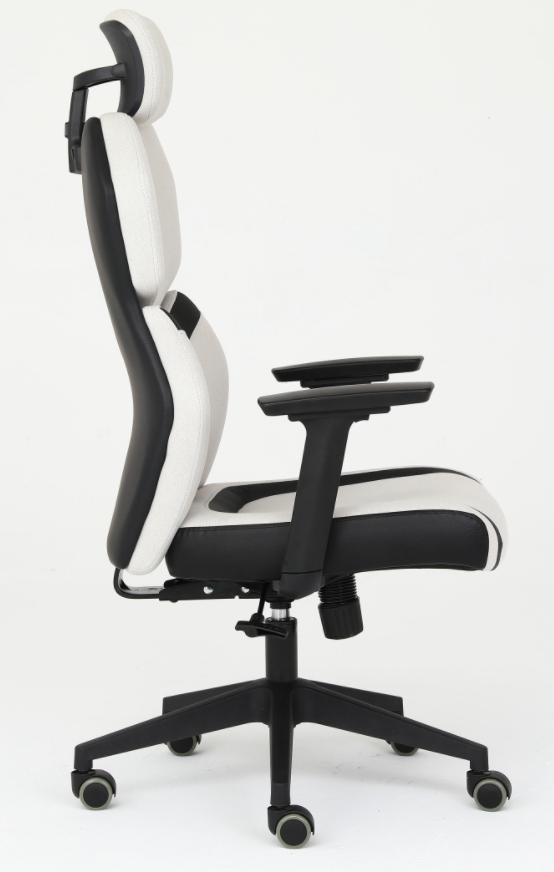
MC196: a game type office chair whose backrest geometry is designed for the European market.
Why Compliance Breaks Down at the Specification Level
Most compliance failures in this category are not manufacturing failures. They are documentation and specification failures. A buyer writes “EN 1335 compliant” into a purchase order, and the factory answers “yes” — but no one ever wrote down which dimensions, which gas lift class, which foam density, which upholstery batch or which carton marking was being promised. When the container arrives, both sides are technically correct and practically incompatible.
The risk is highest in chair families that share a model prefix but not a structure. Anji Maochang produces MC1039 and MC1039-1; the first is classified as a new design big size gaming chair, the second as a heavy duty big size gaming chair with 4D adjustable armrests and a different dimension envelope and carton. The MC196 family is broader still: MC196 is a game type office chair, while MC196-1 is an LED gaming chair built entirely on a wooden frame. A report issued for one configuration does not automatically describe another.
In practice, gaming chair compliance problems cluster in five places:
- Load and structure: the gas lift class, base diameter and frame material are never written into the order, only the word “durable”.
- Dimensions: seat width, seat depth and backrest height drift between the sample and the production batch because no tolerance was agreed.
- Upholstery and foam: PU, PVC, mesh and fabric behave differently against fire-safety and durability requirements, and foam grade is rarely declared at all.
- Carton and labeling: carton size, pieces per carton and loading quantity change silently, which also changes freight and delivery planning.
- Documents: the report that exists covers a different model, a different upholstery, or a different mechanism than the one being shipped.
Industry Background: A Global Product Facing Regional Rules
Gaming chairs are a global category with genuinely regional rules. The global gaming chair market was estimated at USD 1.37 billion in 2024 and is projected to reach approximately USD 2.05 billion by 2030, according to Grand View Research. North America is the largest single region, accounting for a 36.4% revenue share in 2024, per Mordor Intelligence. That matters for compliance because the dominant standards differ by region: North American buyers typically test against a North American standard, while European buyers work from European office-chair and upholstery standards.
Product mix reinforces the point. PC gaming chairs held a 52.6% product segment share in 2024, and PU leather — at 57.3% of material share — remains the most common upholstery choice, based on 2024 category data. Both facts have compliance consequences: PU, PVC and fabric are treated differently under upholstery fire-safety rules, so a material change made late in production can invalidate the documentation you were relying on.
Sourcing is equally concentrated. The Anji furniture cluster in Zhejiang, China, is a leading production base for gaming chairs, and China accounted for a 30.8% share of global furniture exports in 2024 according to Statista / OEC trade data. Anji Maochang Furniture Co., Ltd. sits inside that cluster — approximately 25 staff, a 3,000 m² facility, an R&D team of three engineers, an annual production capacity of 75,000 units, and export business representing 98% of total sales, with major markets in the EU, USA, Thailand, Brazil and South Korea. A factory with that export profile deals with multiple regional documentation sets rather than one, which is exactly why the acceptance criteria — not the sales conversation — has to carry the requirements.
One more shift is worth noting: hybrid “work-and-game” chairs held a 29.8% share of the category in 2024. Hybrid use pushes buyers toward office-chair standards even when the product is a gaming chair, because the chair is used as seating for work, not only for play.
The Three Standards Buyers Ask About Most Often
Three published standards come up repeatedly in gaming chair sourcing conversations. Each covers a different risk, and none of them is interchangeable with the others.
EN 1335 — European office work chairs
EN 1335 is the European standard for office work chairs, published by the European Committee for Standardization. It focuses on dimensions, safety and testing requirements. Gaming chairs sold into European office, home-office and hybrid use are frequently checked against it, because the physical demands of the chair are the same even when the marketing category is different. In spec terms, EN 1335 conversations come back to measurable geometry: seat height range, seat depth, backrest dimensions and stability.
BS 5852 — UK upholstery fire safety
BS 5852 is the UK fire safety standard for upholstered furniture, published by the British Standards Institution, and it is often required for gaming chairs sold in the UK market. Because it applies to the upholstered elements rather than the frame, the relevant question is not “is the chair fire safe?” but “which upholstery, which foam, and which construction was tested?” If the cover material on your order differs from the material on the report, the document may not describe your goods.
ANSI/BIFMA X5.1 — North American safety and durability
ANSI/BIFMA X5.1 is the primary safety and durability standard for general-purpose office and gaming chairs in North America, published by BIFMA. It is the reference point most often requested by North American importers and retailers, and it is a durability standard as much as a safety standard — meaning the components that carry load and move repeatedly (gas lift, base, casters, mechanisms) are central to it.
From Standard to Verifiable Spec: What to Write into the Purchase Order
Load-bearing structure
Load capacity is not a slogan; it is the sum of named components. The MC1039 big size gaming chair uses a Class 3 gas lift, a 370 mm starbase and a frog type multifunctional mechanism, with a stated weight capacity of 150 kg. MC1040, a PU/PVC gaming sofa built on a metal frame, lists the same 150 kg weight capacity alongside a 27.4 kg net weight and lockable silent casters. MC1039-1, the heavy duty big size variant, is defined by a frog type adjustable multifunctional mechanism, 4D adjustable armrests and a soft back cushion. These are the items to write into the order: gas lift class, base diameter, frame material, mechanism type — not the word “reinforced”.
Recline range and backrest geometry
Recline is both a comfort feature and a durability event. 180-degree reclining appears on MC1039, MC1039-1, MC1034 and MC1040, which means the recline mechanism is a repeated-use component that should be verified physically on the sample. Backrest geometry is where regional expectations show up most clearly: MC196’s backrest is designed for the European market, with a raised lumbar section for waist support, a slightly recessed middle section so the back rests gently in place, and a headrest that supports the neck with a slight indentation. The backrest tilt locks in three positions through a 3-gear locking mechanism.
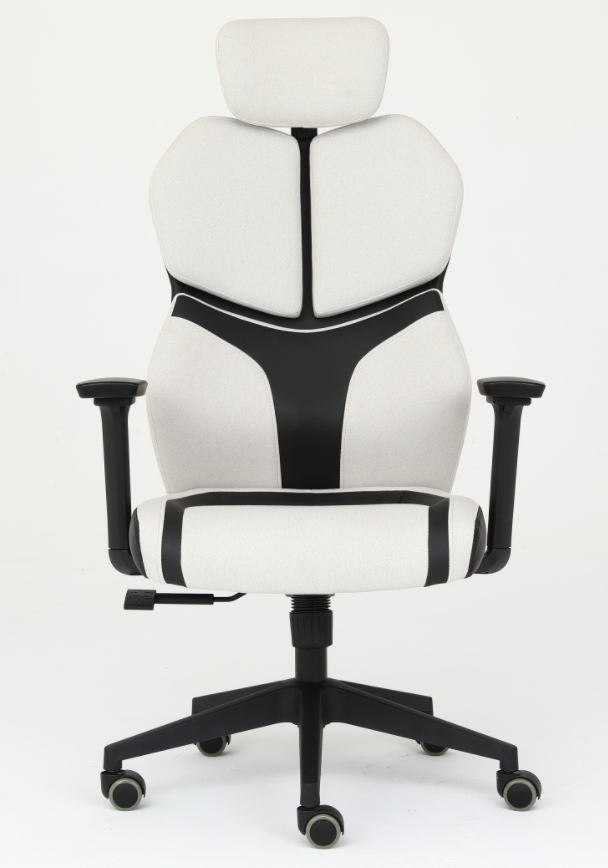
MC196: raised lumbar section, recessed mid-back and neck-supporting headrest — the geometry a European brief usually asks about first.
Upholstery and foam declarations
Upholstery should be declared at the model level, because that is the level at which fire-safety and durability questions are answered. MC1039 is built from PU, PVC, mesh, fabric, plywood and a metal frame. MC1040 uses PU and PVC upholstery on a metal frame, with a coiled spring inside the seat cushion. MC196-4 carries a segmented backrest and a spring-loaded seat cushion in PU, metal and plastic. Foam grade deserves the same treatment: high-density mould foam in the range of 50–65 kg/m³ is the commonly cited benchmark for premium gaming chairs to maintain shape over time, according to category material guidance — so if shape retention matters to your market, ask for a declared foam grade instead of a description.
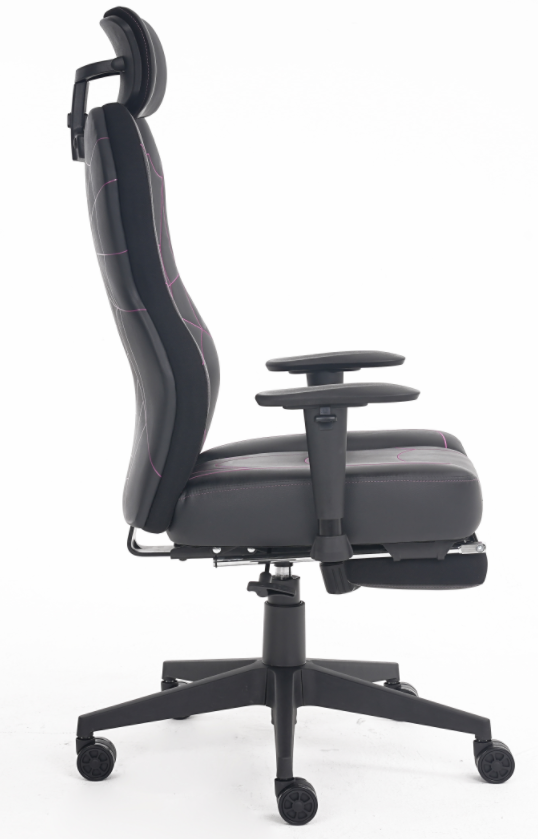
PU and PVC remain the most common gaming chair upholstery — which makes material-level documentation the first thing to confirm.
Carton size, loading quantity and one-piece-per-carton packing
Carton data is compliance data. It tells you whether the batch you receive is the batch you approved, and it sets your freight and delivery plan. MC196 ships one piece per carton at 76 × 32 × 61 cm with a loading quantity of 465 pcs. MC1039-1 ships at 82 × 60 × 53 cm with 260 pcs. MC1040 ships at 82 × 60 × 60 cm with 227 pcs. MC196-4 and MC196-5 both ship one piece per carton at 75 × 36 × 56 cm, loading 447 pcs. When a carton dimension changes, the loading quantity changes with it — and so does the freight you budgeted.
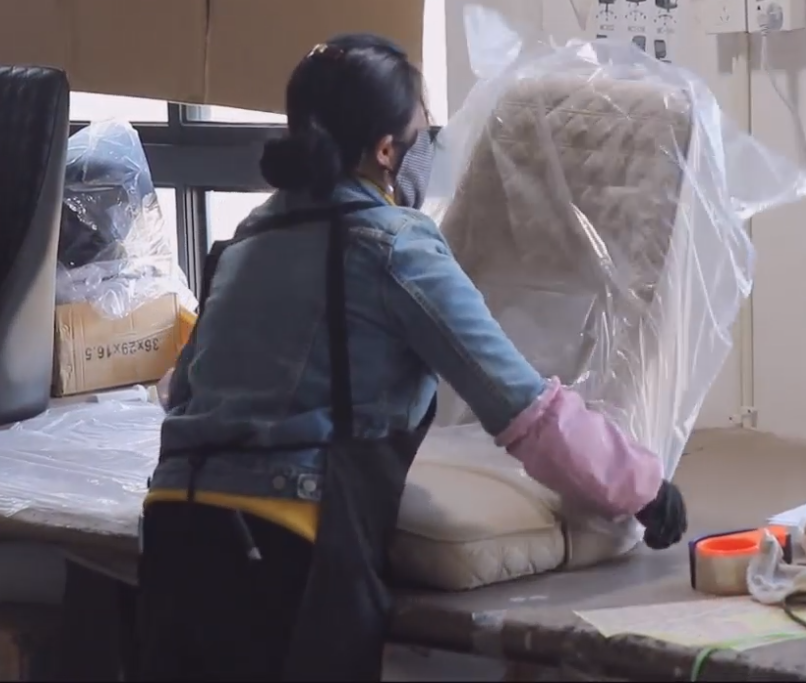
Carton dimensions, piece count per carton and markings are part of the approved specification, not just logistics detail.
Step-by-Step: Building a Gaming Chair Acceptance Criteria Sheet
An acceptance criteria sheet is the document that makes the whole chain enforceable. Build it before the sample is approved, and seven steps are enough.
- Name the market and the standard. Decide whether the order is destined for the EU, the UK or North America, and write down which published standard applies — EN 1335, BS 5852 or ANSI/BIFMA X5.1. Do not write “international standard”.
- Convert the standard into measurable items. Translate the standard into seat height range, seat depth, backrest height, gas lift class, base diameter, recline angle, and upholstery and foam declarations. Anything that cannot be measured or declared does not belong on the sheet.
- Bind the criteria to one model and one configuration. MC1039 and MC1039-1 are different chairs. MC196 and MC196-1 are different chairs. The sheet should name the exact model, materials and mechanism.
- Add carton and packing requirements. Carton dimensions, pieces per carton (one piece per carton across the models above), loading quantity, and carton marking. This is the link between the approved specification and the shipped container.
- Request the documentation pack. Ask which reports and declarations exist, for which model, issued by which laboratory, and which material and mechanism configuration they cover. Request the current specification sheet version as a controlled document.
- Verify the pre-production sample against the sheet. Measure dimensions, operate the recline through its full range, check armrest adjustment, check the gas lift and base, and confirm the upholstery and foam match the declaration.
- Reconcile at loading. Compare carton dimensions, piece count and loading quantity against the approved sheet at loading, so the batch that leaves matches the batch that was approved.
Use Cases: How Regional Spec Checks Change the Brief
EU home and office hybrid. The brief usually combines comfort geometry with office-chair expectations. MC196’s backrest was designed for the European market with a raised lumbar section, a recessed mid-back and a neck-supporting headrest, and its 3-gear locking mechanism allows the backrest to be set at preferred positions. Dimension envelope: W67 × D70 × H124–132 cm.
UK and Ireland orders. The upholstery conversation comes first. If BS 5852 documentation is requested, it has to describe the exact cover and foam on your order — which is why MC1039’s multi-material build (PU, PVC, mesh, fabric, plywood and metal frame) should be specified precisely rather than summarised as “PU chair”.
North American retail. Buyers typically work from ANSI/BIFMA X5.1 and focus on repeatedly loaded components: gas lift, starbase, casters and mechanisms. MC1039’s Class 3 gas lift and 370 mm starbase, and MC1040’s coiled spring seat cushion and lockable casters, are the parts to name.
Internet café projects. These are indoor, long-hour, continuous-use environments with 24/7 seating, matched with gaming desks and computers, and the operational requirement is space plus durability. MC1040 was designed for exactly that pattern of use, with a 150 kg weight capacity, 180-degree recline, height adjustable armrests and silent lockable casters. In a 24/7 setting, carton and loading data also matter commercially: MC1040 loads 227 pcs, so a café fit-out of several hundred seats is a multi-container project from the start.
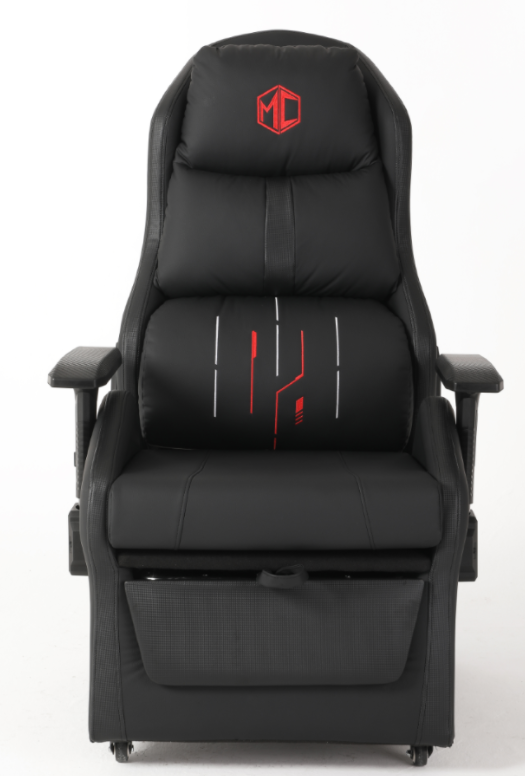
MC1040 gaming sofa: a 150 kg weight capacity, 180-degree recline and lockable silent casters aimed at continuous-use environments.
Dormitory and streaming setups. Here the constraints are recline range, footrest and carton size — because the chair has to reach a small room and be assembled there. MC1039-1 pairs a foldable footrest and 180-degree recline with a carton of 82 × 60 × 53 cm; MC196-4 and MC196-5 use a 75 × 36 × 56 cm carton at 447 pcs, which is a more compact unit for parcel-style delivery.
Comparison: MC1039, MC1039-1, MC1040 and MC196 Spec Checks
| Model | Category | Upholstery and frame materials | Key structural specs | Dimensions (W × D × H) | Carton size (cm) | Loading quantity | Stated weight capacity |
|---|---|---|---|---|---|---|---|
| MC1039 | New design big size gaming chair | PU, PVC, mesh, fabric, plywood, metal frame | Class 3 gas lift; 370 mm starbase; frog type multifunctional mechanism; 180-degree recline; foldable footrest; coiled spring seat cushion | — | — | — | 150 kg |
| MC1039-1 | Heavy duty big size gaming chair | PU, metal, plastic | Frog type adjustable multifunctional mechanism; 4D adjustable armrests; foldable footrest; 180-degree recline; soft back cushion | W74 × D80 × H126–132 | 82 × 60 × 53 | 260 pcs | — |
| MC1040 | Gaming sofa | PU and PVC upholstery; metal frame | 180-degree recline; height adjustable armrest; foldable footrest; lockable silent casters; coiled spring seat cushion; soft back cushion | W80 × D72 × H119 | 82 × 60 × 60 | 227 pcs | 150 kg (net weight 27.4 kg) |
| MC196 | Game type office chair | Fabric, metal, foam, plastic | Backrest designed for the European market (raised lumbar section, recessed mid-back, neck-supporting headrest); 3-gear locking backrest tilt | W67 × D70 × H124–132 | 76 × 32 × 61 | 465 pcs | — |
A dash means the value is not listed in that model’s published specification data — request it in writing before it goes into a purchase order. All figures above are as published for the named models.
Frequently Asked Questions
Which standards should a gaming chair be checked against in the EU, the UK and North America?
Three published standards are commonly referenced. EN 1335 is the European standard for office work chairs, covering dimensions, safety and testing requirements that also apply to gaming chairs. BS 5852 is the UK fire safety standard for upholstered furniture, often required for chairs sold in the UK market. ANSI/BIFMA X5.1 is the primary safety and durability standard for general-purpose office and gaming chairs in North America. Naming a standard is not the same as holding a report for a model: ask which report exists, for which model, from which laboratory, and whether it covers the exact upholstery, foam and mechanism configuration on your order.
How do you verify that a gaming chair can really carry a 150 kg load?
Load capacity is built from named components, so verification starts there. MC1039 uses a Class 3 gas lift and a 370 mm starbase with a stated weight capacity of 150 kg. MC1040, a PU and PVC gaming sofa on a metal frame, lists the same 150 kg weight capacity and a 27.4 kg net weight, with lockable silent casters and a coiled spring seat cushion. For a heavy duty brief, MC1039-1 is defined by a frog type adjustable multifunctional mechanism, 4D adjustable armrests and 180-degree recline. Verify by confirming gas lift class, base diameter and frame material in writing, then checking them on the pre-production sample rather than on the brochure.
What drives cost in a compliance-focused gaming chair order?
Cost differences usually come from materials, structure and shipping volume rather than from labeling. Upholstery choice is the first driver — PU and PVC, mesh and fabric behave differently and are documented differently, and PU remained the most common gaming chair material at 57.3% of material share in 2024. Mechanism and load-bearing specification is the second: gas lift class, starbase diameter and mechanism type change the component cost. Carton volume is the third and is often overlooked, because carton size sets the loading quantity — MC196 loads 465 pcs while MC1040 loads 227 pcs — so the same chair footprint can carry very different freight cost per unit. Ask for a line-item specification against your acceptance criteria sheet so cost is attached to a named part, not to a general quality claim.
Can a buyer validate compliance before mass production?
Yes — by pairing a pre-production sample with a document pack. Measure the sample against the specification sheet, including carton dimensions and piece count per carton. Operate the mechanisms through their full range: the 3-gear locking backrest tilt on MC196, the 180-degree recline on MC1039, MC1039-1, MC1034 and MC1040, the 4D adjustable armrests on MC1039-1, and the retractable footrest on models such as MC196-4. Confirm the upholstery and frame materials match the declaration (fabric, metal, foam and plastic for MC196; PU and PVC upholstery on a metal frame for MC1040), then request the reports and declarations that apply to your market for that exact model. Anji Maochang Furniture publishes model-level specification data and can supply the current product catalogue as a starting reference — the 2026 catalogue is available at the catalogue download page, and sample and specification requests can be sent directly before an order is placed.
How do carton sizes and loading quantities affect delivery planning?
Carton size and loading quantity decide how many units fit in a container, which sets your freight and your delivery schedule. As published: MC196 cartons measure 76 × 32 × 61 cm and load 465 pcs; MC1039-1 cartons measure 82 × 60 × 53 cm and load 260 pcs; MC1040 cartons measure 82 × 60 × 60 cm and load 227 pcs; MC196-4 and MC196-5 cartons measure 75 × 36 × 56 cm and load 447 pcs. Across these models the packing is one piece per carton, so carton volume translates directly into units per container — MC1040 loads less than half the units MC196 loads per container, purely because its carton is larger. Confirm carton dimension, piece count and loading quantity in writing before booking freight, and reconcile them against the approved specification sheet at loading.
Conclusion: Compliance Is a Written Specification, Not a Claim
The compliance question for a gaming chair order is not “is this chair certified?” It is “does the written specification describe a chair that meets a named standard for a named market, and can the factory show the document that proves it for this exact model?” Answer that, and the rest — load class, recline range, upholstery declaration, carton dimension, loading quantity — becomes a checklist rather than a negotiation.
Start with the standard that applies to your market: EN 1335 for European office-type use, BS 5852 for UK upholstery requirements, ANSI/BIFMA X5.1 for North America. Convert it into measurable items, bind those items to a single model and configuration, and verify them on the sample and again at loading. For heavy-duty and large-size briefs, MC1039 with its Class 3 gas lift, 370 mm starbase and 150 kg capacity, and MC1040 with its 150 kg capacity, 180-degree recline and lockable casters, are the models whose published data already answers most of the structural questions. For European home and office hybrid briefs, MC196 brings the regional backrest geometry into the same document.
Next Step: Build Your Acceptance Criteria with the Factory
Anji Maochang Furniture Co., Ltd. supplies gaming chairs, office chairs and manicure chairs from Anji County, Zhejiang Province, China, with 98% of sales going to export markets including the EU, USA, Thailand, Brazil and South Korea. If you are drafting a compliance-focused order for MC1039, MC1040, MC196 or another model, request the specification sheet, the model-level documentation pack and a pre-production sample so the acceptance criteria can be verified before mass production begins.
Contact: Ross Chen — rosschen@mcrfurniture.com · WhatsApp +86 18357006883 · www.mcrfurniture.com · Download the 2026 catalogue (PDF)
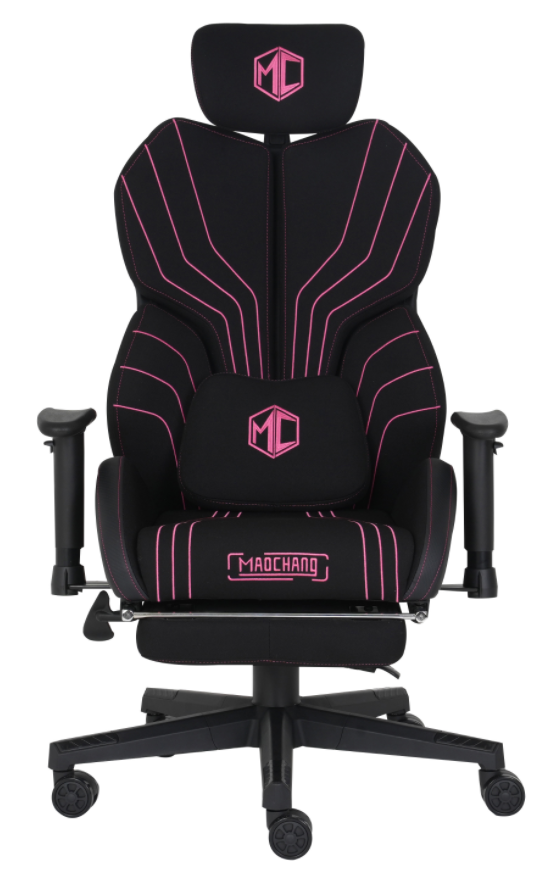
Hybrid work-and-game seating is one of the fastest-moving segments in this category — and one of the most standard-sensitive.
Have Questions or Need More Details?
Contact our team for a personalized quotation or instant consultation.
Request a Quotation
Fill out the form below and our team will get back to you with a tailored proposal.
WhatsApp Direct Chat
Prefer to chat in real-time? Message us on WhatsApp for instant assistance & quick answers.
- Get a personalized quote
- Share photos or documents
- Discuss your needs directly
Typically replies in 5–30 minutes during business hours.