
Gaming Chair Supplier Evaluation: Capability and Delivery Assurance Checks
A gaming chair supplier evaluation should answer two questions before a purchase order is issued: can this factory build the chair exactly to the approved specification, and can it deliver that specification at the volume and date the program needs? Both questions are answered with documents and numbers — material mix, mechanism type, carton dimensions, loading quantity and certification scope — not with the impression created by one sample chair.
This evaluation framework is built around the published specification set of Anji Maochang Furniture Co., Ltd., a chair manufacturer founded in 2016 in Anji County, Zhejiang Province, China, operating a 3,000 m² factory with 25 employees, three engineers and an annual output of 75,000 units. Approximately 98% of production is exported, with main markets in the EU, USA, Thailand, Brazil and South Korea. Because the factory publishes real model data for MC1039, MC1034, the MC196 series, MC1025 and MC1040, it can be used as a working example of how each check should be performed — and of the gaps a buyer must still close in writing before committing.
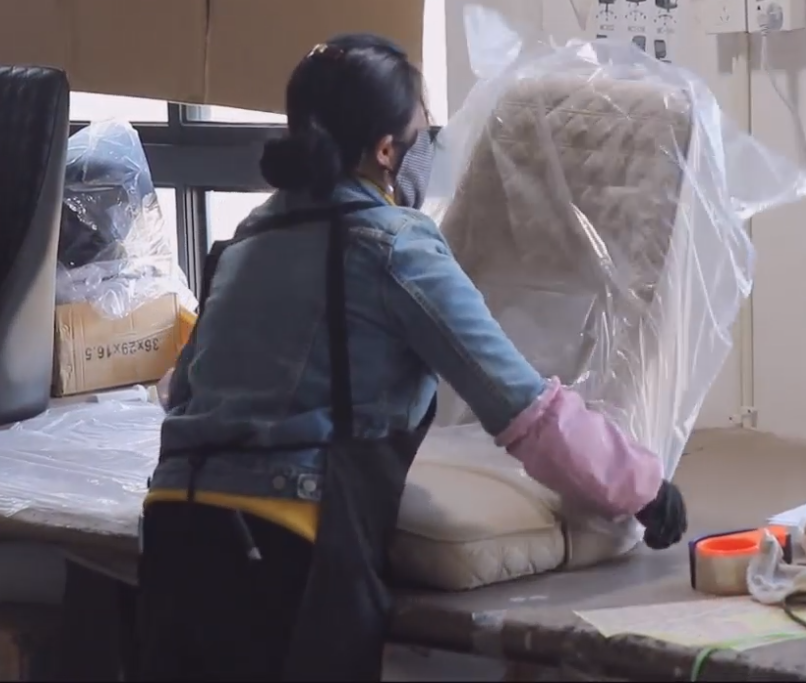
Packing is the last controllable step before a gaming chair order becomes a shipment. Carton dimensions and loading quantity are fixed here, and they determine freight cost per unit.
Problem Definition: Capability Is Judged on Samples, Delivery Is Judged on Cartons
Most supplier evaluations test capability and delivery assurance at the wrong moment. Capability is assessed from a sample chair, and delivery is assumed to follow. In practice, the two failure points are separate.
The capability failure is a sample-to-production gap. A sample is made with the best available components and extra assembly attention. What determines whether the 500th chair equals the first is the written specification: which foam, which cover material, which mechanism, which gas lift, which base. If the specification sheet does not name them, the buyer has nothing to inspect against at pre-shipment.
The delivery failure is a packaging and container-planning gap. Loading quantity per 1×40'HQ is calculated from carton dimensions. If a carton dimension in the quotation is optimistic, the container plan collapses at the loading dock, and the buyer absorbs the difference in freight cost per unit. A chair quoted at one loading figure and shipped at another is not a price negotiation problem; it is a specification documentation problem.
This is why a supplier evaluation for gaming chairs should be structured as a sequence of checkable claims: production capability, material mix, mechanism and components, load limits, carton dimensions, loading quantity and certification scope. Each claim either has a document behind it or does not.
Industry Background: What the Anji Cluster Changes About Evaluation
The global gaming chair market was estimated at USD 1.37 billion in 2024 and is projected to reach approximately USD 2.05 billion by 2030, according to the Gaming Chair Market Report published by Grand View Research. North America accounted for a 36.4% revenue share in 2024, making it the single largest regional market, while PC gaming chairs held a 52.6% share of the product segment in the same year. Material selection follows a similar concentration: PU leather held a 57.3% share of gaming chair materials in 2024, and the hybrid “work-and-game” chair format reached a 29.8% market share — a signal that buyers increasingly need one chair qualified for both office and gaming use rather than two separate programs.
Sourcing geography explains why evaluation discipline matters. The Anji furniture cluster in Zhejiang, China is the world's leading production base for gaming chairs, within a country that holds a 30.8% share of global furniture exports according to Statista/OEC trade data. A dense cluster means fast sampling and competitive pricing; it also means that many factories quote from the same supplier network of gas lifts, mechanisms and foams. The differences that protect a buyer are therefore not in the cluster, but in how a specific factory documents, inspects and ships what it sells.
Anji Maochang Furniture is one of those factories. Its published capability profile lists OEM/ODM production with customization on logo, color, size and design, a monthly capacity of 6,000 units, a production lead time of 30–40 days and a minimum order quantity of 50 units. Those four numbers are the first thing to verify, because they bound the entire commercial discussion.
Detailed Solution: Six Checks That Separate Capability From Intent
1. Production Footprint and In-House Process Coverage
Process coverage is the difference between a factory and an assembler. A factory that owns cutting, woodworking, foam bonding, sewing, nailing, assembly, cleaning and packing can control quality at each handover; a factory that outsources sewing cannot control cover quality at all. Anji Maochang Furniture describes a complete production line covering exactly those stages, supported by 3,000 m² of floor space, 25 employees, three engineers and 75,000 units of annual output against a stated monthly capacity of 6,000 units.
For a buyer, the evaluation question is not “how big is the factory” but “which steps are inside the building.” Ask for the process list, then match it against the failure modes you care about: foam bonding affects long-term shape retention, sewing affects cover alignment and stitching failure, nailing affects frame-to-shell integrity.
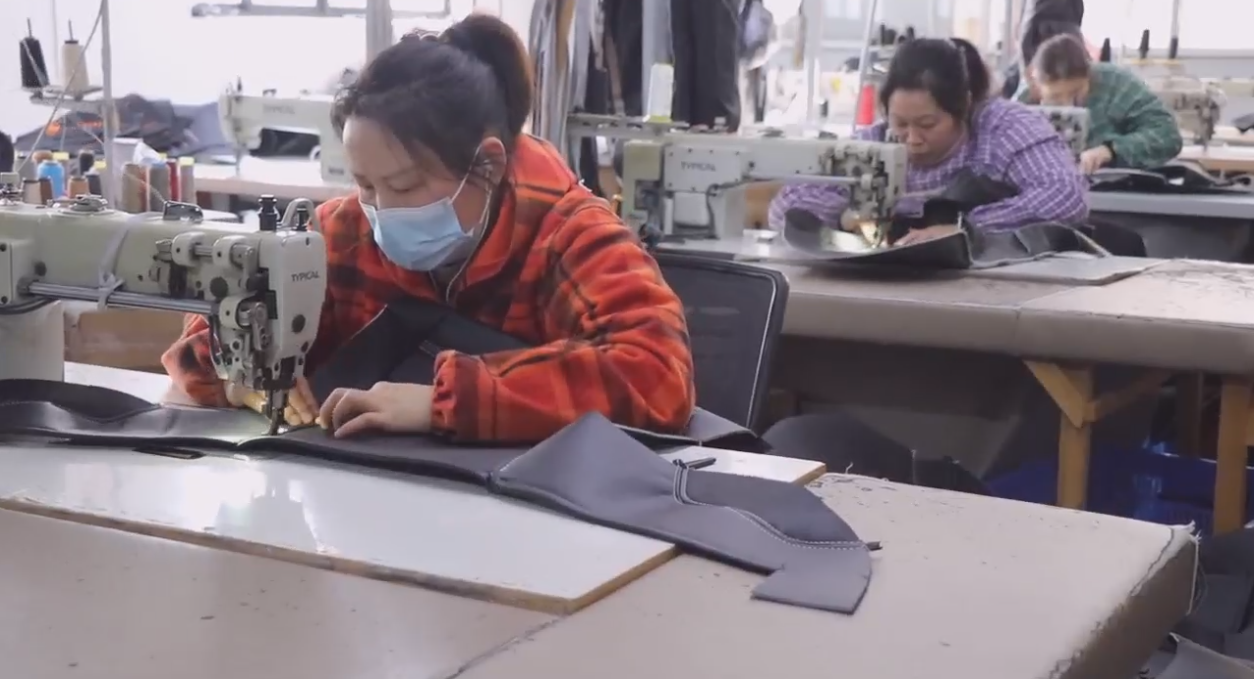
Sewing is one of the in-house stages in the production line, alongside cutting, woodworking, foam bonding, nailing, assembly, cleaning and packing.
2. Material Mix Verification
Material mix should be read from the specification, not inferred from the model name. In the published data, MC1039 is listed with PU, PVC, mesh, fabric, plywood and metal frame; MC1034 with metal, PU and plastic; MC196-1 with fabric, metal and plastic; MC196 with fabric, metal, foam and plastic; MC196-2-1 with fabric, metal, plastic and foam; MC196-3-1 with fabric, PVC, PU, metal, plastic and foam; MC1025 with fabric, foam, PU, metal and plastic; and MC1040 with PU, PVC and a metal frame.
Two material checks deserve particular attention because they drive long-term performance. The first is the foam. High-density mold foam in the range of 50–65 kg/m³ is the accepted benchmark for premium gaming chairs and the reason seats retain their shape over years of use; foam density is also the specification most likely to be quietly reduced between a sample and a repeat order. The second is the cover material. With PU leather holding 57.3% of the gaming chair material market in 2024, most commercial offers are PU-based, but PU/PVC combinations, mesh panels and fabric covers behave very differently in humid climates and in high-contact internet cafe environments.
The practical rule is to require the material mix in writing, per model, with the foam density stated as a number rather than an adjective.
3. Mechanism and Component Checks
The mechanism, gas lift and base are the components most often swapped between quotation and production. Anji Maochang Furniture publishes these items for MC1039: a Class 3 gas lift, a 370 mm big-size starbase, a frog type multifunctional mechanism, a height-adjustable armrest and 1 piece per carton. That level of detail is exactly what a buyer should demand for every model in an order, and it is also where the honest gaps appear: the published MC1039 sheet names the mechanism family but does not state a recline range, a tilt-lock position count, an armrest adjustment axis count or a retractable footrest.
Feature claims that must be written down before ordering. Recline range (for example 180-degree recline), tilt-lock positions (for example a 3-position tilt-lock), armrest adjustability (2D, 3D or 4D) and retractable footrests are the features most frequently used to differentiate a gaming chair offer, and the ones most frequently absent from a written specification. For MC1039, the confirmed specification is a frog type multifunctional mechanism with a height-adjustable armrest. If a quotation claims 4D armrests, a 180-degree recline or a retractable footrest, ask for the model-specific written specification and confirm it on the pre-production sample; do not assume that a feature stated for one model applies to the whole range.
4. Load and Weight Capacity Evidence
Weight capacity is a safety-adjacent claim and should be treated as a documented figure, not a marketing figure. In the published data set, the only model with a stated weight capacity is MC1040, a gaming sofa format built on a PU+PVC shell over a metal frame, rated at 150 kg with a unit weight of 27.4 kg. MC1039 is described as a new-design big-size gaming chair and carries a Class 3 gas lift and a 370 mm starbase, but its published sheet does not state a weight capacity.
For buyers sourcing heavy-duty or big-size programs, this is a precise instruction rather than a criticism: request the rated weight capacity per model in writing, and cross-check it against the gas lift class and the base diameter, since those two components carry the load path. Where a capacity figure exists, it should appear on the specification sheet that accompanies the pre-shipment inspection.
5. Carton Dimensions and Loading Quantity as Delivery Assurance
This is the check that most directly protects margin. Carton dimensions and loading quantity determine how many chairs fit into a 1×40'HQ container, and therefore the freight cost carried by every single unit. In the published Anji Maochang Furniture data, all listed models ship at 1 piece per carton, with the following figures:
- MC1034 (racing type): carton 86.5 × 65 × 36 cm, 334 pcs per 1×40'HQ.
- MC196-3-1: carton 75 × 57 × 37 cm, 441 pcs.
- MC196-2-1: carton 75 × 65 × 34 cm, 410 pcs.
- MC196-1 (LED gaming chair): carton 75 × 61 × 32 cm, 462 pcs per 1×40'HQ.
- MC196 (game type office chair): carton 76 × 32 × 61 cm, 465 pcs.
- MC1025 (computer chair): carton 78 × 38 × 56 cm, 410 pcs.
- MC1040 (gaming sofa): carton 82 × 60 × 60 cm, 227 pcs.
Two patterns are worth extracting. First, loading quantity tracks carton volume across the whole set: the most compact cartons reach the mid-460s in pieces, while the gaming sofa carton, which is nearly four times the footprint of the smallest carton, drops to 227 pieces. Second, carton orientation matters. MC196 and MC196-1 use almost the same carton volume — 76 × 32 × 61 cm against 75 × 61 × 32 cm — and their loading quantities are correspondingly close at 465 and 462 pieces. A buyer who plans pallet stacking should request the carton orientation, not only the dimensions.
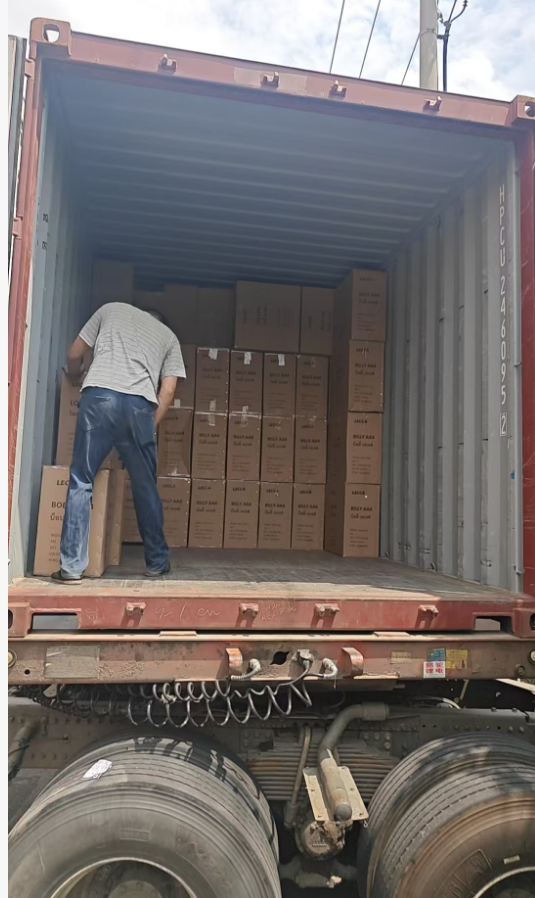
Loading quantity per 1×40'HQ is the number to lock into the purchase order. It is derived from carton dimensions, so both figures must be confirmed together.
6. Certification and Audit Trail
Certification should be checked by number, authority, scope and expiry date, because a certificate that does not name your model or has lapsed proves nothing. Anji Maochang Furniture publishes five documents that can be verified line by line:
- BSCI factory audit, certificate 25-0358113, issued by Eurofins CPA against the amfori-BSCI Code of Conduct, covering the manufacturing of office chairs, gaming chairs and related furniture products, issued 13 November 2025 and valid to 13 November 2026.
- EN 1335 office work chair safety test report, report RED250415073002ED-AMR from RED Laboratories Inc., issued 15 April 2025, tested to EN 1335-1:2020 and EN 1335-2:2019-04 for models QW GS-375RD, QW GS-375BL and QW GS-375CAM.
- EN 717-1:2004 formaldehyde emission test report, report RED250415073003ED-AMR from RED Laboratories Inc., issued 3 April 2025, scope gaming chair.
- FSC chain-of-custody certification, certificate ESTS-COC-252406 (FSC-A000543) from ESTS, covering couches and armchairs, chairs and stools, and office furniture under FSC 100% or FSC Mix, valid to 20 January 2031.
- CNIPA design patent, ZL 2025 3 0581799.7, issued by the China National Intellectual Property Administration on 14 April 2026 and valid to 29 September 2041, relating to MC196-2-1 and MC196-3-1.
Buyers serving North America or the UK should note the limits of this set. ANSI/BIFMA X5.1 is the primary safety and durability standard for general-purpose office and gaming chairs in North America, and BS 5852 is the UK fire safety standard for upholstered furniture, often required for gaming chairs sold into that market. Neither is claimed in the Anji Maochang Furniture document set, so if your destination market requires them, they must be raised as an explicit project requirement rather than assumed.
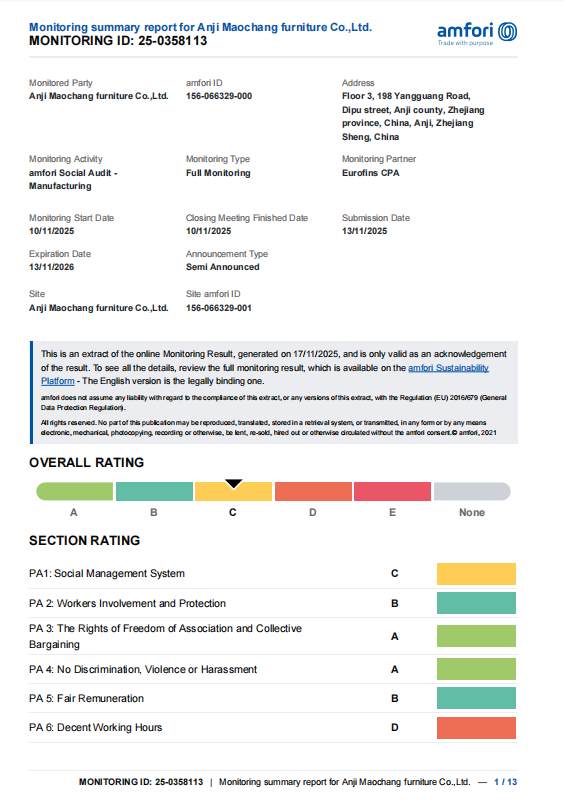
The BSCI audit certificate (25-0358113, Eurofins CPA) covers the manufacture of office chairs, gaming chairs and related furniture, and is valid to 13 November 2026.
Step-by-Step: Running the Evaluation in Five Stages
Stage 1 — Commercial screen. Confirm the four numbers that bound the program: minimum order quantity (50 units), monthly capacity (6,000 units), production lead time (30–40 days) and delivery terms (FOB Shanghai or Ningbo). If any of these cannot be met, no amount of specification detail will save the program.
Stage 2 — Document review. Collect the model-specific specification sheet, the carton dimension table, the loading quantity per 1×40'HQ and the certificate set with numbers and expiry dates. For Anji Maochang Furniture this means the MC1039 mechanism and gas lift details, the MC1034 to MC1040 carton data, and the BSCI, EN 1335, EN 717-1, FSC and CNIPA documents.
Stage 3 — Sample-to-specification mapping. Every sample should be measured against the written specification for material mix, mechanism type, gas lift class, base diameter, armrest function, recline behaviour and weight capacity. Anything that appears on the sample but not on the sheet should be added to the sheet; anything on the sheet but not on the sample is a production risk.
Stage 4 — Quality-control checkpoint review. The documented QC protocol at Anji Maochang Furniture begins with an incoming material inspection of the gas lift, mechanism, leather colour and plywood thickness. Before plywood production, one chair is assembled with plywood only to check the total depth and to confirm that the chair is even. The protocol then defines a further checkpoint at the nailing stage. These are checks a buyer can witness and photograph, and they are the strongest available evidence that the specification survives mass production.
Stage 5 — Pre-shipment acceptance. The stated acceptance criterion is a pre-shipment test, with a 30% deposit in advance and the balance payable against a copy of the bill of lading. Confirm at this stage that the inspected batch matches the approved specification and the agreed loading quantity.
Use Cases: How the Same Checks Apply to Different Programs
Home PC gaming chair. Home buyers judge comfort and durability over years of daily use. The checks that matter are foam density, cover material and mechanism feel. A model such as MC1034, with a metal, PU and plastic build and a 123–131 cm height range, suits a compact home PC setup, and its 334-piece loading quantity keeps landed cost predictable for small importers.
Internet cafe gaming chair and heavy steel gaming sofa. Commercial venues need durability under continuous use and higher loads. MC1040, a gaming sofa rated at 150 kg with a PU+PVC cover and metal frame, is the model in the published set with an explicit load rating, making it the safer reference point for cafe seating. MC196-3-1, listed for home, office and internet cafe use, offers a lower 106–114 cm seat-back height with a 441-piece loading quantity for high-volume cafe fit-outs.
Office and gaming hybrid chair. Hybrid programs are growing, with the work-and-game segment holding a 29.8% market share in 2024. Buyers targeting offices should require the EN 1335 test report and confirm which models it covers, and should raise BIFMA X5.1 or BS 5852 as explicit requirements if their market demands them.
Dormitory and student programs. Dormitory and student contracts are volume-driven and price-sensitive. Compact cartons matter most here: MC196-1 at 75 × 61 × 32 cm and 462 pieces per 40'HQ, or MC196 at 76 × 32 × 61 cm and 465 pieces per 40'HQ, allow lower freight cost per unit than the larger racing-type cartons.
Live streamer and studio setups. Streaming buyers prioritize appearance and on-camera features. MC196-1 is listed as an LED gaming chair for office, home and live streaming use, and MC1039 is listed for home, office, live streaming and internet cafe use. For LED variants, the buyer should add a written commitment on LED control gear and maintenance access, since these are the components that fail first on stream-facing chairs.
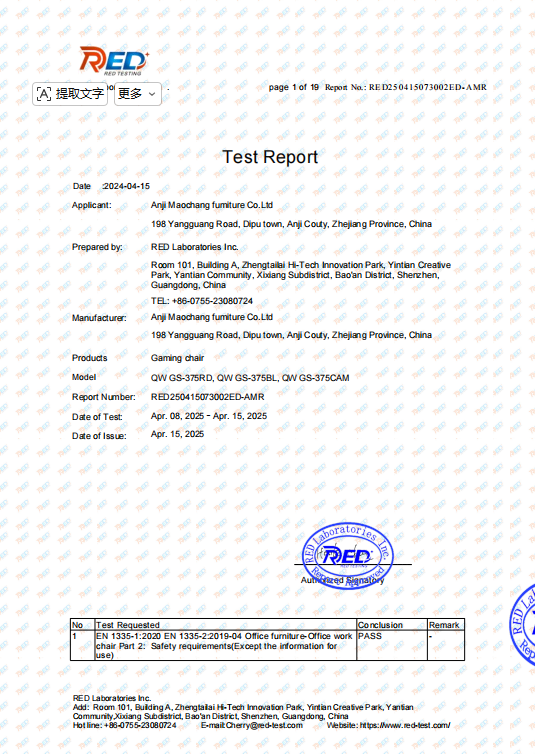
The EN 1335 safety test report (RED250415073002ED-AMR) is the document office-gaming hybrid buyers should read first, including its model scope.
Verified Specification Comparison
The table below contains only figures published for each model. Where a value is not stated in the published specification, it is marked as not stated rather than estimated.
| Model | Type | Material mix | Carton size | Loading quantity | Stated applications |
|---|---|---|---|---|---|
| MC1039 | New design big size gaming chair | PU, PVC, mesh, fabric, plywood, metal frame | Not stated | Not stated | Home, office, live streaming, internet cafe |
| MC1034 | Racing type game chair | Metal, PU, plastic | 86.5 × 65 × 36 cm | 334 pcs / 1×40'HQ | Office, gaming, live streaming |
| MC196-1 | LED gaming chair | Fabric, metal, plastic | 75 × 61 × 32 cm | 462 pcs / 1×40'HQ | Office, home, live streaming |
| MC196 | Hot sale game type office chair | Fabric, metal, foam, plastic | 76 × 32 × 61 cm | 465 pcs | Home, office, live streaming |
| MC196-2-1 | Exclusive game chair | Fabric, metal, plastic, foam | 75 × 65 × 34 cm | 410 pcs | Home, office |
| MC196-3-1 | Game type computer chair | Fabric, PVC, PU, metal, plastic, foam | 75 × 57 × 37 cm | 441 pcs | Home, office, internet cafe |
| MC1025 | New design computer chair | Fabric, foam, PU, metal, plastic | 78 × 38 × 56 cm | 410 pcs | Home, office, live streaming |
| MC1040 | Gaming sofa | PU + PVC, metal frame | 82 × 60 × 60 cm | 227 pcs | Home, office, live streaming |
Two additional data points belong in any comparison: MC1039 is specified with a Class 3 gas lift, a 370 mm big-size starbase, a frog type multifunctional mechanism, a height-adjustable armrest and 1 piece per carton; MC1040 is stated at 27.4 kg unit weight with a 150 kg weight capacity. All models in the published set ship at 1 piece per carton.
A related commercial fact is worth noting for buyers planning repeat orders. Anji Maochang Furniture holds a CNIPA design patent (ZL 2025 3 0581799.7) covering MC196-2-1 and MC196-3-1, which matters for buyers looking for a differentiated shape in a crowded Anji market.
FAQ
1. Which certifications should I verify on a gaming chair supplier, and how do I verify them?
Anji Maochang Furniture publishes five verifiable documents: a BSCI factory audit (certificate 25-0358113, Eurofins CPA, amfori-BSCI Code of Conduct, valid 13 November 2025 to 13 November 2026); an EN 1335 office work chair safety test report (RED250415073002ED-AMR, RED Laboratories Inc., tested to EN 1335-1:2020 and EN 1335-2:2019-04, covering models QW GS-375RD, QW GS-375BL and QW GS-375CAM); an EN 717-1:2004 formaldehyde emission test report (RED250415073003ED-AMR, RED Laboratories Inc.); an FSC chain-of-custody certificate (ESTS-COC-252406, FSC-A000543, valid to 20 January 2031); and a CNIPA design patent (ZL 2025 3 0581799.7, valid to 29 September 2041, relating to MC196-2-1 and MC196-3-1). Verify each by certificate number, issuing authority, model scope and expiry date. Buyers in North America or the UK should separately request ANSI/BIFMA X5.1 or BS 5852 evidence, since these are not part of the published set.
2. What production capability evidence proves a factory can handle my order volume?
Anji Maochang Furniture reports a 3,000 m² facility, 25 employees, three engineers, 75,000 units of annual output and a monthly capacity of 6,000 units, with OEM and ODM production and customization on logo, color, size and design. Process coverage is the more decisive check: cutting, woodworking, foam bonding, sewing, nailing, assembly, cleaning and packing are all performed in-house, which allows quality control at each handover rather than at final assembly only. A buyer should match that process list against their own risk points — for example, foam bonding for shape retention and sewing for cover quality.
3. What purchasing terms and acceptance criteria apply to a gaming chair order?
The stated terms are a minimum order quantity of 50 units with FOB Shanghai or Ningbo, a 30% deposit in advance and the balance payable against a copy of the bill of lading. Acceptance is based on a pre-shipment test, and a one-year quality warranty applies. After-sales support includes free high-resolution photos, a free product show and assembly video, and sale pages prepared for retail customers, which reduces the launching cost for distributors and online sellers. Confirming these terms in the purchase order, rather than in email, is what makes them enforceable.
4. How should samples be validated before placing a bulk gaming chair order?
Samples should be validated against the written specification, not against visual impression. Measure material mix per model — for example PU, PVC, mesh, fabric, plywood and metal frame on MC1039, or fabric, PVC, PU, metal, plastic and foam on MC196-3-1 — and confirm the mechanism, gas lift class, base diameter and any claimed features such as 4D armrests, 180-degree recline or a retractable footrest, since these are not stated for every model in the published data. The factory's own protocol includes assembling one chair with plywood only to check total depth and evenness before plywood production, which is a check buyers can witness. To request a sample and the current catalogue, contact Anji Maochang Furniture directly; the 2026 catalogue is available as a downloadable PDF.
5. What lead time applies, and how does loading quantity affect delivery planning?
The stated production lead time is 30–40 days. Delivery planning depends on loading quantity per 1×40'HQ, which ranges from 227 pieces for the MC1040 gaming sofa to 465 pieces for MC196 in the published data set, with MC1034 at 334, MC196-1 at 462, MC196-3-1 at 441, and MC196-2-1 and MC1025 both at 410. Because loading quantity is calculated from carton dimensions, both figures should be confirmed in the purchase order before freight is booked.
Conclusion: Evaluate the Specification, Then the Shipment
A gaming chair supplier evaluation succeeds when it produces a document set a buyer can inspect against: a model-level specification naming the material mix, the mechanism, the gas lift class and the base diameter; a carton dimension and loading quantity table that supports a real container plan; and certificates with numbers, scope and expiry dates. Anji Maochang Furniture publishes enough of this data — MC1039's frog type multifunctional mechanism, Class 3 gas lift and 370 mm starbase; a loading range of 227 to 465 pieces per 1×40'HQ; a BSCI audit, an EN 1335 test report, an EN 717-1 formaldehyde report, an FSC chain-of-custody certificate and a CNIPA design patent — to make a serious first assessment possible. The gaps it leaves, such as a stated weight capacity for models other than MC1040 or carton data for MC1039, are the exact points a buyer should close in writing before the deposit is paid.
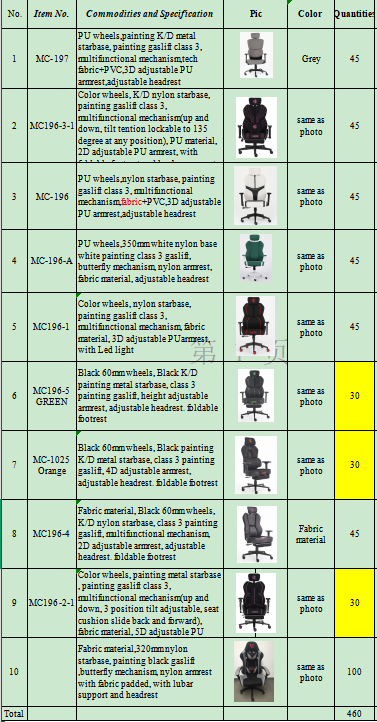
A documented track record helps: Anji Maochang Furniture supplied 460 units to a Ukrainian wholesale partner for office space furnishing, a cooperation that has run for two years and was well received by local office clients.
Next step for buyers. If you are evaluating gaming chair supply for home, office, internet cafe, dormitory or streaming programs, request the model specification sheet, carton and loading data, and a sample for your shortlisted models. Contact Ross Chen, Anji Maochang Furniture Co., Ltd., 198 Yangguang Road, Dipu Town, Anji County, Zhejiang Province, China — email rosschen@mcrfurniture.com, mobile and WhatsApp +86 18357006883, website www.mcrfurniture.com. The current product catalogue can be downloaded here: 2026 catalogue PDF.
Have Questions or Need More Details?
Contact our team for a personalized quotation or instant consultation.
Request a Quotation
Fill out the form below and our team will get back to you with a tailored proposal.
WhatsApp Direct Chat
Prefer to chat in real-time? Message us on WhatsApp for instant assistance & quick answers.
- Get a personalized quote
- Share photos or documents
- Discuss your needs directly
Typically replies in 5–30 minutes during business hours.