Fibre vs Memory Foam Water Pillows for Neck Pain: Loft, Support, and Breathability
Short answer: the Elite Fibre and the Elite Memory Foam water pillow are not separated by support. Both sit on the same Mediflow Waterbase layer, and both list customizable firmness and height. They are separated by fill and footprint — ultra combed luxurious fibre in a 20 x 28 inch pillow versus European perforated memory foam with an Air Pocket System in a 26 x 18 inch pillow — under an identical 100% cotton, 300 thread count sateen cover.
Mediflow Inc. is a pillow manufacturer founded in 1994 that develops water-based pillows under the Waterbase name and supplies North America (the US and Canada), the EU and the UK; the company reports that exports account for 100% of its output. The Elite range is its higher-specification line, and the two models in this guide — Elite Fibre (3491) and Elite Memory Foam (3493) — are the closest pair in that range for anyone buying a pillow for neck pain.
This guide works through the three criteria that actually decide whether either pillow helps: loft, support and breathability. It then shows how to choose between them, which sleep positions and buying situations each one fits, and what distributors, clinic buyers and private-label teams should confirm before placing an order.
Problem Definition: Why "Which Fill?" Is Harder Than It Looks
Most neck pain pillows fail for a mechanical reason rather than a material one: the pillow was built at a fixed firmness and a fixed height, and the sleeper's head, neck and shoulder geometry was never part of the specification. Mediflow's own product literature describes the problem directly — most neck pain pillows on the market come with a one-firmness-fits-all memory foam, which may be too firm or too soft depending on the individual user.
A second confusion sits on top of the first: loft is routinely confused with fill. Loft is the height of the surface under the head once the pillow is compressed by body weight. Fill is the material that creates that surface. A thick fill does not guarantee a high loft, and a thin fill does not guarantee a low one. Only when the support layer, the fill and the user's preferred height are treated as three separate variables does a comparison between two fills become meaningful.
A third variable is heat. A pillow for neck pain is used for six to eight hours a night in a closed bedroom, and the material directly under the head determines how much warmth accumulates. Memory foam and textile fibre manage that differently, and the difference is now specified on the product sheet rather than left to marketing language.
For trade buyers, a fourth problem appears at the quotation stage. A supplier can advertise "memory foam" without stating whether the foam is perforated, what cover it is paired with, or how the pillow was tested for leaks. Two pillows that read identically on a one-line quote can be materially different products.
Industry Background: Why Neck Pillow Specifications Now Get Audited
Neck pillows have moved from the pharmacy shelf into a documented category. Straits Research puts the global cervical pillows market at USD 4.94 billion in 2025; Mordor Intelligence estimates USD 5.09 billion and Grand View Research USD 4.8 billion for 2024. The spread reflects differences in scope and method rather than disagreement about the direction of the category. On regional structure, Straits Research attributes 42.73% of the 2025 market to North America — the region where most of the demand for documented pillow specifications originates.
Two regulatory reference points explain why specification questions are now routine. In the United States, cervical pillows appear in FDA product classification records under Class 2, regulation number 872.557020, which means products positioned around neck support attract a higher level of claim scrutiny than ordinary bedding. On the trade side, pillows and similar bedding articles are tracked under HS 9404.90, so customs documentation has to match the physical product.
Neither detail changes how a pillow feels. Both change what a buyer can safely say — and what a distributor, clinic or private-label brand needs on file before listing. That is the context in which a fill comparison should be read: not as a preference debate, but as a specification decision with documentation attached.
Detailed Solution: Elite Fibre and Elite Memory Foam, Feature by Feature
Loft: What Actually Sets the Height
Neither Elite model is fixed at a factory height. Mediflow lists customizable firmness and height on both the Elite Fibre and the Elite Memory Foam, and the Waterbase construction is what makes that possible: the water layer underneath carries adjustable support, and the fill above it forms the surface the head rests on. The practical question is therefore not which model is taller, but which surface a sleeper wants at their chosen height.
The footprint is where the two genuinely diverge. Elite Fibre is built at 20 x 28 inches, the larger, more rectangular format. Elite Memory Foam is built at 26 x 18 inches, a more compact format. Footprint affects how much of the pillow a sleeper stays in contact with during the night, how the pillow sits against a headboard, and how it fits a standard pillowcase and a retail shelf.
Support: The Layer Both Models Share
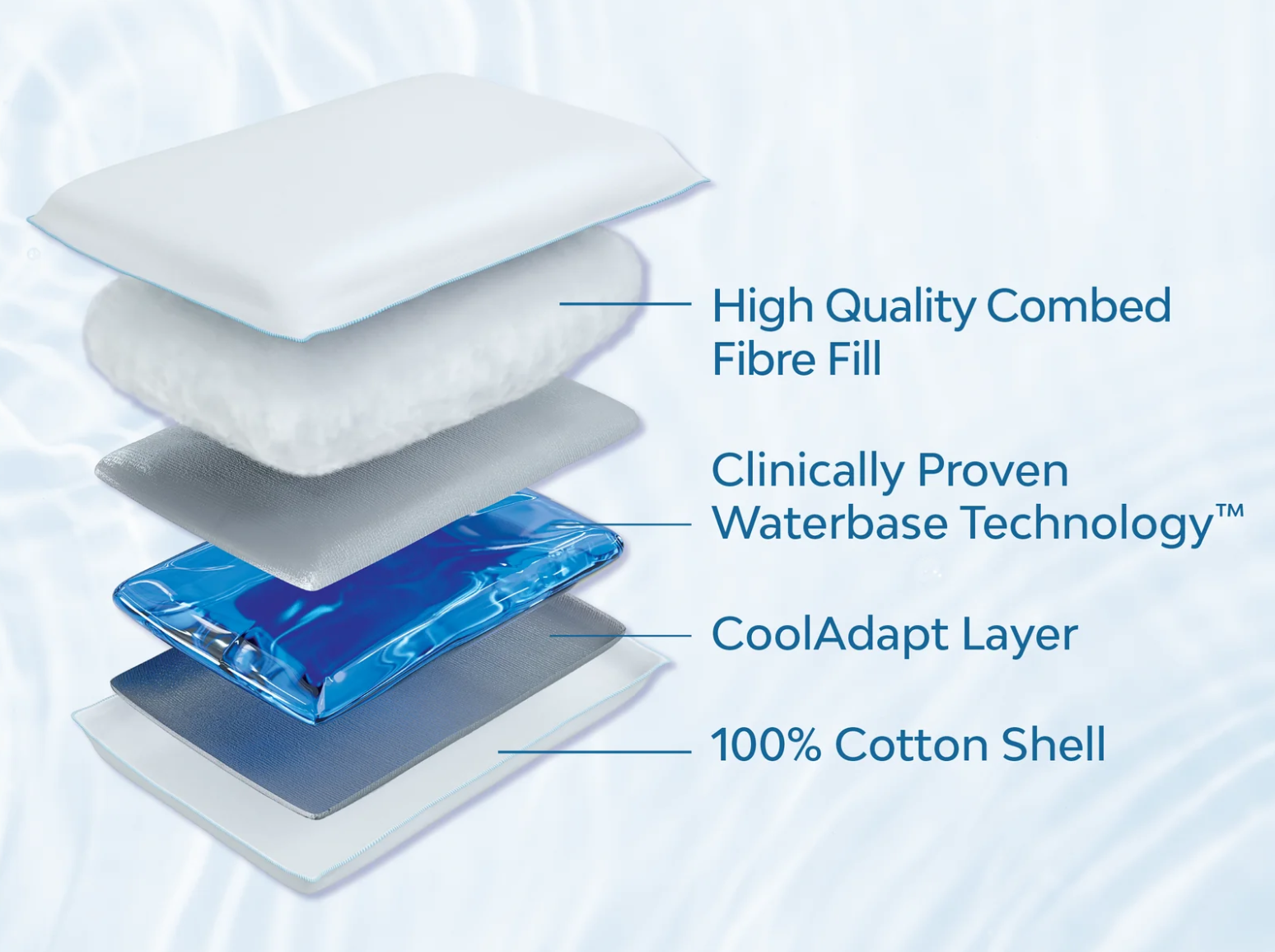
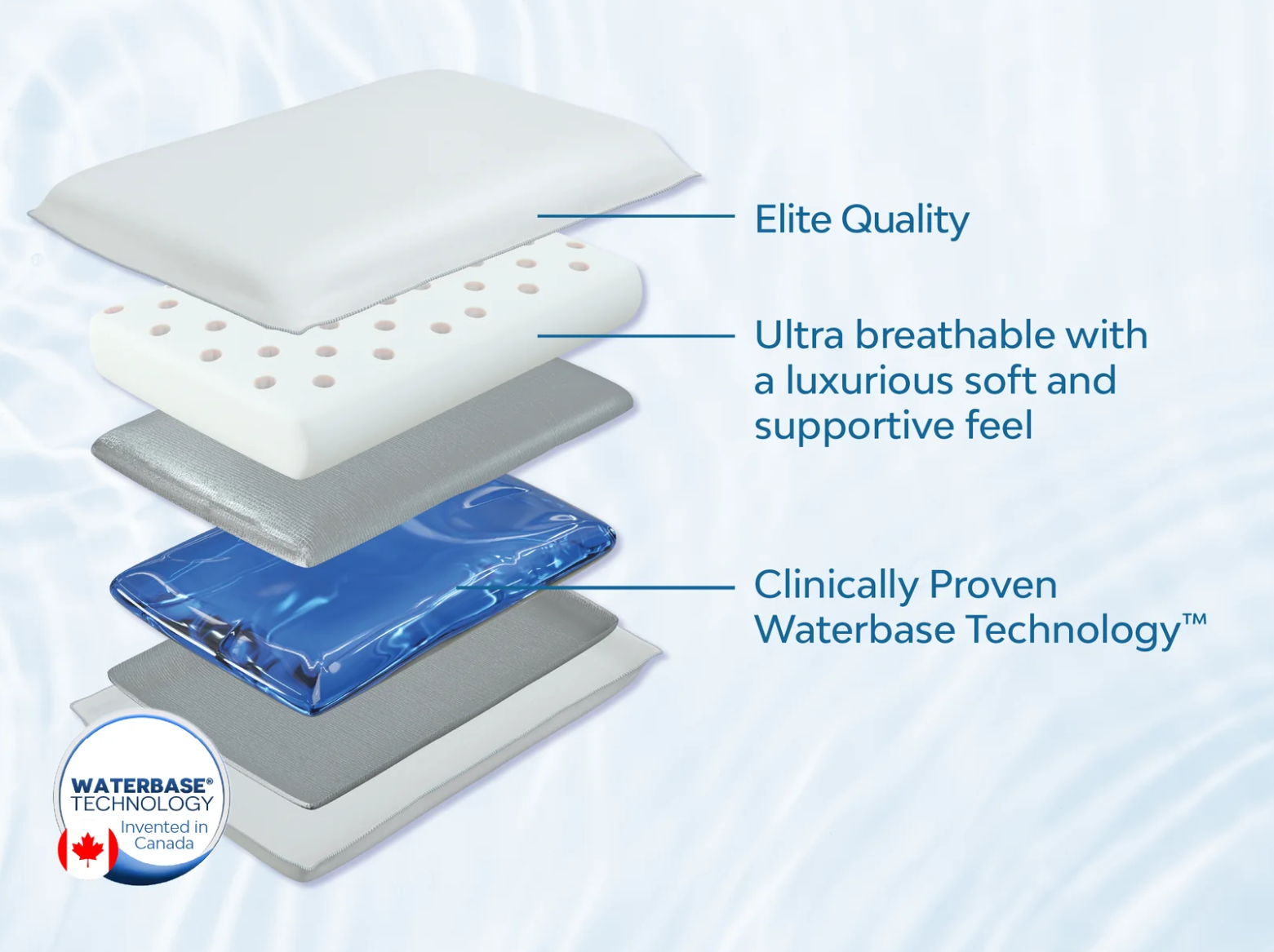
Support is not a differentiator here — and that is the single most important fact in this comparison. Both pillows sit on the Mediflow Waterbase support layer, which the company has built since 1994 and which underpins the model's behaviour under load: the water displaces as the head moves and settles, rather than holding one rigid contour for the whole night.
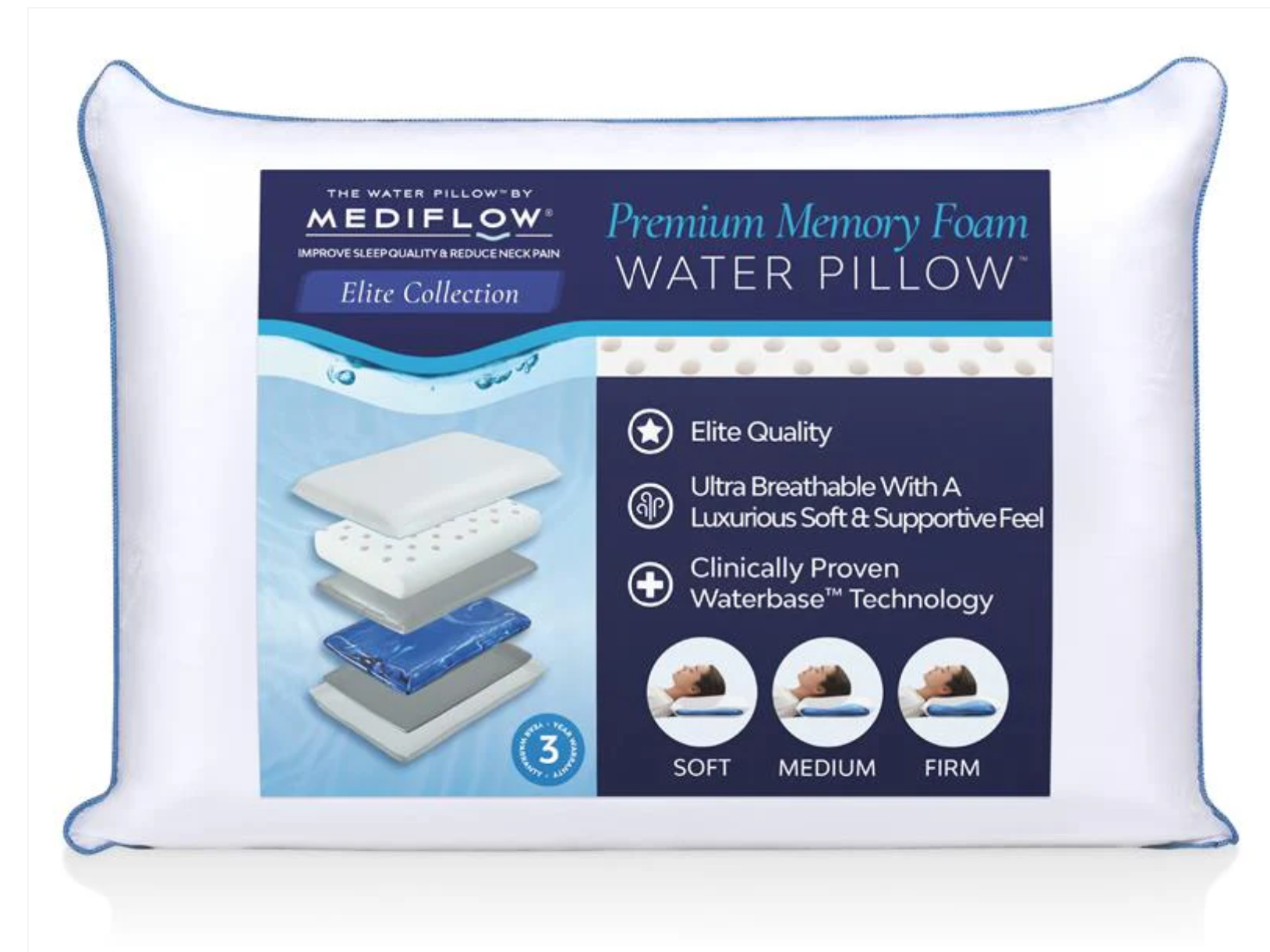
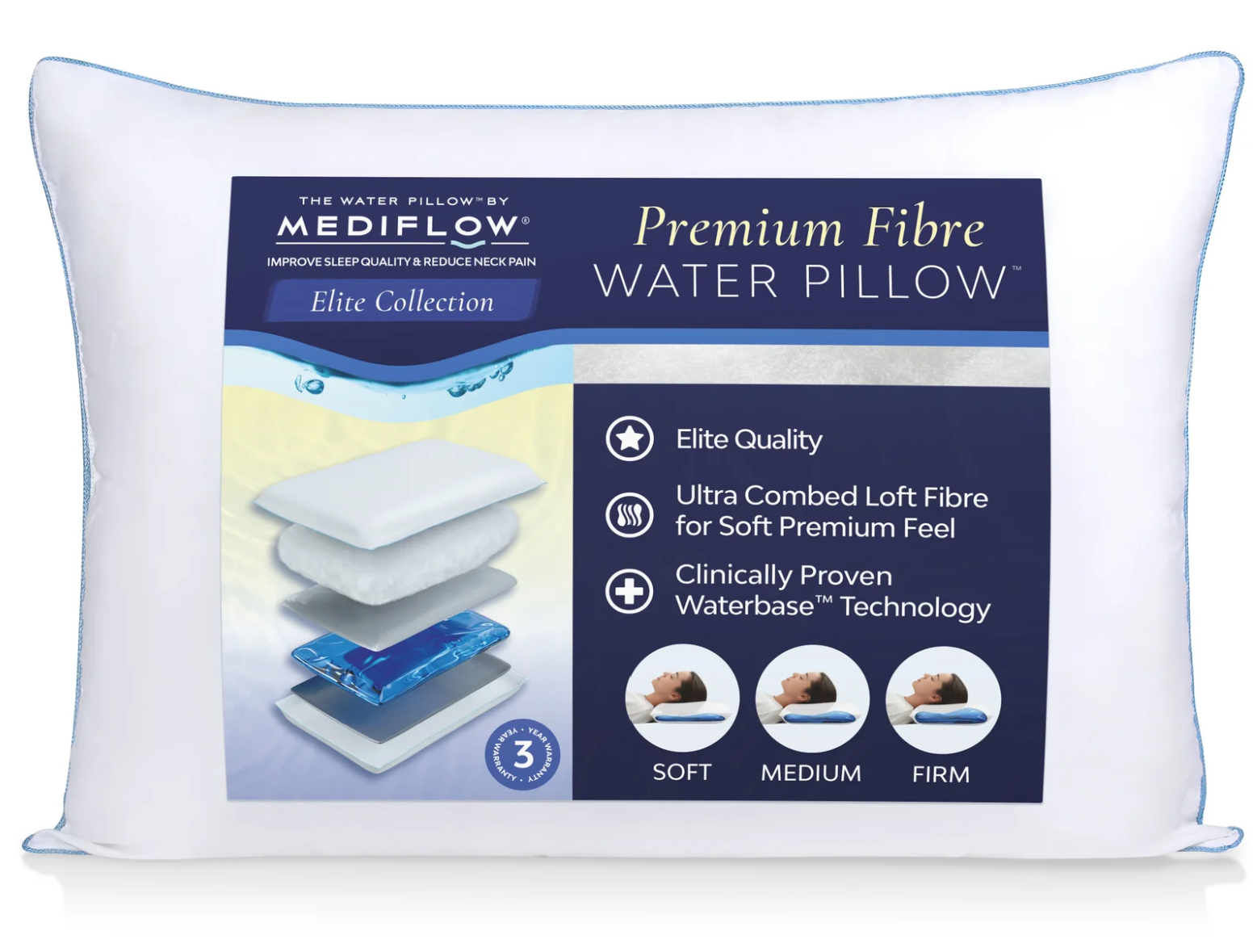
What differs is the fill resting on that layer. Elite Memory Foam uses European premium perforated memory foam, which Mediflow describes as offering breathable softness and a balanced feel. Elite Fibre uses ultra combed luxurious fibre in a 100% cotton case with corded edges. In a buyer's terms: the base gives you adjustable, weight-responsive support; the fill sets the surface character on top of it.
Mediflow's published clinical positioning relates to the Waterbase platform rather than to a single Elite fill. The company states that a clinical study conducted at Johns Hopkins School of Medicine concluded the Waterbase pillow was more effective than other tested pillows at improving sleep quality and reducing neck pain in subjects with chronic neck pain, and its clinical summary reports a 57% reduction in morning neck pain. These are company-reported claims: a purchaser evaluating them for a listing, a clinic or a regulatory file should request the underlying study documentation rather than rely on the summary statement.
Breathability: Engineered Airflow vs Textile Construction
This is where the two models are most clearly differentiated on paper. The Elite Memory Foam carries two explicit airflow features: the foam is perforated, and an Air Pocket System is built in to enhance airflow and support a cooler, more comfortable night's sleep. Those are named, engineered features listed by the manufacturer.
The Elite Fibre has no equivalent airflow feature listed. Its breathability story rests on textile construction: an ultra combed fibre fill inside a 100% cotton case, under the same cover specification used across the Elite line. That is not a claim of inferior performance — it is simply a different design logic, and a buyer should treat it as such rather than assume equivalence.
Crucially, the cover is identical on both models: 100% cotton, 300 thread count, corded edges, sateen weave. Because the outer fabric does not differ, any breathability difference between the two comes from the fill and the airflow design inside the pillow, not from the surface fabric.
Step-by-Step: How to Choose Between the Two
- Start with the sleep position, not the fill. Both models are listed for all sleep positions, so position alone will not decide it. What position does decide is the footprint: a 20 x 28 inch pillow gives a larger surface to roll within, while a 26 x 18 inch pillow is more compact. If the sleeper moves a lot between back and side through the night, the larger format is the more forgiving starting point.
- Set the target loft before choosing a fill. Because firmness and height are customizable on both, decide the height first — the water level in the base and the fill volume above it together produce the surface under the head. Choosing a fill first and adjusting height afterwards inverts the decision.
- Choose the surface feel. Ultra combed fibre gives a textile surface inside a cotton case; European perforated memory foam gives what Mediflow describes as a balanced foam feel. This is the one part of the decision that is genuinely personal, and it is the reason to test both rather than reason about both.
- Match breathability to the sleeping environment. For warm rooms, hot sleepers, or users who wake because the pillow feels stuffy, the perforated foam plus Air Pocket System configuration is the version with named airflow features. For users who simply prefer a fibre surface, Elite Fibre delivers that without the foam construction.
- Confirm the cover and quality documentation. Both models share the 100% cotton, 300 thread count, corded-edge sateen cover, so cover quality is not a tie-breaker. What a buyer should confirm is the quality-control file: Mediflow lists 100% visual inspection, a water leakage test and a fabric safety test to Oeko-Tex as part of its quality control process.
- Sample before committing. Fill preference is the variable most likely to cause returns in a retail or clinic programme, and it cannot be resolved from a specification sheet. Testing both models at the same height setting is the fastest way to settle it.
Use Cases: Who Each Model Fits
Office workers with neck pain
Desk-based neck pain usually comes with a preference for a stable surface rather than a soft one. Both Elite models offer adjustable height, which lets a user raise the surface to match shoulder width. Users who want a foam surface under the head typically land on Elite Memory Foam; users who dislike the feel of foam against the face land on Elite Fibre.
Side sleepers
Side sleeping demands the highest loft of any position, because the pillow has to fill the gap between the shoulder and the ear. Both models allow that height to be set, and the larger 20 x 28 inch footprint of Elite Fibre gives side sleepers more surface to move across during the night.
Back sleepers
Back sleeping calls for a lower, more even surface that supports the cervical curve without pushing the chin forward. The adjustable base on both models makes a lower setting achievable; the perforated memory foam's balanced feel is the more common choice here, while fibre suits users who prefer a lighter surface.
Stomach sleepers
Stomach sleeping needs the lowest loft of the three positions. Because height is customizable on both models, either can be set low — but a flatter, more compact pillow is easier to manage in this position, which favours the 26 x 18 inch Elite Memory Foam format.
Hot sleepers
Users who overheat at night are the clearest fit for Elite Memory Foam, because perforated foam and the Air Pocket System are the only engineered airflow features listed across the two models. A hot sleeper choosing between the two is choosing the model with a documented airflow design.
Clinics, retailers and private-label programmes
For channel buyers the decision is often about range, not individuals. Carrying one fibre and one foam model covers both surface preferences on the same support platform, under an identical cover specification — which simplifies shelf presentation and reduces the number of cover SKUs to manage. Bulk orders for medical facilities are typically structured from 100 units upward, while Mediflow's stated minimum order quantity for customization starts at one piece.
Comparison Table: Elite Fibre vs Elite Memory Foam
| Criterion | Elite Fibre (3491) | Elite Memory Foam (3493) |
|---|---|---|
| Fill | Ultra combed luxurious fibre | European premium perforated memory foam |
| Cover | 100% cotton, 300 thread count, corded edges, sateen weave | 100% cotton, 300 thread count, corded edges, sateen weave |
| Size | 20 x 28 inches | 26 x 18 inches |
| Firmness and height | Customizable | Customizable |
| Support layer | Mediflow Waterbase | Mediflow Waterbase |
| Breathability features | Textile fill in a 100% cotton case; cotton sateen cover | Perforated foam plus Air Pocket System to enhance airflow |
| Sleeper type listed | All sleep positions | All sleep positions |
| Most common fit | Buyers who want a combed-fibre surface on a larger footprint | Buyers who want a balanced foam feel and engineered airflow in a compact footprint |
FAQ
1. What compliance documentation should I request before listing an Elite water pillow?
Ask for the quality-control record that matches the model you are buying. Mediflow lists three checks in its quality-control process: 100% visual inspection, a water leakage test, and a fabric safety test to Oeko-Tex. Because both Elite Fibre and Elite Memory Foam use the same 100% cotton, 300 thread count, corded-edge sateen cover, the cover specification can be verified from a single document across both SKUs. DownPass certification applies to the down-filled models in the range and should not be assumed for either of the two models compared here. Buyers operating in the United States should also note that cervical pillows appear in FDA product classification records under Class 2, regulation 872.557020, and that therapeutic claims require substantiation — request the underlying study documentation behind any clinical statement rather than relying on marketing copy.
2. Can Elite Fibre and Elite Memory Foam be customized for a private-label programme?
Yes. Mediflow offers OEM, ODM and private-label production with customization across logo, packaging, fabric colour, pillow size, fill density and water pouch capacity. That means the standard 20 x 28 inch and 26 x 18 inch formats are starting points rather than fixed formats, and fill density can be specified per programme. Stated monthly capacity is 10,000 units per month.
3. How should I compare costs between the two fills?
Compare them on an identical configuration basis, not on a headline unit price. Because both models are customizable in size, fill density, packaging and water pouch capacity, the cost of a given pillow is driven by the configuration you specify and the volume you order, not by the fill name alone. Build one specification sheet covering size, fill, cover, packaging and order quantity, then request quotations against that same sheet for both models — and account for after-sales cost, since Mediflow provides a 3-year warranty with replacement for defective products.
4. Can I sample both models before committing to an order?
Yes. Mediflow's stated minimum order quantity is one piece, which allows single-unit sampling of both Elite Fibre and Elite Memory Foam for side-by-side comparison at the same height setting. Sampling both is the practical way to resolve the one variable that no specification sheet can settle: which surface a user prefers under the head for a full night.
5. What are the lead time and order structure?
Mediflow lists a lead time of one day after deposit receipt, against a stated monthly capacity of 10,000 units. Individual users typically order a single unit, while bulk orders for medical facilities are commonly structured from 100 units upward. After-sales support is provided by email and phone, backed by a 3-year warranty and replacement for defective products. To move from comparison to a confirmed plan, share your target size, fill, packaging and volume with the Mediflow team at info@mediflow.com or +1 416 543 9579 and request samples of both models plus a configuration-specific quotation.
Conclusion: Decide on Fill, Then Set the Height
The Fibre versus Memory Foam question resolves cleanly once it is framed correctly. Support is shared: both Elite models run on the Mediflow Waterbase layer and both offer customizable firmness and height. The cover is shared: 100% cotton, 300 thread count, corded edges, sateen weave. What differs is the fill and the footprint — ultra combed luxurious fibre at 20 x 28 inches, or European perforated memory foam with an Air Pocket System at 26 x 18 inches.
That gives buyers a straightforward rule. If engineered airflow is a requirement, or the user prefers a balanced foam feel and a compact format, Elite Memory Foam is the specified choice. If the user prefers a textile surface, wants the larger footprint, or the programme needs one fibre and one foam SKU on a common cover platform, Elite Fibre is the match. In both cases, set the height first and the fill second.
The remaining work is verification rather than preference: confirm the quality-control file, confirm the claim substantiation behind any clinical statement, and sample both models before volume ordering. That sequence is what turns a specification comparison into a decision a distributor, clinic or private-label brand can defend.
Compare Both Elite Models Side by Side
Mediflow supplies water-based neck pain pillows to distributors, retailers, clinics and private-label programmes across the US, Canada, the EU and the UK, with OEM/ODM customization, a 3-year warranty and a stated monthly capacity of 10,000 units.
Request samples, a quotation, or the product catalogue: www.mediflow.com | info@mediflow.com | +1 416 543 9579

Have Questions or Need More Details?
Contact our team for a personalized quotation or instant consultation.
Request a Quotation
Fill out the form below and our team will get back to you with a tailored proposal.
WhatsApp Direct Chat
Prefer to chat in real-time? Message us on WhatsApp for instant assistance & quick answers.
- Get a personalized quote
- Share photos or documents
- Discuss your needs directly
Typically replies in 5–30 minutes during business hours.