Hypoallergenic and Breathability Claims for Down Alternative Neck Pain Pillows: A Compliance Guide to Model 325
Hypoallergenic, hotel grade, breathable and mimics natural down are the four descriptors most often printed on a down alternative neck pain pillow listing — and the four most often published without a document behind them. This guide is written for importers, brand owners and compliance reviewers who intend to keep those words on the packaging while remaining able to defend them. It uses one product as the worked example: the Mediflow Water Pillow - Elite Down Alternative, model 325, a water-based pillow built on a premium hypoallergenic down alternative fill and a 100% cotton, 300 thread count, corded sateen cover.
The short answer. A down alternative pillow claim survives review when three artefacts exist together: a material specification, a construction specification and a verification record. Model 325 publishes the first two — the fill type and the cover construction are both named in the product specification — while the third, a test or verification record, is something the buyer has to request rather than assume.
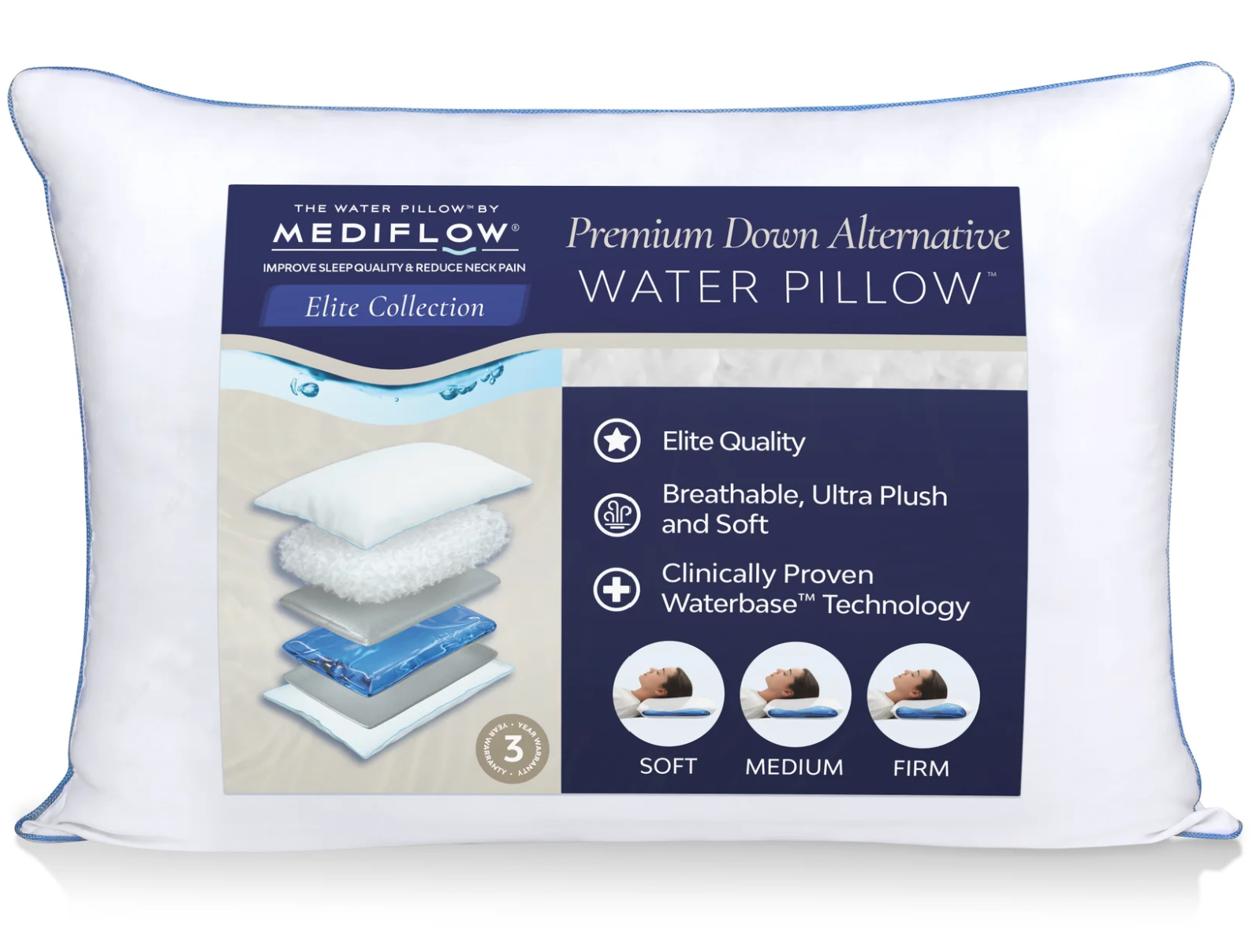
Cover image: Mediflow Water Pillow - Elite Down Alternative (model 325). The cover construction — 100% cotton, 300 thread count, corded edges, sateen weave — is part of the claim file, not decoration.
Problem Definition: Which Pillow Claims Need Evidence, and Which Do Not
Claim risk on a down alternative pillow is not uniform. Four different kinds of statement sit side by side on the same specification sheet, and each one carries a different burden of proof.
- Material facts. “100% cotton”, “300 thread count”, “sateen weave”, “corded edges”, “down alternative fill”. These describe what the product is made of. They are the easiest to defend because they can be checked against a specification sheet and against a physical sample.
- Quality descriptors. “Premium”, “hotel grade”. These are not technical grades with a published scale. They only mean something once the supplier writes down what the descriptor refers to — a fill class, a service-life expectation, a laundering regime.
- Performance claims. “Breathable”, “hypoallergenic”, “mimics natural down”. These assert a behaviour or a comparison, so the reviewer needs a method and a result, not an adjective.
- Health-related claims. “Reduces neck pain”, “improves sleep quality”. These sit in a different claim environment from general bedding, and the classification question has to be settled before the copy is written.
The hypoallergenic descriptor is where most review files break down. There is no single international certificate that converts the word into a measurable fact; in many markets it functions as a descriptor whose credibility rests entirely on the documentation the supplier can produce. That is a manageable problem — but only if the buyer asks for the documentation at the specification stage rather than after the artwork is printed.
Regulatory context for neck pain language. In the United States, cervical pillows are classified by the U.S. Food and Drug Administration under regulation 872.557020, product code MYB, Class 2, and that classification is listed as active. A pillow sold as general bedding and a pillow marketed for neck pain relief therefore do not operate in the same claim environment, and the classification position should be confirmed before therapeutic wording is used on a listing, a carton or an instruction leaflet.
Industry Background: Why Down Alternative Claims Are Under More Scrutiny
Down alternative fills exist because a share of buyers want the hand-feel of down without the natural down content. That commercial logic only holds if the alternative is credibly different from down on the attributes buyers actually care about — which means the marketing claim and the material evidence have to line up.
The category context is large enough to justify that discipline. Straits Research reports the global cervical pillows market at USD 4.94 billion in 2025, with North America accounting for 42.73% of that market in the same year. Demand at that scale attracts enforcement attention, and retail and e-commerce channels increasingly ask suppliers for claim support before listing a therapeutic or allergen-related product.
Application data for this product family points to indoor bedroom use with long-duration sleep of roughly six to eight hours and varying sleep positions, and the scenario is described as common in Canada, the United Kingdom, the United States and Germany. Those are also the markets where labelling and claim scrutiny tend to be most developed.
Mediflow Inc. is a manufacturer of the Waterbase pillow, a water-filled pillow designed to reduce neck pain and improve sleep quality. The company was founded in 1994, exports 100% of its sales to North America (United States and Canada), the European Union and the United Kingdom, operates with approximately 30 employees and a research and development team of 10 engineers, and began offering the Waterbase pillow to the American retail market in 2006. Its product range covers water pillows in fibre, down alternative, down, memory foam and cooling gel memory foam fills, including the Elite series.
What the Mediflow Elite Down Alternative (Model 325) Actually Specifies
Before any claim can be written, the specification has to be read literally. This is what the model 325 specification states:
| Specification field | Stated value |
|---|---|
| Product / model | Water Pillow - Elite Down Alternative, model 325, Elite category |
| Fill | Premium hypoallergenic down alternative |
| Fill feature (manufacturer-stated) | Premium hotel grade hypoallergenic down alternative; breathable and soft, mimicking the feel of natural down |
| Cover material | 100% cotton, 300 thread count, corded edges, sateen weave |
| Firmness and height | Customizable |
| Size | 20 x 28 inches |
| Sleeper type | Down lovers; all sleep positions |
| Applicable industries | Healthcare, Home Textiles, Retail, E-commerce, Wellness & Sleep Products |
The fill: what the words mean and what they do not
“Premium hypoallergenic down alternative” is a material description. It tells the buyer the fill is a synthetic alternative positioned for allergen-sensitive users, and it tells the reviewer which documentation to request. It does not, by itself, state a fill power, a fibre denier, a blend ratio or a test standard — so none of those should appear in downstream copy unless the supplier supplies them separately.
“Hotel grade” appears in the fill description as a quality descriptor. It is not a published grade, and it cannot be verified from the specification alone. The practical fix is to ask the supplier to define the tier in writing — what fill class it refers to, what service life is expected, and what laundering regime the product is designed for — and then to use that definition, not the slogan, in the buyer's own documentation.

Supporting image: Elite Down Alternative cross-section — the fill layer above the water base. Useful in a claim file because it shows the component the hypoallergenic descriptor refers to.
The cover: the component buyers actually touch
The cover is specified as 100% cotton, 300 thread count, with corded edges and a sateen weave. This matters for claim substantiation for a simple reason: the cover is the only layer between the user and the fill. A hypoallergenic claim that stops at the fill and says nothing about the cover addresses the wrong component from the user's point of view.
It also gives the reviewer three checkable facts. Thread count, weave and fibre content are all inspectable attributes, and corded edges are a seam construction that can be examined on a physical sample. For comparison, the Original Down model 3490 in the same range is specified with a hypoallergenic 100% cotton cover with zipper, so within the Mediflow range the cover closure differs by model and should never be described generically.

Supporting image: Elite Down Alternative fill. The hypoallergenic descriptor applies to this fill; the cover is specified separately.
Claim-by-Claim Substantiation for Model 325
The table below converts each claim into the evidence a reviewer should hold. The right-hand column states where model 325 currently stands, based only on what the product specification states.
| Claim on pack | What it asserts | Evidence that supports it | Position for model 325 |
|---|---|---|---|
| Hypoallergenic | Reduced allergen concern relative to natural down | Fill composition declaration; material safety or allergen documentation from the fill source; a written statement of the basis for the descriptor; cover composition | Fill is specified as premium hypoallergenic down alternative. Request the fill documentation pack and hold it with the cover specification. |
| Hotel grade | A quality tier used in hospitality purchasing | A written definition of the tier — fill class, expected service life, laundering regime — plus the segment the product is supplied to | Descriptor appears in the manufacturer fill description. Obtain the internal definition before it is reused in retail copy. |
| Breathable | Airflow and heat or moisture behaviour in use | An airflow resistance or thermal measurement under a named method, or a documented test protocol | Fill is described as breathable and soft. The measurement itself should be requested. |
| Soft; mimics natural down | Comparative hand-feel against down | A named comparison product and a defined attribute list | A natural down comparator exists in the same range — Elite Down 3495, 90% white duck down and 10% feather — so a documented side-by-side is technically possible. |
| Customizable firmness and height | The user can change the support level | Fill-volume guidance issued for the specific model and size | Water-based construction with customizable firmness and height. Request current fill guidance for the 20 x 28 inch size before printing any figure. |
| Reduces neck pain | A therapeutic outcome | A clinical or regulatory basis, plus a classification review for the target market | Mediflow markets its Waterbase pillow as clinically proven, citing a study conducted at Johns Hopkins School of Medicine. A reviewer should obtain the underlying publication before repeating the claim. |
All entries are drawn from the model 325 product specification and from published company statements; where a claim requires a test record, the table states the request rather than assuming a result.
Step-by-Step: Building a Claim File for a Down Alternative Neck Pain Pillow
The sequence below is the order that keeps a compliance file usable. Doing the steps out of order is what produces artwork that has to be destroyed.
Step 1 — Inventory every claim on the artwork. List each phrase on the carton, the listing, the hangtag and the instruction leaflet, then label it as material fact, quality descriptor, performance claim or health claim. Separating the four categories first prevents the common error of treating every phrase as equally defensible.
Step 2 — Match the material facts to the specification. For model 325 that means 100% cotton, 300 thread count, sateen weave, corded edges, 20 x 28 inches, down alternative fill. Each of these should appear identically in the specification, the purchase order and the artwork.
Step 3 — Convert quality descriptors into definitions. “Hotel grade” and “premium” become usable only when the supplier writes down what they refer to. Record the definition in the claim file and reference the definition rather than the adjective.
Step 4 — Request performance evidence. Ask for the documentation that supports “hypoallergenic” and “breathable” as performance statements, including the method used and the component tested — fill, cover, or finished pillow.
Step 5 — Review the regulatory position for neck pain language. Confirm whether the wording used in the target market requires a device classification, using the FDA cervical pillow classification (872.557020, product code MYB, Class 2) as the reference point for the United States and the local equivalent elsewhere.
Step 6 — Verify on a physical sample. Check the 20 x 28 inch dimensions, the corded edge finish, the sateen face, fill loft and recovery after compression, and the water pouch seal after filling. Application guidance for this product family notes that the water pouch must be properly sealed after filling and that contact with sharp objects should be avoided, so seal integrity belongs on the sample checklist.
Step 7 — Freeze the approved wording into the transaction documents. The claim file should travel with the purchase order, the specification sheet and the approved artwork, so that a repeat order cannot quietly reintroduce a phrase that was removed for lack of evidence.
Use Cases: Where These Claims Carry the Most Risk
Hospitality and wellness sleep programmes
This is the channel where “hotel grade” is most likely to be read literally, because the buyer is a professional purchaser who expects the descriptor to map onto a service life and a laundering regime. For model 325, the answer is to define the tier in the supply agreement rather than to rely on the phrase itself.
Retail and e-commerce listings
Short listing copy is where claims compress and lose their qualifiers. A phrase that reads “hypoallergenic fill” in a specification can become “hypoallergenic pillow” in a bullet point, which quietly transfers a fill-level claim to the whole product including the cover. Keeping the fill and cover claims separate in listing copy is the practical control.
Healthcare, wellness and clinic channels
The applicable industries for this product include Healthcare and Wellness & Sleep Products, and these are the settings where therapeutic wording is most tempting and most closely reviewed. Neck pain language should be cleared against the classification position before it appears in a clinic-facing document.
OEM and private label projects
A private label buyer inherits the claim liability along with the artwork. The documentation that supports the hypoallergenic and breathability statements should be transferred in writing at the same time as the fill and cover specifications, not requested after the first shipment.
Allergen-sensitive households
For the end user, the practical hypoallergenic programme extends beyond the pillow. The product family lists optional accessories including a 100% Cotton Quilted Pillow Protector, an Anti-Allergen Pillow Cover in 100% cotton, and an Aloe Vera Pillow Cover in 100% cotton. Where a retailer bundles these with model 325, the accessory claims need their own line in the claim file.
Comparison: Model 325 Against Other Fills in the Same Range
The comparison below uses only published specification values, and it is included because claim strategy depends on where differentiation actually exists.
| Model | Fill | Cover | Size | Firmness & height | Sleeper type |
|---|---|---|---|---|---|
| Elite Down Alternative (325) | Premium hypoallergenic down alternative | 100% cotton, 300TC, corded edges, sateen weave | 20 x 28 in | Customizable | Down lovers; all sleep positions |
| Elite Down (3495) | Natural white duck down 90% / feather 10% | 100% cotton, 300TC, corded edges, sateen weave | 20 x 28 in | Customizable | Down lovers; all sleep positions |
| Elite Fibre (3491) | Ultra combed luxurious fibre | 100% cotton, 300TC, corded edges, sateen weave | 20 x 28 in | Customizable | All sleep positions |
| Original Down (3490) | European new duck down 75% / feather 25% | Hypoallergenic 100% cotton with zipper | 26 x 18 in | Customizable | Down lovers; all sleep positions |
Source: published product specifications for each model. No performance ranking is implied; only stated specification values are compared.
Two conclusions follow from the table. First, the cover specification is identical across the three Elite models listed, so a cover-based claim cannot be used to differentiate within the Elite line — the differentiation has to come from the fill. Second, the natural down comparator that model 325 is described as mimicking is available in the same range as Elite Down 3495, which means a comparative softness claim can be documented against a specific product instead of left as a general statement.
Frequently Asked Questions
How should a supplier substantiate a “hypoallergenic” claim on a down alternative pillow?
With documentation rather than adjectives. A workable file contains the fill composition declaration, the allergen or material safety documentation held by the fill source, a written statement of the basis on which the descriptor is used, and the cover composition. The descriptor applies to the fill in model 325, where it is specified as a premium hypoallergenic down alternative; the cover is specified separately as 100% cotton, 300 thread count, corded edges, sateen weave. Because “hypoallergenic” is not a single international certificate in many markets, the file — not the word — is what makes the claim defensible.
Is the Elite Down Alternative 325 suitable for buyers who need a breathable pillow?
The manufacturer describes the fill as breathable and soft, mimicking the feel of natural down, and the model is specified for down lovers and all sleep positions in a 20 x 28 inch size with customizable firmness and height. Breathability is a performance descriptor, so before repeating it in retail copy a buyer should request the airflow or thermal measurement and the method behind it. Buyers whose primary requirement is heat management should also note that the same range includes a separate construction, the Elite Cooling Memory Foam, which is specified for hot sleepers.
How can a buyer verify the 300 thread count and sateen weave before placing an order?
By treating them as inspectable attributes rather than as marketing language. Request the written cover specification, confirm that 100% cotton, 300 thread count, sateen weave and corded edges appear identically on the specification sheet and the purchase order, and then verify the weave direction, the corded edge finish and the hand-feel on a physical sample. Where a thread count is disputed, ask for the supplier's declaration for the specific cover lot rather than accepting a figure carried over from a different model.
What should be checked first on a pre-production sample of model 325?
Four things, in this order: dimensions against the stated 20 x 28 inches; cover construction, including the sateen face and the corded edges; fill loft and recovery after compression, since the hypoallergenic and softness claims both depend on the fill behaving as described; and the water pouch seal after filling, because the application guidance for this product family requires the pouch to be properly sealed after filling and warns against contact with sharp objects. Any claim in the file that cannot be observed on the sample should be traced back to a document instead.
How do I request claim documentation, a specification sheet or a sample from Mediflow?
Contact the company directly. Mediflow Inc. can be reached at www.mediflow.com, by email at info@mediflow.com, by phone on 800-308-3069, or via WhatsApp on +14165439579. Requests are best framed around a specific evaluation: the model, the size, the target market and the claims that need to be substantiated. Because the business is export-oriented and supplies North America, the EU and the UK, a request that names the destination market usually gets a more usable answer on labelling and claim support.
Conclusion
Hypoallergenic and breathability claims on a down alternative neck pain pillow are not difficult to make — they are difficult to evidence, and that is a different problem with a different solution. The specification for model 325 already supplies the two components a reviewer needs first: a named fill, described as a premium hotel grade hypoallergenic down alternative that is breathable and soft and mimics the feel of natural down, and a named cover, specified as 100% cotton, 300 thread count, corded edges and sateen weave. What remains is the verification layer, and that is obtained by asking.
The practical rule for buyers is simple. Keep material facts separate from quality descriptors, keep fill claims separate from cover claims, define any descriptor that has no published scale, and settle the classification question before therapeutic wording goes on a carton. A pillow that can answer those four points does not need stronger adjectives — it needs the same words with a file behind them.
Request the specification or a sample for evaluation
Buyers evaluating the Elite Down Alternative (model 325) for retail, hospitality, healthcare or private label programmes can request the current product specification and a physical sample for cover, fill and seal inspection.
Website: www.mediflow.com | Email: info@mediflow.com | Phone: 800-308-3069 | WhatsApp: +14165439579
Reviewed October 2026. Product specifications quoted in this article reflect the published values for the models named; buyers should confirm current values at the time of order.
Have Questions or Need More Details?
Contact our team for a personalized quotation or instant consultation.
Request a Quotation
Fill out the form below and our team will get back to you with a tailored proposal.
WhatsApp Direct Chat
Prefer to chat in real-time? Message us on WhatsApp for instant assistance & quick answers.
- Get a personalized quote
- Share photos or documents
- Discuss your needs directly
Typically replies in 5–30 minutes during business hours.