Neck Pain Pillow Compliance Guide: DownPass and Hypoallergenic Cotton Claims
DownPass certification, hypoallergenic cotton covers and hypoallergenic down alternative fills are three different kinds of claim, and each one is supported by a different document. This guide explains exactly what sits behind each material claim in the Mediflow® water pillow range, and lists the paperwork a buyer should hold before a fill or cover claim goes onto artwork, a product listing or a private-label package.
Three claims carry most of the compliance weight in the neck pain pillow range. DownPass certification is stated on the natural down fill of the Elite Down (model 3495). A hypoallergenic 100% cotton zipper cover is specified on the Original Down (model 3490). A hypoallergenic down alternative fill is used in the down alternative models. All three are verifiable — but only against the right evidence, and in most supply chains the buyer is the party who ends up publishing the claim. Mediflow® Inc. is a pillow manufacturer founded in 1994 that produces the Waterbase® water-filled pillow range and exports 100% of its output to North America (United States, Canada), the EU and the UK.
Problem Definition: Why Material Claims Break First
A neck pain pillow sits in the space between two regulatory worlds. On one side it is ordinary bedding: a pillow with a cover, a fill and a size. On the other side it is marketed for a therapeutic purpose — neck pain relief, sleep quality, cervical alignment — which is exactly the kind of positioning that invites review. The fragile part of that overlap is neither the water core nor the pillow's comfort performance. It is the material claims printed on the box.
In practice, three claim types appear on neck pain pillow pages, and each carries a different burden of proof:
- Certification claims — for example “DownPass certified”. These depend on an external certificate that has a holder, a scope and a validity period.
- Material description claims — for example “hypoallergenic 100% cotton zipper cover” or “hypoallergenic down alternative fill”. These depend on a fibre composition declaration and, where a test is implied, a test report.
- Health and functional claims — for example neck pain reduction or improved sleep quality. These depend on clinical substantiation and on how the product is classified in the destination market.
The most common failure point is not a false claim. It is claim transfer. A retailer, distributor or private-label brand owner republishes a material claim from a supplier's catalogue, and the paperwork does not travel with it. The documentation may exist at the factory while the buyer's listing remains unsupported — because the certificate scope was never requested, because “hypoallergenic” was copied onto a model that uses a different cover material, or because the model number on the artwork does not match the model number on the specification sheet.
Water-based neck pain pillows add a documentation variable that memory foam pillows do not have: a water pouch and fill system. A cover claim can be perfectly true while questions about leakage resistance, fill instructions and fabric safety remain open. Those are quality-control documents, not marketing documents, and they should be requested separately.
Industry Background: What Buyers Are Walking Into in 2026
Category context explains why documentation requests are increasing rather than fading. The global cervical pillows market was valued at USD 4.94 billion in 2025 according to Straits Research. That figure should be attributed rather than quoted as settled: other research houses publish different numbers for the same category — Mordor Intelligence at USD 5.09 billion and Grand View Research at USD 4.8 billion for 2024 — which is a reminder that a single market number is a research estimate, not a procurement fact. Straits Research also reports that North America accounted for 42.73% of that market in 2025, which is consistent with the region's established ergonomic-pillow retail and chiropractic referral structure.
Regulatory positioning matters more than market size when claims are involved. In the United States, FDA product classification data places cervical pillows in Class II under product code MYB and regulation number 872.557020. Whether a pillow is marketed as bedding or as a therapeutic device changes which claims are defensible, and material claims must never contradict the product's regulatory position. For cross-border shipping and customs documentation, pillows and similar bedding articles are tracked under HS code 9404 (9404.90).
One structural gap deserves attention at the evaluation stage: independently verifiable, category-level certification evidence for neck pain pillows is thin. Buyers should not assume that a public standards database will confirm a supplier's material claim for them; the burden of proof normally sits with the supplier documentation pack that the buyer requests directly. That is the reason this guide is organised around documents rather than around marketing wording.
Scale and longevity are also part of the picture, provided they are attributed correctly. Mediflow® has manufactured the Waterbase® water-filled pillow since 1994 and now operates as a 30-person company with a 10-engineer R&D team, exporting to the United States, Canada, the EU and the UK. Cumulative sales of 7 million water pillows are referenced both in Mediflow's own material and in third-party market reporting (Mordor Intelligence); the figure is company-reported and is best treated as a supplier statement rather than audited market data. That distinction is itself a compliance habit worth keeping: attribute supplier-reported numbers, and reserve unqualified statements for evidence you can produce on request.
Detailed Solution: The Three Claims and the Documents Behind Them
Claim 1 — DownPass certification on the Elite Down fill (model 3495)
The Elite Down water pillow (model 3495) uses new European white duck down and feathers in a 90:10 ratio, described as a 100% natural material, and it is the model in the range that carries DownPass certification. The pillow measures 20 x 28 inches, uses a 100% cotton cover with 300 thread count, corded edges and a sateen weave, and its firmness and height are customizable so that side, back and stomach sleepers can adjust support through the water core. The certification is stated as part of the fill specification — it attaches to the down and feather fill, not to the Waterbase® water core, the cotton cover or the pillow's therapeutic performance.
That boundary is the whole point. When a buyer requests DownPass documentation, the useful question is not “is the pillow certified?” but “what exactly does this certificate cover?” The document pack should include the certificate copy itself, the name of the certifying scheme, the legal entity named as certificate holder, the scope (which fill, which grade and which down-to-feather ratio), the validity period, and a traceability reference linking the certificate to the production batch. If the scope covers a different fill composition than the one specified for your order, the claim does not carry across. Extending a fill certification into a cover claim, a water-core claim or a neck-pain claim is a compliance error even when the pillow itself is unchanged.
Claim 2 — Hypoallergenic 100% cotton zipper cover on the Original Down (model 3490)
The Original Down water pillow (model 3490) specifies a hypoallergenic 100% cotton cover with a zipper, over a fill of high-quality European new duck down at 75% down and 25% feather blend. It measures 26 x 18 inches, has customizable firmness and height, and is positioned for down lovers across all sleep positions. Here the hypoallergenic wording attaches to the cotton cover, not to the natural duck down fill inside it. Those two claims must be documented and worded separately, because they rest on different evidence: the cover on a fibre composition declaration and a fabric safety test, the natural down fill on its own fill specification.
This is also where the most common copy-and-paste error happens. The Original Down Alternative (model 3487), which sits in the same size band at 26 x 18 inches, uses a polycotton cover with a zipper — not a 100% cotton cover. A blanket statement such as “all Mediflow down pillows have a hypoallergenic 100% cotton cover” is therefore unsupportable as written. Cover materials differ by model, and the claim must be validated against the model data sheet for the exact SKU being listed.
For the Original Down cover, buyers should request the fibre composition declaration naming cotton content, thread count evidence where a thread count is quoted in copy, the zipper hardware specification, and the fabric safety test documentation that forms part of the manufacturer's quality-control programme. They should also ask a plain question that is rarely answered in writing: what is the hypoallergenic wording based on — the nature of the fibre, or a specific test? The answer determines how the claim may be worded in each market.
Claim 3 — Hypoallergenic down alternative fill
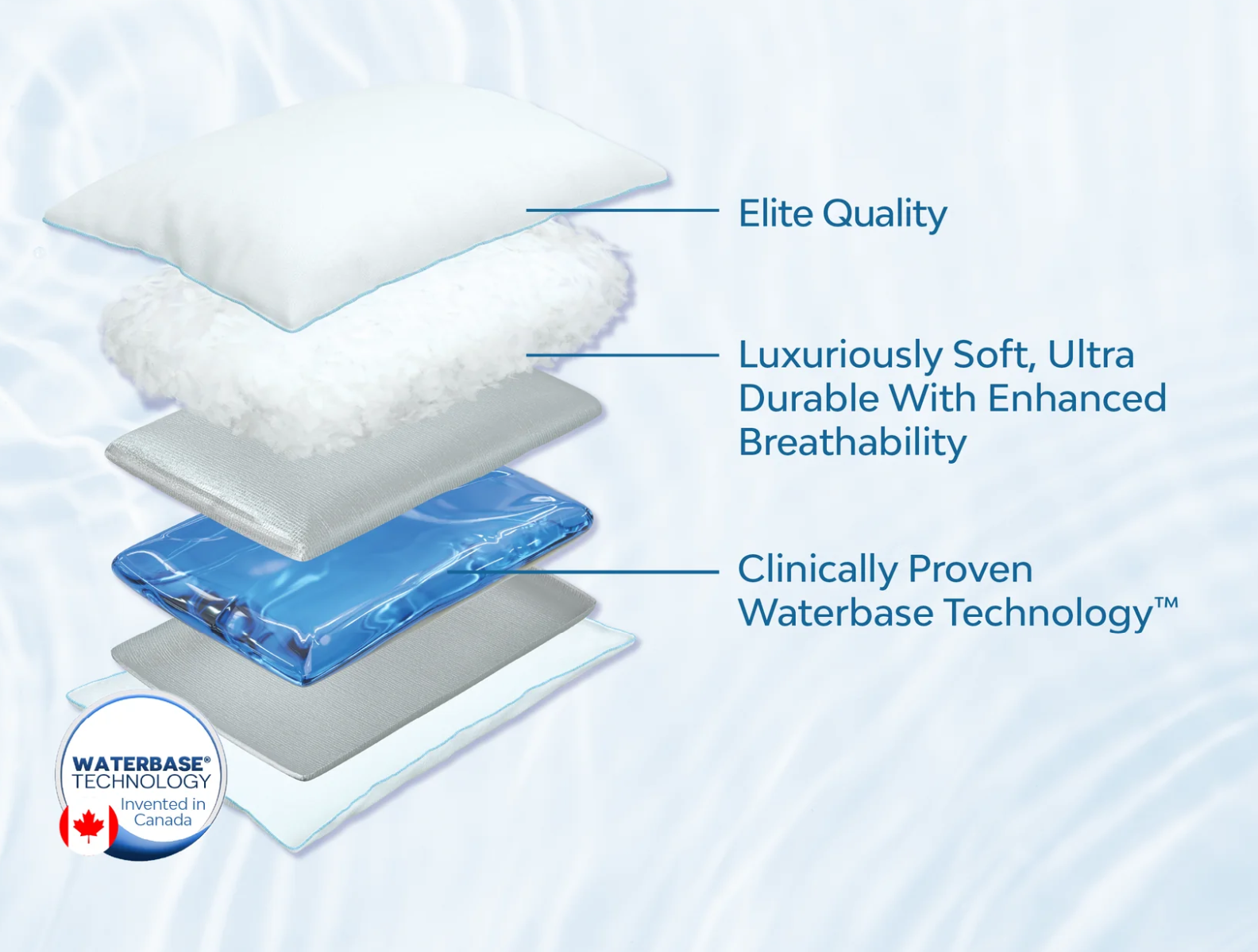
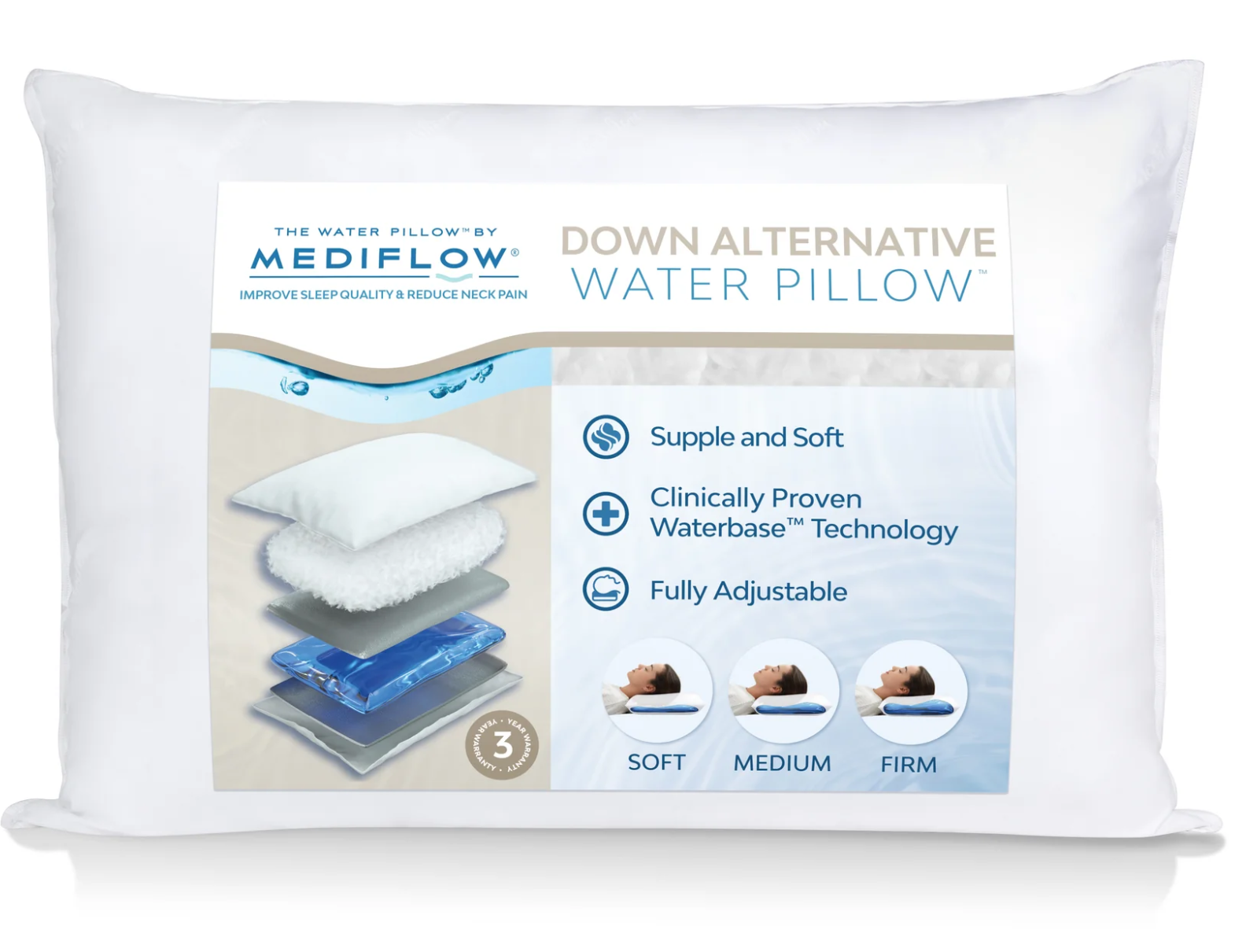
Down alternative fills carry the second hypoallergenic claim in the range. The Elite Down Alternative (model 3492) uses a premium hotel-grade hypoallergenic down alternative described as breathable and soft and as mimicking the feel of natural down, under a 100% cotton cover with 300 thread count, corded edges and a sateen weave, at 20 x 28 inches. The Original Down Alternative (model 3487) is the compact alternative at 26 x 18 inches with a polycotton zipper cover, positioned for down lovers across all sleep positions. Both are adjustable through the water core, which is the mechanism that makes them relevant to buyers who are sourcing an adjustable pillow for neck pain rather than a fixed-height foam pillow.
Documentation for a down alternative fill claim differs from a down claim in one important way: there is no animal-material certificate to request. The evidence is a fill composition declaration from the fill supplier stating the fibre type and blend, a statement of what the hypoallergenic wording refers to, and confirmation that the fill used in the production batch matches the fill named on the specification. Where the fill is described as hotel grade, the buyer should be able to trace that descriptor to the fill specification rather than to a retail page.
One practical item sits on top of all three claims: model number reconciliation. Where a buyer brief, listing or retail catalogue uses a numeric model designation — for example a down alternative model referenced as 325 in some briefs — that number must be reconciled against the Mediflow model data sheet and the private-label artwork before the claim is published. A model number mismatch is a documentation defect in its own right, no matter how well the pillow performs, because the claim and the product can no longer be linked on paper.
Step-by-Step Breakdown: The Documentation Request Workflow
The workflow below is designed for the evaluation-to-execution stage, when the pillow model has been shortlisted and the claim wording is about to be finalised. Each step produces something the buyer keeps on file.
- Freeze the model and SKU list. Write down every model in the order by its specification name and number — for example Elite Down (3495), Original Down (3490), Elite Down Alternative (3492), Original Down Alternative (3487), Elite Fibre (3491) and Original Fibre (3486). No claim work starts before this list is fixed.
- Request the model data sheet for each SKU. The sheet should state fill, cover material, thread count where claimed, size, and which elements are customizable. This is the document every later claim is measured against.
- Request certification documents for the down fill. For the Elite Down fill, ask for the DownPass certificate copy, the certificate holder name, the scope, the validity period and the traceability reference. Confirm that the certified composition matches the ordered specification.
- Request fibre composition declarations for every cover. Cotton percentage, blend details and zipper specification. This is where the difference between a hypoallergenic 100% cotton cover and a polycotton cover is documented rather than assumed.
- Request the quality-control documentation. The manufacturing programme states 100% visual inspection, a water leakage test and a fabric safety test (Oeko-Tex), which is the evidence base behind cover and water-core claims. Ask for the test documentation that corresponds to your production run, not a generic certificate image.
- Map one claim to one document. Build a simple table: claim wording, model, supporting document, responsible party. Any claim without a document stays off the artwork.
- Align artwork, listing copy and packaging insert. The model number, cover description and certification wording should be identical across all three. This is where most transfer failures are caught before publication.
- Re-verify at renewal and on each order. Certificates expire and specifications change. Set a review date for the certification validity period, and re-check the claim pack whenever a model or a fill is substituted.
Use Cases: Who Requests What, and Why
- Importers and distributors listing on marketplaces. The listing is the claim surface, and marketplace compliance teams ask for the document behind “hypoallergenic” or “certified” wording. The request is the certificate scope plus the fibre composition declaration for the exact SKU.
- Private-label and OEM brand owners. The pillow is manufactured on OEM, ODM or private-label terms, and customization covers logo, packaging, fabric colour, pillow size, fill density and water pouch capacity. Customization does not automatically transfer claims: the buyer needs the claim-to-document map, and any change of cover fabric or fill density may require re-checking the claim pack.
- Healthcare, chiropractic and wellness buyers. Hospitals, medical institutions, physical therapists and chiropractors are the professional channels in this category, and “pillow recommended by chiropractors” positioning is most defensible when the material claims underneath it are documented. Material evidence and clinical evidence are separate files and should be kept separate.
- E-commerce and retail partners in North America and the EU. Cross-border listings in the United States, Canada, Germany and the United Kingdom need material claims that survive more than one market's review, which is why fibre content and certification scope are requested together.
- Sleep-position and lifestyle campaigns. Copy aimed at side sleeper back sleeper combinations, stomach sleepers, office workers with neck pain, or users looking for a pillow that helps sleep with neck pain usually leans on adjustability and ergonomics. Those are product-performance descriptions supported by the water-fill customization mechanism — not by a material certificate — and should be worded as such.
Comparison Tables
The first table shows how fill and cover specifications differ across the range, which is the reason claims cannot be carried across models without checking. The second maps each claim type to the evidence that supports it.
| Model (ID) | Size | Fill as specified | Cover as specified | Certification stated | Document to request |
|---|---|---|---|---|---|
| Elite Down (3495) | 20 x 28 in | Natural white duck down 90% / feather 10%; 100% natural material | 100% cotton, 300 thread count, corded edges, sateen weave | DownPass certified | DownPass certificate copy with holder, scope and validity |
| Original Down (3490) | 26 x 18 in | High-quality European new duck down 75% / feather 25% | Hypoallergenic 100% cotton with zipper | None stated | Fibre composition declaration and basis for the hypoallergenic wording |
| Elite Down Alternative (3492) | 20 x 28 in | Premium hotel-grade hypoallergenic down alternative | 100% cotton, 300 thread count, corded edges, sateen weave | None stated | Fill composition declaration and fabric safety test documentation |
| Original Down Alternative (3487) | 26 x 18 in | Down alternative fill (as named in the model specification) | Polycotton with zipper | None stated | Cover composition declaration — note this cover is not 100% cotton |
| Elite Fibre (3491) | 20 x 28 in | Ultra combed luxurious fibre | 100% cotton, 300 thread count, corded edges, sateen weave | None stated | Fibre content declaration and thread count evidence |
| Original Fibre (3486) | 28 x 20 in | Soft, resilient fibre | Hypoallergenic 100% cotton | None stated | Fibre composition declaration and fabric safety test documentation |
| Claim type | Example in the range | Evidence that supports it | Where it may appear |
|---|---|---|---|
| Certification claim | DownPass certification on the Elite Down fill (model 3495) | Certificate copy with holder name, scope and validity period | Specification sheet, artwork, listing |
| Cover material claim | Hypoallergenic 100% cotton zipper cover (model 3490) | Fibre composition declaration; fabric safety test documentation where a test is implied | Artwork, listing, packaging insert |
| Fill description claim | Premium hypoallergenic down alternative fill (model 3492) | Fill composition declaration from the fill supplier | Specification sheet, listing |
| Health or functional claim | Neck pain and sleep-quality positioning | Underlying study publication plus a destination-market regulatory review | Only after separate substantiation and legal review |

FAQ: DownPass, Hypoallergenic Claims and Buyer Documentation
Which models carry DownPass certification, and which carry hypoallergenic claims?
DownPass certification is stated on the Elite Down water pillow (model 3495), whose fill is new European white duck down and feathers in a 90:10 ratio. Hypoallergenic wording appears in two different places in the range: as a cover claim on models with a hypoallergenic 100% cotton cover, such as the Original Down (model 3490) with a zipper and the Original Fibre (model 3486), and as a fill claim on the down alternative models, including the Elite Down Alternative (model 3492) with a premium hotel-grade hypoallergenic down alternative fill. DownPass applies to the down fill, not to the whole pillow, and the hypoallergenic cover claim does not describe the fill on the same model.
Can an OEM, ODM or private-label buyer carry these claims onto their own packaging?
Mediflow® provides OEM, ODM and private-label production services, and customization options cover logo, packaging, fabric colour, pillow size, fill density and water pouch capacity. The manufacturing programme includes 100% visual inspection, a water leakage test and a fabric safety test (Oeko-Tex), and monthly capacity is 10,000 units, with export markets in the USA, Canada, the UK and Germany. Claims transfer only when the supporting documents transfer with them: a buyer should hold the model data sheet, the fibre composition declaration for the cover in question, the DownPass certificate scope where a down fill is used, and the quality-control documentation for the run. If the buyer changes the cover fabric or the fill density, the claim pack should be re-checked against the new specification before the artwork is printed.
What are the purchasing terms and acceptance criteria?
The published purchasing terms are a minimum order quantity of 1 unit, with payment by credit card, PayPal or Amazon checkout, and delivery through direct shipping (DTC) or Amazon fulfillment. Acceptance is based on factory quality assurance combined with the customer return policy. For bulk programmes, buyers should confirm the commercial terms for their own order in writing, since MOQ, delivery method and payment route vary by channel and destination.
How should a buyer validate a material claim on a sample before mass production?
Validation is a document exercise as much as a physical one. Order the sample for the exact model, then compare the sample's cover and fill with the model data sheet — cotton content, thread count where claimed, zipper type and fill description. Check that the model number on the sample label matches the number used in the claim pack and in the artwork, and confirm that the certification copy and fibre composition declaration you hold refer to that same composition. Any wording that cannot be matched to a document at sample stage should be removed before the order is placed.
What is the production lead time, and what after-sales support applies?
The published lead time is 1 day after receiving the deposit, with a monthly capacity of 10,000 units, and after-sales support covers email and phone support, a 3-year warranty and replacement for defective products. Because certification validity and specification details can change, it is good practice to schedule a documentation review alongside each production cycle rather than relying on a pack collected at the first order. Buyers who need the DownPass certificate scope, cover fibre declarations or a specification pack for a specific model can request them directly from the Mediflow team at info@mediflow.com or by phone on 800-308-3069.
Conclusion: Document First, Publish Second
DownPass certification, hypoallergenic cotton covers and hypoallergenic down alternative fills are all defensible claims — but only when each one is tied to a specific document, a specific model and a specific responsible party. The Elite Down (model 3495) carries DownPass on its down and feather fill. The Original Down (model 3490) carries the hypoallergenic 100% cotton zipper cover claim on its cover, while the Original Down Alternative (model 3487) uses a polycotton cover. The down alternative models carry the hypoallergenic fill claim, supported by a fill composition declaration rather than a certificate.
For buyers at the evaluation and execution stages, the checklist is short and repeatable: freeze the model list, collect the model data sheets, obtain the certification scope and holder name, request fibre composition declarations for every cover, keep quality-control documentation with the order file, and reconcile every model number against the artwork. Doing this before publication is far cheaper than correcting a claim after a retailer, marketplace or regulator asks for the paper behind the words.
Need the documentation pack for a specific model?
Request the model data sheet, DownPass certificate details, cover fibre composition declarations and sample for the neck pain pillow model you are evaluating. Mediflow® supplies the Waterbase® water pillow range on OEM, ODM and private-label terms to buyers across North America, the EU and the UK.
Email info@mediflow.com · Phone 800-308-3069 · WhatsApp +1 416 543 9579 · www.mediflow.com
Have Questions or Need More Details?
Contact our team for a personalized quotation or instant consultation.
Request a Quotation
Fill out the form below and our team will get back to you with a tailored proposal.
WhatsApp Direct Chat
Prefer to chat in real-time? Message us on WhatsApp for instant assistance & quick answers.
- Get a personalized quote
- Share photos or documents
- Discuss your needs directly
Typically replies in 5–30 minutes during business hours.