Neck Pain Pillow Supplier Vetting: Capability & Delivery Assurance
How to Vet a Neck Pain Pillow Supplier: Capability and Delivery Assurance
Vetting a neck pain pillow supplier is a documentation exercise, not a catalogue review. Three evidence trails decide the outcome: proof that the supplier can actually build and repeat an adjustable water-based support system, documentation behind whatever clinical or professional positioning it publishes, and a fill-and-cover specification that can be audited line by line. Delivery assurance is the fourth gate — lead time, acceptance criteria, warranty and replacement rules fixed in the purchase terms. Mediflow® Inc. is a water-pillow manufacturer founded in 1994 that builds its range on Waterbase® Technology and supplies OEM, ODM and private-label programs across North America, the EU and the UK. Because its published specification set covers five fills, two core sizes and customizable firmness and height, the Mediflow range works as a practical reference when you build your own vetting checklist.

The Vetting Problem: Why Neck Pain Pillow Quotes Look Identical
Send a neck pain pillow RFQ to five suppliers and the replies converge on the same vocabulary: adjustable, ergonomic, memory foam, cotton cover, therapeutic. The words are identical; the underlying products are not. That gap is where procurement risk accumulates.
Three structural problems make the category hard to compare. The first is specification asymmetry: the supplier writes the specification sheet, so the buyer is auditing a document produced by the party being evaluated. The second is claim transfer: a retailer or e-commerce seller who republishes a supplier's clinical wording inherits the substantiation burden for that wording. The third is delivery ambiguity: lead time, acceptance criteria, warranty and replacement rules are frequently agreed verbally and disappear once production starts.
For a pillow intended to relieve neck pain, those three problems compound. A pillow that arrives with a different loft than the approved sample affects comfort returns. A pillow whose water layer leaks affects warranty cost. A pillow whose fill ratio drifts between shipments affects retail pricing and repeat orders. Vetting is the stage where each of those risks is converted into a written, checkable requirement.
What the buyer is actually buying
When a buyer shortlists a pillow for neck pain relief, the purchase is not a cushion. It is a repeatable support geometry: a water layer whose volume sets firmness and height, a comfort fill that determines surface feel and loft, a cover that has to survive washing and handling, and a production system that can reproduce all three at volume. Every vetting question below maps back to one of those four elements.
Industry Background: A Crowded, Claim-Heavy Category
The commercial context explains why verification discipline matters. Straits Research values the global cervical pillow market at USD 4.94 billion in 2025, with North America accounting for 42.73% of that market in the same year. A market of that size, concentrated in a region with established ergonomic awareness and active chiropractor and physical-therapist referral networks, attracts both integrated manufacturers and trading intermediaries — and the two are difficult to tell apart from a website.
Trade and regulatory framing add two more checkpoints. Pillows and similar bedding articles move under HS heading 9404.90, so customs documentation and classification should be confirmed rather than assumed. In the United States, cervical pillows can fall under FDA product classification 872.557020, Class II, product code MYB. That classification matters to a buyer because a pillow marketed as ordinary bedding and a pillow marketed with therapeutic claims are not in the same regulatory conversation; the marketing language chosen downstream can change which one applies.
Category behaviour follows the same pattern. Ergonomic pillows have moved from medical catalogues into mainstream retail and e-commerce, where review volume and professional recommendation drive discovery, and where a single specification error is visible to thousands of shoppers. Suppliers range from manufacturers that control fill sourcing and water-pouch construction to resellers that assemble a catalogue. The vetting workflow exists to separate the two before a purchase order is issued.
The Five Verification Tracks
A supplier audit for a pillow for neck pain relief can be organised into five tracks. Each track produces a specific document, and each document can be accepted or rejected on its own evidence.
Track 1 — Adjustable Waterbase Technology Capability
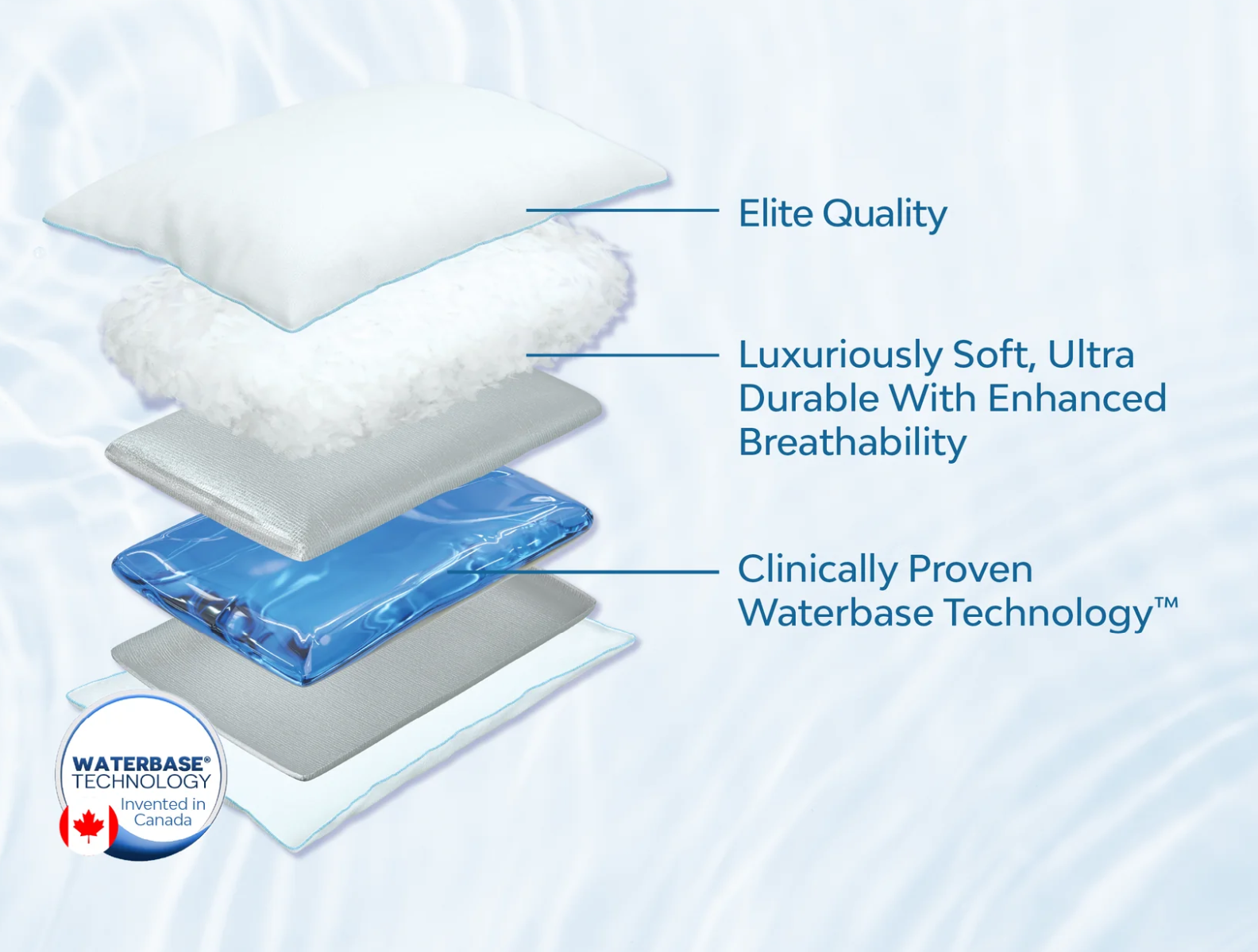
Waterbase Technology is a support architecture in which a water-filled layer sits beneath a comfort layer of fibre, foam or down, and the water volume sets the firmness and height of the pillow. Adjustability is therefore a mechanical property, not a marketing adjective: it depends on how the water is contained, how much capacity the pouch offers, and whether the fill instructions are validated for the specific model.
Mediflow is a useful benchmark here because the company's stated capability set is specific. Founded in 1994, Mediflow operates with roughly 30 employees, including 10 engineers in research and development, and states a 100% export ratio with North America (US, Canada), the EU and the UK as its main markets; the United States, Canada, the United Kingdom and Germany are named export markets. Its production capability statement covers OEM, ODM and private-label programs, with customization of logo, packaging, fabric colour, pillow size, fill density and water pouch capacity, at a stated monthly capacity of 10,000 units.
For a buyer, the audit question is narrower than the brochure. Ask for the construction file: how the water layer is contained, what water pouch capacities are available, what leakage test is performed and at which stage, and how customizable firmness and height are executed in production rather than in a sample room. A supplier that cannot describe its water layer and its leak test in writing is, in practical terms, offering a foam pillow with water wording.
Track 2 — Clinical-Credibility Positioning
Clinical language is the most transferred and least verified asset in this category. A buyer needs to separate three different things that are often presented as one: brand positioning, a substantiated claim, and reproducible test data.
Mediflow's positioning is documented and specific. The company states that a clinical study conducted at Johns Hopkins School of Medicine — described by the company as the only study of its kind done on pillows — concluded that the Mediflow Waterbase pillow was more effective than the other pillows tested, foam included, at improving sleep quality and reducing neck pain in subjects with chronic neck pain. Mediflow's case documentation further cites a 57% reduction in morning neck pain from that study, recommendation by over 10,000 healthcare professionals worldwide, and more than 17,500 five-star customer reviews.
Two practical tests follow. First, ask for the study citation and confirm the endpoints — morning neck pain, sleep quality, duration, comparator pillow — rather than accepting a summary sentence. Second, check where the claim sits relative to regulation: if a listing describes a pillow as reducing or treating neck pain, confirm whether that pushes the product toward the FDA cervical pillow classification route (872.557020, Class II, product code MYB) rather than ordinary bedding, and document the decision. A pillow recommended by chiropractors should also be evidenced with a named professional segment and a documented basis, not a stock phrase.
Track 3 — Fill and Cover Specification Audit
This is the track where most supplier comparisons fail, because the specification sheet uses the same words for different inputs. Down at a 90:10 down-to-feather ratio and down at a 75:25 ratio are not the same material; a 300 thread count sateen weave with corded edges and a zippered hypoallergenic cotton cover are not the same cover. Both may be described as a pillow for neck pain relief.
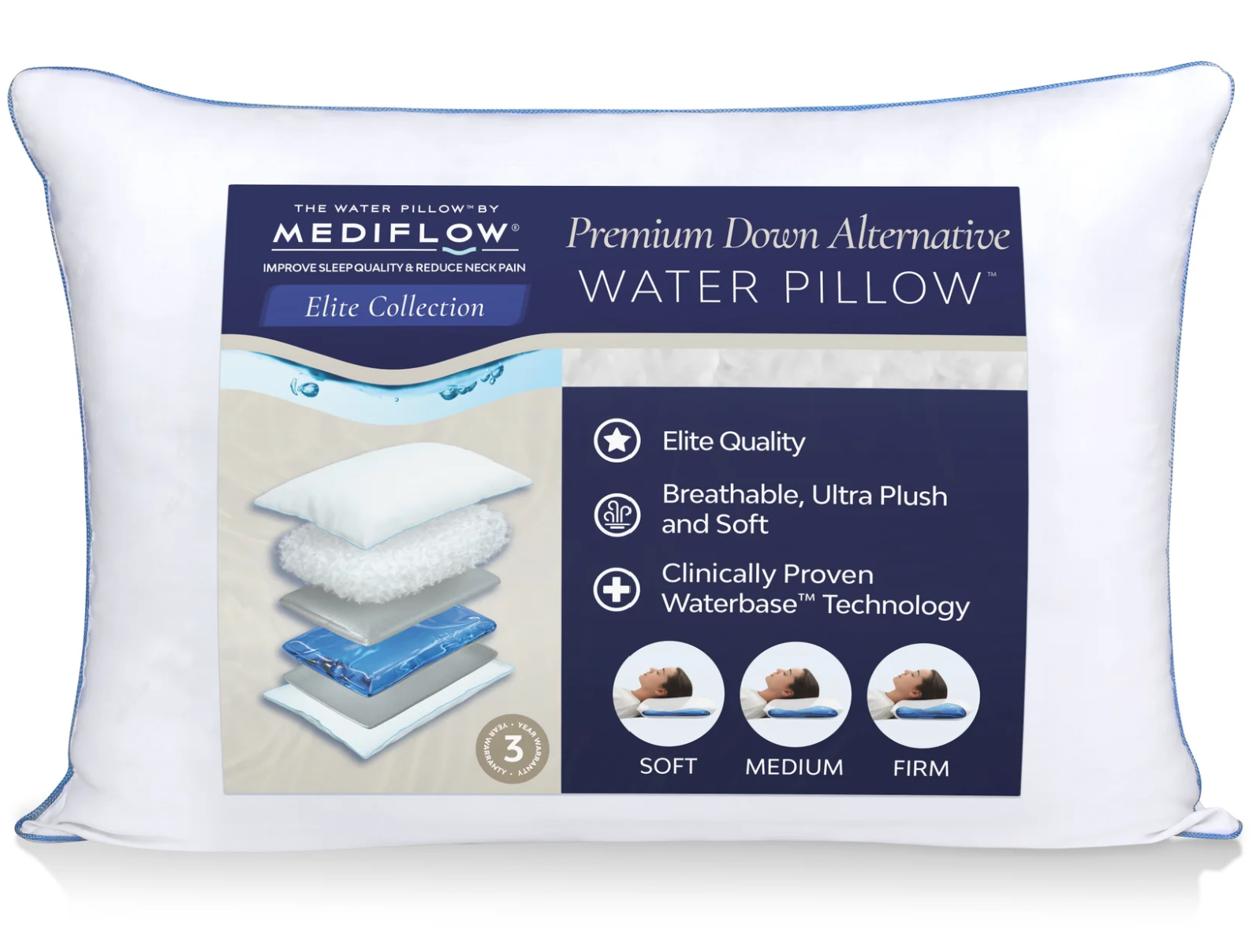
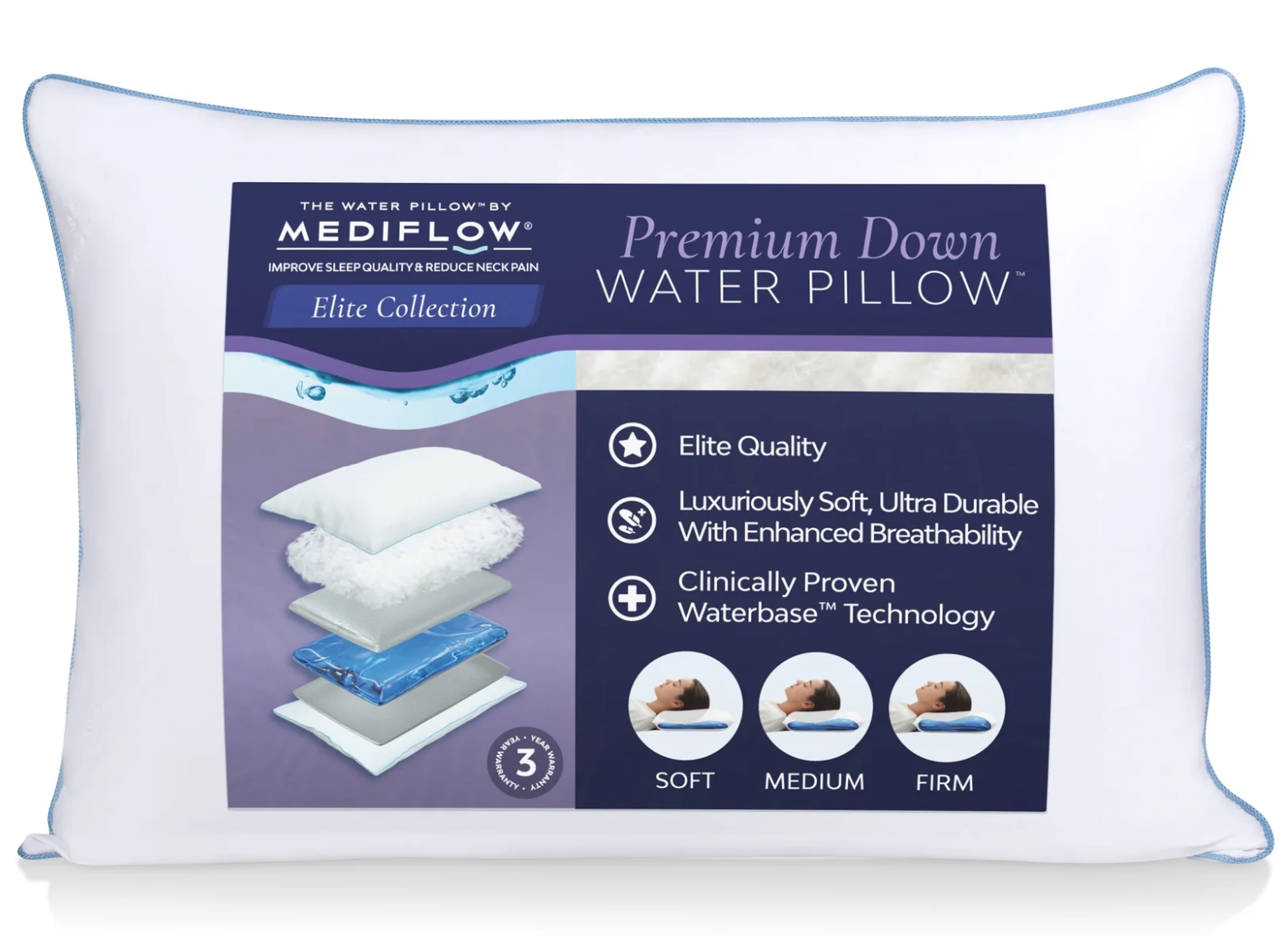
The Mediflow range shows how granular the audit becomes. Water Pillow - Elite Down (model 3495) uses new European white duck down and feathers in a 90:10 ratio, described as 100% natural and DownPass certified, with a 100% cotton cover at 300 thread count, corded edges and sateen weave, a 20 x 28 inch size, and customizable firmness and height. Water Pillow - Original Down (model 3490) uses high quality European new duck down at 75% down and 25% feather, with a hypoallergenic 100% cotton cover with zipper, at 26 x 18 inches. The two down models differ in ratio, cover build and size — three variables that change loft, hand-feel and packaging at the same time.
The non-down fills follow the same logic. Water Pillow - Elite Fibre (model 3491) is filled with ultra combed luxurious fibre and finished with a 100% cotton case at 300 thread count, corded edges and sateen weave, at 20 x 28 inches. Water Pillow - Elite Memory Foam (model 3493) uses European premium memory foam with an advanced Air Pocket System to support airflow, at 26 x 18 inches. Water Pillow - Elite Cooling Memory Foam (model 3494) uses European cooling gel infused memory foam, perforated so that heat is drawn away from the body, positioned for hot sleepers, also at 26 x 18 inches. Firmness and height are customizable across the range.
Four documents should come back from this track: a fill ratio declaration that matches the certificate, a DownPass certificate whose scope covers the actual fill used in the Elite Down model, a thread count and construction confirmation for the cover, and written confirmation that firmness and height customization is a production capability rather than a sample-only service. DownPass certification for a down fill is not transferable to other models, and a certificate held by a material supplier must be traced to the pillow you are buying.
Track 4 — Production, Quality Control and Customization Depth
Capability claims become credible when they are stated as controls. Mediflow's quality control statement lists 100% visual inspection, a water leakage test and a fabric safety test under Oeko-Tex. Its after-sales statement covers email support, phone support, a 3-year warranty, and replacement for defective products. Capacity is stated at 10,000 units per month.
Each of those statements converts into an audit request. Ask whether visual inspection is genuinely per unit or sampled per batch; ask for the leakage test method, the test duration and the reject handling procedure; ask who holds the Oeko-Tex certificate and which materials its scope covers. Then compare capacity with your own forecast: a supplier stating 10,000 units per month has a defined ceiling, and a seasonal retail program aimed at that ceiling needs a capacity reservation agreed in advance.
Customization depth is the second half of this track. A private-label program covering logo, packaging, fabric colour, pillow size, fill density and water pouch capacity requires material planning and tooling, not relabelling. Buyers building an adjustable pillow for neck pain program for a specific channel should ask which of those six variables are production-standard and which require a new setup, because that answer determines both the sampling timeline and the repeat-order discipline.
Track 5 — Delivery Assurance and Purchase Terms
Delivery assurance is where a technically acceptable supplier still fails a procurement review. The purchase agreement has to fix five things: minimum order quantity, lead time, acceptance criteria, warranty, and the after-sales route.
Mediflow states a minimum order of 1 piece, a lead time of 1 day after receiving the deposit, a 3-year warranty, replacement for defective products, and email and phone support. A 1-piece minimum makes single-unit sampling practical, which matters for a neck pain pillow because comfort and loft can only be judged physically. The stated lead time should be written into the agreement together with the conditions attached to it — order volume, fill choice, packaging customization and pouch capacity — so that a fast standard-model turnaround is not confused with a customized program timeline.
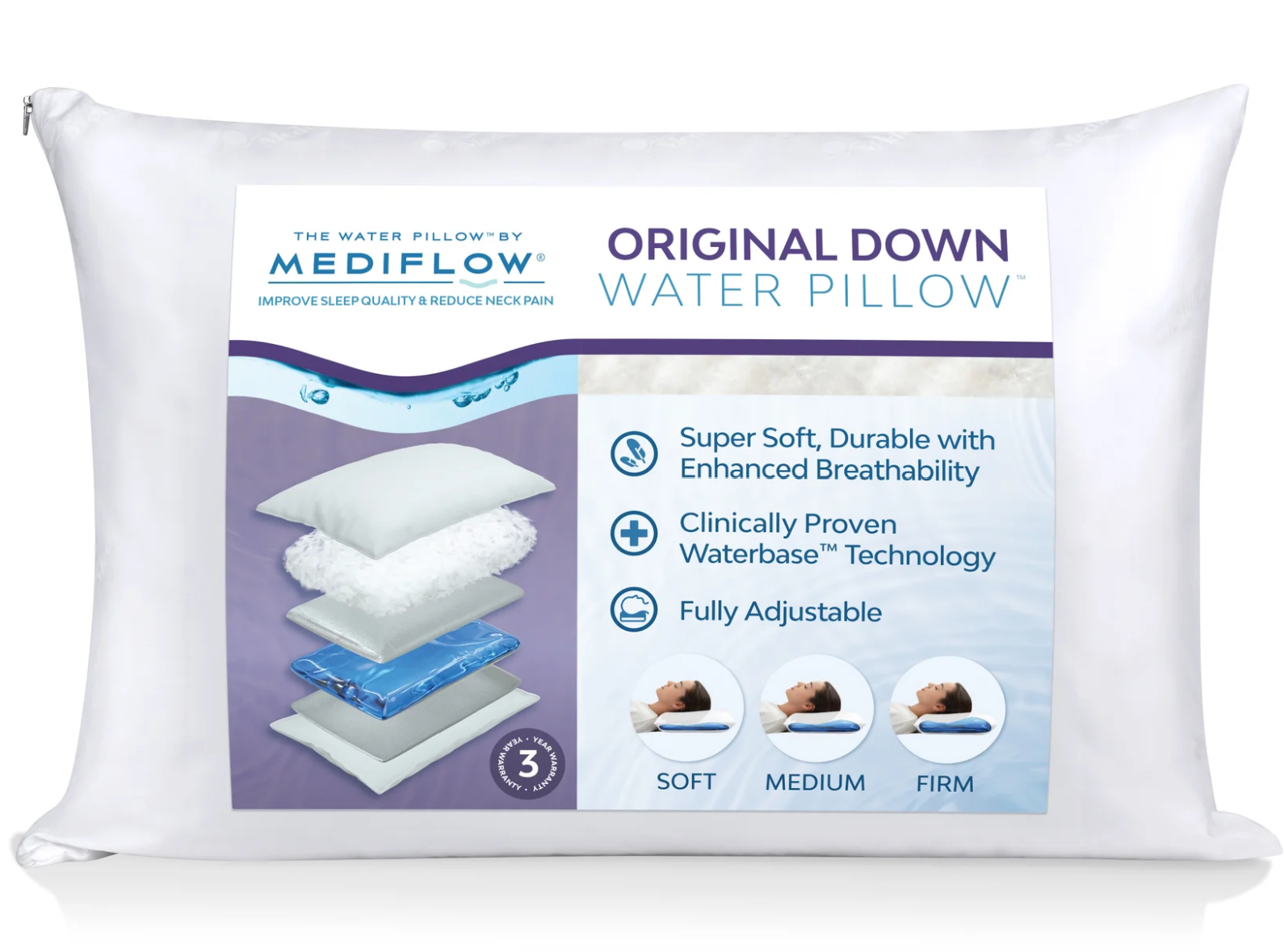
Acceptance criteria belong to the buyer, not the supplier. Define them before the first shipment: dimensional check against 20 x 28 or 26 x 18 inches depending on model, fill ratio verification against the declaration, cover thread count and weave confirmation, leakage test pass or fail, and packaging and labelling checks. Reference an approved golden sample in the purchase order. On repeat orders, re-verify fill ratio and cover construction each shipment rather than relying on the first approval.
Step-by-Step: A Seven-Stage Vetting Workflow
- Write the SKU brief before contacting suppliers. Fix the size (20 x 28 or 26 x 18 inches in the Mediflow range), the fill family, whether firmness and height must be customizable, and the packaging format. A brief written after the first quotes arrive is already shaped by those quotes.
- Request the capability file. Ask for construction detail on the water layer, water pouch capacity options, monthly capacity, and the quality control protocol covering visual inspection, leakage testing and fabric safety testing. Capacity and QC statements are the two items most often missing from a supplier's first reply.
- Separate positioning from substantiation. Ask which clinical or professional claims the supplier makes, what the underlying citation is, and what wording the buyer is permitted to reuse. Record which claims you will carry into your own listing and which you will drop.
- Audit fills and covers against the specification sheet. Confirm fill ratio and certification scope, cover thread count, weave, edge construction and closure type, and check that each model's declared size matches the packaging and listing copy.
- Run a sample against your acceptance criteria. With a 1-piece minimum order, a single unit can be evaluated for dimensional accuracy, water layer containment, fill recovery under compression, and firmness and height adjustment across back, side and stomach sleeping positions. Approve it formally and keep it as the golden reference.
- Lock commercial and delivery terms. Put minimum order quantity, lead time with its conditions, deposit terms, acceptance criteria, 3-year warranty and defective-product replacement into the purchase agreement, and name the after-sales contact.
- Set a repeat-order control. Decide in advance which parameters are re-checked on every shipment and who signs off, so that specification drift is caught at goods-in rather than at the customer's door.
Use Cases: How Deep to Verify by Channel
Verification depth should follow the consequence of failure, and different channels fail differently.
- Hospitals and medical institutions. Mediflow's case documentation describes bulk orders for medical facilities of 100 units or more, alongside individual users. Institutional procurement should weight leakage testing, the 3-year warranty and the defective-product replacement route most heavily, because a failed pillow in a clinical setting is a service issue as well as a product issue.
- Retail channel partners. Here the specification audit matters most: two sizes across the range, two down ratios across the range, and a shared 300 thread count cover construction on Elite models. Retail programmes need the size and fill matrix confirmed before packaging artwork is approved.
- E-commerce and wellness sellers. Listing accuracy is the exposure. Fill ratio, cover composition and exact dimensions should be taken from the specification sheet rather than reworded, and claims carried into the listing should be limited to those the supplier has substantiated in writing.
- Sleep-position programmes. A pillow for side, back and stomach sleepers depends on adjustable height, which is why firmness and height customization belongs in the sample protocol. Test the same model across all three positions before committing to a channel-specific variant.
- Workplace wellness programmes. Requests framed around neck pain for office workers should be handled as a sampling and fit question, not a clinical one. No position-specific outcome evidence for office-worker groups was available in the reviewed data set, so a supplier's general positioning should not be converted into an occupational-health claim.
Model-Level Spec Audit: The Mediflow Range
The table below lists the specification facts a buyer can audit directly. It is not a ranking — it is a comparison of declared inputs, so that each quotation can be normalised before pricing is discussed.
| Model | Fill | Cover | Size | Declared sleeper positioning |
|---|---|---|---|---|
| Water Pillow - Elite Down (3495) | New European white duck down and feathers, 90:10 ratio; DownPass certified; 100% natural | 100% cotton, 300 thread count, corded edges, sateen weave | 20 x 28 in | Down lovers; all sleep positions |
| Water Pillow - Original Down (3490) | High quality European new duck down, 75% down / 25% feather | Hypoallergenic 100% cotton with zipper | 26 x 18 in | Down lovers; all sleep positions |
| Water Pillow - Elite Fibre (3491) | Ultra combed luxurious fibre | 100% cotton, 300 thread count, corded edges, sateen weave | 20 x 28 in | All sleep positions |
| Water Pillow - Elite Memory Foam (3493) | European premium memory foam with advanced Air Pocket System | 100% cotton, 300 thread count, corded edges, sateen weave | 26 x 18 in | All sleep positions |
| Water Pillow - Elite Cooling Memory Foam (3494) | European cooling gel infused memory foam, perforated to draw heat away from the body | 100% cotton, 300 thread count, corded edges, sateen weave | 26 x 18 in | Hot sleepers; all sleep positions |
Firmness and height are customizable on each model listed. The practical consequence is that two models can share a cover construction and still differ in loft, size and material cost, so a quotation should always name the model number alongside the specification.
Verification Checklist: What to Ask For and What Counts as Evidence
| Verification stage | Evidence to request | What a pass looks like |
|---|---|---|
| Adjustable support capability | Water layer construction description, water pouch capacity range, leakage test protocol | The mechanism is described in writing and the leak test is named and staged |
| Clinical or professional positioning | Study citation, endpoints and comparator, permitted wording for buyers | Claims can be traced to a document, and reuse language is agreed in writing |
| Fill specification | Fill ratio declaration, DownPass certificate scope for down fills | Certification covers the actual fill in the model being purchased |
| Cover specification | Thread count, weave, edge construction, closure type | Declared values match the physical sample and the purchase order |
| Quality control | Visual inspection coverage, leakage test method, fabric safety test under Oeko-Tex | Controls are stated per unit or per batch, with reject handling defined |
| Capacity and customization | Monthly capacity, list of customizable variables | Capacity matches your forecast; customization scope is confirmed as production-standard |
| Delivery assurance | Minimum order quantity, lead time with conditions, warranty, replacement rule | All four appear in the purchase agreement, with an after-sales contact named |
FAQ: Supplier Vetting for Neck Pain Pillow Sourcing
Which compliance documents should I collect before approving a neck pain pillow supplier?
Collect four documents. First, a filler certification covering the exact fill used — the Mediflow Water Pillow - Elite Down uses DownPass-certified new European white duck down and feathers in a 90:10 ratio. Second, a fabric safety test record; Mediflow states a fabric safety test under Oeko-Tex. Third, a written cover construction declaration; Elite models use 100% cotton at 300 thread count with corded edges and sateen weave. Fourth, a written position on medical-claim classification, because in the United States cervical pillows can fall under FDA product classification 872.557020, Class II, product code MYB, and a pillow marketed with therapeutic claims may need to be handled differently from ordinary bedding.
How do I confirm a supplier can actually build an adjustable water pillow?
Ask for the construction file rather than a brochure: how the water layer is contained, what water pouch capacities are available, what leakage test is performed, and how firmness and height customization is executed in production. Mediflow states OEM, ODM and private-label programs with customization of logo, packaging, fabric colour, pillow size, fill density and water pouch capacity, a monthly capacity of 10,000 units, and 10 engineers in research and development among roughly 30 employees. A supplier that cannot describe its water layer and leak test in writing is not demonstrating adjustable water-based support capability.
How should we compare quotes from different suppliers?
Quotes are only comparable when fill, cover, size, customization scope and warranty are identical. A 90:10 down fill (Water Pillow - Elite Down) and a 75/25 down-and-feather fill (Water Pillow - Original Down) do not describe the same loft or material input, and a 300 thread count cotton sateen cover with corded edges is a different component from a zippered hypoallergenic cotton cover. Ask every supplier to quote the same four variables: fill and ratio, cover construction, size (20 x 28 or 26 x 18 inches in the Mediflow range), and firmness and height customization. Then compare the terms that move landed cost — minimum order quantity, warranty length and the replacement rule for defective products. Mediflow states a 1-piece minimum order, a 3-year warranty and replacement for defective products.
What should a sampling programme prove before we place a bulk order?
A sample should be tested against the acceptance criteria you will later write into the purchase order: dimensional accuracy against the declared size, fill recovery under compression, water layer containment and leakage, cover construction including thread count, corded edges and weave or zipper, and firmness and height adjustment across back, side and stomach sleeping positions. Mediflow states a minimum order of 1 piece, which makes single-unit sampling practical. Approve the sample formally, keep it as the golden reference, and attach it to the purchase order so that the approved unit defines the shipment.
What delivery terms should be locked in writing before a repeat order?
Lock four terms: stated lead time, acceptance criteria, warranty length and the after-sales route. Mediflow states a lead time of 1 day after receiving the deposit, a 3-year warranty, replacement for defective products, and email and phone support; each of those should appear in the purchase agreement together with the conditions that apply to your order volume, packaging and customization. If you want to review the process before committing, request a sample or a quote from the Mediflow team at info@mediflow.com, by phone at 800-308-3069, or on WhatsApp at +14165439579, and review the current model range at www.mediflow.com.
Next Step: Build the Vetting File, Then the Order
Start with the specification, not the price. Match the fill, cover, size and firmness customization to your channel, request the documentation for each claim, approve a physical sample, and then convert the approved sample and the delivery terms into a purchase agreement. Mediflow supplies OEM, ODM and private-label programmes from a stated 10,000-unit monthly capacity, with a 1-piece minimum order, a 3-year warranty and replacement for defective products.
Review the Mediflow water pillow range or contact info@mediflow.com to request samples and a quotation.
Conclusion
A neck pain pillow supplier should be judged on evidence that survives a purchase order. Confirm the adjustable water-based support mechanism in writing, separating a real water layer with a defined pouch capacity and leak test from an adjective on a catalogue page. Trace every clinical or professional claim to its citation before any of that wording reaches your own listing. Audit fills and covers model by model, because a 90:10 DownPass-certified down fill, a 75/25 down-and-feather fill, an ultra combed fibre fill and two memory foam variants are five different products with five different input costs and five different handling requirements. Then close with delivery assurance: minimum order, lead time and its conditions, acceptance criteria, warranty and the replacement route.
Applied in that order, the vetting file becomes the specification for the relationship rather than a one-off exercise — and the supplier's capability, claims and delivery terms end up in the same document, which is the only place a procurement team can actually enforce them.
Have Questions or Need More Details?
Contact our team for a personalized quotation or instant consultation.
Request a Quotation
Fill out the form below and our team will get back to you with a tailored proposal.
WhatsApp Direct Chat
Prefer to chat in real-time? Message us on WhatsApp for instant assistance & quick answers.
- Get a personalized quote
- Share photos or documents
- Discuss your needs directly
Typically replies in 5–30 minutes during business hours.