
OEM Neck Pain Pillow Projects: FAQ on Sizes, Fills, and Repeat Orders
An OEM neck pain pillow project succeeds or fails on four decisions: the size you commit to, the fill you specify, the cover construction you lock into the specification sheet, and the order terms that let the fifth purchase order match the first. Mediflow Inc. — a water-pillow manufacturer founded in 1994 that builds pillows on its Waterbase® water-layer platform — produces OEM, ODM, and private-label neck pain pillows in two sizes, 20 x 28 in and 26 x 18 in, with down, down alternative, fibre, memory foam, and cooling memory foam fills, and 100% cotton 300-thread-count covers on Elite models.
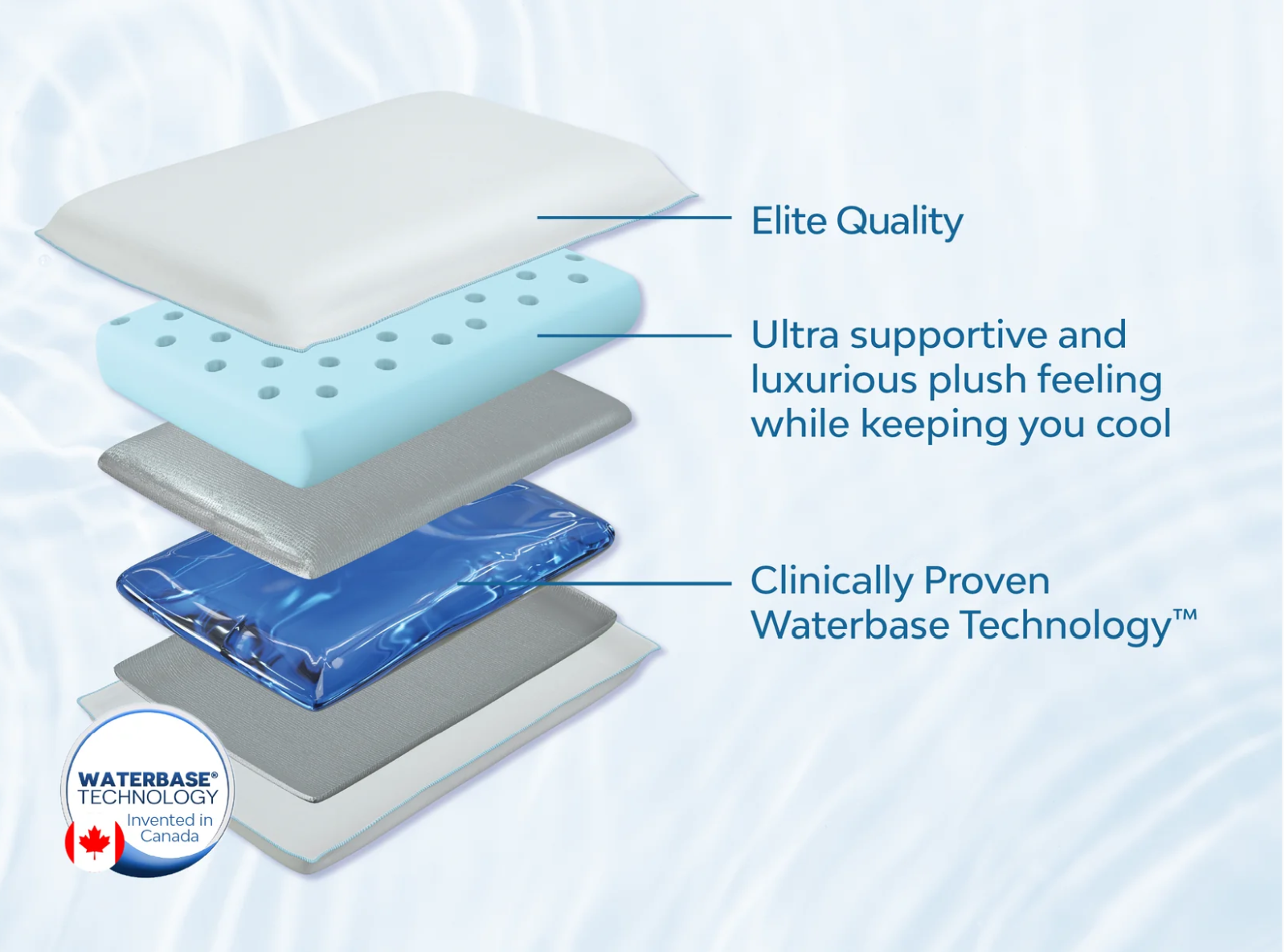
Waterbase® water-layer construction across the Original and Elite neck pain pillow ranges.
Problem Definition: Where OEM Neck Pain Pillow Programs Break Down
Most OEM neck pain pillow programs do not fail at the factory. They fail in the gap between a marketing brief and a technical specification. Four gaps account for most of the friction:
- Size chosen by preference rather than by channel. A 20 x 28 in pillow and a 26 x 18 in pillow behave differently in cartons, on shelf, in e-commerce shipping boxes, and in institutional laundry cycles. Choosing size late forces repackaging and re-quoting.
- Fill named by marketing term rather than construction. "Down feel" and "down fill" are different specifications with different certification obligations and different repeat-order risks.
- Cover specification dropped on reorder. Thread count, weave, corded edges, and zipper presence are the parameters that quietly change between production runs when they are not written down.
- Compliance language copied from a supplier website onto packaging. Therapeutic wording, medical-device positioning, and fiber-content claims are regulated separately from the physical product.
For a buyer in the Evaluation to Execution stage, the practical objective is a specification sheet that a factory can reproduce without interpretation — and a supplier who will confirm that sheet on every reorder.
Industry Background: How the Neck Pain Pillow Category Is Structured
The commercial category that OEM buyers are entering is measurable but methodologically uneven. Straits Research estimates the global cervical pillows market at USD 4.94 billion in 2025, with North America accounting for 42.73% of that value (Straits Research, 2025). Mordor Intelligence and Grand View Research publish different totals for overlapping periods, so a single figure should be treated as one estimate rather than a consensus number.
Two regulatory markers shape how a product is positioned once it leaves the factory:
- Customs classification. Cervical pillows are tracked under HS code 9404.90 (mattresses and bedding articles), which determines duty treatment and documentation in most export markets.
- Medical-device classification in the United States. Cervical pillows sit under FDA product code MYB, Class II. Class II status matters commercially: a product marketed with therapeutic claims is treated differently from a product marketed as ordinary bedding.
Demand is split across four buyer types that rarely share the same specification: healthcare and clinical channels, home textiles, retail, e-commerce, and wellness and sleep programs. Each channel applies different pressure to size, cover durability, and packaging.
Detailed Solution: What the Mediflow OEM Platform Actually Covers
Mediflow Inc. is a water-pillow manufacturer established in 1994, with 30 employees, a 10-engineer development team, and 100% of output exported to North America (United States, Canada), the EU, and the UK. The company builds the Waterbase® pillow, in which a water layer sits beneath a fiber, down, or foam comfort layer.
Production models and customization scope
The manufacturer provides OEM, ODM, and Private Label production services. Customization options cover logo, packaging, fabric color, pillow size, fill density, and water pouch capacity. That list matters because it separates a genuine OEM program from a catalogue resale: size and fill density are product-level variables, while water pouch capacity is the functional lever that changes how firm the pillow feels to the end user without changing the outer dimensions.
Operational parameters buyers should record
- Monthly capacity: 10,000 units / month
- Minimum order quantity: 1 piece
- Lead time: 1 day after receiving deposit (confirm against project volume and fill type)
- Quality control: 100% visual inspection, water leakage test, and fabric safety test (Oeko-Tex)
- After-sales: email support, phone support, 3-year warranty, and replacement of defective products
Size decisions: 20 x 28 in versus 26 x 18 in
Size availability is model-linked, not universal. In the current range, the 20 x 28 in format covers Original Fibre, Original Memory Foam, Elite Fibre, Elite Down Alternative, and Elite Down. The 26 x 18 in format covers Original Down, Original Down Alternative, Original Cooling Memory Foam, Elite Memory Foam, and Elite Cooling Memory Foam.
For a project brief, the practical split is this: the 20 x 28 in format aligns with a full-size domestic pillow footprint and suits retail shelf programs and home-textile assortments, while the 26 x 18 in format is a more compact build that suits e-commerce shipping economics, hospitality replenishment, and space-constrained retail. Where a program needs a fill that exists in only one size, size becomes a constraint rather than a free variable — confirm the pairing before the packaging artwork is approved.
Fill decisions: down, down alternative, fibre, memory foam, cooling memory foam
Elite Down uses natural white duck down (90%) and feather (10%) in a 20 x 28 in build, and is DownPass certified. Original Down uses high-quality European new duck down at a 75% down / 25% feather ratio in a 26 x 18 in build. The distinction is not cosmetic: certification scope and down-to-feather ratio are exactly the parameters auditors and retail compliance teams ask a supplier to document.
Elite Down Alternative uses a premium hotel-grade hypoallergenic down alternative described as breathable and soft, mimicking the feel of natural down, at 20 x 28 in. For buyers targeting allergy-sensitive customers or markets where natural down documentation is burdensome, this is the fill that keeps the down-like hand feel without the down supply chain.
Fibre covers two positions: Elite Fibre (ultra-combed luxurious fibre, 20 x 28 in) and Original Fibre (soft, resilient fibre, 28 x 20 in). Fibre is typically the entry position in a range and the easiest fill to re-specify consistently across runs.
Elite Memory Foam uses European perforated memory foam with an Air Pocket System designed to enhance airflow, at 26 x 18 in. Elite Cooling Memory Foam uses European cooling gel-infused memory foam, perforated to draw heat away from the body, at 26 x 18 in. Original Cooling Memory Foam uses ventilated cooling gel-infused memory foam, also at 26 x 18 in. Both cooling options target the warm-sleeper segment, which is a meaningful positioning angle for e-commerce listings.
Cover decisions: 300TC cotton sateen versus cotton and polycotton
All Elite models share one cover specification: 100% cotton, 300 thread count, corded edges, sateen weave. Original models split three ways — hypoallergenic 100% cotton on Original Fibre and Original Memory Foam, hypoallergenic 100% cotton with zipper on Original Down, and polycotton with zipper on Original Down Alternative and Original Cooling Memory Foam.
The zipper detail is a functional decision, not a trim decision. A zippered cover gives the end user access to the water pouch and the fill layer, which supports the adjustable-support proposition and simplifies after-sales handling. A non-zippered cover produces a cleaner silhouette and a lower assembly cost. Whichever you choose, write it into the specification sheet with thread count, weave, and edge finish, because those three attributes are the most common source of reorder drift.
Step-by-Step Breakdown: Running an OEM Neck Pain Pillow Project
- Fix the size against the channel, not the sample. Decide 20 x 28 in or 26 x 18 in by carton dimensions, shelf or listing format, and shipping cost. Then verify the chosen fill exists in that size.
- Select the fill family by end-user segment. Down for premium natural positioning, down alternative for hypoallergenic down-feel positioning, fibre for entry price architecture, memory foam for contouring support, cooling memory foam for warm sleepers.
- Lock the cover specification in writing. Record thread count, weave, edge finish, and zipper presence per model. Elite covers are 100% cotton 300TC with corded edges and sateen weave.
- Define the brand customization set. Logo, packaging, fabric color, pillow size, fill density, and water pouch capacity are all configurable — agree which of these are brand-differentiating and which are fixed.
- Set the water pouch capacity and fill density targets. These two parameters determine perceived firmness and are the specification items most likely to drift between runs if left as verbal guidance.
- Approve the quality protocol. Confirm in writing that production includes 100% visual inspection, water leakage testing, and fabric safety testing to Oeko-Tex.
- Agree commercial terms and calendar. Minimum order quantity is 1 piece, stated lead time is 1 day after deposit, and monthly capacity is 10,000 units — map your launch and reorder cadence against the capacity figure, not against the lead time alone.
- Publish a repeat-order specification sheet. One page, per model: size, fill and ratio, cover and thread count, water pouch capacity, fill density, packaging artwork version, and QC checks. This document is what makes the fifth order identical to the first.
- Define the after-sales commitment. The manufacturer provides email and phone support, a 3-year warranty, and replacement of defective products — align your own retail warranty text with that coverage before publishing.
Use Cases: Where These OEM Programs Are Deployed
Mediflow's supply relationships documented across the United States, Canada, Germany, and the United Kingdom span end consumers, hospitals and medical institutions, physical therapists and chiropractors, and retail channel partners. Individual users typically buy one unit; medical facilities place bulk orders of 100 units or more. The manufacturer cites a 5–10 year durability window for the water-based core system.
- Healthcare and clinical channels. Hospitals, clinics, and physical therapists need a repeatable specification, a documented QC protocol, and replacement handling. The 26 x 18 in Original Down and Original Cooling Memory Foam formats suit institutional ordering where storage space is limited.
- Home textiles. Assortment buyers pair a full-size 20 x 28 in pillow with existing bedding dimensions and match cover color to the range — which is why fabric color appears in the customization list.
- Retail. Shelf programs depend on packaging and carton consistency. The 20 x 28 in format aligns with conventional pillow merchandising; a private-label logo and packaging design carry the brand.
- E-commerce. Compact 26 x 18 in models reduce dimensional shipping weight, and the cooling fills give listings a distinct, verifiable feature set for warm sleepers.
- Wellness and sleep programs. Sleep-improvement programs and chiropractor-referred channels need adjustable support across all sleeping positions — back, side, and stomach sleepers — which is where adjustable water pouch capacity does commercial work that a fixed-foam pillow cannot.
Comparison Table: Mediflow OEM Neck Pain Pillow Configurations
| Model | Size | Fill | Cover | Stated sleeper type |
|---|---|---|---|---|
| Original Fibre | 28 x 20 in | Fibre | Hypoallergenic 100% cotton | All sleep positions |
| Original Memory Foam | 28 x 20 in | Memory foam | Hypoallergenic 100% cotton | All sleep positions |
| Original Down | 26 x 18 in | European new duck down, 75% down / 25% feather | Hypoallergenic 100% cotton with zipper | Down lovers; all sleep positions |
| Original Down Alternative | 26 x 18 in | Down alternative | Polycotton with zipper | Down lovers; all sleep positions |
| Original Cooling Memory Foam | 26 x 18 in | Ventilated cooling gel-infused memory foam | Polycotton with zipper | Warm sleepers; all sleep positions |
| Elite Fibre | 20 x 28 in | Ultra-combed luxurious fibre | 100% cotton, 300TC, corded edges, sateen weave | All sleep positions |
| Elite Down Alternative | 20 x 28 in | Premium hotel-grade hypoallergenic down alternative | 100% cotton, 300TC, corded edges, sateen weave | Down lovers; all sleep positions |
| Elite Down | 20 x 28 in | Natural white duck down 90% / feather 10%, DownPass certified | 100% cotton, 300TC, corded edges, sateen weave | Down lovers; all sleep positions |
| Elite Memory Foam | 26 x 18 in | European perforated memory foam with Air Pocket System | 100% cotton, 300TC, corded edges, sateen weave | All sleep positions |
| Elite Cooling Memory Foam | 26 x 18 in | European cooling gel-infused, perforated memory foam | 100% cotton, 300TC, corded edges, sateen weave | Hot sleepers; all sleep positions |
All ten models share Waterbase® Technology as the support layer, with customizable firmness and height. The differentiator inside the range is fill and cover, not the support mechanism.
Frequently Asked Questions
What compliance points should an OEM neck pain pillow buyer confirm before ordering?
Three items. First, product classification: in the United States, cervical pillows fall under FDA product code MYB, Class II, so the therapeutic language on your packaging determines how the product is treated. Second, material documentation: Mediflow runs a 100% visual inspection, a water leakage test, and a fabric safety test to Oeko-Tex, and the Elite Down fill is DownPass certified. Third, claim substantiation: Mediflow attributes its neck pain positioning to a clinical study conducted at Johns Hopkins School of Medicine, and a buyer planning to repeat that claim in their own market should request the underlying publication and confirm local requirements before printing it.
What can be customized in an OEM neck pain pillow program, and at what capacity?
Mediflow provides OEM, ODM, and Private Label production services. Customization options cover logo, packaging, fabric color, pillow size, fill density, and water pouch capacity. Monthly capacity is 10,000 units per month, supported by a 30-person organisation with 10 engineers, and output is 100% export-oriented across the United States, Canada, the EU, and the UK. Size customization is bounded by the fill: the 20 x 28 in format covers Original Fibre, Original Memory Foam, Elite Fibre, Elite Down Alternative, and Elite Down, while the 26 x 18 in format covers Original Down, Original Down Alternative, Original Cooling Memory Foam, Elite Memory Foam, and Elite Cooling Memory Foam.
What is the minimum order quantity, and what drives cost differences between configurations?
The minimum order quantity is 1 piece, which allows a project to start from a single validation unit rather than a container commitment. Cost differences inside the range track three specification choices rather than the water-layer platform itself: fill family (natural down such as the 90/10 Elite Down versus fibre or down alternative), cover construction (100% cotton 300-thread-count sateen with corded edges on Elite models versus hypoallergenic cotton or polycotton with zipper on Original models), and the level of brand customization applied to logo, packaging, and fabric color. Project pricing is quoted against the confirmed specification sheet rather than a published list.
How should a buyer validate a sample before committing to a repeat-order program?
Validate against the specification sheet, not against general impressions. Check the size against the drawings (20 x 28 in or 26 x 18 in), confirm the fill and, for down, the down-to-feather ratio, verify the cover thread count, weave, edge finish, and whether a zipper is present, then test the water pouch capacity and fill density at the firmness level you intend to sell. On the physical side, confirm leakage performance and fabric safety documentation. Because the same specification has to survive reorder cycles, record what you approved — the sample is only useful if it becomes a written reference.
What lead time and after-sales coverage apply to repeat orders?
Mediflow states a lead time of 1 day after receiving deposit, against a monthly capacity of 10,000 units per month — so a repeat-order calendar should be planned around the capacity ceiling rather than the lead-time figure alone. After-sales coverage includes email support, phone support, a 3-year warranty, and replacement of defective products, which is the coverage your own retail or clinical terms should be checked against. To start a project, request a sample or a specification-based quote from the Mediflow team at www.mediflow.com, by email at info@mediflow.com, or by phone at 800-308-3069.
Conclusion
An OEM neck pain pillow program is a specification problem before it is a sourcing problem. Decide the size first — 20 x 28 in for full-size retail and home-textile assortments, 26 x 18 in for compact, e-commerce, and institutional formats — then match it to the fill that supports your positioning: 90/10 DownPass-certified Elite Down, 75/25 Original Down, hotel-grade Elite Down Alternative, fibre, perforated Elite Memory Foam, or cooling gel-infused memory foam. Then fix the cover in writing, because 300-thread-count cotton sateen with corded edges and a hypoallergenic cotton or polycotton cover with zipper are different products at different price points.
Mediflow Inc. supports that sequence with OEM, ODM, and Private Label production, customization across logo, packaging, fabric color, pillow size, fill density, and water pouch capacity, a minimum order quantity of 1 piece, 10,000 units per month of capacity, and a QC protocol built on 100% visual inspection, water leakage testing, and Oeko-Tex fabric safety testing. For buyers moving from evaluation into execution, the next step is a sample and a written specification — that combination is what makes repeat orders repeatable.
Have Questions or Need More Details?
Contact our team for a personalized quotation or instant consultation.
Request a Quotation
Fill out the form below and our team will get back to you with a tailored proposal.
WhatsApp Direct Chat
Prefer to chat in real-time? Message us on WhatsApp for instant assistance & quick answers.
- Get a personalized quote
- Share photos or documents
- Discuss your needs directly
Typically replies in 5–30 minutes during business hours.