
Compliance Guide for Garment Accessories: Eco-Materials and Industry Standards
Shirt packaging accessories — collar bands, collar stays, butterflies, pins, clips, cardboard and poly bags — ship inside the garment, not beside it. That single fact shapes how compliance work is structured. A retail audit or an importer's incoming inspection does not review the shirt separately from the collar band holding its shape, so the accessories carry a documentation burden comparable to the garment itself.
This guide is written for buyers in the evaluation stage: brand owners, garment manufacturers, importers and distributors who need to confirm that a shirt packaging accessory order will clear their compliance process before it is placed. It covers the materials that dominate the category — PS, PVC, PET, PE/PP film, metal and wood-pulp paper — how each fits into a compliance portfolio, which items default to no printed logo, and how a manufacturer's certificate scope should be matched against an actual SKU list rather than a catalogue headline.
The manufacturer referenced throughout is Wuxi Mingyu Garment Accessories Factory, a shirt packaging accessories producer based in E'hu Town, Xishan District, Wuxi, Jiangsu, China. Founded in 2004, the factory supplies collar bands, collar stays, collar butterflies, cardboard, moisture-proof paper, plastic clips and packaging bags to brand owners, garment manufacturers, distributors and exporters, with 85% of output exported to Europe, North America, South America and Asia.

Shirt packaging accessories are produced as a coordinated set of collar structure, closure and presentation components.
Where the Compliance Gap Actually Starts
The most common compliance failure in this category is not a missing certificate. It is a certificate that does not match the goods on the pallet.
Three versions of that problem recur in buyer audits and quality disputes:
- Material mismatch. A purchase order specifies a PET collar band, the shipment arrives as PVC, and the certificate scope — which names specific polymers and film types — no longer applies to what was delivered.
- Undocumented logo state. A buyer assumes every component is unprinted, then receives a batch of foiled butterflies or laser-engraved collar stays that were never recorded on the specification sheet.
- Scope overreach. A certificate is cited for a full catalogue when its written scope covers only a subset of products, film types or finishes.
Practical rule: compliance is confirmed at the material-and-SKU level, not at the supplier level. The question to answer is not "does this factory hold a certificate" but "does the certificate's scope description cover the exact material, film type and finish of the SKUs being shipped."
Industry Background: Why Accessory Compliance Is Getting More Scrutiny
Garment packaging has grown into a substantial, audited category in its own right rather than a disposable line item in a garment's cost sheet. The global garment packaging market was valued at USD 18.6 billion in 2025 and is projected to reach USD 31.4 billion by 2034, according to the Garment Packaging Market Research Report 2034 published by Dataintelo. Asia Pacific held a 41.5% revenue share of that market in 2025, which concentrates both production capacity and regulatory attention in the same region.
The structural side of the category is also significant. The garment interlining market — the material family behind shirt collar structure — reached USD 3.65 billion in 2025, according to Garment Interlining Market Size Forecast Report 2026–2030 published by The Business Research Company. For buyers, the implication is straightforward: the components that hold a collar in shape and present a shirt at retail are now procured, priced and audited as a defined category with its own material specifications.
Alongside market growth, eco-material expectations have moved from a differentiator into a standard line item on procurement questionnaires. Buyers increasingly ask which polymers, films and papers are used, whether they sit in recognised recycling streams, and whether the supplier can evidence those claims against a written scope. That shift is what makes a material-by-material compliance reading necessary rather than optional.
How PS, PVC, PET, Metal and Paper Fit Into a Compliance Portfolio
Each material family in shirt packaging accessories carries a different compliance profile, and the portfolio approach — matching each component to the right material and the right documentation — is more workable than trying to make one material cover every function.
PS (Polystyrene)
Polystyrene appears in the closure end of the accessory set, most commonly in plastic clips. In Wuxi Mingyu's range, clips are produced in PS or metal at 3.3 cm / 3.7 cm × 0.8 cm × 1.2 mm, 1.2 mm thickness, in a silver X-shape, with a customisable logo and an MOQ of 100,000 pcs. PS is a rigid polymer chosen for dimensional stability in a small, load-bearing part. From a compliance standpoint, PS components should be verified as an independent line item — a certificate that names PET and PE film does not automatically describe a polystyrene clip.
PVC
PVC is the workhorse material for collar presentation components in this range. It appears in:
- Plastic collar bands — 50 × 3.4 cm, 0.50 mm thickness
- Plastic butterflies — light blue fine-sand PVC, 26 × 10.4 cm, 0.25 mm
- Plastic collar stays — white PVC, 6.35 cm × 1 cm × 0.75 mm, customisable logo
- Collar supports — light blue PVC, 22.7 × 18.5 cm, 0.35 mm, no logo
PVC components offer predictable stiffness and a clean retail finish. The compliance task with PVC is precision: because the category contains multiple polymers with different recycling profiles, buyers should confirm the polymer named on the specification against the polymer named in any supporting documentation, component by component.
PET (Polyethylene Terephthalate)
PET is where eco-material positioning and compliance portfolios most often intersect. White PET plastic collar bands in this range are produced at 48.1 × 4 cm × 0.35 mm, in white PET, rectangle style, with no logo and an MOQ of 10,000 pcs. PET is one of the most widely collected plastics in municipal and industrial recycling streams, which is why it appears frequently in buyers' eco-material specifications. The relevant compliance point is documentation alignment: PET film is explicitly named within the scope of Wuxi Mingyu's OEKO-TEX STANDARD 100 certificate SH001 275178, issued by TESTEX, which covers plastic accessories made of PET and PE film — including collar bands, butterflies, collar stays and poly bags — that are transparent and partly mechanically coined. The certificate is assessed against OEKO-TEX STANDARD 100 and EN ISO 17050-1, and runs from 12 January 2026 to 15 January 2027.
PE / PP Film
Poly bags close out the packaging set. Wuxi Mingyu produces transparent plastic bags at 35 × 26 cm with a single-side thickness of 0.035 mm, rectangle style, no logo, MOQ 10,000 pcs. PE film, like PET, sits inside the named scope of certificate SH001 275178. Bags are frequently overlooked in compliance reviews because they are treated as secondary packaging, yet they are the accessory most likely to be handled directly by a consumer after purchase — which is precisely why they belong on the verified material list.
Metals (Stainless Steel and Brass)
Metal components serve the two ends of the packing process: holding the folded shirt and reinforcing the collar.
- Metal pins — stainless steel or brass, common size 26 × 0.6 mm, thickness 0.6 mm or 0.65 mm, silver, rectangle style, logo: none, MOQ 10,000 pcs.
- Metal collar stays — stainless steel in four common sizes: 55.9 × 9 × 0.8 mm, 63.5 × 9 × 0.8 mm, 69.9 × 9 × 0.8 mm and 76.2 × 9 × 0.8 mm, common thickness 0.8 mm, available in silver, blue, black, gold and rose gold, with customised laser-engraved logos, MOQ 1,000 pcs.
Metals sit in mature recycling streams, but they cannot be assessed under a polymer certificate scope. Metal parts need their own material verification — alloy grade, finish and, where applicable, coating — documented separately from the plastic and paper items in the same order.
Paper and Wood Pulp
Paper is the largest single material family in the accessory set and the most directly aligned with recyclable-material positioning. The range includes:
- Cardboard — 100% natural wood pulp paper, 21 × 35.2 cm, 500 gsm, white, customisable logo
- Paper butterflies — 400 g single white paper, 15 × 3 cm
- Paper collar bands — specialty tenacity paper with 15 holes, 47.2 × 3.8 cm, 1 mm, no logo
- Belly bands — paper, 58 × 10 cm, 0.25 mm, colourful, customisable logo
- Tissue paper — 36 × 40 cm, 17 gsm, white, customisable logo
- Hang tags — 100% natural wood-pulp paper, 4 × 7 cm, 500 gsm, black, customisable logo
- Gift boxes — paper cardboard wrapped with 120–150 g art paper, 22 × 35 cm, 2–3 mm
Wood-pulp paper is a well-established recycling stream, but printed, foiled or coated paper behaves differently from unprinted stock. Buyers specifying eco-material paper components should state the printing and coating requirements at the same time as the substrate, because the finishing step changes the recyclability profile.
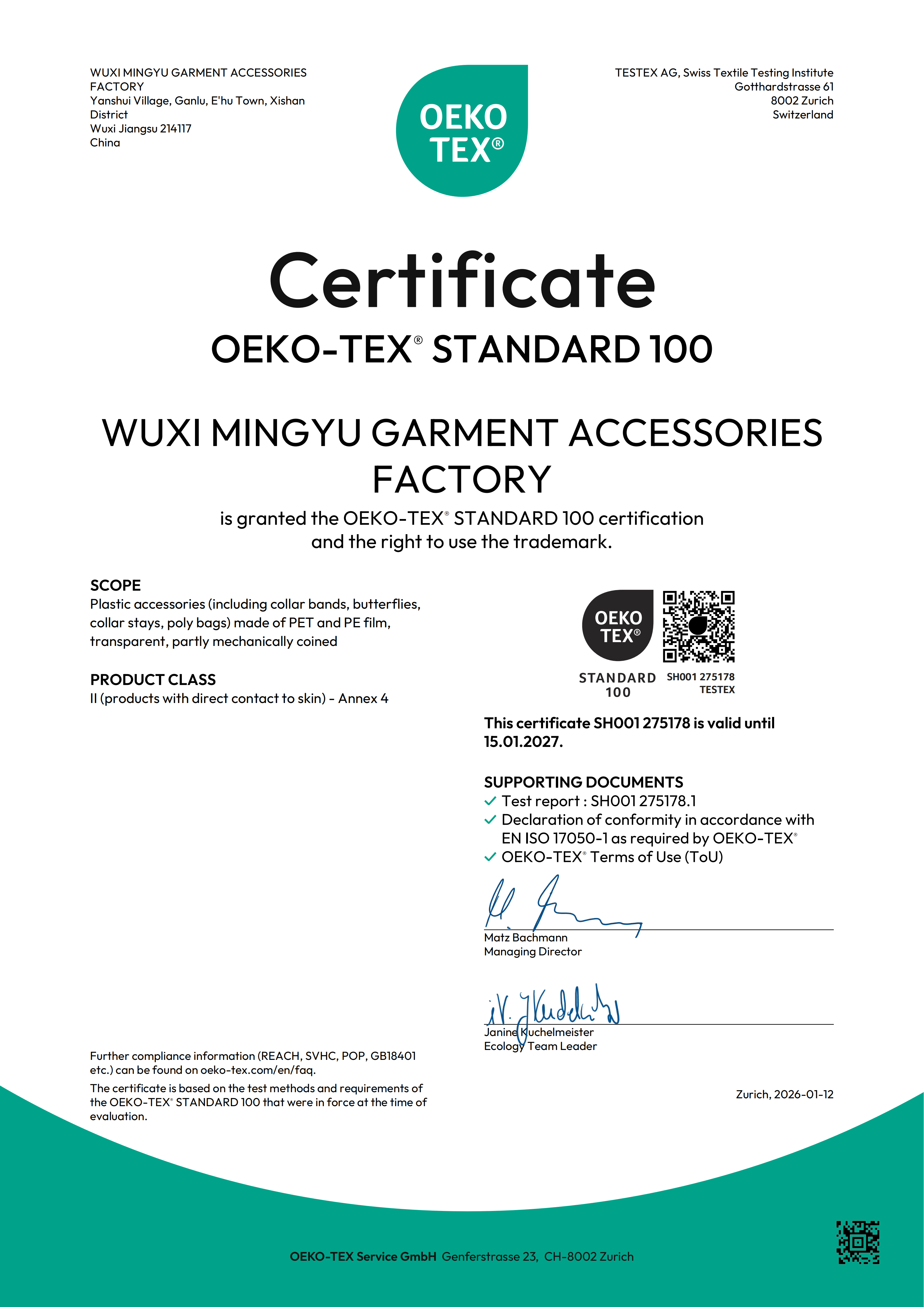
Certificate SH001 275178, issued by TESTEX, names the film types and product groups within its scope — the wording buyers should read line by line against their bill of materials.
Default Logo States: The Detail That Quietly Breaks Compliance Files
Several components in this category ship with no printed or applied logo by default, and that default is itself a compliance-relevant fact. An unprinted accessory removes ink, foil and adhesive from the material discussion entirely; a printed accessory introduces them.
Components that default to no logo:
- Metal pins — logo: none
- White PET plastic collar bands (48.1 × 4 cm × 0.35 mm) — logo: none
- Paper collar bands (47.2 × 3.8 cm, 1 mm) — logo: none
- Collar supports (22.7 × 18.5 cm, 0.35 mm) — logo: none
- Plastic bags (35 × 26 cm, 0.035 mm) — logo: none
Components that accept customised logos: plastic butterflies, paper butterflies, PVC collar stays, metal collar stays (laser-engraved), plastic clips, cardboard, belly bands, tissue paper, hang tags and gift boxes. The factory's OEM/ODM capability covers size, colour, style, printing or foiling, mould opening and logo stamping or printing.
For a buyer building a compliance file, the efficient practice is to record the default logo state of every line item on the purchase order. A specification sheet that states "no logo" for pins, PET collar bands, paper collar bands, collar supports and bags prevents an unplanned branding step from appearing in a shipment and, with it, an unplanned material question.
Step-by-Step: Building a Compliance-Ready Accessory Order
The sequence below reflects how accessory compliance is verified in practice, from material list to locked purchase order.
- Map every SKU to its material. List each component with its polymer, metal alloy or paper grade. Collar band = PVC or PET; collar stay = PVC or stainless steel; butterfly = PVC or 400 g paper; clip = PS or metal; bag = PE film; cardboard, belly band, tissue and tags = wood-pulp paper.
- Pull the certificate scope and read the wording literally. Certificate SH001 275178 covers plastic accessories made of PET and PE film, transparent and partly mechanically coined, including collar bands, butterflies, collar stays and poly bags. Compare that sentence against your SKU list.
- Separate the non-covered items. PVC components, PS clips, metal pins and stays, and all paper items are not described by a PET/PE film scope. Document their material specification independently.
- Record the default logo state per line item and confirm in writing which items will carry printing, foiling, stamping or laser engraving.
- Confirm the recyclable-material claim against the substrate and the finish. Unprinted wood-pulp paper, PET and PE film are the components most straightforwardly placed in recognised recycling streams.
- Validate on a physical sample, not a catalogue image. Check material, thickness and dimensions against the specification before the order is locked.
- Note the certificate validity window and re-check annually. SH001 275178 runs to 15 January 2027; renewal status should be confirmed before orders extend past that date.
Use Cases: Who Applies This Framework and Why
The compliance-first approach is driven by three buyer profiles, and each one stresses a different part of the portfolio.
Brand owners finishing their own labelled shirts
Brand owners carry the retail-facing risk. Their priority is the presentation layer — butterflies, cardboard, tissue and hang tags — where printed branding is most likely and where the recyclable-material story is most visible to a consumer. For this group, the decisive step is separating printed from unprinted paper components in the specification.
Garment manufacturers packing for export
Export manufacturers face incoming inspection at the destination. Their priority is material consistency: that the PET collar band ordered is the PET collar band shipped, at the specified 48.1 × 4 cm and 0.35 mm, and that documentation matches. Collar structure components — stays, supports and bands — matter most here, because a material substitution in a stiffening component is easy to miss and hard to defend.
Distributors and importers serving multiple markets
Distributors hold stock across markets with differing expectations. Their priority is portfolio flexibility: being able to offer a PET or paper version of a component where a market asks for recyclable material, and a PVC or metal version where stiffness or finish is the deciding factor. A supplier that can supply both routes from one production base removes an entire re-sourcing cycle.
Wuxi Mingyu's own case record reflects this profile. The factory serves brand owners, garment manufacturers, distributors and exporters globally, across multiple regions, and has maintained a five-year cooperation with clients with no major recorded mistakes. The supporting factors cited for that record are long industry experience, a global sales network and automated production equipment.

Automated creasing, punching and die-cutting equipment supports consistent thickness and dimensions across cardboard and collar stay components.
Comparison Table: Material-to-Compliance Mapping
The table below maps each material family to its representative products, default logo state, general recycling position and the specific compliance question it raises. It is intended as a working checklist, not a substitute for the certificate scope wording itself.
| Material | Representative product | Default logo state | General recycling position | Compliance question to resolve |
|---|---|---|---|---|
| PET film | Plastic collar band, 48.1 × 4 cm × 0.35 mm, white PET | None | Widely collected plastic stream | Named in certificate scope for PET and PE film plastics |
| PE / PP film | Plastic bag, 35 × 26 cm, 0.035 mm, transparent | None | Widely collected plastic stream | Named in certificate scope for PET and PE film plastics |
| PVC | Collar band 50 × 3.4 cm × 0.50 mm; butterfly 26 × 10.4 cm × 0.25 mm; collar stay 6.35 cm × 1 cm × 0.75 mm; collar support 22.7 × 18.5 cm × 0.35 mm | Mixed — butterflies and collar stays customisable; collar supports none | Recycling infrastructure more limited | Not described by a PET/PE film scope; verify separately |
| PS | Plastic clip, 3.3–3.7 cm × 0.8 cm × 1.2 mm, X-shape | Customisable | Depends on local infrastructure | Rigid polymer; verify per SKU outside film-based scopes |
| Stainless steel / brass | Metal pin 26 × 0.6 mm; metal collar stay 55.9–76.2 mm × 9 mm × 0.8 mm | Pin: none; stay: customisable laser engraving | Mature metal recycling streams | Metal parts need separate alloy and finish verification |
| Wood-pulp paper | Cardboard 21 × 35.2 cm, 500 gsm; paper butterfly 15 × 3 cm; paper collar band 47.2 × 3.8 cm; belly band 58 × 10 cm; tissue 36 × 40 cm; hang tag 4 × 7 cm; gift box 22 × 35 cm | Mostly customisable; paper collar band none | Well-established paper stream | Printing, foiling and coating change the recyclability profile |

In-house quality control runs across each production stage to hold material and dimensional consistency.
Frequently Asked Questions
What compliance documentation should be requested for shirt packaging accessories?
The document set has to match the materials that will actually ship. For plastic film accessories, a commonly referenced benchmark is OEKO-TEX STANDARD 100. Wuxi Mingyu Garment Accessories Factory holds OEKO-TEX STANDARD 100 certification SH001 275178, issued by TESTEX, covering plastic accessories made of PET and PE film — including collar bands, butterflies, collar stays and poly bags — that are transparent and partly mechanically coined. The certificate is assessed against OEKO-TEX STANDARD 100 and EN ISO 17050-1, is valid for all markets worldwide, and runs from 12 January 2026 to 15 January 2027.
Can the accessories be customised with our own logo, and what is the minimum order quantity?
Customisation depends on the component. Collar butterflies, PVC and metal collar stays, plastic clips, cardboard, belly bands, tissue paper, hang tags and gift boxes all accept customised logos, and OEM/ODM support covers size, colour, style, printing or foiling, mould opening and logo stamping or printing. Several items are supplied with no logo by default: metal pins, white PET plastic collar bands, paper collar bands, collar supports and plastic bags. Minimum order quantity starts at 1,000 sets, with individual components carrying their own thresholds — for example 1,000 pcs for metal collar stays, 10,000 pcs for most plastic and paper items, and 100,000 pcs for plastic clips.
What drives the cost difference between PS, PVC, PET and metal components?
Cost is driven by material choice, component geometry, finishing steps and order volume rather than a single headline figure. A PS clip and a stainless-steel pin use different raw materials and different tooling, and adding printing, foiling, mould opening or laser engraving introduces a separate production step. Buyers comparing quotations should compare the full specification — material, thickness, dimensions, logo state and MOQ — rather than unit price in isolation.
What specification details should be confirmed on a pre-production sample?
Material, thickness and dimensions are the three parameters that most often differ between a catalogue listing and an incoming shipment. Representative references from the range include a white PET plastic collar band at 48.1 × 4 cm × 0.35 mm, a PVC collar band at 50 × 3.4 cm × 0.50 mm, a PVC collar stay at 6.35 cm × 1 cm × 0.75 mm, and a stainless-steel collar stay produced in four common sizes from 55.9 × 9 × 0.8 mm to 76.2 × 9 × 0.8 mm. Confirming these values on a physical sample, together with the default logo state of each line item, closes the most common compliance gap in this category.
What is the standard lead time and production capacity?
Standard lead time is 7–20 working days after order confirmation. Monthly production capacity is 7.5 million sets, supported by automated creasing machines, punching machines and cardboard / collar stay die-cutting machines, with 100% testing carried out through each production procedure. The factory operates a 2,500 m² facility in Wuxi, Jiangsu, with 25 employees, 3 engineers, a 90-million-set annual output and 85% export ratio. Buyer support covers customer service and technical follow-up after delivery. From here, the practical next step is to send your SKU and material list for a quotation, or to request samples and the company profile through wxmingyu.com.
Conclusion
Compliance for shirt packaging accessories is settled at the material line, not the catalogue line. A certificate is only useful when its written scope — the polymers, film types and product groups it names — matches the SKUs on the purchase order. That is why the PET and PE film components, PET collar bands, poly bags, butterflies and collar stays, sit inside a named scope, while PVC items, PS clips, metal pins and stays, and all the wood-pulp paper components require their own material verification.
The eco-material side of the portfolio works the same way. White PET collar bands, PE film bags and unprinted wood-pulp paper components are the items most straightforwardly placed in recognised recycling streams, and they are also the items that default to no logo — which removes ink and finishing from the material discussion entirely. Where branding is required, the specification should state the printing, foiling or engraving step at the same time as the substrate.
Handled this way, a shirt packaging accessory order stops being a compliance risk carried on the garment's back and becomes a documented, verifiable part of the finished product.
Next Step: Sample, Quotation and Company Profile
For buyers moving from evaluation to decision, Wuxi Mingyu Garment Accessories Factory can supply material specifications, certificate scope details, physical samples and a full quotation against your SKU list. The factory profile, including product range and capability summary, is available for download.
Download the Wuxi Mingyu Garment Accessories Factory company profile (PDF)
Contact: Lili | Email: lili.ma@wxmingyu.com | Tel: +86 13914100407 | WhatsApp | Website: www.wxmingyu.com

Sample requests should always be validated against material, thickness and dimensions, not catalogue images alone.
Editorial note: certification scope, product specifications and production figures in this guide refer to Wuxi Mingyu Garment Accessories Factory. Certificate SH001 275178 is valid from 12 January 2026 to 15 January 2027; buyers should confirm renewal status for orders extending beyond that date.
Have Questions or Need More Details?
Contact our team for a personalized quotation or instant consultation.
Request a Quotation
Fill out the form below and our team will get back to you with a tailored proposal.
WhatsApp Direct Chat
Prefer to chat in real-time? Message us on WhatsApp for instant assistance & quick answers.
- Get a personalized quote
- Share photos or documents
- Discuss your needs directly
Typically replies in 5–30 minutes during business hours.