Metal Pin vs. Plastic Clip for Shirt Packaging: A Buyer Comparison
Metal Pin vs. Plastic Clip for Shirt Packaging: A Buyer Comparison
Shirt packers rarely get the luxury of a long specification exercise. A fastening accessory either holds the folded shirt, collar and board together through packing, cartoning and transport, or it does not. When the two candidates on the table are a metal pin and a clip, the decision usually turns on five commercial facts rather than personal preference: form and material, deformation resistance, eco-friendly material options, logo customization, and MOQ thresholds.
The answer first: a metal pin is a rectangle-style, silver-coloured pin in stainless steel or brass, supplied with no printed logo by default, and it starts at a minimum order quantity of 10,000 pieces. A clip is an X-shape fastener in PS (polystyrene) or metal, 1.2 mm thick, offered in 3.3 cm or 3.7 cm lengths, with logo customization supported — but its minimum order quantity is 100,000 pieces. For most buyers, that tenfold MOQ gap decides the purchase long before the shape does.
Both fasteners are supplied for shirt packing by Wuxi Mingyu Garment Accessories Factory (www.wxmingyu.com), a manufacturer founded in 2004 in Wuxi, Jiangsu, China, specialising in shirt packing accessories such as PVC/PET collar bands, collar stays, collar butterflies, shirt cardboard, moisture-proof paper, plastic clips and plastic packaging bags.
Problem Definition: What “Pin or Clip” Really Asks
In a shirt packaging bill of materials, the pin and the clip occupy the same line: the small fastener that stops a folded shirt from shifting. They are not interchangeable in the way buyers often assume, because they hold the garment differently and they are sold under different commercial conditions.
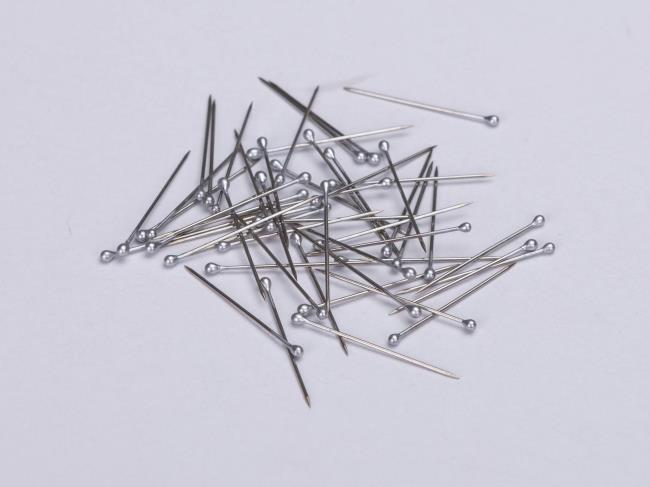
A metal pin — listed in the supplier’s product data as a “Metal Pin with Red Head” — is a thin, low-profile metal fastener intended for shirt packing and the garment accessories industry. A clip is a family rather than a single item: the range includes metal clip, plastic clip, U Shape Plastic Big Clip, Clear Square Plastic Clip, Alligator Clip, Plastic Clip with Teeth, Square Plastic Clip and Square Plastic Shirt Back Clip, all intended for shirt packing in the garment accessories industry.
Because the two products are produced, packed and priced differently, comparing them on unit price alone produces bad decisions in both directions: buyers over-commit to a clip MOQ they cannot consume, or they plan a branded fastener and discover the pin ships without any printing as standard.
Industry Background: Why Fastener Specifications Get Scrutinised Now
Shirt packaging components are a small line item inside a much larger spend, and that larger spend is growing. The global garment packaging market was valued at USD 18.6 billion in 2025 and is projected to reach USD 31.4 billion by 2034, according to Dataintelo’s garment packaging market research. In the same year, Asia Pacific accounted for a 41.5% revenue share of that market.
The component supply chain behind shirts has also become more specialised. The garment interlining market — the material family that supports shirt collar structure — reached USD 3.65 billion in 2025, based on The Business Research Company’s interlining market forecast. Collars, bands, stays and fasteners are now bought as engineered components with their own specifications rather than as commodity sundries.
The manufacturing side reflects the same trend. Wuxi Mingyu Garment Accessories Factory operates a 2,500 m² facility with approximately 25 staff, a research and development team of three engineers and an annual production capacity of about 90 million sets. Roughly 85% of its output is exported, with major markets in Europe, North America, South America and Asia. That combination — component-level specification plus export-scale supply — is exactly why a pin-versus-clip decision should be documented rather than assumed.
Metal Pin: Specification, Form and Default Configuration
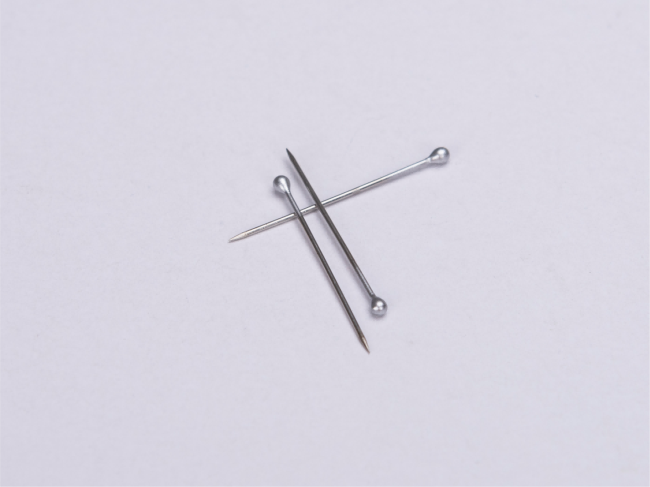
The metal pin is the simpler of the two configurations, and its specification is short enough to check line by line:
- Product type: Metal Pin with Red Head
- Material: stainless steel or brass
- Common size: 26 × 0.6 mm, with thickness options of 0.6 mm and 0.65 mm
- Colour: silver
- Style: rectangle
- Logo: none — the pin ships without a printed logo in its default configuration
- Usage: shirt packing, garment accessories industry
- MOQ: 10,000 pieces
- Stated properties: resistant to deformation; eco-friendly material options
The commercial consequence is straightforward. The pin is a specification-light, unbranded fastener that a buyer can place into a mid-volume programme without triggering a minimum quantity beyond a realistic consumption cycle. Its default no-logo configuration also keeps artwork, proofing and print approvals out of the ordering path. Where a printed or custom design is required, the supplier states that custom design and printed logos can be arranged, so this detail should be confirmed at quotation rather than assumed as standard.
Clip: Specification, Form and Marking Options
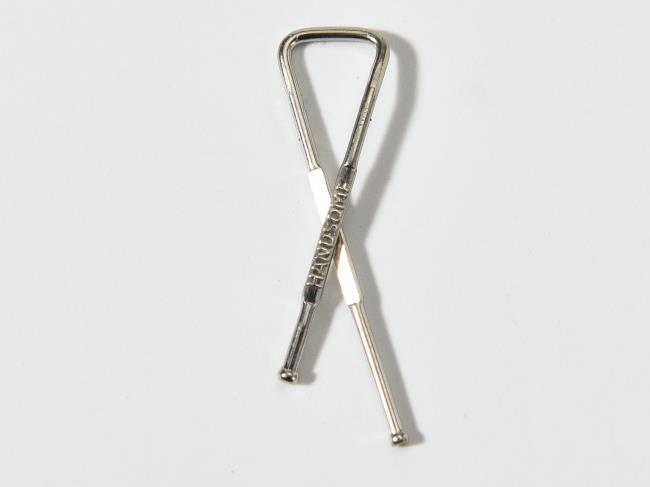
The clip is the more configurable of the two, and it is a family of shapes rather than one moulding:
- Types: metal clip, plastic clip, U Shape Plastic Big Clip, Clear Square Plastic Clip, Alligator Clip, Plastic Clip with Teeth, Square Plastic Clip, Square Plastic Shirt Back Clip
- Material: PS (polystyrene) or metal — so “plastic clip” describes the PS variants, while the range also includes metal clip versions
- Size: 3.3 cm or 3.7 cm length × 0.8 cm width × 1.2 mm thickness
- Thickness: 1.2 mm
- Colour: silver
- Style: X shape
- Logo: customizable; custom design and logo printing are supported
- Usage: shirt packing
- MOQ: 100,000 pieces
- Stated properties: resistant to deformation; eco-friendly materials
Two details matter for buyers. First, thickness: at 1.2 mm the clip is a substantially heavier gauge than the pin’s 0.6 mm or 0.65 mm, which changes how it sits against a folded shirt and how it behaves on a packing line. Second, length options: 3.3 cm and 3.7 cm give two footprints to match different fold widths, so the correct choice has to be tested against the actual shirt rather than selected from a photograph.
Point-by-Point Comparison for Shirt Packers
Form and material
The metal pin is a rectangle-style pin: narrow profile, silver, in stainless steel or brass, at a common 26 × 0.6 mm. The clip is an X-shape gripper in PS or metal, silver, at 3.3 cm or 3.7 cm × 0.8 cm × 1.2 mm. In practice the pin relies on a thin, low-profile form while the clip relies on a wider gripping footprint with more than double the material thickness. Only a trial on your own fold, shirt weight and collar construction will show which of the two behaves better at the packing table.
Deformation resistance
Both products are listed as resistant to deformation, and this is consistent with their materials: stainless steel and brass for the pin, PS and metal for the clip. The clip resists bending partly through gauge — 1.2 mm against the pin’s 0.6–0.65 mm. What the published data does not contain is a comparative bending or recovery test, so deformation resistance should be treated as a supplier performance claim and verified with a sample under your own handling conditions, especially if shirts are packed tightly or shipped long distances.
Eco-friendly material options
Both the pin and the clip are listed with eco-friendly material options and as resistant to deformation, and the supplier supports OEM & ODM customization on size, colour, printing and logo across its garment packaging accessory range. On documentation, the supplier states that it provides complete authoritative certificates for export and has extensive experience with factory audit inspections. Item-level certificates were not part of the fastener data available here, so buyers with restricted-substance or market-entry requirements should request the exact documents they need with the quotation and match them against their destination market rules.
Logo customization
This is where the two products diverge most clearly. The metal pin’s standard configuration includes no logo; the clip’s specification supports logo customization and custom design. For a branded retail programme, that difference alone can eliminate the pin unless a custom printed version is confirmed. For unbranded or concealed fastening, the pin’s no-logo default removes an approval step and an artwork dependency entirely.
MOQ thresholds
The thresholds are 10,000 pieces for the metal pin and 100,000 pieces for the clip — a tenfold difference. The arithmetic is worth doing before any negotiation: a programme that consumes 20,000 fasteners fits inside the pin’s MOQ with a single order, while the same programme would require a clip order five times larger than annual consumption, or a deliberate decision to stock and carry the balance. High-volume, consolidated programmes with a branding requirement are the natural home for the clip; smaller, specification-light programmes are the natural home for the pin.
Step-by-Step: How to Choose Between a Pin and a Clip
- Define the job the fastener must do. Decide whether it only has to hold the folded shirt and board, or whether it also has to carry visible branding. The pin’s no-logo default and the clip’s customizable logo answer different briefs.
- Test the form against the actual fold. A 26 × 0.6 mm rectangle pin and a 3.3 cm or 3.7 cm X-shape clip sit differently on a folded shirt; both clip length options should be trialled before selection.
- Match material and thickness to the garment. Stainless steel or brass at 0.6–0.65 mm (pin) versus PS or metal at 1.2 mm (clip). A thicker fastener is not automatically better — it changes the appearance and feel of the pack.
- Settle the marking question early. If a printed logo is mandatory, treat the clip as the documented route and request print details; if the fastener is hidden inside the poly bag, the pin’s unbranded default is simpler.
- Compare MOQ with real consumption. 10,000 pieces (pin) versus 100,000 pieces (clip). Confirm you can absorb the threshold before opening any discussion about unit price.
- Validate with a sample and lock the documents. The supplier supports custom design, mould opening, colour and size customization, and states a standard lead time of 7–20 working days after order confirmation — so build sampling and document review into the timeline, not after it.
Where Each Fastener Fits: Shirt Packing Use Cases
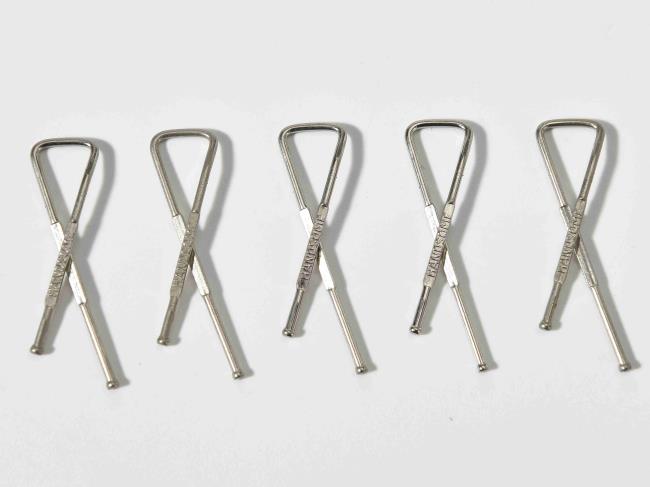
Mid-volume standard shirt programmes. When the fastener is functional rather than decorative, the pin’s 10,000-piece MOQ and rectangle profile allow a clean, unbranded specification without over-buying.
High-volume branded retail programmes. Where the fastener is part of the retail presentation and volumes are consolidated, the clip’s 1.2 mm X-shape body and logo customization suit branded packs in 3.3 cm or 3.7 cm lengths.
Mixed portfolios. Brands packing several shirt lines often run both: pins for standard folded shirts where the fastener is concealed, clips for premium or gift-boxed presentations where a branded fastener is visible.
Export and cross-border programmes. Both fasteners can be combined with the supplier’s wider shirt packing kit — collar bands, collar stays, collar butterflies, shirt cardboard, tissue paper and poly bags — under one order. The company has set up distribution warehouses, agencies or factories in Sri Lanka, Argentina, Bangladesh, Indonesia, Colombia and Kenya, established a Sri Lanka factory in 2013 and a Vietnam factory in 2017, and implemented an OA management system in 2018, all of which shorten regional lead time for buyers in those markets.
Metal Pin vs. Clip: Specification Comparison Table
| Comparison point | Metal pin | Clip |
|---|---|---|
| Product type | Metal Pin with Red Head | Metal clip, plastic clip, U Shape Plastic Big Clip, Clear Square Plastic Clip, Alligator Clip, Plastic Clip with Teeth, Square Plastic Clip, Square Plastic Shirt Back Clip |
| Material | Stainless steel, brass | PS (polystyrene) or metal |
| Form / style | Rectangle pin | X shape clip |
| Size | Common 26 × 0.6 mm | 3.3 cm or 3.7 cm length × 0.8 cm width × 1.2 mm thickness |
| Thickness | 0.6 mm, 0.65 mm | 1.2 mm |
| Colour | Silver | Silver |
| Logo | None by default | Customizable; custom design and logo printing supported |
| Deformation resistance | Listed as resistant to deformation | Listed as resistant to deformation |
| Eco-friendly material options | Listed | Listed |
| Usage | Shirt packing | Shirt packing |
| MOQ | 10,000 pieces | 100,000 pieces |
Frequently Asked Questions
Are metal pins and clips for shirt packaging available with eco-friendly material options?
Both products are listed with eco-friendly material options and as resistant to deformation. The manufacturer, Wuxi Mingyu Garment Accessories Factory, supports OEM & ODM customization on size, colour, printing and logo, and states that it provides complete authoritative certificates for export and has extensive experience with factory audit inspections. Item-level certificates for the pin and clip were not included in the product data, so confirm the exact documents your destination market requires at quotation stage.
What materials and sizes separate the metal pin from the clip?
The metal pin is made of stainless steel or brass, in silver, with a rectangle style, a common size of 26 × 0.6 mm and thickness options of 0.6 mm or 0.65 mm. The clip is made of PS (polystyrene) or metal, in silver, with an X shape and dimensions of 3.3 cm or 3.7 cm length, 0.8 cm width and 1.2 mm thickness. Both are intended for shirt packing in the garment accessories industry.
What are the MOQ thresholds for each fastener?
The metal pin has a minimum order quantity of 10,000 pieces; the clip has a minimum order quantity of 100,000 pieces. The tenfold difference is the single most important commercial figure in this comparison: pins fit mid-volume and unbranded programmes, while clips suit consolidated high-volume programmes that also need logo customization.
Can I validate a pin or clip with a sample before placing an order?
Sample validation is recommended, because the published specifications contain no comparative bending or recovery test data. Ask for the pin in the target material and thickness (0.6 mm or 0.65 mm) and the clip in both length options (3.3 cm and 3.7 cm), then test them on your own folded shirts. The manufacturer supports custom design, mould opening and size, colour and printing customization, so a sample round also confirms which customization steps are needed.
What is the normal lead time, and how are export orders supported?
Standard lead time is 7–20 working days after order confirmation. The manufacturer holds its own export qualification and a mature logistics network, and operates distribution warehouses, agencies or factories in Sri Lanka, Argentina, Bangladesh, Indonesia, Colombia and Kenya, with local factories established in Sri Lanka in 2013 and Vietnam in 2017, which shortens delivery for regional clients. To move a pin or clip decision forward, send your shirt type, fastener quantity and branding requirement through www.wxmingyu.com and request a quotation and a sample plan.
Conclusion
Metal pin or clip is not a question of which fastener is better — it is a question of which commercial and physical profile fits the programme. The pin gives shirt packers a 10,000-piece MOQ, a 26 × 0.6 mm rectangle profile in stainless steel or brass, and a no-logo default that keeps ordering simple. The clip asks for 100,000 pieces, brings a 1.2 mm X-shape body in PS or metal, and is the configuration documented with logo customization.
Decide on the five criteria set out above — form and material, deformation resistance, eco-friendly material options, logo customization and MOQ — then verify the choice with a sample of each fastener on your own packing line.
Next step: compare the two fasteners against your own order volume. Request a metal pin or clip sample and quotation from Wuxi Mingyu Garment Accessories Factory, or download the company profile for the full accessory range and contact details.
Company profile (PDF): Brief Company Profile – Wuxi Mingyu Garment Accessories Factory
Website: www.wxmingyu.com · Email: lili.ma@wxmingyu.com · WhatsApp: +8615052109975