
Paper Butterfly vs. Plastic Butterfly: Shirt Collar Packaging
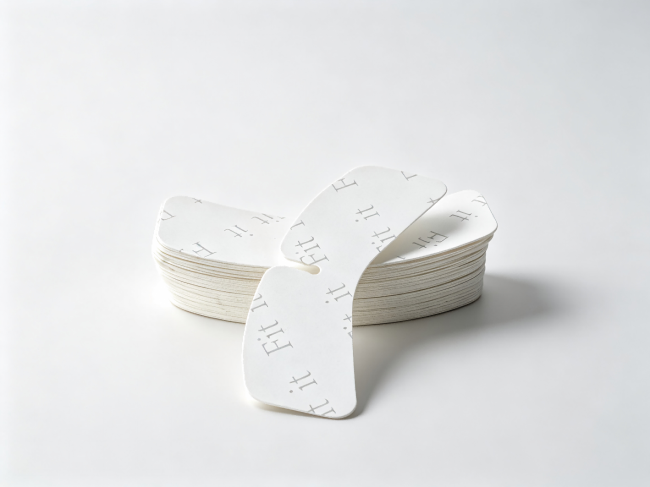
Paper butterfly, 400 g single white paper, 15 cm × 3 cm, logo customizable — the paper-side reference for this comparison.
Paper butterflies and plastic butterflies do the same basic job: they hold a folded shirt collar in shape between the collar band and the shirt body. They differ in what they are made of, how your logo sits on them, and how the finished shirt reads on a shelf, in a photograph or inside a mailer. Choose the paper butterfly when the retail program is paper-first and printing is the main branding task; choose the plastic butterfly when you need the larger format, a film surface, or the single and bubble variants.
Both formats in this comparison are supplied by Wuxi Mingyu Garment Accessories Factory (MingYu Garment Accessories), a shirt packing accessories manufacturer founded in 2004 in Wuxi, Jiangsu, China, which exports 85% of its output to Europe, North America, South America and Asia. The comparison below uses the factory's published specifications for product 8164 (Paper Butterfly) and product 8144 (Plastic Butterfly), plus its OEKO-TEX and GRS certification data, so the differences can be checked line by line rather than argued in general terms.
At a glance
- Choose paper when the packaging brief is paper-first, the logo print is the branding job, and a 15 cm × 3 cm insert fits your collar height.
- Choose plastic when you need a 26 cm × 10.4 cm format, a film surface for a colour-led look, or a single or bubble variant.
- Identical on two points: both SKUs carry a 10,000-piece MOQ and both are listed with customizable logos.
- Both are documented: product 8164 and product 8144 are covered under MingYu's OEKO-TEX STANDARD 100 certificate SH001 275178, issued by TESTEX.
The problem: two inserts that look alike but answer different requirements
A shirt collar is not held by one component. It is held by a system: a collar band (also called collar tape, produced from PVC or specialty tenacity paper, sometimes with collar interlining or a collar stiffener behind it), one or two collar stays, and a collar butterfly or collar insert that spreads the collar points and keeps the fold flat. Around that sit the collar support insert, the shirt cardboard, tissue paper, the poly bag, the hang tag or belly band, and closure parts such as a shirt clip or shirt pin.
That system is why the paper-versus-plastic question is harder than a material swap. Buying teams arrive at it from different search paths — some look for a collar butterfly, others for a collar bone, a collar insert, a collar support or a butterfly insert — and the pages they land on describe similar-looking parts with different specifications. Catalogues usually list material and size, but rarely state the decision criteria that separate one material from the other.
In practice, six constraints decide the order:
- Retailer material policy. Some programs ask for paper-based or single-material components, others accept film as long as it is documented.
- Print and branding. Logo size, ink coverage, colour matching and whether foiling or stamping is involved.
- Format. Insert length and height against collar band width, collar stay length and the folding style used on the line.
- Compliance documents. OEKO-TEX listings, recycled-content certificates and written confirmation of article coverage.
- Order economics. MOQ, lead time and reorder rhythm across a mixed accessory order.
- Packing line behaviour. How quickly the insert is picked and placed, and whether it bends or creases during packing.
The common failure is deciding on the word “eco-friendly” alone. That single word can hide a claim you cannot document, a print that looks different from the digital proof, or a format that lets the collar collapse under compression. The sections below separate the two options on facts you can verify.
Industry background: why a small insert gets attention
Collar butterflies sit inside the garment packaging category, which Dataintelo values at USD 18.6 billion in 2025 and projects to reach USD 31.4 billion by 2034 in its Garment Packaging Market Research Report 2034. The same source reports that Asia Pacific held a 41.5% revenue share of that market in 2025. These figures describe the packaging category the insert belongs to, not the butterfly segment on its own, but they explain why material choices inside that category are scrutinised: packaging volume is large, and small component swaps move real tonnage.
Two commercial pressures keep the question alive. First, the collar is the first part of a folded shirt a customer sees, so the insert is a brand surface as much as a stiffener. Second, retail and e-commerce programs increasingly ask suppliers to document what a component is made of and how it is handled at end of life. Buyers therefore compare not only appearance but also whether a material can be declared, certified and defended in a supplier questionnaire.
Production context matters too. MingYu Garment Accessories operates a 2,500 m² facility with 25 employees, a three-engineer technical team and an annual output of 90 million sets, with a monthly capacity of 7.5 million sets and 100% testing; standard lead time is 7–20 days. The factory holds distribution warehouses, agencies or manufacturing sites in Sri Lanka, Argentina, Bangladesh, Indonesia, Colombia and Kenya, and established a Sri Lankan factory in 2013 and a Vietnamese factory in 2017. For a buyer comparing two materials, that footprint matters when one option has to be re-sourced mid-program.
What each butterfly actually is
Paper butterfly: 400 g single white paper
- Material 400 g single white paper
- Format 15 cm × 3 cm
- Grammage 400 GSM
- Colour White
- Shape Butterfly
- Variants in range Paper Collar Butterfly, Dog Bone Paper Collar Butterfly, Paper Big Butterfly
- Logo Customizable
- Use Shirt packing; garment manufacturing and shirt and formal-wear production
- MOQ 10,000 pieces
- Compliance Product 8164 is listed under OEKO-TEX STANDARD 100
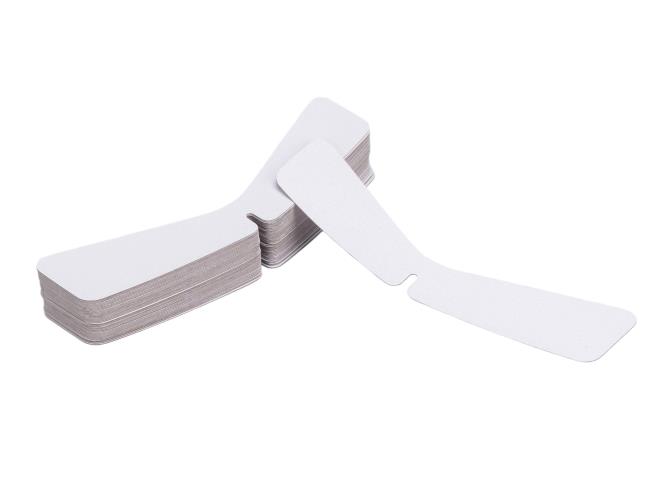
Paper butterfly: a 400 GSM white paper insert with a customizable logo, used to hold the folded collar flat.
The paper family gives you shape options before you even discuss material: the standard butterfly, a dog-bone profile and a big butterfly. If your collar is narrow or your folding style is tight, the profile variants may solve a fit problem that a material change cannot.
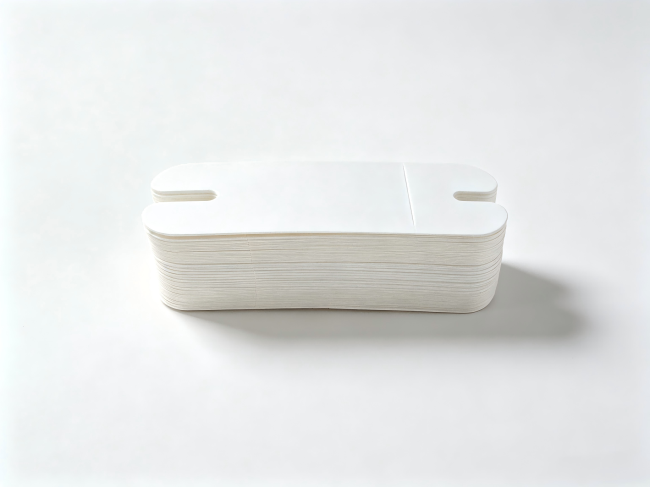
Dog Bone Paper Collar Butterfly — one of the profile variants available in the paper range.
Plastic butterfly: 0.25 mm light blue fine sand PVC
- Material Light blue fine sand PVC (the product family also covers PVC and PET)
- Format 26 cm × 10.4 cm
- Thickness 0.25 mm
- Colour Light blue
- Shape Butterfly
- Variants in range Plastic Single Butterfly, Plastic Bubble Butterfly, Plastic Frosted PVC Butterfly, Plastic White PET Butterfly, Plastic PVC Bubble Butterfly, Plastic Bubble PET Butterfly
- Logo Customizable
- Use Shirt packing; apparel industry
- MOQ 10,000 pieces
- Compliance Product 8144 is listed under OEKO-TEX STANDARD 100
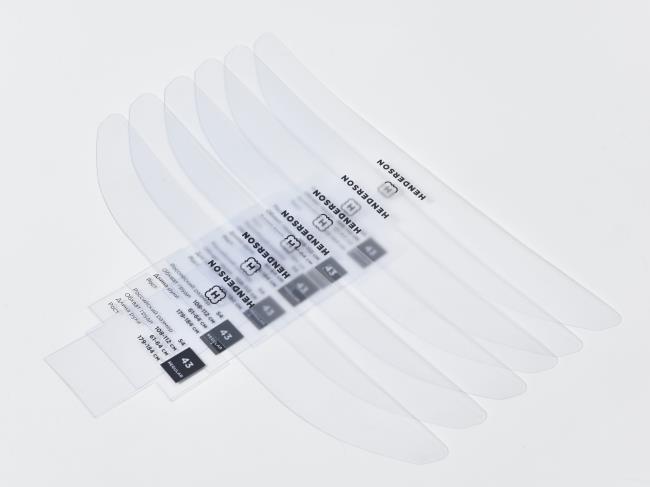
Plastic single butterfly: light blue fine sand PVC, 0.25 mm, 26 cm × 10.4 cm, logo customizable.
One caution on specification sheets: the paper butterfly is described by grammage (400 GSM) and the plastic butterfly by gauge (0.25 mm). These are different measurements and cannot be read as equivalent stiffness. If stiffness is the deciding factor, compare physical samples on a folded shirt, not the numbers on the page.
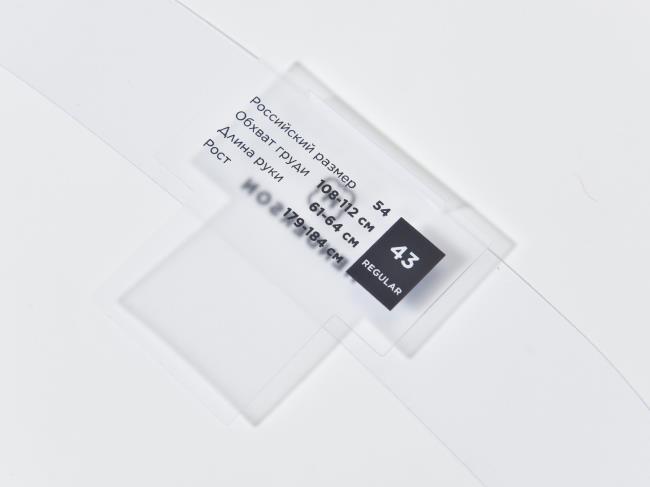
The plastic range also includes single and bubble formats, plus frosted PVC and white PET variants.
Head-to-head: six dimensions that decide the order
1. Material and end of life
The paper butterfly is a cellulose product: 400 g single white paper. Paper-based inserts are generally accepted in mixed paper recovery streams, which is why paper-first retail programs start here. Two caveats apply. Heavy foil stamping or film lamination can complicate acceptance at the mill, so confirm the finishing route before you make a recyclability statement. And acceptance rules differ by country, so the practical test is whether your target market's paper stream takes the actual article, not whether paper is nominally recyclable.
The plastic butterfly is film: light blue fine sand PVC in the standard format, with PET variants in the same family. PVC film is generally not accepted in most municipal paper or plastic collection streams, while PET film is more widely collected in many markets. If a retail customer has a hard paper-based or single-material target, paper is the lower-risk starting point. If film is required for performance or presentation, ask specifically for the PET variants and confirm local acceptance rather than assuming it.
2. Logo printing and branding
Both SKUs are listed with a customizable logo, and both support print logo and custom design. The difference is the surface. Printing on an uncoated 400 g white paper sheet generally reads matte, because ink absorbs into the fibre; that suits restrained one- and two-colour marks, and it sits naturally alongside paper hang tags, paper cardboard and tissue paper in the same pack. Printing on PVC film generally reads sharper and glossier, which suits a bolder wordmark or a colour block.
Size changes the artwork brief. A 3 cm-high paper strip leaves limited room, so keep the mark simple, high-contrast and legible at small scale. The 10.4 cm-wide plastic format gives more space for a wordmark, a size indicator or a short brand line. MingYu's stated customization covers size, colour, style, printing and foiling, mold opening, and logo stamping or printing, so both routes can be finished — but approve a printed sample from each material rather than a single digital proof, because ink behaves differently on paper and on film.
3. Aesthetics and retail presentation
Paper reads quiet and premium. A white matte insert disappears behind the collar, keeps the visual focus on the shirt, and matches paper-based gift boxes, belly bands and hang tags. It is the natural choice for a restrained, single-material presentation and for brand programs that want the packaging story to be visible without a printed claim.
Plastic reads structured and colour-led. The standard light blue fine sand PVC finish puts a colour note inside the collar area, which helps a seasonal collection or a colour-themed display. Where the brief calls for something else, the range offers frosted PVC for a softer matte look and white PET where a neutral film is preferred. Neither look is better in the abstract; the question is which one matches the shirt and the retail environment the shirt will be sold in.
4. Collar coverage and format
This is the dimension buyers most often skip. The paper butterfly is 15 cm × 3 cm; the plastic butterfly is 26 cm × 10.4 cm. They are not the same size class, and the plastic insert covers considerably more of the collar and shoulder area. A larger insert can hold a wide collar spread very cleanly, but it can also interfere with a narrow collar band or press a crease into the yoke if the folding style was designed around a smaller part.
Match the insert to the rest of the collar system before choosing the material. MingYu's own collar band options illustrate the range you may be pairing with: a PVC collar band at 50 cm × 3.4 cm with 0.50 mm thickness, or a paper collar band in specialty tenacity paper at 47.2 cm × 3.8 cm with 1 mm thickness. Place the candidate butterfly on a shirt built with your actual band and stays, then judge. A format that is wrong for the collar will not be rescued by the material.
5. Compliance documentation
MingYu Garment Accessories holds OEKO-TEX STANDARD 100 certificate SH001 275178, issued by TESTEX under the OEKO-TEX STANDARD 100 and EN ISO 17050-1 standard. The certificate runs from 12 January 2026 to 15 January 2027 and applies to the world market. Both relevant articles are listed: product 8164 (paper butterfly) and product 8144 (plastic butterfly).
Read the scope carefully before you write a claim. The certificate's stated scope describes plastic accessories — including collar bands, butterflies, collar stays and poly bags — made of PET and PE film, transparent, partly mechanically coined. Because the standard plastic butterfly format is light blue fine sand PVC and the paper butterfly is 400 g paper, a careful buyer requests the certificate copy and written confirmation that the exact article, colour and material being purchased is covered, rather than relying on a product-family listing. That single email protects the packaging claim.
A second document is relevant if recycled content is part of the brief. The factory holds GRS certification SGC-GRC09119-GRS-2026-07, issued by SGS under Global Recycled Standard V4.0, Content Claim Standard V3.1 and the Textile Exchange Standards Claims Policy V1.3, valid from 31 July 2026 to 30 July 2027 and covering trading, warehousing and distribution of final products, and manufacturing. For a shipment-level recycled-content claim, ask for the transaction certificate that matches the order.
6. MOQ, lead time and continuity
MOQ does not separate these two options: both the paper butterfly and the plastic butterfly carry a 10,000-piece minimum. Other accessories in the same pack do differ, which matters when you build a mixed order — metal collar stays are listed at 1,000 pieces and clips at 100,000 pieces. Plan quantities per SKU rather than assuming one threshold applies across the pack.
Lead time is 7–20 days after order confirmation, against a monthly capacity of 7.5 million sets with 100% testing. For repeat programs, the overseas warehouses and agencies in Sri Lanka, Argentina, Bangladesh, Indonesia, Colombia and Kenya, together with the Sri Lankan and Vietnamese factories, are relevant to regional replenishment and to reducing delivery distance.
Comparison table: paper vs. plastic butterfly
| Dimension | Paper Butterfly (product 8164) | Plastic Butterfly (product 8144) |
|---|---|---|
| Material | 400 g single white paper | Light blue fine sand PVC (PVC and PET family) |
| Standard format | 15 cm × 3 cm | 26 cm × 10.4 cm |
| Thickness spec | 400 GSM | 0.25 mm |
| Colour | White | Light blue |
| Shape and variants | Butterfly; dog bone and big butterfly profiles also in range | Butterfly; single and bubble variants, frosted PVC and white PET also in range |
| Logo | Customizable | Customizable |
| MOQ | 10,000 pieces | 10,000 pieces |
| OEKO-TEX STANDARD 100 | Listed for product 8164 | Listed for product 8144 |
| End-of-life direction | Paper recovery stream; confirm local acceptance and finishing effects | Film stream; PET more widely collected than PVC; confirm local acceptance |
| Presentation character | Matte white, understated, matches paper-based packs | Glossy colour, structured, colour-led packs |
| Main decision risk | Finish choices that complicate paper recovery | PVC acceptance in the target market |
Step-by-step: how to choose in six steps
- Fix the collar construction first. Write down the collar band type and width, the collar stay length and the folding style. The butterfly is a supporting part inside that system, so the system limits the sensible options before material is discussed.
- Write the retail requirement in one line. For example: “paper-based components preferred” or “film accepted, documentation required”. That one line usually eliminates one of the two materials and saves a week of sampling.
- Decide the print method and artwork scale. A 3 cm-high paper strip suits a compact, high-contrast mark; a 10.4 cm-wide film format allows a wordmark or size indicator. Confirm whether printing, stamping or foiling is needed before sampling.
- Match format to coverage. Ask for both standard sizes and place them on a folded shirt with your own collar band and stays. Check that the insert neither under-supports the collar points nor presses into the shoulder fold.
- Run a physical trial. Pack a small batch of shirts through your normal poly bag and carton, then inspect collar shape on opening. Include print registration and colour in the check, and time the insertion step on the line.
- Lock documents and replenishment. Collect the certificate copy, written confirmation of article coverage, the certificate expiry date, the MOQ, the lead time and your reorder point. Lead time runs 7–20 days after confirmation, so start the document check in parallel with sampling, not after it.
Use cases: which butterfly fits which program
Paper-first retail program
For a department store or brand program that has set a paper-based packaging target, the paper butterfly closes the loop with a paper collar band, paper cardboard, tissue paper and a paper hang tag. The result is a single-material story you can describe accurately in a supplier questionnaire, with a matte white insert that keeps attention on the collar itself.
Colour-led premium presentation
Where the shirt is sold in a gift box and the pack carries a colour theme, the light blue fine sand PVC butterfly adds a controlled colour note inside the collar area. Pair it with a coordinated gift box and tissue paper, and use the wider 10.4 cm surface for a wordmark. Confirm that the finish you choose matches the colour standard of the rest of the pack.
E-commerce and mailer packing
Shirts that travel in mailers are compressed in transit, so the insert has to hold shape under load. The plastic range's single and bubble variants are the options to evaluate here; confirm the raised profile and gauge against your collar height before committing. Add a shirt clip or shirt pin for fold control and a poly bag for protection.
Long-transit and humid-route export
For shipments through humid routes, film's moisture behaviour is the practical argument for plastic, supported by the moisture-proof paper the factory also produces. Document the packing sequence so the insert, band and stays are placed in the same order at both ends of the route.
Mixed accessory orders
Most buyers order the butterfly alongside collar stays, clips, hang tags, cardboard and bags. Because thresholds differ by SKU — 10,000 pieces for both butterflies, 1,000 pieces for metal collar stays, 100,000 pieces for clips — build the purchase order line by line and confirm whether pricing is per piece or per set.
FAQ
Are the paper and plastic butterflies OEKO-TEX certified?
Yes. MingYu's OEKO-TEX STANDARD 100 certificate SH001 275178 was issued by TESTEX under the OEKO-TEX STANDARD 100 and EN ISO 17050-1 standard, is valid from 12 January 2026 to 15 January 2027, and applies to the world market. Product 8164 (paper butterfly) and product 8144 (plastic butterfly) are both listed. The certificate's stated scope covers plastic accessories, including collar bands, butterflies, collar stays and poly bags, made of PET and PE film, transparent, partly mechanically coined, so ask for the certificate copy and written confirmation that your exact article, colour and material is covered — particularly for the light blue PVC format or the 400 g paper version. Also diarise the 15 January 2027 expiry before your production window closes.
Can both butterflies carry our logo, and can size or shape be changed?
Both are listed with a customizable logo and both support print logo and custom design. MingYu's customization covers size, colour, style, printing and foiling, mold opening, and logo stamping or printing. Practical guidance: on the 3 cm-high paper strip keep the mark simple and high contrast, while the 10.4 cm-wide plastic format leaves room for a wordmark, size indicator or short brand line. Because ink behaves differently on uncoated paper and on PVC film, approve a printed sample from each material rather than a single digital proof.
Do the two options have different MOQs, and what drives cost?
Both butterfly SKUs carry a 10,000-piece MOQ, so MOQ alone does not separate them; other accessories do differ, with metal collar stays listed at 1,000 pieces and clips at 100,000 pieces. Cost drivers are the base material, the yield per paper sheet or film roll at your format, the number of print colours, whether foiling or stamping is added, mold opening for a custom profile, and packing or labelling requirements. The factory also states a minimum of 1,000 sets for accessory sets, so confirm whether your order is priced per piece or per set, and ask for a quotation that separates material, print and packing so the two options can be compared line by line.
How should we run a fair sample comparison?
Order both materials in the same print specification where possible, then test on four points. Fit: place each insert on a folded shirt built with your own collar band and stays. Print: check registration, colour and legibility at real size. Handling: time the insertion step and note whether the insert creases or bends during packing. Transit: pack through your normal poly bag and carton and inspect collar shape on opening. Keep the approved sample and its specification sheet as the bulk reference, and allow extra time in the schedule if custom printing or mold opening is involved.
What is the lead time for bulk butterfly orders?
Standard lead time is 7–20 days after order confirmation, with a monthly capacity of 7.5 million sets and 100% testing. Overseas warehouses and agencies in Sri Lanka, Argentina, Bangladesh, Indonesia, Colombia and Kenya, plus the Sri Lankan factory established in 2013 and the Vietnamese factory established in 2017, can shorten delivery for regional programs. For a first order, add sample approval and print proofing before the production clock starts. To start a sample or quotation request, send your collar band specification, a photo of your folding method and your logo artwork to lili.ma@wxmingyu.com or message +86 15052109975 on WhatsApp.
Conclusion: let the retail requirement pick the material
The decision is not paper versus plastic in the abstract. It is which of the two satisfies the constraint that cannot move. If the retail program needs a paper-based, printable insert and a 15 cm × 3 cm format fits the collar, the paper butterfly delivers that with a white matte finish, three profile options and a 10,000-piece MOQ. If the program needs a larger 26 cm × 10.4 cm insert, a film surface for a colour-led look, or the single and bubble variants, the plastic butterfly is the correct starting point — provided you confirm how the target market treats PVC and whether a PET variant is the better fit.
On both routes, the items that decide whether the order runs smoothly are the same: written confirmation of certificate coverage for the exact article, an approved printed sample rather than a screen proof, a physical fit trial on your own collar band and stays, and a replenishment plan built around the 7–20 day lead time. MingYu Garment Accessories reports long-term cooperation with brand owners, garment manufacturers, distributors and exporters across repeat programs, which is the practical test of whether a supplier can hold a specification over time.
Compare both butterflies on your own collar
Request a paper butterfly and a plastic butterfly sample in the same print specification, and we will quote against your collar band, folding method and artwork. Bulk lead time is 7–20 days after confirmation, with a monthly capacity of 7.5 million sets.
Email: lili.ma@wxmingyu.com | Tel: +86 13914100407 | WhatsApp: +86 15052109975 | Web: www.wxmingyu.com
Download the company profile and full accessory list: MingYu Garment Accessories company brochure (PDF)
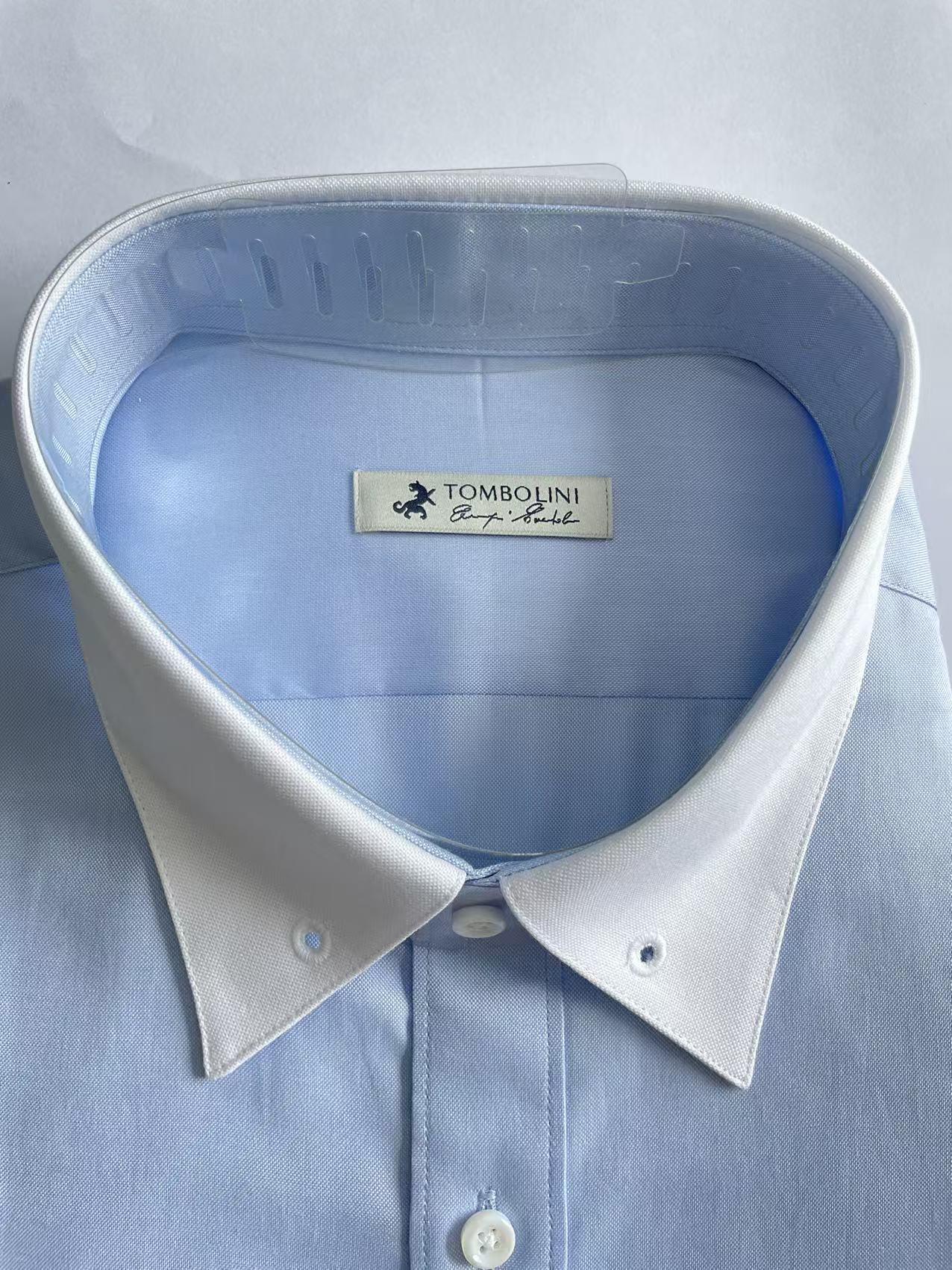
In production, the butterfly is placed after the collar band and stays — the reason format fit is tested before material is locked.
Have Questions or Need More Details?
Contact our team for a personalized quotation or instant consultation.
Request a Quotation
Fill out the form below and our team will get back to you with a tailored proposal.
WhatsApp Direct Chat
Prefer to chat in real-time? Message us on WhatsApp for instant assistance & quick answers.
- Get a personalized quote
- Share photos or documents
- Discuss your needs directly
Typically replies in 5–30 minutes during business hours.