
Factory vs Trading Company for Restaurant Furniture: A Commercial Buyer Comparison
For commercial buyers, choosing between a factory and a trading company is not a choice between quality and convenience. It is a choice about where accountability sits: who owns the production line, who controls the specification, and who can prove the finished restaurant furniture was built to it.
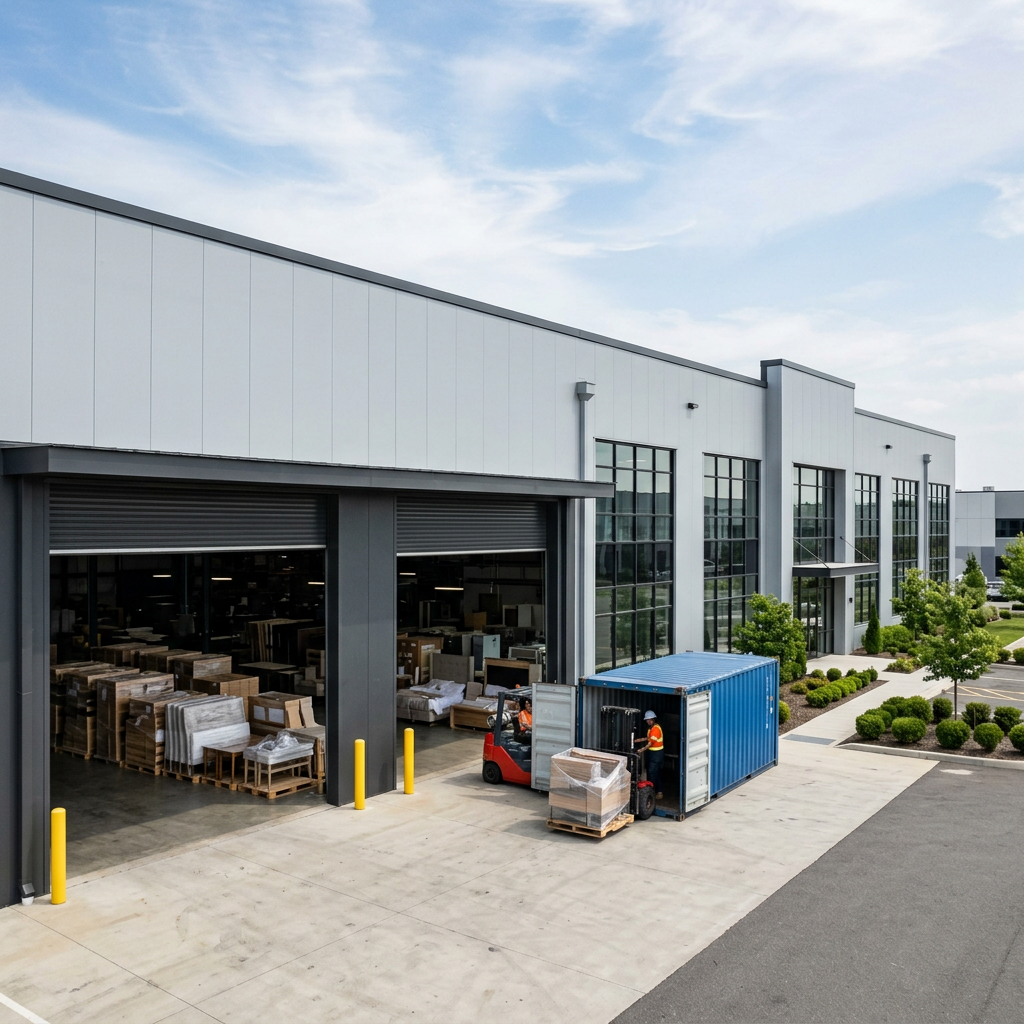
A factory-direct restaurant furniture order is built inside a controlled manufacturing facility, where woodworking, metalworking, upholstery and finishing stages can be inspected before shipment.
This comparison is written for restaurant owners, hotel groups, contractors, interior designers and procurement teams placing multi-item orders: restaurant furniture sets that combine restaurant chairs and tables, restaurant sofa booths, banquette seating and bar seating. It works through the factors that actually decide the outcome — factory status, custom capability, design and CAD support, full restaurant package supply, quoting and payment terms, MOQ, production lead time, shipping terms, packing, warranty and factory visits. MingMeng Furniture, a Guangzhou-based manufacturer of custom restaurant, café, hotel, bar and contract furniture, is used throughout as a documented factory-side example so that each factor can be judged against real evidence rather than a general impression.
Short answer
A factory-direct supplier gives the buyer visibility into production, tooling, custom development and quality control, and can coordinate an entire restaurant furniture package under one specification. A trading company can offer broader catalogue access and commercial flexibility, but production is carried out by third parties, so specification control and inspection depend on how well the intermediary manages those factories. The deciding factor is not the label — it is what the supplier can document.
The Real Question Behind the Factory-or-Trading-Company Decision
Most buyers are not genuinely choosing between a manufacturer and a middleman. They are trying to avoid five specific failures that show up on hospitality furniture orders:
- Specification drift — the approved sample, the drawing and the delivered booth do not match.
- Split responsibility — chairs come from one supplier, dining tables from another, booth seating from a third, and nobody owns the finish match across the restaurant.
- Invisible production — the buyer cannot see the line, the tooling or the pre-shipment check, and only discovers problems at the installation site.
- Unverifiable compliance — certificates exist but do not correspond to the ordered model or the destination market.
- Schedule risk — lead time is quoted without accounting for sample approval, material setup or finish matching.
A factory-direct route addresses these problems through ownership of production. A trading route addresses them through supplier management. Both are legitimate business models, but they require different verification on the buyer's side, and they carry different risks when a restaurant opening date is fixed.
The practical test is simple and can be applied line by line: for each item on the order, who is responsible for it, and what evidence exists that it was built to specification?
Industry Background: Why Sourcing Route Now Matters More
Published estimates of the global restaurant furniture market differ substantially, because research publishers define the category differently and use different base years. Three commercial research figures illustrate the spread: Market Growth Reports estimates growth from USD 638.8 million in 2026 to USD 929.57 million by 2035 at a CAGR of 4.3%; Business Research Insights values the market at USD 0.88 billion in 2025 rising to USD 1.38 billion by 2034 at a CAGR of 5.13%; Dataintelo values it at USD 6.62 billion in 2025 rising to USD 11.01 billion by 2034 at a CAGR of 5.8%.
These figures are not directly comparable. They reflect different market definitions, base years and publisher methodologies, so they should be read as directional indicators of category growth rather than as a precise procurement benchmark. None of the figures should be averaged.
What is consistent across hospitality projects is the way orders are structured. A restaurant fit-out rarely buys a single product. It buys a coordinated set: chairs and tables for the restaurant, booth seating along a wall, bar stools at a counter, lounge seating near reception, and sometimes a custom bar counter. Increasingly, buyers handle that as one full restaurant furniture package rather than as separate table and seating orders. That shift raises the coordination bar for every supplier, and it turns the factory-versus-trading-company question into a concrete operational issue rather than a theoretical one.
Commercial restaurant furniture is also used far more intensively than residential furniture. Durability depends on frame structure, joints, materials, finish, upholstery and maintenance, and on the duty level specified for the project. For high-traffic venues, furniture should be selected on commercial-use requirements rather than appearance alone — which is precisely the kind of decision that requires direct knowledge of what is inside the frame.
Ten Decision Factors That Separate a Factory from a Trading Company
1. Factory status and production ownership
This is where the two sourcing routes diverge first. Guangzhou Mingmeng Furniture Co., Ltd. was established in 2015 and operates a 15,000㎡ manufacturing facility with more than 200 skilled workers and in-house production lines covering woodworking, metalworking, upholstery, cutting, welding, polishing, painting, powder coating, CNC processing, assembly and quality inspection. The company states that it is a furniture manufacturer with its own factory, specialising in commercial restaurant and hospitality furniture, and that it supports factory-direct production, project-based customisation, OEM/ODM development and quality control from production through shipment.
What to verify: whether the quoted price comes from the factory that will actually produce the order; how many production stages are genuinely in-house; and whether any subcontracted steps are disclosed in writing.
2. Custom capability and product scope
A trading company sells what its partner factories already make. A factory with its own development capability sells what it can engineer. MingMeng customises dimensions, structures, materials, upholstery, colours, wood and metal finishes, tabletops, booth configurations and complete project furniture combinations against architectural drawings, interior concepts, operational requirements and project budgets. OEM and ODM development are supported.
What to verify: whether a non-standard dimension is a routine workflow or a special favour, and whether the supplier can produce the mixed categories on your list — chairs, dining tables, booth seating, bar stools, counters and lounge sofas — under one specification.
3. Design, CAD and 3D support
The faster a layout becomes a manufacturable drawing, the lower the risk of site problems. MingMeng supports furniture layout coordination, CAD drawings, dimension adjustment and 3D visualisation for applicable project orders, and can manufacture according to the customer's approved drawings and specifications. Projects can also be developed from a floor plan, reference photos, mood boards or written requirements when CAD files are not available.
What to verify: who owns the drawing, whether revisions are included, and whether production is formally tied to an approved drawing revision rather than to an email description.
4. Full restaurant package supply
This is the factor buyers feel most on opening day. MingMeng's product scope covers restaurant chairs, dining tables, booth and banquette seating, bar stools, bar tables, custom bar counters, lounge chairs, sofas, hotel guest-room and lobby furniture, outdoor dining furniture, canteen furniture and table bases. When all of these come from one factory, upholstery, wood tones, metal finishes and tabletop materials can be developed as a single palette.
What to verify: whether the order becomes one purchase order, one quality-control process and one shipment — or whether three suppliers will each interpret the same colour reference differently.
5. Quotation structure and payment terms
Two quotes are only comparable when they describe the same thing. MingMeng states that pricing is determined by the confirmed product specification, including materials, dimensions, quantity, construction, finish and upholstery complexity, packaging and delivery term, and that payment terms depend on order value and the commercial agreement and should be confirmed in the quotation or contract. Quantity can affect unit price through production efficiency and material purchasing conditions.
What to verify: identical specification, quantity basis and Incoterm across every quote you compare. A price difference is often a delivery-term difference, not a production-cost difference.
6. Minimum order quantity
MOQ is a commercial constraint that behaves differently at a factory than at a trading company. MingMeng states that MOQ depends on product type, customisation level, material setup and order mix; that custom models generally start at 10–50 pieces per style; and that its published figure for custom restaurant booth manufacturing is 20 units. Trial orders and mixed-model orders can be discussed depending on the product, material setup and total order planning.
What to verify: whether the MOQ applies per model, per finish or per order, and whether mixing models from one project across several finishes changes the minimum.
7. Production lead time
Lead time is where a trading company's advantage in flexibility can disappear, because the intermediary's schedule depends on someone else's line. MingMeng quotes standard models at 20–30 days and customised models at 35–50 days including sample approval. Custom dimensions, structures, materials or finishes may require a different MOQ and a longer preparation window because of material setup.
What to verify: the point at which the clock starts — purchase order, deposit, or drawing approval — and whether sample approval sits inside the quoted window.
8. Packing, shipping terms and export logistics
Restaurant furniture travels as upholstery, timber, metal and occasionally stone. Damage risk is a procurement cost, not a transport detail. MingMeng supports EXW, FOB, CIF, CFR and DDP terms and can arrange freight on request, with availability depending on destination, product, customs and tax handling. Packing control is part of the quality process: packing inspection can be included for bulk orders.
What to verify: corner and edge protection, how tabletops are braced, the container loading plan, and who files a claim if goods are damaged under the agreed delivery term.
9. Certification and compliance evidence
Compliance is the factor most often accepted on trust — and the easiest to check. MingMeng's commercial chair MM102 carries a CE Certificate of Compliance, certificate number CTG2511057084B-SC01AD, issued by Shenzhen CTG Testing Co., Ltd. against EN 16139:2013 Level 2 and EN 1022:2023. Bar seating is covered separately: the MM103 commercial bar chair test report CTG2511057084B-SR02AD and the MM104 commercial bar stool test report CTG2511057084B-SR04AD follow the same standards through the same authority. Material-level evidence includes REACH SVHC test reports CZH12250205012, issued by Shenzhen Zhonghan Certification Technology Co., Ltd., and BSTDGD31243813112202CR, issued by Dongguan BST Testing Co., Ltd. MingMeng's stated certification set also includes CE, TÜV, RoHS and a Certificate of Conformity, and the company has developed 10+ national patented designs.
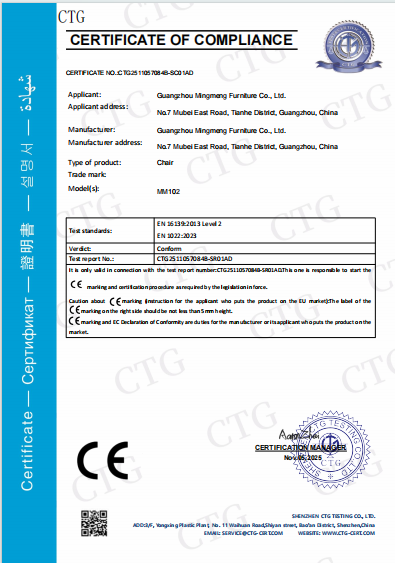
Model-level evidence beats a certification logo: the MM102 commercial chair CE Certificate of Compliance (CTG2511057084B-SC01AD) references the test standards EN 16139:2013 Level 2 and EN 1022:2023.
What to verify: that the certificate number corresponds to the model you are ordering, that it covers the commercial duty level your venue requires, and that the destination market's requirements — including any flame-retardancy or material restrictions — are confirmed per project regulation.
10. Warranty, after-sales and factory visits
A warranty is only meaningful when its scope is written down. MingMeng states that warranty terms depend on the product, project specification and commercial agreement, and are confirmed in the quotation or contract; that coverage depends on the agreed specification; that replacement parts can be arranged where the required component is identifiable and available; and that repair guidance, replacement parts or coordination support are provided depending on the issue and contract terms. Project orders can include on-site installation guidance and spare parts support, subject to contract. Factory visits can be arranged by appointment, and video tours are offered to overseas customers.
What to verify: what the warranty covers, how a claim is raised, how quickly spare components can be supplied, and whether a factory visit or documented video tour is offered before the order is placed.
Step-by-Step: How to Evaluate a Supplier Before You Commit
Buyers who run the following sequence get comparable answers from factories and trading companies alike, because every step produces a document rather than an assurance.
- Define the package, not the item. List furniture types, quantities, zones and the design intent: dining chairs and tables, restaurant booth set, bar stools, lounge and reception seating. State the opening date. This becomes the basis for every quotation you request.
- Ask for a production map. Request a written statement of which production stages the supplier performs in-house and which are subcontracted, and where each item on your list will be manufactured.
- Test custom capability with a specific question. Send one genuinely custom requirement — an L-shaped booth sized to a wall length, a table base height matched to a counter, a chair finish matched to a brand colour. The quality of the response reveals whether customisation is a workflow or a claim.
- Request the drawing and approval path in writing. The standard commercial workflow runs: project inquiry and requirement collection, design and specification confirmation, sample or material and finish approval, order confirmation, bulk production, quality inspection, export packing and shipment coordination. Confirm that bulk production does not begin before drawings, dimensions, materials, finishes, quantities and approved samples are confirmed in writing.
- Normalise the quotation. Ask every supplier to quote the same specification, the same quantity basis, the same packaging and the same Incoterm. Only then compare price.
- Verify compliance documents against exact models. Match certificate numbers to the models on your order list rather than accepting a general compliance statement.
- Inspect before shipment, in person or by video. MingMeng's quality control for bulk orders includes sample inspection and random checks, and can provide final inspection reports and packing inspection, with inspection able to follow project-specific standards including pre-shipment checks.
Use Cases: What Factory-Direct Execution Looks Like in Practice
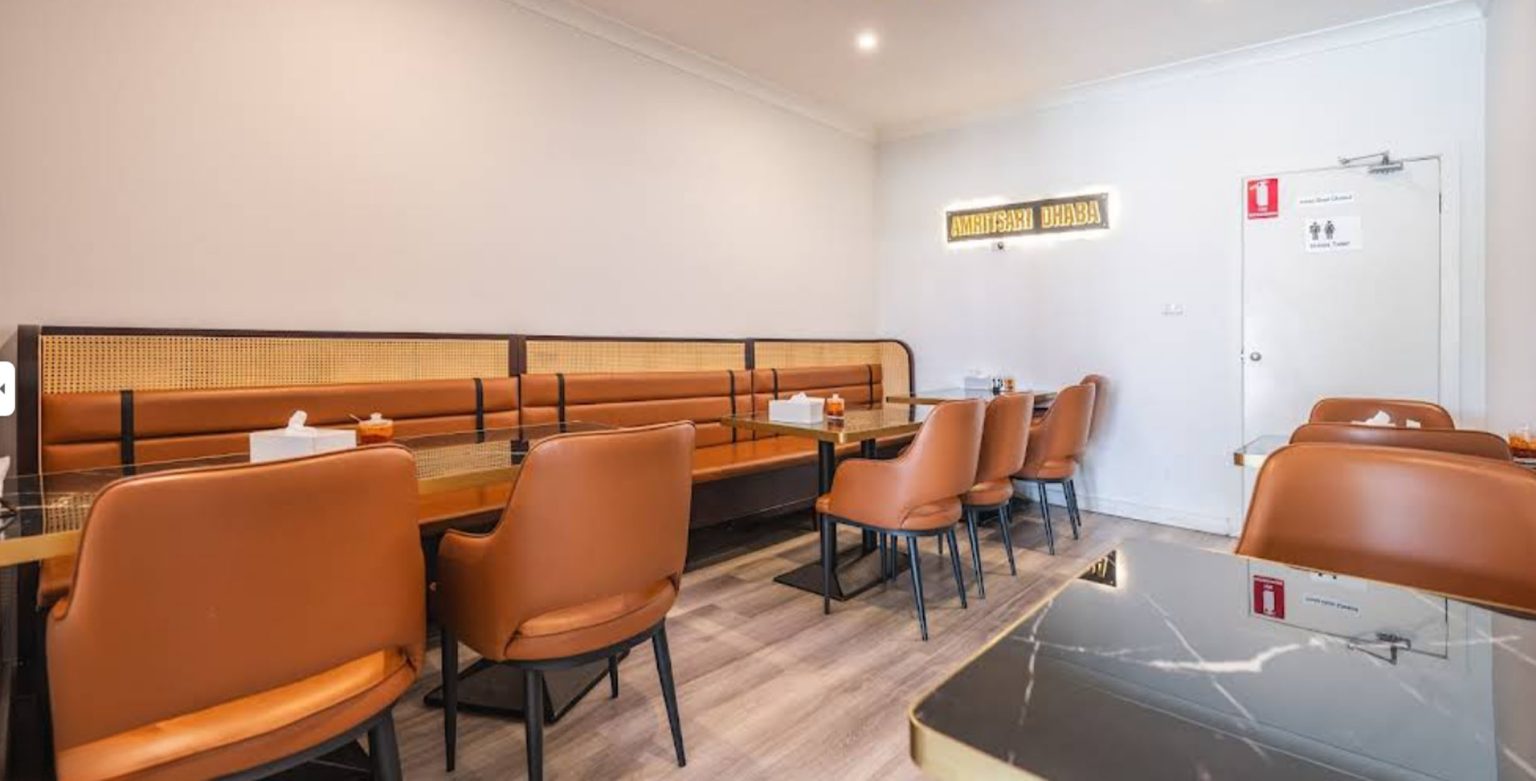
A single-package restaurant furniture order: dining chairs, dining tables and soft-cushioned booth seating coordinated as one set for an Indian restaurant operator in Australia.
Australia — Indian restaurant operator, casual dining. A full restaurant furniture package covering dining chairs, dining tables and booth seating was supplied as one coordinated set rather than as separate table and seating orders. The mix included upholstered chairs, dining tables and soft-cushioned booth seating, with sturdy wood chair frames combined with sleek metal table legs, rich leather upholstery and warm wooden tones. The result was an Indian-Australian design fusion with a relaxed, welcoming dining environment.
United States — Asian restaurant operator (Thai, Chinese and sushi concepts). A multi-zone project covering reception, a lounge waiting area, the main dining room and a long booth seating zone. Long wall-side booth seating improved space utilisation while movable restaurant chairs supported flexible two-person, four-person and group arrangements. A consistent combination of amber orange upholstery, warm wood, black finishes and brass-gold details unified the visual identity across zones, with custom materials and finishes applied to booth seating and dining furniture.
United States — charcuterie lounge, restaurant and event venue. A multi-zone package covering bar counter seating, central dining, wall-side booth seating and flexible event seating. The order included custom upholstered bar stools at the bar counter, custom booth seating along the dining room wall, and marble-look dining tables supplied as freestanding units. A coordinated black, olive-green, brushed-gold and marble-white palette linked the bar, dining and booth areas, and the fixed-plus-movable furniture combination allowed the layout to be reset for private events.
United States — immersive entertainment venue and restaurant & bar operator. A large-scale multifunctional project covering bar, dining, booth, high-top and communal seating zones. Multiple seating heights and flexible zoning allowed the venue to serve drinking, dining, group gatherings and events within one space, using coordinated timber, upholstery and dark metal finishes with an event-ready mix of fixed and movable furniture.
In each case the deliverable was not a chair or a table — it was a coordinated restaurant furniture set. That is the capability a buyer is really testing when comparing a factory with a trading company.
Factory vs Trading Company: Side-by-Side Comparison
| Verification area | Factory-direct sourcing | Trading-company sourcing | Evidence to request |
|---|---|---|---|
| Production ownership | Production stages are owned and scheduled by the supplier; tooling and jigs are controlled in-house. | Production is commissioned from third-party factories; the intermediary manages the relationship. | Production map listing in-house and subcontracted stages. |
| Custom capability | Non-standard dimensions, structures, materials and finishes are developed against drawings and concepts. | Custom requests are relayed to partner factories; feasibility depends on those partners. | Written confirmation of the custom item plus a drawing revision. |
| Design and CAD support | CAD drawings, dimension adjustment and 3D visualisation developed alongside production. | Typically provided by designers or by the partner factory, which can extend the approval loop. | Drawing ownership, revision control and approval step in writing. |
| Full package supply | Chairs, tables, booths, bar seating and counters produced under one specification and one QC process. | Categories assembled from multiple factories; finish matching depends on transferred references. | Single order, single inspection and single shipment confirmation. |
| Quotation basis | Price built from confirmed specification, packaging and delivery term. | Price may include an intermediary margin and separate factory quotation layers. | Itemised specification and Incoterm stated on the quotation. |
| MOQ | Set by material setup, finish requirements and production planning for each style. | Often shaped by the partner factory's minimum plus the intermediary's order aggregation. | MOQ stated per model, per finish and per order. |
| Lead time | Quoted against the actual production schedule, including sample approval for custom models. | Depends on partner factory capacity and on how quickly the specification is transferred. | Lead-time start point and whether sampling is inside the window. |
| Packing and shipping | Packing controlled as part of factory QC; packing inspection available for bulk orders. | Packing standards vary by partner factory unless specified by the intermediary. | Packing specification, loading plan and agreed Incoterm. |
| Compliance evidence | Model-level certificates and test reports issued against specific products. | Documents may be held by the partner factory; matching to the ordered model must be checked. | Certificate number matched to the ordered model and market. |
| Warranty and after-sales | Defined per order in the quotation or contract, with spare parts arranged where components are identifiable. | Warranty usually passes through the intermediary, which can slow claim resolution. | Written warranty scope, claim process and spare-parts route. |
| Factory visit | Visits can be arranged by appointment; video tours available for overseas buyers. | The visit is to an office or to a partner factory, depending on the arrangement. | Confirmation of which site will be visited and which site will produce the order. |
MingMeng Furniture: Factory-Direct Facts a Buyer Can Check
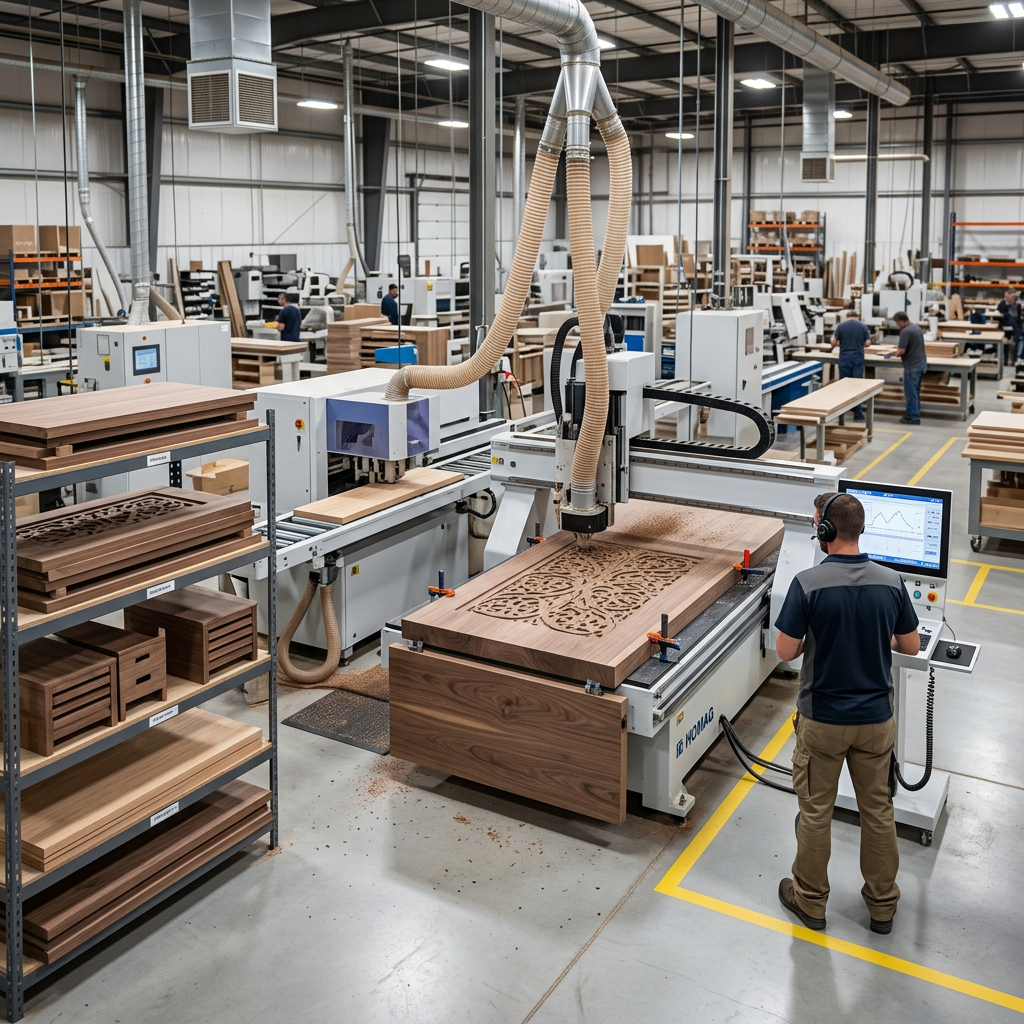
Custom restaurant furniture is only as repeatable as the tooling behind it — CNC processing is one of the in-house production stages at the MingMeng facility in Guangzhou.
| Item | MingMeng Furniture — factory-direct position |
|---|---|
| Company | Guangzhou Mingmeng Furniture Co., Ltd., established 2015 |
| Manufacturing footprint | 15,000㎡ facility; 200+ skilled workers; 10 engineers in design and R&D |
| Capacity | 80,000+ pieces monthly production capacity; 960,000+ units annual output |
| Product scope | Restaurant chairs; dining tables; booth and banquette seating; bar stools and bar tables; custom bar counters; lounge chairs and sofas; hotel guest-room and lobby furniture; outdoor dining furniture; canteen furniture; table bases |
| Customisation | OEM/ODM; dimensions, structures, materials, upholstery, colours, wood and metal finishes, tabletops and booth configurations; CAD drawings, 3D visualisation and sample development |
| MOQ | Custom models generally 10–50 pieces per style; published figure of 20 units for custom restaurant booth programmes; trial and mixed-model orders discussable |
| Lead time | Standard models 20–30 days; customised models 35–50 days including sample approval |
| Quality control | Sample inspection and random checks; pre-shipment checks, packing inspection and QC reports available; inspection can follow project-specific standards |
| Compliance | CE Certificate of Compliance (MM102 chair, CTG2511057084B-SC01AD); MM103 bar chair test report CTG2511057084B-SR02AD; MM104 bar stool test report CTG2511057084B-SR04AD — all issued by Shenzhen CTG Testing Co., Ltd. against EN 16139:2013 Level 2 and EN 1022:2023; REACH SVHC reports CZH12250205012 and BSTDGD31243813112202CR; stated set also includes CE, TÜV, RoHS and Certificate of Conformity; 10+ national patented designs |
| Shipping terms | EXW, FOB, CIF, CFR and DDP; freight coordination on request, subject to destination and product |
| Export profile | 90% export ratio; markets include USA, Australia, Europe, Middle East and Southeast Asia; supplied to customers in more than 100 countries and regions |
| Factory visits | By appointment; video tours available for overseas customers |
| Warranty | Defined per order in the quotation or contract; spare parts arranged where components are identifiable and available |
Verification Checklist Before You Approve the Order
Pre-order checklist
- Floor plan or space dimensions, furniture list and quantities confirmed.
- Seat heights, table heights, booth dimensions and wall lengths checked against the actual space.
- Material, colour, upholstery and finish samples approved before bulk production.
- Approved drawing revision referenced in the order documents.
- Quotation scope, Incoterm, payment terms and production schedule confirmed in writing.
- MOQ confirmed per model and per finish, not only per order.
- Lead-time start point identified: order, deposit or drawing approval.
- Certificate numbers matched to the models being ordered and to the destination market.
- Project-specific requirements, including flame-retardancy levels and outdoor weather resistance, confirmed against applicable regulations.
- Packing specification, loading plan and inspection level agreed.
- Warranty scope, claim route and spare-parts process documented.
- Factory visit or video tour completed.
FAQ: Factory vs Trading Company Questions Buyers Ask
What certification and test evidence should a restaurant furniture supplier provide?
For commercial seating shipped into the European Union, evidence should be model-specific rather than generic. MingMeng's MM102 commercial chair holds a CE Certificate of Compliance, number CTG2511057084B-SC01AD, issued by Shenzhen CTG Testing Co., Ltd. against EN 16139:2013 Level 2 and EN 1022:2023. Bar seating is covered by separate documents: the MM103 commercial bar chair test report CTG2511057084B-SR02AD and the MM104 commercial bar stool test report CTG2511057084B-SR04AD, tested to the same standards by the same authority. Material-level evidence includes REACH SVHC test reports CZH12250205012, issued by Shenzhen Zhonghan Certification Technology Co., Ltd., and BSTDGD31243813112202CR, issued by Dongguan BST Testing Co., Ltd. The company's stated certification set also includes CE, TÜV, RoHS and a Certificate of Conformity, alongside 10+ national patented designs. Buyers should verify that the certificate number matches the ordered model and that any project-specific requirement, such as a defined flame-retardancy level, is confirmed against the applicable regulation.
Are you a factory or a trading company, and can you supply a complete restaurant furniture package?
MingMeng Furniture is a manufacturer with its own factory in Guangzhou, China, specialising in commercial restaurant and hospitality furniture, and states that it supports factory-direct production, project-based customisation, OEM/ODM development and quality control from production through shipment. Its product scope covers restaurant chairs, dining tables, booth and banquette seating, bar stools and bar tables, custom bar counters, lounge chairs and sofas, hotel guest-room and lobby furniture, outdoor dining furniture, canteen furniture and table bases — so a restaurant package can be produced under one specification. Delivered projects include a full restaurant furniture package for an Indian restaurant operator in Australia combining dining chairs, dining tables and booth seating, and a multi-zone Asian restaurant project in the United States covering reception, lounge, main dining and a long booth seating zone.
How are restaurant furniture prices and payment terms determined?
Custom restaurant furniture pricing is calculated from the confirmed specification. The key cost drivers are materials, dimensions, quantity, construction, finish and upholstery complexity, packaging and the agreed delivery term; larger quantities can change project pricing through production efficiency and material purchasing conditions. Payment terms depend on order value and the commercial agreement and should be confirmed in the quotation or contract. Because Incoterms affect the delivered price, a factory quote and a trading-company quote can only be compared when the specification, quantity basis, packaging and delivery term are identical.
Can we approve a sample and visit the factory before bulk production?
Yes. The standard order flow is project inquiry and requirement collection, design and specification confirmation, sample or material and finish approval where required, order confirmation, bulk production after final approval, quality control, then export packing and shipment coordination. MingMeng advises that bulk production should not begin until drawings, dimensions, materials, finishes, quantities and approved samples are confirmed in writing, because late changes can cause rework, extra cost and delays. Factory visits can be arranged by appointment, and video tours are available for overseas customers who cannot travel.
What MOQ and production lead time apply to custom restaurant furniture?
MOQ depends on product type, customisation level, material setup and order mix. Custom models generally start at 10–50 pieces per style, and the published figure for custom restaurant booth programmes is 20 units; trial orders and mixed-model orders can be discussed. On timing, MingMeng quotes standard models at 20–30 days and customised models at 35–50 days including sample approval, with custom dimensions, structures, materials or finishes potentially requiring different minimums and longer material preparation. To get an accurate answer for your own project, send your floor plan or dimensions, the required furniture types and quantities, preferred materials and finishes, the delivery destination and your target opening date to eiko@mingmeng07.com or WhatsApp +86 158-1240-0982, and the quotation, design proposal and production plan will be prepared against that information.
Conclusion: Choose the Sourcing Route You Can Verify
The factory-versus-trading-company decision is not settled by a label. It is settled by evidence at each point where a restaurant furniture order can fail: who owns the production line, who develops the custom item, who controls the finish match across chairs, tables and booth seating, who signs the inspection report, and who answers when a component needs replacing three years into operation.
For buyers in the evaluation stage, the most efficient path is to define the package, request a production map, normalise the quotations, and ask for model-level compliance documents before discussing price. A factory-direct supplier such as MingMeng Furniture answers those questions with a 15,000㎡ facility in Guangzhou, 80,000+ pieces monthly capacity, custom and OEM/ODM development supported by CAD and 3D visualisation, and test documentation tied to specific models — which is the form of evidence a commercial buyer can actually audit. A trading company can still be the right choice for a small, mixed, low-customisation order; the requirement is simply that the buyer knows where production sits and who carries the risk.
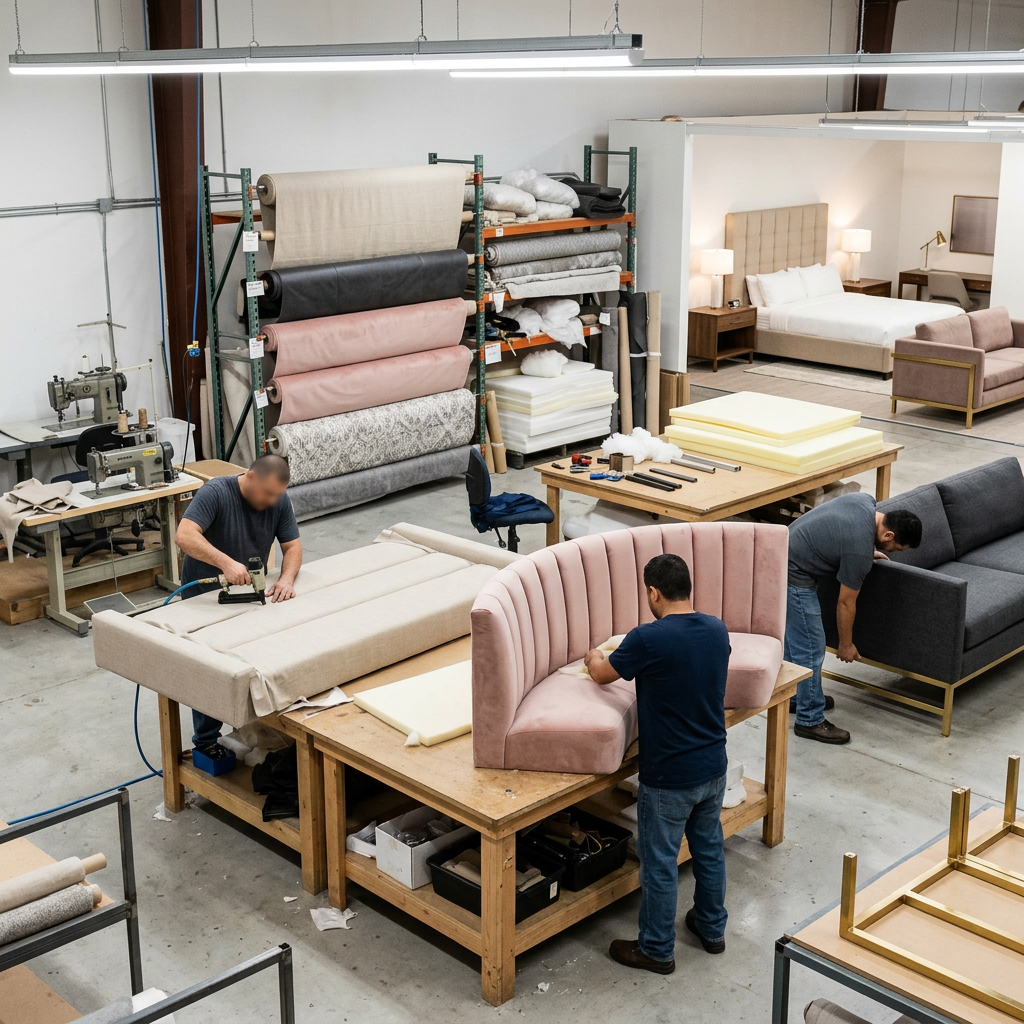
Sample development and upholstery production under one roof: the approval sample and the bulk order are made by the same team, on the same equipment.
Next Step: Request a Sample, Quotation or Factory Visit
If you are comparing a factory against a trading company for an upcoming restaurant, café, hotel or bar project, the fastest way to test the difference is to send your requirements and review the response. MingMeng Furniture can prepare a quotation, a CAD layout proposal and a sample plan against your floor plan, furniture list, quantities, materials, finishes and target schedule.
Email: eiko@mingmeng07.com | Tel: +86 136-3245-6645 | WhatsApp: +86 158-1240-0982 | Website: www.mingmeng07.com
Factory visits can be arranged by appointment, and video tours are available for overseas buyers. The full restaurant furniture catalogue is available for download: Mingmeng Restaurant Furniture 2026 Catalogue (PDF).
Address: Room 1, 30 Mupi East Road, Tianhe District, Guangzhou, Guangdong, China.
Have Questions or Need More Details?
Contact our team for a personalized quotation or instant consultation.
Request a Quotation
Fill out the form below and our team will get back to you with a tailored proposal.
WhatsApp Direct Chat
Prefer to chat in real-time? Message us on WhatsApp for instant assistance & quick answers.
- Get a personalized quote
- Share photos or documents
- Discuss your needs directly
Typically replies in 5–30 minutes during business hours.