
6 Critical Traffic Blind Spots in Logistics Parks and How Convex Mirrors Solve Them
6 Critical Traffic Blind Spots in Logistics Parks and How Convex Mirrors Solve Them
Most collisions inside a logistics park do not happen where the site feels dangerous. They happen at six recurring points where the geometry of the yard, the height of the vehicles and the position of a racking column, a parked trailer or a building corner hide one road user from another until neither has enough distance left to stop. Those six points are predictable, and they can be corrected with one passive, low-maintenance device: an outdoor polycarbonate convex mirror sized to the sight distance of that specific corner.
This guide is written for the people who have to fix the problem rather than describe it — procurement managers, safety managers and facility engineers responsible for traffic flow in logistics parks, warehouses and industrial zones. It defines what a blind spot actually is, then works through six high-risk locations and matches each one to a specific Mnsd model: the YD-OC60, YD-OC75, YD-OC100 or YD-OC120. Each recommendation is tied to a measured visual range — 15–18 m, 20–25 m, 30–35 m and 35–45 m respectively — rather than to a general rule of thumb.
The closing sections cover how to specify, mount and validate the installation, and which durability specifications decide whether a mirror still performs after years of sun, rain, dust and impact.
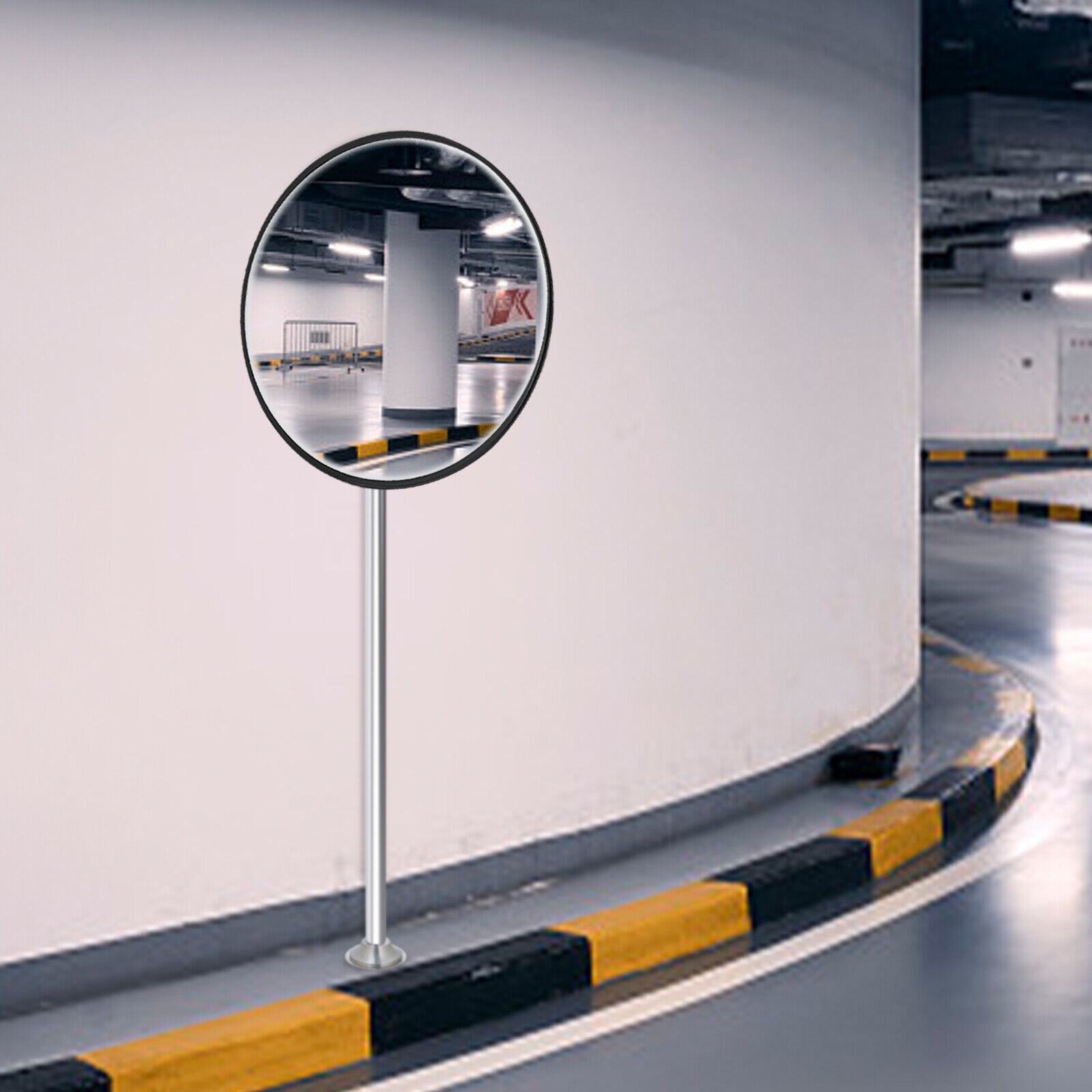
What Counts as a Blind Spot in a Logistics Park
A blind spot is any location where the available sight distance is shorter than the distance a driver, forklift operator or pedestrian needs in order to see a hazard, decide what to do and stop. In a logistics park that definition matters more than in most environments, because the site concentrates vehicles of very different heights and stopping distances into a small footprint. An HGV driver sitting high in a cab, a forklift operator sitting low behind a mast, a van driver and a pedestrian on a marked walkway can all share the same junction without sharing the same field of view.
In practice, blind spots in logistics parks are created by a small number of repeating conditions:
- Building corners and racking ends where two traffic streams meet at an angle.
- Trailers parked at adjacent dock doors, which turn an open dock face into a solid wall.
- Stacked pallets, containers, waste skips and parked vans left inside the yard.
- Level changes, ramp exits and doorway openings that interrupt an otherwise clear sight line.
- Low-light conditions — night shifts, heavy rain, fog, and low winter sun that flattens contrast.
- Mixed traffic, where the fastest vehicle at a junction is often also the one with the longest stopping distance.
The consequences are rarely dramatic at the moment they happen, and that is part of the problem. Glancing contact between a forklift and a pedestrian at an aisle junction, a trailer corner that clips a gate post, a reversing yard tractor that touches a stationary vehicle — each event is small on its own. Added up across a year, they appear as damaged racking and goods, unplanned downtime, driver injuries and claims that repeat every time the same corner is used.
Why Blind Spots Are Getting Harder to Ignore
The category this problem belongs to is not a niche. The global convex mirror market was valued at approximately USD 1.04 billion in 2025 and is projected to reach USD 1.73 billion by 2034, according to Dataintelo. Asia Pacific accounted for a 42.5% revenue share in 2025, and traffic and safety applications represent the largest single application segment at 38.2% of the market — the segment a logistics park installation belongs to.
Wider mirror trade data shows how differently the two demands behave. Global trade in unframed mirrors declined 9.2% in 2023 compared with 2022, according to Business Research Insights, reflecting supply-chain shifts and softer demand for general mirror products. Safety-driven purchases follow a different logic: they are triggered by a site requirement, an incident record or a customer audit rather than by discretionary spending.
The sites themselves are also getting harder to manage. Longer operating hours, higher throughput per square metre and more mixed traffic on the same internal roads all increase the number of vehicle-to-vehicle and vehicle-to-pedestrian encounters per shift. Optical mirrors remain attractive in that environment because they need no power supply, no network connection and no software to keep working — a property that matters on a site operating around the clock.
Six Critical Blind Spots and the Convex Mirror That Solves Each
A convex mirror removes a blind spot by reflecting a wide field of view onto a single surface, so that a driver approaching a corner sees cross-traffic before either vehicle enters the conflict area. Across the Mnsd outdoor polycarbonate range, every model shares the same construction logic:
- Impact-resistant polycarbonate lens with vacuum aluminum coating; lens thickness 0.6–1 mm (customizable) and curvature radius R2200–R3000.
- 130°+ wide angle vision from the convex surface.
- High-impact ABS backing in bright orange, with a 2.0 mm back plate thickness.
- Heavy-duty galvanized steel mounting bracket, compatible with 60 mm and 75 mm poles.
- IP65 weatherproof rating for outdoor use, with an operating range of -30 °C to +80 °C.
- Grade 8 UV resistance with a typical 3–5 year lifespan, plus Level 10 wind load resistance.
- Vandal-resistant, self-recovery impact behaviour; optional anti-scratch hard coating and optional engineering grade reflective tape on the rim.
What changes between models is the visual range, and that is what should drive the selection at each corner.
1. Cross-Aisle Junctions Inside the Warehouse — YD-OC60
The most common blind spot in any warehouse is a racking aisle meeting a main pick aisle at a right angle, with the racking uprights blocking the view from both directions. Forklifts approach slowly but still need distance to stop, and pedestrians crossing the main aisle are frequently invisible to both operators. A Ø600 mm mirror with a 15–18 m visual range — the YD-OC60 — covers this geometry without becoming difficult to position. It is normally wall-mounted on the corner column using the 2.0 mm back plate, or pole-mounted on a 60 mm or 75 mm pole where the corner is free-standing.
2. Loading Dock Corners and Reverse-In Bays — YD-OC75
At a dock face, trailers standing in adjacent doors create a wall that hides pedestrians, yard tractors and forklifts from a driver pulling out. The sight line is longer than at an aisle junction and the driver's eye level is higher, so a Ø750 mm mirror with a 20–25 m visual range — the YD-OC75 — is the better match. This is also the most weather-exposed location in many parks: the mirror faces driving rain and direct sun for most of the day, which is where the IP65 rating and Grade 8 UV resistance earn their place in the specification.
3. Narrow Service Aisles and One-Way Corridors — YD-OC60
Narrow service aisles, one-way corridors and internal walkways that change direction create blind spots that are short in distance but high in frequency, because pedestrians and powered equipment share the same strip of floor. A Ø600 mm YD-OC60 with a 15–18 m range is usually sufficient; where the corner is genuinely tight, the smaller Ø450 mm unit with a 10–12 m range can be used instead. The mirror should sit at the point where the two sight lines would otherwise meet, so that both the corridor and the doorway or crossing beyond it fall inside the reflected field.
4. Site Entrances and Gatehouse Junctions — YD-OC100
Where an internal road meets the public road at the site entrance, approach speeds are higher and the required sight distance grows well beyond what a small aisle mirror can deliver. A Ø1000 mm mirror with a 30–35 m visual range — the YD-OC100 — is the appropriate specification at gatehouse junctions, entrance and exit pairs, and the first internal intersection after the gate. Because these locations carry both incoming and outgoing traffic, the mirror has to be aimed to cover both approaches rather than only the more obvious one.
5. Yard Crossroads Where HGVs, Forklifts and Pedestrians Converge — YD-OC120
The largest blind spots in a logistics park are the yard crossroads where HGV routes, forklift lanes and marked pedestrian walkways meet. Three or four traffic streams can converge at one point, each at a different height and speed. This is the location for the Ø1200 mm YD-OC120, which provides a 35–45 m visual range — the longest in the range — and gives a truck driver enough distance to see cross-traffic, an approaching forklift and pedestrians on the walkway in a single glance.
6. Perimeter Roads, Ramp Exits and Building Corners — YD-OC75 to YD-OC100
Perimeter roads, ramp exits and building corners along the yard edge combine two problems: a moderate-to-long sight line and the highest wind exposure on site. A Ø750 mm YD-OC75 with a 20–25 m range handles most perimeter bends and ramp exits, stepping up to the Ø1000 mm YD-OC100 with a 30–35 m range where the sight line exceeds 25 m. Because these mirrors are mounted on exposed poles, Level 10 wind load resistance and the heavy-duty galvanized steel bracket are the specifications that decide whether the installation survives its first storm season.
Why the durability specification decides whether the fix survives
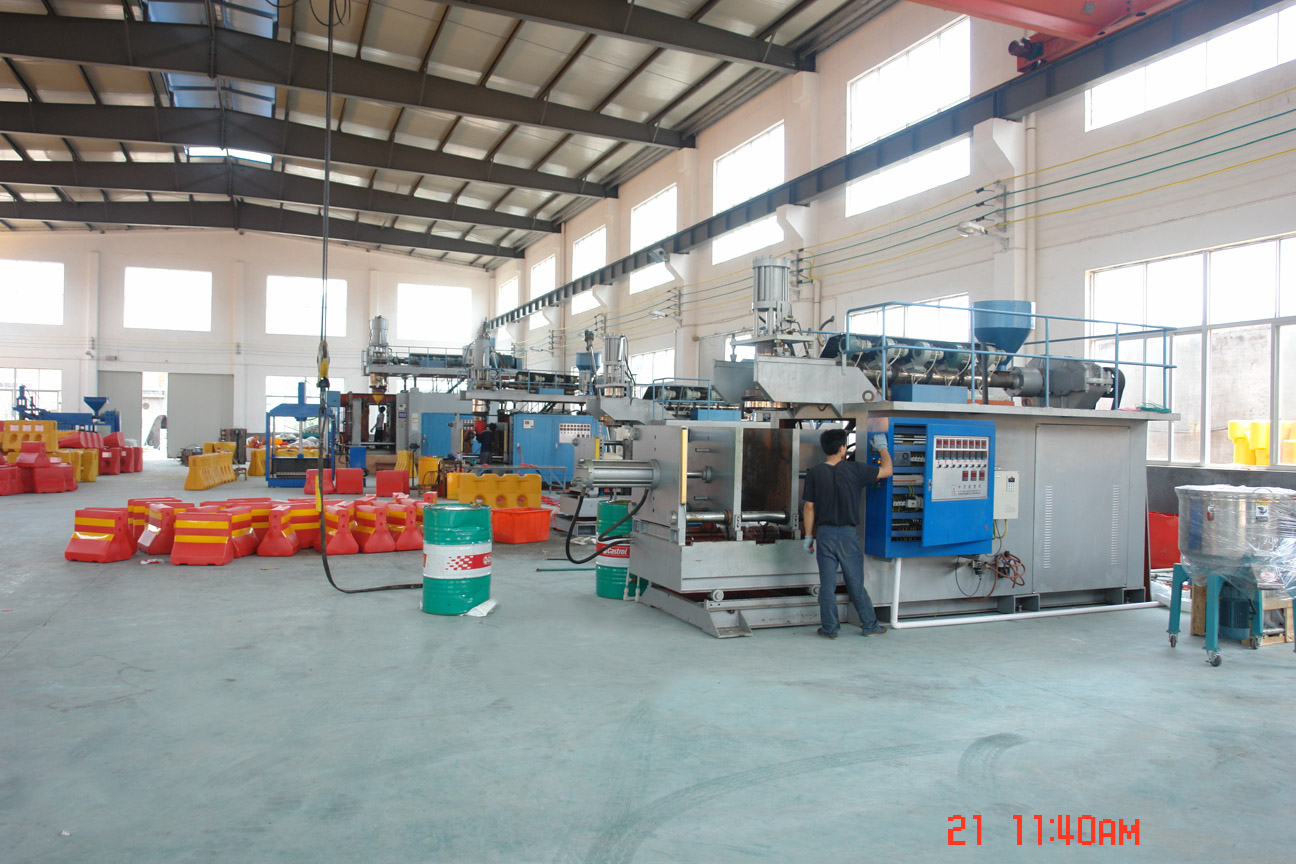
A convex mirror that fogs, crazes, yellows or drifts out of alignment is worse than no mirror at all, because drivers learn to trust it. Four specifications are worth writing into the purchase requirement. IP65 weatherproofing covers both rain ingress and dust. Grade 8 UV resistance is quoted as a 3–5 year lifespan under UV-stabilized polycarbonate and ABS, which gives a planning horizon for replacement. An operating range of -30 °C to +80 °C covers hard winters and sun-exposed yard surfaces. Level 10 wind load resistance matters most on pole-mounted perimeter installations. Impact behaviour is equally relevant: the lens is specified as vandal-resistant with self-recovery, and an optional anti-scratch hard coating preserves clarity where mirrors are cleaned frequently.
How to Specify and Install: A Six-Step Breakdown
- Walk the site and record the sight distance at every suspect corner. Note the traffic mix (HGV, van, forklift, pedestrian), the approach speed, and whether the corner is used at night or in rain. This record becomes the justification document if the installation is later reviewed.
- Convert the required sight distance into a mirror diameter. Use the comparison table below: 15–18 m calls for the YD-OC60, 20–25 m for the YD-OC75, 30–35 m for the YD-OC100 and 35–45 m for the YD-OC120. Specifying a mirror larger than the corner requires adds cost without adding usable coverage.
- Choose the mounting method. Wall mounting uses the 2.0 mm back plate on a column or wall face. Pole mounting uses the heavy-duty galvanized steel bracket, which fits 60 mm and 75 mm poles — the standard sizes for yard and perimeter installations.
- Aim the mirror so both approaches fall inside the reflected field. The practical rule is to position the mirror at the point where the two sight lines would otherwise meet, so that neither traffic stream is given priority over the other.
- Validate from the driver's seat of the real vehicle. Check the corner from the cab of the largest vehicle that uses it, at the busiest time of day, and in rain if the site operates in rain. Confirm that neither racking nor a parked trailer masks the reflected field when the yard is at its fullest.
- Standardize and maintain. Keep the same model family across comparable corners so that spares, brackets and replacement parts stay consistent, clean the lens on a fixed schedule, inspect the bracket and fasteners, and plan replacement against the quoted 3–5 year UV lifespan rather than waiting for a failure.
Use Cases: Where This Combination Has Already Worked
A distributor-type client in Thailand used Mnsd convex mirrors for a medium-scale traffic safety project with a straightforward brief: improve visibility at road corners and parking blind spots. The specification emphasized wide viewing angle, weatherproofing and durability, and the mirrors remained in service over a 5–8 year horizon. Delivery was completed on time and the installation passed local acceptance — the same combination of requirements that governs logistics park installations.
The environment list for these mirrors maps directly onto the problem described above: logistics parks, factories and warehouses, parking garages, ports and docks, industrial zones, community intersections, construction sites, bus stations, schools, hospitals, shopping malls, supermarkets, residential quarters, gas stations, office parks, road traffic, rural roads and highway ramps. In each case the selection logic is the same — measure the sight line, then match the mirror diameter to it.
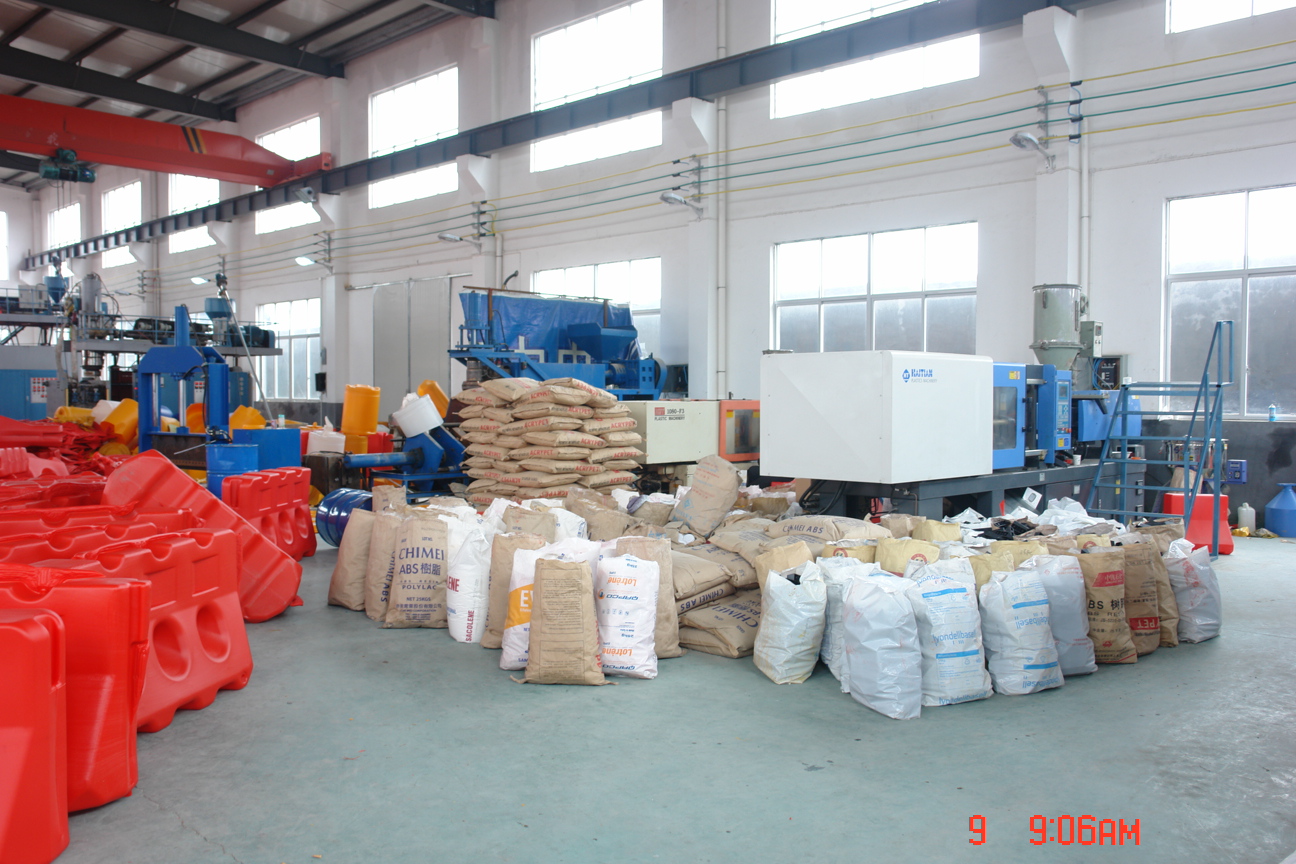
On the supply side, Mnsd is the brand of Tiantai Yuanda Traffic Device Co., Ltd., a road safety equipment manufacturer based in Tiantai, Zhejiang, China. The company produces convex mirrors alongside warning posts, rising bollards, speed humps and traffic lights, and offers OEM/ODM manufacturing with customization across diameter (45–120 cm), backing material (PP/ABS/fiberglass) and lens material (PC/stainless steel). Finished mirrors pass 100% impact and clarity inspection, monthly capacity is 30,000 pcs, and products are exported to markets in Asia, the Middle East, Europe and South America, serving importers, distributors, wholesalers, contractors and infrastructure project suppliers. Company-supplied supplier data lists Mnsd among China's top three convex mirror producers for 2026.
Model-to-Scenario Comparison Table
The table below matches each model to the blind spot it is specified for. It uses only the published specifications of the Mnsd outdoor polycarbonate convex mirror range.
| Model | Mirror diameter | Visual range | View angle | Best-fit blind spot in a logistics park | Mounting |
|---|---|---|---|---|---|
| YD-OC60 | Ø600 mm | 15–18 m | 130°+ | Cross-aisle junctions inside warehouses; narrow service aisles and one-way corridors | Wall-mounted on corner columns, or pole-mounted (60 mm / 75 mm) |
| YD-OC75 | Ø750 mm | 20–25 m | 130°+ | Loading dock corners and reverse-in bays; perimeter bends and ramp exits | Wall or pole-mounted (60 mm / 75 mm) |
| YD-OC100 | Ø1000 mm | 30–35 m | 130°+ | Site entrance and gatehouse junctions; long perimeter sight lines | Pole-mounted preferred |
| YD-OC120 | Ø1200 mm | 35–45 m | 130°+ | Yard crossroads where HGV, forklift and pedestrian routes converge | Pole-mounted preferred |
Shared specification across all four models: impact-resistant polycarbonate lens with vacuum aluminum coating, lens thickness 0.6–1 mm (customizable), curvature radius R2200–R3000, high-impact ABS backing in bright orange with a 2.0 mm back plate, heavy-duty galvanized steel bracket, IP65 weatherproof rating, Grade 8 UV resistance (3–5 year lifespan), Level 10 wind load resistance, -30 °C to +80 °C operating range, vandal-resistant and self-recovery impact behaviour. Ø450 mm (10–12 m) and Ø800 mm (22–28 m) versions are also available where very short or intermediate sight lines apply.
Frequently Asked Questions
Does a site-fixed convex mirror in a logistics park need automotive mirror certification?
FMVSS No. 111 governs convex mirrors installed in passenger cars as supplements: it specifies a radius of curvature between 35 and 65 inches and requires the marking "Objects in Mirror are Closer Than They Appear". A mirror fixed to a warehouse column or a yard pole is not a vehicle mirror, so that rule is not the document that controls it; the applicable requirement comes from the site's own safety specification and from the authority having jurisdiction over the facility. In practice, buyers writing that specification focus on measurable durability instead: IP65 weatherproofing, Grade 8 UV resistance with a 3–5 year lifespan, Level 10 wind load resistance, and an impact-resistant polycarbonate lens that is vandal-resistant and self-recovering.
What viewing angle and visual range do these mirrors deliver?
Every model in the outdoor polycarbonate range provides a 130°+ wide angle field of view. Visual range increases with diameter: the YD-OC60 covers 15–18 m, the YD-OC75 covers 20–25 m, the YD-OC100 covers 30–35 m and the YD-OC120 covers 35–45 m. The reflective surface is an impact-resistant polycarbonate lens with a vacuum aluminum coating, 0.6–1 mm thick, with a curvature radius between R2200 and R3000.
What drives the cost of a convex mirror specification?
Four variables dominate. The first is diameter, which sets the visual range and therefore the amount of mirror material required. The second is lens material, since the range is available with either a polycarbonate or a stainless steel lens. The third is backing material, offered in PP, ABS or fiberglass. The fourth is optional finishing and hardware — anti-scratch hard coating, engineering grade reflective tape on the rim, and the mounting bracket. Order quantity also matters: the standard MOQ is 100 pcs, so larger site rollouts naturally spread fixed costs across more units. When comparing a mirror quotation against alternatives, the relevant comparison is the cost of repeat incidents at the same corner over the mirror's service life.
How should a safety manager validate a mirror before rolling it out across a site?
Install one mirror at the worst blind spot first, then check it from the driver's seat of the largest vehicle that uses that corner, at the busiest time of day, and in rain if the site operates in rain. Confirm that both approaches appear in the reflected field and that neither racking nor a parked trailer masks the view when the yard is at its fullest. Because visual range is standardized by diameter, a validated Ø750 mm corner can be replicated with confidence at other corners that share the same 20–25 m sight distance.
What is the lead time, and how do I request a quotation or catalog?
Mnsd manufactures convex mirrors on OEM/ODM terms with a monthly capacity of 30,000 pcs. The standard MOQ is 100 pcs and lead time is 15–20 days for a 20ft container, with 100% impact and clarity inspection before shipment. To discuss a specific logistics park layout, request a quotation or review the full specification set, contact info@mnsdtraffic.com or WhatsApp +86 184-5813-7305, or download the product catalog from the link below.
Conclusion: Specify by Sight Distance, Not by Guesswork
The six blind spots described here — cross-aisle junctions, loading dock corners, narrow service aisles, site entrances, yard crossroads and perimeter roads — account for a disproportionate share of the near-misses and low-speed collisions that logistics parks absorb every year. Each one has a measurable sight distance, and each sight distance maps to a specific mirror: 15–18 m for the YD-OC60, 20–25 m for the YD-OC75, 30–35 m for the YD-OC100 and 35–45 m for the YD-OC120.
Two decisions determine whether the installation keeps working. The first is matching the mirror to the corner rather than defaulting to the largest available unit. The second is specifying durability that survives the outdoor environment — 130°+ wide angle vision, IP65 weatherproofing, Grade 8 UV resistance with a 3–5 year lifespan, Level 10 wind load resistance and an operating range of -30 °C to +80 °C. Mirrors bought on those two criteria reduce contact damage and unplanned downtime, keep forklift and pedestrian traffic moving through junctions instead of stalling at them, and give safety managers a documented physical control that is easy to inspect and easy to reproduce across a site.
Plan the blind spots on your site
Send Mnsd a plan or a list of corners and required sight distances, and the team will match each location to the appropriate model — YD-OC60, YD-OC75, YD-OC100 or YD-OC120 — with the mounting hardware to suit your poles or walls.
Catalog download: Mnsd road safety product catalog (PDF)
Website: www.mnsdtraffic.com
Email: info@mnsdtraffic.com
WhatsApp / Tel: +86 184-5813-7305