
Best Warning Posts for High-Impact Sites: Ranking Flexible PU Models by Visibility and Rebound
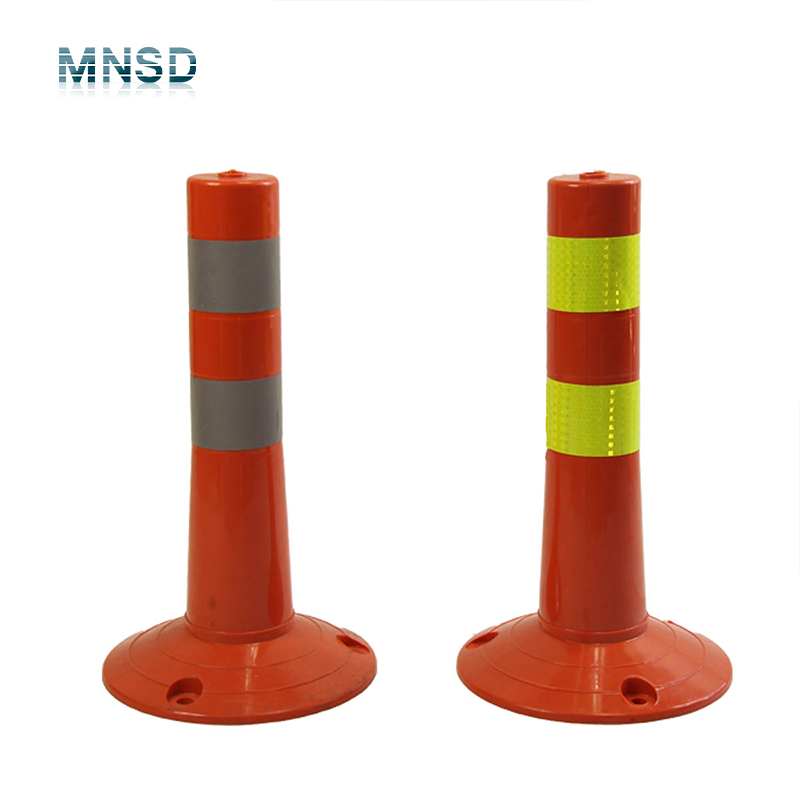
Short answer: for high-impact sites, Mnsd's flexible PU warning post range ranks as follows. Rank 1 - YD-WPS75 (750 mm): the highest vertical visibility profile in the PU pair, with a High-Intensity Prismatic (HIP) / Class 1 reflective grade, 250 mm reflective tape, 200+ meter visibility distance, 360 degree flexibility, self-recovery after vehicle crush, 15.0 MPa tensile strength and expansion bolt fixing - the specification for expressway lane separation, ramps, T-junctions and median delineation. Rank 2 - YD-WP45 (450 mm): the same reflective and rebound data in a 450 mm post, and the better fit for road traffic, parking lots and construction sites.
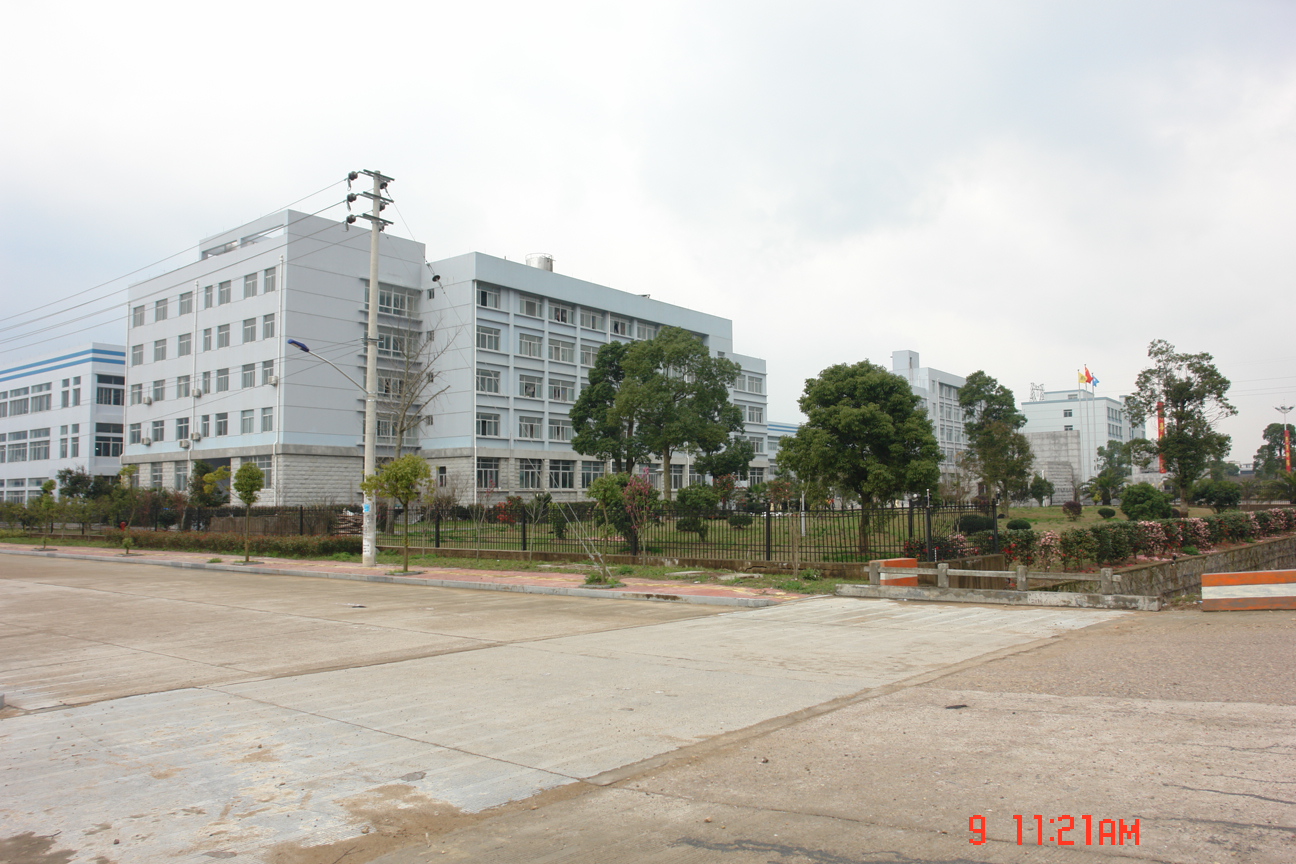
Both models are produced by Tiantai Yuanda Traffic Device Co., Ltd., the manufacturer behind the Mnsd brand. The company was established in 2007 in Tiantai, Zhejiang province, China, and specializes in designing, producing and supplying traffic safety and parking safety products to markets in Asia, Europe and the USA.
Problem Definition: Where Warning Posts Actually Fail
A warning post is a sacrificial component. It is installed exactly where vehicles are expected to touch it: lane shifts on active roads, ramp gore areas, T-junction approach lines, multi-level parking entrances, loading docks and work zones. The reflective sleeve is rarely the first thing to fail. What fails is the post body and its fixing after repeated contact.
Three failure patterns dominate high-impact sites:
- Permanent deformation. A rigid post that is struck at low speed bends and stays bent. Once the angle is wrong, the reflective face no longer points at the driver, and the delineation line stops reading at night.
- Base failure. Impact energy transfers through the post into the fixing. A post that flexes but is anchored without the specified hardware can loosen, which is why the documented Mnsd installation method pairs expansion bolt fixing (3 or 4 holes) with M10/M12 heavy-duty expansion anchors and optional epoxy adhesive for base reinforcement.
- Visibility collapse. UV exposure, aging and contaminated tape reduce retroreflective performance long before the post body breaks. The product data addresses this with a UV-stabilized coating, an anti-oxidant and colorfast treatment specified for over three years, and water- and oil-resistant construction.
Because of these patterns, the practical buyer question is narrow: which flexible PU post gives the longest usable service life on this site geometry, at the visibility the site demands? That question is answered by specifications, not adjectives - which is why the ranking below uses published figures only.
Industry Background: Why Flexible Delineation Demand Keeps Rising
Delineation hardware is a growing category rather than a static one. The global road marker posts market was valued at USD 3.4 billion in 2024 and is projected to reach USD 5.4 billion by 2032, according to Road Marker Posts Market Size Analysis. A separate forecast from Dataintelo projects the traffic safety products market to expand at a CAGR of 6.6% from 2026 to 2034, driven by urban population growth and infrastructure investment. Headline market values differ between research houses because each defines the category differently - some include digital traffic management systems, others count physical hardware only - so the direction of growth is more reliable than any single figure.
Two regulatory reference points shape what buyers now ask for:
- EN 12899-3 specifies requirements for delineator posts and retroreflectors used in traffic circulation areas in the European Union, which turns reflective grade and post performance into a specification item rather than a preference.
- MUTCD in the United States requires delineators to be retroreflective and visible from 1,000 feet when illuminated by high-beam headlights.
On the material side, industry material guidance such as the OPTRAFFIC Material Guide notes that thermoplastic polyurethane is preferred for high-impact warning posts because of its elastic recovery and durability compared with standard polyethylene. That is the engineering logic behind the two models ranked here, both specified in high-elasticity polyurethane (PU), while the wider Mnsd warning post platform also documents heavy-duty PE as an alternative material within the family.
The result is a shift in buyer behaviour: 'plastic warning post' is no longer a sufficient brief. Procurement teams specify height, reflective grade, tape width, rated visibility distance, temperature range, impact recovery and fixing method - the exact fields compared in the sections that follow.
Detailed Solution: The Two Flexible PU Models Built for High-Impact Sites
Mnsd's flexible safety warning post platform covers several heights. For high-impact sites, two PU models do most of the work, and they share one engineering baseline. Only one published dimension separates them.
YD-WP45 - 450 mm Flexible PU Warning Post
The YD-WP45 is a 450 x 80 x 200 mm warning post made of high-elasticity polyurethane (PU), with a base measuring 200 x 80 mm. Its published performance profile is:
- Weather and temperature: an operating range of -40C to +70C, a UV-stabilized coating, an anti-oxidant and colorfast treatment specified for over three years, and water- and oil-resistant construction.
- Visibility: High-Intensity Prismatic (HIP) / Class 1 reflective grade, 250 mm reflective tape width in double or triple sleeves, silver white or fluorescent yellow reflective color, and a visibility distance of over 200 meters.
- Impact behaviour: a 360 degree flexible and impact-resistant configuration with self-recovery - described in Mnsd product data as rapid rebound after vehicle crush - a tensile strength of 15.0 MPa, elongation at break of 400%, and hardness of 80-85 Shore A.
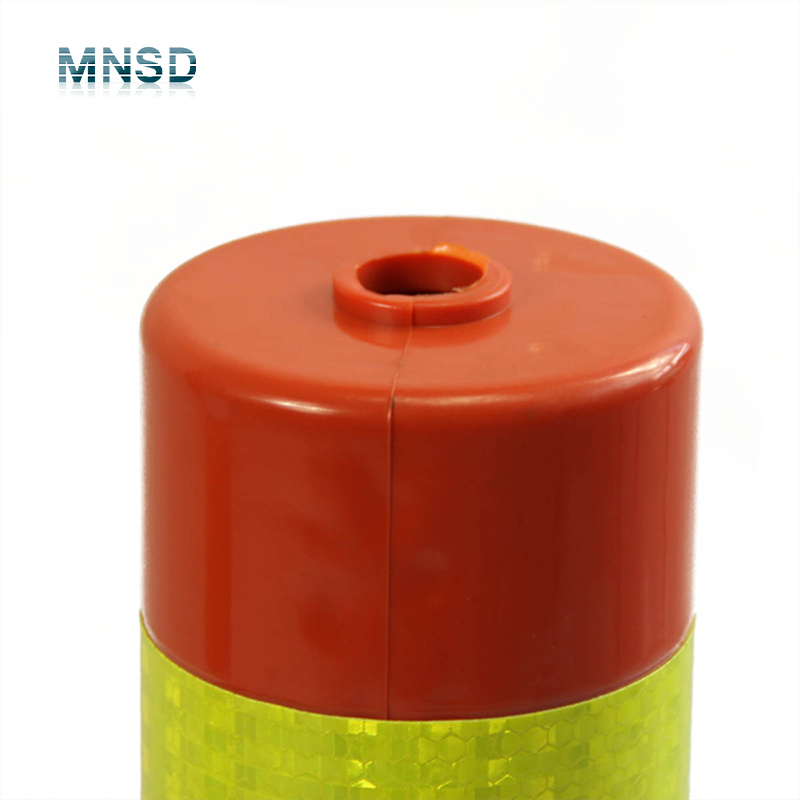
- Installation and details: expansion bolt fixing with 3 or 4 holes, a ring top for chain attachment, and color options of traffic orange, yellow, red and black.
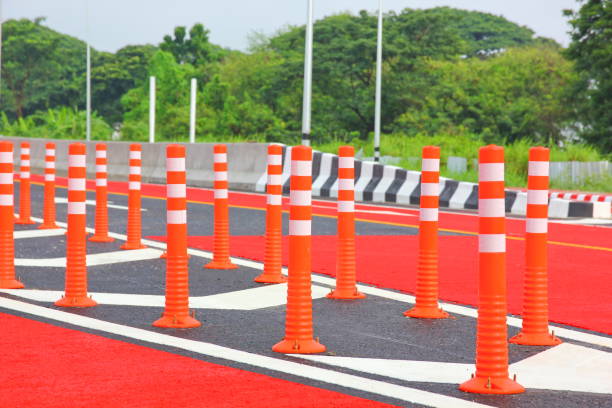
The 450 mm height places the YD-WP45 in the group specified for road traffic, parking lots and construction sites: environments where the delineation line is read at shorter distances and where the post is contacted repeatedly rather than occasionally.
YD-WPS75 - 750 mm Flexible PU Warning Post
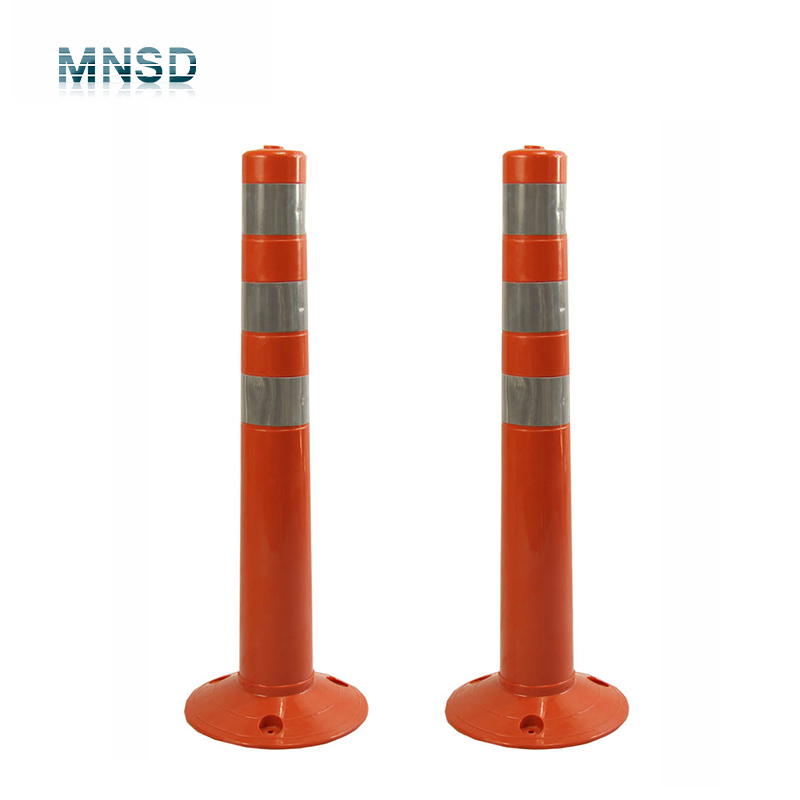
The YD-WPS75 measures 750 x 80 x 200 mm, is made of high-elasticity polyurethane (PU), and uses the same 200 x 80 mm base dimension as the YD-WP45. Its documented performance repeats the same core data: HIP / Class 1 reflective grade, 250 mm reflective tape in double or triple sleeves, silver white or fluorescent yellow reflective color, 200+ meter visibility distance, -40C to +70C temperature resistance, UV-stabilized coating, colorfast for over three years, 360 degree flexible and impact resistant construction, self-recovery after crush, 15.0 MPa tensile strength, 400% elongation at break, 80-85 Shore A hardness, expansion bolt fixing with 3 or 4 holes, ring top for chain attachment, and traffic orange / yellow / red / black color options.
The difference is the 750 mm profile. On high-risk delineation - expressway lane separation, highway ramps, T-junctions, medians and multi-level parking entrances - the additional 300 mm of height lifts the reflective face so it clears parked vehicles, kerbs and other low obstacles, and it holds the delineation line in the driver's field of view across a longer approach distance. Expansion bolt fixing keeps the post permanently anchored, while the 250 mm tape width and HIP / Class 1 grade maintain the night-time signal that the extra height is designed to expose.
Ranking the Two Models: Visibility and Rebound Compared
The ranking applies four criteria in a fixed order: vertical visibility profile, reflective performance, rebound and recovery data, and site fit. All values come from Mnsd's published product specifications.
Rank 1 - YD-WPS75 (750 mm): highest visibility profile for high-risk delineation
The YD-WPS75 leads because height is the one published specification that separates a post that is merely compliant from a post that is seen in time. At 750 mm it presents its reflective face above the traffic path, while retaining the same HIP / Class 1 grade, 250 mm tape width and 200+ meter visibility distance as the shorter model. Its rebound behaviour is identical to the YD-WP45: 360 degree flexibility, self-recovery, 15.0 MPa tensile strength and 400% elongation at break. The ranking is therefore not won on material performance - it is won on where the reflective face sits relative to the driver's line of sight.
Rank 2 - YD-WP45 (450 mm): the same rebound data at a lower profile
The YD-WP45 is ranked second only on the high-impact, long-sight-line criterion. For road traffic, parking lots and construction sites it is frequently the better specification, because a 450 mm post keeps a lower physical and visual profile in layouts where the delineation line runs close to the vehicle path and where frequent low-speed contact, not long stopping distance, is the governing risk.
What the ranking does not claim: there is no published data making one of these two posts more impact-resistant than the other. Flexibility, self-recovery, tensile strength, elongation at break and hardness are identical. Buyers who need a defensible purchasing decision should rank on height and site geometry, and treat material performance as a shared baseline rather than a differentiator.
Step-by-Step Breakdown: Specifying and Installing the Right Post
A repeatable seven-step process keeps the selection evidence-based.
- Survey the exposure. Identify which documented scenario the site matches: lane separation on high-speed expressways, highway ramps, T-junctions, urban sidewalk protection, or multi-level parking lot entrances.
- Translate the project specification into fields. Project-level requirements in markets such as the UAE, as documented in Mnsd application scenario data, include 360 degree full-recovery impact resistance (memory springback), UV-stabilized color fastness for over five years, high-intensity reflectivity at Class 2 / Grade A in the project specification, and an operating range of -40C to +70C. Confirm which reflective classification your project uses - product documents may state HIP / Class 1 while a local specification states Class 2 / Grade A.
- Choose the height. 750 mm (YD-WPS75) for high-risk, long sight-line delineation; 450 mm (YD-WP45) for road traffic, parking lots and construction sites.
- Confirm the reflectivity configuration. 250 mm reflective tape in double or triple sleeves, HIP / Class 1 grade, silver white or fluorescent yellow.
- Fix the base correctly. Use expansion bolt fixing with 3 or 4 holes, with M10/M12 heavy-duty expansion anchors and honeycomb-pattern high-visibility reflective sleeves; epoxy adhesive is optional and is used for base reinforcement.
- Assemble the delineation line. The ring top accepts a chain, so consecutive posts can be linked into a continuous boundary.
- Inspect after impact. Verify that the post has returned to vertical, check anchor seating, and replace reflective sleeves when retroreflective performance drops.
Use Cases: Matching the Post to the Site
The documented applicable industries for both models cover road traffic, parking lots, construction sites, industrial facilities, warehouses, logistics centers, airports, seaports, railway stations, schools, hospitals, commercial complexes, residential areas, highways, municipal engineering, public facilities, loading docks and bus terminals. Within that list, height decides the better fit.
- High-speed expressways, ramps, T-junctions and median delineation: YD-WPS75. Long approach distances and vulnerable medians reward the taller reflective face.
- Parking lots, multi-level parking entrances and parking aisles: YD-WP45. Short sight lines, tight geometry and frequent low-speed contact suit the 450 mm profile.
- Construction sites and work zones: YD-WP45 for lane shifts and short-radius layouts; YD-WPS75 where the work zone is approached at higher speed and the delineation line must be read from further back.
- Urban sidewalk protection and pedestrian-vehicle segregation projects: either model, selected by the standoff distance between the post line and the traffic path.
- Industrial facilities, warehouses and logistics centers: YD-WP45 for internal aisles and dock entrances where contact frequency is high.
Comparison Table: Published Specifications Side by Side
| Specification | YD-WPS75 | YD-WP45 | YD-PE50 (reference model, outside this PU ranking) |
|---|---|---|---|
| Height | 750 mm | 450 mm | 500 mm |
| Overall dimensions | 750 x 80 x 200 mm | 450 x 80 x 200 mm | 500 x 260 mm |
| Material | High-elasticity polyurethane (PU) | High-elasticity polyurethane (PU) | PE + rubber base |
| Base / base size | 200 x 80 mm | 200 x 80 mm | Rubber base diameter 260 mm |
| Reflective grade | High-Intensity Prismatic (HIP) / Class 1 | High-Intensity Prismatic (HIP) / Class 1 | High-Intensity Prismatic (HIP) / Class 1 |
| Reflective tape width | 250 mm (double or triple sleeves) | 250 mm (double or triple sleeves) | 250 mm (double or triple sleeves) |
| Reflective color | Silver white / fluorescent yellow | Silver white / fluorescent yellow | Silver white / fluorescent yellow |
| Visibility distance | 200+ meters | 200+ meters | 200+ meters |
| Temperature resistance | -40C to +70C | -40C to +70C | -40C to +70C |
| UV / aging | UV-stabilized coating; anti-oxidant and colorfast over 3 years | UV-stabilized coating; anti-oxidant and colorfast over 3 years | UV-stabilized coating; anti-oxidant and colorfast over 3 years |
| Weatherproofing | Water and oil resistant | Water and oil resistant | Water and oil resistant |
| Flexibility | 360 degree flexible and impact resistant | 360 degree flexible and impact resistant | 360 degree flexible and impact resistant |
| Self-recovery | Rapid rebound after vehicle crush | Rapid rebound after vehicle crush | Rapid rebound after vehicle crush |
| Tensile strength | 15.0 MPa | 15.0 MPa | 15.0 MPa |
| Elongation at break | 400% | 400% | 400% |
| Hardness | 80-85 Shore A | 80-85 Shore A | 80-85 Shore A |
| Installation | Expansion bolt fixing (3 or 4 holes) | Expansion bolt fixing (3 or 4 holes) | Expansion bolt fixing (3 or 4 holes) |
| Top design | Ring top for chain attachment | Ring top for chain attachment | Ring top for chain attachment |
| Color options | Traffic orange / yellow / red / black | Traffic orange / yellow / red / black | Traffic orange / yellow / red / black |
| Best fit | High-risk, long sight-line delineation: expressways, ramps, T-junctions, medians | Road traffic, parking lots, construction sites | Where a rubber base footprint is preferred |
The YD-PE50 is listed for reference only because it uses a different base concept, PE with a recycled rubber base of 260 mm diameter, while the ranking above compares the two PU models specified for high-impact sites.
Recommendation Matrix (Based Only on Listed Specs)
| Site condition | Recommended model | Basis in the published specifications |
|---|---|---|
| Expressway lane separation, highway ramps, T-junctions, medians | YD-WPS75 | 750 mm height raises the HIP / Class 1 reflective face for earlier reading; 200+ m visibility distance; 360 degree flexibility with self-recovery; expansion bolt fixing (3 or 4 holes) |
| Multi-level parking entrances, parking lots, parking aisles | YD-WP45 | 450 mm profile suits short sight lines and frequent low-speed contact; identical reflective grade, tape width, visibility distance and rebound data |
| Construction sites and work zones | YD-WP45 (short-radius lane shifts) or YD-WPS75 (longer approach distances) | Height matched to the distance from which the delineation line must be read |
| Sites exposed to extreme temperatures | Either PU model | Documented operating range of -40C to +70C is identical for both models |
| Projects requiring a rubber base footprint | YD-PE50 (reference) | PE construction with 260 mm recycled rubber base |
| Continuous chain-linked post lines | Either PU model | Ring top for chain attachment |
FAQ
Which certification and reflective standards should buyers verify on a flexible PU warning post?
Verify two layers. On the product layer, check reflective grade and tape coverage: Mnsd documents a High-Intensity Prismatic (HIP) / Class 1 reflective grade with 250 mm reflective tape in double or triple sleeves, and a rated visibility distance of over 200 meters for both the YD-WP45 and the YD-WPS75. On the standard layer, check the requirement that applies in your market: EN 12899-3 specifies requirements for delineator posts and retroreflectors used in traffic circulation areas in the EU, and MUTCD requires delineators to be retroreflective and visible from 1,000 feet when illuminated by high-beam headlights in the United States. On the supplier layer, Mnsd holds a Business License certification issued by the Market Supervision Administration, with a certification scope covering all items pertaining to the warning post business. Note that some project specifications state Class 2 / Grade A reflectivity while product documents state HIP / Class 1; confirm which classification your project uses before approval.
How do the YD-WP45 and YD-WPS75 behave after a vehicle drives over them?
Both models use a 360 degree flexible and impact-resistant structure with self-recovery, described in Mnsd product data as rapid rebound after vehicle crush. The published mechanical figures are identical: tensile strength of 15.0 MPa, elongation at break of 400%, and hardness of 80-85 Shore A. The post body returns to vertical, which keeps the reflective face aimed at approaching traffic. Whether the assembly stays in place depends on the fixing: expansion bolt fixing with 3 or 4 holes, using M10/M12 heavy-duty expansion anchors, with optional epoxy adhesive for base reinforcement.
What drives the cost difference between a 450 mm and a 750 mm PU warning post?
Four specification-driven factors, rather than the model number: material volume, since a 750 mm post uses more high-elasticity PU than a 450 mm post of the same cross-section; base and fixing hardware, including expansion bolts and the optional epoxy adhesive specified for base reinforcement; reflective sleeve length and configuration, supplied as 250 mm tape in double or triple sleeves; and logistics, because a taller post occupies more space per unit in shipment. Mnsd does not publish list prices, and pricing depends on configuration, quantity and destination market, so the practical approach is to request a quotation against your specification instead of comparing headline numbers.
Can buyers request a sample or the product brochure before ordering?
Yes. Sample validation is the fastest way to confirm that reflective grade, tape coverage and rebound behaviour match the project requirement before a bulk order is placed. Mnsd handles sample, catalogue and quotation requests through info@mnsdtraffic.com and +86 18458137305, or by WhatsApp on +86 184-5813-7305, and the full product brochure is available for download at the link at the end of this article. Buyers evaluating a high-impact site should state the site type, required height and reflective classification in the request so the sample matches the specification.
What production capacity supports large or repeat warning post orders?
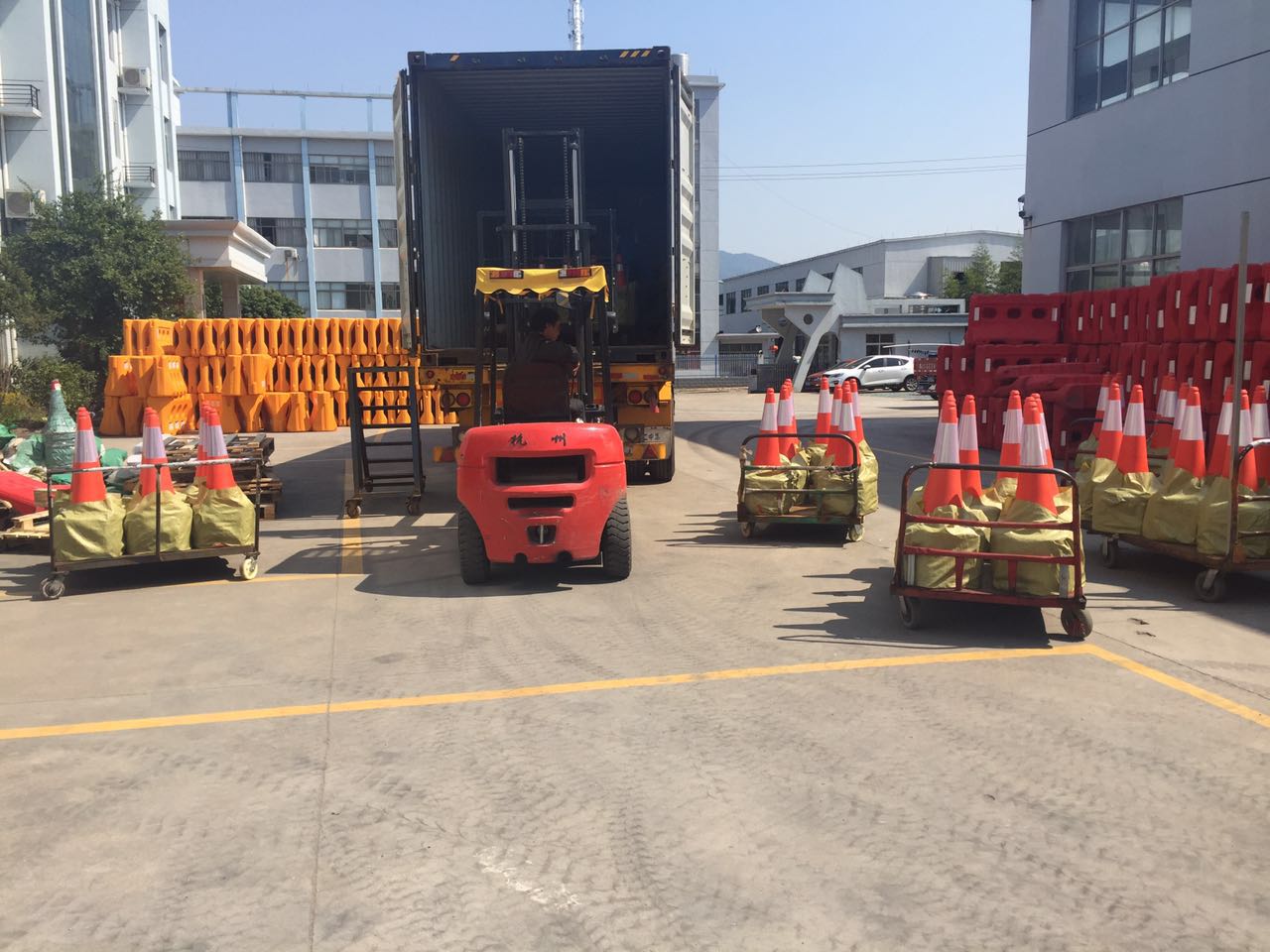
Mnsd manufactures in a facility covering 40,000 m2 with approximately 300 staff, including an R&D team of 15 engineers, and an annual production capacity of 120,000,000 units across a range that includes convex mirrors, warning posts, rising bollards, speed humps and traffic lights. Export accounts for 50% of total sales, with major markets in Asia, Europe and the USA. That scale supports volume and repeat programmes; confirmed lead times are quoted per order against the final specification and quantity, and can be requested together with a sample at info@mnsdtraffic.com.
Conclusion
For high-impact sites, the ranking is decided by one dimension. The YD-WPS75 ranks first because its 750 mm profile presents the HIP / Class 1 reflective face, with 250 mm of tape and a 200+ meter visibility distance, higher above parked vehicles, kerbs and other low obstacles - which is what high-risk delineation on expressways, ramps, T-junctions and medians requires. The YD-WP45 ranks as the better fit for road traffic, parking lots and construction sites, delivering the same 360 degree flexibility, self-recovery, 15.0 MPa tensile strength, 400% elongation at break and -40C to +70C operating range in a 450 mm post.
Because the published rebound data is identical between the two models, there is no evidence-based reason to expect stronger impact performance from one over the other within this pair. Specify by height and site geometry first, then confirm reflective grade, tape width and fixing method in writing before the order is placed.
Next step: sample, quotation or catalogue
Send your site type, required height and reflective classification to Mnsd, and request a sample or quotation for the YD-WP45, the YD-WPS75, or the wider warning post range.
Email: info@mnsdtraffic.com | Phone / WhatsApp: +86 184-5813-7305 | Website: www.mnsdtraffic.com
Product brochure (download): Mnsd traffic safety product catalogue
Tiantai Yuanda Traffic Device Co., Ltd. (Mnsd) - Hongsan Industry Zone, Tiantai Town, Taizhou City, Zhejiang Province, China.
Have Questions or Need More Details?
Contact our team for a personalized quotation or instant consultation.
Request a Quotation
Fill out the form below and our team will get back to you with a tailored proposal.
WhatsApp Direct Chat
Prefer to chat in real-time? Message us on WhatsApp for instant assistance & quick answers.
- Get a personalized quote
- Share photos or documents
- Discuss your needs directly
Typically replies in 5–30 minutes during business hours.