
How Flexible Warning Posts Prevent Costly Collision Damage in Tight Parking Garages
How Flexible Warning Posts Prevent Costly Collision Damage in Tight Parking Garages
Flexible warning posts prevent costly collision damage in tight parking garages because they yield instead of resist. A high-elasticity polyurethane (PU) warning post bends through 360° when a vehicle touches it, takes the contact as elastic deformation, and rebounds upright as the vehicle passes. A rigid bollard does the opposite: it holds its line, transfers the force into the vehicle body and into its own anchor, and often ends up bent, cracked, or sheared off — leaving the conflict point it was protecting unmarked until someone replaces it.
For garage operators, facility managers, and the contractors who fit out parking decks, the practical question is not whether a post looks sturdy. It is what happens during the two seconds when a reversing SUV, a delivery van, or a distracted driver clips the corner of a ramp. That is the moment where flexible delineation changes the repair bill.
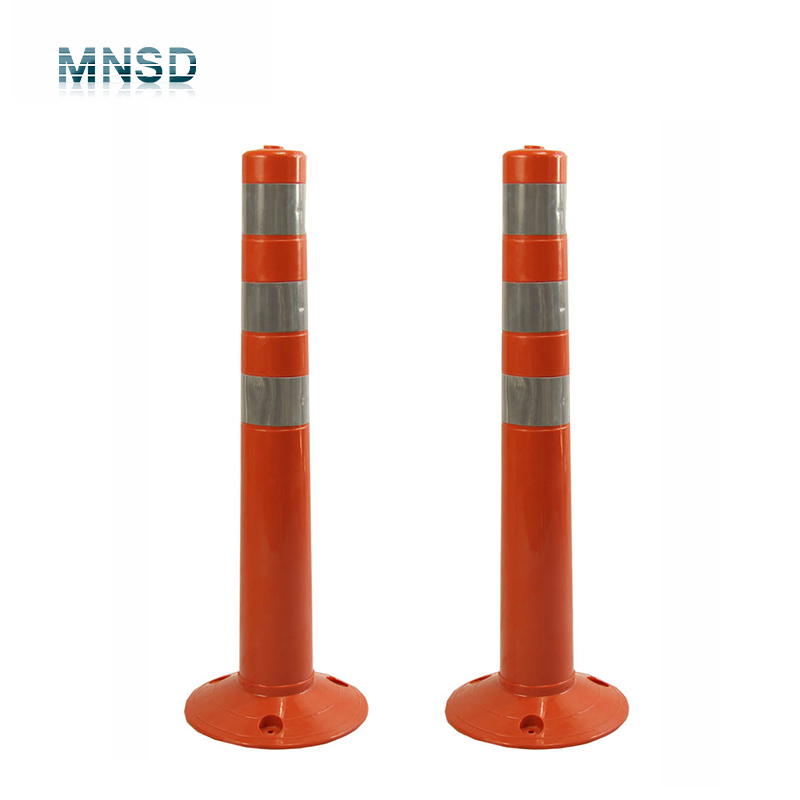
Mnsd YD-WPS75, a 750 mm pure PU warning post supplied for high-visibility parking and traffic delineation.
What Counts as Costly Collision Damage in a Tight Parking Garage
Collision damage in a confined garage is rarely a single line item. It usually appears in three layers at once:
- Vehicle damage. Bumper covers, parking sensors, lamp units, and paintwork are the first cost, and they are usually paid by a driver, an insurer, or a fleet operator.
- Structure and fixture damage. Posts, column guards, wall coatings, conduits, and signage take the second hit, and repairs often require closing the bay or the lane while the work is done.
- Operational and liability cost. A broken post leaves the conflict point unmarked. Until it is replaced, the same corner is unprotected, and the next incident becomes more likely than the first.
Tight garages concentrate all three layers. Column grids leave narrow bay approaches. Ramp mouths and stair cores create blind corners. Ceiling heights and drainage falls limit what can be installed at all. And the same deck is used by sedans, SUVs, vans, and service vehicles with very different turning radii. In that environment, a hard, immovable object placed inside the driving envelope stops being a warning and becomes an impact target.
Rigid bollards fail in two predictable ways in this setting. Either they stay standing and pass the impact into the vehicle, which is the expensive outcome for the car, or they break, bend, or pull out of their fixing, which is the expensive outcome for the facility. Both outcomes are familiar to operators of underground and multi-storey garages, and both are exactly what a flexible post is engineered to avoid.
Industry Background: Why Flexible Delineation Is Being Specified More Often
The market context supports the shift. The global road marker posts market was valued at USD 3.4 billion in 2024 and is projected to reach USD 5.4 billion by 2032, according to Road Marker Posts Market Size Analysis. Dataintelo projects the broader traffic safety products market to expand at a CAGR of 6.6% from 2026 to 2034, driven by urban population growth and infrastructure investment.
Buyers should treat headline market figures with some care. Depending on whether digital traffic management systems are counted alongside physical hardware, published 2024 estimates for the traffic safety market range from USD 6.4 billion (Strategic Market Research) to USD 12.5 billion (Spherical Insights). The growth direction is consistent; the absolute numbers are not directly comparable.
Standards are the more useful reference point for a garage project. In Europe, EN 12899-3 specifies requirements for delineator posts and retroreflectors used in traffic circulation areas. In the United States, MUTCD requires delineators to be retroreflective and visible from 1,000 feet when illuminated by high-beam headlights. ASTM D2765, which measures the gel content and swell ratio of crosslinked ethylene plastics, is one of the test procedures relevant to industrial safety products. These documents tell a specifier what a warning post has to achieve; they do not tell them which material will survive repeated contact.
Material guidance answers that second question. Published material guidance from OPTRAFFIC rates thermoplastic polyurethane (TPU) above standard polyethylene (PE) for high-impact warning posts, citing elastic recovery and durability. The same reasoning is why the Mnsd flexible range uses high-elasticity PU as its primary body material.
On the supply side, the traffic equipment category is dominated by a small group of global names: Global Market Insights reports that 3M, Honeywell, and SWARCO together hold approximately 39.2% of the market (Top 5 share). For a garage project, that concentration matters mainly because it shapes the specifications buyers inherit — and because it makes clear that most projects are actually delivered by specialist manufacturers. One of them is Mnsd, the brand under which Tiantai Yuanda Traffic Device Co.,Ltd, a road safety equipment manufacturer based in Tiantai, Zhejiang, China, supplies warning posts, traffic delineators, convex mirrors, speed bumps, and related parking and road safety products to importers, distributors, contractors, and infrastructure project suppliers.
The Solution: How High-Elasticity PU Warning Posts Change the Outcome
A flexible PU warning post solves the garage problem with three material behaviors working together: 360° flexibility, impact resistance, and self-recovery with rapid rebound after vehicle crush. The shaft deflects in whatever direction the contact comes from, so there is no single "correct" impact angle to design around. The material stretches instead of fracturing, and once the vehicle has passed, the post returns to its upright position and continues to mark the same line.
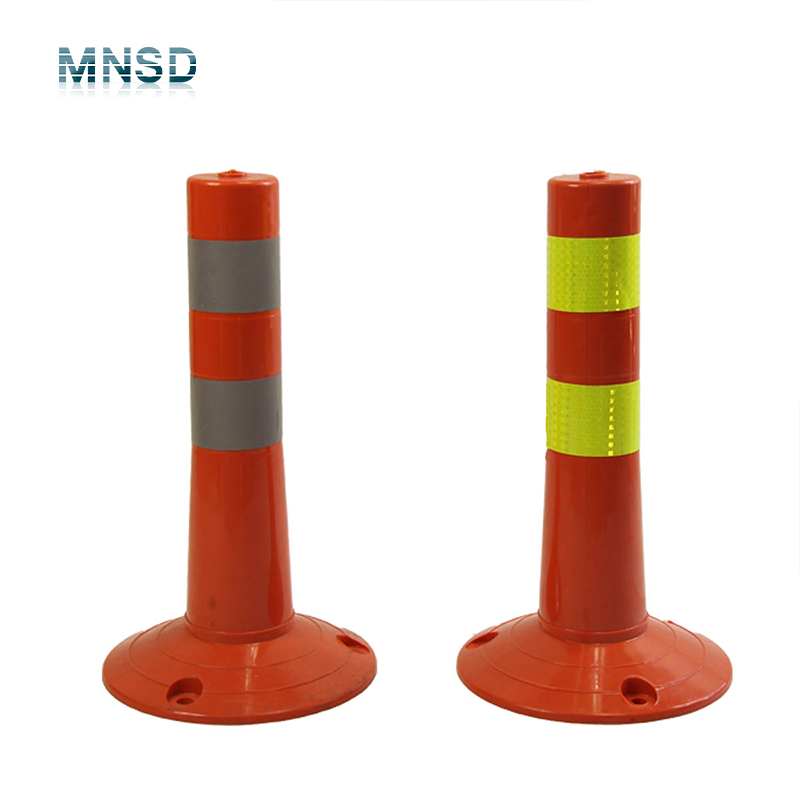
Mnsd YD-WP45: a 450 mm PU warning post with a 200 × 80 mm base, used for lane-edge and bay-edge delineation.
The performance figures below are documented across the Mnsd flexible warning post range, including the YD-WP45, YD-WPS75, and the PE-based YD-PE50.
Table 1 — Documented performance of the Mnsd flexible warning post range
| Property | Specification |
|---|---|
| Body material | High-elasticity polyurethane (PU) or heavy-duty PE |
| Base material | Recycled rubber or integrated plastic base |
| Temperature resistance | −40 °C to +70 °C |
| UV protection | UV-stabilized coating |
| Aging resistance | Anti-oxidant and colorfast (over 3 years) |
| Weatherproofing | Water and oil resistant |
| Reflective grade | High-Intensity Prismatic (HIP) / Class 1 |
| Reflective tape width | 250 mm (double or triple sleeves) |
| Reflective colors | Silver white / fluorescent yellow |
| Visibility distance | 200+ meters |
| Flexibility | 360° flexible and impact resistant |
| Self-recovery | Rapid rebound after vehicle crush |
| Tensile strength | 15.0 MPa |
| Elongation at break | 400% |
| Hardness | 80–85 Shore A |
| Installation | Expansion bolt fixing (3 or 4 holes) |
| Top design | Ring top for chain attachment |
| Color options | Traffic orange / yellow / red / black |
The range differs mainly in height and base, and that is what determines where each model belongs inside a garage.
Table 2 — Model selection by height and base
| Model | Height and base | Body material | Typical garage position |
|---|---|---|---|
| YD-WP45 | 450 mm; base 200 × 80 mm | PU | Lane-edge and bay-edge delineation on flat decks |
| YD-PE50 | 500 mm; rubber base diameter Φ260 mm | PE + rubber base | High-contact entries and ramps, where a wider footprint spreads load |
| YD-WPS75 | 750 mm; base 200 × 80 mm | PU | Corners, ramp mouths, and blind intersections that must be seen from a distance |
Two installation details matter on site. First, the posts are fixed with expansion bolts through three or four holes, using M10/M12 heavy-duty anchors, with optional epoxy reinforcement of the base. Second, the ring top allows a chain to be threaded between posts, which is useful where an operator wants to close a bay without installing a gate.
Step-by-Step: What Happens at the Moment of Contact
- Approach and detection. The shaft carries 250 mm high-intensity prismatic Class 1 reflective tape in double or triple sleeves, in silver white or fluorescent yellow, with a documented visibility distance of 200+ meters. In a garage, the practical effect is that the post is picked up at the far end of a ramp or from the opposite end of a bay row.
- Contact. The 360° flexible shaft bends away in the direction of the force instead of holding position. The driver meets a compliant object, not a fixed hard surface.
- Deformation instead of fracture. A tensile strength of 15.0 MPa and an elongation at break of 400% describe a material that extends substantially before it fails. A documented hardness of 80–85 Shore A keeps the post firm enough to handle normally while still yielding on impact.
- Self-recovery. After the vehicle passes, the post rebounds to its upright position — the memory-springback behavior documented for the range as 360° full-recovery impact resistance.
- Marking continuity. Because the post returns to position, the delineation line stays intact. No bay or lane sits unmarked while a replacement is ordered and fitted.
Step-by-Step: Specifying the Right Post for Each Conflict Point
- Map the conflict points first. Walk the deck and list the places where vehicles and structures sit inside the same turning envelope: corners at stair cores and lift lobbies, ramp mouths, column edges, EV charging bays, fire lanes, and loading dock approaches.
- Match the height to the position. Use the 450 mm YD-WP45 for lane and bay edges, the 500 mm YD-PE50 with its wider Φ260 mm rubber base where the deck takes frequent vehicle contact, and the 750 mm YD-WPS75 where the post must be seen over a long approach or read against a busy background.
- Choose the base and fixing method. Expansion bolt fixing through 3 or 4 holes with M10/M12 anchors suits sound concrete decks. A rubber base distributes load over a wider footprint. Optional epoxy reinforcement helps where the deck surface is thin or worn.
- Decide the reflective configuration. Silver white or fluorescent yellow, 250 mm tape, in double or triple sleeves. More sleeves mean more reflective area per post; that is a real trade-off against material cost, not a cosmetic upgrade.
- Check the environment. Confirm the −40 °C to +70 °C range, the UV-stabilized coating, and water and oil resistance against conditions in the garage, including washdown and de-icing salt in cold climates. Anti-oxidant and colorfast performance is documented over three years.
- Plan quantity and delivery. Mnsd's documented figures are a 200 pcs minimum order quantity, a 10–15 day lead time for bulk orders, a monthly capacity of 50,000 pcs, and high-speed injection molding as the production mode. Customization covers height, color, and reflective tape brand or grade, including 3M or Grade A. Quality control includes a 1,000+ times compression and rebound test, and the after-sales UV-resistance guarantee covers no fading for three years.
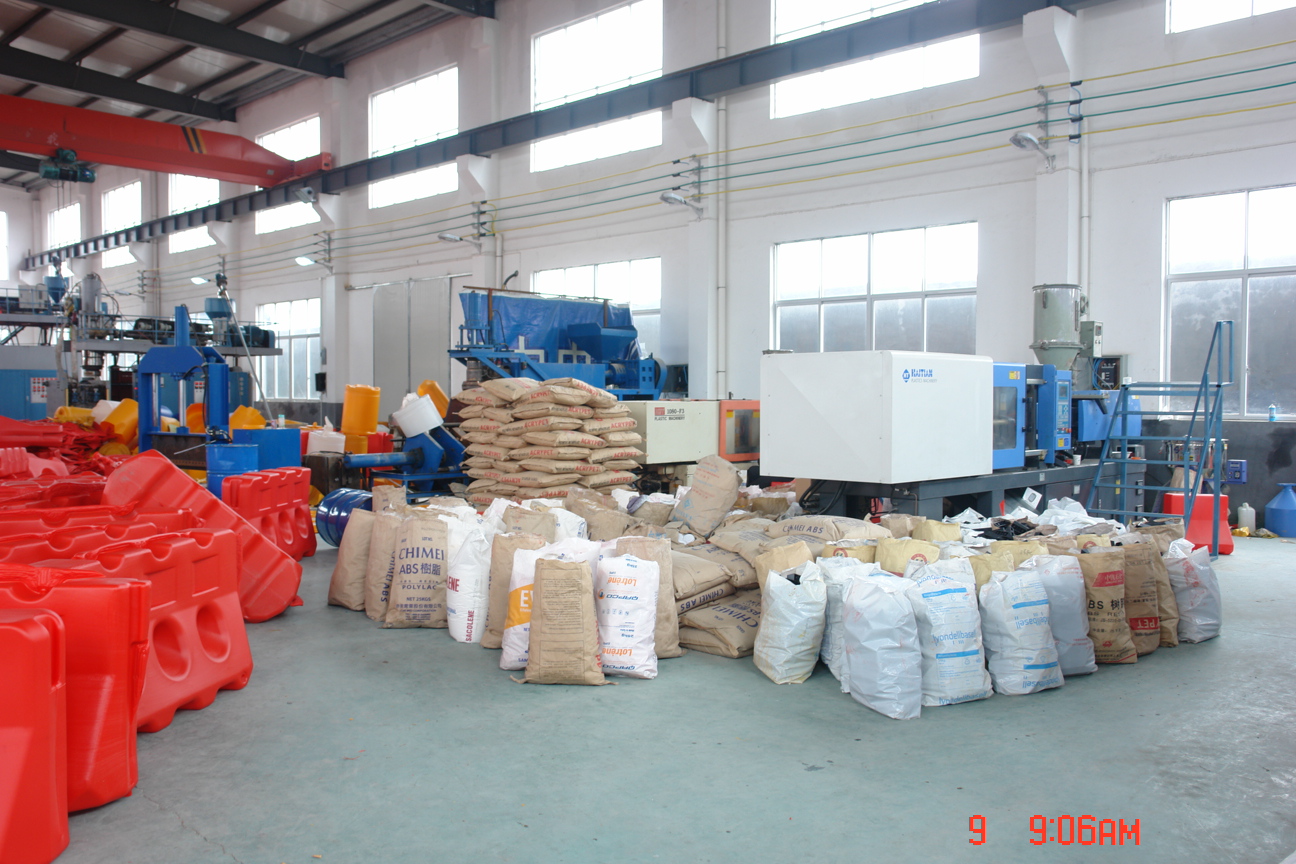
Production line at the Mnsd manufacturing base in Tiantai, Zhejiang, where the flexible warning post range is produced by high-speed injection molding.
Use Cases: Where Flexible Warning Posts Pay for Themselves
Parking lots and parking garages are named applications in Mnsd's product documentation, alongside road traffic, industrial facilities, warehouses, logistics centers, airports, seaports, railway stations, schools, hospitals, commercial complexes, residential areas, loading docks, and bus terminals. In practice, garage projects split into four groups:
- Commercial and mixed-use garages. Column-edge protection, lift lobby corners, and EV charging bays, where drivers reverse repeatedly into the same tight geometry.
- Hospital and airport garages. High traffic volumes, unfamiliar drivers, and frequent drop-off movement make contact frequency the main driver of cost.
- Residential and community garages. Tight bays and habitual parking positions, where the same corner is hit year after year by the same residents.
- Industrial, warehouse, and logistics yards. Trucks and trailers with wide turning circles approaching loading docks, where a damaged rigid post can stop work entirely.
Outside the garage context, the same product is used in road and municipal work. In a contractor project in Vietnam, warning posts were installed to warn vehicles and pedestrians and to mark road edges and dangerous areas, with a documented service duration of 5 to 8 years. The project was completed and accepted by the local authority, and the recorded highlights were high visibility, durability, impact resistance, and easy installation.
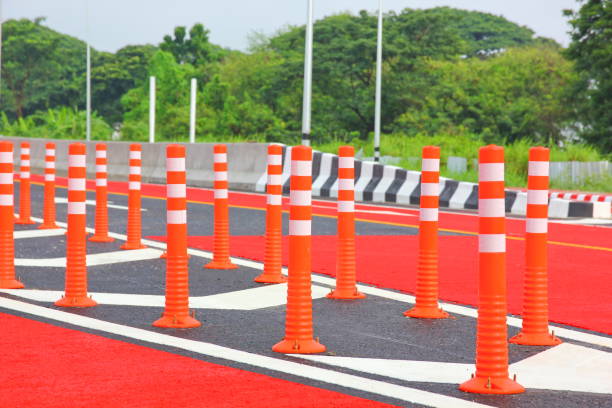
A flexible reflective warning post in service on a traffic channelization project. The same deflection-and-rebound behavior applies to garage lane separation.
Mnsd's documented application guidance for this category covers lane separation on high-speed expressways, highway ramps, T-junctions, urban sidewalk protection, and multi-level parking lot entrances, using surface-mounted or bolt-down permanent installation with high-visibility reflective sleeves, M10/M12 anchors, and optional epoxy base reinforcement. A parking garage is the small-scale, low-speed version of the same problem: a hard-edged traffic path that needs a soft-edged boundary.
Comparison: Rigid Bollard vs PE Warning Post vs PU Flexible Warning Post
The table below compares the three options a garage project normally has on the table. Figures for the Mnsd flexible PU range come from Mnsd product documentation; the rigid bollard column describes the general behavior of a fixed steel or concrete post, and the PE column reflects published material guidance rather than a specific product test result.
| Attribute | Rigid steel or concrete bollard | PE warning post | Mnsd flexible PU warning post (YD-WP45 / YD-WPS75) |
|---|---|---|---|
| Behavior on vehicle contact | No flex; impact force transfers to the vehicle and to the post fixing | Flexes under load | 360° flexible and impact resistant |
| Recovery after contact | None; bending, cracking, or shearing is possible | Limited elastic recovery | Self-recovery with rapid rebound after vehicle crush |
| Material guidance | Not applicable | Published material guidance rates elastic TPU above standard PE for impact recovery and durability | High-elasticity PU body |
| Tensile strength | Not specified in available documentation | Not specified in available documentation | 15.0 MPa |
| Elongation at break | Not specified in available documentation | Not specified in available documentation | 400% |
| Hardness | Not specified in available documentation | Not specified in available documentation | 80–85 Shore A |
| Temperature resistance | Not specified in available documentation | −40 °C to +70 °C (documented for the Mnsd PE-based YD-PE50) | −40 °C to +70 °C |
| Reflective marking | Often a separate add-on component; not specified here | 250 mm HIP Class 1 tape, double or triple sleeves | 250 mm HIP Class 1 tape, double or triple sleeves; visibility 200+ m |
| Installation | Cast-in or bolted, per project design | Expansion bolt fixing (3 or 4 holes) with ring top | Expansion bolt fixing (3 or 4 holes) with ring top for chain attachment |
| Typical garage outcome after contact | Vehicle repair plus post replacement; the conflict point stays unmarked in the interim | Contact is taken by the post's deflection rather than by a fixed hard surface | Contact is taken by the post's deflection, and the post returns to service |
Cells marked "not specified in available documentation" indicate that no verified figure was available for this comparison; no estimate has been substituted.
FAQ: Flexible Warning Posts in Parking Garages
What certification should a buyer check when sourcing warning posts for a parking project?
Mnsd holds a Business License, number 91331023669153260K, issued by the Market Supervision Administration under the China Policy standard. The license is valid from 2007-11-13 to 2107-11-13, applies to the All Countries market, and covers the warning post business, including the YD-PE50 model. Because a business license is a manufacturer-level document, project buyers should also check the standard that governs the site itself: EN 12899-3 for delineator posts and retroreflectors in traffic circulation areas in Europe, and the MUTCD requirement that delineators be retroreflective and visible from 1,000 feet under high-beam headlights in the United States. Confirm at quotation stage which documentation your project specification actually requires.
Can a flexible post really survive being driven over repeatedly in a busy garage?
The documented performance of the Mnsd range is 360° flexibility, impact resistance, and self-recovery with rapid rebound after vehicle crush, supported by a tensile strength of 15.0 MPa, an elongation at break of 400%, hardness of 80–85 Shore A, temperature resistance from −40 °C to +70 °C, and anti-oxidant and colorfast performance over three years. Production quality control includes a 1,000+ times compression and rebound test, and the after-sales UV-resistance guarantee covers no fading for three years. Surviving repeated low-speed parking contact depends on the model, base, and fixing being matched to the site, which is why the specification steps above matter as much as the material itself.
What determines the price of a flexible warning post order?
Mnsd does not publish a price list for this range, so the cost of an order is built from the specification. The main variables are the model and height (450 mm, 500 mm, or 750 mm); the body material (high-elasticity PU versus heavy-duty PE); the base type (integrated plastic base or recycled rubber base, such as the Φ260 mm base on the YD-PE50); the reflective configuration (double or triple sleeves, and tape grade or brand, including 3M or Grade A); customization of height and color, with traffic orange, yellow, red, and black among the standard options; the order quantity measured against the 200 pcs MOQ; and delivery requirements against a 10–15 day bulk lead time. Fixing these variables before requesting a quotation is the fastest way to compare suppliers on equal terms.
How do buyers validate a flexible warning post before a bulk order?
Validation usually runs in three checks. First, documentation: confirm model number, height, base dimensions, material, reflective class, and temperature range against your site drawing. Second, physical checks on a sample of the exact model you intend to order: compress the shaft by hand and watch how quickly it returns, inspect the sleeve count and tape grade, check the flatness of the base and the hole pattern for M10/M12 anchors, and confirm the ring top if you plan to chain bays together. Third, environmental fit: confirm the −40 °C to +70 °C range, UV-stabilized coating, and water and oil resistance against conditions in your garage. The three models most often evaluated for garage work are the YD-WP45, YD-WPS75, and YD-PE50.
What MOQ and lead time should a garage project plan for?
Mnsd's documented figures are a 200 pcs minimum order quantity, a 10–15 day lead time for bulk orders, a monthly production capacity of 50,000 pcs, and high-speed injection molding as the production mode. For a phased garage rollout, quantity planning should be done bay-line by bay-line before the order is placed, so a single shipment covers the full protection plan instead of triggering a second order later at a higher unit cost. For a project-specific quotation, a sample request, or the full product catalog, contact Mnsd at info@mnsdtraffic.com, by WhatsApp at +86 184-5813-7305, or through www.mnsdtraffic.com; the current product brochure is available as a PDF download.
Conclusion
Collision damage in tight parking garages is not caused by drivers alone. It is caused by placing fixed, hard objects inside a driving envelope that vehicles cannot always respect. A rigid bollard answers that problem with resistance, which converts a minor contact into vehicle bodywork and a broken post. A flexible PU warning post answers it with movement: 360° deflection, impact resistance, and rapid rebound after vehicle crush, with a tensile strength of 15.0 MPa, elongation at break of 400%, temperature resistance from −40 °C to +70 °C, and a documented visibility distance of 200+ meters.
The practical path is straightforward. Map the conflict points, match the model to the position using the YD-WP45, YD-PE50, and YD-WPS75, confirm the fixing and reflective configuration, verify the certification your specification requires, and plan the order quantity against the 200 pcs MOQ and the 10–15 day lead time. Done once and done properly, flexible delineation removes the recurring cost that a tight garage otherwise charges in repair bills and unmarked corners.
Next step: catalog, samples, and project pricing
Mnsd supplies the flexible warning post range to importers, distributors, contractors, and infrastructure project suppliers. Download the full product catalog, request a sample, or send your garage layout for a model recommendation and quotation.
Email: info@mnsdtraffic.com | WhatsApp: +86 184-5813-7305 | Website: www.mnsdtraffic.com
Catalog PDF: Download the Mnsd traffic safety product catalog
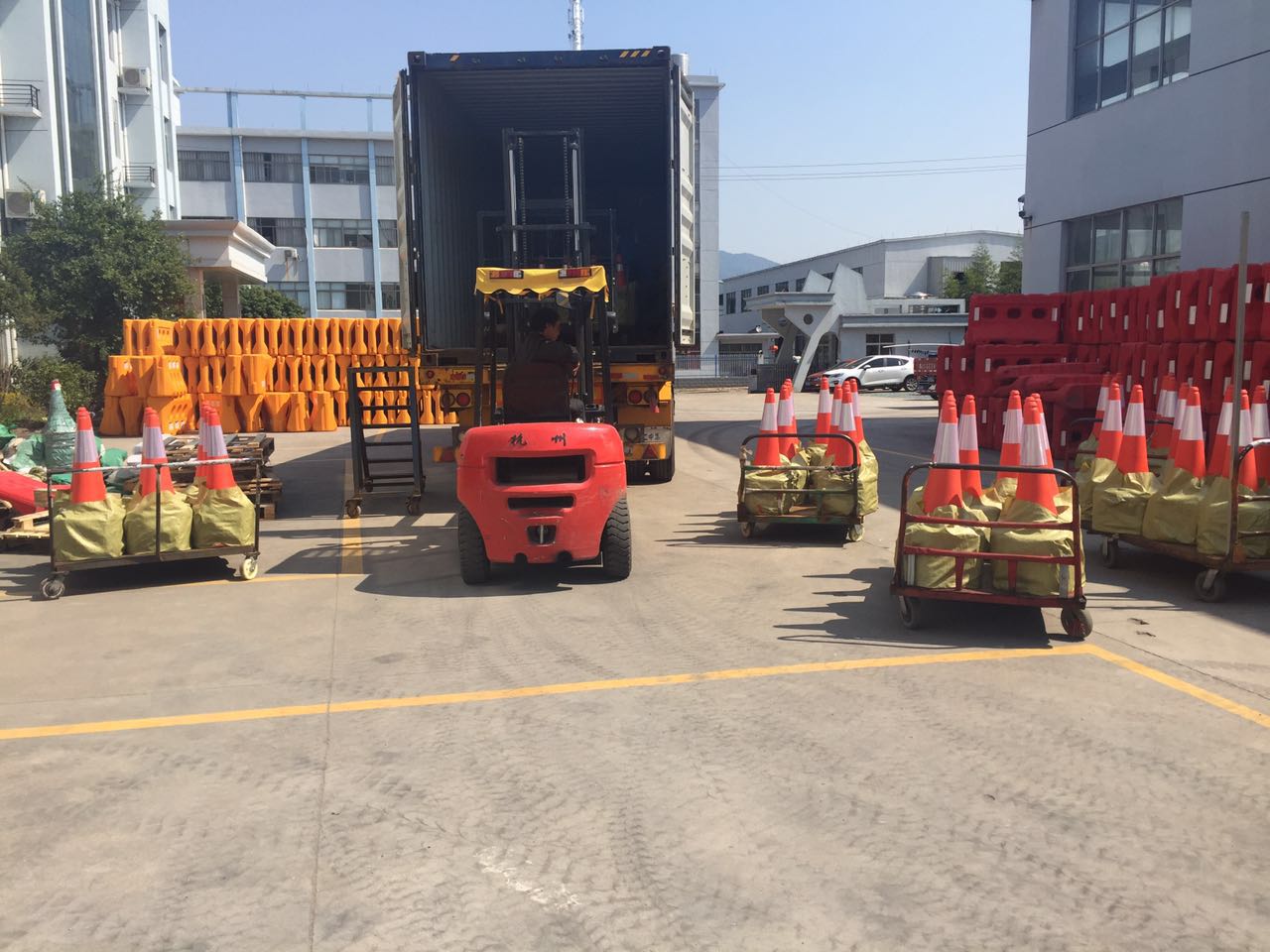
Flexible warning post orders prepared for export shipment from the Mnsd facility.