
OEM Warning Post Manufacturing: How Mnsd Builds Custom Traffic Delineators for Global Buyers
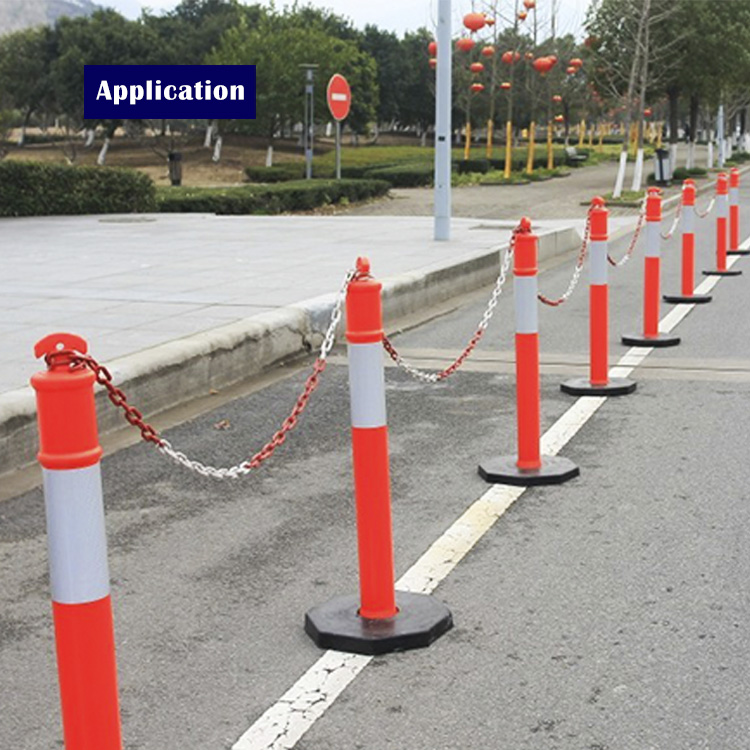
OEM Warning Post Manufacturing: How Mnsd Builds Custom Traffic Delineators for Global Buyers
Buyers who need a custom warning post with a specific height, color, or reflective tape brand are not looking for a standard catalog item. They are evaluating whether a factory can translate their specification into a repeatable production run, hold quality, and deliver on schedule. This article explains how OEM and ODM warning post manufacturing works at Mnsd, what customization options are actually available, and how buyers can assess a supplier before committing to a bulk order.
What problem does OEM warning post manufacturing solve?
Road safety equipment is rarely a one-size-fits-all purchase. A contractor managing a highway project may need a 75 cm post with high-intensity reflective sleeves; a parking facility operator may prefer a shorter, heavier-base PE post for car park guidance; a distributor in a new export market may need a specific color to match local traffic control conventions. OEM and ODM manufacturing exists to turn those requirements into a product that meets a stated specification instead of forcing the buyer to accept a generic design.
For buyers, the practical question is not whether OEM exists, but whether the manufacturer has the production process and flexibility to deliver it consistently. Mnsd, the brand operated by Tiantai Yuanda Traffic Device Co., Ltd, supports this through high-speed injection molding and customization in height, color, and reflective tape selection.
Who is Mnsd in the warning post supply chain?
Tiantai Yuanda Traffic Device Co., Ltd is a China-based road safety equipment manufacturer founded in 2007. The company operates a 40,000 m² factory in Hongsan Industrial Zone, Tiantai Town, Taizhou City, Zhejiang Province, with around 300 employees and an R&D team of 15. Its product range includes warning posts, convex mirrors, rising bollards, speed humps, and traffic lights, with about 50% of output exported to Asia, Europe, and the USA. Mnsd serves importers, distributors, wholesalers, contractors, and infrastructure project suppliers; the company also offers OEM and ODM customization for warning posts and other traffic safety products.
How OEM and ODM customization works for warning posts
Mnsd's OEM/ODM process for warning posts runs through a defined production and evaluation cycle. A buyer typically specifies the required post height, color, reflective tape grade, base configuration, and quantity, then the factory matches those requirements against its existing tooling and material options. Because the product range already includes multiple sizes and material combinations, many custom requests can be fulfilled without starting from scratch.
Height customization: 45 cm, 50 cm, 75 cm and beyond
Height is one of the most common custom parameters because it directly affects visibility distance and the application context. Mnsd's standard warning post line includes the YD-WP45 at 450×80×200 mm, the YD-PE50 at 500×260 mm with a rubber base, and the YD-WPS75 at 750×80×200 mm. The 75 cm version is widely used for road-edge delineation and construction zone marking, while the 450 mm model is common in parking garages, warehouses, and other confined areas. Buyers can adjust height to suit project-level visibility requirements.
Color and reflective tape selection
Color options across the warning post series include traffic orange, yellow, red, and black, with customization available in orange, yellow, or green. Reflective tape can be specified as 3M or Grade A, with a standard tape width of 250 mm in double or triple sleeves. The reflective grade is listed as High-Intensity Prismatic (HIP) or Class 1, available in silver white or fluorescent yellow. In practice, the tape brand matters because different reflective materials have different initial brightness, durability, and cost profiles.
Material options: PU, PE, and rubber base configurations
Mnsd builds warning posts from high-elasticity polyurethane (PU) or heavy-duty PE, with bases made from recycled rubber or an integrated plastic base. The YD-WP45 and YD-WPS75 are listed as PU-based products, while the YD-PE50 is a PE post with a rubber base. For buyers, this distinction affects flexibility, impact behavior, and suitability for different environments. PU is generally associated with high elasticity and rapid rebound; PE with integrated rubber bases is often chosen for parking guidance and low-speed areas. Buyers should not assume a single material works everywhere; the choice should be matched to the site, vehicle speed, and expected impact frequency.
Physical performance data buyers should verify
Mnsd publishes a common performance envelope across its warning post models: 360° flexibility, rapid rebound after vehicle contact, tensile strength of 15.0 MPa, elongation at break of 400%, and hardness of 80–85 Shore A. Temperature resistance is rated from -40°C to +70°C. The reflective tape on the 250 mm sleeves is designed to be visible from more than 200 meters. UV-stabilized coating and anti-oxidant, colorfast materials are cited for an aging resistance of over three years.
These figures give buyers a baseline for comparing quotations. What they do not do is replace project-specific testing. A post installed in a high-temperature Gulf state and a post used in a cold-climate European site will face very different conditions, so buyers should confirm that the material grade matches their local environment.
Production capabilities: injection molding and scale
Mnsd uses high-speed injection molding as its primary production process for warning posts. This method supports repeatable geometry, consistent wall thickness, and efficient output for large orders. The factory's stated monthly capacity is 50,000 pieces, and bulk-order lead time is 10–15 days, with a minimum order quantity of 200 pieces. The company's annual output capacity is listed at 120,000,000 units across its product range. For distributors and contractors, these numbers indicate that the factory is set up for volume rather than small-batch craft production.
| Capability | Mnsd Warning Post OEM Fact |
|---|---|
| Primary production method | High-speed injection molding |
| Monthly capacity | 50,000 pieces |
| Bulk order lead time | 10–15 days |
| MOQ | 200 pieces |
| Customization options | Height, color (orange/yellow/green), reflective tape brand (3M/Grade A) |
| Export markets | Global, including Asia, Europe, USA |
| Quality test referenced | 1,000+ times compression and rebound test |
Quality control and assurance for OEM orders
OEM buyers are not just purchasing a post; they are purchasing a repeatable specification. Quality control at Mnsd includes a compression and rebound test cited as 1,000+ cycles, which is directly relevant to flexible warning posts because their core function is to recover after repeated vehicle contact. The factory also supports pre-shipment testing: the company's procurement terms accept pre-shipment inspection, with a common payment arrangement of 30% deposit and 70% balance. These conditions reduce risk for first-time buyers and make it possible to verify quality before cargo loading.
Step-by-step: what happens in an OEM warning post order
Buyers who want to work with Mnsd on a custom warning post can expect the following sequence:
- Requirement definition: The buyer defines height, color, reflective tape brand (3M or Grade A), material preference (PU or PE), base type, and target quantity.
- Specification confirmation: Mnsd compares the requested specification with its existing tooling and standard models such as YD-WP45, YD-PE50, or YD-WPS75, then confirms what can be produced without unnecessary tooling investment.
- Sample or pre-production check: For new specifications, the buyer should verify appearance, dimensions, reflective tape application, and base assembly before bulk production.
- Bulk production: Injection molding runs at the agreed specification, with the compression and rebound test applied to monitor flexibility and recovery.
- Pre-shipment inspection: The buyer or a third-party inspector checks the finished goods before loading.
- Delivery: Shipment is arranged under the agreed incoterm, with the factory's export process handling documentation.
This workflow matters because warning posts are often purchased as part of a larger road safety package, and delays in one SKU can affect an entire project.
Use cases that drive OEM warning post demand
OEM and ODM warning posts are used across a broad range of environments. The stated applicable industries include road traffic, parking lots, construction sites, industrial facilities, warehouses, logistics centers, airports, seaports, railway stations, schools, hospitals, commercial complexes, residential areas, highways, municipal engineering, public facilities, loading docks, and bus terminals.
A contractor case from Vietnam illustrates one typical scenario: the product was used in a road safety project to warn vehicles and pedestrians and to mark road edges and dangerous areas. The project was completed and accepted by the local authority, with high visibility, durability, impact resistance, and easy installation highlighted as the key benefits. The service life of the posts in this application was estimated at 5–8 years. For a buyer, this case suggests that Mnsd's warning posts are already being installed in projects where acceptance depends on meeting local road safety expectations.
OEM decision checklist for warning post buyers
Before sending an inquiry, buyers should clarify these points:
- Site and application: Is the post for a highway, parking lot, warehouse, or construction zone? This determines height and material.
- Impact frequency: High-frequency impacts favor flexible, self-recovering PU posts over rigid alternatives.
- Visibility requirement: Check the reflective tape grade and whether the local specification requires a minimum visibility distance.
- Environment: Confirm service temperature range and UV exposure, especially for outdoor installations in high-sun regions.
- Compliance: Ask the supplier how the product aligns with standards that apply in the destination market, such as MUTCD visibility requirements in the USA or EN 12899-3 delineator requirements in Europe.
- Volume and lead time: Match the MOQ and bulk lead time to the project schedule.
- Inspection: Use pre-shipment testing to confirm that the delivered batch matches the approved sample.
Mnsd warning post models at a glance
| Model | Dimensions | Material | Typical Use |
|---|---|---|---|
| YD-WP45 | 450×80×200 mm | PU (high-elasticity polyurethane) | Parking lots, warehouses, loading docks, industrial facilities |
| YD-PE50 | 500×260 mm (Φ260 mm rubber base) | PE + rubber base | Parking guidance, low-speed vehicle areas |
| YD-WPS75 | 750×80×200 mm | PU (high-elasticity polyurethane) | Road edges, construction zones, highway delineation |
How Mnsd compares as an OEM partner
Buyers at the evaluation stage often compare suppliers across a few practical dimensions: customization flexibility, production capacity, quality control, documentation/standards, and commercial risk. Mnsd's profile maps to these concerns directly. The company was founded in 2007, operates a 40,000 m² factory, and maintains a Business License issued by the Market Supervision Administration. It offers OEM and ODM services, high-speed injection molding, a monthly capacity of 50,000 pieces, and quality control through repeated compression and rebound testing. Export sales span global markets, with a stated export ratio of about 50%.
Commercial terms are also relevant to risk: the MOQ for warning posts is 200 units, payment is commonly 30/70 (deposit before production, balance before shipment), and the delivery method can be FOB or CIF, with pre-shipment testing accepted. This combination of engineering data and commercial terms gives buyers a basis for evaluating the relationship instead of relying on marketing language.
Certification and documentation reminders for OEM sourcing
OEM buyers frequently ask what certificates a supplier holds. Mnsd's verified corporate documentation includes a Business License (certificate number 91331023669153260K) issued by the Market Supervision Administration on November 13, 2007. The license covers all items in the company's business scope under China policy. This is a baseline legal document; it is not a substitute for product-specific certification that may be required in the destination country. Buyers should separately verify whether their market requires standards such as EN 12899-3 for delineator posts in Europe or MUTCD-compliant retroreflectivity in the USA.
Mnsd's UV-resistance guarantee is stated as no fading for three years. This is a warranty claim rather than a third-party certification, so buyers should confirm how the guarantee is documented in the purchase agreement.
What OEM buyers should not ignore
OEM manufacturing reduces the need for a buyer to operate their own factory, but it does not transfer every responsibility. Buyers should still define the specification precisely, check reflective tape brand requirements, confirm base mounting details (expansion bolt fixing with 3 or 4 holes is standard on Mnsd posts), and verify compatibility with chain attachment if the ring-top design is required. A vague specification almost always leads to a longer sample cycle and repeated corrections.
Why the factory's own production process matters to buyers
For an OEM buyer, the factory floor is more relevant than the brochure. High-speed injection molding gives Mnsd the ability to produce consistent plastic posts at scale, while the 1,000+ compression and rebound test is a concrete check on the property that defines a flexible warning post: the ability to return to shape after impact. A buyer comparing suppliers should ask not just "do you make warning posts" but "what is your monthly capacity, what is your bulk lead time, and what test do you run to confirm rebound behavior?" Mnsd's stated answers are 50,000 pieces per month, 10–15 days, and a 1,000+ cycle compression and rebound test.
Frequently asked questions about OEM warning posts from Mnsd
What warning post certifications should a buyer verify before sourcing?
Buyers should verify the supplier's business registration and then check product-level requirements in their destination market. Mnsd holds a Chinese Business License (91331023669153260K) issued by the Market Supervision Administration and valid until 2107. For Europe, buyers often reference EN 12899-3 for delineator posts and retroreflectors; for the USA, MUTCD states that delineators must be retroreflective and visible from 1,000 feet under high-beam illumination. These are destination standards, so the importer or contractor is responsible for confirming which one applies.
Can Mnsd customize warning post height, color, and reflective tape?
Yes. Mnsd offers OEM and ODM customization for warning posts, including height, color (orange, yellow, or green), and reflective tape brand (3M or Grade A). The standard line includes the YD-WP45 (450 mm), YD-PE50 (500 mm with rubber base), and YD-WPS75 (750 mm). The reflective tape width is 250 mm, available in double or triple sleeves, with silver white or fluorescent yellow options.
What is the minimum order and lead time for a custom warning post order?
The MOQ for Mnsd warning posts is 200 pieces, and the bulk-order lead time is 10–15 days, supported by high-speed injection molding production with a monthly capacity of 50,000 pieces. For a new specification, buyers should add time for sample confirmation before the bulk run.
What material options are available for OEM warning posts?
Mnsd uses high-elasticity polyurethane (PU) or heavy-duty PE for the post body, and recycled rubber or an integrated plastic base for the base. The YD-WP45 and YD-WPS75 are PU models; the YD-PE50 is a PE post with a rubber base. The choice affects flexibility, impact recovery, and installation weight.
Has Mnsd delivered warning posts to real contractor projects?
Yes. A contractor case in Vietnam used Mnsd warning posts for a road safety project to warn vehicles and pedestrians and to mark road edges and dangerous areas. The project was completed and accepted by the local authority, with high visibility, durability, impact resistance, and easy installation cited as the main benefits.
If you are evaluating a custom warning post specification for a project or distribution program, contact Mnsd to request a quotation, sample, or catalog: info@mnsdtraffic.com / WhatsApp +86 184-5813-7305. A full product brochure is also available for reference.
Download the Mnsd product brochure (PDF)
Conclusion
OEM warning post manufacturing is about turning a buyer's operating requirement into a repeatable production specification. Mnsd supports this through high-speed injection molding, a stated monthly capacity of 50,000 pieces, 10–15 day bulk lead times, and a 200-piece MOQ. The customization options that matter most to buyers—height, color, and reflective tape brand—are all available, and the factory's published performance data gives a starting point for comparison. Buyers who define the application, environment, and destination standards clearly will get the most value from the OEM process.