
Warning Post Application Guide: YD-WP45 & YD-WPS75 for Roads, Parking & Construction
Warning Post Application Guide: YD-WP45 & YD-WPS75 for Roads, Parking & Construction
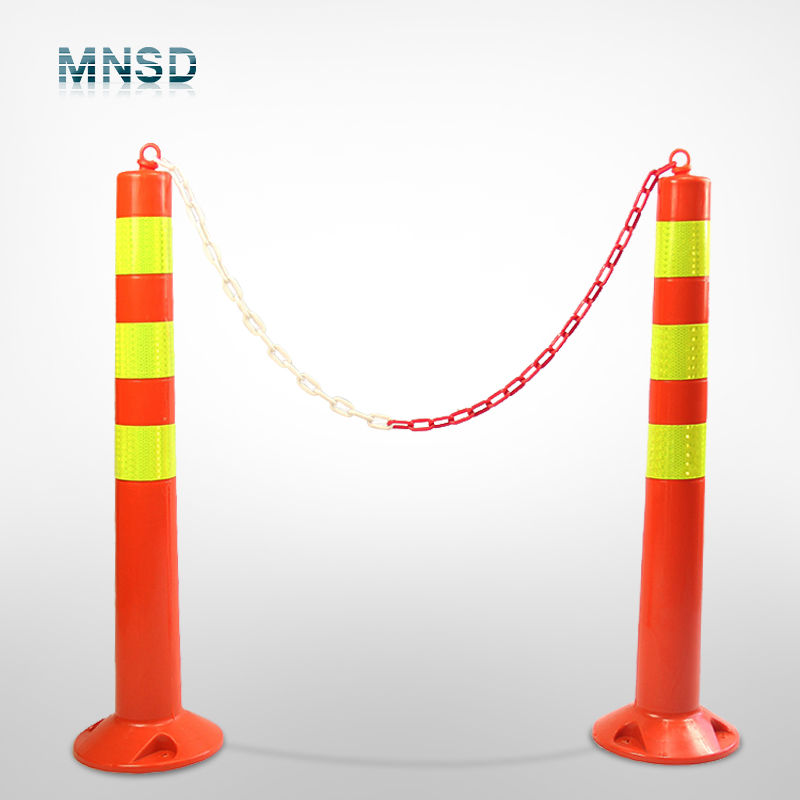
At the decision stage, the question is no longer whether flexible delineation works. It is which post belongs on which site. Mnsd builds two polyurethane models that answer two different site realities: the YD-WP45, a 450 mm PU post with a 200×80 mm base and 80–85 Shore A hardness, and the YD-WPS75, a 750×80×200 mm PU post with HIP/Class 1 reflective grade, self-recovery and expansion-bolt fixing.
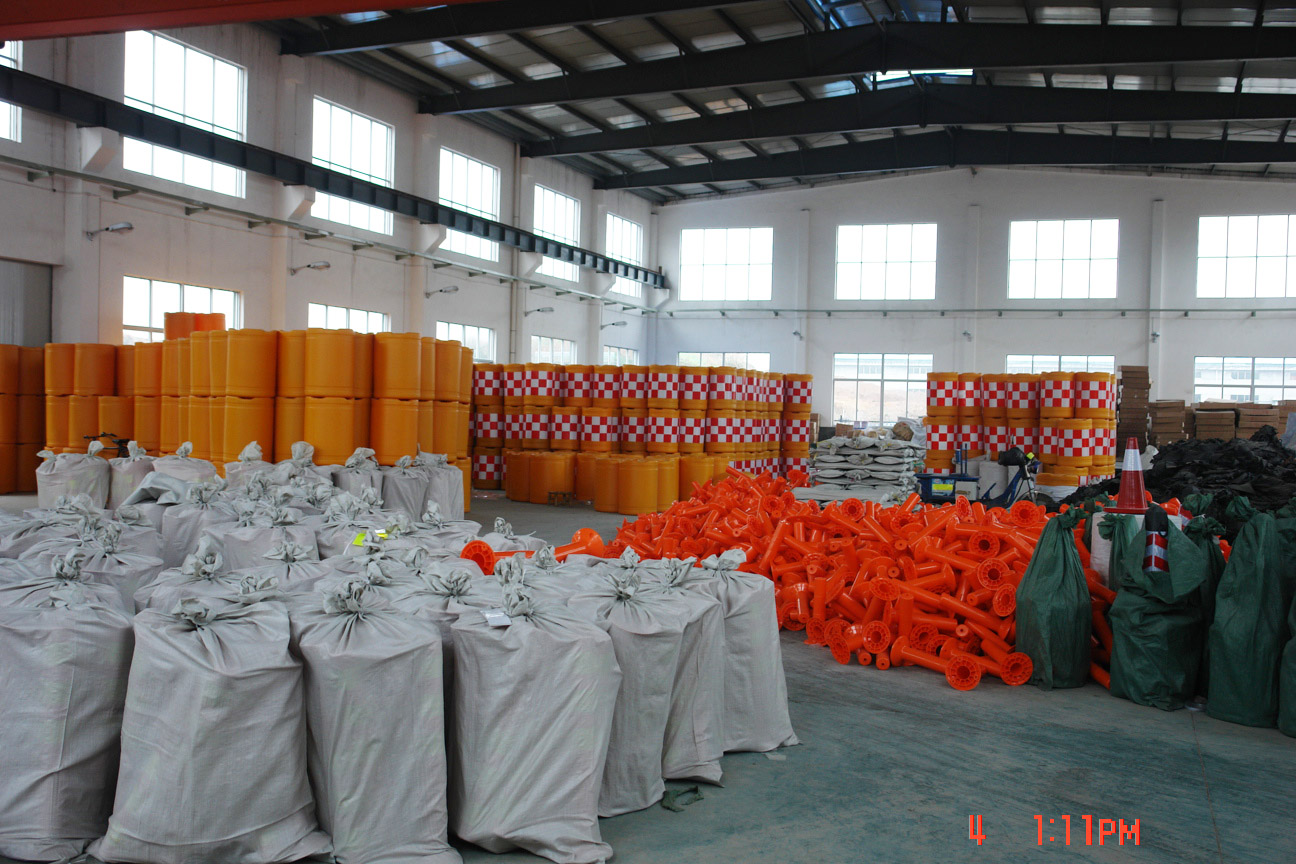
Mnsd is the road safety brand of Tiantai Yuanda Traffic Device Co., Ltd, a manufacturer based in Tiantai, Zhejiang, China that produces warning posts, convex mirrors, speed humps, rising bollards and traffic lights for importers, distributors and project suppliers.
Short answer. Specify the YD-WP45 where the delineation line must stay low and close to vehicle bodywork — parking lots, parking garages, warehouses and low-speed internal roads. Specify the YD-WPS75 where the post must be read early and survive repeated contact — road traffic, highway ramps, work zones and construction sites — because its 750 mm height, HIP/Class 1 reflective grade and 360° self-recovery suit longer approach distances and heavier impact exposure.
The Decision Problem: One Post Specification Cannot Serve Roads, Parking and Construction
Warning posts fail on site for reasons that are usually visible in the specification, not in the material. A post that is too short for a highway approach disappears below the sight line of a driver at distance. A post that is too tall inside a covered parking garage becomes a target for roof racks, mirrors and delivery vehicle bodies. A post fixed with the wrong base gets knocked loose by the first careless reverse, and a post with an unsuitable reflective grade reads only at the last second at night.
Because a single SKU is often pushed across an entire project for procurement simplicity, the mismatch is not noticed at the quotation stage. It appears weeks later, when maintenance crews start replacing the same post positions repeatedly, or when a site manager asks why drivers are still cutting the corner.
The decision, therefore, is a two-variable problem: height and impact behaviour on one side, and mounting and reflectivity on the other. Mnsd addresses it with two models instead of one — the YD-WP45 and the YD-WPS75 — plus a base choice between recycled rubber and integrated plastic.
Industry Background: Where Flexible Warning Posts Sit in Traffic Safety Hardware
A warning post is a delineation and visual-warning device. In the way flexible roadside delineator posts are described by established suppliers such as Pexco, they are impact-resistant plastic posts that warn drivers of a change in alignment and help them track the roadway. That functional definition matters at the decision stage: a warning post guides and warns, and it is not a containment barrier where crash energy must be absorbed.
Demand for this hardware sits inside a larger road safety market. MarketsandMarkets valued the global road safety market — hardware and solutions, including delineators and warning devices — at USD 7.62 billion in 2026. That figure covers the wider category rather than warning posts alone, so it is best used as context for category scale rather than as a warning-post market size.
Material behaviour is the second background factor. PU warning posts are described in technical comparisons of delineator materials as returning to their original state after being impacted repeatedly, which is the property that makes a flexible post reusable rather than consumable. A rigid post that bends and stays bent has to be replaced; a PU post that recovers keeps doing its job after contact.
Compliance context is the third factor. Approval requirements for road-facing devices are set by the road authority in each market, and those requirements differ. A reflective grade printed on a specification sheet describes the sheeting on the product; it is not the same thing as an acceptance record for a specific project. Buyers working on tendered work should treat the grade as one input and the authority's document list as another.
The Two Models: YD-WP45 and YD-WPS75 Explained
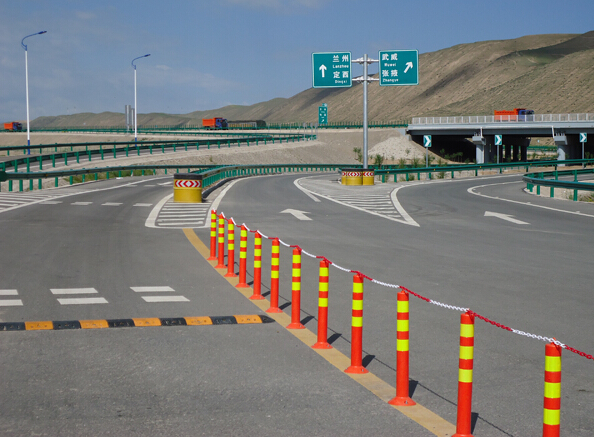
YD-WP45: the 450 mm PU post for low-profile delineation
YD-WP45 specification
- Post height: 450 mm
- Material: PU (polyurethane)
- Base: 200×80 mm
- Hardness: 80–85 Shore A
- Visibility: more than 200 m
- Temperature range: -40°C to +70°C
- Weatherproof, water-resistant and oil-resistant
What these numbers mean for a buyer is straightforward. The 450 mm height keeps the delineation line low, so the post reads as a boundary marker rather than a roadside object, which is what parking areas and internal roads need. The 200×80 mm base gives the post its standing footprint. The 80–85 Shore A hardness is the interesting figure: it describes a PU that is firm enough to stay upright on its own and flexible enough to deflect and recover instead of snapping. The -40°C to +70°C range covers cold-weather and hot-climate installation, and the water and oil resistance matters in exactly the places 450 mm posts are used — garage decks, service areas and parking structures where vehicles leave oil and where cleaning water is routine.
YD-WPS75: the 750 mm PU post for high-visibility road and work-zone delineation
YD-WPS75 specification
- Post dimensions: 750×80×200 mm
- Material: PU (polyurethane)
- Reflective grade: HIP / Class 1
- Visibility: 200+ m
- Impact behaviour: self-recovery, 360° flexible, impact resistant
- Tensile strength: 15.0 MPa
- Mounting: expansion bolt fixing with 3 or 4 holes
- Top: ring top for chain attachment
The YD-WPS75 answers a different brief. Its 750 mm height lifts the reflective surface into a higher, more readable position at distance, and the HIP/Class 1 reflective grade is the specification buyers should quote when night-time readability is a project requirement. The 360° flexibility and self-recovery describe how the post behaves under contact from any direction — it deflects and returns, which is the behaviour that keeps a delineation line intact through a construction season. A 15.0 MPa tensile strength is the material property behind that durability.
Two details are easy to overlook and worth checking early. First, mounting is by expansion bolt through 3 or 4 holes, so the surface and hardware must be confirmed at specification stage rather than on the day of installation. Second, the ring top allows a chain to be attached, which lets the same post serve as a closed-off section marker when a work zone needs a physical link between posts rather than only a visual line.
Base options: recycled rubber and integrated plastic
Base configuration is a separate decision from model selection. Mnsd's warning post range uses either a recycled rubber base or an integrated plastic base, and the two suit different operating patterns rather than different quality tiers. A recycled rubber base is a discrete ballast element, which is the practical choice where posts must be relocated or where drilling into the surface is not acceptable. An integrated plastic base forms part of the post itself, which keeps handling simple where posts are installed and then left in place. The YD-WPS75 adds a third possibility through expansion-bolt fixing, which is the appropriate route where the post must be anchored to a hard surface in a fixed alignment.
Decision rule: confirm the base type and the fixing method together, as one line item in the quotation. A post specified with the wrong base is a post that will be replaced early, whatever its height.
Heat, cold and the temperature envelope
The YD-WP45 is rated from -40°C to +70°C, which covers the ambient range of most export markets. For high-temperature climates, Mnsd's heat-resistance approach focuses on wall thickness to prevent sagging and targets material stability up to 60°C. Where a site is expected to experience sustained surface temperatures beyond the stated envelope — dark asphalt in direct summer sun, for example — the requirement should be raised with the supplier before the order is confirmed, because the envelope is a specification limit rather than a marketing range.
Step-by-Step: Specifying a Warning Post for a Real Site
The sequence below turns the two model sheets into a site decision. It is written for the person who signs off the purchase order, not only for the installer.
- Define the job the post has to do. Decide whether the post is warning a driver of an alignment change, marking the edge of a parking aisle, or closing off a work zone. Alignment warning at distance points to the 750 mm YD-WPS75; aisle and edge marking points to the 450 mm YD-WP45.
- Set the height against the sight line, not the budget. A 450 mm post is the right answer where the reader is a slow-moving driver or a pedestrian-adjacent area. A 750 mm post is the right answer where the reader is approaching at speed or where the post must be visible above other street furniture.
- Match the reflective grade to the requirement. The YD-WPS75 carries HIP/Class 1 reflective grade and 200+ m visibility. Where a project specification calls for HIP/Class 1, that is the model to quote; the YD-WP45 covers visibility beyond 200 m without a stated reflective grade in the specification data.
- Check the climate envelope. The YD-WP45 is rated -40°C to +70°C. For hot-climate projects, confirm the heat-resistance expectation for the specific installation, since wall thickness and material stability are managed against temperature.
- Choose the base and the fixing method. Recycled rubber base where the post must be movable or the surface cannot be drilled; integrated plastic base where the post is installed once; expansion-bolt fixing through 3 or 4 holes where the YD-WPS75 must be anchored in a fixed alignment.
- Decide whether posts must be linked. If the site needs a chain or tape line between posts — typical in work zones — specify the YD-WPS75 ring top so the linkage is designed in rather than improvised on site.
- Validate with a sample and confirm the order configuration. Check hardness, flex, reflective appearance and mounting surface against a physical sample, then confirm model mix, base type, fixing method, quantity and packing in the quotation.
Use Cases: Matching the Model to the Site
Road traffic and highway alignment
On road approaches, ramps and alignment changes, the post has to be visible before the driver commits to a line. The YD-WPS75 is the model for this job: 750 mm of height, HIP/Class 1 reflective grade, 200+ m visibility and 360° flexibility so that a strike does not remove the marker for the rest of the season. The expansion-bolt fixing keeps the post in a consistent alignment where the surface allows it.
Parking lots and parking garages
Parking environments punish tall objects. Roof racks, wing mirrors and reversing delivery vehicles make contact routine, and the surface is often a deck that should not be drilled at will. The YD-WP45 is designed for this pattern: 450 mm height, 80–85 Shore A hardness for deflection without collapse, and water and oil resistance that suits garage floors. Where the layout changes seasonally, a recycled rubber base allows the line to be re-set without new fixings.
Construction sites and work zones
Work zones need a line that can be closed, re-opened and moved. The YD-WPS75 contributes three things here: the height and HIP/Class 1 grade for early reading, self-recovery for repeated contact by plant and vehicles, and the ring top so a chain can link posts into a controlled section. The 15.0 MPa tensile strength is the property that supports that repeated flexing.
Warehouses, logistics yards and industrial internal roads
Inside a yard, the risk is not speed but volume of movement — forklifts, vans and trucks turning in tight geometry. A 450 mm YD-WP45 marks the boundary without creating a tall obstacle, and the PU construction recovers after contact instead of leaving a permanent bend. Where a high-visibility boundary is needed at a gate or a blind corner, the YD-WPS75 can be used on the same site without creating a visual mismatch.
Across all four environments, Mnsd positions warning posts as a low-cost, maintenance-light alternative to guardrails and barriers for delineation purposes: no power, no wiring, and cleaning or replacement rather than servicing. That positioning applies to delineation and visual warning — where containment is required, a different product category is the correct answer.
YD-WP45 vs YD-WPS75: Specification Comparison
| Parameter | YD-WP45 | YD-WPS75 |
|---|---|---|
| Post height | 450 mm | 750 mm |
| Post dimensions | 450 mm post with 200×80 mm base | 750×80×200 mm |
| Material | PU (polyurethane) | PU (polyurethane) |
| Hardness | 80–85 Shore A | Not stated in the specification data |
| Reflective grade | Not stated in the specification data | HIP / Class 1 |
| Visibility | More than 200 m | 200+ m |
| Impact behaviour | Flexible PU construction | Self-recovery, 360° flexible, impact resistant |
| Tensile strength | Not stated in the specification data | 15.0 MPa |
| Temperature range | -40°C to +70°C | Not stated in the specification data |
| Weather, water, oil | Weatherproof, water-resistant, oil-resistant | Not stated in the specification data |
| Mounting | 200×80 mm base | Expansion bolt fixing with 3 or 4 holes |
| Top detail | Not stated in the specification data | Ring top for chain attachment |
Only the specifications listed above are stated in the product data. Where a cell reads “not stated”, the buyer should request the value from Mnsd rather than assume parity with the other model.
Site-to-model matrix
| Site condition | Primary model | Specification-based reason |
|---|---|---|
| Highway ramp and alignment change | YD-WPS75 | 750 mm height plus HIP/Class 1 reflective grade for early reading |
| Work zone needing a linked line | YD-WPS75 | Ring top for chain attachment, self-recovery, 360° flexibility |
| Parking aisle and bay edge marking | YD-WP45 | 450 mm low profile with 80–85 Shore A flexibility |
| Parking garage deck and ramp | YD-WP45 | Water and oil resistance suited to garage surfaces |
| Hot-climate outdoor installation | YD-WP45 | Rated -40°C to +70°C |
| Fixed anchor to hard surface | YD-WPS75 | Expansion bolt fixing through 3 or 4 holes |
| Relocatable line or event layout | Base decision | Recycled rubber base supports re-setting without new fixings |
FAQ: Deciding Between YD-WP45 and YD-WPS75
- Does HIP/Class 1 reflective grade mean the YD-WPS75 is approved for public roads?
- No. HIP/Class 1 describes the reflective grade of the sheeting used on the YD-WPS75; it is a product specification, not an approval. Approval for public-road use is granted by the road authority in the destination market, and the criteria vary between authorities. Buyers in tender-driven markets should confirm the reflective grade and post height against the project specification before ordering.
- Can YD-WP45 and YD-WPS75 be used on the same project?
- Yes. Both models are PU constructions with visibility beyond 200 m, so they can be specified together without creating a visual mismatch. The practical split is height and impact behaviour: the YD-WP45 provides a 450 mm delineation line with a 200×80 mm base and 80–85 Shore A hardness, while the YD-WPS75 rises to 750 mm with HIP/Class 1 reflective grade, 360° flexibility, self-recovery and expansion-bolt fixing through 3 or 4 holes. A typical mixed layout uses the taller post on approaches and the shorter post inside parking and pedestrian-adjacent areas.
- Which model is more economical to run?
- Neither model needs power, and both are positioned as low-maintenance delineators that require cleaning rather than servicing. Cost differences come from specification decisions rather than material alone: height, reflective grade, and base or fixing type. The YD-WP45 uses a 450 mm PU post with a 200×80 mm base; the YD-WPS75 uses a 750 mm PU post with HIP/Class 1 reflective grade, a ring top and expansion-bolt fixing, which adds material and hardware. Mnsd quotes per project against model, quantity, base type and destination, so the full configuration should be quoted rather than the post height alone.
- Can buyers request a sample before ordering?
- Yes. Hardness, flex and reflectivity are difficult to judge from a data sheet, so a physical sample lets a buyer check the 80–85 Shore A hardness of the YD-WP45, the 360° flex and self-recovery of the YD-WPS75, the appearance of the HIP/Class 1 reflective grade, and whether the base or the 3- or 4-hole expansion fixing matches the mounting surface. Samples can be requested from Mnsd at info@mnsdtraffic.com or through www.mnsdtraffic.com.
- How should buyers plan lead time and the first order?
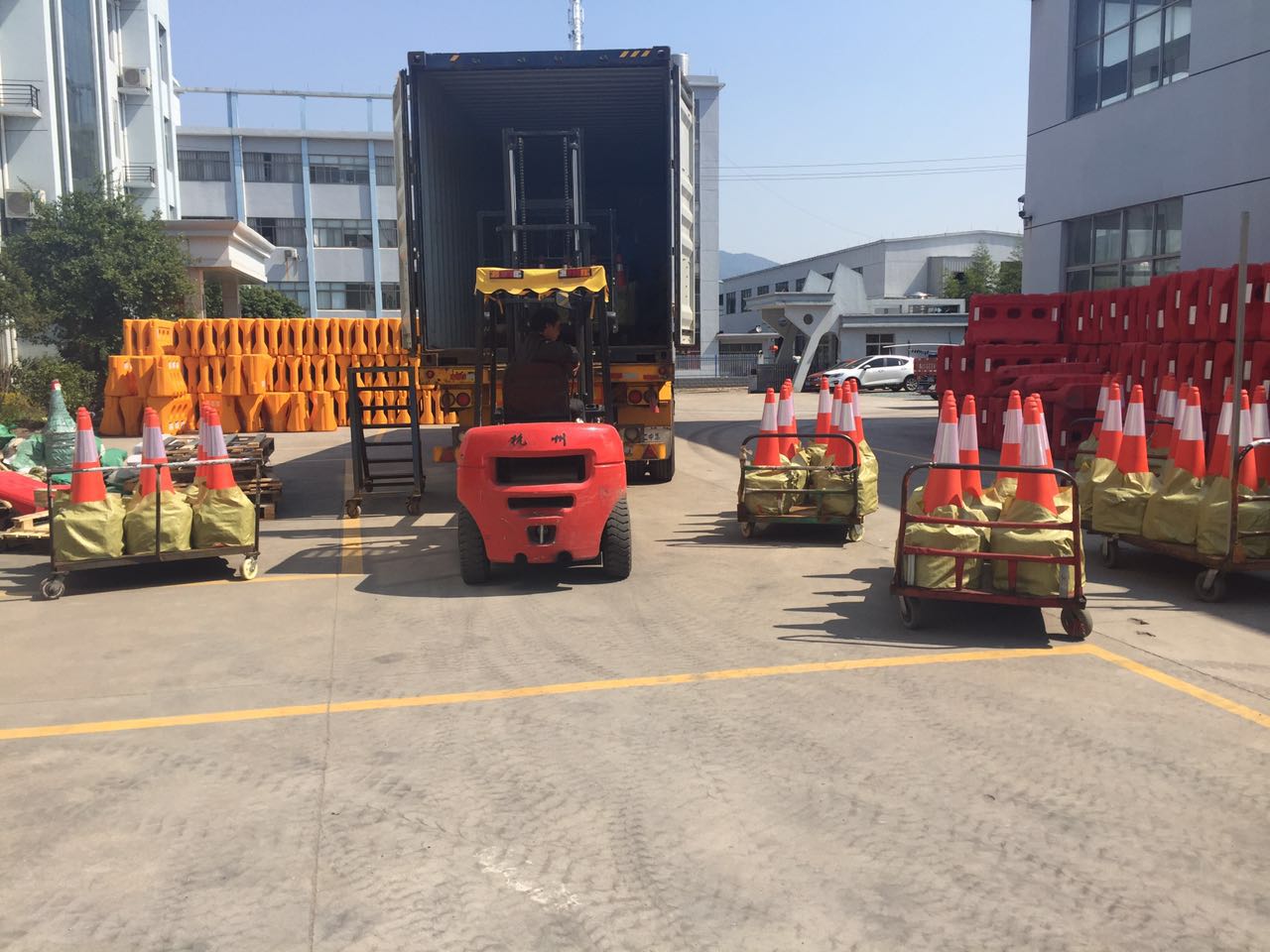
- Lead time is driven by configuration, not by the model name. Four items should be fixed before an order is placed: the model mix, the base type (recycled rubber or integrated plastic), the fixing method, and the reflective grade required for each site. Mnsd confirms quantity, packing and delivery in the quotation once those details are agreed. Buyers planning a project rollout can request a quotation and the product catalogue from Mnsd, and can review the range in the downloadable brochure before finalising the site schedule.
Conclusion: Decide by Site, Then by Specification
The YD-WP45 and the YD-WPS75 are not competing answers to the same question. They answer two site conditions. Where the delineation line must stay low, resist oil and water, and survive bodywork contact in a parking or warehouse environment, the 450 mm YD-WP45 with its 200×80 mm base and 80–85 Shore A hardness is the specification that fits. Where the post must be read at distance and survive repeated impact in road traffic or a construction zone, the 750 mm YD-WPS75 — HIP/Class 1 reflective grade, 200+ m visibility, 360° flexibility, self-recovery, 15.0 MPa tensile strength, expansion-bolt fixing and ring top — is the specification that fits.
The base decision sits underneath both: recycled rubber where the layout must move, integrated plastic where it will not, and expansion-bolt fixing where the post must be anchored. Get those three variables aligned with the site, verify the ambiguous cells in the data with a sample, and the warning post stops being a repeat maintenance item.
Request a quote, sample or catalogue
Mnsd supplies the YD-WP45 and YD-WPS75 to importers, distributors and project buyers. Send your site drawings or a specification list with the model mix, base type and fixing method, and Mnsd will confirm configuration, packing and delivery in the quotation.
Email: info@mnsdtraffic.com · Tel / WhatsApp: +86 18458137305 · Web: www.mnsdtraffic.com
Download the product brochure: Mnsd traffic safety product catalogue (PDF)
Have Questions or Need More Details?
Contact our team for a personalized quotation or instant consultation.
Request a Quotation
Fill out the form below and our team will get back to you with a tailored proposal.
WhatsApp Direct Chat
Prefer to chat in real-time? Message us on WhatsApp for instant assistance & quick answers.
- Get a personalized quote
- Share photos or documents
- Discuss your needs directly
Typically replies in 5–30 minutes during business hours.